โ€œMore Easily,โ€ My Eye; or, Kaltenborn and the Dragon

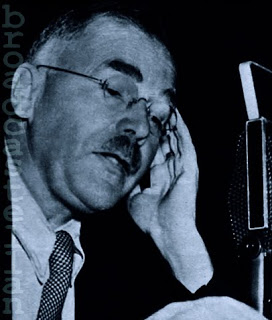
โ€œEducation comes more easily through the ear than through the eye,โ€ H. V. Kaltenborn declared back in 1926. He had to believe that, or needed to convince others of it, at least. After all, the newspaper editor had embarked on a new career that was entirely dependent on the publicโ€™s ability to listen and learn when he, as early as 1921, first stepped behind a microphone to throw his disembodied voice onto the airwaves, eventually to become Americaโ€™s foremost radio commentator. Writing about โ€œRadioโ€™s Responsibility as a Molder of Public Opinion,โ€ Kaltenborn argued education to be the mediumโ€™s โ€œgreatest opportunity.โ€ And even though the opportunity seized most eagerly was advertising, some sixty American colleges and universities were broadcasting educational programs during those early, pre-network days of the โ€œFifth Estate.โ€

Kaltenborn reasoned that education by radio was superior to traditional correspondence courses since the aural medium could make up for the โ€œimperfect contact between student and teacherโ€ through โ€œthe appeal of voice and personality.โ€ Among the subjects particular suited to radio he numbered โ€œliterature, oral English, foreign languages, history, and music,โ€ but added that any class not requiring special โ€œapparatus or laboratory work [could] be taught on the air.โ€

Not that a polyglot like H(ans) V(on), whose father was born in Germany, had any use for such on-air instructions, but a number of local stations (KFAB, Nebraska, and WMBQ, Brooklyn, among them) broadcast introductory courses in German during the early to mid-1930s. According to Waldo Abbot, who, in the 1930s, directed the University of Michiganโ€™s educational broadcasts heard over WJR, Detroit, nearly four hundred stations in the US accepted foreign language programs, many of which were geared toward non-English communities, be they German, Albanian or Mesquakie. In 1942, as Variety radio editor Robert Landry pointed out, some two hundred local stations in the US were broadcasting in thirty languages other than English, at which time in history the efficacy of services in the public interest was being hotly debated.

Growing up in West Germany, I frequently tuned in to the English language Broadcasting Service of the British Forces (BFBS) and, lying in bed at night, twisted the dial in search of faraway international stations. Yet as much as the chatter of different, distant voices intrigued me, I was not so much enlightened as I was enchanted; and rather than translating what I heard, I was transported by it. I may have had an ear for language, but whatever came my way by way of the airwaves back then was mostly in one ear and out of the other.

Even when language poses no barrier to understanding, I do not assimilate spoken utterances as readily as written words. I was raised in the age of television and, to some degree, by that medium. So insurmountable was the visual bias that I have never been able entirely to rely on my ear when it comes to taking even the simplest instructions. I discovered early on, for instance, that it was difficult for me to write down a number taken from dictation; to this day, I struggle to piece together words that are being spelled out for me. My chirographic transcriptions of speech are often incomplete or frustratingly inaccurate.

Yes, I have long been keenly aware of the pigโ€™s ear that nature made of my senses. I learned that those cartilaginous funnels couldnโ€™t be relied upon to make, let alone fill, a purse, silken or otherwise. My head being thoroughly porcine, I nonetheless chose radio as the subject for my doctoral studyโ€”if only to give my eyes an earful.

If only education came โ€œmore easilyโ€ to me โ€œthrough the ear than through the eye,โ€ now that I am once again putting my ear for language to the test. Iโ€™ve been living in Wales for over five years now, but, insofar as I had occasion to mingle with the locals, I have communicated exclusively in English. Contrary to a travel guide one of my German friends showed me upon visiting, Welsh is by no means a language in extremis, even if its rejuvenescence is largely owing to the resuscitative measures of nationalist politics. Taking our recent move from a remote cottage in the country to a house in town as an incentive, I decided to grab the red dragon by its forked tongue at last. I started taking classes. โ€œDwi โ€˜n dysgu Cymraeg.โ€

To augment my weekly lessons, I am listening to recordings of the BBCโ€™s Catchphrase program, a late-20th-century radio series designed to introduce English speakers to the Welsh language. While it is a comfort to me that fleeting speech is reproducible at the touch of a button or key, I am still finding it difficult to take in and recall what I am hearing, particularly as I am being asked to learn โ€œparrot fashion,โ€ to play and replay by ear without being given a table or chart that would allow me to discern a grammatical pattern. Much of what I have heard still sounds to me what the Germans call Kauderwelschโ€”or plain gibberish.

Though I am not quite licked yet, the Welsh ddraig keeps sticking out its tongue to make a mockery of my efforts. Itโ€™s no use slaying it by ear. I simply wasnโ€™t bornโ€”nor am I Kaltenbornโ€”to do it.


Related writings
โ€œโ€˜. . . from hell to breakfastโ€™: H. V. Kaltenborn Reportingโ€
โ€œโ€˜Alone Togetherโ€™: A Portrait of the Artist as an Artistโ€™s Spouseโ€

A โ€œkind of monsterโ€: Me[, Fascism] and Orson Welles

It doesnโ€™t happen often that, after watching a 21-century movie based on a 21-century novel, I walk straight into the nearest bookstore to get my hands on a shiny paperback copy of the original, the initial publication of which escaped me as a matter of course. Come to think of it, this never happened before; and that it did happen in the case of Me and Orson Welles has a lot to do with the fact that the film is concerned with the 1930s, with New York City, and with that wunderkind from Wisconsin, the most lionized exponent of American radio drama, into which by now dried up wellspring of entertainment, commerce and propaganda it permits us a rare peek. You might say that I was the target audience for Richard Linklaterโ€™s comedy, which goes a long way in explaining its lack of success at the box office.

And yet, despite the filmโ€™s considerable enticementsโ€”among them its scrupulous attention to verisimilitudinous detail and a nonchalant disregard for those moviegoers who, having been drawn in by Zac Efron, draw a blank whenever references to, say, Les Tremayne or The Columbia Workshop are being tossed into their popcorn littered lapsโ€”it wasnโ€™t my fondness for the subject matter, much less the richness of the material, that convinced me to pick up Robert Kaplowโ€™s novel, first published in 2003. Indeed, it was the glossiness of the treatment that left me with the impression that something had gotten lost or left behind in the process of adaptationโ€”and I was curious to discover what that might be.

On the face of it, the movie is as faithful to the novel as the book is to the history and culture on which it draws.  Much of the dialogue is lifted verbatim from the page, even though the decision not to let the protagonist remain the teller of his own tale constitutes a significant shift in perspective as we now get to experience the events alongside the young man rather than through his mind’s eye.  In one trailer for the film, the voice-over narration is retained, suggesting how much more intimate and intricate this story could have beenโ€”and indeed is in printโ€”and how emotionally uninvolving the adaptation has turned out to be.

Without Samuelsโ€™s narration and with a scene-stealing performance by Christian McKay as Welles, the screen version gives the unguarded protรฉgรฉ, portrayed by the comparatively bland Efron, rather less of a chance to have the final word and to claim center stage, as the sly title suggests, by putting himself first.

The question at the heart of the story, on page and screen alike, is whether successes and failures are born or made.  Prominence or obscurity, life or death, are not so much determined by individual talent, the story drives home, but by the circumstances and relationships in which that talent can or cannot manifest itself.  We know Welles is a phony when he goes around giving the same spiel to each member of the cast who is about to crack up and endanger the opening of the show, insisting that they are โ€œGod-created.โ€  They are, if anything, Welles-created or Welles-undone.

Finding this out the hard wayโ€”however easy it may have looked initiallyโ€”is high school student Richard Samuels who, stumbling onto the scene quite by accicent, becomes a minor player in a major theatrical production of a Shakespearean drama directed by a very young, and very determined, Orson Welles.  Samuelsโ€™s fortunes are made and lost within a single week, at the end of which his name is stricken from the playbill and his life reconsigned to inconspicuity, all on account of that towering ego of the Mercury.

The premise is an intriguing one: a forgotten man who lives to tell how and why he did matter, after allโ€”a handsome stand-in for all of us who blew it at some crucial stage in our lives and careers.  Shrewdly concealing that it was he who nearly ruined the Mercury during dress rehearsal by setting off the sprinklers, Samuels can luxuriate in the belief that he may have inadvertently saved the production by reassuring a superstitious Welles that opening night would run smoothly.

Speculating about the personalities and motives of historical figures, dramas based on true events often insert an imaginary proxy or guide into the scene of the action, a marginal figure through or with whom the audience experiences a past it is invited to assume otherwise real.  And given that Me and Orson Welles goes to considerable length capturing the goings-on at the Mercury Theater, anno 1937, I was quite willing to make that assumption.  Hey, even Joe Cotten looks remarkably like Joseph Cotten (without the charisma, mind).

It was not until I read the novel that I realized that Kaplow and the screenwriters, while ostensibly drawing their figures from life, attributed individual traits and behaviors to different real-life personages.  Whereas actor George Coulouris is having opening night jitters on screen, it was the lesser-known Joseph Holland who experienced same in the novel.

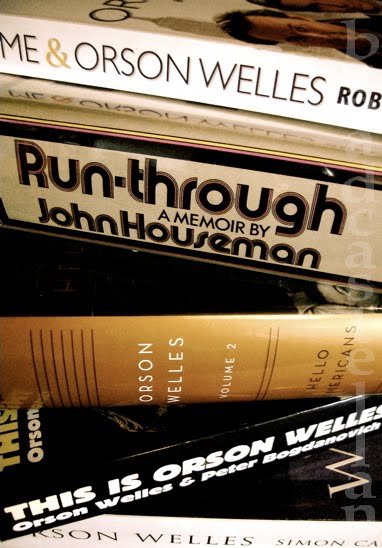
Although quite willing to let bygones be fiction, I consulted Mercury producer John Housemanโ€™s memoir Run-through, which suggests that the apprehensive one was indeed Coulouris.  Housemanโ€™s recollections also reveal that the fictional character of Samuels was based in part on young Arthur Anderson, a regular on radioโ€™s Letโ€™s Pretend program who, like Samuels, played the role of Lucius in the Mercury production.  According to Houseman, it was Anderson who flooded the theater by conducting experiments with the sprinkler valves.

Never mind irrigation; I was trying to arrive at the source of my irritation, which, plainly put, is this: Why research so thoroughly to so little avail? Why be content to present a slight drama peopled with folks whose names, though no longer on the tip of everyoneโ€™s tongue, can be found in the annals of film and theater? The missed opportunityโ€”an opportunity that Welles certainly seizedโ€”of becoming culturally and politically relevant makes itself felt in the character of Sam Leve, the Mercuryโ€™s set designerโ€”a forgotten character reconsidered in the novel but neglected anew in the screenplay.

Andersonโ€™s contributions aside, it is to Leveโ€™s account of the Mercuryโ€™s Julius Caesar that Kaplow was indebted, a debt he acknowledges in the โ€œSpecial thanksโ€ preceding the narrative he fashioned from it.

โ€œ[P]oor downtrodden Sam Leveโ€โ€”as Simon Callow calls him rather patronizingly in his biography of Orson Wellesโ€”was very nearly denied credit for his work on the set.  Featuring prominently in the novel, he is partially vindicated by being given one of the novelโ€™s most poignant speeches, a speech that turns Me and Orson Welles into something larger and grander than an intriguing if inconsequential speculation about a brilliant, egomaniacal boy wonder.

Confiding in Leve, with whom he has no such exchange in the movie, Samuels calls Welles a โ€œkind of monster,โ€ to which Leve replies: โ€œWe live in a world where monsters get their faces on the covers of the magazines.โ€  In this exchange is expressed what mightโ€”and, I believe, shouldโ€”have been the crux of the screen version: the story of a โ€œkind of monster,โ€ a man who professes to turn Julius Caesar into an indictment of fascism, however conceptually flawed (as Callow points out), but who, in his dictatorial stance, refuses to acknowledge Leveโ€™s contributions in the credits of the playbill and shows no qualms in replacing Samuels when the latter begins to assert himself.

โ€œAs in the synagogue we sing the praises of God,โ€ Leve philosophizes in the speech that did not make it into the screenplay, โ€œso in the theatre we sing the dignity of man.โ€  Without becoming overly didactic or metaphorical, Me and Orson Welles, the motion picture, could have put its authenticity to greater, more dignified purpose by not obscuring or trivializing history, by reminding us that Jews like Leve and Samuels were fighting for recognition as the Jewish people of Europe were facing annihilation.

To some degree, the glossy, rather more Gentile film version is complicit in the effacement of Jewish culture by homogenizing the story, by removing the Jewish references and Yiddish expressions that distinguish Kaplowโ€™s novel.  Instead of erasing the historical subtext, the film might have encouraged us to see the Mercuryโ€™s troubled production of Julius Caesar as an ambitious if somewhat ambiguous and perhaps disingenuous reading of the signs of the times, thereby making us consider the role and responsibility of the performing artsโ€”including films like Me and Orson Wellesโ€”in the shaping of history and of our understanding of it.


Related writings
โ€œOn This Day in 1938: The Mercury Players โ€˜dismember Caesarโ€™โ€
โ€œOn This Day in 1937: The Shadow Gets a Voice-overโ€

Mother, She Wrote

โ€œThere’s no family uniting instinct, anyhow; it’s habit and sentiment and material convenience hold families together after adolescence. There’s always friction, conflict, unwilling concessions. Always!โ€ Growing up in a familial household whose microclimate was marked by the extremes of hot-temperedness and bone-chilling calculation, I amassed enough empirical evidence to convince me that this observationโ€”made by one of the characters in Ann Veronica (1909), H. G. Wellsโ€™s assault on Victorian conventionsโ€”is worth reconsidering. It is not enough to say that there is no โ€œfamily uniting instinct.โ€ What is likely the case during adolescence, rather than afterwards, is that the drive designed to keep us from destroying ourselves becomes the one that drives us away from each other. Depending on the test to which habit, sentiment and convenience are put, this might well constitute a family disuniting instinct.
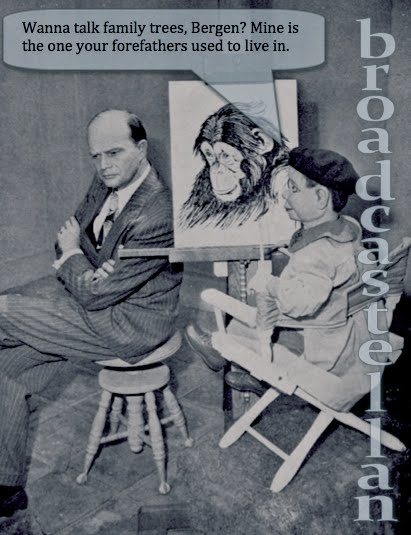
Not even a motherโ€™s inherent disposition toward her childโ€”to which no analogous response exists in the offspring, particularly once the expediencies that appear to increase its chances of survival are being called into questionโ€”is equal to the impulse of self-preservation. I was twenty when I made that discovery; the discovery that there was no love lost between my mother and myself, or, rather, that whatever love or nurturing instinct, on her part, there had been was lost irretrievably.

Years ago, I tried to capture and let go of that moment in a work of fiction:

An early evening in late October. She stands in the dimly lit hallway, a dinner fork in her right hand, blocking the door, the path back inside. The memory of what caused the fight is erased forever by its emotional impact, its lasting consequences. The implement, picked up from the dining table during an argument (some trifle, no doubt, of a nettlesomeย disagreement), has not yet touched any food today.

In one variant of this recollection, she simply stands there, defending herself. She wants to end the discussion on her terms. In another version (which is the more comforting, thus probably the more distorted one) she keeps attacking with fierce stabs, brandishing the fork as if it were a sword. Was it self-control that kept her from taking the knife instead? She is right-handed, after all.ย 

Though never hitting its target, the fork, brandished or not, becomes indeed an effective weapon in this fight. Itโ€™s an immediate symbol, a sudden and unmistakable reminder that it is in her hands to refuse nourishment, to withhold the care she has been expected to provide for so many years, and to drive the overgrown child from the parental tableโ€”and out of the house.ย 

โ€œGet out. Now!โ€

She is in control and knows it. She will win this, too, even though the length of the skirmish and the vehemence of the resistance are taxing her mettle. It has been taxed plenty. In this house, coexistence has always been subject to contest, as if decisions about a game of cards, a piece of furniture moved from its usual spot, or even the distribution of a single piece of pie were fundamental matters of survival. In this house, anything could be weaponized. In this house, which since the day of its conception has been a challenge to the ideals of domesticity and concord, has slowly worn down the respect and dignity of its inhabitants, and forced its dwellers into corners of seclusion, scheming and shame, it is only plaster and mortar that keeps those walled within from hurling bricks at each other.ย 

โ€œI want you out of here. Now. Get out. Out.โ€ Her terse wordsโ€”intelligent missiles launched in quick succession at the climactic stage of a traumatizing blitzโ€”penetrate instantly, successfully obliterating any doubt as to the severity of her anguish, and, second thoughts thus laid waste to, even the remotest possibility of reconciliation.

This time she really means it. She screams, screeches, and hisses, her words barely escaping her clenched teeth. It is frightening and pathetic at once, this sudden theatrical turn, an over-the-top rendition of the old generation gap standard. Yet somewhere underneath the brilliant colors of this textbook illustration of parent-child conflict and adolescent rebellion is a murky layer of something far more disquieting and unseemlyโ€”something downright oedipal.

Words, exquisitely vile, surface and come within reach but remain untransmitted, untransmissible. Addressing her in that way is a taboo too strong to be broken even in a moment of desperate savagery. Instead, the longing for revenge, for a reciprocal demonstration of the pain she, too, is capable of inflicting, will feed a thousand dreams.

Ultimately, it is fear that becomes overpowering. There is more than rage in her expression. It is manifest loathing. Two decades of motherhood have taken their toll.

At last, she slams the door. A frantic attempt to climb back inside, through the open bathroom window, fails when she, with a quick turn at the handle, erects a barrier of glass and metal.

The slippery steps leading to the front doorโ€”now away from itโ€”feel like blocks of ice, a bitterness stinging through thin polyester dress socks. There was no time to put on shoes. This is a time to evacuate. Humiliated, cold, and terrified. Thrown out of the house.

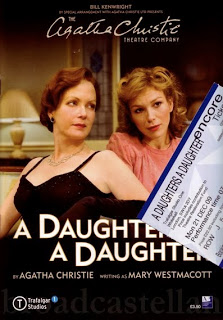
Now, contrary to what these fictionalized recollections suggest, Iโ€™m not one to cry over spilt motherโ€™s milk; besides, I did return homeโ€”through that doorโ€”and stayed at my parentsโ€™ house for another excruciating two years. It would have been far smarter and far more dignified to let go and move on. I had clearly outstayed my welcome. The realization came to me again the other night when I went to see the A Daughterโ€™s a Daughter, a cool examination of what may happen to close family ties once both mother and child reach maturity. The playwright, who resorted to the pseudonymous disguise of Mary Westmacott, was none other than mystery novelist Agatha Christie.

So, I oughtnโ€™t to have been surprised by the lack of sentiment in the portrayal of a parent-child relationship that goes sour once the expiration date has passed. Think Grey Gardens without the cats. After all, in guessing games like And Then There Were None and The ABC Murders, Christie reduced human suffering to a countdown. And when she went back to the nursery, it was mainly to borrow rhymes that provided titles for some of her most memorable imaginary murders, the ruthless precision of which was a kind of voodoo doll to me during my troubled adolescence.

Still, I was surprised by the chill of the unassuming yet memorable drama acted out by Jenny Seagrove and Honeysuckle Weeks in Londonโ€™s Trafalgar Studios that December evening. I was surprised by a playโ€”staged for the first time since its weeklong run in 1956โ€”that was not merely unsentimental but unfolded without the apparently requisite hysterics that characterize Hollywoodโ€™s traditional approaches to the subject.

To be sure, A Daughterโ€™s a Daughter is hardly unconventional. It is not A Daughterโ€™s a Daughterโ€™s a Daughter. Modest rather than modernist, controlled more than contrived, it is assured and unselfconscious, a confidence to which the apparent tautology of the title attests. Yes, a daughterโ€™s a daughterโ€”and just what acts of filial devotion or maternal sacrifice does that entail? How far can the umbilical bond be stretched into adulthood until someoneโ€™s going to snap?

The central characters in Christieโ€™s play reassure anyone who got away from mother or let go of a child that, whatever anyone tells youโ€”least of all arch conservatives who urge you to trust in family because itโ€™s cheaper than social reformโ€”survival must mean an embrace of change and a change of embraces.


Related writings
โ€œIstanbul (Not Constantinople); or, There’s No Boat โ€˜Sailing to Byzantiumโ€™โ€
โ€œCaught At Last: Some Personal Notes on The Mousetrapโ€
โ€œEarwitness for the Prosecutionโ€
โ€œOn This Day in 1890 and 1934: Agatha Christie and Mutual Are Born, Ill-conceived Partnership and Issue to Followโ€

Letters of a [Class] Betrayed: Opera Without Soap

I am not inclined to manual labor. If I lift a finger, it is likely to come down on what isnโ€™t grammatically up to scratch or else to add a few scrapes to my scalp as I take some rambling bull by the inkhorn. There has been a little more of that going on latelyโ€”teaching and editingโ€”and, my furrowed pate notwithstanding, I am heartily glad of it. Yet as much as I relish being back in the game after suffering the indignity of being benched for the betterโ€”or, rather, worseโ€”part of the past five seasons, the academy has never felt like a home court to me. It is as if, carved into the trunk of my family tree however rotten, puny and lacking in shelter it might be, are memos more emphatic than the certificates of achievement now gathering dust in the drawer I am so little inclined to tidy. Instead of considering myself invited as I enter places of culture and learning, I still feel at times as if I were crashing a party.

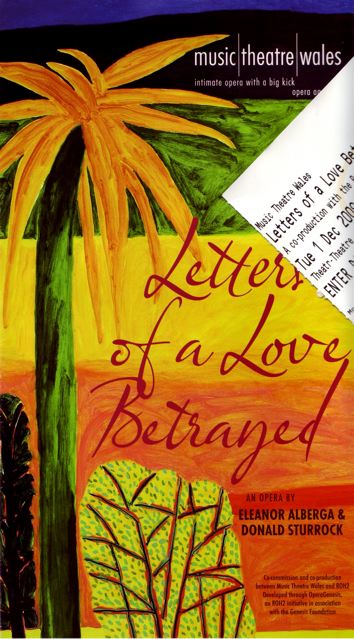
Program and ticket stub for Letters of a Love Betrayed

You see, I was born into that endangered social stratum known as the working class. It is an origin of which I am mindful, though neither proud nor ashamed. At least, I am not ashamed of it now. I used to be as thrilled about it as Ann Blythโ€™s character in Mildred Pierce, even though my parents bore a closer resemblance to Lana Turner in Imitation of Lifeโ€”that is, too busy to notice that living up to their aspirations left their offspring in the dust they raised as they tried to shake the dirt clinging to their roots. At any rate, stuck in that cloud of dust was I, an asthmatic kid who couldnโ€™t afford to hold his breath at the off chance of parental attention.

Not to suffocate under the rubble of post-Second World War Germany, my parents had to put their noses far closer to the proverbial grindstone than I ever did. Their generation, aided by American interests, pulled off the Wirtschaftswunder or โ€œeconomic miracle,โ€ a sleight-of-hands-on approach to the lasting trauma caused by total war and final solution, the coming to terms with which would have required equipment far more difficult to handle than shovel and broom.

I am not so disingenuous as to pass off my staying put as a form of sit-down strike, of giving the clean-and-cover-up efforts of my parentsโ€™ generation the spotless finger; but apart from the months I ill served my country working as a hospital orderly or the hours I spent cleaning apartments in New York City to help finance my college education, I remained sedentary for much of my life.

So far, itโ€™s been a life spent lost in thoughts, ensconced in writing, and plunked down for performances that artists work on studiously for our delight and instructionโ€”the kind of delight my father found it difficult to accept as serious work and the instruction he thought less of than the empirical knowledge that, along with calluses, is the badge and perquisite of the experience-hardened laborer.

I suppose it is easier for the workerโ€”not to be equated here with the impecuniousโ€”to aspire to material possessions instead of culture and learning, since exposing yourself to something that poses a challenge rather than promising instant gratification requires still more work on the part of those who have little time and less energy to spare.

Now, my comparatively indolent existence permits me to spare that time; yet, as if my conscience and buttocks alike had been shaped by Protestant work ethics, I often feel rather uncomfortable. Iโ€™m not one to pooh-pooh the benefits of resting on oneโ€™s Popo (as dainty Germans call the posterior); but, there is nothing like wriggling in my seat in hopes of improving my mind to convince me that the callusesโ€”and Iโ€”belong elsewhere.

I had that impression sitting through Letters of a Love Betrayed, a new opera by Eleanor Alberga (libretto by Donald Sturrock). Reading about it, I was intrigued by the promised fusion of Latin rhythms and a neo-Gothic romance based on a story by Isabel Allende, but felt let down by a score that to my untrained ear sounded forbidding, unmelodious, and, worse still, forgettable. Perhaps, the perceived cacophony was the result of a clanging together of too many stereotypes. Whatever melo- Letters possesses is all in the drama; derivative and contrived, it is creakier than a chair that has been squirmed out of too often.

I didnโ€™t get it. I didnโ€™t like it. I felt like a tired, vitamin deprived miner lured into a soup kitchen of the arts, the drama being a concession to what is assumed to be his tastes as he is being fed a presumably healthy diet with a none too musical spoon.

As I sat down again to express my thoughts on the matter of whatโ€™s the matter with me, I kept wondering whether what I was responding to so angrily was utter musical rubbish, dreck worse than the grime to which I chose not to expose myself, or whether my inability to open my mind was dictated to me by my past, a past unfolding in letters of a class betrayed.

โ€œMarching backwardsโ€: โ€œThe Great Tennessee Monkey Trialโ€ Is Back on the Air

The Darwin bicentenary is drawing to a close. Throughout the year, exhibitions were staged all over Britain to commemorate the achievements of the scientist and the controversy his theories wrought; numerous plays and documentaries were presented on stage, screen and radio, including a new production of Inherit the Wind (1955), currently on at the Old Vic. I was hoping to catch up with it when next I am in London; but, just like last month, I my hopes went the way of all dodos as only those survive the box office onslaught who see it fit to book early.

Not that setting foot on the stage of the Darwin debate requires any great effort or investment once you are in the great metropolis. During my last visit to the kingdomโ€™s capital, I found myselfโ€”that is to say, I was caught unawares as I walked through the halls of the Royal Academy of Artsโ€”in the very spot where, back in 1858, the papers that evolved into The Origin of Species were first presented.

This week, BBC Radio 4 is transporting us back to a rather less dignified scene down in Dayton, Tennessee, where, in the summer of 1925, the theory of evolution was being put on trial, with Clarence Darrow taking the floor for the defense. Peter Goodchild, a writer-producer who served as researcher for and became editor of the British television series on which the American broadcast institution Nova was modeled, adapted court transcripts to recreate the media event billed, somewhat prematurely, as the “trial of the century.”

Like the LA Theatre Works production before it, this new Radio Wales/Cymru presentation boasts a pedigree cast including tyro octogenarians Jerry Hardin as Judge John Raulston and Ed Asner as William Jennings Bryan, John de Lancie as Clarence Darrow, Stacy Keach as Dudley Field Malone, and Neil Patrick Harris as young biology teacher John Scopes, the knowing if rather naive lawbreaker at the nominal center of the proceedings who gets to tell us about it all.

โ€œI was enjoying myself,โ€ the defendant nostalgically recalls his life and times, anno 1925, as he ushers us into the courtroom, for the ensuing drama in which he was little more than a supporting player. โ€œIt was the year of the Charleston,โ€ of Louis Armstrongโ€™s first recordings, โ€œthe year The Great Gatsby was written.โ€ Not that marching backwards to the so-called โ€œMonkey trialโ€ isโ€”or should ever becomeโ€”the stuff of wistful reminiscences. โ€œBut, in the same year, Hitler wrote Mein Kampf, Scopes adds, โ€œand in Tennessee, they passed the Butler Act.โ€

Darrow called the ban on evolution as a high school subjectโ€”and any subsequent criminalization of intellectual discourse and expressed beliefsโ€”the โ€œsetting of man against man and creed against creedโ€ that, if unchallenged, would go on โ€œuntil with flying banners and beating drums, we are marching backwards to the 16th century.”

He was not, of course, referring to the Renaissance; rather, he was dreading a rebirth of the age of witch-hunts, superstitions and religious persecution. โ€œWe have the purpose of preventing bigots and ignoramuses from controlling the education of the United States, and you know it, and that is all,โ€ Darrow declared.

It is a line you wonโ€™t hear in the play; yet, however condensed it might be, the radio dramatization is as close as we get nowadays to the experience of listening to the trial back in 1925, when it was remote broadcast over WGN, Chicago, at the considerable cost of $1000 per day for wire charges. According to Slate and Cookโ€™s It Sounds Impossible, the courtroom was โ€œrearranged to accommodate the microphones,โ€ which only heightened the theatricality of the event.

I have never thought of radio drama as ersatz; in this case, certainly, getting an earful of the Darrow-Bryan exchange does not sound like a booby prize for having missed out on the staging and fictionalization of the trial as Inherit the Wind.


Related post
โ€œInherit the . . . Air: Dialing for Darwin on His 200th Birthdayโ€

A Room With a View-Master; or, Four-Eyes in the Third Dimension

What the Bwana Devil! Iโ€™ve been trying on various kinds of glasses to take in Channel 4โ€™s 3D festโ€”but none transport me into the third dimension. Turns out, viewing the weeklong series of films and specials, culminating in a โ€œ3-D Magic Spectacularโ€ and a clipfest of โ€œThe Greatest Ever 3-D Momentsโ€โ€”requires special goggles that can only be obtained from a certain chain of supermarkets whose reach does not extend to Mid Wales. By the time we got around to driving some 100 miles down south, the glasses had already been snatched up. The thought of having a digital recording of โ€œThe Queen in 3-D”โ€”contemporary film footage of the 1953 coronationโ€”without being able to take it in makes me want to jump out and hurl flaming arrows at whoever devised this regionally biased marketing scheme.
Had the coronation taken place only a year or two later, this experimental and previously unseen documentary might never have been shot right at you. After all, 1953 was a big year in three-dimensional filmmaking; but it proved little more than a fad. By the time Hitchcockโ€™s Dial M for Murder was released in the spring of 1954, the novelty had already worn off and, to this day, few viewers get to experience the climactic scene in the way it was re-conceived for the film.

I caught up with the stereoscopic movies of the 1950sโ€”among them It Came from Outer Space, House of Wax, and Miss Sadie Thompsonโ€”when they aired on German television back during the early 1980s 3D craze, which was similarly brief yet decidedly less distinguished: Parasite, Metalstorm, Spacehunter, and the inept Indiana Jones knockoff El Tesoro de las cuatro coronas.

Ever since I got my first stereoscope, known as a View-Master, I have been enthralled by three-dimensional images, or at least by the idea thereof. Rather peculiar, this, considering that those of us fortunate enough to have a set of matching peepers get to experience the same effect without having to sport ill-fitting, nausea-inducing eyewear.

So far this year I have put up with putting on special spectacles to see five 21st-century 3D movies, among them Coraline, The Final Destination, and Up (not counting the partially 3D IMAX presentation of Harry Potter and the Half-Blood Prince). ย It seems that 2009 is even a bigger year for 3D than 1953. Yet while I rejoice in the prospect of further excursions into space, it strikes me that, as 3D goes mainstream at last, the technology has lost some of its rogue appeal.

Movies like Ice Age: Dawn of the Dinosaurs do not exploit the potentialities of the medium with the abandon the added dimension invites. I mean, why throw money at 3D films if they donโ€™t throw anything back at you? Maybe Iโ€™m wearing rose-colored glasses, but I am still hoping for a throwback to those 1950s throwaways. In the meantime, Iโ€™ll gladly return to radio drama, the invisible, immaterial theater whose action unfolds in the fourth dimension.

Listen, Learn, and Log

I am hardly the go-getter type. My goals are even more modest than my needs, which is to say that a full and fulfilling present day matters more to me than any future success for the prediction and preparation of which I lack the foresight. Among my few ambitions is it to amass volumes enough to have one of the most comprehensive private libraries devoted to turning the volume upโ€”to American and, to a lesser degree, British radio and to the dramatics of the air in particular: published scripts, contemporary criticism, and latter-day assessments of the so-called โ€œgolden ageโ€ of radio.

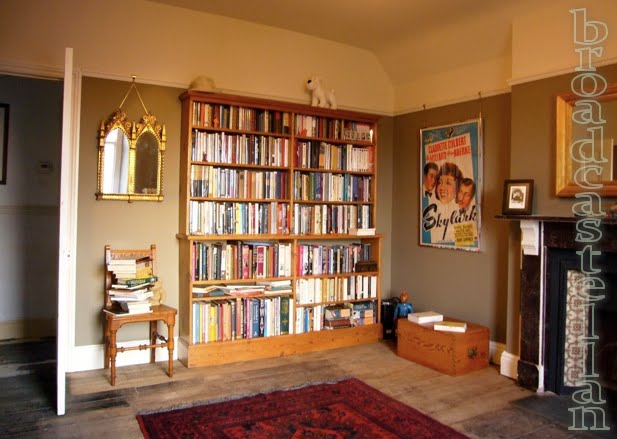
Until now, matters were complicated by the fact that I never had my own shelves on which to store such records of radioโ€™s past. Well, Iโ€™ve got the bookshelves set up in my room at last. Nearly five months after moving into our new old house, I once again enjoy ready access to the appreciable if generally unappreciated literature of the air.

Back in November 1923, a critic of Radio Broadcast magazine observed that since libraries and radio have similar aims, it was

surprising that they have not cooperated nearly as fully as they might. Much of the radio broadcasting is instructive and entertaining; and so is it with the books on the library shelves. Radio is ever improving the musical and literary tastes of thousands of listeners-in, who, having their interest aroused, may find increased pleasure from music or literatureโ€”and the libraries can supply the latter.

Some twenty years later, what there was of radio literature hardly reflected the programs enjoyed by millions on radio. Calling it a โ€œsad observation,โ€ Sherman H. Dryer remarked in Radio in Wartime (1942) that

in the twenty-five years of its life few serious or critical books have been written about radio. The literature of radio is divided into two main parts: anthologies of โ€œbestโ€ broadcasts, or vocational textsโ€”How to Write for Radio, Radio Direction, How to Become an Announcer.

To these two kinds of books, Dryerโ€”among a few others like Robert Landry, Francis Chase, and Charles Siepmannโ€”added a small number of critical studies on radio broadcasting; and, two decades later, there emerged a market for nostalgia and history.

As Max J. Herzberg put it in Radio and English Teaching (1941), radio โ€œneed not be a substitute for the library; it can result in more and not less frequent use of books.โ€

I find that, tuning in, I not only turn to books on radio, but go in search of related material, original sources and histories. In other words, radio does not merely compel me to set up a shelf for books devoted to the subject; it continues to educate me about Western culture, the histories in which it dealt and out of which it arose. Looking at the faces of long forgotten performers and reading about their once famous acts tells me a lot about the boundaries and hazards of any pursuit of happiness defined by popularity and the statistical apparatus relied upon for its measurement.

The by now unpopular culture of radio dramatics has proven an academic and professional cul-de-sac for me; but my interest in and commitment to its study has remained nearly undiminished. As I said, I am not very ambitiousโ€”which is precisely why I feel free to continue the pursuit of what doesnโ€™t seem to get me anywhere . . .

This, by the way, is my 701st entry into the broadcastellan journal.

โ€œI’ve Got a Little Listโ€ (and the Hot Mikado Isnโ€™t on It)

At the risk of sounding like a loser at a Vegas spelling bee, I am a serious eye roller. Like a roulette wheel on an off night, each circulation marks the extent of my displeasure. The other night, I was really taking my peepers for a spin. Judging from such ocular proof, you might have thought that more than eyeballs were about to roll. Indeed, it seemed as if I were going to face the Lord High Executioner himself. Instead, we were merely going to a production of The Hot Mikado. I just couldnโ€™t warm to the idea of going camp on a classic that seems least in need of burlesqueโ€”or Berlesques, for that matter. Not that this stopped middle-aged troupers like Jack Benny, Bob Hope, and Groucho Marx to play โ€œThree Little Maidsโ€ (as part of a war relief benefit broadcast); but, at least, those tuning in were spared the visuals.

If I was less than enthusiastic, it was mainly on account of Charleyโ€™s Aunt. That dubious Victor/Victorian dowager had way too many nephewsโ€”and โ€œthey’d none of them be missed, they’d none of them be missed.โ€ Cross-dressing has long been on the none too little list of circus and sideshow acts that are more of a source of irritation than of hilarity. One strategically placed banana peel does more for me than two oranges nestling in a bed of chest hair. Itโ€™s a fruitโ€™s prerogative.

The origins of my aversion date back to the time when I began to realize that what I needed to get off my chest one day was something other than the fur I was not destined to grow in profusion. I was about twelve. Still without a costume on the morning of the annual school carnival, I let my older sister, who was as resourceful as she was bossy, talk me into wearing one of the skirts she had long discarded in favor of rather too tight-fitting jeans. Being dressed in my sisterโ€™s clothes was awkward for me, considering that I was fairly confused about my gender to begin with, certain only about the one to which I was drawn. More than a skirt was about to come out of the closet, and I was not equipped to deal with it.

Responding to my calculatedly nonchalant remark that the costume was some kind of last-minute ersatz, our smug, self-loving English teacher, Herr Julius, told the assembled class that, during carnival, folks tended to reveal what they secretly longed to be, which, apparently, went well beyond the common desire not to be humiliated. No wonder Herr Julius did not bother to don a mask other than the one with which he confronted us all the scholastic year round.

Matters were complicated further by my wayward anatomy. Letโ€™s just say that it didnโ€™t require oranges to make a fairly convincing girl out of me; I was equipped with fleshy protuberances that earned me the sobriquet โ€œbattle of the sexes.โ€ I wondered whether I was destined to shroud myself in one pretense in order to drop another. That, in a pair of coconut shells, is why cross-dressers and any such La Cage faux dollies were never to become my bag. And Iโ€™ve got a lot of baggage.

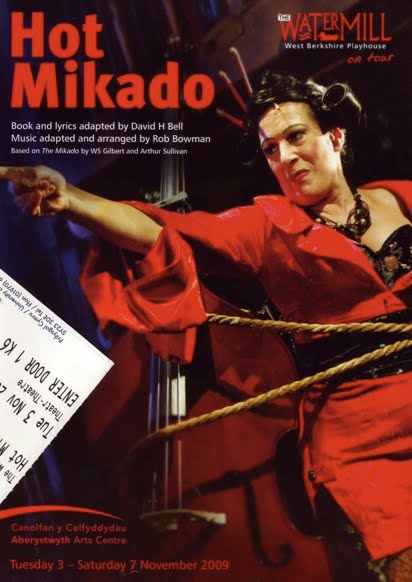
What has that to do with The Hot Mikado, the show I was so reluctant to clap my eyes on? As it turns out, not very much. I had been mistaken about the gender of the performer playing Katisha, the character on the poster (pictured above) that was advertising the Watermill production I caught at Aberystwyth Arts Centre.

Far from being some newfangled cabaret act, The Hot Mikado is seventy years old this year. Appropriating presumably WASPish entertainment for a younger and less exclusive audience, it was first performed in 1939 with an all-black, extravagantly decked out cast headed by the legendary Bill โ€œBojanglesโ€ Robinson in the title role. The currently touring Watermill productionโ€”which is soon to conclude in Girona, Spainโ€”updates the carnivalesque spectacle in retro-1980s colors, with Manga and movie inspired costumes, as well as assorted references to Susan Boyle and British politics. The music is still jazz-infused Gilbert and Sullivan.

Set โ€œsomewhere in Japanโ€ and produced at a time when Mr. Moto was forced to take an extended Vacation, the anachronistic Hot Mikado was all jitterbug without being bugged down by pre-war jitters. It is outlandish rather than freakish, amalgamated rather than discordant, qualities reassuring to anyone who has ever felt mixed up or unable to mix. A few bum notes aside, the production was hardly an occasion for any prolonged orbiting of orbs. The joyous spectacle of it kept even my mindโ€™s eye from rolling, from running over the bones, funny or otherwise, that tend to tumble out of this Fibber McGeean closet of mine . . .

Related recordings
Greek war relief special (8 February 1941), featuring Frank Morgan, Bob Hope, Jack Benny and Groucho Marx singing songs from The Mikado
โ€œHollywood Mikadoโ€, starring Fred Allen (11 May 1947)
Chicago Theater production of โ€œThe Mikadoโ€ (22 October 1949)
The Railroad Hour production of โ€œThe Mikadoโ€ (5 December 1949

“. . . in fire and blood and anguishโ€: An Inspector Calls Repeatedly

As I was saying: what is wanting here is continuity, some sort of story on the go, a sense of goings-on ongoing, of the so on and so on and so on. It would be laziest to claim, as I have done, that what prevents me from turning a seemingly random clipbook into the attraction that is the yet-to-come is largely owing to the kind of clippings for which this (mis)nominal journal is reserved.

Instead of looking ahead, I keep on hearkening back. As I recall, which is what my kind of introspective retrospection calls for, my life always seemed to unfold in hindsight, not so much enveloped as developing. I know better than to regard history as a series of acts perpetrated rather than ideas perpetuatedโ€”but that knowledge does not prevent me from living ahistorically. According to J. B. Priestley, I am bound to regret this.

For the most part, mine has been a life apart; many are the instances, momentous events even, in which I just was not in the moment. What was I feeling when the Berlin Wall fell? My diary wonโ€™t tell you. It only refers to the event in passingโ€”and with detachmentโ€”as something that would have been โ€œnoch vor kurzem undenkbarโ€ (unthinkable even a short time ago). โ€œUndenkbar,โ€ perhaps, since I had never given it much Gedanke.

I recall being revolted by David Hasselhoffโ€™s โ€œLooking for Freedom,โ€ a 1989 chart topper all over Europe, but was not aware that the songโ€™s popularity was owing to political events then in the making, let alone that Hasselhoff was part of the revolution (as claimed, with tongue firmly in cheek, in a current BBC Radio 2 retrospective). I never made the connection. Nothing seemed to connect, least of all with me. My existence, as I saw it, was coincidental and inconsequential.

It is not for nothing that my generation was known as the โ€œno futureโ€ generation. Life in the Western middle of Europe was, to many, solely dependent on the whim or disposition of two world leaders, on a red telephone, and a scientistโ€™s finger on a long-range missile switch.

I came briefly into contact with my past self when, on a recent weekend in London, I looked into the fresh faces of my nieces, whom I had not seen in over twelve years since I steadfastly refuse to set foot again on German soil. I never did make peace with my native country, and, as much as I enjoy a good Schlachtplatte (literally, a battle or slaughter platter, which is a dish of assorted meats), Iโ€™d much rather rely on German exports than return to the scene of inner turmoil.

The belated realization that, growing up in the Rhineland, I had never witnessed a celebration of Armistice Day, seen a World War I memorial (of which there is one in nearly every village here in Britain) or witnessed the annual spectacle of lapels sprouting poppies, only deepened my suspicion that it was the shame of defeat that rendered causality ineffective in a post-1918 German construct of history, and that what was being commemorated elsewhere was victory rather than the failure to insure it.

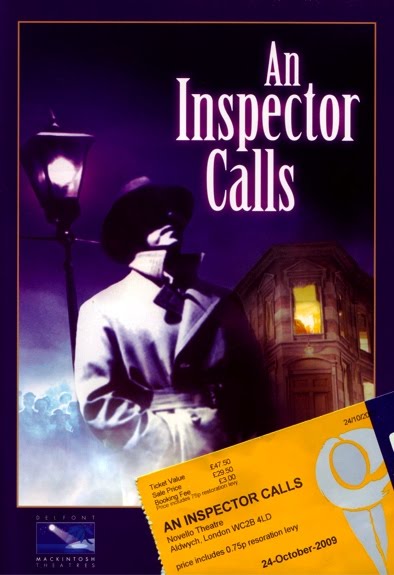
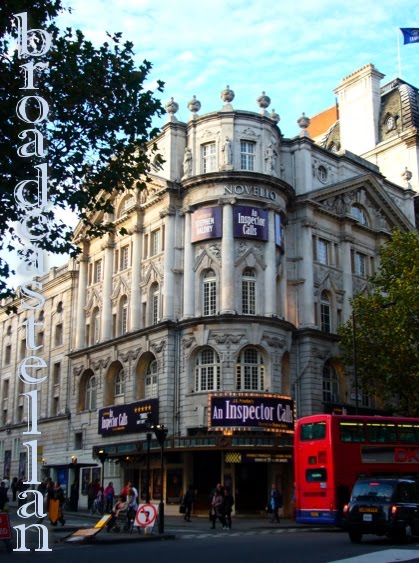
As the fatalism expressed in the grating conclusion of the most recent installment in The Final Destination series of disaster horror suggested to me, causality without social or moral responsibility is a mere exercise in predictability. “We are responsible for each other. And I tell you that the time will soon come when, if men will not learn that lesson, then they will be taught it in fire and glood and anguish.โ€ J. B. Priestley keeps saying as much in An Inspector Calls, the previously maligned 1990s production of which I caught again on said trip to London a few weeks ago.

โ€œYouโ€™ve a lot to learn yet,โ€ pragmatic and presumably self-made Mr. Birling advises the younger generation, anno 1912.

And Iโ€™m talking as a hard-headed, practical man of business. ย And I say there isnโ€™t a chance of war. ย The worldโ€™s developing so fast that itโ€™ll make war impossible. Look at the progress weโ€™re making [. . .]. ย Why, a friend of mine went over this new liner last weekโ€”the Titanicโ€”she sails next weekโ€”forty-six thousand eight hundred tonsโ€”and every luxuryโ€”and unsinkable, absolutely unsinkable. ย That what youโ€™ve got to keep your eye on, facts like that, progress like thatโ€”and not a few German officers talking nonsense and a few scaremongers here making a fuss about nothing. ย Now you three young people, just listen to thisโ€”and remember what Iโ€™m telling you now. ย In twenty or thirty yearsโ€™ timeโ€”letโ€™s say in 1940, you mighty be giving a little party like thisโ€”your son or daughter might be getting engagedโ€”and I tell you by that time youโ€™ll be living in a world thatโ€™ll have forgotten all these Capital versus Labour agitations and all these silly little war scares. ย Thereโ€™ll be peace and prosperity and rapid progress everywhereโ€”except of course in Russia, which will always be behindhand, naturally.

Mr. Birling is blind not only to the signs of the time but also to his responsibilities in designing the future while consigning the present to waste and ruin. Even when given the chance in Priestleyโ€™s fantastic setup, he is incapable of turning hindsight into insight. Knowledge, after all, is not synonymous with understanding. As much as I keep rejoicing in Mr. Birlingโ€™s fallโ€”a delight dimmed by the knowledge that his is our downfall by proxyโ€”logic dictates that I fall well short of understanding the consequences of my own ahistorical ways.

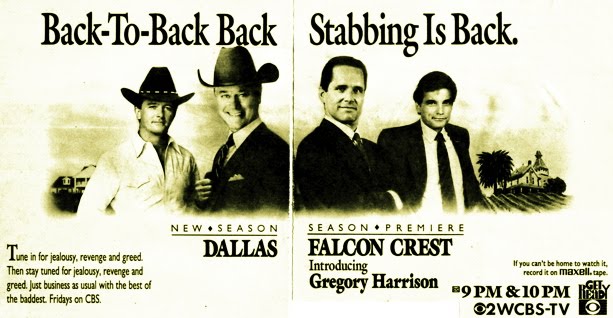
Back to Back-to-Back; or, Serialization of Schemes

A long time (well, okay, make that โ€˜about four and a half yearsโ€™) ago I came to the realization that the key to keeping an online journalโ€”and oneโ€™s fingers regularly on the keyboard in its serviceโ€”is serialization: some kind of evolving plot that, like life and Stella Dallas on a diet, keeps thickening and thinning from Monday till Doomsday until the inevitable sundown that not even Guiding Light could outshine.

Despite this realization, though, I have never managed to make a success of stringing together the latest on my follies and failures, mainly because I did not set out to make my person the axis around which this less than celestial body of essays spins. That, in recent months, the revolutions have ground to a near halt and affairs have become all but devolutionary is largely owing to the series of friction that is my one life to live beyond these virtual pages. These days, writing in installments begins and ends in โ€˜stall,โ€™ which is the least I tend to do best.

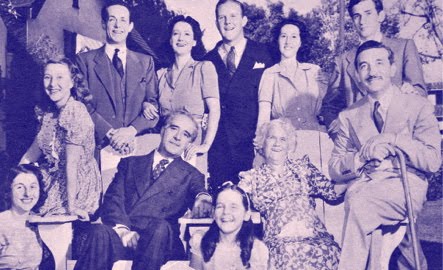
The cast of One Man’s Family

Not that the contemplation of the presumably out-of-date lends itself to frequent updates. I mean, whatโ€™s the point of being current when your harvest is raisins? For the love of ribbon mikes, how many times can you run away with the A & P Gypsies and still expect anyone to follow the run-down caravan in which you survey the bygone scene? Good for how many yarns are the bewildering progeny of the Happiness Boys, that old โ€œInterwoven Pair,โ€ until any attempt at catching up with the catโ€™s whiskers and its litter unravels like knitting gone kittyโ€™s corner? Why go on circulating gossip from the Make Believe Ballroom as the world turns the radio off?

Clearly, there is room for a chorus line of doubt when I now announce the beginning of a new chapter in the cancellation dodging saga of broadcastellan. Anyone hoping for a weekly quintuplet of All My Mindโ€™s Children should be advised that this is going to be more a case of One Manโ€™s Family Planning . . .