Seems Mr. Corwin Is Here to Stay

Letโ€™s start by setting forth
That it is good to take a swig of fancy every now and then,
A nip or two of wonderment,
To jag the mind.

Itโ€™s good to send your thoughts excursioning
Beyond the paved and well-worn alleys of your life
If only as a form of exercise [. . .]

The man who prescribed this โ€œform of exerciseโ€ in โ€œSeems Radio Is Here to Stayโ€ some seventy years ago, back in April 1939, is producer-director-writer Norman Corwin. Today, he turns 99. Radioโ€™s foremost playwright was forced, however, to take the exercise outside the medium he loved. By the late-1940s, there was no room in US radio for โ€œexcursioning,โ€ and a frustrated Corwin advised anyone who wanted to โ€œmake a living from radioโ€ to be โ€œmediocre.โ€ The โ€œwriter who wants to do the best work in his power, in defiance of formula, I say: Forget radio.โ€

Corwin insisted that he was writing “neither with cynicism, anger, nor contempt.”

My only emotion is that of sadness for an old friend, now bedridden, who has been kind and generous to many writers, including me. The disease is probably incurable. Radio may well die, as a cultural force, of the after-effects of the childbirth of television. The complications are greed, venality and social irresponsibilities. Its spawn, the half-breed that is neither pictures nor radio but both, is already devouring everything around it, an omniphage chomping steadily into the economy of books, sports, movies and radio itself.

No, Corwin was not about to defect, like radioโ€™s talent, sponsors and audiences, to the rivaling medium of television. Unless its producers were ready to โ€œapply as much money and time to serious experimentation on the level of the old Columbia Workshop,โ€ he would โ€œcontinue to be more interested in radio, films, and print.โ€ To a dramatist concerned with the play of ideas, television had “neither the full scope and mobility of cinema, the immediacy of the legitimate theatre, nor the powerful suggestibility of radioโ€™s unillustrated spoken word.โ€

It is of this โ€œsuggestibilityโ€ that the body of Norman Corwinโ€™s work remains one of the most persuasive illustrations.


Related writings
“The Life of Radio: Norman Corwin Turns 97”
“A Mind for Biography: Norman Corwin, ‘Ann Rutledge,’ and Joan Fontaine”
“Magnetic Realism: Norman Corwin’s One World Flight

โ€œThe Canada Dry humoristโ€: Jack Bennyโ€™s Radio Debut

โ€œWell, he wonโ€™t last long.โ€ That is what I thought, back in April 1993, when I tuned in to witness Conan Oโ€™Brienโ€™s debut as host of Late Night. Gawky and twitchy, the comedy writer turned performer was so ill at ease he made me jittery. It felt like watching the rehearsal for a cancellation notice, the curtain rising and falling on a production staged by Bialystock and Bloom.

I might have had a similar response if, on this day, 2 May, in 1932, I had I tuned in to witness the debut of Jack Benny as master of ceremonies for the Canada Dry Program: “Ladies and gentlemen, this is Jack Benny talking, and making my first appearance on the air professionally. By that I mean I am finally getting paid, which of course will be a great relief to my creditor.”

Listening to that stiltedly casual preface, the creditor must have been anything but relieved. It was a mere five weeks earlier that the seasoned vaudevillian had first stepped behind the microphone on a program hosted by Ed Sullivan, who, as Arthur Frank Wertheim points out in Radio Comedy (1979), thought that his guest comedian was as โ€œnervous as a goat.” Apparently, the idea was to conceal the lack of confidence by scripting it as self-deprecating humor.

Bennyโ€™s famous persona, a vain skinflint rather too sure of himself (or too insecure to let on), was not yet in place; and without his inflated ego, Benny comes across like Harold Lloyd without his trademark glasses. To be sure, an MC does not get much to do besides introducing the acts, and Bennyโ€™s act was to confess as much:

I, er, I really donโ€™t know why Iโ€™m here; Iโ€™m supposed to be a sort of a master of ceremonies to tell you all the things that will happen, which would happen anyway.  I must introduce the different artists who could easily introduce themselves, and also talk about the Canada Dry made-to-order by the glass, which is a waste of time since you know all about it.  You drink it, like it, and donโ€™t want to hear about it. So, ladies and gentlemen, a master of ceremonies, is really a guy who is unemployed and gets paid for it.

Even the commercials, as delivered by Bennyโ€”rather than an announcerโ€”were self-conscious, which, however awkward it may sound today, was a novel approach to advertising back then. A huckster with humility: โ€œI suppose nobody will drink it now,โ€ Benny quipped after one of his attempts to promote the product.

Two years and several sponsors later, Benny was still not quite tops among radioโ€™s leading personalities, trailing Joe Penner, Bing Crosby, and Eddie Cantor (according to a Radio Guide reader poll published in March 1934). More appreciative than the public were the national radio editors, who voted him the best comedian on the air.

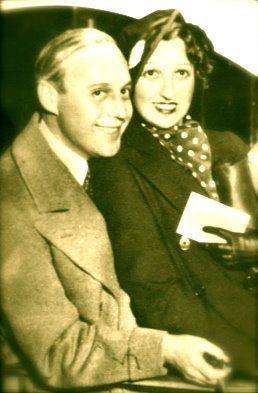
Considering Bennyโ€™s inauspicious debut, the comedianโ€™s rise to fame and well-deserved popularity is quite remarkable. Partner Mary Livingstone (pictured with Benny above), who did not appear on the program until several months later, would have found in this broadcast ample material with which to cut Benny down to size. Back then, though, there was not much to cut.

โ€œEr, that, ladies and gentlemen,โ€ Benny concluded the 2 May 1932 broadcast, โ€œthat was the last number on our first program on the 2nd of May. Are you sleepinโ€™, huh?โ€


Related writings
โ€œ’. . . that same young man in that same brown suit’: A ‘Jackass’ Takes a Bow” (Benny’s seventh anniversary)
“How Jack Benny’s Gagmen Lost Their Typewriter”

Craig’s Other Wife

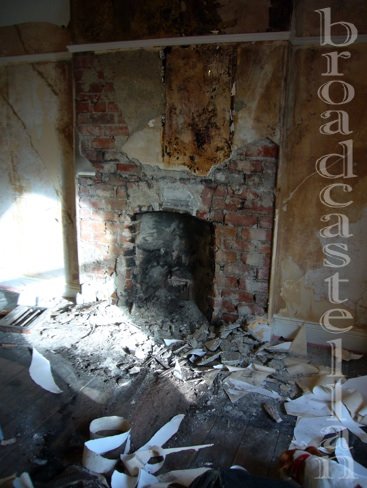
โ€œApril is the cruellest month,โ€ T. S. Eliot wrote (in his opening lines for โ€œThe Waste Landโ€)โ€”โ€œmixing / Memory and desire.โ€ I somehow felt the cruelty of this mixture more keenly this year, being that the seasonal rebirth coincides with activities amounting to more than spring cleaning, a project that triggered memories of a less than happy home and anxieties about moving. The first month of renovating our house in town has passed; and even though another month will go by before our relocation, I am desirous to move on and continue with this journal without mentioning or alluding to our future domicile (pictured) in every post. So, during the month of May, I shall try to refrain from making any references to the place.

Not that the house is done with me yet. It is, to bowdlerize the title of a ghost story by Bulwer-Lytton, the House in the Brain (“Accursed be the house, and restless be the dwellers therein”). Never mind such literary allusions. Onomastics alone suggest that I should dwell on the subject, being that my last name is pronounced H O I Z E Rโ€”which sounds just like the German plural for house (Hรคuser). An architect or real estate agent could not ask for a better one.

To be sure, I have hardly exhausted the subject of moving, building, and dwelling; but whatever it is that I had on my mind shall, for the time being, remain unsaid. After all, as Heidegger reminds me, the word โ€œbauenโ€ [building] derives from โ€œbuan, bhu, beo,โ€ and, originally, โ€œbin,โ€ the first person singular of โ€œseinโ€ [to be]. To let is be and move on seems to me the soundest mode of living . . . and the safest way of keeping this journal alive . . .

So to Speke

When not at work on our new old houseโ€”where the floorboards are up in anticipation of central heatingโ€”we are on the road and down narrow country lanes to get our calloused hands on the pieces of antique furniture that we acquired, in 21st-century style, by way of online auction. In order to create the illusion that we are getting out of the house, rather than just something into it, and to put our own restoration project into a perspective from which it looks more dollhouse than madhouse, we make stopovers at nearby National Trust properties like Chirk Castle or Speke Hall.

The latter (pictured here) is a Tudor mansion that, like some superannuated craft, sits sidelined along Liverpoolโ€™s John Lennon Airport, formerly known as RAF Speke. The architecture of the Hall, from the openings under the eaves that allowed those within to spy on the potentially hostile droppers-in without to the hole into which a Catholic priest could be lowered to escape Protestant persecution, bespeaks a history of keeping mum.

Situated though it is far from Speke, and being fictional besides, what came to mind was Audley Court, a mystery house with a Tudor past and Victorian interior that served as the setting of Mary Elizabeth Braddonโ€™s sensational crime novel Lady Audleyโ€™s Secret. The hugely popular thriller was first serialized beginning in 1861 and subsequently adapted for the stage. Resuscitated for a ten-part serial currently aired on BBC Radio 4, the eponymous โ€œladyโ€โ€”a gold digger, bigamist, and arsonist whose ambitions are famously diagnosed as the mark of โ€œlatent insanityโ€โ€”can now be eavesdropped on as she, sounding rather more demure than she appeared to my mindโ€™s ear when reading the novel, attempts to keep up appearances, even if it means having to make her first husband, a gold digger in his own right, disappear down a well.

As if the house, Audley Court, did not have a checkered past of its ownโ€”

a house in which you incontinently lost yourself if ever you were so rash as to attempt to penetrate its mysteries alone; a house in which no one room had any sympathy with another, every chamber running off at a tangent into an inner chamber, and through that down some narrow staircase leading to a door which, in its turn, led back into that very part of the house from which you thought yourself the furthest; a house that could never have been planned by any mortal architect, but must have been the handiwork of that good old builder, Time, who, adding a room one year, and knocking down a room another year, [ … ] had contrived, in some eleven centuries, to run up such a mansion as was not elsewhere to be met with throughout the county […].

โ€œOf course,โ€ the narrator insists,

in such a house there were secret chambers; the little daughter of the present owner, Sir Michael Audley, had fallen by accident upon the discovery of one. ย A board had rattled under her feet in the great nursery where she played, and on attention being drawn to it, it was found to be loose, and so removed, revealed a ladder, leading to a hiding-place between the floor of the nursery and the ceiling of the room belowโ€”a hiding-place so small that he who had hid there must have crouched on his hands and knees or lain at full length, and yet large enough to contain a quaint old carved oak chest, half filled with priests’ vestments, which had been hidden away, no doubt, in those cruel days when the life of a man was in danger if he was discovered to have harbored a Roman Catholic priest, or to have mass said in his house.

Loose floorboards weโ€™ve got plenty in our own domicile, and room enough for a holy manhole below. It being a late-Victorian townhouse, though, the hidden story we laid bare is that of the upstairs-downstairs variety. At the back, in the part of the house where the servants labored and lived, there once was a separate staircase, long since dismantled. It was by way of those steep steps that the maid, having performed her chores out of the familyโ€™s sight and earshot, withdrew, latently insane or otherwise, into the modest quarters allotted to her.

I wonder whether she read Lady Audleyโ€™s Secret, if indeed she found time to read at all, and whether she read it as a cautionary tale or an inspirational oneโ€”as the story of a woman who dared to rewrite her own destiny:

No more dependency, no more drudgery, no more humiliations,โ€ Lucy exclaimed secretly, โ€œevery trace of the old life melted awayโ€”every clue to identity buried and forgottenโ€”except […]

… that wedding ring, wrapped in paper.  Itโ€™s enough to make a priest turn in his hole.

Dwelling on the Subject: The House in the Child

My future study, getting a make-over

How insignificant, at the moment, seem the influences of the sensible things which are tossed and fall and lie about us, so, or so, in the environment of early childhood. How indelibly, as we afterwards discover, they affect us; with what capricious attractions and associations they figure themselves on the white paper, the smooth wax, of our ingenuous souls, as โ€œwith lead in the rock for ever,โ€ giving form and feature, and as it were assigned house-room in our memory, to early experiences of feeling and thought, which abide with us ever afterwards, thus, and not otherwise.

It was Walter Paterโ€™s โ€œThe Child in the Houseโ€ (1878) that gave me the idea for a title; but it was my history of habitation that made me write The House in the Child, a fictionalized autobiography. I received some sort of graduate prize for submitting a fragment of it, a rather generous acknowledgement of the pain it took to attempt its constructionโ€”and fail. Now that I am quite preoccupied with the impending moveโ€”a subject that, to recycle a line from Charlotte Perkins Gilmanโ€™s โ€œYellow Wallpaperโ€ (1892),ย  โ€œdwells in my mind soโ€โ€”it occurred to me just how long the concept of dwelling has been on my mind, that maze of memories Pater calls the brain-building.

The House in the Child was never finished; and that is just as it should be, for the house was never finished with me. The foundation for the narrative was a sense of dislocation and the absence of private spaceโ€”living abroad, with a dinner table as a study, wondering what โ€œhomeโ€ meant. Thinking about the past, it came home to me that my family had been destroyed by the ambition of building that house. And yet, retreating into my own room (a luxury denied me during much of my adulthood) and the hidden realm of thought, I had done so little to keep the architecture of domesticity from falling apart.

Writing about myselfโ€”this most self-serving of literary endeavorsโ€”offered me a chance at revision, a chance to think of myself as someone who was not always thinking of himself first. I was not this child, but I might have been:

She points at the colorful map drawn neatly with crayonsโ€”red, blue, and green. Mostly red, though, because it makes everything look more significant and urgent somehow, like a warning label. On the map, the house looks like a castle, with chambers and vaults, corridors and hidden passageways. Everythingโ€™s angular and crooked, like in a real maze. A map can make any place important even if it really needs no map at all. The new house is much too small, reallyโ€”too plain, straight, and square. Nobody gets lost in a bungalow. But this drawing was not supposed to make it all clearer and plainer. It was meant to add the mystery and adventure the whole place lacked from the start.

There is still so much to unpack; but she needs to rest for a moment, anyway; and so she sits right here, glancing at this piece of paper.

โ€œEverythingโ€™s set up nicely, donโ€™t you think? You kids will love it. No more fighting about space and privacy, no more arguing about what goes where. Now, let me see.โ€

She plays the game well, slowly following the paths with her finger, studying the map as if it really were the floor plan to an enormous fortress.

Maybe she enjoys this moment because she is just as disenchanted with her new home as . . .

โ€œAh, here we are. This is your room. Your sisterโ€™s room is next to it . . . right here, see? And somewhere down here, in the basement, is the workroom. And you know whoโ€™s going to spend most of his free time in there. Then there is our bedroom, straight across this hallway, here. This is what we always wanted, isnโ€™t it? Weโ€™re all going to have our own rooms now.โ€

All except she. She does not have a place to herself, like we all do. What is her place? Where can she go to close the door? She has to sleep with him at night.

Maybe thatโ€™s why she keeps staring at the map, examining it as if she were looking for a vacant space to rest her eyes. Maybe she holds on to this plan because it promises a hiding place not to be found elsewhereโ€”not provided for in our house. Maybe thatโ€™s why her finger keeps running up and down the paths, back and forth, back and forth, like a mouse trapped in a labyrinth.

Finally, she lets go, gets up, and turns out the light.

โ€œYou can always come here, Mutti.โ€ But she has already closed the doorโ€”and she did not take the map . . .

โ€œI pulled and she shookโ€: A Dรฉcor to Try Oneโ€™s Decorum

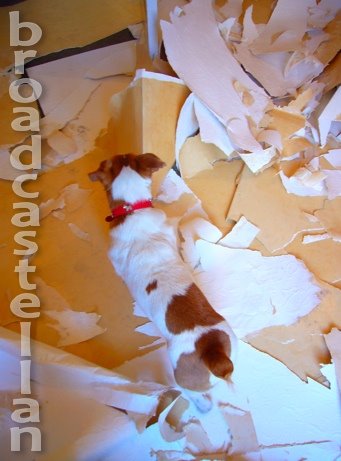
My dog, Montague, demonstrating his wallpaper training in response to my stripping

All right, so Iโ€™m sounding like an aging burlesque queen about to toss her tassels and turn in the G-string that is a turn-on no longerโ€”but, by Gypsy, I am tired of stripping. Wallpaper, I mean. This old Mazeppa has nothing but a scraper for a gimmick, and the only hand she ever got for all her grinding is a mighty sore one. I just could not live with it, though, that dreadful patternโ€”having it stare me down in defiance, berate me for letting myself be defeated by all the work that needs doing in the old house we plan on inhabiting before long. The idea (not mine, mind) was to paint over itโ€”but I scratched that faster than I could scrape. It might peep out from behind the paint, that ghastly design. It might start to creep up on me if I donโ€™t get at it firstโ€”just like in that most famous of all interior decorating nightmares, Charlotte Perkins Gilmanโ€™s โ€œYellow Wallpaperโ€ (1892). To date, Gilmanโ€™s feminist tale of terror is the most convincing argument for taking it all off.

To the tormented soul telling the story, the paper she finds in her roomโ€”the room in which she is meant to restโ€”becomes a โ€œconstant irritant.โ€ Within a few short weeks of studying it, for want of the intellectual activity denied to her, she is driven to the distraction once classified as hysteria:

The color is hideous enough, and unreliable enough, and infuriating enough, but the pattern is torturing.ย 

You think you have mastered it, but just as you get well underway in following, it turns a back-somersault and there you are. It slaps you in the face, knocks you down, and tramples upon you. It is like a bad dream.

Unlike the blank, โ€œdeadโ€ paper on which she writes in secret, the wallpaper is teeming with life, just below the surface. It is the surface of conventions that Gilman tears down with a vengeance:

This bed will not move!

I tried to lift and push it until I was lame, and then I got so angry I bit off a little piece at one cornerโ€”but it hurt my teeth.

Then I peeled off all the paper I could reach standing on the floor. It sticks horribly and the pattern just enjoys it! All those strangled heads and bulbous eyes and waddling fungus growths just shriek with derision!

When Gilman’s story was adapted for US radio, listeners to CBSโ€™s Suspense program may have felt rather differently about this schizophrenic battle when, in a broadcast that aired on 29 July 1948, it was enacted by Agnes Moorehead, who, in tackling the part, had to struggle as well with our memories of the neurotic and disagreeable Mrs. Elbert Stevenson, her most famous Suspense role. โ€œSorry, Wrong Paper,โ€ I kept thinking as I witnessed the disintegration. And yet, as the hard and cutting echoes of Mrs. Stevenson suggest, paper can beat both rock and scissorsโ€”a thought that filled me with renewed terror.

โ€œIt dwells in my mind so!โ€ Gilmanโ€™s character remarks, tellingly, about the dreaded wall covering. The dwelling has overmastered the dweller, like a wild animal resisting domestication, a beast beyond paper training. The prospect of being dominated or possessed in this way by a questionable dรฉcor is a scenario horrifying enough for me to put penknife to paper . . . and keep stripping.

"Milkman" in the Attic

โ€œLook, sonny, weโ€™re up here for work. Weโ€™ve put this attic off, and put this attic off. Now that weโ€™re here, letโ€™s make every minute count.โ€ That was the voice of reason Rush Gookโ€”and several million radio listeners besidesโ€”heard on the day (18 August 1942, to be precise) that mom Sade decided it was time to tackle that stuffy space under the roof of the โ€œsmall house half-way up in the next block.โ€

Our attic, revealing the age of our house

As anyone familiar with Paul Rhymerโ€™s Vic and Sade could guess right off, there was more room for doubt than reason that the task would be accomplished, and that, when the brief visit with the home folks was over, said space would be any more disorganized than it was before the job got underway. You could expect more order, method and sanity sticking your head into Fibber McGeeโ€™s closet.

Now, Iโ€™m not being etymologically sound here, but it is probably no coincidence that attics are just a single consonant removed from anticsโ€”and that is just what you should expect to find while up there, even if it is antiques youโ€™re after.

Our new old house has not one but two attic spacesโ€”and in the smaller of these we found ourselves confronted with some kind of time capsule. Only, it wasnโ€™t quite the right time.

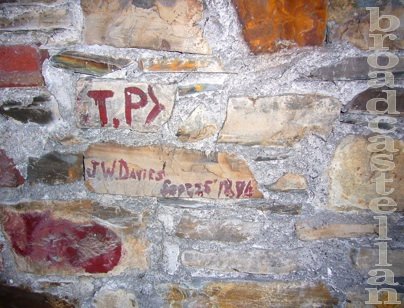
The graffiti on the wall suggests that construction was pretty much completed by September 1896, which was probably the last time the roof space was clutter free. Not that I want it to be barren of memories, mind.

Given the age of the house, I was kind of hoping for a family skeleton. Romantic novels of the Victorian age suggest that the darkest secrets are best kept just below the roof, rather than being crammed into the proverbial closet. Jane Eyre’s Bertha Mason comes to mind, and that seminal study on the subject (Gilbert and Gubarโ€™s Madwoman in the Attic).

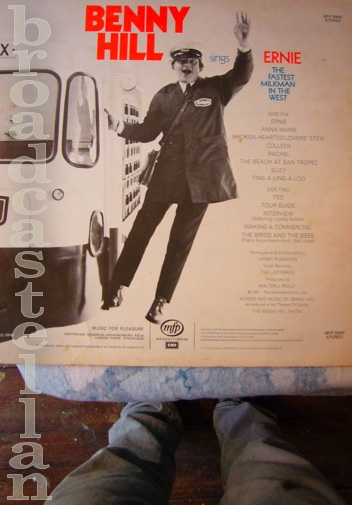
The Benny Hill album

Instead, we were treated to โ€œBenny Hill Sings โ€˜Ernie, the Fastest Milkman in the West.โ€™” Not exactly a Victorian treasureโ€”but at least Ernieโ€™s story has the proper romantic ingredients: lust, rivalry, and premature death (a โ€œstale pork pie caught him in the eye and Ernie bit the dustโ€); there is even revenge from the beyond, as the milkmanโ€™s โ€œevil-lookingโ€ successor, Two-Ton Ted from Teddington, is denied the pleasures of his wedding night:

Was that the trees a-rustling? Or the hinges of the gate? / Or Ernie’s ghostly gold tops a-rattling in their crate?

The cleanup sure slowed down once I came across that discarded collection of vinyl, the highlight of which, to me, is a curiosity labeled โ€œMemories of Steam.โ€ The locomotives on the cover could not deceive anyone into expecting the tell-all record of an inveterate Lothario; but I was thrilled nonetheless, transported back to the days when, as a boy, I was given an album of collected noises that led me to stage my own audio dramasโ€”signifying nothing to anyone else, but chock-full of sound and fury. Come to think of it, that one record may well have laid the tracks that, long and winding though they were, earned me a doctorate . . . just the kind of certificate to relegate to the space I had just visited.

Another find in the attic

Yep, even a climb up to an attic filled with the leavings of previous inhabitants leads me no further than some dim corners of my own memory. Unlike Sade and Rush, I do not have to wait for crazy Uncle Fletcher to disrupt the tasks at hand with one of his dubious recollections (โ€œSadie, do you remember Irma Flo Kessy there in Belvidere?โ€ She was a โ€œpeevish womanโ€ who “used to have a little habit of slappinโ€™ her husbandโ€™s face in publicโ€). I can count on my own past to traipse close behind and creep up on me.

This time, though, the detour into those mental crevices was a welcome and trouble-free one. Down below, rooms hung with ghastly wallpaper were waiting for a hand attached to my aching body . . .

Related recordings
โ€œCleaning the Attic,โ€ Vic and Sade (18 August 1942)

Related writings
“The Home Folks Are Moving In”
โ€œHome Folks Lose Ground to Plot Developers”


Dream Like Petrocelli

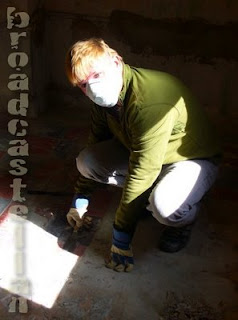
The presumably out-of-date with which I choose to concern myself in this journal cannot be expected to have an air of minty freshness about it; but by now broadcastellan is beginning to smell downright musty. Still, I cannot quite muster the energy to attend to the cobwebs in which this nugatory niche is shrouded. The state of neglect is owing to the dust that has enveloped my carcass of late. For the past three weeks or so, we have been engrossed in the project of renovating a late-Victorian house we intend on calling home in a few short weeks from now, or whenever the central heating and at least one of the bathrooms are installed.

Each day, it is becoming a little easier for me to see past the rubble and imagine myself lolling there, keeping up with past in the leisurely and blissfully inconsequential manner to which I have become so readily accustomed. Until that can happen, though, I shall have to go back, again and again, to scrape floors, strip wallpaper, and remove whatever trace we find of those who lived in there immediately before us, all the while uncovering the more distant past they deemed it fit to hide behind layers of outmoded modernity.

Aside from the dirt and the all too apparent signs of aging, the only thing I seem to have in common with this place is the state of being pre-occupied. It isnโ€™t the work alone and the costs involved that weigh on my mind. It is my own history of habitation on which I feel compelled to dwell. I am reminded of the time when my father decided to get us out of that working class neighborhood whose drabness and influx of foreign workers must have seemed a stigma to him but that was to prepubescent me the only world I knew . . . and one shared by a great many kids my age.

Sure, the prospect of having, for the first time in my life, a room of my own was exciting; but the move, some fifteen miles from where I had grown up, came at a great price . . . including the loss of my ability to communicate, to make myself understood and others laugh (something that was important to me, being that I felt too short to be good at much else). Regional dialects were very pronounced back then in Germany; and moving even that short distance meant that I could barely follow what folks were saying, let alone lead them in laughter. I remember our neighbor asking my sister and me whether we had come to help our father build the house. โ€œYes,โ€ I said, expectantly. I thought the man had just offered me a couple of peaches. Thatโ€™s how it sounded to me, anyhow. Life wasn’t going to be a bowl of fruit.

For my parents, it was the picket fence dream coming true (without the picket fence, mind you, which is an American clichรฉ). Still, being working class, no matter how hard we tried to come across otherwise, meant that the house was coming along only graduallyโ€”which is why my mother could relate to Petrocelli.

Petrocelli was a mid-1970s crime drama, and a pretty formulaic one at that. The action unfolded in flashbacks, from crime to prosecution; but it always ended in the presentโ€”and that present was a construction site. After each case, defense lawyer Petrocelli went to inspect the progress on his new home, the one his job helped to build. Week after week, there was little noticeable change, a state of incompletion that made it easy for my mother to identify with the frustrated ambitions of the titular character.

As for myself, I felt it difficult to relate to anything or anyone back then. Everything was unfamiliar and new (even the ledgers I had filled with pictures and stories had been discarded during the move), and apart from the promise of having that room to myself, nothing seemed worth the trouble of giving up so much of what had felt like home to me, no matter how it might have looked to a status-conscious adult.

To this day, putting tens and hundreds of thousands into a single project like building or doing up a house is troubling to me. Rather than the financial risk and the potential hardship it poses, it is the peril it can mean to oneโ€™s sense of home. You see, the house my father built was never to become our home. It meant the end of our familyโ€”the end of all family activities for which there was no money left in the budget, the end of my parentsโ€™ marriage and, ultimately albeit indirectly, my fatherโ€™s life.

In retrospect, that new houseโ€”the dream of being a four-walled somebodyโ€”looks an awful lot like a Petrocelli flashback . . . a wrong move and a slow process of undoing.

A Half-Dollar and a Dream: Arthur Miller, Scrooge, and a โ€œbig pile of French copperโ€

The currency market has been giving me a headache. The British pound is anything but sterling these days, which, along with our impending move and the renovation project it entails, is making a visit to the old neighborhood seem more like a pipe dream to me. The old neighborhood, after all, is some three thousand miles away, on the Upper East Side of Manhattan; and even though I have come to like life here in Wales, New York is often on my mind. You donโ€™t have to be an inveterate penny-pincher to be feeling the pressure of the economic squeeze. I wonder just how many dreams are being deferred for lack of funding, dreams far greater than the wants and desires that preoccupy those who, like me, are hardly in dire straits.

Back in March 1885, Joseph Pulitzer was doing his part to make such a larger-than-life dream a reality when he tried to raise funds for the erection of the Statue of Liberty. In one of his most sentimental plays for radio, Arthur Miller told the story through the eyes of a soldier and his miserly grandfatherโ€”Millerโ€™s Scrooge.

Broadcast on 26 March 1945, โ€œGrandpa and the Statueโ€ is announced as a โ€œwarm, human story of the most famous pinup girl in the world.โ€ Miller claimed that he โ€œcould not bearโ€ to write just โ€œanother Statue of Liberty showโ€ designed to โ€œillustrate how friendly we are with France and how the Statue of Liberty will stand forever as a symbol of a symbol and so on.โ€ As I put it in my dissertation, the Dickensian comedy he wrote instead โ€œis a nostalgic response to the publicโ€™s growing World War-weariness and the prospects of international unity and concord after Yalta.โ€

As the play opens, a wounded American soldier, recovering in a hospital room with a view of New York Harbor, recalls how his grandfatherโ€”โ€œMerciless Monaghan,โ€ the โ€œstingiest man in Brooklynโ€ got โ€œall twisted up with the Statue of Liberty.โ€ Old Monaghan (played by Charles Laughton) refused to make a contribution to the Statue Fund and, for decades to come, stubbornly defended his position until, one day, his grandson entreats him to take a ferry to Bedloeโ€™s Island:

GRANDPA. What I canโ€™t understand is what all these people see in that statue that theyโ€™ll keep a boat like this full makinโ€™ the trip, year in year out. ย To hear the newspapers talk, if the statue was gone weโ€™d be at war with the nation that stole her the followinโ€™ morninโ€™ early. ย All it is is a big pile of French copper.

YOUNG MONAGHAN. The teacher says it shows us that we got liberty.

GRANDPA. Bah! If youโ€™ve got liberty you donโ€™t need a statue to tell you you got it; and if you havenโ€™t got liberty no statueโ€™s going to do you any good tellinโ€™ you you got it. It was a criminal waste of the peopleโ€™s money.ย 

Among the visitors to Bedloe Island is a veteran of the Spanish-American War. Celebrating the birthday of his fallen brother by visiting the โ€œonly stone heโ€™s got,โ€ the veteran convinces the old man that the โ€œstatue kinda looks like what we believe.โ€

Profoundly moved, Monaghan asks to be left alone while inspecting the inscription at the base of the statue: 

GRANDPA (to himself). โ€œGive me your tired, your poor, your huddled
masses . . .โ€

(Music: Swells from a sneak to full, then under to background.)

YOUNG MONAGHAN. I ran over and got my peanuts and stood there cracking them open, looking around. And I happened to glance over to grampa. He had his nose right up to that bronze tablet, reading it. And then he reached into his pocket and kinda spied around over his eyeglasses to see if anybody was looking, and then he took out a coin and stuck it in a crack of cement over the tablet.

(Biz: Coin falling onto concrete.)

YOUNG MONAGHAN. It fell out and before he could pick it up I got a look at it. It was a half a buck. He picked it up and pressed it into the crack so it stuck. And then he came over to me and we went home.

(Music: Changes to stronger, more forceful theme.)

Thatโ€™s why, when I look at her now through this window, I remember that time and that poem [. . .].

Unlike the published script (as it appeared in the 1948 anthology Plays from Radio), the broadcast play concludes with the last lines of Emma Lazarusโ€™s famous if oft misquoted sonnet โ€œThe New Colossus.โ€

I am highly critical of Arthur Miller in Etherized Victorians; but, for all its sentimental propagandizing, โ€œGrandpa and the Statueโ€ is one of Millerโ€™s most affecting plays for the medium. As I read and listen to it now, so far away from New York City, I get a little wistful; and yet, the message is not lost on me, either, as I think of the larger picture, the ideals worth our investment, and the funds unreplenished, that makes my pouting for a few weeks in the Big Apple seem downright petty. Besides, I’ve got the airwaves to carry me through and keep me buoyant when I go “Oh, boy.”


Related recordings
โ€Grandpa and the Statue 26 March 1945

Related writings
“Politics and Plumbing” (Arthur Millerโ€™s โ€œPussycatโ€)
โ€œArthur Miller Asks Americans to โ€˜Listen for the Sound of Wingsโ€™”
โ€œArthur Miller Unleashes a Pussycatโ€

Many Returns, Mostly Happy: Toscanini at NBC

“I want you to go to Milan and get him. The American radio listener deserves the very best in music. All we can lose is a few weeks of your time and the expenses of the trip. No more cables. Get on a boat.”

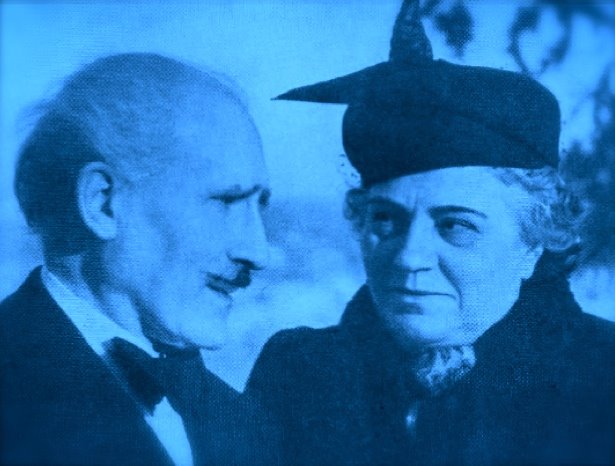
Toscanini and his wife, Carla De Martini

That is what, back in the fall of 1936, RCA president and NBC chairman David Sarnoff told New York Post music critic Samuel Chotzinoff, whom Sarnoff made musical director at NBC. The man that โ€œChotzyโ€ was to go “get” was none other than the legendary Arturo Toscanini, born on this day, 25 March, in 1867. Earlier that year, Toscanini had announced his retirement from the New York Philharmonic Symphony Orchestra and, on 1 March 1936, he had conducted what he meant to be his final radio concert as guest conductor of the General Motors Symphony. Nearly seventy, Toscanini could hardly be expected to jump at the opportunity of raising his baton in a series of weekly broadcasts; but that is just what General Sarnoff had in mind.

Chotzinoff, who was a friend of the temperamental Maestro and later recalled his career in the somewhat less than faithful Intimate Portrait, sailed for Europe to make Toscanini an offer he could not refuse. He was promised an orchestra โ€œhand-picked from the finest virtuosi available,โ€ along with the enticing sum of $40,000, and the added perk to have his income tax paid by the network.

According to radio historian Thomas DeLong, it took a shrewd businesswoman, Toscaniniโ€™s wife (pictured above with her husband), to convince Arturo that it was worth his while to return to the US. The best part of the deal, though, was getting away from Mussolini, whom Toscanini openly despised.

The first of the Saturday evening concerts, broadcast live from studio 8-H at Radio City, New York, was heard on Christmas in 1937. As Francis Chase wrote in the October 1938 issue of Radio Stars, a studio audience of

over 1,400 persons sat breathless as the white-haired, flashing-eyed, dynamic little figure of Toscanini mounted the podium before one of the greatest symphony orchestras ever assembled; certainly the greatest ever presented wholly for the radio audience. ย The finest instrumentalists from many great American orchestras sat beneath the master’s baton, while in the brilliant audience, listeners hardly breathed. ย There was not the faintest rustle of a program (so that no slightest sound should mar the transmission, programs had been printed on silk).

Less attention was paid to the studio acoustics, which, as B. H. Haggin argues, were โ€œunresonantly dry, flat, hard and made airlessly tight by the audience which filled the studio.โ€ That did not stop the perfectionist from demanding the best from his orchestra, and, judging from the rehearsal recordings shared on NBC’s Biography in Sound tribute that aired on the day after Toscanini died, the Maestro was fierce in his criticism. โ€œDo you believe that I am crazy?โ€ he asked the performers, not waiting for a reply. “No,” he insisted, “sensitive.”

Year after year, the aging and only very gradually mellowed Toscanini vowed to retireโ€”but for seventeen seasons he returned to the studio until, on 4 April 1954, he stepped from the podium for the last time; having faltered and dropped his baton during a performance temporarily taken off the air and replaced with recorded music, Toscanini walked off before the orchestra had played the final chord. He was eighty-seven years old.

The stick with which he conducted the NBC orchestra (if not always too well), must have been a kind of crutch to Toscanini. It enabled him to hold together a body of artists at an age when most men can barely keep their own from falling apart.

Related recordings
โ€œThe Man Behind the Legend: A Tribute to Arturo Toscanini,โ€ Biography in Sound (22 January 1957)
Beethoven, Symphony No. 5, NBC Symphony Orchestra, (probably 11 November) 1939