That’s a Sound All Right, but It Ain’t Music

As much as I enjoy Hollywood musicals, I’ve never sat through The Sound of Music. In fact, before I moved to the US, I had never even heard of the film, let alone anything of the true story behind it. Being born and raised in Germany does have its advantages, you might say; but I am not inclined to be flippant about censorship. Fact is, depictions of Nazism in popular culture were carefully filtered in (West) Germany, even decades after the end of the Third Reich. The reminders of past atrocities and the shared culpability for them were apparently deemed too humiliating or distressing to audiences out to enjoy a bit of cinematic escapism. Perhaps, the decision not to exhibit certain films or to edit and dub them so as to render them inoffensive was based on the notion that the horrors hinted at or exploited for their melodramatic value were too severe to serve as mere diversions. In any case, I was not exposed to the Von Trapps. And when I had my first glimpse of them, I did not feel particularly sorry to have missed out on the acquaintance.

I was as much turned off by the 1960s look of what was meant to have been the late 1930s as I was by those cloying sounds and images. This picture needed to be altogether darker, the music more haunting, more angry and sorrowful than “My Favorite Things.” For years, I avoided what to many remains a sing-a-long occasion. A few weeks ago, the stubborn Teuton in me surrendered at last and got a discount ticket to Andrew Lloyd Webber’s production of the Rodgers and Hammerstein classic at the London Palladium, a production launched and shrewdly promoted back in 2006 by an American Idol-style singing contest in which the British public, along with Sir Andrew, went in search of the perfect Maria.

I can’t say that the West End changed my mind about The Sound of Music. Sure, there are bright and eminently hummable numbers in it, but what is left of the story has less weight than the average supermodel. What is at stake for Maria is not life or liberty, but a chance to trill a few more tunes. No moral dilemma, no sense of danger, no signs of turmoil as Maria grapples with the difficulties of choosing between the convent and the conventional. I don’t expect a treatise on the relationship between fascism and the church; but I sure am tired of those insipid scenes of Sister Activity to which nuns are reduced in popular culture.

In the production’s single instance of dramatically effective set design, the auditorium is transformed into a fascist venue, as brown shirted guards appear in the isles and swastika banners are imposed onto the walls of the Palladium; but the machinery, the show tune factory that is The Sound of Music, does not permit any forebodings to build, any doubt or dread to work on the spectator’s mind. The pageant must go on, dispassionate and smooth as clockwork.

Not everything was quite so well oiled that evening. I knew that what had been mounted here would not amount to anything resembling absorbing melodrama the moment I saw Maria atop a circular platform that was slowly and laboriously tilted in an obvious but feeble imitation of Ted McCord’s Oscar-nominated cinematography. The hills were alive all right; you could hear them aching so loudly that Maria—not the one chosen on the reality program but a paler substitute (the chirpily unengaging Summer Strallen)—couldn’t climb any high note piercing enough to deaden them, spread out as she was on that giant pizza like a slice of parma ham, extra lean.
Less dulcet than the tones produced by those tectonic shifts was whatever emanated from the gaping jaws of the Captain, impersonated that night by Simon MacCorkindale, whose credentials as an actor include, need I say more, featured roles in Falcon Crest and Jaws III. “If you know the notes to sing,” Maria instructs the children in “Do-Re-Mi.” Well, you still can’t “sing most anything” if restricted by the vocal chords of a MacCorkindale, whose rendition of “Edelweiss” should have resulted in his immediate seizure by Nazi officials. The Sound of Music was the croaking Mac’s first—and, let the nuns of the world pray, his last—venture into musical theater.

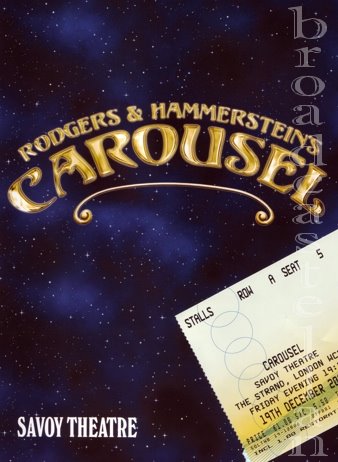
Decidedly more rewarding both tunefully and dramatically is the current West End production of Carousel at the Savoy, which I saw the following day. Starring Jeremiah James as the troubled Billy Bigelow and an earthy, buxom Lesley Garrett as Nettie, it proved a nutritious alternative to pizza with the Von Trapps.
“Oh no he isn’t” (“Oh yes he is”): Mickey Rooney in Bristol

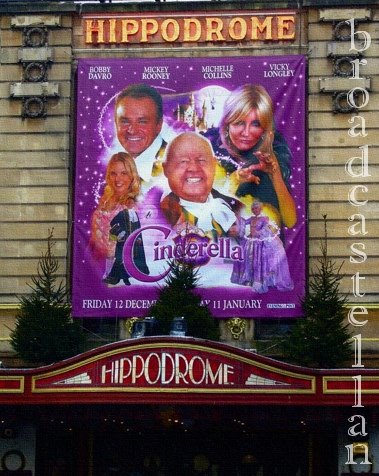
When I read that Boys Town dropout Mickey Rooney was to appear once again on the British stage, I resolved to adjust our vacation schedule accordingly and ring in the new year in Bristol, England. Why not cheer on the late-octogenarian trouper as he performs his way into the Guinness Book of Records, I thought. Rooney, who has been on the boards and in the studios for nine decades, can currently be seen as Baron Hardup in the pantomime Cinderella at Bristol’s old Hippodrome. Granted, I was not exactly panting for panto, unaccustomed as I am to that most British of holiday theatricals. The first one I caught, back in 2005, boasted Ian McKellen . . . in drag. It felt as if I had crashed a fancy dress party, with everyone around me too inebriated to permit me to catch up or on.

The experience left me more bewildered than tickled. I failed to find amusement in such consummate waste of thespian talent on what struck me as a vulgar, charmless production of Aladdin at the Old Vic in London. I did not understand that vulgarity is the very charm of British panto—an outrageous spectacle befitting the topsy-turvitudinous twelve-nightly revels.

This time around, having just had my fill of Pulitzer Prize-winning drama (August: Osage Country), opera (Hansel and Gretel), and musicals (The Sound of Music and Carousel) in London, I was ready for something decidedly more lowbrow. Besides, the Hippodrome’s presentation of Cinderella presented us with the opportunity to meet up with friends, among them Michelle Collins (aforementioned), who was cast as the Wicked Stepmother.

We ended up spending quite some time backstage, then dined and partied with cast members after Mickey had slipped out of the theater. The superannuated Andy Hardy made it clear that he was not to be approached for signatures or photo opportunities; nor was he to be seen anywhere but onstage, not given to mingling with his British co-stars whose names can mean nothing to a Hollywood legend.

His exclusivity is a wise precaution, no doubt. Who, at his or any age, would relish the prospect of being badgered after a night’s work while stepping into the icy dark of a backdoor alley, being coughed and sneezed at by the occupational hazards that are autograph hunters, some of whom, if they had just come out of the show, were still somewhat musty after being shot at, as was my misfortune, with a giant water pistol fired by comedian Bobby Davro? Indeed, it was rather sporting of the hardy one to fulfill his contractual obligations, being that his eighth wife, Jan, who was slated to join him as the Fairy Godmother, had taken ill.

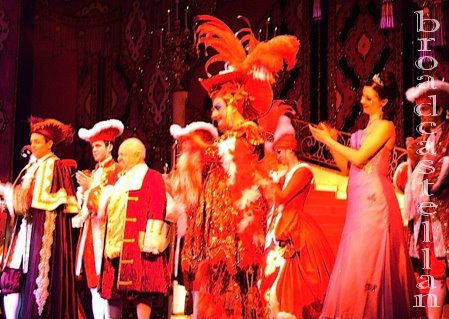
So, how was Mr. Rooney, you ask? Well, he was . . . there, or very nearly so. It appeared that only few members of the audience particularly cared. I doubt that many were quite aware just who this old fellow was. A couple seated in front of us, pointing at the oversized keepsake playbill, shook their heads at the sight of his picture, whereas the photograph of Ms. Collins triggered nods of recognition. It’s a long way from 1930s Hollywood to 21st-century Bristol, you know.

You might think that, with a name like Joe Yule, the man who made a name for himself as Mickey Rooney was born to spread Christmas cheer. Instead, as if finding himself on stage quite by accident, the distant star twinkled beyond the reach or ken of a high-spirited crowd eager to laugh at Buttons (Davro), hiss the Wicked Stepmother (Collins), or cheer the juveniles—that is to say, interact with the characters in traditional panto fashion. To the children, the action-slowing walk-ons of Rooney’s kindly grandfather figure must have been either inconsequential or else incomprehensible, lost within the noisy glare of the spectacle. Still, there he was, aware, no doubt, that showcases such as the pantomine are about the only opportunity left to an actor of his years to make what is little more than a stage cameo.

For all the fun of Cinderella (and jolly good fun it certainly was), there was something pathetic about yesterday’s Huck Finn being benched on the sidelines, looking on benevolently if slightly bewildered. Mr. Rooney, who had two short musical numbers, including a wistful rendition of “Smile,” spent most of his time seated to the left of the stage while nominally assuming its center. The tunes suited him, but were incongruous all the same with a production that relied heavily on contemporary pop music as if out to turn the fairy tale favorite into High Jinks Musical.

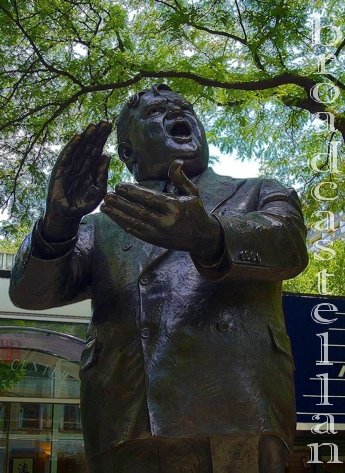
Not far from the Hippodrome, on the vast emptiness that is Millennium Square, there stands a forlorn statue of Bristol’s native son Cary Grant, unheeded by tourists (of which there were few) and locals (who may well shun the space) alike. Still, there it is, clutching the script for To Catch a Thief as if determined to catch the next flight back to California. Like small-statured Rooney, his stage presence and its reception, the statue brought to mind the quest (the questionable) upon which I had embarked when, feeling displaced and unsure of myself, I commenced this journal back in 2005: to keep up with the out-of-date as if rehearsing my exit in a state of conspicuous invisibility. Yet, here I am, forever behind . . . like a pantomime horse’s ass.

" . . . from numberless and nameless agonies": The Bill of Rights Remembered

I might as well end this year’s regular programming here at broadcastellan with a bang. This one was sure made an impact, heard by as many as sixty million Americans—at once. Subtitled “A Dramatic Celebration of the American Bill of Rights, Including an Address by Franklin D. Roosevelt,” We Hold These Truths made radio history on this day, 15 December, in 1942. It also made the most of history in the making.

“No other single dramatic performance [. . . ] ever enjoyed so large an audience,” author Norman Corwin remarked in his notes on the published script. The program was “[w]ritten at the invitation of the US Office of Facts and Figures” to commemorate the 150th anniversary of the United States Bill of Rights, which came into effect on 15 December 1791,; but it was already in the works when the attack on Pearl Harbor took place.

“In fact,” Corwin later recalled (in Years of the Electric Ear), “I was on a train travelling from New York to Hollywood, still working on the script when the attack on Pearl Harbor took place.” Now that the United States had entered the war, the broadcast became a rallying cry, a reminder of the rights it is the duty of all those who possess them to protect.

“To many listening Americans,” Movie-Radio Guide summed up in its 3-9 January 1942 issue,

the big “Bill of Rights” program broadcast over the Nation’s networks Monday, Dec. 15, was an utterly unforgettable event. To the many personalities who joined their talents to produce the program it was likewise a memorable privilege. Coming as it did at a time when it could not have meant mere to the nation, the broadcast brought America figuratively to its feet. A transcription of the superb dramatic production [. . .] will be preserved in the archives at Washington.

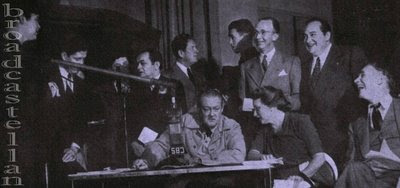
The cast, as shown above, included Orson Welles, Rudy Vallee, Edward G. Robinson, Bob Burns, James Stewart, Walter Brennan, Edward Arnold, as well as (seated) Lionel Barrymore, Marjorie Main, and Walter Huston.

According to the Movie-Radio Guide, “[o]ne of the highlights of the presentation was the performance of James “Jimmy” Stewart.” So moved was he by the reading that, at the close of the broadcast, he “pulled off his earphones” and “let down his emotions, excusing himself from the studio and reportedly breaking into tears in private.” No wonder, Stewart was called upon to introduce President Roosevelt, who addressed the public from Washington, DC. Upon this experience, the humble actor remarked: “Imagine a corporal introducing a Commander in Chief of the armed forces!”

Not Quite the "Voiceless Sinatra": Van Johnson (1916-2008) on the Air

I am not sure who came up with the moniker “the voiceless Sinatra,” which is attached to virtually every obituary of and tribute for Van Johnson, the Hollywood actor who died on 12 December 2008 at the age of 92. Apparently, the coining of the phrase dates back to the mid-1940s and was meant to capture the boy-next-door’s appeal to teen-aged moviegoers (audible in the 11 December 1945 Theater of Romance introduction to Love Affair). It is a misleading label nonetheless, considering that Johnson was heard in musicals and had many a voice-only part in the so-called theater of the mind. Back in 1985, I saw him on the New York stage, when he starred in La Cage Aux Folles, the first Broadway musical I ever saw. Johnson’s show business career was long and diverse, if slow in becoming distinguished.

Many of his early roles were little more than featured bit parts designed to draw attention to the young hopeful on the MGM lot. As was the case with many a rising star, radio assisted in his promotion. Along with first-billed Edward Arnold and his co-star Fay Bainter, Johnson was given the opportunity to reprise his role in The War Against Mrs. Hadley for the in a Lux Radio Theater, in a broadcast commemorating the first anniversary of the attack on Pearl Harbor (7 December 1942). Introducing the players, host Cecil B. DeMille referred to Johnson as one of Hollywood’s “promising newcomers.”

Due to a severe accident, Johnson very nearly did not get a chance to make good on that promise. Barred from military action, he served his country on the home front, appearing in a string of wartime pictures, including The Human Comedy, A Guy Named Joe, and Thirty Seconds over Tokyo. Last night, I saw him in The White Cliffs of Dover. In it, Johnson plays the hapless admirer of a young woman (Irene Dunne) who visits England shortly before the Great War, falls in love and stays. Johnson is seen in the opening scene, but has only one memorable moment thereafter when he gets to kiss his married sweetheart during a chance encounter. I suppose MGM had so many stars back then that it could afford such frivolous casting.

Throughout the Second World War, Johnson remained “one of the screen’s most rapidly rising young personalities,” as he was billed on the 2 November 1944 broadcast of Suspense. Since his fine performance in “The Singing Walls” is not available on the Internet Archive, where you will hear Preston Foster and Dane Clark instead (in a 2 September 1943 production of the play), I have temporarily made the recording available here..

Johnson returned to Suspense four times, namely for ”The Defense Rests” (6 October 1949), ”Salvage” (6 April 1950), ”Strange for a Killer” (15 March 1951), and “Around the World” (6 April 1953).

Aside from his numerous dramatic performances on the air, including the Theatre Guild’s non-musical presentation of State Fair (4 January 1953), Van Johnson was also heard singing “Pennies from Heaven” as a tribute to an ailing Bing Crosby on The Big Show (1 April 1951). “I haven’t been singing much since I’ve been in pictures,” the former “song-and-dance man” warned his hostess after performing in a scene from his upcoming picture Go for Broke (1951), “My voice might crack.” Well, whatever Bob Hope’s cracks, “Go for Croak” he did not. Van Johnson’s was not such bad record for someone allegedly “voiceless.”

"Bleiben Sie wohl und halten Sie sich munter": A Visit at Kaltenmeyer’s

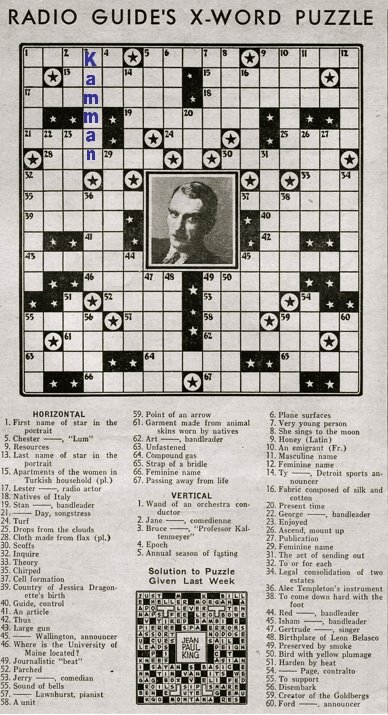
K A M M A N. I am sure a lot of readers of Radio Guide magazine would have found “Bruce ___, ‘Professor Kaltenmeyer” as easy a crossword puzzle clue as “Jane ___, comedienne” or “___ Wallington, announcer.”

From 1932 onwards, Bruce Kamman played the good-natured and much put upon teacher of the gang at Kaltenmeyer’s Kindergarten, a weekly comedy program that originiated from WMAQ, Chicago. Kaltenmeyer’s is one of those popular programs that have all but disappeared into thin air, the exception being the 12 December 1936 broadcast (which you may access on Jerry Haendiges’s invaluable “Same Time, Same Station” site). Reminiscent of and anticipating German schoolboy comedies like Heinrich Spoerl’s Feuerzangenbowle or Erich Kästner’s Das Fliegende Klassenzimmer (both 1933), Kaltenmeyer is a winsome trifle of a show. Each week, the Kindergarten opened with the catchy signature “Just for Fun”:

Kaltenmeyer’s starting,
Let’s all go to school.
In this kindergarten,
Where nonsense is the rule.

Indeed, much of it is nonsense, some of it song. Fibber McGee and Molly team Jim and Marian Jordan were featured on the program; until the fall of 1936, they were among the Professor’s international crowd of poopils. The 12 December 1936 broadcast (an excerpt of which was later rebroadcast on Recollections at Thirty) includes the somewhat incongruously wistful “Sweetheart, Let’s Grow Old Together” and offers at least one memorable pun involving the definition of the word “indisputable,” which one Kaltenmeyer’s rambunctious kids (adults all) manages to put into the following sentence: “Indisputable weather we’re having.”

It is Bruce Kamman’s voice, though, that adds “indisputable” charm to the nonsense. It is the kind of Sig Ruman-Frank Reichert voice—warm, avuncular, and too Jean Hersholt to be altogether ridiculously, let alone threateningly Teutonic. According to Francis M. Nevins’s The Sound of Detection, the Cincinnati-born Kamman, who entered radio as early as 1920, would continue his broadcasting career off mike, namely by producing and directing episodes of the Ellery Queen mystery-cum-celebrity quiz program.

Kamman’s days as Kaltenmeyer came to an end once the Germans began to wage war in Europe. In 1940, well before the United States entered the Second World War, Kaltenmeyer stopped saying “Auf Wiedersehen.” The character was removed from the Kindergarten, and what was left of the show folded soon thereafter.

I guess, when you make a career of sounding like Sig Ruman, you were expected to start shouting “Sieg Heil!” or hiss sinisterly and subsequently expire, rather than be permitted to send kindly greetings like “Bleiben Sie wohl und halten Sie sich munter” (“stay well and cheerful”) to the American people, whatever their heritage or dialect. Clearly “good old days” recalled in the theme song were over.

Now, let’s all go to back to the school that was radio and solve the puzzle . . .

“I hold no animosity toward the Jews”: The Father Coughlin Factor

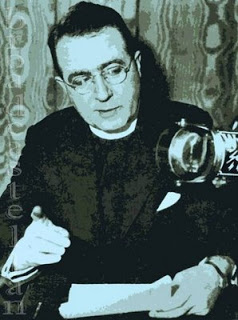
Listeners tuning in to station WHBI, Newark, New Jersey, on this day, 11 December, in 1938, were reminded that what they were about to hear was “in no sense a donated hour.” The broadcast was “paid for at full commercial rates”; and as long as they desired Father Coughlin into their homes, he would be “glad to speak fearlessly and courageously” from the Shrine of the Little Flower in Royal Oak, Michigan, from whence he spread what was billed as a “message of Christianity and Americanism to Catholic and Protestant and religious Jew.”

As Siegel and Siegel point out in their aforementioned study Radio and the Jews (2007), Father Coughlin was at that time increasingly coming under attack. In the fall of 1938, some stations no longer carried his weekly radio addresses, which had once been heard by as many as forty-five million US Americans. While anxious to defend himself, Coughlin was not about to recant or withdraw.

In his 11 December broadcast, he expounded again on his favorite subject, “persecution and Communism,” by which he meant the persecution of American Christians by Communist Jews. It was his “desire as a non-Jew,” Coughlin insisted, to tell his audience, including “fellow Jewish citizens,” the “truth.”

The adjective “religious,” attached as was by Coughlin only to Jew, not to Catholic or Protestant, was significant in his defense of his special brand of anti-Semitism, a distinction between “good” and “bad” Jews that enabled him to denounce “atheistic Jews” as Communists. “Show me a man who disbelieves in God, and particularly who opposes the dissemination of knowledge concerning God, and I will show you an embryonic Communist.”

In his condemnation of the “insidious serpent” of atheism as manifested in Communism, however, Coughlin made no mention of non-practicing Catholics or non-believing Protestants. According to his preachings, the Jew, rather than the Catholic or Protestant, was that “embryonic” Communist. No other religions got as much as a mention.

Ostensibly to “inform” listeners “what thoughts millions of persons are entertaining,” Coughlin argued that, in “Europe particularly, Jews in great numbers have been identified with the Communist movement, with Communist slaughter and Christian persecution.”

He urged American Jews—the “Godless” among whom were conspiring to do away with “the last vestiges of Christmas practices from our schools”—to disassociate themselves from the Jews in Europe at the very moment in modern history when the Jews in Europe were most in need of support from the free world:

O, there comes a time in the life of every individual as well as in the life of every nation when righteousness and justice must take precedence over the bonds of race and blood.  Tolerance then becomes a heinous vice when it tolerates the theology of atheism, the patriotism of internationalism, and the justice of religious persecution.

While “graciously admit[ing] the contribution towards religion and culture accredited to Jews”; while claiming to have spent “many precious hours” in the “companionship of the prophets of Israel,” Coughlin got down at last to the nastiness that was his business. As he put it,

when the house of our civilization is wrapped in the lurid flames of destruction, this is not the time for idle eulogizing.  When the house is on fire, its tenants are not apt to gather in the drawing room to be thrilled by its paintings and raptured by its sculpture, its poetry, its tomes of music or its encyclopedia of science, which are there on exhibit.  When the house is on fire, as is the house of our civilization today, we dispense with gratifying urbanities and call in the fire department to save our possessions lest they be lost in the general conflagration.

Any acknowledgment that the “conflagration” threatened the Jews more than the Christians so shortly after Kristallnacht—the atrocities of which he gainsaid in his 20 November 1938 broadcast—are relegated to the attic that are the dependent clauses of Father Coughlin’s rhetoric, which, in its far from courageous concessions, is as disingenuous and invidious as the language of Bill O’Reilly today.

Hollywood and the Three Rs (Romance, Realism, and Wrinkles)

A few months ago, I went to see a Broadway musical based on a television play by Paddy Chayefsky. Confronted with those keywords alone, I pretty much knew that A Catered Affair was not the kind of razzle-dazzler that makes me want to join a chorus line or find myself a chandelier to swing from. A Catered Affair is more Schlitz than champagne, more kitchen sink than swimming pool. Drab, stale, and too-understated-for-a-thousand-seater, it left me colder than yesterday’s toast (and I said as much then).

What made me want to attend the Affair was the chance to see three seasoned performers who, before being thus ill catered to, had been seen at grander and livelier dos: Faith Prince, Tom Wopat, and Harvey Fierstein, whose idea it was to revive and presumably update Chayefsky’s 1955 original. Last night, I caught up with the 1956 movie version as adapted for the screen by Gore Vidal. Similarly drab, but without the cliché-laden lyrics and with a more memorable score by André Previn; and starring Bette Davis, of course.

When we first see Davis’s middle-aged mother on the screen, she is performing her hausfrau chores listening to The Romance of Helen Trent, a radio soap opera that encouraged those tuning in to dream of love in “middle life and even beyond.” It was probably the quickest and most effective way of establishing the character and setting the mood. After all, Davis’s Aggie, whose own marriage is not the stuff of romance, is determined to throw her daughter the wedding that she, Aggie, never had. She is living by proxy, as through Trent’s loves and travails, a fictional character that makes it possible for Aggie to keep on dreaming.

Once again, I was thankful for my many excursions into the world of radio drama; but I also wondered whether the aging Ms. Davis and her far from youthful co-star, Ernest Borgnine, are giving me what Helen Trent promised its listeners back then: an assurance that life goes on past 35 (which, in today’s life expectancy math, translates into, say, 45).

I rarely watch or read anything with or by anyone yet living. It is not that I am morbid—it is because I prefer a certain kind of writing and movie-making. To me, whatever I read, see, or experience is living, insofar as my own mind and brain may be considered alive or capable of giving birth. So, when I followed up our small-screening of The Catered Affair by the requisite dipping into the Internet Movie Database, I was surprised to see that, aside from André Previn, three of its key players are not only alive but still active in show business.

The unsinkable Debbie Reynolds (no surprise there), the Time Machine tested Rod Taylor (next seen as Winston Churchill in Quentin Tarantino’s Inglourious Basterds), and the indomitable Mr. Borgnine, who has five projects in various stages of production. Not even cats can count on Borgnine lives. To think that, having played a middle-aged working man some five decades ago and still going strong today is both inspiring and . . . exasperating.

Why exasperating? Well, the media contribute to or are responsible for the disappearing act of many an act over the age of, say, fifty (or anyone who looks what we think of as being past middle aged, no matter how far we manage to stretch our earthly existence or Botox our past out of existence these days). You might repeat or even believe the adage that forty is the new thirty, but in Hollywood, sixty is still the same-old ninety. Sure, there are grannios (cameos for the superannuated) and grampaparts in family mush or sitcoms; but few films explore life beyond fifty without rendering maturity all supernatural in a Joan Collins sort of way.

Helen Trent and the heroines of radio were allowed to get old because audiences did not have to look at—or past—the wrinkles and liver spots. High definition, I suspect, is only taking us further down the road of low fidelity, away from the age-old romance that is the reality of life.

"Samson, made captive, blind": Milton on the Wireless

BBC Radio 3 is in the middle of a Milton season, designed to commemorate the 400th anniversary of the poet’s birth. This week, John Milton’s works are the subject of The Essay; his views, their significance and influence, are discussed on this week’s Sunday Feature, while excerpts from his poetry are recited on Words and Music. On 14 December, a new production of Milton’s Samson Agonistes will be presented by Drama on 3.

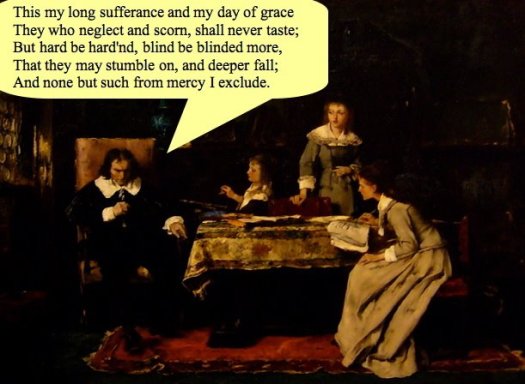
The wireless gave birth to the career of many a Milton, from announcers Milton Cross and John Milton Kennedy to comic Milton Berle. Among its writers numbers Milton Geiger, a playwright whom Best Broadcasts anthologist Max Wylie singled out for his ability to bring “reality and movement to a property that is in every sense an allegory.” More than any of those Miltons on the air, John, the poet and essayist, is truly in his element in the so-called blind medium of radio. His struggle to combat metaphorical blindness while being afflicted with physical sightlessness—a challenge that became the subject of a radio play (previously discussed here) was frequently the theme of his poetry, from “To Mr. Cyriack Skinner Upon His Blindness” to Paradise Lost and, finally, Samson Agonistes:

“O loss of sight, of thee I most complain!” the captured Samson, blinded and bereft of his powers, laments:

Blind among enemies! O worse than chains,
Dungeon, or beggary, or decrepit age!
Light, the prime work of God, to me is extinct,
And all her various objects of delight
Annulled, which might in part my grief have eased.
Inferior to the vilest now become
Of man or worm, the vilest here excel me:
They creep, yet see; I, dark in light, exposed
To daily fraud, contempt, abuse and wrong,
Within doors, or without, still as a fool,
In power of others, never in my own—
Scarce half I seem to live, dead more than half.

As a political writer eager to get his word out, Milton might have embraced the swift spreading of ideas that wireless technology makes possible. He would have seen in broadcasting the dissemination of so much good mingled “almost inseparably” with so much evil, from which the good is “hardly to be discerned.” To him, though, discernment was not the result of a shutting out of anything potentially harmful or ostensibly bad, but of a taking in of it all and an informed judging of its qualities. He would have welcomed the chance to have his words reach the ears of the multitude in a single broadcast, and of hearing the voices of others in an open forum.

Yet was there ever such a forum on the air? As he did in his Areopagitica, Milton would have objected to the licensing and censorship that threaten and curtail the freedom of speech. Commercial broadcasting, he might have argued, is not unlike Samson, betrayed, imprisoned and abused: “in power of others, never in [its] own,” a “moving grave” awaiting death by television. Even when it was still capable of bringing down the house, radio, like Samson, went down in the process before ever entirely convincing anyone of the power and virtue of sightless vision.

So, if Samson is Radio, who is his Delilah? Would it be television, the sponsors, radio executives, or, perhaps, the Philistine public at large?

The Black Sheep and the Baby: A Kind of Christmas Story

I was not the last person to see Ilse Hiss alive; but I would like to think that I was the last one she had wanted to see. Shortly before Thanksgiving, Tante Ilse had been hospitalized with pneumonia. I knew then that she would not come out of that room upright and walking. She knew it, too. During the last few years of her life, I had gotten very close to my great-aunt. I have no other relatives in America, and none elsewhere that would speak to me. Call me a black sheep, if you like. I’m sure my family calls me many other things besides. Anyway, this isn’t about me. This isn’t even about Tante Ilse; but I had no idea what is was all about when the nurse handed me that small parcel. My inheritance, I thought.

Tante Ilse had already left me plenty. Memories, mostly. Hours of impressions and recollections I had preserved on tape. Her ‘recording angel’ she once called me in what I assumed to be a rare moment of sentimentality. Then she winked at me, chuckled, and, in that year-round Octoberfest of an accent she had kept after nearly six decades of life in America, she added: “Aindshell? I brobaply don’t know der haff of it.”

Tante Ilse, as I said before, had been a baby crier; she had a talent for bawling that was very much in demand during the days before television, when radio was the nation’s home theater. “Vrom me, dey wanted only babies,” Tante Ilse summed up her unlikely—and largely undocumented—history in show business. “Alleright, babies I gave dem. Och, how dey endjoyed to hear me gurkle and coo. Only during Christmas I vas still. Den, de holy invent dook over; and he was not allowed to make much noiss.” So, when the nurse handed me that audiotape, I expected it to contain a sampling of her cries.

To my disappointment, there wasn’t as much as a whimper on it. Just talk and music, and a rather dismal poetry recital: an old radio program from one of New York’s small, independent stations. As tuned-in as I was to old-time radio back then, having made it the subject of my Master’s thesis, I did not recognize any of the voices. Why had my aunt given me this recording? And why had she not shared it with me before? I could not help thinking that Tante Ilse, prim and Protestant in spite of herself, was sending me a message she could only deliver from the grave.

Aside from Walt Whitman, whose poetry was haltingly recited, the only name mentioned on the program was that of the announcer, one frightfully British sounding Cecil Bridgewater, whom I had never heard of. I was none the wiser after my aunt’s funeral. The friends she made during her radio days had long passed on, and no one present could recall much of her early life, her leaving Germany after the Nazis had come into power, her struggle to earn a living in New York City, and her unlikely foray into broadcasting after she was overheard imitating a toddler at her neighborhood market. “You call this grying?” she had scoffed; and when she screamed back, a radio executive in line took note.

I had her account of all that on tape. I never got to ask, though, and never dared to ask, just what had prompted her to leave her home town, accompanied by her brother, Heini, a miserable failure of a man about whom I knew nothing other than that he had deserted his wife and unborn child for a new life in New York. My father never spoke of Opa Heini, who died in apparent shame and obscurity before reaching the age of sixty, other than referring to him as the “Deserteur.”

Anyway, I followed Tante Ilse’s example more than half a century later, for very personal reasons of my own; and as thorough as I was in my research of her odd career as a baby crier, I never insisted on getting her life story, assuming that, like an infant, she would speak when she was ready. What a lousy excuse for a historian I had been; and how I regretted not to have asked while I still had the chance.

But, back to the tape. This was a few years before we all got on the Internet, mind; and, having checked every book on the subject of broadcasting available to me, all I could think of was to consult the Manhattan telephone directory. Would you believe, there was a listing for C. Bridgewater.

So, shortly before Christmas Eve, I found myself in the Upper East Side apartment of one Cecil V. Bridgewater, aged 94. A dapper chap he was, with a keen memory, for the gift of which I very much envied him. I played the recording. Not only did he recognize his voice, he recalled the program, Poetry for Everyone, which he announced during the early 1940s. He had never heard of my aunt, though; and, as we listened, he kept eyeing me, as if wondering what I had really come to find out.

I was about to leave when he turned to me and said: “You know, about that fellow who read Whitman.” “Yes?” I asked, encouragingly.

“He was not much of an orator, was he?”

“No,” I agreed.

“He wasn’t a professional, either, just a college kid from Columbia who had volunteered to recite. The station had little money for voice talent. He was never asked back.”

“I’m not surprised,” I retorted, flippantly.

“The thing was, he wasn’t really reading for Everyone,” at which point the old man performed a little dance with his finger to put the last word in quotation marks.

“No?” I urged on.

“I think I can tell you,” he responded, confidentially. “He was reading it to someone in particular. Like a code, you know.”

Tante Ilse, I thought.

“And he got hold of the transcription, as well. You know, a recording of the broadcast. I can think of only one person, besides him, who could have kept it all those years.”

I sensed he was not referring to my aunt.

“When I walked out of the studio that night, I saw him again,” Mr. Bridgewater continued. “He was in the company of another young fellow and, well, they looked very much . . . absorbed in each other’s company.”

He looked at me, and gave me a knowing smile. “I remember it well because I was very suspicious.”

“Because they were both men?” I asked.

“No,” he said, rather irritated by the question, “because the other one was German.”

At that moment, for the first time, I felt a kinship with that other black sheep beyond the fold, for mine was a story that my grandfather had lived. And I was grateful to his sister for giving me a chance to find him out at last by sharing what she could be sure would stir me to research. How brave of Tante Ilse to leave behind all she knew for the sake and safety of the likes of me, sheltering him in a cloak of silence, even as she cried like a newborn child:

Do you see O my brothers and sisters?
It is not chaos or death. . . It is form and union and plan. . . . it is eternal life. . . . it is happiness.

"We must be prepared for anything at any time": A Word from the Little Flower

Lying in bed last night, I was troubled by the sensation that, should I fall asleep, I might never wake again. I thought of what I would leave behind, and the catalogue of my accomplishments was so short that I was forced to change the subject for want of material. It was a rare moment of anxiety brought on by the dizzying headache that, I presume, is one symptom of a five-week-old cold I cannot seem to shake. I wonder how many folks, even in the best of health, had that feeling back in December 1941 when, instead of mind’s eyeing the seasonal shop windows, they were confronted with the likelihood that their world was coming to an end.

The raid on Pearl Harbor on this day, 7 December, in 1941, forced many Americans to reexamine their life or, perhaps, examine it for the first time. Wondering about the future and their part in shaping it, civilians no doubt asked of themselves what, if anything, they might be able to contribute, although we should not rule out that some were busy conceiving ways of avoiding any such contributions.

I well recall that feeling of utter worthlessness during the days following the attack on the World Trade Center, when I dutifully took the train (or the bus, or whatever mode of transportation would run) up to the Bronx to teach college students not to split their infinitives or dangle their modifiers. In light of the deadly strike and the uncertainties ahead, making my mark in red ink struck me as petty and pointless. The most troubling sight, the most nauseating response was anything suggesting “business as usual.” It was not so much reassuring as offensive, this make-believe of “life goes on.”

In his radio address to the people of New York, Mayor Fiorello La Guardia, known as the Little Flower, still had to bring home that business in the city was going to be far from usual. Being that the city itself had not come under attack and there were no immediately signs of violent change, many of those tuning in to WNYC had to be reminded of the urgency of the situation and its possible effects on a city thousands of miles from either Hawaii or Europe.

“I want to warn the people of this city that we are in an extreme crisis,” La Guardia addressed the public:

Anyone familiar with world conditions will know that the Nazi government is masterminding Japanese policy and the action taken by the Japanese government this afternoon. It was carrying out the now known Nazi technique of murder by surprise. So there is no doubt that the thugs and gangsters now controlling the Nazi government are responsible and have guided the Japanese government in the attack on American territory and the attack on the Philippine Islands. 

Therefore, I want to warn the people of this city and on the Atlantic coast that we must not and cannot feel secure or assured because we are on the Atlantic coast and the activities of this afternoon have taken place in the Pacific. We must be prepared for anything at any time.

While ordering “all Japanese subjects to remain in their homes until their status [was] determined by [the] federal government,” La Guardia urged citizens to be “calm,” arguing that there was “no need of being excited or unduly alarmed.”

Listening to such historical recordings, I imagine myself in the moment, imagine the bewilderment of those who had stayed out of world politics, the irritation of those to whom such a disruption of the holiday season meant inconvenience or financial loss, the immigrant who would be subjected to the suspicion and the hatred of their neighbors.

Perhaps it is my own sense of historical insignificance that makes it possible for me to imagine what it was like to wake up on the morning of Monday, 8 December 1941, of feeling the burden of living, and of taking on the challenge of translating such an onus into a chance to matter, if only for a little while—to be prepared for death as well as life.