
 Just how up have we grown since, say, the 1950s? You know, those innocent days of atomic terror, Cold War fears and anti-Communist witch-hunting. We who presume to have grown up tend to make small of what lies behind us, whether we ridicule or romanticize it. We not only know, we know better. We believe ourselves so much more educated, sophisticated or complicated than folks back in the day, whatever that day might be. It rarely occurs to us that we may have lost something other than simplicity, that we have forgotten much that was worth remembering. All those fables and fairy tales, for instance, those legends and myths that once were known to children and adults alike, the archetypal yarns that bound us, tied us to distant yet related cultures, to past generations, and to antiquity by reminding us that we are one with the earth and the universe. We have not so much grown up, it seems to me, as we are growing apart.
Imagine a children’s program these days dramatizing the by now little known story of “Ceres and Prosperina,” which was heard on this day, 28 November, in 1953 by anyone tuning in to the popular and long-running radio series Let’s Pretend. Obviously, this was well before those Teenage Mutant Ninja Turtles graced the plastic lunch boxes of a myth-starved generation.
Let’s Pretend rarely resorted to such faux myths and ersatz folk tales; instead, it kept many of the traditional ones alive, from “Bluebeard” to “Hiawatha,” from “Jason and the Golden Fleece” to “The Emperor’s New Clothes.” Under what Norman Corwin in his Foreword to cast member Arthur Anderson’s chronicle of the program called the “benign dictatorship” of Nila Mack, Let’s Pretend “enjoyed a run of 24 years, during which it scooped up almost half a hundred national awards, and also during which the adapter-director-producer smoked two and a half packs of cigarettes daily.”
For the “Ceres and Proserpina” episode, the producers of the series (Ms. Mack, pictured above, had died earlier that year of a heart attack) did not feel obliged to explain just who these characters were, other than pointing out that this Roman myth was a perfect story for Thanksgiving, which had been celebrated two days prior to the Saturday broadcast. As the host of the series, Uncle Bill Adams, put it:
Thanksgiving is America’s own holiday; but ever since the beginning of time people have been celebrating the harvest season one way or another. The Greeks and Romans, two thousand years ago, had a wonderful harvest story. And today we’re doing it for the first time on Let’s Pretend.
All that needed to be clarified to make “Ceres and Proserpina” (as streamlined and sanitized for radio by Johanna Johnston) come alive to the target audience of tots was the meaning of the word “pomegranate.” As Sybil Trent defined it, “it’s round and red, and a little bigger than an apple, Pretenders, but the inside is full of red seeds like big currants, full of juice and very delicious.”
I suspect that, these days, the producers of a kids’ program would have to spend more time explaining or justifying their choice of presenting a myth like “Ceres and Proserpina” than they would the shape or taste of the fruit that plays such a pivotal role in it. Thanksgiving aside, the story was readily made relevant to its listeners, who were reminded of the people who, even eight years after the end of the Second World War, were living in abject poverty overseas. As announcer Jim Campbell explained:
Yes, Pretenders, now that the Thanksgiving season is almost over and everybody is beginning to think about Christmas, here’s a reminder for you to pass on to your families. Many children, and grown-ups, too, in lands that were devastated by the war, face a very miserable Christmas indeed, unless some good Americans play Santa Claus for them.
This year, a “miserable” or, at any rate, less splendid holiday season is being forecast for many families, including “some good Americans”; but no one seems to advocate Ovid’s Metamorphoses as an alternative to the computerized fantasy games that are less likely this season to fly off the shelves of the electronic stores not yet closed down for good. Along with cost-effective radio dramatics, mythology is the kind of nutritious snack that has long disappeared from the menu of children’s entertainment. The change of seasons, fancifully explained by “Ceres and Proserpine,” is now defined by commerce, by what is and what is not on display in the shop windows. It is the modern myth of perpetual growth and prosperity that may well prove the less relevant and enduring one. By all means, have that pomegranate, but brace yourself for a prolonged visit with Pluto.


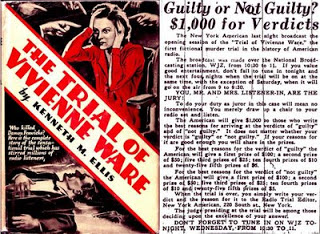 “It does not matter whether your verdict is ‘guilty’ or ‘not guilty.’ If your reasons for it are good enough you will share in the prizes.” With this peculiar invitation, millions of US Americans were lured to their radios, tuned in to WJZ, for a trial in which they, the listening public, were called upon to act as jurors. As previously mentioned here,


 “You will want to know what are my qualifications,” Ring Lardner introduced himself to the readers of his new radio column in the New Yorker back in June 1932. “Well,” the renowned humorist-turned-broadcast critic remarked, “for the last two months I have been a faithful listen-inner, leaving the thing run day and night [ . . .].” Lardner was hospitalized at the time, but he sure knew how to make the most of his misfortune by twisting the dial long enough to squeeze a few bucks out of it, and that at a time when, like today, there were hardly any competitors on the scene but, unlike today, there were millions eager to listen to and read about the radio, its programs and personalities.

 Harry Heuser