Lying Down/Sitting Up: “Significant Othering” in Cat People (1942)

Never equals: Irena at Oliver’s feet

Cat People (1942) is a legendary and much-loved B-movie […] that, as Geoffrey O’Brien has argued in “Darkness Betrayed,” his notes on the Blu-ray release of Jacques Tourneur’s fantasy film, “manages, over multiple viewings, to break free from its own legend.”  Despite the fact that viewers—professional critics, academics and horror film enthusiasts alike—“have sifted every shot and every situation of this seventy-three-minute feature,” O’Brien adds, a “fundamental mysteriousness remains, a slippery unwillingness to submit to final explanation.”

There is no danger of that slippage into certainty happening here.  My mind, too, has a “slippery” nature.  It is resistant to, and indeed incapable of, any thought amounting to an “explanation” that could possibly be taken for a “final” solution—a terminal reasoning that, bearing my Germany ancestry in mind, has demonstrably shown to bring about and justify no end of horrors.  

A lack of understanding: Irena and Oliver

Cat People was produced at a particular time of uncertainty—and of particular uncertainties—about democratically enshrined equalities, about the limits of reason and the extent to which the stirring of irrational fear could be instrumental in the unfolding of millionfold death.  It is fantasy that, rather than being escapist, gets us to the core of uncertainties about the state of humanity, the doubtful definition and futurity of which, a year after the raid on Pearl Harbor and the end of US isolationism, many a cat got many a tongue.

Cat People is “fantastic” in the way the term was proposed by Tzvetan Todorov.  In his seminal study The Fantastic(1973), Todorov argues that the phrase “I nearly reached the point of believing” constitutes the “formula” that “sums up the spirit” he calls “fantastic.”  Perhaps, that thought, being proposed so declaratively and summarily, itself sounds rather too conclusive.  Subverting such reasoning, the “fantastic” exists only because it resists any summing up.  To grasp it in this way is to deny it.  Its existence is predicated on its elusiveness, on its perceived indeterminacy.

Continue reading “Lying Down/Sitting Up: “Significant Othering” in Cat People (1942)”

Flesh/Fur: “Significant Othering” in Island of Lost Souls (1932)

The index for volume 94 of Essays, Poems and Reviews, collected by George E. J. Powell. Aberystwyth University

Some years ago, researching the life of the Anglo-Welsh dilettante and collector George Powell of Nanteos (1842-1882), I set out to piece together whatever archival material I could get my hands on to gain access to the heart and mind of an eminently queer Victorian, a man who is now mainly known, if at all, as a friend of—and bad influence on—the poet Algernon Swinburne.

Powell bequeathed “all [he] possess[ed] of bigotry and virtue” to Aberystwyth University, where I teach art history and where, as part of my “Gothic Imagination” module, I screen films in the gothic mode on Wednesday afternoons.  For the third entry in “Significant Othering,” the current series, I chose Island of Lost Souls (1932), a pre-code Hollywood creature feature loosely based on The Island of Doctor Moreau (1896) by H. G. Wells.

Continue reading “Flesh/Fur: “Significant Othering” in Island of Lost Souls (1932)”

Mirror/Lamp: “Significant Othering” in The Old Dark House (1932)

The last time I approached that Old Dark House – the titular edifice of a 1932 Hollywood thriller directed by the queer English filmmaker James Whale and founded on a novel by the English social critic J. B. Priestley—my eyes were not focussed on any particular visual detail.  I was remarking generally on the house as a concretization of Priestley’s views on the condition of Britain after the so-called Great War, as the film and its source, Priestley’s Benighted (1927), are often understood: Interwar Britain as an empire haunted by its past and a kingdom lacking a vision as unifying as the largely unchallenged rule of its alleged heyday.

Never mind the map. Now entering gothic territory

Not that British moviegoers, let alone US American audiences, would have considered this perspective, partially obscured by the retitling of the property, as being essential to the experience of the fun house-ghost train atmosphere the film conjures.  Sure, the house, with its shadowy corridors, massive oaken doors and branching staircases, is as ill-lit as any old Gothic-fictional castle; but the unenlightened ones at the heart of this picture are its denizens, the backward, dim-witted and intractable Femms in whose midst we, along with a small group of unfortunate travelers, find ourselves.

Continue reading “Mirror/Lamp: “Significant Othering” in The Old Dark House (1932)”

Apart/in Parts: “Significant Othering” in The Lodger (1927)

In conjunction with “Gothic Imagination,” a visual culture module I teach at the School of Art, Aberystwyth University, I host an extracurricular festival of films by way of which to skirt the boundaries of the gothic beyond the landmarks and hallmarks of the Gothic as genre.

The Alfred Hitchcock-helmed silent romance thriller The Lodger (1927), a loose adaptation of a short story (1911) and novel (1913) by the suffragette Marie Belloc Lowndes, has featured in each of these series of film screenings—“Treacherous Territories” (2019), “Uneasy Threshold” (2021) and “Significant Othering” (2023). Approaching The Lodger anew, “Significant Othering” concentrates on the gothic or gothicized bodies that—in whole or in parts—figure in the sprawling landscape of movies in the gothic mode.

None of the prime embodiments of the literary Gothic materialize in the films screened.  The modally gothic does not depend on the presence of Frankenstein’s creature, Jekyll and Hyde, or Dracula; the multiplicity and hybridity that characterize those familiarly strange bodies are alive—make that “undead”—in the mutations of the gothic mode beyond the permutations of the genre.

As The Lodger drives home, what makes bodies what we might call gothic—although others may argue otherwise—is their otherness or, more precisely, the othering of them.

Continue reading “Apart/in Parts: “Significant Othering” in The Lodger (1927)”

Picasso and Lobsters: My “Rendez-Vous” with Heidi Horten

To say that I had misgivings about visiting the Heidi Horten Collection during a recent stay in Vienna is an understatement, especially in light of the scandal surrounding the scrapped auction of Horten’s jewelry, misappropriated as it was from Jewish families from whose disenfranchisement Horten and her husband demonstrably profited.  

The Heidi Horten Collection. All photographs: Harry Heuser

“Christie’s Cancels Sale of Jewelry Connected to Nazi-Era Fortune,” a 31 August 2023 headline in the New York Times read.  According to the article, the “decision follow[ed] a backlash from Jewish organizations after the auction house generated $202 million” in an earlier sale of Horten’s hoarded treasures.

My views on the Heidi Horten Collection—just like my viewing of the temporary exhibition “Rendez-Vous: Picasso, Chagall, Klein and Their Times” then on show there—were no doubt skewed.  And yet, I am certain that I would have felt just as disturbed and affronted had I been unaware of the controversy.

Continue reading “Picasso and Lobsters: My “Rendez-Vous” with Heidi Horten”

Gaslight Express: Ethel Lina White’s The Wheel Spins, the Vanishing Spinster, and the Freewheeling Single Englishwoman

Winifred Froy spelling her name for Iris Carr in the Alfred Hitchcock directed adaptation of Ethel Lina White’s novel The Wheel Spins (1936)

I was determined to read at least a few chapters of The Wheel Spins (1936) in transit.  The novel is, after all, set aboard a train, hundreds of miles from what the main character, Iris Carr, regards—and at times calls into question—as home.  Written by a female novelist born in Wales, it is a story concerned with Englishness, with patriotism, prejudices and pretenses, and with feeling foreign in strange, peculiarly European, company.

So, after booking a last-minute vacation in the Europe that is now foreign territory to the British—living though they may be alongside European expatriates like myself—I made sure to slip the 2023 British Library paperback edition of White’s mystery into my hand luggage before departure for Vienna.  Habitually slow to turn the pages, I was certain there would be more left in store for me than the dénouement on the short onward rail trip a few days later to the capital of Slovakia, just as it was turning on besieged Ukraine in the matter of grain exports.

Continue reading “Gaslight Express: Ethel Lina White’s The Wheel Spins, the Vanishing Spinster, and the Freewheeling Single Englishwoman”

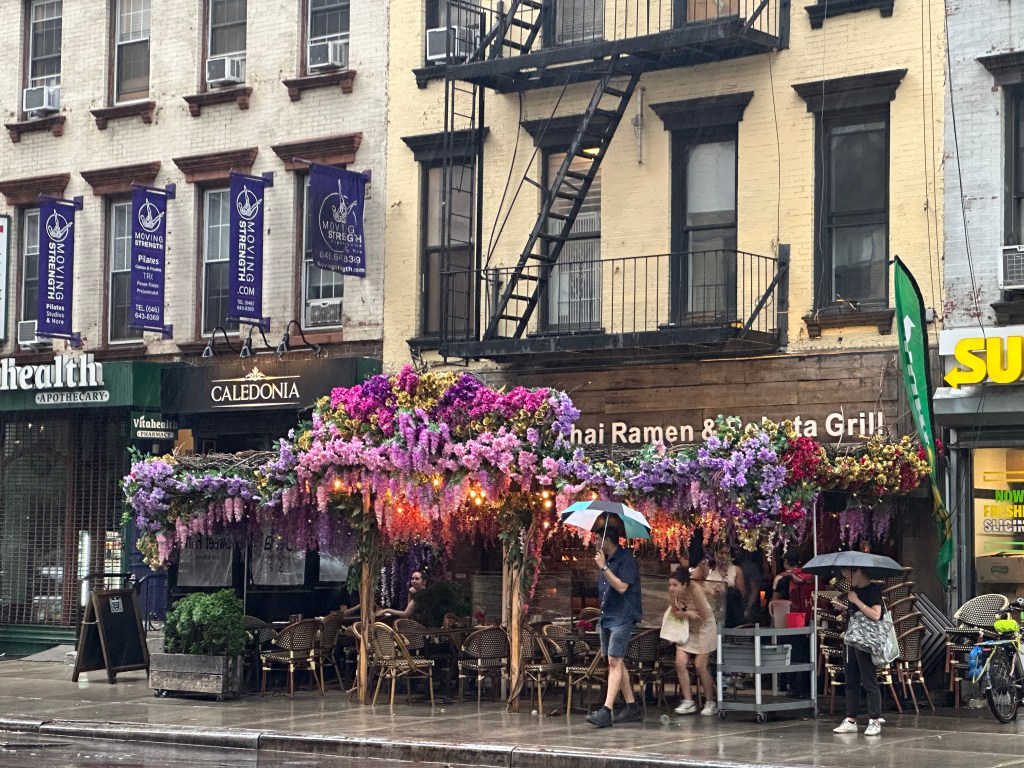
Flowering Inferno: Weather Extremes, Ersatz Aesthetics, and the Sprouting of Plastic Plants in New York City’s Outdoor Spaces

“Notice anything different since your last visit?” asked a friend of mine—himself a former New Yorker now living in the wasteland of discarded values that is the Sunshine State of emergency known as Florida.  We were chatting on the phone some time after my arrival in the estival Big Apple, a stew seasoned with the smoke of Canadian wildfires.

Yorkville, 9 July 2023

I had not been in town for about eight months, so I was bound to spot some change beyond the odd coin left in my wallet. My bank account was taking a sustained beating while I was trying to enjoy a few drinks with friends at my favorite watering holes.  But that was to be expected.

West Village, 12 July 2023

Apart from air pollution, price hikes and the relentless bulldozing of neighborhood community, continuity and character wrought by the wrecking of the architecture for a glimpse of which we will soon have to refer to painting by Edward Hopper—nothing new there, either—what struck me most was an outbreak different from but related to the pandemic that, in the form of COVID-19 testing tents on Manhattan street corners, still dominated the sidewalks in the autumn of 2022.  At one of them, I had tested positive for the first time.

Continue reading “Flowering Inferno: Weather Extremes, Ersatz Aesthetics, and the Sprouting of Plastic Plants in New York City’s Outdoor Spaces”

Crying Bleeding Kicking Screaming: Curating Prints by Marcelle Hanselaar from the School of Art Collection

Poster design by Neil Holland featuring Marcelle Hanselaar’s print “The Addict” (2015)

“I love it when curators come up with juicy titles.”  That is how London-based painter-printmaker Marcelle Hanselaar announced the exhibition Crying Bleeding Kicking Screaming in one of her newsletters.

As Hanselaar put it, a title like that offers a “glimpse” of how others read her work and “how it might impact the viewer.”  It is “part preparation and part enticement to what will be shown and the very least it will do is to put visitors in a state of mind of curiosity.”

Hanselaar’s prints – and their titles – do just that: they make us curious, and they play on our inquisitiveness.  They do not necessarily show and tell us what we want to see, but they remind us that we are eager and anxious to look.  Providing another chance to view works in public, an exhibition can and should also facilitate the act of looking.

Continue reading “Crying Bleeding Kicking Screaming: Curating Prints by Marcelle Hanselaar from the School of Art Collection”

Thick Velour on Thin Veneer: Steven Moffat’s “The Unfriend” and the Fraying of Our Social Fabric

Souvenirs of my London theater experience, March 2023

The London theater season in early spring 2023 was as droughty as the weather was damp.  Rarely was so little being offered to so many, and with such few discounts.  Being in town to attend the opening of the London International Print Fair at Somerset House, I managed to catch up with what I thought was worth my while and then worked myself down to what I would generally consider bottom drawer best kept shut.  No, not Only Fools and Horses: The Musical.  After all, you can lead European fools like me to water, but you cannot make them splash out on bottled nostalgia for supposedly true Britishness.

After belatedly taking in The Lehman Trilogy – hoping in vain to find some reference to my alma mater, named in honor of one of the title characters, or to connect meaningfully in any other way to what is basically a semi-dramatized performance of a PowerPoint – I quickly ran out of theatrical options.

I did go see – and was intrigued – by the twenty-first century update of Oklahoma!, which almost works, pretty much right up to the heretofore feel-good finale that it very nearly nixes in bloodshed and yet awkwardly depends on, thus proving the old adage that you can’t have your ammo and spend it.  

I also appreciated the philosophical and weighty if already slightly past its sell-by dystopia Marjorie Prime at the Menier Chocolate Factory, even though I could never quite tell Anne Reid’s AI character from either Anne Reid, the actress, or from the character’s fleshly alter ego.  There being nothing else to see for someone on my budget – and I draw the line well before subjecting myself to the firing squad of a musical experience such as Bonnie and Clyde – the last resort was a matinee of The Unfriend.  And no discount.

Turns out, I enjoyed the least ambitious of those four shows the most, however low the bar.  Essentially a Britcom mounted in the West End, The Unfriend is as thin as the decorated shell of an Easter egg that someone – television-trained playwright Steven Moffat, assisted by his Dracula collaborator, director Mark Gatiss, a renowned darkside devotee – blew, as is customary, out of all substance and traces of nutrition while managing to keep it intact for our amusement.  I mean, Edward Albee it ain’t.  More like Are You Being Stiffed? or Mrs. Brown’s Bodies.

Reflecting on the impotence of being English, The Unfriend taps into the self-consciousness of the British regarding their apparently cultural or just plain apparent politeness – I mean, ask any European how that civility manifests on the continent – and their love-hate relationship with their overbearing American cousin, or whatever the family ties of post-Brexit Britain to the US.

In The Unfriend, the American cousin by any other name is the brash and manipulative Elsa Jean Krakowski.  Elka Ostrovsky, Betty White’s similarly clad character in Hot in Cleveland came to my readily distracted mind at the mention of that name; then again, The Unfriend is so derivative a farce that it affords any number of associations.

In the 30 March 2023 matinee of The Unfriend at the Criterion Theatre, which, the program informs me, opened about 150 years earlier with a production of An American Lady, Elsa, who is more of a dame, was played con molto brio by Olivier Award-nominated – and Remain-voting – English actress Frances Barber, even though the role would perhaps be more fully and faithfully inhabited by Kathleen Turner – a former Serial Mom, no less. 

A denizen of the Colorado capital made famous the world over by Dynasty, Elsa is a widow – possibly a black one – of what with some lexical flexibility and generosity of spirit might still go for midlife.  Her velour tracksuit – underneath which she admits to be “chins all the way down” – is as plush as the veneer of British politesse is demonstrated to be ripe for the abrasing.

Well, in this game of rock-paper-scissors, Elsa has the upper hand, especially since the other hands are either flailing or shaking.  From the start – we first encounter garrulous Elsa onboard a cruise ship, a premise based on a true story told to Moffatt, where she meets the certifiably middle aged, and all around middling British couple Debbie and Peter (also based on real people and deftly impersonated by Amanda Abbington and Reece Shearsmith) – I felt encouraged to warm, however reluctantly, to the anti-mystique of Elsa, a hot mess concocted of shrewdness and forth-far-rightness.  She is too obvious to be deceitful, too in-your-face to be masking her true self … or so we are led to believe.  Who is Elsa? What is she, that all the swains croak on her? 

Then again, Elsa is drawn that way: a flat character devoid of the very dimensions or nuances that are also lacking in today’s political discourse, references to which pop up to give the farcical proceedings a tinge of relevance.  “I’d do him,” Elsa declares in the opening scene when confronted with the likeness of a similarly garish former US president.  Her stated reason for voting for him, a second time around, is that “he’s funny.”  Apparently constructed under the influence of conspiracy theories, her ramshackle alternative to logic may be summed up by her claim that “[h]e only lost because of fraud and people voting against him.”

Elsa, as her British hosts discover before she even drops in, as threatened on the high seas, is a celebrity of sorts, and of one of the worst sorts at that, the ex-President excepting: she is suspected to be a serial killer.  Only Fools and Corpses, anyone? 

The English characters, confronted with the possibility of their demise, are hamstringed in their attempt to get shot of her – legally, that is – by their sense of obligation toward their unwelcome guest.  “You English, you’re so polite,” Elsa gushes.  It is a courtesy Debbie and Peter do not extend to their neighbor (Michael Simkins) who, despite having lived next door for ten years, is not known to them – or any of us – by name.  Peter is too easily distracted by calls and text messages to pay attention to a man whose presence is less keenly felt as that of priggish Mrs. Grundy, to mention a long-established convention of British comedy.

The Unfriend, to be sure, does not belabor or foreground its dramatic heritage.  It goes all out for nowness.  And yet, as refreshing as it is to see a comedy that responds to and mirrors our present, the play is already beginning to feel dated in its efforts to keep up the appearance of keeping up.  It is as contemporary as last year’s smartphone technology, especially in its references to the pandemic that delayed its arrival.  Not surprisingly, Elsa has her own take on Covid-19.  Peculiarly but all the same representative of an all too familiar type, she reminds her hosts that the people she was supposed to have poisoned “were all vaccinated.”

Speaking of silent killers, real or imaginary, The Unfriend is ripe with all the crudeness of British toilet humor – a recurring threat in act one is the breaking of wind and a stool sample takes center stage in number two.  A farce invested in farts and feces, The Unfriend is not about British politeness, in a bad manner of speaking, or about the relationship between cultures who don’t see eye to eye on the distinction (“Tomayto-tomahto”?) between toilet and bathroom as much as it about human interaction – friendship, family and neighborliness – in the age of social media.  

Elsa tracks down her unwitting – and very nearly witless – victims-in-waiting via Facebook, and what Debbie and Peter learn about her, via the legacy media of tabloid television, they find posted on YouTube.  Meanwhile, Elsa connects with the couple’s son, Alex (Gabriel Howell), by playing violent computer games off which she also manages to ween him.

“Isn’t technology wonderful!” Elsa chirps.  Not that she remains convinced that such dubious advancements – or her new British acquaintances, for that matter – are quite so “wonderful” when she is confronted with her past.  “Why did you google me?” she protests.  “Why would anyone google a person like that? It’s so rude!”  According to Elsa, online research for the sake of self-preservation is more insensitive than bumping off your other half.

“Facebook got it right,” Peter moans.  What “the real world needs” is an “unfriend button.”  If The Unfriend were a college composition, that might be its thesis, as signposted by the title.  Luckily, it ain’t.  As a comedy, it invites us, especially those among us who remember a world before virtuality, collectively to roll our eyes and laugh out loud at the precarious state of what we once understood to mean “social.”

Hoarder Line: Some Notes on the Difference between Hoarding and Collecting

Early in 2023, I participated in a workshop at Aberystwyth University exploring collectibles and the collection of ephemera.  I was the only participant, among academics and museum staff, to talk about my private collection of ephemera.  So as to give that fruit fly of a presentation an afterlife, I have gathered my notes for this entry in my journal, which, after all, was created for the purpose of ‘keeping up with the out-of-date.’  

The presentation was titled “Making It Matter: Ephemerabilia, Queer Identity, and the Imperative of Being Out of Touch.”

I know, titles are like jokes.  If you have to explain them, they don’t work.  But, here goes:

“Ephemerabilia,” meaning, the love of the fugitive, the fragile, and perhaps even the futile.  All of the above – which may apply to any of our lives and bodies.  All of the above – but not ‘trivial.’  Nothing is trivial in itself.  Just like nothing is memorable in itself.  Someone has to make it matter.

For that reason, the word “minor” in Maurice Rickards’ definition of ephemera is problematic, as it devalues what it defines.  To quote myself: “Trivia is knowledge we refuse the potential to matter,” whereas “Memorabilia is matter we grant the capacity to mean differently.”

The need to make something matter and mean something, something else, no matter what, is, to me, intimately bound up with queer identity, with my sense of being, thinking, feeling, and loving differently.

And that is where, to me, the compulsion of being out of touch comes in: being drawn to what has been relegated to the margins, to matter that has been disregarded and discarded as presumably nonessential or unrepresentative.

I could have put the last two words in parenthesis; because sharing my passion for the untouchable – or the “not touched much lately” – means coming out with what drives me.  Making something neglected and presumably immaterial matter and mean something anew is an act of reification.

It means saying I matter.  But the question I keep asking myself, in relation to my collection habits, is “What’s the matter with me?”

Let’s say I say “I am a collector.”  Which question should I expect to follow? Is it “What are you collecting?” How about: “Why are you collecting?” “Why do you collect what you collect?”

What I collect is stated – and illustrated – on my website.  I collect ephemera related to products of what once was popular entertainment – early-to-mid twentieth-century, mainly US American, film, theatre and radio – that are lesser-known now.  I call it “unpopular culture.”

My collection is all fairly methodically put into actual and virtual drawers. Unlike in this scenario.  

The image on the left shows my ex’s apartment on the Upper East Side of Manhattan.  I once lived there, for about fifteen years, and, for over 33 years now I have stayed at that place whenever I am in the city.

Due to the pandemic, I hadn’t been back in three years.  In the fall of 2022, my ex had a heart attack just days before I was set to arrive there.  I looked after the apartment while visiting him at the hospital.  Anyway, I was shocked when I saw the place in such disarray.  My ex has always been a hoarder.  But the place had become almost unnavigable in the intervening years.

Obviously, hoarding is not collecting.  But is it so obvious? Is the distinction perhaps too obvious?  Sure, hoarding is chaotic.  It is indiscriminate, whereas collecting is orderly and discerning.  Collections are curated. whereas the compulsion of the hoarder may strike us as an infliction, an illness that may or may not be curable.

Curating is derived from the Latin word “curare,” meaning to care.  Does it follow that the hoarder is careless? While staying in my ex’s apartment, I took it upon myself to discard of some items I deemed trash.

Given that chaos, I thought my ex would never notice.  When my ex returned to the apartment after three months of intensive care, hospital care and aftercare, he emailed me and inquired about some of the objects I had discarded.

And he was so incensed about my attempt at tidying that he pretty much ended our 33-year-old friendship.

Seriously, to give up a friendship over a pile of cheap Chinese take-away containers, most of them without matching lids? That struck me as unreasonable, disproportionate.

But the fact that my ex remembered where what is in that chaos made me rethink the relationship between hoarding and collecting.

And it made me question whether collecting is not like hoarding in its illogical, perhaps even pathological clinging to matter that may not matter to most.  Something that takes up so much time and space, it can threaten to diminish rather than enrich our experience of life.

Possessions can take possession of us.  This is not vanity.  It is not conspicuous consumption.  For gay men born into decades of intolerance and legal discrimination, it may be a stab at making our existence more concrete and at leaving a trace or trail of it behind.  I should have known better than to mess with the mess that I found.

I have had occasion – or made it one – to examine the collection of the queer Anglo-Welsh Victorian dilettante George Powell in an exhibition I staged with my curating students a few years ago.  Powell bequeathed his collection to our museum.  But you might say he was a poor curator of his collection.  He did not collect methodically.  And some of the objects in his collections are fakes or copies of dubious provenance.

Powell had no offspring, even though he married toward the end of his short life.  Stating his intention to leave his collection to our museum, he referred to it as all he possessed of bigotry and virtue, meaning, bijouterie and vertu – trinket and treasure.

Powell left the lot to what is now Aberystwyth University.  In his book collection, for instance, was a popular volume called Book of Wonderful Characters, which contains a short account of the life of Chevalier D’Eon, who lived as a crossdresser for half a century and to whom we owe the term “eonism.”

I sensed that Powell created through that bequest a diary of sorts – an invitation, by way of visual and material clues among the objects he once possessed, to go in search of him.

The “it” in “making it matter” refers less to the collection than it does to the collector. Powell did not curate his collection to take care that what might reflect poorly on his character or cause suspicion as to his tastes.  To filter anything out would mean to erase what was at the core of his being, which is why Powell initially insisted that a museum be built to house it and that the collection be kept in one place, Aberystwyth, in its entirety.

He did not want to disappear behind his collection but reappear through it.  He wanted to be become readable, to be understood.  The Powell case made me more aware of the relationship between the private act of collecting and the public act of sharing a collection, of remaining visible through one’s collection.

Powell’s desire to remain visible, become readable and be understood becomes clearer to me in the contemporary periodicals he bequeathed to our University.  Here, he did not give us the lot – the magazines, cover to cover – but he cut out which articles he wanted to preserve and bound them in leather.  There is no telling whether he read the articles.  But it is clear that he thought they mattered and should matter to others.  And they are quite eclectic, ranging from articles on animal cruelty to drunkenness and insanity.

Articles on ‘Consanguinity in Marriage’ and ‘Marriages between First Cousins in England and Their Effects,’ which were no doubt of particular interest to him because his grandmothers were sisters and his parents first cousins.

Powell appeared to have been drawing attention to his struggle to figure out who he was and why he was the way he was.

Trying to understand what motivated Powell as a collector, I made a public display in the galleries of the School of Art Museum at Aberystywyth Univeristy of my own collection of cinema, theatre and radio-related ephemera.  In my gallery texts, I asked:

‘Do we collect things simply to indulge our passion for them? If so, why make a display of that passion? Showcasing seems calculated to raise certain objects to the status of ‘collectibles’ so as to advance the collector as connoisseur.  And yet, might not the urge to exhibit our personal belongings be rather more elemental?’

What are ‘collectibles’? What is collectible? Take, for instance, two different but related types of objects in my collection. Cigarette cards of once well-known but now mostly forgotten performers, in this case radio stars.  As well as movie posters and lobby cards of films of roughly that same period.

Both feature performers from the world of popular – or now less popular – entertainment.  Both are finite.  Lobby cards were generally produced in sets of eight.  Cigarette cards in sets of up to fifty.

The main difference is that cigarette cards were designed to be collected.  They were meant to be habit-forming, to encourage addiction.

Lobby cards on the other hand were not designed as collectibles.  In fact, as the fine print states, collecting them was prohibited by the studios whose property they remained.

By now, the industry that cigarette cards once served has become detached from them.  They no longer advertise and encourage addictive products, which makes them candidates for my belated affection, and which makes it possible for me to make them matter differently.

There are other intimate reasons why I mostly collect the likenesses of one particular actress: Claudette Colbert.

I became intrigued by the French-born US American actress watching a movie on television with my grandmother when I was 8 or 9.  I didn’t start collecting until decades later.  Nor did I know then that Colbert was rumoured to be queer.

My collection is also a catalogue of the love: more than 90% of my collection has been gifted to me by gay men, and almost all of which by my husband.  Original film posters are now almost out of my league as a collector.

I do not collect objects because of their monetary value, of which, due to the fact that the items were given to me, I often have no knowledge.  I have always been attracted to what is of little value to others.

A queer friend told me once that, as a child, he used to pick the crayon no other kid would pick up – the least popular colour.  Embracing neglected objects to me is related to the feeling of having been unwanted and misunderstood as a child.

Exhibiting my collection, I realized just how intimate collecting is.  I was very self-conscious about opening my drawers to display those objects – paper dolls, mass-produced pictures of performers few people today still relate to.  When I tried to exhibit the cigarette cards, I also realized they were too small to be impactful or readable for display.

So I created a slideshow of them.  There are objects in my collection that matter more once they are dematerialized.  I scan many books and scripts so that I need no longer handle the physical artifact.  It preserves the object.  But it also makes the object less meaningful if what matters is the visual or written information it conveys.  Not that I dispose of ephemera in my collection once I have scanned them.

The most ephemeral items in my collection are literally untouchable.  They are digitized sound recordings.  The cigarette cards of radio performers are, like scripts and contemporary books on radio, not the real thing.  They are a means to materialise the immaterial culture they commemorate: the world of sound broadcasting.

My (Im)memorabilia exhibition contained a listening station and featured a soundtrack of clips on a loop.  They are from my collection of audio recordings, now widely available online.  The files contain recordings of radio broadcasts from the 1930s to 1950s, most of them plays, almost all of which were part of episodes of series or chapters of serials.

The vast majority of plays were also broadcast only a single time.  Despite the recordings that gradually materialized from the vaults, they were as ephemeral as soundwaves.  That they survive at all is owing to their commercial value.

The recordings are evidence for the sponsor that the programme they funded actually existed and could be inspected – or audited.  As cultural products they were not valued.  They still are not valued much.  They certainly never received the scrutiny or status accorded to motion pictures or television programmes.

I organize the folders alphabetically by each series title.

And each subfolder contains recordings of broadcasts from those series.  Some subfolders contain close to one thousand recordings per series.  Cataloguing these immaterial objects, which I have written about at some length in my study Immaterial Culture and on my blog broadcastellan, involves adding and correcting information about talents involved in a broadcast play; verifying air dates by referencing old newspapers and magazines; checking for sound quality and recording speed; and replacing files with newer, cleaner, more authentic recordings.

It is not possible to listen to all of those recordings in full.  There are now over 30,000 of them.  It is almost impossible to keep track of them.

Unlike my ex, I have forgotten about many of the items in my collection. But like my ex, I would be very upset if only a single item went missing. Most of these recordings are readily available on the internet, copyright being a murky issue.  In my writing, I have argued for their cultural significance, their artistic merit.  But I have not been successful in making a career out of my caring.  I am wary of intellectualising my desire, and I am suspicious of such attempt by academics.

The difference between hoarding and collecting lies in the adding of value.  Hoarding is an act of accumulation.  Collecting is an act of accretion, of value added.

The ‘imperative’ in my title is the imperative of the matter – what drives us, what makes us who we are.  The ‘it’ in “Making it Matter” refers both to the ephemeron and the life of its collector who deems it worth preserving.  That my efforts have been futile only seems to fuel a desire that has been termed “The Queer Art of Failure.”