Misinformation, Please: Earl Derr Biggers, Rex Stout, and Charlie Chan’s Sons

Earlier today, I added a few titles to our movie database, a list I try to keep up to date so as not to lose track of our collection. Yesterday, the fifth and final Charlie Chan box set arrived in the mail, containing the seven last entries into the 20th Century Fox series. Among them are some of my favorites: Charlie Chan at the Wax Museum, Castle in the Desert, and Dead Men Tell. Ever since I discovered these movies on German television—in German, mind you—I have been inordinately fond of the much-traveled sleuth, no matter how ramshackle to politically incorrect his vehicles.

As I shared here a few years ago, I never enjoyed a close relationship with my father, long since departed, and the Chan pictures somehow made me, an introvert teenager, long for the kind of bond grown-up sons number one and two maintained with their gentle and generous pop. Charmed by the series, I picked up Earl Derr Biggers’s Chan novels . . . and was greatly disappointed.

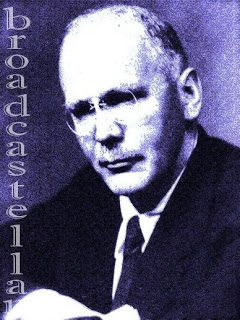
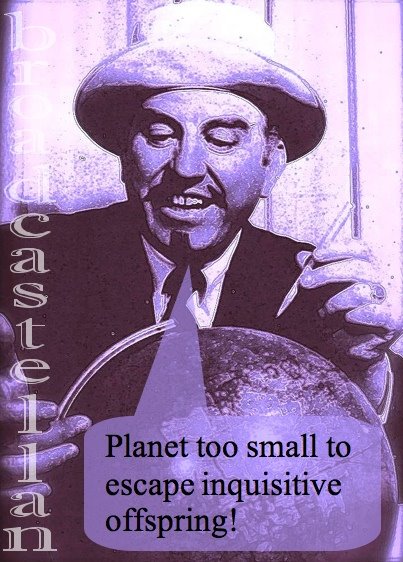
Biggers, whose Seven Keys to Baldpate was being presented on the Lux Radio Theatre on this day, 26 September, in 1938 (as already discussed here) may have been the father of Charlie Chan, but the brainchild, like Frankenstein before him, was passed around so often and given so many transformations that few recalled or bothered with his origins. After the author’s death, there followed such a long line of foster parents that hardly any of the family traits and characteristics can still be traced in the child. Shown above, for instance, is radio Chan Ed Begley (in a picture freely adapted from its source).

Some folks, though, remember. One of them was mystery writer Rex Stout. On this day in 1939, Stout appeared on the quiz program Information, Please! (discussed here) and, along with his fellow panelists, was called upon to answer a number of mystery related questions. In a task posed by a listener from Morristown, Pennsylvania, the panelists were to name heroes of crime fiction who were aided in their detective work by their fathers, their offspring, and their secretaries.

Clearly, this was a subject of which mystery writer Rex Stout could be expected to be familiar. Sure enough, the father of Nero Wolfe was quick to identify Ellery Queen’s paternal helpmate. “I’d hate to ask you to mention the actual titles of books by one of your rivals,” host Clifton Fadiman remarked, “but could you name, er, one or two of Mr. Queen’s books?” He should have said, Messrs. Queen, of course; but never mind.

At any rate, a straight answer from the competitor was not forthcoming, aside from the sly reply “The Adventures of Ellery Queen,” the title of the radio series based on the character but not penned by its creators.

When it came to naming a crime-solving father being assisted by his son, Stout shrouded himself in silence. It’s a “series of books,” Fadiman assisted, that had been successfully adapted for the screen. “Charlie Chan,” fellow panelist Carl Van Doren replied. “Quite right,” said Fadiman. To be sure, the word “assisted” is rather questionable; for, as Chan remarked in Murder over New York (also part of the abovementioned collection), “many cases would have been solved much sooner” had son Jimmy not insisted on getting involved.

Fadiman was ready to move on; but Stout voiced his disagreement. “Pardon me, Mr. Fadiman,” he interjected, “not in any of his books was he aided by his son, except that his son laced up his shoes or something for him.”

“That’s a help,” said the host, brushing aside the objection without giving it any consideration. “Korrektur bitte,” Chan’s German alter ego might well have protested, however mildly. Stout was right. The father-son relationship was created for the movies so as to give the rather austere Chan his Watsonian sidekick.

And very glad I am for this infidelity and the wayward child thus begot. “Does anyone help Nero Wolfe in your own series of stories, Mr. Stout,” Fadiman inquired. “I do, pretty often,” he quipped, missing out on a chance to give Archie Goodwin his due. Not long after the Information, Please broadcast, at a time when even Charlie Chan was enlisted into the Secret Service, Stout turned “lie detective” to expose the misinformation, spread through enemy propaganda, in a series titled Our Secret Weapon.
An Ear Against the Blue Wall

I tire easily of Henry James and can countenance only so much blue. If I got a kick out of being cryptic, I’d say that about explains why this journal contains only a single reference to Dragnet, the influential crime drama that, between 1949 and 1957, caught the ear of millions tuning in to NBC radio. As much as I enjoy detective stories, I don’t warm readily to cop shows. Or cops, for that matter, the sight of whom is rarely a comfort to me. Let me give you a “for instance.” One sunny afternoon in September, I was sitting on a bench in Carl Schurz Park on the Upper East Side of Manhattan. It being the beginning of a new semester, and the beginning of my career as a doctoral student, I had a backpack full of books to pore over so as not to fall behind right from the start. I was—and am—a slow reader; and, when it comes to American and British fiction, a non-native one at that.

So, I took out the library copy of James’s Princess Casamassima, a tome so long and somnolent that I struggled to keep my eyes open. The next thing I know is that an officer addresses me from a police car several yards behind me, insists that I had broken a law, and hands me a ticket. I was very nearly speechless; but, after cautioning a few old ladies on the verge of dozing off over their cross-stitching that they would do so at their own peril, I betook myself, past the crowds gathered in the area for the annual German-American Steuben Parade, to the nearest precinct, where I protested against the treatment I had received. At that point I ran into what is commonly known as the blue wall. There was no alternative but to appear in court, a prospect likely to make the non-immigrant even more uneasy than the citizen.

However trifling, this experience made me think of those who had been abused in the name of the law, in the name of all the laws the breaking of which does not mean the least bit of harm or inconvenience to anyone, but whose enforcement provides those in uniform with the opportunity to intimidate, demonstrate their might, and put a few coins into government coffers. My case was ultimately dismissed; but the whole affair caused me no slight irritation. Is it any wonder that I prefer my Friday on a desert island?

Still, the chance of placing an ear on that blue wall and listening in on the workings of the force has an undeniable appeal. The one radio program to cater to spies like me was Night Watch (1954-55), billed as “the actual on-the-scene report of your police force in action.”

“You’re gonna ride with us tonight,” the narrator promised those tuning in to CBS on this day, 25 September, in 1954. “And remember, the people you meet are not actors. What happens to us, happens to you; because this is it. This is real. This is Night Watch.

This early reality show was presented with the cooperation of the police department of Culver City, California, and took listeners straight to the scene of conflict. In the 25 September 1954 installment, the cases involve stolen motel towels and a disagreement between a mother and her fourteen-year-old daughter whose unrehearsed, unscripted words and untrained voices leave no doubt as to the authenticity of the recorded incident, careful editing notwithstanding.

While Night Watch did not feature the sensational crimes that listeners came to expect from fictional programs, the reporter accompanying the officers was attacked, shot and stabbed, on at least two occasions while serving as proxy witness to scenes of juvenile delinquency, prostitution, domestic abuse and suicide.

No matter how diligent, courteous, and compassionate the officers, the star attractions of the series are the average, anonymous folks of whose lives the audience gets an earful as if being handed a glass to press against the walls behind which dwelled the neighbors to whom our doors are closed. Having been kicked off that bench, I can meet them with something else besides idle curiosity.

The Lilt of the Lilliputian

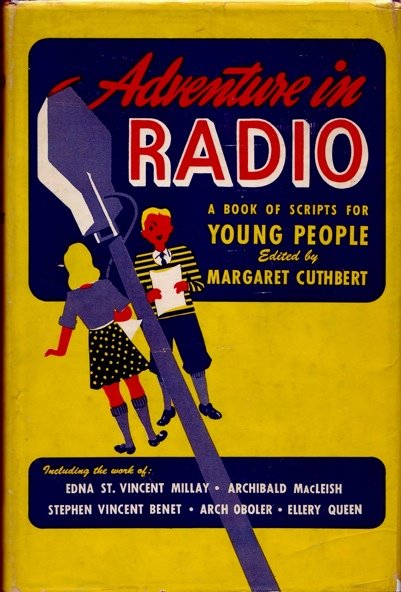
The cover of Adventure in Radio, from my collection

A few years ago, walking home from graduate school one afternoon, I stopped by at a second-hand bookstore in my old neighborhood of Yorkville, Manhattan. Judging from the window display, the shop seemed to specialize in children’s books and memorabilia. While this did not deter me, I hardly expected to make any significant acquisition of a volume on the subject to which this journal is chiefly devoted. I mean, I was not looking for a decoder ring or some such souvenir from the bygone age of radio dramatics. I was, after all, researching my dissertation. There was on the shelves a beautiful copy of Adventure in Radio (1945). Subtitled “A Book of Scripts for Young People,” it may be expected to include juvenile playlets written for the medium, although not necessarily produced on network radio. On such compilations, of which there are many, I was not inclined to waste money or time.

Spiting my assumptions, Adventure in Radio not only contains a number of broadcast scripts from programs like Jack Armstrong and Let’s Pretend but also propaganda plays and wartime commentaries geared toward an adult audience. In addition, it offers insights on the production of radio plays, on sound effects, announcing, and “radio language.” It took a little salestalk from the owner of the by now long closed store, but I was soon convinced. Where (I did not know much about eBay back then) would I ever find such a book again? And how could I claim to be serious about old-time radio if I did not snatch up this copy? So, I handed over my $40 (it was the price tag that made me hesitate) and walked off, eager to continue my studies . . . and determined to find the recordings to match the published scripts now at my fingertips.

That often proved quite difficult; but I had made up my mind that I was not going to write about words divorced from performance. I wanted to hear what was being done with those scripts, how they were edited and interpreted. Take the NBC University Theater’s production of “Gulliver’s Travels,” for instance. It was broadcast on this day, 24 September, in 1948. My appreciation of the challenges of soundstaging the play grew after reading the comments with which Frank Papp, a director of radio drama for NBC, prefaces the script, originally written for the series World’s Great Novels. Papp points out the “unusual problems” Frank Wells’s adaptation posed in production:

In the matter of casting, the Lilliputian was the most difficult.  Here was needed a voice which gave the illusion of a tiny man.  A trick voice in itself would be only a caricature.  What was required was a voice that created a picture of a real human being of Lilliputian size.  After extensive auditioning, an actor was found whose talent and vocal capabilities fulfilled these requirements.

The actor portraying Gulliver was placed in an isolation booth, Papp explains, “so that the Lilliputian’s voice would not spill over into his microphone” and the two voices could be miked separately, with a volume reflecting the size of each character. The voice of the King of Brobdingnag, meanwhile, was “fed” both through an electronic filter to amplify its base quality and through NBC’s largest echo chamber to create the illusion of a giant.

The 24 September 1948 presentation of “Gulliver’s Travels,” starring Henry Hull in the title role, does not quite live up to the expectations raised by Papp’s introduction. Under the direction of Max Hutto, child actor (Anthony Boris) is cast in the role of the Lilliputian, a choice that infantilizes the character and renders pointless the effects achieved by the sound engineer.

While Wells’s script downsizes Swift’s story and diminishes its bitterness and bite, it is the production that contributes to a sense that Gulliver’s Travels is, at heart, a juvenile fantasy, despite its airing on the ambitious if misguided NBC University Theater, a program that linked listening to such bowdlerizations with courses in distant learning. I may have been able to match the script with a production, but it was not the one described in Adventure in Radio.

Squeezed as I am into the isolation booth of my preoccupations, it is my mind’s voice that supplies the lilt of the Lilliputian . . .

Beyond M: Douglas Sirk’s Zu Neuen Ufern (1937)

No, I don’t mean “N”—even though “N” for Nazis would be a good way to begin any survey of German films produced in the years following the release of Fritz Lang’s classic thriller. The aforementioned Blaue Engel aside, M is perhaps the only German film of the 1930s and ‘40s with which cinéasts the world over can be expected to be familiar. That much more attention is paid to German silent films than to any talking picture produced in Germany before Fassbinder achieved international success is owing, to some degree, to the Teutonic tongue and the aversion Americans have to dubbing and subtitling.

Another reason for the relative obscurity of classic German cinema is that the US set the standard for commercially viable motion pictures after the silent era came to an end; and few international films could rival the production values to which moviegoers growing up with MGM or Paramount spectacles were accustomed.

Politics, of course, are another key factor. Fassbinder’s 1970s melodramas no doubt appealed to many disenchanted Americans due to their working-class, liberal tendencies, which for an intriguing alternative to the newly emerging, vacuous blockbusters that carried on the tradition of formulaic filmmaking after the production code had been retired in the mid-1960s.

Fassbinder and Werner Herzog aside, what happened between M and Das Boot (1980), the first truly popular German post-World War II film in the US? Or, to narrow it down to the period between the end of the Weimar Republic in 1933 and the establishment of the Federal Republic of Germany in 1949, what kinds of films were produced in Germany when the Reich lost most of its artistic talents to the United States? Over then next few months I am going to look at a number of German movies of that era, beginning with Zu Neuen Ufern (1937) starring the aforementioned Zarah Leander.

Zu Neuen Ufern (meaning “To New Shores”) is a costume drama directed and co-written (or, rather, adapted) by a filmmaker who would become one of Hollywood’s foremost melodramatists: Douglas Sirk (then working under his German name, Detlef Sierck), an artist admired and understood by Fassbinder, who not only emulated Sierck but made him relevant to a 70s audience.

When Zu Neuen Ufern was released in New York—in the German enclave of Yorkville—a New York Times reviewer remarked upon Sierck’s “smooth” direction of a movie full of “highly interesting scenes.” What makes the film most interesting today is not its smoothly plotted series of incidents but its brooding theme of lost liberty and constraint.

The film is set in early Victorian England and New South Wales; one is a prison of conventions, the other a penal colony. Leander’s character, the scandalous yet popular actress Gloria Vane, has taken the blame for a forgery committed by her financially desperate lover, Sir Albert Finsbury, and is sentenced to serve seven years in an Australian penitentiary.

The only way to shorten the sentence is for the prisoners to correct the shortage of women by accepting the marriage proposal of an eligible local. Gloria reluctantly condescends to being wed to an Australian farmer—only to back down and go in search of her lover, who fled to Australia prior to Gloria’s trial and has remained ignorant of her fate.

Having achieved success in the military, Albert is about to marry the governor’s daughter. Gloria, who has learned about the wedding, confesses to Albert that her love for him has been exhausted, upon which the hapless lover commits suicide . . . on the very day of the wedding the thought of which he can no longer endure. Finally recognizing the kindness of the farmer responsible for her release from the prison to which she, in a moment of utter despair, vainly attempts to regain entrance, Gloria marries her liberator.

High melodrama, in short, but admirably underplayed by the remarkably restraint Leander, who does not give her scenes the full treatment for which her compatriot, Garbo, became famous. Its sensational plot notwithstanding, Zu Neuen Ufern is neither cheap nor hysterical. Underscored by Leander’s songs—the haunting “Ich steh’ im Regen” and the sly “Yes, Sir!”—the theme is that of futile longing, of wishing to belong and not being able to exert one’s free will in the pursuit of happiness. It is the nightmare vision of an artist at odds with an increasingly restrictive regime. Sierck was looking for a new “Ufer” and an artistic world beyond UFA, the Nazi-sanctioned studio that produced his films.

To be ”vom anderen Ufer” is a colloquial German term for being beyond traditional marriage, for being set apart if not forcefully transported to the other side for one’s deviance from or defiance of the norm. Neither shore provides a safe harbor. Meanwhile, a common word used in Nazi Germany for aberration in art and nature, “entartet.” is uttered by an unsavory character complaining about the thinness of the female prisoners he has come to inspect in hopes of matrimony.

Sierck seems to adopt the language to pervert the perverse in the society from which the film is only superficially removed. Putting his heroine on display in court, on the stage, and behind bars, he constructs a theater of desire in which a valiant creature like Gloria Vane—who at one point is being pelted with rubbish for singing with feeling after she spots her lost love in the audience—struggles to keep her integrity at the loss of liberty and love.

Douglas Sirk eventually achieved great success on Western shores, yet was forced throughout his career to remain guarded in rendering what could, at best, be an Imitation of Life. In Zu Neuen Ufern, that imitation is the compromise Gloria finds in turning a marriage of convenience into an alternative for solitude, imprisonment, or death.

” … from hell to breakfast”: H. V. Kaltenborn Reporting

Listening selectively to US broadcast recordings of the 1930s, ‘40s, and ‘50s—the period often referred to as the radio’s golden age—I often neglect the kind of program that, during the late 1930s was fast gaining in significance as millions of Americans, many of whom were immigrants from Europe and Russia, were following reports from the Old World they had left. On this day, 22 September, in 1939, news commentator H. V. Kaltenborn kept CBS listeners abreast of the situation in Europe, paying special attention to the politically unstable kingdom of Romania.

As I learned yesterday, reading My Eyes Are in My Heart by aforementioned radio announcer Ted Husing, the King and Queen of Romania were savvy people not averse to selling out or forging lucrative alliances. On a tour of the United States back in 1926, Queen Maria of Romania, made a splash in the advertising world, agreeing to appear on radio, promote products, and be seen shopping in certain stores, all for the right sum of money.

Romania had one particularly valuable commodity, and the country, still neutral in the fall of 1939 was keen on keeping good relations with the nation that was about to swallow the continent. On 21 September, premier Armand Călinescu was assassinated by Romania’s fascist Iron Guard and Gheorghe Argeşanu, former Minister of War, was named as his successor. Here is how Kaltenborn (whose German title would have been Baron von Kaltenborn-Stachau, had he not been born and raised in Wisconsin) described the situation to American listeners:

That means that they are going to have a military government, as strong a government as King Carol [II] could possibly create, and it needs to be strong in view of the situation faced by imperiled Romania. Russian armies are menacing from the north.  German armies are menacing from the west.

While Russia was anxious to regain territory lost to Romania after Germany needed Romanian oil, Kaltenborn explained; and in trying not to offend either giant, Romania was on the brink of becoming another Poland.

Speaking rapidly and with animation, Kaltenborn occasionally stumbled in his commentary; he generally used notes rather than a prepared script, a technique that lent urgency to his reportage.

By 1939, he was a veteran, his beginnings in broadcasting dating back to 1922 (as you will learn listening to this Recollections tribute from 3 April 1957). As early as 1926, he had remarked upon “Radio’s Responsibility as a Molder of Public Opinion,” upon radio’s role as the Fifth Estate. “Public opinion is the king of America, and radio must assume a more conscious responsibility as democracy’s kingmaker,” he had cautioned.

World War II had only just begun; but news analysts like Kaltenborn were preparing the ignorant, the indifferent, and the isolationists for the inevitable, however tentative and cautious they were in their warnings:

I spent a good part of yesterday in Washington, I interviewed members of the Cabinet, outstanding leaders of the Senate, some of the most outspoken leaders of the opposition to lifting the embargo [against sending military aid to European countries facing threats from Germany and Russia, an embargo maintained as part the US Neutrality Act that FDR had urged Congress to repeal on 21 September], and got a picture of the atmosphere of Washington.  There is general apprehension in Washington that somehow, in some way, in spite of our not wanting it, that the country may be pushed towards war.

“Let those who seek to retain the present embargo position,” Kaltenborn insisted,

be wholly consistent and seek new legislation to cut off cloth and copper and meat and wheat and a thousand other articles from all the nations at war.  I seek a greater consistency through the repeal of the embargo provisions and a return to international law.

Kaltenborn then read a bulletin from the United Press, which stated that the isolationists in the Senate intended to fight the President on the embargo repeal “from hell to breakfast.”

Recordings of broadcast news and commentaries like this (which you may find in this invaluable Old Time Radio Researchers Group compilation), bring to life a time of fear and uncertainty without an awareness of which classic radio plays like “The War of the Worlds” cannot be fully understood.

Seeing Jungle Red; or, Arthur Godfrey’s Sneeze

The Latvian National Opera had not yet reopened for the fall season. Little more could be said in our defense. Having enjoyed another organ concert in the Dome, followed by a Russian meal at Arbat, we once again made our way through the old town to pay a visit to the city’s Forum Cinemas, a multiplex boasting the largest screen in Northern Europe. By the end of our stay, we had pretty much exhausted its late-night offerings (the overrated Dark Knight, the enjoyably featherweight Mamma Mia, the horrific Midnight Meat Train featuring Lipstick Jungle’s Brooke Shields, the enchanting art house fantasy The Fall, and the daft but tolerable Get Smart).

Not ready to head back to our hotel, situated none too conveniently in a remote spot of the run-down Russian quarter (seen above, beyond the cinema and the market, an area towered over by a block of bricks known as Stalin’s birthday cake), we decided to spend a few more Lats, the local currency, on . . . Disaster Movie.

Little did I know that what we were about to behold is now deemed the worst film ever made. Disaster Movie makes the average Saturday Night Live burlesque look like a penetrating commentary on the human condition. It is Airplane! operated by Alitalia. Bankrupt and ramshackle, it doesn’t just run on empty, it never gets off the ground into which it runs the genre. Without much hesitation, I added my lone star to the IMDb jury’s near unanimous verdict.

Having paid to watch, I can hardly lay claim to standards. And yet, I am determined not to throw money at The Women, the long-in-the-works remake of the Cukor classic, a so-called update starring (if you can call it that) a line of Hollywood A-list dropouts including Annette Bening and Meg Ryan. Who, I ask, is content to substitute the nail-polished treat of a lifetime for what looks like a Lifetime treatment of same?

On this day, 21 September, in 1939, radio personality Arthur Godfrey was called upon to promote the original on the Sun Dial, a morning program originating from the studios of WJSV in Washington, DC. The at that time not so “Old Redhead” alerted listeners to a midnight screening of The Women. And “how about the women treating the men to this show?” Godfrey dutifully added. Glancing at the advertising copy before him, the antemeridian plate spinner continued in a drone suggesting somnolence and stupefaction:

It says, talking about style: wait till you see that gorgeous $250 nightgown that is part of the Technicolor fashion show in that new picture The Women. Fancy that, paying $250 for a nightie [. . .]. Mine costs a dollar and a half, and I bet I sleep better than she does, I bet you. [Chuckle]. Well, anyway, MGM has screened Clare Boothe’s malicious, delicious play that’s a riot of revelations about our own sex. You know, men is what I’m talking, men. Norma Shearer, Joan Crawford, Rosalind Russell head a 100 percent female cast.

That historic lineup was hardly anything to sneeze at. Yet Godfrey did just that—letting out what is a rare enough sound in radio. Perhaps he was allergic to women’s pictures or rebelling at the thought of touting what did not match his persona; perhaps it was merely the effect of sleeping in that five-and-dime nightgown, a garment out of which many of those tuning in on that Thursday morning were jumping at what was the most surprising and lively sound in Godfrey’s lazy chatter. Coincidence or commentary, what a time for a sneeze!

After all, Godfrey told listeners that he had a “hunch” he was being recorded. Indeed, he was. The 21 September 1939 broadcast emanating from or transmitted by CBS affiliate WJSV has been preserved in its entirety, providing today’s listener with the opportunity to experience the pastime of a past generation, from serial dramas like the Angelus Lipstick-sponsored Romance of Helen Trent (aforementioned) to news presented by the recently departed George Putnam.

No matter how nonchalant, Godfrey was aware that his words were being captured for posterity. As pop-cultural waste like Disaster Movie drives home, such knowledge does not translate into an effort to deliver memorable performances. Fast cash is more practical than lasting fame. Meanwhile, if another take on The Women is your fancy, stay put for Jack Benny’s 5 November 1939 send-up or listen to Tallulah Bankhead’s 7 December 1950 portrayal of Sylvia Fowler on The Big Show. Instead of settling for a bromide, you might as well “put some gin in it.” It’s a little trick I learned from the Countess De Lave.

Return to Radio Street

Writing this journal, I often think of myself as being on the verge of extinction. A sense of pastness pervades my present, delayed responses to the supposedly bygone, with modern technology determining (and potentially terminating) my virtual presence. In my largely inconsequential musings on popular culture, I am perched on the edge of both nostalgia and history, dreading the irresponsibility and the impossible responsibilities of such territories foreign to me. At best, I can represent myself—and that but feebly, squeezed in as I am by the marginalia, the marginality of my interests, intellect, and imagination.

A quest of self between the nowhere of nostalgia and the distinct there—and therefores—of history? Somehow, that is not unlike riding the retro tram that takes visitors to Latvia through the nation’s capital, Riga. No wonder. I recently returned from there.

The “Retro Tram” takes you to the Jugendstil district, where you will find the largest accumulation of art nouveau architecture in the world (a designated World Heritage site); it also takes you to Riga’s garden city, Mezapark and its nouveau riche . . . past the Latvian National Opera, the Riga Latvian Society, the National Library of Latvia, past and through a series of cemeteries, all the way to the Riga National Zoological Garden. National! That elusive, loathsome, longing-inspiring notion.

Even though it numbers among the world’s less-than-happy countries, if a recent survey is to be believed, Latvia strikes one—or struck me—as a young nation eager to find and define itself. Wars, occupations, repressions of native culture and language, and now the surge (or scourge) of Western commercialism have made this a difficult and perhaps impossible project. One such commercial enterprise, the Retro Tram, takes you—the tourist—past sites revealing German influences and bygone splendor, while much of the old town seems like a theme park—or the construction site for one—featuring new buildings meant to reflect one past while obscuring a more recent, the horrors of which are reenacted or displayed in some of the city’s museums (the Occupation Museum, for instance). Are these places representative of the nation or placeholders for a national identity lost in (or to) the spirit of European unity?

It seemed appropriate that the tram is departing from and returning to a street whose name bespeaks or proclaims the quest for such solidarity, for union and the voicing of uniting ideas in a language that unites: Radio, McLuhan’s “tribal drum.” As I am returning now to Radio Street, to the subject that is right up mine, I struggle once more to make the past my present while steering clear of both the headlongevity of nostalgia and the impossible burden—the hubris—of history. All I can offer is a splash in the shallow puddles of my own reflections as I make my way down what, to me, is anything but Memory Lane . . .

A Slice of Bacon . . . to Go

It seems I am going back to school.  If I take Francis Bacon literally, that is. Considering that his stained-glass likeness greets me whenever I turn on the boiler or am induced by allergies to reach for the vacuum cleaner, it is high time I start quoting him now. According to the aforementioned essayist, “He that travelleth into a country before he hath some entrance into the language, goeth to school, and not to travel.” A timely reminder, as we are off tomorrow on a last-minute trip to Riga, Latvia.

Stained-glass likeness of Francis Bacon in our home

Es nerunāju latviski.  That is to say, I am a stranger to the native tongue (which is related to Sanskrit); and, having just gotten my hands on a couple of guidebooks, I realise that I am a stranger as well to much of the culture and history of the Baltic nation, even though German influences are pronounced—being that Riga was founded by Albrecht von Buxthoeven, a German bishop, and rarely enjoyed independence for long—and English, as is the case in most larger Western cities nowadays, is widely understood.

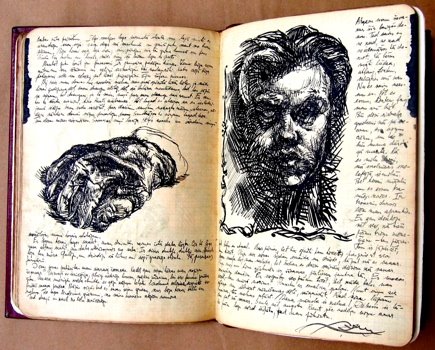
Francis Rudolf’s diary with self-portrait

Much could be gleaned, no doubt, from the journal of a local, that is, a Latvian Francis, meaning the expatriate Renaissance man Francis Rudolf or Rudolph (1921-2005), some of whose paintings, drawings and diaries (shown here) were gifted a few years ago to a university here in Aberystwyth, the town where I currently reside.

“Expatriate” is too clinical a term: Rudolf was forced to migrate during his youth, when Latvia was being invaded by the Nazis and the Red Army.  There he is, sticking out his tongue at us who are still largely ignorant of his world; yet it was he who put Latvia on the map for us and got me intrigued about Riga.

Francis Rudolf, undated self-portrait

Richard Wagner and Sergei Eisenstein aside, there are few names in the Riga travel guides to which a journal devoted to US radio dramatics can readily relate.  Determined not to stoop to the sharing of random snapshots, I shan’t continue broadcastellan until the conclusion of my “scholarly” outing, which is preceded and followed by sojourns in familiar destinations in Wales (Cardiff), England (Manchester), and the Netherlands (Amsterdam). Technology permitting, I might file the occasional report.

It rather irks me to be silenced by the marginal nature of my chosen subject.  What a failure of self-expression, what a missed opportunity a journal like this is if it cannot accommodate whatever its keeper happens upon, sees and undergoes; yet such is the curse of the concept blog.

“Let him keep [. . . ] a diary,” Bacon rightly advises.  I often regret my own strictures in this respect, as I imagine that my experiences may be rather more relatable to some than the dramatics of radio are to most.  Besides, an online diary is ideally suited to the recording of everyday observations.  

As has been demonstrated rather conclusively by the dead air I left behind on past travels, I seem incapable of reconciling the peripatetic with the armchair reflective.  Still, I hope my experiences are going to enter into this journal somehow.  As Bacon recommends,

[w]hen a traveller returneth home, let him not leave the countries, where he hath travelled, altogether behind him […].  And let his travel appear rather in his discourse, than his apparel or gesture; and in his discourse, let him be rather advised in his answers, than forward to tell stories; and let it appear that he doth not change his country manners, for those of foreign parts; but only prick in [that is, plant] some flowers, of that he hath learned abroad, into the customs of his own country.

Now, I have long been confused as to what “his own country” might mean, being that I have not lived in what is presumably and legally “home” to me for nearly two decades; but, in lieu of on-the-spot reports, I shall endeavor to gather and display such “flowers” as may withstand the airwaves or can be securely propped against a microphone . . .

Taking a Name for Yourself: The Strange Case of Peter Lorre Vs. Peter Lorre

If only my father had been a serial killer. That’s what I thought, one afternoon, when I called the government office in charge of name changes. Regulations were so strict in Germany, the reason of doing away with your old moniker had to be something close to murder in the family. “We can only hope” is what I said to the bureaucrat on the other end of the line and, hanging up, gave up on the idea. I was just about to move to the United States and thought that it might be easier for me not to be “Harry Heuser” and face the prospect of being called “User,” as “Heuser” is so often mispronounced.

Now, I had no fancy alternative in mind; “Hauser” (as in Kaspar Hauser) would have done just nicely. I certainly did not try to free ride on someone else’s fame, faded or otherwise. That is what happened in the strange case of “Peter Lorre Vs. Peter Lorre,” a radio play by Michael Butts based on The Lost One by Stephen D. Youngkin; it premiered on BBC Radio Four this afternoon (1 September 2008) and was available here for listening until 7 September 2008. Having long had a fascination for the aforementioned Lorre, as well as onomastics, I was all ears.

“Peter Lorre Vs. Peter Lorre” is concerned with the final stage of the actor’s career, which coincided with those dark years in which aging Hollywood players found themselves crushed under the rubble of the old studio system that had cast them into stars. The 60s were cruel indeed; and many of the once highly paid players were reduced to accepting parts in low-budget horror films, about the only genre open to them. Sure, they could stop acting; but, for those who had made a living of it, this meant a kind of death; which is why many settled for gradual decay. In the case of Peter Lorre, who had been in the thriller business since his breakout role in Fritz Lang’s M, the decline had been more gradual still; he had been typecast so early in his career that he was soon reduced to caricatures. Just when Lorre was trying to push for a remake of M to restore the name he had made for himself, someone else was trying to claim it.

“Some fruitcake has filed a deposition,” his agent, Lester Salkow, informs Lorre, “He wants to use your name.” Determined to have this threat to his identity “stopped,” Lorre was puzzled nonetheless. “Why would anyone want to be me?” The “anyone” in question was Eugene Weingand, a Hollywood-based real estate salesman born in Germany in 1934.

“How would you feel,” the judge asks Weingand, “if your name was Peter Lorre and someone came in and wanted to use that same name after you developed it for a period of over thirty years?” To this Weingand made no reply; but, as Butts’s play has it, it got Lorre thinking and caused him to re-examine the worth of his name, not merely as a handle for salables but as a synecdoche of the self.

Weingand’s petition was rejected; yet, after Lorre’s death in 1964, he took the actor’s name for appearances in film and on television (in Get Smart, for instance), eventually settling for colourful parodies of Lorre’s ghoulish screen persona in cereal commercials. Weingand even claimed to be Lorre’s son, adding “Jr.” to his assumed name. Having just fast-forwarded through Hitchcock’s Torn Curtain (1966) and spotted him in the scene shown above, I cannot deny the resemblance.

Nor can I deny the resemblance of Lorre’s voice to that of British character actor Stephen Greif, who is remarkable in one of the two title roles. So torn and identity crisis tormented is the aging Hollywood star he portrays that you might as well say that Greif is heard in both of the title roles. “Strange,” Lorre comments on Weingand’s story, whose statements he reads, slipping into the role of the deluded man to whose ambitions his life in the public eye gave birth.

 “I feel I know him,” Lorre tells his agent. Having so long played roles he would rather disown, Lorre could not bring himself to calling his namesake an impostor.

Radio at the Movies: Manslaughter (1922)

Radio was little more than a craze back in 1922; but the radio and the microphone were already prominently featured in Cecil B. DeMille’s Manslaughter, released in September 1922, some ten months after US Secretary of Commerce Herbert Hoover declared the medium to be useless for point-to-point communication, thereby paving the way for broadcasting while leaving hobbyists in the dust of centralized, scheduled entertainment and the big business it was meant to promote. That same year, comedian Ed Wynn made his first foray into radio, the first drama presentation went on the air, and the first commercial went out to anyone equipped with headphones and crystal sets.

The reception was often poor; and critics were not enthusiastic either. One commentator, having just witnessed one of those early broadcast, remarked:

[W]e prefer to stumble downstairs and out again into the silent lanes to meditate on the civilization of 1930, when there will be only one orchestra left on earth, giving nightly world-wide concerts; when all the universities will be combined into one super-institution conducting courses by radio for students in Zanzibar, Kamchatka and Oskaloosa; when instead of newspapers, trained orators will dictate the news of the world day and night, and the bed-time story will be told every evening from Paris to the sleepy children of a weary world; when every person will be instantly accessible day or night to all the bores he knows, and will know them all; when the last vestiges of privacy, solitude and contemplation will have vanished into limbo.

It took a few decades longer for wireless technology to achieve what the reviewer predicted to happen by 1930; but it would not have surprised me if broadcasting had received a similarly unfavorable treatment in one of DeMille’s epics, in which the vices of modern society were frequently likened to the debaucheries of Rome in its fall. Not so.

Manslaughter, as told by DeMille, is a story of redemption in which both Lydia Thorne, the “speed-mad” socialite justly accused of the titular crime and Daniel O’Bannon, the principled District Attorney who sees to it that she pays for same are suffering the consequences of their actions. Rather inexplicably, O’Bannon has fallen in love with the selfish woman he is sending to jail, presumably because he can see her potential for good even though he accepts the duty of showing everyone how bad she really is.

Ultimately, the two are brought back together through the melodramatic expediency of fate and, having confessed everything else, confess their love. She has paid her dues to society and is thoroughly reformed; he has overcome self-destruction and despair. After all, this is a C. B. DeMille picture.

Before the lovers can run off together, the romance is delayed once more by an important announcement. This is where the radio comes in. O’Bannon has decided to run for governor; but one of his rivals for the hand of Lydia Thorne reminds him that she is a convicted criminal and won’t do as the wife of an elected official. Instead of being denounced and exposed by radio, in place to keep the public abreast of election results, O’Bannon grabs the microphone to broadcast a very personal decision.

It seems that DeMille was courting the new medium to prepare for his role as host and ostensible producer of the Lux Radio Theater, for which the story was adapted in 1938, with Fredric March reprising the role of O’Bannon he had played opposite Claudette Colbert, DeMille’s favorite leading lady, in the remake shot in the year so dreaded by the reviewer of that early broadcast back in 1922. Herbert Hoover’s comments notwithstanding, in DeMille’s Manslaughter, the radio is still very much a communication device. O’Bannon broadcasts unannounced and unrehearsed, just as he makes up his mind about Lydia Thorne. Unlike motorcars and their freewheeling owners, radio was fast without being loose.