No Headstone, No Regrets

How do you survive the ordeal of executing the killing of some 140,000 people and counting. Perhaps, by counting on facts and figures to counter or discount any accounts of fatality and disfigurement; by recounting to myself, for decades to come, that I could not be held accountable, having merely carried out orders as someone to be counted on; or by counting the praises bestowed upon me by those of my countrymen I would be pleased to encounter, for having been instrumental in ending a war that, without my precise handling of the instruments, might have ended the lives of countless more.

Paul Warfield Tibbets, Jr., the commander of the Enola Gay, whose idea of a loving tribute was to name after his mother the B-29 out of whose womb “Little Boy” dropped onto the roofs of Hiroshima, insisted that he had “no regrets” about the outcome of his mission, that he slept “clearly every night.” Clearly, he won’t be counting sheep, or charred bodies, tonight. Mr. Tibbets, the world took note, died today at the age of 92.

When I came across that announcement, I was reminded of “14 August,” a radio play by poet-journalist Norman Corwin (previously discussed here to mark the 60th anniversary of VJ Day). With it, Corwin sought to assure Americans that “God and uranium” had been on their “side,” that the “wrath of the atom fell like a commandment,” and that it was “worth a cheer” that the “Jap who never lost a war has lost a world; learning, at some cost, that crime does not pay.”

Broadcast on VJ-Day, “14 August” asked listeners to remember those Americans “dead as clay” after defending “the rights of men,” after “fighting for “people the likes of you.” No mention was made of the Japanese whose lives were turned to ash in the streets of Hiroshima; no words uttered to suggest that achieving peace at such “cost” might, too, be considered a “crime” for which someone other than the dead might have to pay.

I am reminded, too, of the aforementioned radio writer-historian Erik Barnouw, who, upon learning that the US government had “seized and impounded” reels of film shot in Hiroshima (and Nagasaki) by Japanese cameramen (headed by Akira Iwasaki), the reported return of which to Japan in 1968 led Barnouw to produce the documentary Hiroshima-Nagasaki, 1945 (1970). Reviewing the long-suppressed footage, Barnouw commented (in Media Marathon [1996]):

The material we saw had been organized in sequences, which included “effects on wood,” “effects on concrete,” “effects on internal organs,” and so forth, as though scientific questions had determined the shooting.  Other sequences showed grotesque destruction of buildings and bridges.

Finding only a “few sequences of people at improvised treatment shelters,” Barnouw was “troubled” by the “paucity” of what he referred to as “human effects footage.” Who could be counted on to tell the stories so often unaccounted for in the records of history?

The Allies’ fight against the Axis was a worthy cause; what is unworthy of those who lost their lives on either side is a victor’s sweeping dismissal of any consequences other than victory and the suppression or outright erasure of documents suggesting trauma rather than triumph.

VJ Day was hardly an occasion to show compassion for the defeated enemy, you might say, and that it is understandable that relief about the end of the war expressed itself in levity (as heard on the Fred Allen Show from 25 November 1945, a clip of which is featured in the above video [since then removed]).

To consider it appropriate, some thirty years later, to restage the Hiroshima bombing for a Texas air show; to insist, another thirty years on, that it is a “damn big insult” to acknowledge the sufferings of those who were killed for however worthy a cause, as Mr. Tibbets has done, strikes me as a failure to rival the inhumanity that is the success of Hiroshima.

Having long refused to draw attention to the death of thousands, Mr. Tibbets decided to make his own farewell a gesture of self-erasure. He had the foresight to request that no headstone be placed on his burial site, predicting that his contempt or disregard for others might tempt those ignored by him to turn his final resting place into a stage for protest.

Mr. Tibbets, it seems, was one to shun debate. Perhaps, a remarkably headstrong patriot like he deserves nothing more than our respect for his final wish: a vanishing act in keeping with a life of denial, a grave as unmarked as those of the victims unremarked upon.

“No regrets.” It is these words, and the words of those who call resolve what is a lack of compassion and an unwillingness or inability to countenance doubt, that we must mark, lest we are prepared to mark the occasion of another Hiroshima . . .

Halloweaned from Image Horror

Montague was hoping for a feast as I carved the pumpkin, next to which he condescended to pose for me here. Much to his disappointment, none of his tricks could get a treat out of me. The treats this evening are going to be for the ear, delivered to those who are willing to lend one in exchange for the promise of goose bumps, up-and-down-your-spine shivers, or a state of unease and lingering disquietude. “Did Freddy Kruger Slay Cocteau?” I once asked. I am inclined to think that pictures numb us more quickly than the exposure to sound and silence, and the protean apparitions they conjure, millionfold, in the minds of those who dare to wear a blindfold.

This would be the night to lay your eyes to rest (unless you are already equipped for the trial, like Edward Arnold’s non-sighted detective in Eyes in the Night, which I screened yesterday) and accept the invitation to pass through the Creaking Door into the Inner Sanctum of sonic Terror, a world in The Shadow of doubt and Suspicion removed from the image hell of the in-your-face horrors with which we, jumpy enough at the very mention of “terrorism,” are wont to make ourselves jump these days. You know, the kind of boo! that so quickly turns into the blech! of boredom and disgust. So, Quiet, Please, and Lights Out, everybody. It is time to step into the vault . . .

Mind you, many found their way back into that Black Castle. In this age of podcasting and streaming, the thrill of listening to ghost stories and dramatized tales of terror is once again being experienced by a vast audience, a ratings-defying, multicultural multitude impossible to track down. Anyone anywhere can listen now; and, apparently, quite a few folks do. As of this writing, episodes of The Shadow have been downloaded nearly 225,000 times from the Internet Archives. To be sure, that is a fraction of the original weekly audience for this long-running episodic thriller program (previously discussed here), but a sizeable fraction nonetheless.

“How a thirty-something academic in the valleys of Wales acquired so much knowledge of American old-time radio begins to shape up as the makings of a new Mysterious Traveler script,” remarked the aforementioned radio thriller writer David Kogan. Now, Kogan could have been describing me, who, as a thirty-something academic, moved from the broadcasting metropolis of New York City to this Wild West of Britain. He was, in fact, describing Richard J. Hand, whose Terror on the Air! (2006) I am perusing this Hallowe’en.

I was curious to discover which radio thrillers Hand gave his “thumbs up” and which ones got the finger (there is no mention of Edith Meiser’s Sherlock Holmes thrillers, for instance). Predictably, Howard Koch’s previously discussed adaptation of The War of the Worlds) features prominently. If I were in New York City on 3 November, I would certainly return to the Partners & Crime bookstore in Greenwich Village (last visited here), where this seminal and resonant shockumentary is being recreated in the make-believe studio of W-WOW!. Surely, few American radio plays have surpassed the thrills elicited by that infamous Mercury Theater on the Air broadcast from 30 October 1938.

Also mentioned by Hand are the Mercury productions of “Dracula” and “The Hitch-Hiker,” as are radio melodrama anthologies like Creeps by Night, The Hermit’s Cave and Alonzo Deen Cole’s pioneering Witch’s Tale. Making the bloody cut as well is “It Happened” (11 May 1938), one of my favorites among Arch Oboler’s Lights Out offerings, starring Mercedes MacCambridge as a schoolgirl rather too eager to delve into the mysteries of Paris. Hand calls it a “fast-moving play” that combines elements of the “crime thriller” with “Gothic horror,” a play that is “melodramatic in plot but modernist in technique.”

Now, despite leaping at the opportunity of witnessing the “State Executioner” in a soundstaging at the Museum of Radio and Television in New York some years ago, I am no Oboler enthusiast, as I made clear in Etherized Victorians; but “It Happens” is largely devoid of Oboleric pretensions. Dragging listeners Grand Guignolens volens into the sewers of their dirty minds, and there is no mind dirtier than a receptive one, it creates indelible images without having to show—or shower us with—buckets of blood. “Pleasant dreams . . . hmmmmm?”

Radio Is . . . a "Popular Corpse"

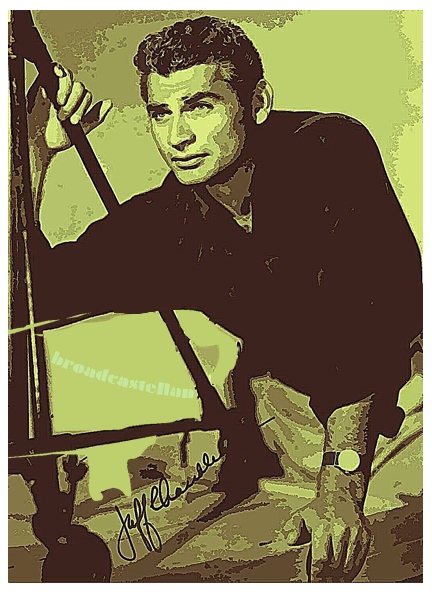
Well, you know you’re in trouble when you are asked to find a missing dame who “collects epitaphs.” On this day, 30 October, in 1948, radio detective Michael Shayne was hired to find such a dame. Could he be featuring prominently in that album of headstone headlines before this case is solved? His assignment that Saturday evening was “The Case of the Popular Corpse.” Back then, Shayne was portrayed by Jeff Chandler, who, at that time, was also cast opposite the aforementioned Eve Arden in the radio sitcom Our Miss Brooks. His film career would not take off until the early 1950s; and, like many Hollywood hopefuls, the man who came to Tinseltown as Ira Gossel kept afloat on the airwaves, playing frequently in the Lux Radio Theater and stepping behind the microphone to please audiences of Suspense, Escape, and assorted P. I. candy tossed on the air to catch the ear of an increasingly fickle audience.

In the spirit of Halloween, I thought I might investigate the “Popular Corpse,” intrigued by its New Orleans setting and curious about a program I have not as yet given any consideration, serious or otherwise. Turns out, I have been misled, more so than our hapless investigator. “The Popular Corpse” is executed routinely if competently, leaving no ghostly trail in the graveyard of your mind.

“Bei Mir Bist Du Shayne”? Not quite. The sounds of fisticuffs, the rants of an irate gardener, a nocturnal chase in a cemetery, and whatever goes for tough talk in the air-conditioned atmosphere of radio dramatics—not much to make sense or simulate the senses. “You’d better read a book,” commented critic Harriet Van Horne on the state of the radio thriller anno 1948: “I think I’ll take my mystery neat—out of a book—rather than give an ear to the half-hour blood baths common to radio.”

The title of this Michael Shayne episode, scripted by Robert Ryf, is an apt metaphor for the medium itself, for commercial radio, the talent it consumed, and the moribund condition in which it was left well before the end of the 1950s. By the late 1940s, radio thrillers, which rarely equalled, let alone surpassed “The War of the Worlds” (broadcast on this day in 1938), were not necessarily a skeleton in the closet of a motion picture star; but it seems that actors, producers, and audiences alike could not wait to bury them when television began to stomp on the grave of the imagination that radio had kept alive all those years.

That said, The New Adventures of Michael Shayne came to American ears for a decade (from 1944 to 1953); on television, the detective met his demise after a single season (1960-61). Perhaps, looks can kill faster, especially if Jeff Chandler is out of the picture . . .

Silenced Movie: The Life Story of David Lloyd George (1918)

Generally, we don’t regard our movie comings and goings as once-in-a-lifetime events, no matter how extraordinary the experience. In fact, we are inclined to opt for a rerun if a film manages to make us wax hyperbolic in our enthusiasm for it. To be sure, not many moving images have this force; nowadays, they are so readily reproduced, so instantly retrieved, that many of us won’t even bother to sit down for them, knowing that they can be had whenever we are ready for them. We miss out on so much precisely because we are comforted to the point of indifference by the thought that we do not have to miss anything at all. When I write “we,” I do number myself among those who are at-our-fingertipsy with technology. Last weekend’s screening of The Life Story of David Lloyd George at the Fflics film festival here in Wales was a reminder that films can indeed be rare; that they are fragile and subject to forces, natural and otherwise, that cause them to vanish from view.

The Life Story of David Lloyd George was produced in 1918; directed by the prolific but less-than-acclaimed British director Maurice Elvey. Now, I do not quite share the view that the hugely prolific Elvey was a hack. His talkie The Phantom Fiend (1932), with Hitchcock’s Lodger Ivor Novello may not be a cinematic masterpiece; but for all its technical flaws it nearly as experimental as Hitchcock’s version of the old Jack the Ripper thriller. Aside from Novello’s piano playing, Elvey makes great and at times reflexively sly use of the telephone, as he readies the silent version for sound. More accomplished still is Elvey’s second version of Hindle Wakes (1927), a bleak working class melodrama I mentioned here previously.

Like Hindle Wakes, Life Story was partially shot on location in Wales; but in the latter film, the scenery is no mere backdrop for romance, of which the documentarian if propagandist Life Story is almost entirely devoid (notwithstanding the sentimental scenes involving Lloyd George’s relationship with his daughter, portrayed by Hitchcock’s partner Alma Reville). It is the soil in which flourished the career of a British Prime Minister (pictured), the reformer they called the “Welsh Wizard.”

Elvey begins his biography of Lloyd George very nearly ab ovo by presenting us with a shot of his birth certificate. Life Story strives to be historically accurate, but is unapologetically propagandist in its portrayal of the Prime Minister’s accomplishments during the days of the Great War, near the conclusion of which the film was produced. The final image is of Lloyd George (portrayed by Norman Page) looking at his audience, insisting that there must not be another war.

His audience? That, of course, is the crux, the tragedy, and the mystery of Elvey’s D. W. Griffithean epic: it was never publicly screened during the Prime Minister’s lifetime, never referred to by those involved in its making, and discovered not until the mid-1990s, at the home of Lloyd George’s grandson. As film historian Kevin Brownlow remarked in his introduction of the film at the Fflics festival, it is equally astonishing and deplorable that no documentary has as yet been attempted to investigate the film’s disappearance and the silence surrounding it for nearly eight decades.

The Life Story of David Lloyd George is soon being released on DVD, another rarity to become widely available and largely ignored; but it was the bravura performance of silent film composer Neil Brand, whose dramatic underscoring of the cinematographically not always compelling 152-minute biopic made for a once-in-a-lifetime theatrical experience.

Du a Gwyn: Shades and Shadows of Life in Wales

Well, I am used to it. That is, I used to be. Seeing images of my surroundings on the big screen is rather a common experience if you live in the cinematographically well-mapped center of New York City. Moving from Gotham to Cymru (that is, Wales) seemed to push my life effectively off the map I had gone by in the shaping of my existence ever since I first set eyes on the Big Apple. I have been reluctant to discard the old plan in exchange for a new atlas, one that matches my present environs, one that might help me to position instead of dislocating myself. This journal has been largely a mode of escape, a vehicle of expression designed to transport me from a place in which I have not yet found a voice. Just from what am I trying to get away, though? And how much longer can I get away with using a chart of my own making, drawn, as it were, with my eyes closed to the world?

You might say that moving from and vowing never to return to what is supposedly my home (my native Germany), whether to Manhattan (where I lived for about fifteen years) or to Wales (where I have been residing nearly three years now), is a continual rehearsal of my sense of displacement as a gay person, as someone not quite at home in any society, as someone suspicious of the very concept of home. As an expatriate, I have made the experience of being born an outsider a matter of choice.

I have been reminded of my estrangement—and the unease of longing and not belonging—while attending Fflics, the aforementioned festival of classic films representing Welsh life or a Wales imagined elsewhere. How queer, for instance, to feel alienated by The Corn Is Green (1945), a Hollywood movie based on a play by gay actor-dramatist Emlyn Williams and starring gay icon Bette Davis. Here is a studio version of Wales that bears little resemblance to any Cymru past or present, a film that now strikes me as disingenuous and calculating as the strumpet portrayed by Joan Lorring.

Three years ago, I would not have been able to tell that the accents in Corn are as phony as the painted backdrops. However willing I am to suspend disbelief, I cannot go so far as to suppress my new knowledge and experience for the sake of entering into a world that commercially exploits foreignness without embracing it. Williams’s own struggle to come to terms with his marginality is deproblematized, his secret code obliterated. What remains is the missionary message that it takes someone ignorant of your origins to assist in what amounts to a purge, to prompt and prod you into becoming someone you ought to be according to superimposed standards.

An extreme form of such reconditioning is presented in The Silent Village (1943), a propagandist documentary imagining the invasion of a Welsh (and linguistically entirely non-English) community by the Nazis, whose first act is to prohibit the use of the Welsh language. Meeting with silent resistance, then active revolt, the fascist invaders effectively take the town off the map, killing its men and razing its homes in retaliation of the assassination of a high-ranking Nazi official.

It is a remarkably restrained, unsentimental and unhysterical recreation of the Lidice massacre, acted out by ordinary folk in a Welsh mining town not unlike Lidice. While the town of Cwmgiedd was being turned into a symbol, it lost none of its character during or as a result of the location shoot, the iconography of its everyday being carefully rendered. Verisimilitude turned to reality, pastness to present, when one of the Welsh villagers, a schoolboy back in 1943, spoke after the screening of the film about the town’s non-hostile takeover by the British film crew.

Utter hokum by comparison is Graham Cutts’s The Rat (1925), a pseudo-Parisian melodrama reveling in its own irrelevance. Gay Welsh matinee idol Ivor Novello plays a tormented object of heterosexual desire, an apache who comes to value the love of his gal pal over the glamorous world that enslaves him even as he seeks to conquer it. Penned by Novello himself (under the telling pseudonym “David L’Estrange”), The Rat invites decoding; but even if the code can be cracked, the film remains impersonal, sheltered as it is by its own artifice.

Rather more personally relevant to my experience is the image of the stranger in Proud Valley (1940) starring Paul Robeson as a black American introducing himself into a Welsh coal-mining community. “Why, damn and blast it,” one of the miners protests, “aren’t we all black down it that pit?”

As I learned reading Cadewch i Paul Robeson Ganu!, a fascinating account of Robeson’s ties to Wales, the actor-singer-activist found here a “cymuned o’r un anian,” a kindred community. “There is no place in the world I like more than Wales,” he once exclaimed. He expressed his solidarity with the Welsh miners, whom he first encountered and aided in 1929, singing for them (via transatlantic exchange) even when he was barred from international travel after his passport was confiscated by the US government.

It is a “kindred community” like this to which I have yet to gain access; it is this sense of being embraced and found valuable that I have yet to experience here. I realize that, for this to happen, Wales and Welsh have to become a more integral part of my existence as I am sharing it in this journal. So, after following a haunted and hunting Ivor Novello (as a suspicious foreigner and loner) into the London fog shrouding The Phantom Fiend (1932), the underappreciated talkie take on Hitchcock’s Lodger, I am discovering the actor anew in a Welsh setting established in speech and song by Cliff Gordon’s radio comedy “Choir Practice: A Storm in a Welsh Teacup” (produced in 1946) and subsequently adapted for the screen as Valley of Song (1953), another one of the films shown as part of the Fflics festival. Here, at least, the idiom rings true . . .

Next Stop, Proud Valley

How odd, I thought, when I heard myself saying that, instead of screening our customary late night movie, I would retire early because . . . I had a film to catch. The Fflics festival (announced a few weeks ago) got underway today here in Wales and we have tickets for three of the screenings tomorrow. The first film on our agenda, Proud Valley (1940), starring Paul Robeson, will be shown at 10 AM. Robeson’s Welsh connections were still unknown to me when first I posted his picture here; but I have been looking forward to an occasion to explore this bond of brotherhood for quite some time now.

At noon, we are going to emerge from the mineshafts of Proud Valley (also known as The Tunnel) to take in the propaganda film The Silent Village (1943), a recreation of the aforementioned Lidice massacre on Welsh soil. I am equipped with Eduard Stehlík’s account of the 1942 raid on the Czech village, a book I discovered a few weeks ago on a tour of the Jewish Quarter in Prague.

What follows is a detour to Hollywood with Bette Davis as a teacher in a Welsh mining town in The Corn Is Green (1945), based on a play by Welsh actor-dramatist Emlyn Williams. I wonder whether I will be able to spot radio actors John Dehner and Rhoda Williams (whom I once met during an old-time radio convention in Newark) in a cast that is all over the map and as authentic as the one headed by Olivia de Havilland in the 12 June 1950 Lux Radio Theater adaptation of Corn, in which Ms. Williams may also be heard.

In between these courses of acetate treats we might just manage to grab a bite to eat and perhaps get a chance to chat with our friend, silent movie composer and radio playwright Neil Brand, who will accompany Maurice Elvey’s long-lost Life Story of David Lloyd George (1918) at the festival on Saturday evening.

As much as I am looking forward to a day at the pictures, I hope the antemeridian screenings won’t render my cinematic experience an academic one, let alone a series of barely suppressed yawns. Then again, I can count on Mr. Robeson to stir me with his rendition of “Deep River” . . .

Hit and Run: Allan Stevenson (1918-2007)

You have probably never heard of Allan Stevenson, the dead man whose voice is now in my ear. I am quite used to hearing the dead speak. Listening to recordings of old radio melodramas is not unlike attending a séance in which the voices of the departed are being made audible by means of a powerful medium. Mr. Stevenson, though, has not long been what is generally thought of as permanently silent. He walked among the living only a few hours ago, an old man, propped up by a cane and blind in one eye. I may have passed him by on one of my many walks downtown to nearby Hunter College or on my way to see a friend who lived in Stevenson’s neighborhood on East 72nd Street. Absorbed in thoughts, I am often dead to those around me, which is why I feel compelled to lend an ear, however belatedly.

According to an indifferently penned article in the New York Daily News, the retired actor who had performed on Broadway in Maxwell Anderson’s long-running Anne of the Thousand Days starring Rex Harrison (1948-49) and the Phil Silvers success Do Re Mi (1960-62), was killed at 2:36 AM by a hit-and-run driver while trying to cross First Avenue in an attempt to get a cup of coffee, a last friendly gesture to a doorman on his block.

Playing in the theater of the mind some six decades earlier, Stevenson was faced with many perilous situations on both sides of the law; and some of his lives were spent before the conclusion of a thirty-minute broadcast. He had supporting roles on programs like Crime Fighters, a dramatic series promising listeners “master manhunters to match master criminals,” and John Steele, Adventurer. In an episode of the latter, Stevenson played a crooked jockey who has his hopes for a life on Easy Street dashed after riding “The Long Shot” (18 April 1950). It is the story of a man “trapped in the bitterness of the past and [put] face to face with the future,” a man who “learned too late that no one can live alone.”

On NBC’s Radio City Playhouse, best known for staging what would later turn into the Academy Awards behemoth All About Eve (as discussed here), Stevenson was cast in the Runyonesque “Betrayal” (30 August 1948) and, more prominently, in the murder mystery “The Wine of Oropalo” (18 December 1949), in which he played the victim of a deadly manipulation.

In Top Secret, a series of World War II espionage thrillers written and directed by Radio City Playhouse producer Harry W. Junkin, Stevenson was twice cast opposite “gorgeous Ilona Massey” (previously mentioned here). In “The Unknown Mission” (30 July 1950), he played a French baron of considerable wealth and charm whom Massey’s glamorous spy is called upon to eliminate.

“I wish we had proof that he is an enemy agent,” she sighs, “It is hard for a woman, without knowing why, to murder.” The hit-noblewoman seems ideally equipped to carry out the assignment. After all, the young Frenchman has “only one weakness,” she is told. “Women.” His grace, however, is well prepared for the attack. He, too, has murder on his mind; until, that is, he permits himself to wonder whether she might care for him. The two assassins find it impossible to follow their respective orders . . . but the duke’s days are numbered all the same.

A week later, Stevenson was again heard on the program in an episode titled “Disaster in London” (6 August 1950), this time portraying a British intelligence agent who is to assist the baroness to thwart enemy plans to poison and kill the entire population of the metropolis. As is made plain to the listener in one of those Shakespearean asides so effective in audio drama, the Englishman is a traitor, himself involved in the chemical warfare plot.

After learning that recordings of his private conversations bespeak his double-agency, this son of a false hero breaks down to disclose his less-than-ideological motives. “There is no dignity left for you but silence,” the traitor’s mother remarks, only to demand an explanation for her son’s actions.

Programs like Top Secret seem an unworthy memorial to an actor who may have hoped for a rather more distinguished career in the theater. And yet, it is the indignity of his death that calls for an outcry, a voice to expose the infamy of his silent killing . . .

From Here . . . to Eternity: Deborah Kerr (1921-2007)

It was only two weeks ago that I celebrated her 86th birthday and caught up with her early career by watching Major Barbara (1941). Today, the world learned about the death of Deborah Kerr, who passed away on 16 October 2007 after a long illness. While her name is on everyone’s tongue, I am going to keep her voice in my ear, listening to some of her radio performances of the late 1940s and early to mid-1950s, a busy time in the life of the British actress gone Hollywood. “I just wasn’t destined to be a homebody,” Kerr told the readers of The Fan’s Own Film Annual back in 1960, providing her British audience with a glimpse of her peripatetic existence, her life in Hollywood, the challenges of ploughing “through the jungle on an adventurous safari” (for King Solomon’s Mines, shot in Africa), or going on a coast-to-coast tour (thirty-five weeks, forty cities) to play Laura Reynolds in Robert Anderson’s Tea and Sympathy, having starred in its successful Broadway run, which began on her 32nd birthday in 1953.

Yes, Kerr’s life was “one long round of packing luggage and then more or less living out of it for anywhere from four to fourteen months at a stretch.” Yet, through the wonders of the wireless, she still managed to enter the homes of millions of Americans who tuned to Jack Benny, the Screen Guild Theater, or the Hollywood Star Playhouse.

Now, I have never had the chance to see Kerr on stage, where she appeared, for instance, in a West End revival of Emlyn Williams’s The Corn Is Green, the film version of which (starring Bette Davis) I am going to catch at the Fflics film festival here in Aberystwyth next week. To me, radio, not film, is the next best thing to the theater. True, Kerr made her US radio debut at a time when live performances gave way to taped ones; but, even when its sounds are canned, radio still has the kind of intimacy not achieved on celluloid, no matter how small the image you are watching on your personal computer or television set.

Beginning in 1947, the year she moved from Britain to Hollywood, Kerr appeared on a number of popular or prestigious radio programs. Even though she is better known for starring in a film based on a sensational bestseller that, like few others, attacked the radio industry of the late 1940s, Frederic Wakeman’s previously mentioned The Hucksters, Kerr did go on the air, contaminated as it was, to promote her films and meet her audience.

In 1947, 1951 and 1952, she stepped onto the soundstage of the Lux Radio Theatre, starring in “Vacation from Marriage,” an adaptation of Alexander Korda’s Perfect Strangers, in which she had starred opposite Robert Donat back in 1945. For Lux, Kerr also reprised her roles in Edward, My Son (1949) and King Solomon’s Mines (1950).

As previously mentioned, Kerr played the title role in the NBC University Theater an adaptation of Charlotte Brontë’s Jane Eyre (3 April 1949). She went on Tallulah Bankhead’s Big Show to recreate a scene from The Women (17 December 1950), and was heard on the long-running Suspense program in a thriller titled “The Lady Pamela” (31 March 1952).

Just what or who was “The Lady Pamela”? Not your Richardsonian heroine, to be sure. The name conjures Silver Spoon romances; but the spoons all end up in the lady’s pockets. Shamela’s more like it. Written by the prolific radio playwright Antony Ellis, the play opens as Pamela Barnes lays her eyes on a tiara, browsing in a New York antique shop that is promptly held up.

As it turns out, the “Lady” was in on the robbery. A tough, no-nonsense crook, she takes $500 out of the cut of her partner in crime for slapping her rather too realistically during the holdup. The police are soon on her case and “Lady Pamela” lands in the slammer; but the loot remains missing. Released nearly three years later, she returns to New York in search of the stolen goods and the guys who got away with it.

Always the “Lady,” the “first thing [she] did was to get [her] hair done,” to restore the old front. She meets a charming if hardly perfect stranger, one Mr. Wylie, who promises to assist her in finding her former collaborator—for a price:

Pamela: In other words, before you tell me where he is, I have to agree to help you kill him.  Is that the idea?

Wylie: If you want your dough.  That’s the idea.

Pamela: I want my dough, Mr. Wylie.  Where is he?

“You’re quite a girl,” Wylie tells her, after she reveals to him that she was the mastermind behind the robbery. “And are you ‘quite a boy’?” she asks, before she slaps him, too. “You are much too emancipated,” she is told by the one who got away, now a “very top dog in black market,” whom she tracks down in London and confronts over cocktails. “I think I would have killed him there,” she confides in the audience, the play being written in the first person. “If I had had a gun, or a knife, I would have killed him.” Would she? You bet!

Billed as a “dramatic report,” “The Lady Pamela” is a sly playing against type for the generally dignified and often reserved Kerr, who gets her chance to play an American, rather than a British version, of a dame. It is Anna gone Warner Bros., a heroine stripping her period costumes and sipping her Long Island Ice Tea without sympathy. Only on the wireless, folks—Kerr like you’ve never seen her . . .

Elinor Glyn: The Madam Who Had a Name for It

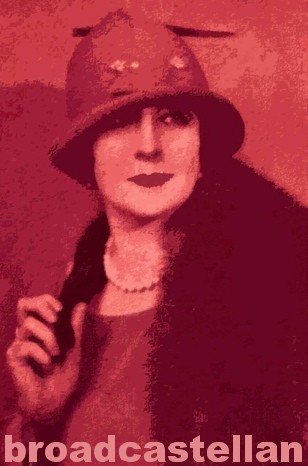
Well, it is Rita Hayworth’s birthday. And that of Arthur Miller, the reluctant radio playwright. Both have featured in this journal, which is reason enough to celebrate instead the birth of the “Madam” who brought “sex appeal” to page and screen by calling it “It.” Her name is Elinor Glyn, born on this day, 16 October, in 1864. “Fate and circumstances have combined to give Elinor Glyn a halo of sensationalism,” remarked Alice M. Williamson, the authoress of the aforementioned Alice in Movieland, from whose delightful tour of 1920s Hollywood the above portrait has been taken and freely adapted. No kidding, Glyn caused a scandal with her novel Three Weeks, published back in 1907, and came from her native England to Hollywood in the early 1920s.

Glyn, to be sure, was full of “It,” even if she felt compelled to cover it up. In the American edition of Three Weeks, for instance, Madam offered the following defense:

For me “the Lady” was a deep study, the analysis of a strange Slav nature, who, from circumstances and education and her general view of life, was beyond the ordinary laws of morality. If I were making the study of a Tiger, I would not give it the attributes of a spaniel, because the public, and I myself, might prefer a spaniel!

Yes, Glyn had learned how to package “It,” wrapping it up to be presentable while promising something you could not wait to unwrap. “I am only the conductor,” Glyn reportedly remarked, “of these glorious currents of health and hope and joy and success, but it is good to help pass magnetic vitality on to others.”

“How it would surprise readers of that long ago success Three Weeks, who think of Madam Glyn as a siren on a tiger skin, to hear this “line of talk” from her,” Williamson marveled. Her readers would get a chance to spot Glyn, who had the last word in Peter Bogdanovich’s Cat’s Meow (2001), in the hit comedy Show People, starring Marion Davies, whom Glyn visited at her Welsh retreat, the previously visited St. Donats Castle.

Glyn’s move to Hollywood, as Williamson recalls, had been a difficult and frustrating one. She had

almost everything against her.  She was supposed, even then, to direct a picture which would be made from her books; but in truth she was allowed to have no authority at all.

She was merely a picturesque figure-head, to whom those really in authority tried to be polite while being evasive—she was permitted to tell a pretty young star what style of hair-dressing became her best, or what the daughter of an English duke would wear when she “followed the guns” in the shooting season […].   If Madam Glyn went east, fondly imagining that she had directed a film, she would see it on the screen and hardly be able to recognise it as her won. But all is changed now. She is trusted and respected as a director. The girl stars whom she moulds for their parts in her pictures feel her fascination, and believe that her influence upon them doesn’t end when their work together is finished.

Now, pardon me, while I am under the influence of The Price of Things, one of the novels Glyn adapted for the screen and directed as well. Its opening lines promise the tale of a married woman who did not mind the influence of a thrilling, if thrillingly ugly, stranger who encourages her “to banish all thought.”

“What do you mean by thought? How can one not think?” Amaryllis Ardayre’s large grey eyes opened in a puzzled way. She was on her honeymoon in Paris at a party at the Russian Embassy, and until now had accepted things and not speculated about them. She had lived in the country and was as good as gold. 

She was accepting her honeymoon with her accustomed calm, although it was not causing her any of the thrills which Elsie Goldmore, her school friend, had assured her she should discover therein.

Honeymoons! Heavens! But perhaps it was because Sir John was dull. He looked dull, she thought, as he stood there talking to the Ambassador. A fine figure of an Englishman but—yes—dull. The Russian, on the contrary, was not dull. He was huge and ugly and rough-hewn—his eyes were yellowish-green and slanted upwards and his face was frankly Calmuck. But you knew that you were talking to a personality—to one who had probably a number of unknown possibilities about him tucked away somewhere.

John had none of these.  One could be certain of exactly what he would do on any given occasion—and it would always be his duty.  The Russian was observing this charming English bride critically; she was such a perfect specimen of that estimable race—well-shaped, refined and healthy.  Chock full of temperament too, he reflected—when she should discover herself.  Temperament and romance and even passion, and there were shrewdness and commonsense as well.

“An agreeable task for a man to undertake her education,” and he wished that he had time.

Jigsaw Puzzled

Well, there she was again, flitting across the screen … unexpected, uncredited—and gone within seconds. You know, the kind of walk-on out of narrative nowhere they call a cameo. How strange, I thought, when I saw her passing by, having just had her on my mind (and in this journal) a few minutes earlier. I could hardly believe my eyes.  Yes (as I shared earlier today on Alternative Film Guide), Marlene Dietrich refused to get out of my head last night, even though the anniversary I had just commemorated (her guesting on the Abbott and Costello Show back in 1942) was hardly a memorable one.

There were many other radio anniversaries to consider that day; but somehow it was Marlene’s name that caught my eye, my ear pricking up to the chance of hearing her voice, forced as it was to utter lines so utterly unworthy of her allure and talent. That was that, I thought, as I closed my computer.

Most nights, just before bedtime, I roll down the blind to screen old movies, all of which are duly recorded in the list to the right of this. I watch whatever I can lay my hands on, even though those hands of mine tend to reach for Hollywood fare of 1930s, ‘40s, and early ‘50s, British and German classics or contemporary film being rare exceptions to this rule of my thumbs.

Recently, I asked a fellow web journalist, the sharer of Relative Esoterica, what it is that makes her decide which movie to watch on any given night. It would not be easy for me to answer that question. When last I was in New York City, I purchased a collection of 100 Thrillers, neatly boxed and taking up no more space than a couple of hardcover novels. Many of the titles I watched this year come from out of that one box, however exasperating the quality of the print may be at times.

Going through that box as if it were filled with candy, slowly getting to those items you either don’t care for or are suspicious of (it might have one of those awful pink fillings), I dug up an item titled Jigsaw. I knew nothing about it, other than that it promised a reencounter with the aforementioned Franchot Tone, who was well past his prime when Jigsaw was shot.

As it turns out, Jigsaw (1949) was a veritable radio drama reunion party, being that it was directed by noted radio drama actor-writer-producer Fletcher Markle (previously mentioned here), and co-written by him and fellow radio writer Vincent McConnor, once known for adapting plays and novels for anthology series like NBC University Theater. The original story is by one John Roeburt, himself an expert on radio thrillers. I recalled his name from his 1940s article “Outlook for Radio Mysteries,” in which he remarked:

In its modern adjustment, the radio mystery show, all types and kinds, lives austerely, with a sharp frugality. The fat has been burned away; costs have been trimmed to the bone. Fees and salaries, for performers, writers, directors, are minimum scale only; musical backing is mainly dubbed in from royalty-free records purchased abroad. The mystery show seldom emanates live, as in halcyon years; the rule today is the mechanical taping of shows.

Jigsaw is not a big budget production, either, a trimming of costs to which Markle must have long been accustomed. In fact, he recruited many of his actors from radio. On hand were radio stalwarts like Myron McCormick, Brainerd Duffield, Hedley Rainnie (virtually a stranger to film), and the remarkable Hester Sondergaard (whose voice I last heard in one of Norman Corwin’s plays for radio). There was no getting away from the aural medium that evening. Not that Markle tried. He employed the device of interior narration, as one character commented on another, without uttering a syllable. It is a peculiar form of narrative that only a long career in radio can explain.

Jigsaw offers rather more than it is able to deliver. It wants to be Boomerang, say, or Arthur Miller’s Focus; but it soon gets lost in a romantic tangle that seems at once conventional and imposed. Still, Markle managed to rally quite a few noted figures from screen, press, and radio to lend their support for his directorial debut. And, yes, among those players was none other than Marlene Dietrich, who, in 1948, had twice been directed by Markle in radio productions of “Arabesque” (heard on Markle’s Studio One, co-starring Rainnie) and “Madame Bovary” (soundstaged by the aforementioned Ford Theater, adapted by Duffield).

So, had I read up on Jigsaw beforehand, I might not have been quite so bewildered by this reencounter with Dietrich. Yes, I can explain it now, citing my own ignorance as the source of my surprise; but I can’t quite explain it away. After what I said last night about her desperate attempt at self-promotion on the Abbott and Costello Show, the leading lady just passed me by, noiselessly, as I stared at the screen, gasping in puzzlement. Coincidence, my eye!