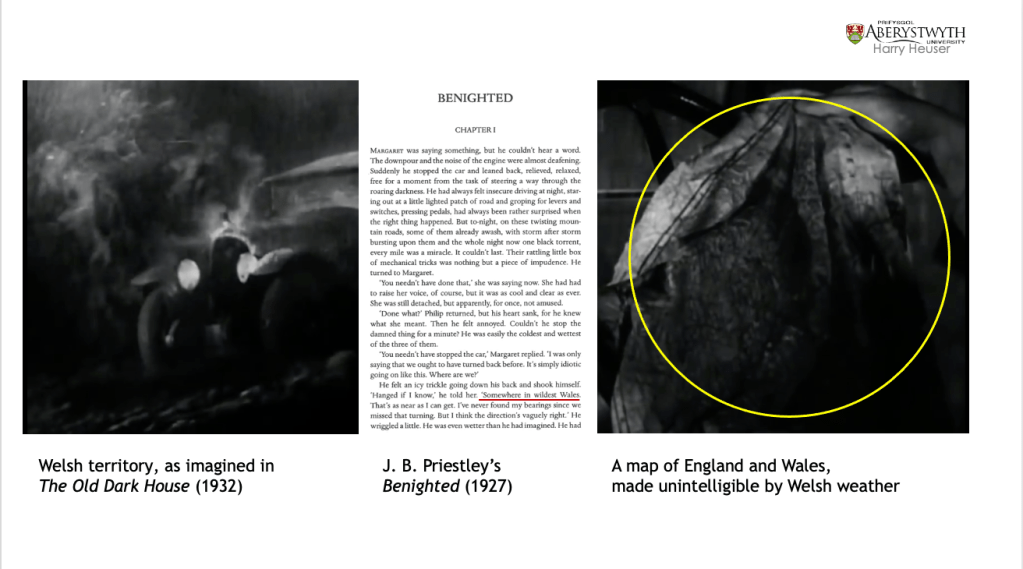
Much has been said about the titular edifice of Universal Studio’s 1932 melodrama The Old Dark House, the third in the series of films I am screening as part of my Gothic Imagination module at Aberystwyth University. Directed by the queer English Great War veteran James Whale, and adapted from J. B. Priestley’s 1927 novel Benighted, The Old Dark House is often argued to be a commentary on Imperial Britain during the so-called interwar years (that is, the period between the two World Wars, Britain having been involved in plenty of other international conflicts besides): an ancient but crumbling family home – run by aging and morally corrupt imbeciles and cut off from the world by water. It has been called, more than once, a “metaphor for … England.”
And yet, the story is not set England but in Wales, and the novel and film alike exploit and perpetuate the stereotypes of what, presumably, constitutes Wales and sets it apart from neighboring England: the wild, the uncivilised, the superstitious and unenlightened. Wales, according to Priestley and Whale, is gothic territory. It is the stuff of romance – or the English definition of romance – meaning that when the English want to go primitive, they think Wales.
Here is what the dreamer Penderel, himself a war veteran, says about Wales as he is being driven around in his friend’s motorcar one dark and dismal night:
I don’t want to go to Shrewsbury. I don’t particularly want to go anywhere. Something might happen here, and nothing ever happens in Shrewsbury, and nothing much on the other side of Shrewsbury. But here there’s always a chance.
The Hollywood ending aside, the film is remarkably faithful to the novel, retaining much of Priestley’s dialogue. While I am not sure just how many US American viewers back then would have understood the reference to the border that Shrewsbury represents, both Priestley and Whale would have known that, when the name “Shrewsbury” is dropped, the meaning “borderline” is implied. Arriving at Shrewsbury – and this is the party’s intention – means traversing the Welsh Bridge over the Severn and arriving back in England.
The party in question – Penderel and his friends, the married and bickering couple Margaret and Philip – has lost its way in what Priestley lets Philip describe as “wildest Wales.” The colonial attitudes toward Wales as both enchanted and benighted – as a place where there is ‘always a chance’ – the chance of an improvement in infrastructure excepting – are at the heart of this modally gothic narrative.
When the drunkard Welsh butler Morgan opens the door upon their unannounced arrival, he “produce[s] from somewhere at the back of his throat, a queer gurgling sound” that Penderel cannot translate. Priestley tells us that “Penderel knew no Welsh.” And yet, he says with confidence, in the book and film version alike, that “Even Welsh out not to sound like that; it was as if a lump of earth had tried to make a remark.”
Wales, to be sure, was just that to England, or many in England, a mute lump of Earth to be exploited for its resources. It is not Wales that is gothic – or Gothic – but the perspective of the English that, fascinating as they may be with the wildness of Wales – impose their views on the nation they invade like “travellers in a foreign country,” as Priestley has Penderel see it.
Morgan, as we soon learn, cannot communicate in any spoken language. He is a personification of Wales infantilised, gesturing like “some prehistoric monster.” Wales, the source of mined ore – of coal and slate and lead, silver and gold – as well as Water, was often seen as little more than potential to be unearthed and funnelled for the benefit of England. The tradition was deemed to be expendable.
In The Old Dark House, as in Benighted, the nightmare vision makes way for daylight. What we experienced was a Phantasmagoria staged by the visiting English. The travelers depart, whether enlightened by what they experienced or just glad to have survived it. The perspective of the hosts is not considered.
Hollywood would return to a fairy-tale Wales in The Wolf Man a decade later, in which Welsh landscape and culture, rendered unrecognisable, become the other when England was seen as the real, the upholder of values, in its fight against fascism. To this day, visitors prefer to be enchanted by Wales, an old dark house whose perceived darkness is to a large extent a product of an English or Anglo-American imagination.
Nothing is innately trifling. As I put it once, when I had the nerve to make a public display – in a museum gallery, no less – of the mass-produced ephemera I collect, ‘Trivia is knowledge we refuse the potential to matter.’ Now, some products of culture are more resistant than others to our realization of them as worth more than a fleeting glance, if that. Exerting the effort to make them matter may feel downright perverse when there are claimed to be so many more deserving candidates for appreciation around.
When looking out for something to look into, I invariably draw on my own sense of otherness, of queerness. It is not altogether by choice that I am drawn to the presumed irrelevant. My perceived marginality is both the effect and the cause of my attraction to the margins. What matters – and according to whom – is always worth questioning. That is why I created Gothic Imagination, an alternative art history course I teach at Aberystwyth University.
To augment the weekly lectures and seminars, I created a series of film screenings for my students further to explore the territories of the visual ‘gothic’ beyond literary genre Gothic and the Gothic as an architectural style. The second film in the chronologically arranged series, The Cat and the Canary (1927), is, for all its technical and cinematographic achievements, a rather undemanding old chestnut. In part, such a view of it is owing to our belatedness of catching up with it, now that much of it strikes us as a grab bag of narrative clichés.
Well, those clichés were up for grabs even back in 1927, as the film draws on its audience’s familiarity with murder mysteries and stage melodramas. Like Seven Keys to Baldpate before it, The Cat and the Canary is parodic and self-reflexive. It play with conventions and our awareness, even our weariness, of them. The Cat got our tongue firmly in cheek; and as much as we may feel sticking it out at the derivative claptrap to which we are subjected, we are encouraged to appreciate that the film anticipates our response, that it is one step ahead, dangling our tongue cheekily in front of us like a carrot intended to keep us playing along.
Is it only a single step ahead? Ahead of what? Is it ahead, retro or perhaps even reactionary? The Cat and the Canary is postmodern before there was a word for it. Like any adaptation of a text I have not caught up with, it also makes me wonder just how what we get to see has evolved and how the film, in addition to interpreting its source material cinematically, questions, edits and revises that material as well.
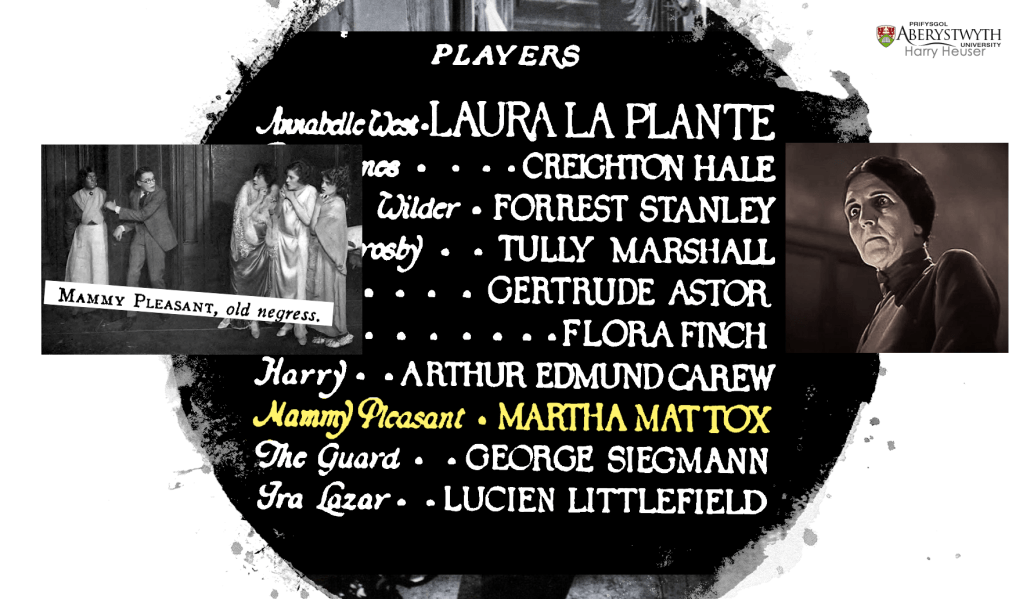
One revision draws attention to itself in the credits – and it made me aware of the consequences the seemingly inconsequential can have. I am referring to the character Mammy Pleasant, a housekeeper played in the film by the scene-stealing Martha Mattox. Given that The Cat and the Canary was released in the same year that The Jazz Singer stridently hammered a sonic nail in the coffin of silent film – at times simply by dragging said nail screechingly across the surface of an eloquent body of work shaped over a quarter of a century – the reference to the ‘Mammy’ legend stood out like a discordant note.
A slide from my introduction to the screening
What is ‘Mammy’ about Mammy Pleasant, particularly when the role is performed by a white female actor? The 1922 stage melodrama by John Willard, who also acted in the play on which the film is based, describes the character as an ‘old negress.’ Not that Blanche Friderici, who originated the part on the stage, was black. She performed it in blackface.
As The Jazz Singer and other early sound films such as the ‘Amos ‘n’ Andy’ vehicle Check and Double Check (1930), blackface and minstrel shows were very much part of Western popular culture at the time, and they were not effectively challenged – that is, were not permitted effectively to challenge – until decades later.
And yet, the film does not partake of that tradition, retaining the character’s name only. In the play, Mammy Pleasant is a servant who has gained enough independence to choose whether or not to serve the future heir to the fortune of her deceased employer, as is clear from this exchange with the family lawyer, Roger Crosby, prior to the reading of the will:
Crosby. Six! All the surviving relatives. By the way—Mammy—your job as guardian of this house is up to-night. What are you going to do?
Mammy. It all depends. If I like the new heirs—I stay here. If I don’t—I goes back to the West Indies.
There is no such exchange in the film, and the ethnicity of Mammy Pleasant is not made central to the characterisation, which in the play is rooted in stereotypes surrounding superstitions to be rooted out in the act of ratiocination. The Cat and the Canary is, after all, not a Gothic romance but a whodunit in which weird goings-on are shown to have a logical, albeit preposterous, explanation.
The name Mammy Pleasant, in Willard’s play at least, carries with it a reference to an actual person – the businesswoman and abolitionist Mary Ellen Pleasant, who, by passing as white, managed to become the first African American millionaire.
In the stage play, produced nearly two decades after Pleasant’s death in 1904, the reference is facetious and derogatory. Mary Ellen Pleasant, who lost the fortune she had made and shared as an activist, and whose character was destroyed when her passing as a white cook and landlady was exposed, is misremembered in the film as a not altogether trustworthy and slightly threatening outsider operating on the inside of a dead white millionaire’s mansion.
Why did the reference remain? How many viewers back in 1927 would have recognised it as a reference to Mary Ellen Pleasant? And how many would have found comic relief in what might have been some sort of white revenge fantasy that renders Pleasant odious while keeping her in her supposed place?
It is a gothic reading, as opposed to a reading of the gothic, that refuses to privilege the center and, imagining alternatives, lets the canary chase the cat for a change. An unlikely scenario, to be sure; but to expose what is cultural it is useful to conjure what is unnatural.
I am not an academic. I am a human being. That’s not just me misquoting The Elephant Man. It is a cri de cœur expressive of what is at the core of my identity as a creative person who happens to have transmogrified into an art history lecturer. To interrogate what that even means, I teach “Gothic Imagination” at the School of Art, Aberystwyth University.
As part of that class, I present an extracurricular series of film screenings exploring the boundaries of the ‘gothic’ beyond the furnishings of the genre ‘Gothic.’ That ‘gothic’ is a term so broadly applied and ill-defined as to render it practically useless is a by now thoroughly predictable way of opening a debate about its practical uses. Then again, the gothic has little to do to with practicalities.
I have no intention to make the term, “salonfähig,” that is, reverting here to my native German, to make it acceptable or viable in an academic setting. Rather, I use the word, which I am applying to visual culture instead of literature, to contest progress or avant-garde narratives traditionally espoused by academies in order to suggest alternative histories and alternatives to the teaching of art history. Attention to the popular, presumably lesser arts is essential to this strategy.
The first series of screenings, coinciding with my previous iteration of “Gothic Imagination,” was titled “Treacherous Territories.” The phrase was meant to capture that challenge of defining and the dangers of inserting a mutable term such as ‘gothic’ into the lecture theaters and seminar rooms that cannot quite accommodate, let alone confine it.
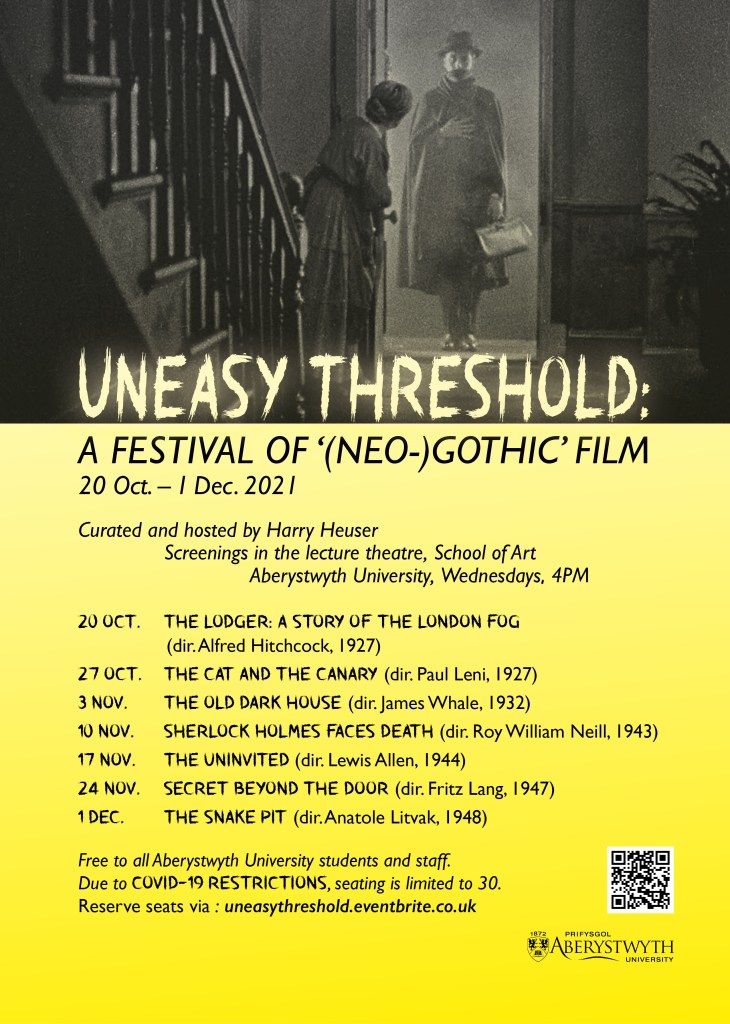
The current series, “Uneasy Threshold,” continues that playful investigation. What, for instance, carries a mystery or a romance over the threshold of ‘gothic’? What is that threshold? And what is the ‘gothic’ interior – the environment in which ‘gothic’ may be contained both as a subject for discussion and as an experience to be had by the viewer of, say, a crime drama, a thriller, a film noir or a horror movie?
As a literary genre, the Gothic began in and with a house – in Strawberry Hill and with the Castle of Otranto, both conceived by Horace Walpole long before Frankenstein, Jekyll/Hyde and Dracula came onto the scene. Those names are on the letter box of the Gothic mansion of our imagination, and I do not mean to evict their bearers; but might there be room as well – be it a closet, a cellar or a boudoir – for a few hundred other, less usual suspects, such as the title character of The Lodger (1927)?
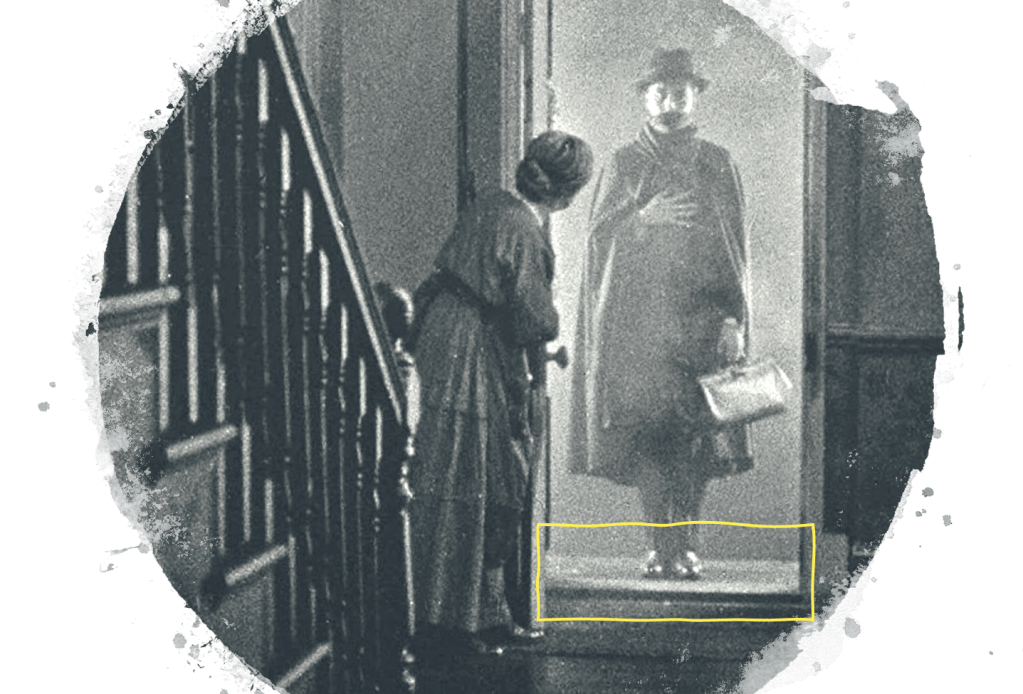
The Lodger insists on moving in on the party assembled at the Gothic castle, just as the Lodger – who may or may not be a serial killer called The Avenger – emerges out of the fog. edges himself into the home of the Buntings, and comes to preoccupy their thoughts and nightmares. Invited, perhaps, but deemed suspect or queer all the same.
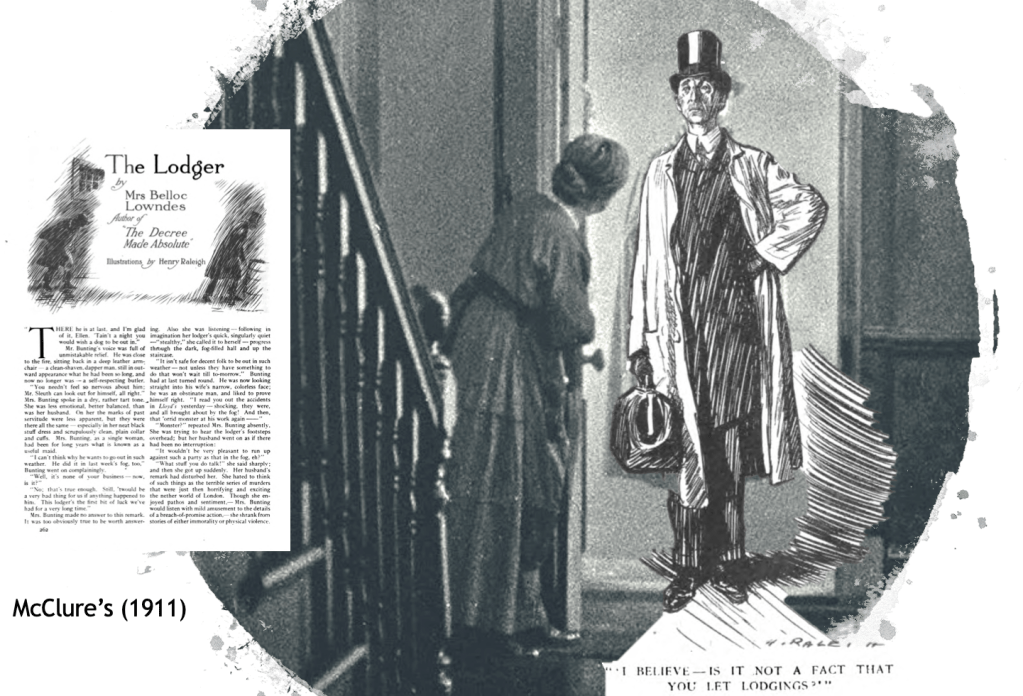
When the Lodger first made his appearance, in 1911, in a short story by Marie Belloc Lowndes, the figure was already lodged in the collective consciousness of urban dwellers who, like the author, were old enough to recall the Whitechapel Murders of 1888 or else were raised with the legend of Jack the Ripper, an alternative to a nursery rhyme all the more terrifying for having neither rhyme nor reason.
The Lodger transforms the story, which Belloc Lowndes turned into a novel, by pouring more sex into the mix. That the layered cake did not quite rise to Hitchcock’s satisfaction was, legend has it, due to the casting of Ivor Novello in the title role: a queer Welsh matinee idol who, Hitchcock argued, was not allowed to get away with murder but was to be pronounced blameless by virtue of his status as a star.
Whether or not that is the true reason for the direction the movie adaptation takes, it does not make the story any less intriguing – or gothic.
The Lodger is the story of a home that becomes “unhomely” – German for “uncanny.” The lodger is no architect or bricklayer; rather, he transforms the dynamics of the group of people dwelling in the house he enters. Blameless he may be, but he is an Avenger all the same, as Sanford Schwartz points out in “To-Night ‘Golden Curls’: Murder and Mimesis in Hitchcock’s The Lodger” – not the killer, but the victim of the killer avenging her death, a victim-turned-vigilante who, misunderstood, dreaded and feared, becomes the subject of her other lover’s revenge.
It is the other, ostensibly sane and safe lover, a police officer, who trespasses – who abuses his power – to trap the innocent man who threatens his supremacy as a prospective husband. The handcuffs he suits to his own pursuits prove harmful to his lover’s trust and nearly cause the death of his rival even after that rival is proven innocent of crime.
The Lodger is gothic as James’s Hogg’s The Private Memoirs and Confessions of a Justified Sinner (1824) is Gothic. It is a story of injustice and sanctioned tyranny. Like Frankenstein’s creature, the Lodger is hunted and tormented. Law, reason and morals are being questioned; and the pillars of civilisation are proven to be unsafe as houses.
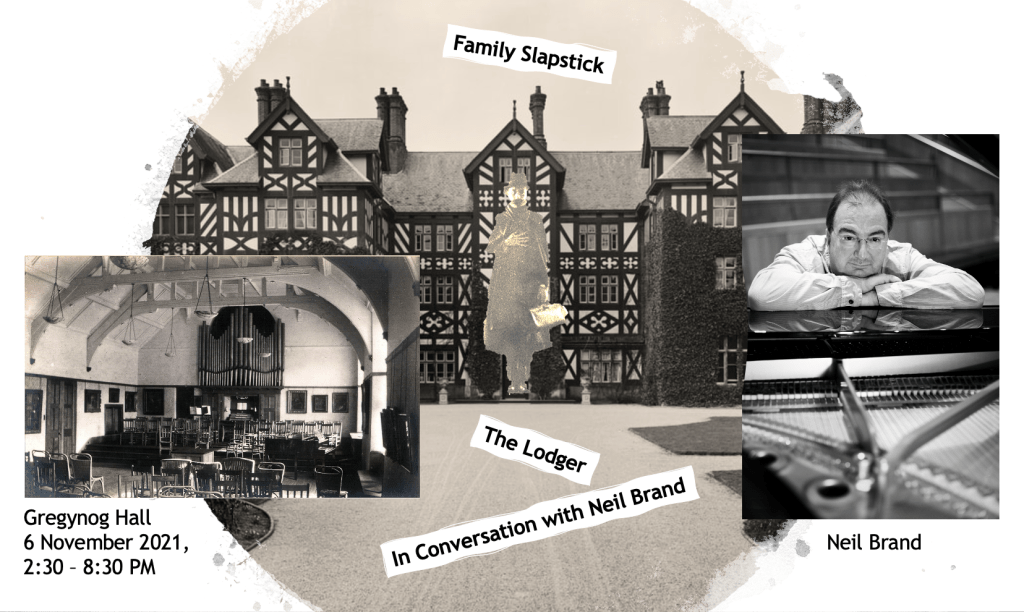
The next time I am (re)viewing The Lodger, the film will be accompanied by Neil Brand at Gregynog Hall, 6 Nov. 2021, when I shall be in conversation with the playwright-composer about silent film music and the language of pre-talkie cinema.
Like most professionals – secret agents excepting – I talk about my work at the slightest provocation. Besides, academics are expected to drop their names freely in the hope that it may take root in a crowded field scattered with formidable grey matter and fragile egos. There is a reason I have not yet mentioned one of my latest projects – the exhibition “Inconvenient Objects.” For a while, it was my blood pressure monitor that had to do most of the talking, delivering clinical statements geared toward a strictly limited audience listening out for official pronouncements that can be made to serve as quantifiable substitutes for my, to my mind, tell-tale cries of anger and frustration.
The power of words is at once affirmed and eroded in the act of our being rendered speechless, be it by way of silencing or sheer incredulity. There is no irony in the fact that, in this case of speech free and curtailed, seemingly innocuous curls of quotation marks are at the heart of the matter.
And just what was – or is – that matter you may well ask after reading this abstract and oblique preamble?
Since 2012, I have been involved in staging exhibitions in the galleries of the School of Art, Aberystwyth University, where I also teach art history and exhibition curating, as well as serving as Director of Research. Most of those exhibitions – Queer Tastes, Ugly, and Alternative Facts among them – are projects that I, with the assistance of the School’s senior curator, create for and realize with groups of undergraduate students each year. All of those shows draw entirely from the School’s collections of some 25,000 objects of visual and material culture.
The School of Art at Aberystwyth has the distinction of being one of only two art schools in the United Kingdom that also operate as accredited museums. I try to make use of that nearly unique status in all my teaching, and curating – in which many prospective students express an interest in their applications – provides me with an opportunity to link art history, theory and praxis in practical, public-oriented and creative ways.
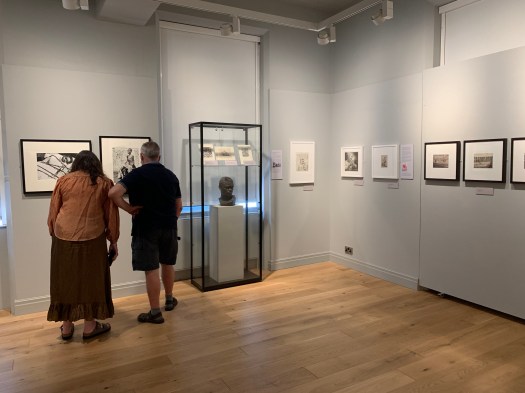
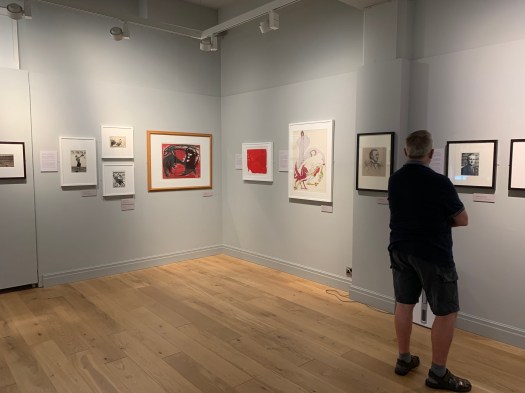
I have long regarded the School of Art’s museum collections and public galleries as a mother lode for staff and students alike, as it enables them to generate and showcase their research. The project for the current show, with which the galleries reopen to the public after over a year during which our collections lingered in the Pandora’s box that is the pandemic of which the previous project, Seeing Red, had been a casualty, was for students to investigate and interpret objects that might pose challenges to cultural institutions due to their subject matter or the politics and ideologies they bespeak.
The selected works range from Third Reich photography to a bust of a Congolese pygmy chief, but also feature groups of female nudes executed by male artists, graphic images of starvation in 1970s Ethiopia, unauthorised sketches of patients in a mental institution and scenes of bullfighting. However rewarding the digging, the mother lode, in this instance, turned out to be a minefield.
The mining metaphor is borrowed from and alludes to one of the best-known examples of institutional critique, a practice of interrogating collections and museum spaces that artist-curators have employed since the 1970s. Fred Wilson’s Mining the Museum was one such landmark project in which the legacies of colonialism were made transparent through the juxtapositional display of objects as outwardly disparate but intimately related as silverware and slave shackles to remind us how and on whose backs the wealth of the United States was built.
“Inconvenient Objects” was conceived to create awareness about the responsibility of contemporary museums such as ours and the role that exhibition curators play in making artifacts and their at times problematic histories accessible to the public.
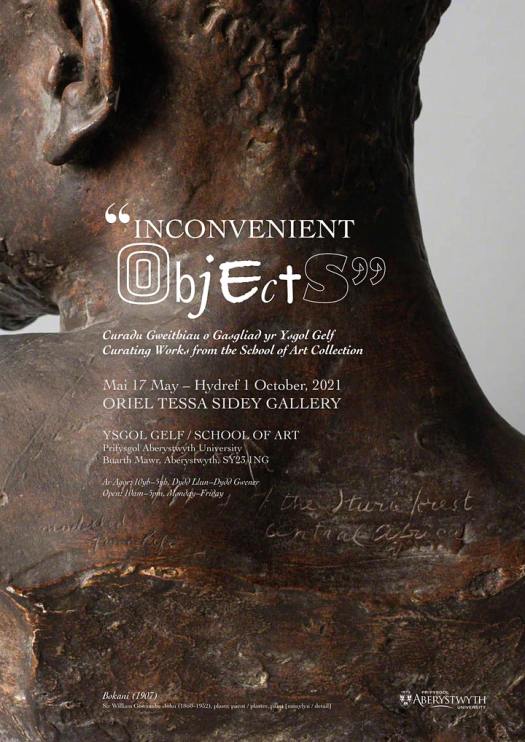
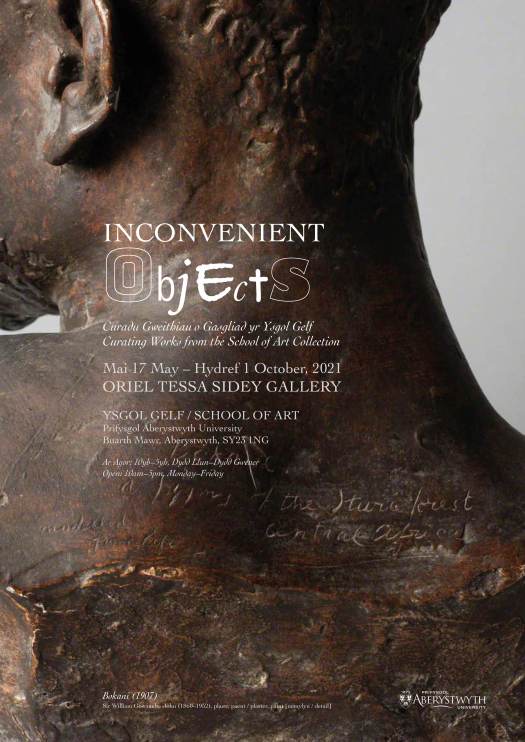
The centerpiece of the exhibition, an early twentieth-century bust ostensibly created in the service of science and not intended as a portrait of the subject, Chief Bokani, was previously shown as an ethnographic “specimen” in the University’s geography department. In the context of the exhibition, the plaster bust – created by one of Wales’ foremost sculptors – encourages debates about ethics and ethnicity in art and science.
Wilson, unearthing a similar bust at the Hood Museum of Art, Dartmouth College, New Hampshire in 2005, had asked: ‘[Can we] extricate ourselves from the violence involved in acquiring these objects?’ The question remains whether “we” – as cultural institutions – can fulfil our civic mission by removing ourselves from the public discourse of reckoning? “We” have a lot to answer for if we don’t ask.
“Inconvenient Objects” so fully lived up to its title that it was ordered shut and hidden from view. The word “inconvenient” was apparently central to the university management’s claim that the show posed a reputational risk. I say “apparently” because what issues the university had with the show was never clearly – let alone directly – communicated to the curatorial team.*
Being that I also serve as the School’s “Equality Champion,” I had envisioned “Inconvenient Objects” as an opportunity to demonstrate that our University is committed to participating in the debate surrounding Black Lives Matter and the legacies of colonialism and empire in which sculptural objects such as our bust of Bokani are enmeshed. Some three thousand words of gallery texts were in place to clarify those objectives.
After nearly two months behind closed doors – a hiding away that is now part of its story – the show was once again opened to the public, and it is scheduled to remain so until 1 October 2021. With the addition of a single label, and a sign advising “viewer discretion” at the entrance, nothing has been altered. And yet, everything has changed.
Our senior curator, who designed the poster, was obliged to place the title of the exhibition in quotation marks, indicating that we do not really mean what we say or else that that “we” does not refer to representatives of our institution. In effect, the museum has been disabled from reflecting upon itself because such a critique – widely practiced elsewhere – might reflect poorly on the academic institution under which it is subsumed.
Minor adjustments though they may seem – a concession that allowed us to hold on to the title of the show – those quotation marks signal a disavowal, a lack of commitment and self-confidence. They undermine the common endeavor to mine our public museums, instead of simply minding the store, an engagement with history and civics that should be all of our business.
*Curatorial team: Audrey Corbelli, Ciara Donnellan, Eve King, Orla Mai-Riley, Farrah Nicholson, Lucia Paone-Michael, Katie Rodge and Katarzyna Rynkowska, with contributions from Cara Cullen and Sarai David, and support from Harry Heuser (text and concept) and Neil Holland (staging and design)
This curated window at the Oxfam Bookstore, Aberystwyth, drew me in.
The themed window of our local Oxfam bookshop here in Aberystwyth was something to behold on that bright July afternoon. A row of handsome, second-hand but well-preserved copies of once popular fiction beckoned, reminding me of the tag I had chosen for this blog devoted to unpopular culture upon its inception back in 2005: “Keeping up with the out-of-date.”
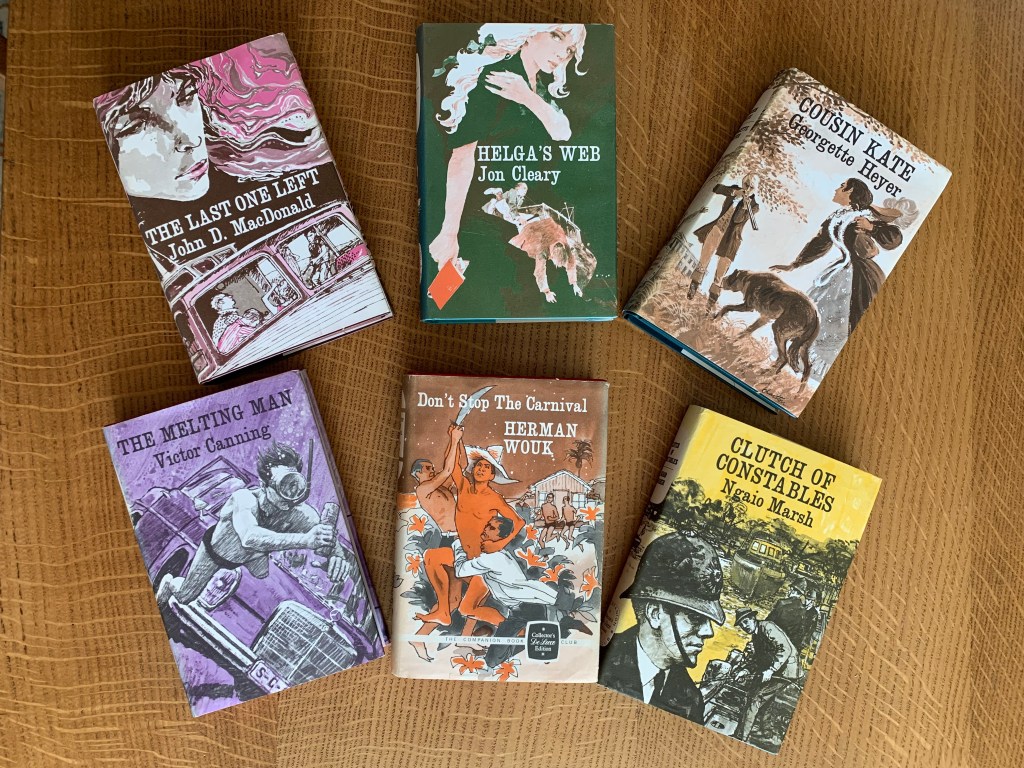
A novelist friend and avid reader, who had come from London for a visit, treated me to a volume of my choice. Three of them, in fact, as the £5-for-three deal made it unnecessary to be quite so discriminating. I passed up on erstwhile bestsellers by A. J. Cronin and Pearl S. Buck, both of whom had vanished from the display a day later, when I returned for another three titles (all six are pictured above). My first choice, however, had been Herman Wouk’s Don’t Stop the Carnival (1965).
I remember picking up Wouk’s tome Youngblood Hawke (1962), in a German translation, from my parent’s sparse bookshelves. My grandfather, likewise, was a Wouk reader, even though his chief interest lay in the writer’s Second World War subjects, to which Opa Heinrich, a former POW, could relate. In my late teens, desultory though my readings were, I enjoyed Wouk’s earlier City Boy (1948) and Marjorie Morningstar (1955).
Volumes I recent additions to my bookshelf
My next encounter with Wouk’s writings dates from my years of graduate studies in New York. I had decided to ditch Thomas Carlyle as a subject and instead write a PhD study on US radio plays. Wouk, as I discussed here previously, had started as a radio writer or gagman. He satirized the industry in Aurora Dawn (1947) and reflected on his experience it in his autobiographical novel Inside, Outside (1985). From the latter I snatched the phrases “Hawkers of feces? Costermongers of shit?” – a reference to laxative commercials on the air – for the title of one of the chapters of Immaterial Culture to capture the dismissal of commercial radio as a legitimate literary forum by those who had written for broadcasting during the 1930s and 1940s but who gained prominence later as published writers and dramatists.
Long story short, I have a kind of casual relationship with Wouk as a writer, a relationship that at one point turned serious (or academic) due to my interest in radio. So, when I spotted that copy of Don’t Stop the Carnival, an old book new to me, I felt inclined to get reacquainted. It turned out to be a bad date.
Don’t Stop the Carnival is a story of middle age. The action, of which there is plenty, is mainly set on an imaginary island in the Caribbean, anno 1959. The novel relates the misadventures of a New Yorker – Norman Paperman – who falls in love with what strikes him as a tropical paradise and decides to take over a hotel, having had no prior experience either with the business or with life on a tropical island. Complications abound, some less comical than others.
Paperman is a Mr. Blandings of sorts, a familiar figure in American fiction. He’d rather lay an egg elsewhere than suffer his ‘disenchantment with Manhattan’ a day longer:
the climbing prices, the increasing crowds and dirt, the gloomy weather, the slow bad transportation, the growing hoodlumism, the political corruption, the mushrooming of office buildings that were rectilinear atrocities of glass, the hideous jams in the few good restaurants, the collapse of decent service even in the luxury hotels, the extortionist prices of tickets to hit shows and the staleness of those hits, and the unutterably narrow weary repetitiousness of the New York life in general, and above all the life of a minor parasite like a press agent.
Perhaps, as his name suggests, Norman is not to be looked at as man but as a page – scribbled on, rather than blank, over the course of nearly fifty years. He may feel like turning over a new leaf – but his life is already scripted in ink that is indelible. Don’t Stop the Carnival sets us up for its conservative moral: stick with what you know, stop kvetching, and don’t even think that the grass could be greener than in Central Park in May.
While it responds to the modernity of its day – to the threat of nuclear war and the growing doubt in the progress narrative of the 1950s – the novel nonetheless shelters in the makeshift of retrospection: it looks back at the end of the Eisenhower years from the vantage point of the violent end of the Kennedy presidency to reflect on the so-called modern liberalism of the early to mid-1960s.
Was this choice of dating the action meant to suggest the datedness of the views expressed by the characters? What were the attitudes of the author toward race relations, civil rights and liberalism? In other words, what comments on the turmoil of the 1960s did Wouk make – or avoid making – by transporting back the readers of his day and dropping them off on an island that, for all its remoteness is nonetheless US territory, and that is about to be developed and exploited for its exoticism and natural resources?
The titular carnival is both figurative and metaphoric – an extended topsy-turvydom (or chaos) in which black mix and mate with white, queer live along straight folks, and Jews like Wouk’s protagonist Norman Paperman mingle with Catholics, Protestants, agnostics, pagans and atheists. He encounters bad infrastructure, worse bureaucracy, and political corruption. This island ain’t that different from Manhattan – which argues getting away from his former life to be futile and pointless.
The Carnival is not only shown to be a dead end but a deadly one. In the final pages of the novel, two characters are killed in quick succession – one central to the narrative, the other – the decidedly other – being marginal. The central one is Norman’s island fling, Iris Tramm, whom he knew as a celebrated actress two decades earlier and is surprised or reencounter, washed up but still alluring, as one of the guests in the hotel he decides to buy.
The island carnival is exposed as a tropical fever that means either death or cure – a cure for an uncommon warmth of non-traditional bonds and realized desires. Paperman recovers, and his understanding wife takes him “home.” His lover, meanwhile, must first lose the companionship of her dog, and then, trashing Paperman’s car while trying to reunite with her wounded pet at a veterinarian’s, her life. Was this the only out Wouk could conceive for a white woman who was the mistress of a black official who dared not to marry her?
It is the treatment of the marginal character of Hassim and his swift, unceremonious and unlamented disposal that lays bare Wouk’s fear of change: the antique dealer Hassim, introduced as a “rotund bald man” with a “bottom swaying like a woman’s,” who openly flirts with young men. In fact, the island is awash with middle-class homosexuals of all ages. Even Paperman’s hotel is pre-owned by a gay couple. And although he must have come across some of them in his former job as a Broadway press agent, Paperman is uneasy in their presence when he and Iris, his illicit love, visit an establishment frequented by gays:
Norman found the proprietor amusing, and he was enjoying the songs of his youth. But the Casa Encantada made him uneasy. Men were flirting with each other all around him; some were cuddling like teen-agers in a movie balcony. The boy in the pink shirt, biting his nails and constantly looking around in a scared way, sat at a small table with one of the rich pederasts from Signal Mountain, a pipe-smoking gray-haired man in tailored olive shirt and shorts, with young tan features carved by plastic surgery, and false teeth. Norman was glad when the proprietor finished a run of Noel Coward songs and left the piano, so that he and Iris could politely get out of the place.
Hassim is shot dead by a policeman, despite posing no risk and committing no crimes. The killing, which occurs in Paperman’s hotel and bar, the Gull Reef, is described in few words and elicits less of a response than the stabbing of a dog a few pages before this incident near the close of the novel.
“As a matter of fact, […] I feel sorry for the poor bugger,” is the response to the death of Hassim by one character, “munching on his thick-piled hamburger” not long after the killing.
“I’ve known thousands of those guys, and there’s no harm in ninety-nine out of a hundred of them. It’s just a sickness and it’s their own business. Though gosh knows, when I was a kid working backstage, I sure got some surprises. Yes ma’am, it was dam near worth my life to bend over and tie my shoelace, I tell you.” He laughed salaciously. His once green face was burning to an odd bronze color like an American Indian’s, and he looked very relaxed and happy. “Actually, Henny [who is Paperman’s wife], I almost hate to say this, but I think this thing’s going to prove a break for the Club. I bet the nances stop coming to Gull Reef after this.”
Such views are unchallenged by the narrator and the main character, who decides to sell his business – to the man expressing those views, no less – and return to New York. “People thought that this [his death] was a bit hard on Hassim,” the narrator sums, “but that the cop after all had only been doing his duty, and that one queer the less in the world was no grievous loss.” Case closed. Business open as usual.
Clearly, queers like me were not considered by Wouk to be among his readers. Targets, yes, but not target audiences. Even the academic treatment of homosexuality – the suggestion that famous writers of the past, too, might have been homosexuals – is ridiculed in the novel, with one PhD student, the lover of Paperman’s teenage daughter, nearly drowning in the sea.
Wouk, who died shortly before his 104th birthday in May 2019, lived beyond the middle age of Don’t Stop the Carnival for more than half a century. I doubt that I shall make him a companion again on whatever is left of my journey.
As a frustrated writer, or, rather, as someone who is disenchanted with the business of publishing and of ending up not reaching an audience, I have come to embrace exhibition curating as an alternative to churning out words for pages rarely turned. I teach curating for the same reason.
Staging an exhibition reminds students of the purpose of research and writing as an act of communication. Seeing an audience walking into the gallery – or knowing that anyone could stop by and find their research on display – is motivating students and encourages them to value their studies differently.
Travelling Through, installation view
As someone who teaches art history, and landscape art in particular, to students whose degree is in art practice, curating also enables me to bridge what they might experience as a gap or disconnect between practice and so-called theory, between their lives as artist and art history at large.
It also gives me a chance to make what I do and who I am feel more connected.
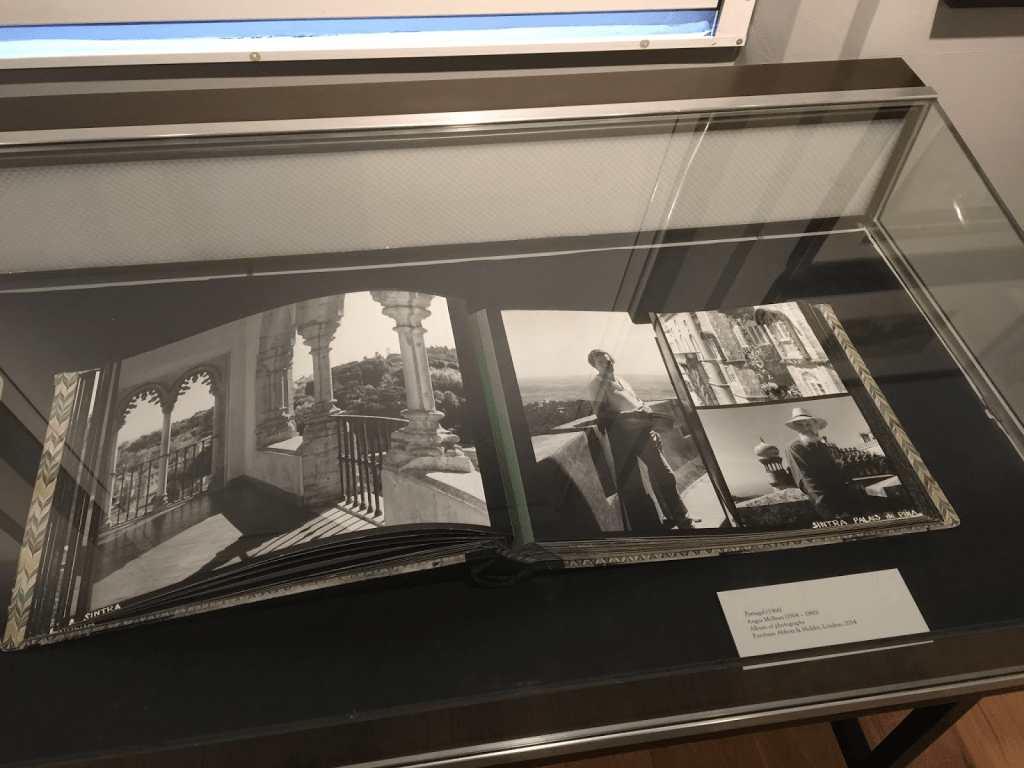
Angus McBean’s personal album of travel photographs featuring McBean and his gay companions (1966)
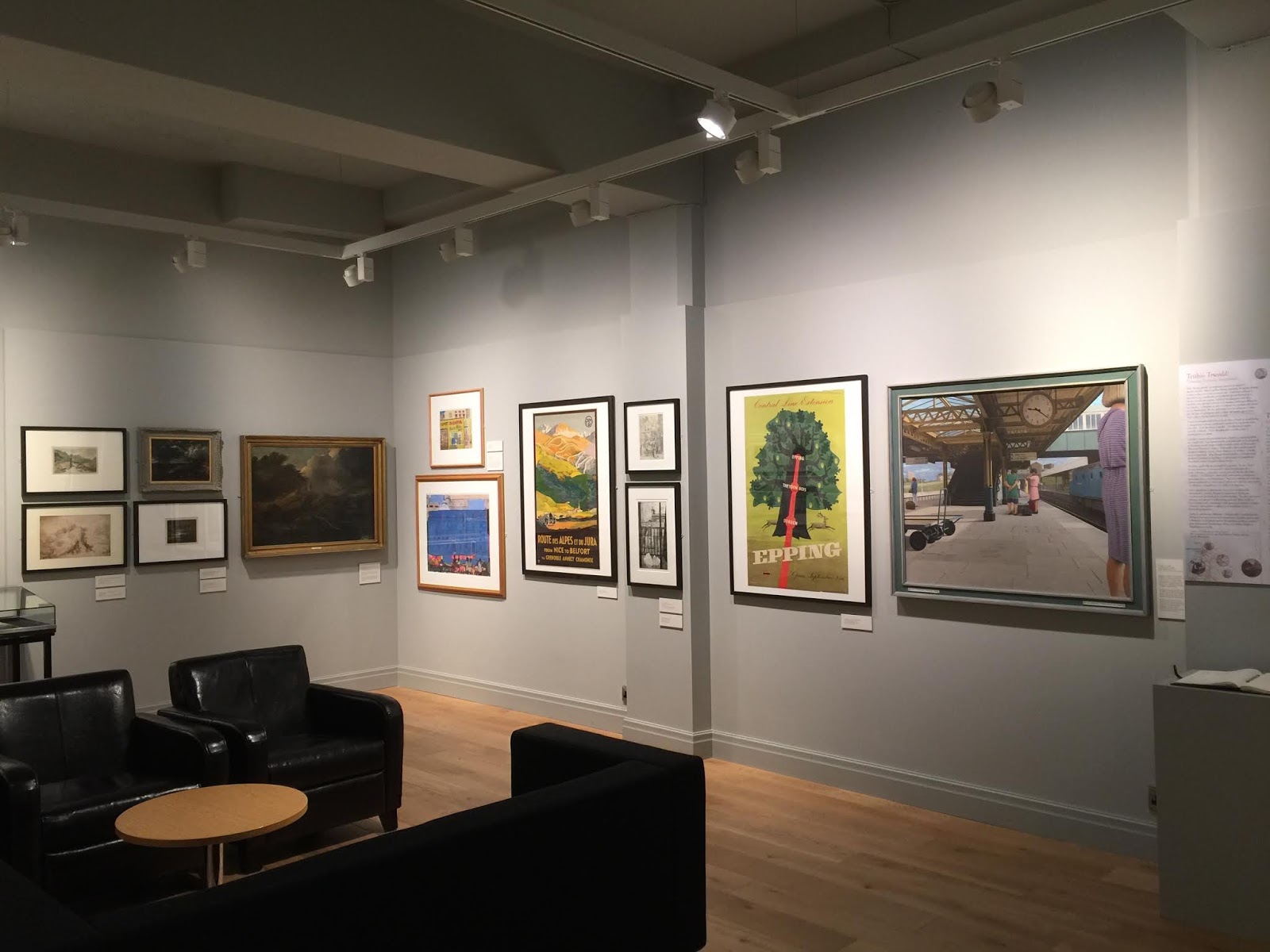
In my latest interactive and evolving exhibition, Travelling Through: Landscapes/Landmarks/Legacies (on show at the School of Art, Aberystwyth University, Wales until 8 February 2019), I bring together landscape paintings, ceramics, fine art prints, travel posters and luggage labels, which are displayed alongside personal photographs, both by a famous photographer (Angus McBean) and by myself.
Here is how I tried to describe the display of those never before publicly displayed images from my personal photo albums:
Before the age of digital photography, smart phones and social media, snapshots were generally reserved for special occasions. Travelling was such an occasion.
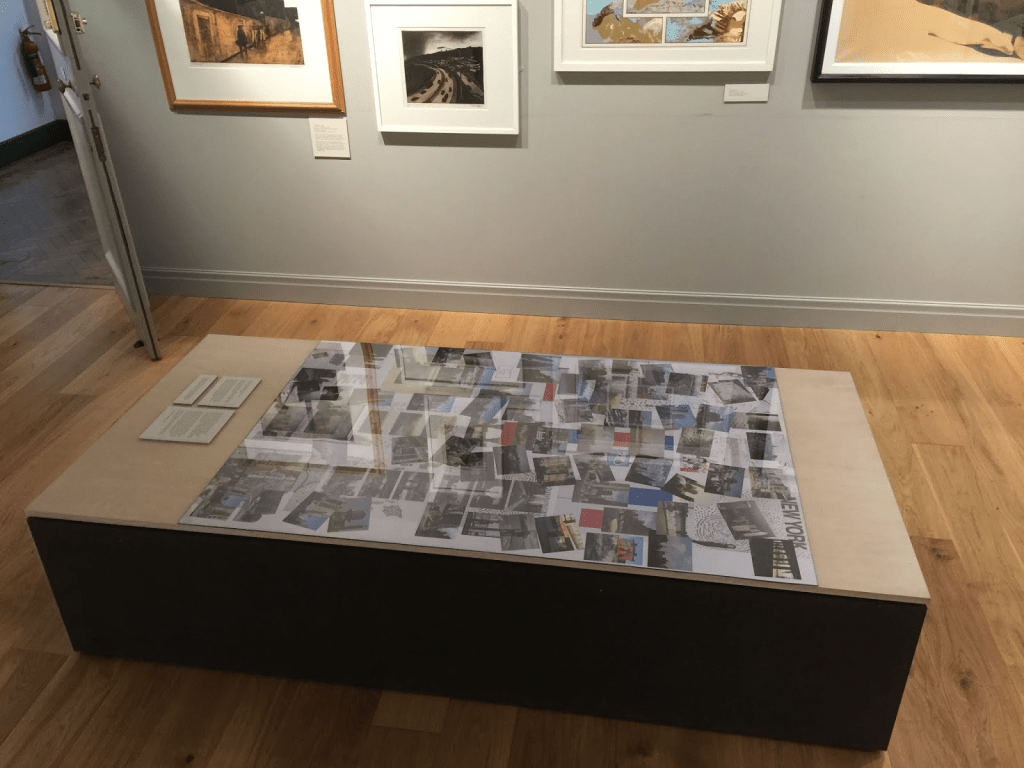
For this collage, I rummaged through old photo albums and recent digital photographs. When I lived in New York, from 1990 to 2004, I very rarely photographed the city. All of these images either predate that period or were produced after it. The historic event of 11 September 2001 can be inferred from the presence and absence of a single landmark.
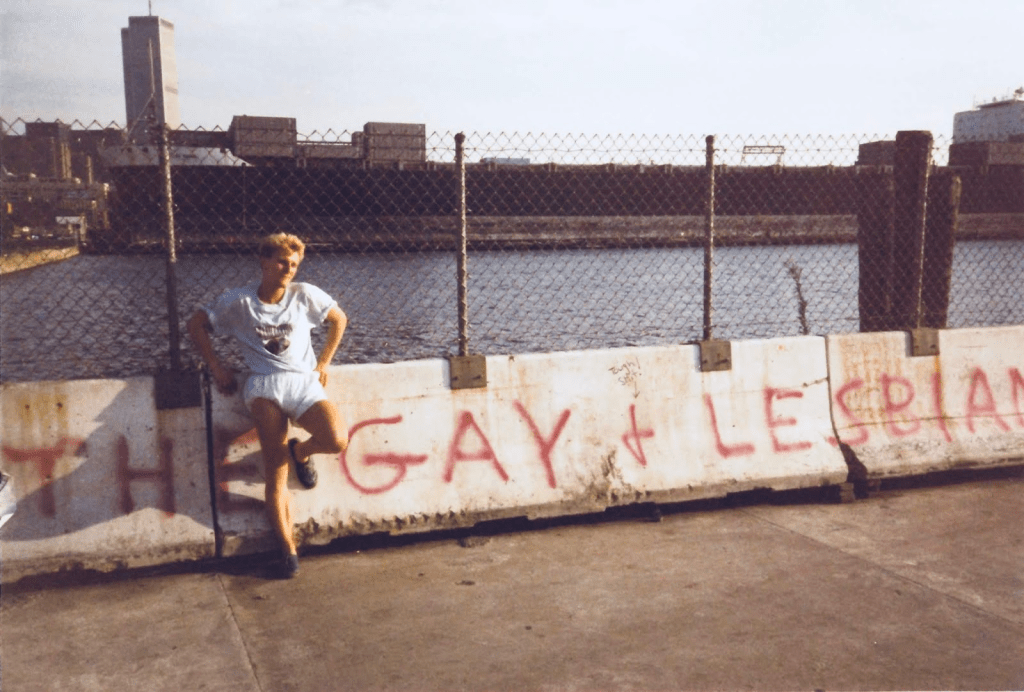
The World Trade Center is prominent in many of my early tourist pictures. Now, aware of my gradual estrangement from Manhattan, I tend to capture the vanishing of places I knew.
Plinth display of NYC, Travelling Through Me (1985 – 2018), digital and digitised photographs
For this collage, I rummaged through old photo albums and recent digital photographs. When I lived in New York, from 1990 to 2004, I very rarely photographed the city. All of these images either predate that period or were produced after it. The historic event of 11 September 2001 can be inferred from the presence and absence of a single landmark.
The World Trade Center is prominent in many of my early tourist pictures. Now, aware of my gradual estrangement from Manhattan, I tend to capture the vanishing of places I knew.
Lost New York City landmarks: Twin Towers and Gay Pier, 1987
Back in the 1980s, New York was not the glamorous metropolis I expected to find as a tourist. My early photographs reflect this experience. Most are generic views of the cityscape. Others show that I tentatively developed an alternative vision I now call ‘gothic.’ Yet unlike Rigby Graham, whose responses to landscape are displayed elsewhere in this gallery, I could never quite resist the sights so obviously signposted as attractions.
Like the personal photo album of the queer Welsh-born photographer Angus McBean, also on show in this exhibition, these pages were not produced with public display in mind. McBean’s album was made at a time when homosexuality was criminalised. It is a private record of his identity as a gay man.
I came out during my first visit to New York. The comparative freedom I enjoyed and the liberation I experienced were curtailed by anxiety at the height of the AIDS crisis.
Being away from home can be an opportunity to explore our true selves. Travelling back with that knowledge can be long and challenging journey.
Harry Heuser, exhibition curator
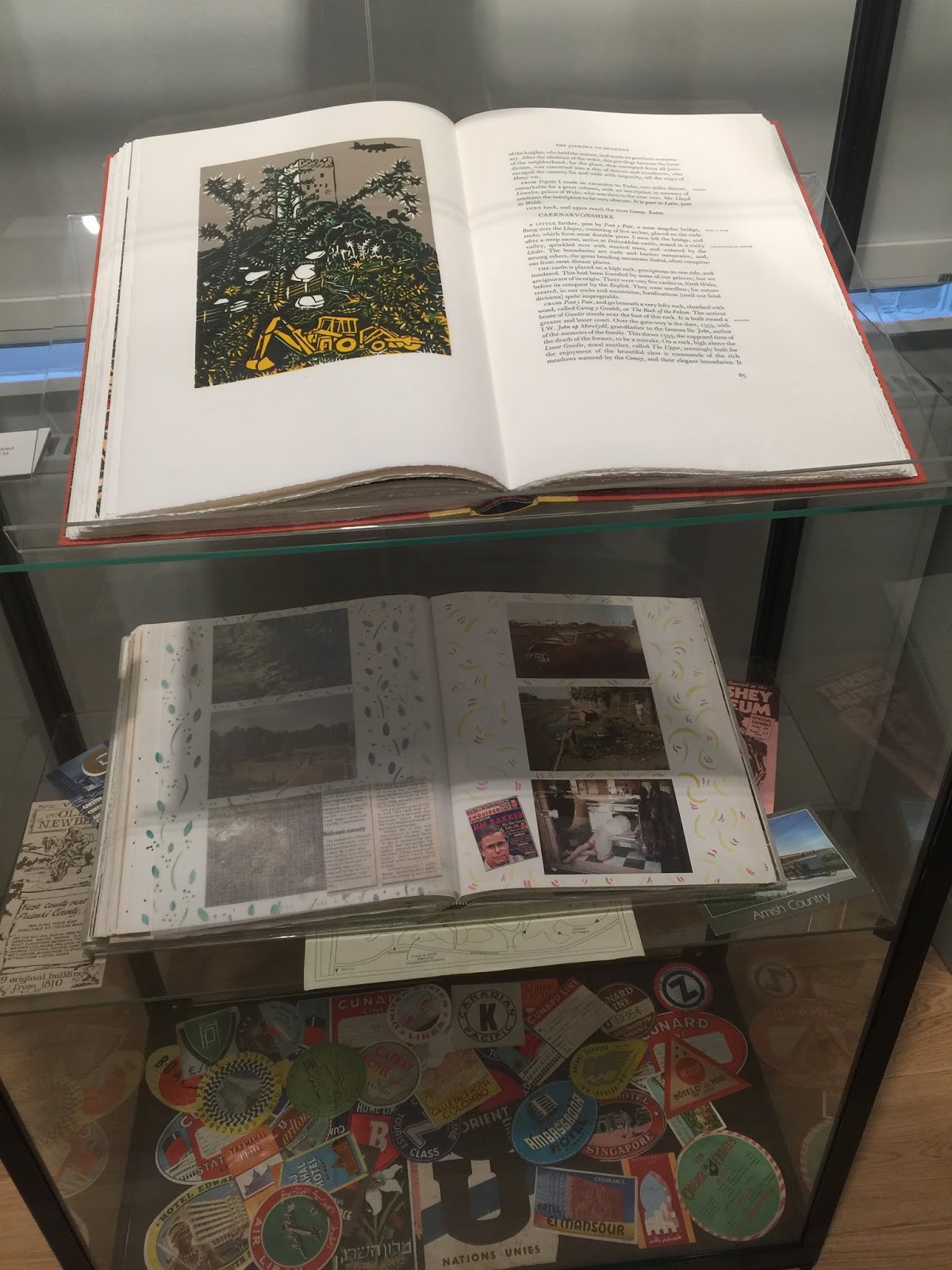
Pennant Tour of Wales featuring illustrations by Rigby Graham, with one of my photo albums and a collage of luggage labels from my collection beneath it.
Poster by Neil Holland, based on a design by Lauren Evans
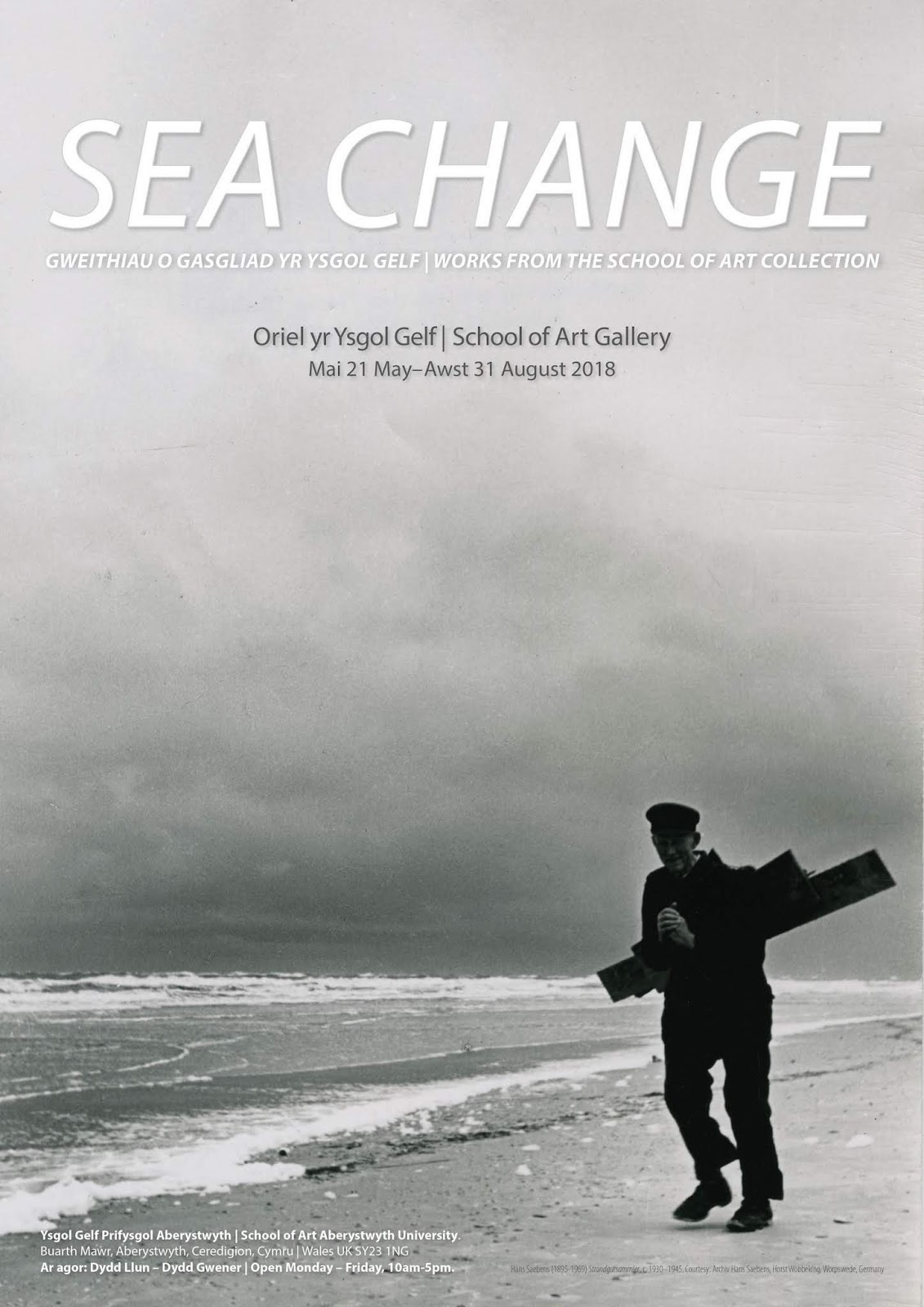
Once a year, I stage an exhibition with undergraduate students of my module “Curating an Exhibition” at the School of Art, Aberystwyth University. The student curators choose objects from the School’s collection, which, over a period of about three months, they research, interpret and narratively arrange in relation to a given theme. The theme for the 2018 exhibition (on show from 21 May until 28 September) is “Sea Change.”
The idea for it came to me watching CNN, where the phrase is frequently heard in promotional spots for Fareed Zakaria’s program. What, I thought, would happen if we considered the literal meanings of each part of the phrase to examine how life along the coast is transformed and transforming as a result of environmental and socio-political developments.
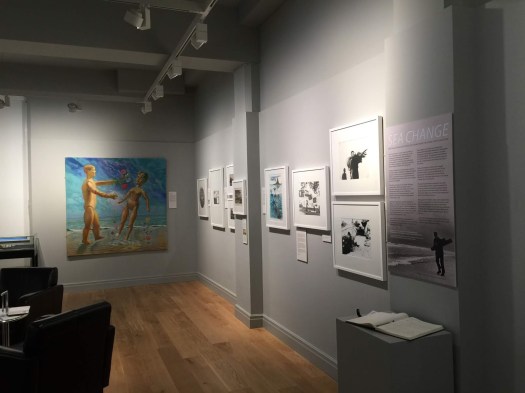
Installation view showing John Roberts’s large painting Fond Farewell (1973)
As always, the narrative evolved gradually, shaped by the objects selected by the exhibition curators. This is the text panel introducing the exhibition:
‘Sea change’ is one of the many expressions introduced to the English language by Shakespeare. It appears in The Tempest as a reference to death – and transformation – by drowning.
This exhibition of works from the School of Art collection explores both the metaphorical and the literal meanings of the phrase.
Today, ‘sea change’ is widely used to suggest moments of upheaval and reorientation. It may denote the end of a personal relationship or a geopolitical shift affecting the lives of millions. Whatever its measurable repercussions, ‘sea change’ is always felt to be profound.
Change may be dreaded or desired. It can mean at once breakdown and a chance for renewal. The storm that wrecks a ship and lays waste to dreams brings firewood to the beachcomber. The engines that turned villages into mill towns also transported workers to holidays by the sea.
Plate, from the series Cumbrian Blue(s) (1998) by Paul Scott
Many aspects of modern society were shaped in the Victorian era. Seaside towns like Aberystwyth owed their transformation to the Industrial Revolution. Since then, our coastal communities have continued to adapt. New challenges, from Global Warming to Brexit, lie ahead as Wales is celebrating the ‘Year of the Sea.’
The prints, paintings, photographs and ceramics on display encourage us to consider what we gain or lose through stability and change.
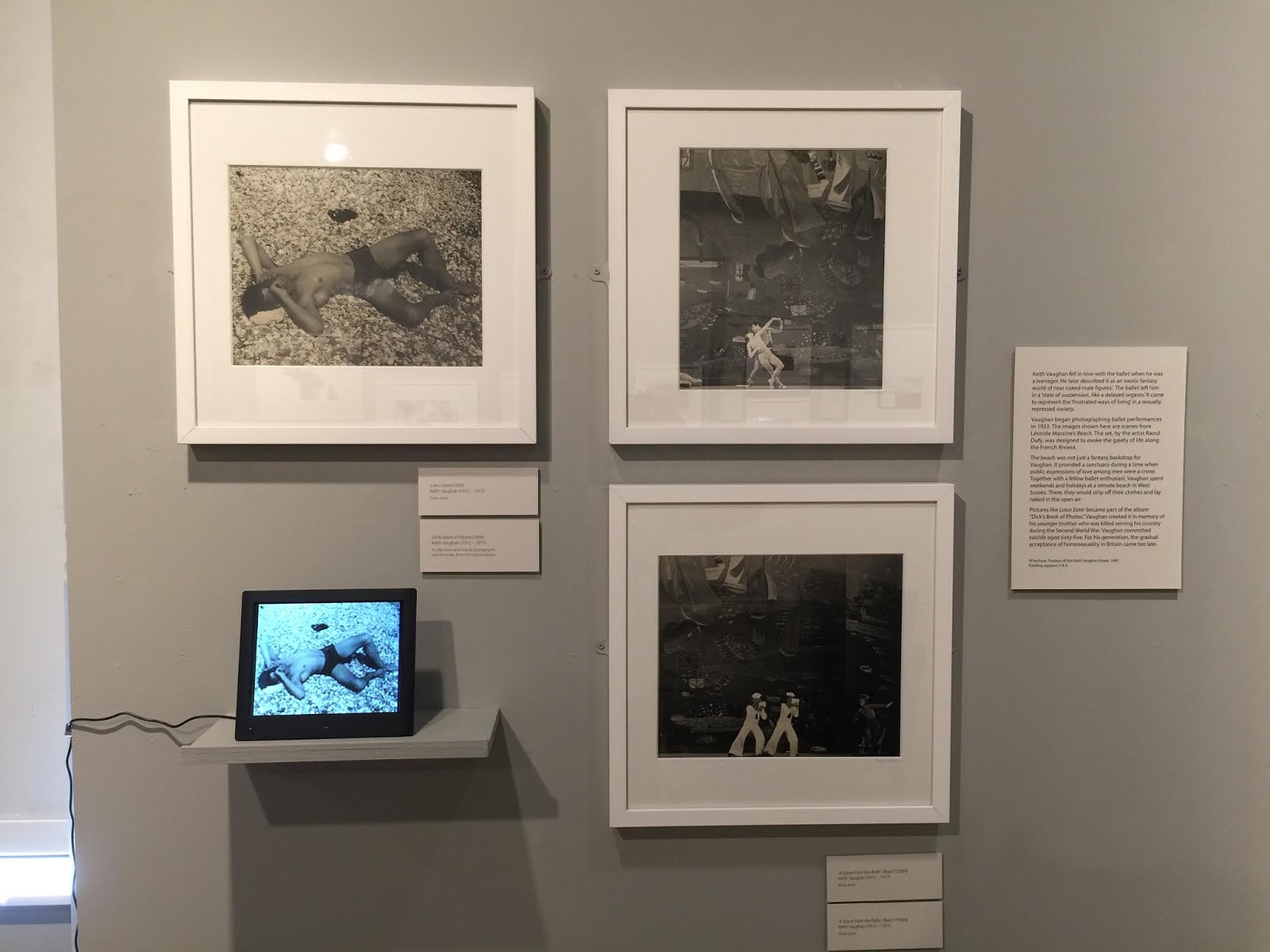
Works by Keith Vaughan feature prominently in the exhibition
Artists whose works are featured in this exhibition include Jean-Antoine Théodore Gudin (1802–1880), Honoré Daumier (1808–1879), Wilhelm Kümpel (1822–1880), Hans Saebens (1895 – 1969), Carlo Bevilacqua (1900 – 1988), Gertrude Hermes (1901–1983), Keith Vaughan (1912 – 1977), Robert Tavener (1920–2004), Gwyn Martin (1921 – 2001), John Vivian Roberts (1923–2003), Bernard Cheese (1925–2013), Terry Bell-Hughes (b. 1939), Chris Penn (1943–2014), Alistair Crawford (b. 1945), Paul Scott (b. 1953), and Kate Malone (b. 1959).
Curators: Lauren Evans, Gerry McGandy, Mike Kirton, Clodagh Metcalfe, Sophie Mockett, Ivy Napp, John Roberts, and Michelle Seifert; with support from Harry Heuser (text and concept) and Neil Holland (staging and design). Additional assistance by Karen Westendorf
I thought that I’d say a few words about the work of the man that brings us together here today – and perhaps about this place in relation to that man.
If Tunnicliffe could be with us today, chances are he wouldn’t be with us. London. The Academy. The artworld. That, he felt, was not his habitat. And yet, we wouldn’t be here if Tunnicliffe had not been elected a member of the Academy – as a printmaker, no less.
Tunnicliffe’s own accounts of his life emphasise his youth growing up and working on a farm. And much of that is reflected in his subject matter.
The Lederhosen were a bit of a gimmick, or a ruse.
Tunnicliffe certainly preferred the outdoors to the inside of institutions. He would rather study bulls than listen to what he would have considered to be so much academic BS. And even though he taught art, Tunnicliffe also said he much preferred birds to boys.
All of this fits the romantic view many of us have of the artist as an outsider. Perhaps, it fits rather too neatly. After all, the farm where Tunnicliffe grew up was near Macclesfield – and the signs of the Industrial Revolution were written in the wind.
Tunnicliffe was not removed from the world of industry or commerce. Nor was he resistant to change. Tunnicliffe, who studied at the Royal College of Art in London, owes his career not to any one institution but to his willingness to adapt.
For decades, far from the madmen crowd, Tunnicliffe produced images that served the advertising racket. His pictures promoted farming products (some toxic), spurious wonder drugs (for dogs) and the Midland Bank. Not exactly the messages of a lover of nature.
The thing is, Tunnicliffe’s pictures were not designed as vehicles for his own thoughts. He made products of visual culture to which messages could be attached by others, at a price, to suit their purposes.
Tunnicliffe also produced book illustrations. Many of his wood engravings – and the many more scraperboard images we are not even showing here – were secondary to a given text, enhancing or supporting it.
By the time he became an Associate of the Royal Academy, in 1944 (and a full member ten years later), Tunnicliffe had ceased to produce so-called ‘fine’ prints. The stock market crash had made it necessary for Tunnicliffe to rethink his career and to find his niche in order to make a living as a maker of images.
Partly as a result of this commodification, Tunnicliffe’s prints were never exhibited in a solo show here at the Royal Academy – until now.
You might well protest that what you see on display here today is not much of a print exhibition, either, given that his wood engravings are displayed alongside cheap reproductions and colourful paintings that might overpower them.
Print curator James Laver said nearly seventy years ago that it was ‘a pity’ that so few visitors to the Royal Academy come to ‘the little room in which the etchings and engravings are exhibited.’ Even those who did come visit had ‘neither the patience nor the strength to appreciate what is on the walls. For prints are intimate things. [They] need individual attention, like shy, sensitive children.’
I hardly think that individual attention span has increased over the last seventy years. And the Royal Academy seems to reflect that, or perhaps give in to it.
What Second Naturedoes bring across is the compromise that is Tunnicliffe’s work, and the way in which editioned prints and one-of-a-kind paintings compete with multiple copies: images of visual culture in the service of commerce, of advertising and the printed word. The purity or sanctity of art is, after all, little more than the modernist rubbishing of modernity.
As I said, this is Tunnicliffe’s first show here as a printmaker. Tunnicliffe regularly exhibited his watercolour paintings here at the Academy’s Summer Exhibitions, and they always sold. The one solo show he had here was an exhibition of post mortem studies of birds from his personal sketchbook back in the early 1970s.
That show was initiated by the Welsh painter Kyffin Williams, who, like Tunnicliffe and his wife, lived on Anglesey.
Well, the Royal Academy did not know quite what to do with those sketches. It consulted an ornithologist who vouched for their accuracy but also said that he had seen many like them just as accomplished. The works were arranged according to family, genus and species. In other words, those private studies, which Tunnicliffe lent only reluctantly, ended up portraying him as an imitator of nature.
Choosing a composition, combining pictorial elements and omitting detail – all that was important to Tunnicliffe. His pictures were designed to be decorative, as he called it. Faithful, decorative, or both at once, Tunnicliffe’s work can easily be coopted by those who say ‘now that is real art.’ Or, ‘when a farmer’s boy can become a Royal Academician, surely there cannot be any talk of inequality.’
Tunnicliffe was pragmatic rather than programmatic. He made images to make a living. But he did not promote a conservative agenda.
The gallery, shortly before the talk
Whether you find such a career uplifting or frustrating is a matter of politics. For me, it is intriguing because it confronts me with my own biases. A career like Tunnicliffe’s does not fit into the avant-garde narratives we resort to when we tell or teach the histories of twentieth-century art from modernism to postmodernism, or roughly the six decades during which Tunnicliffe worked professionally.
When I thought about a suitable title for our essay and the exhibition on display here, I set out by looking at what Tunnicliffe said about his work. I somehow wanted him – and his works – to stand on their own and let them do what most of them were not even intended to do – to speak for themselves or, if that is an impossibility, for Tunnicliffe.
In my research on Tunnicliffe, I came across a dramatic exclamation. ‘To hell with nature.’ Tunnicliffe said that in a nature lover’s magazine devoted to British birds. He said it toward the end of his career. To me, it expresses the frustration of a man whose work is generally judged on the strength of its resemblance to nature. As a kind of second-hand nature.
It would have made for a provocative title, don’t you think? But, even though I would have been quoting him, I would also have taking such a rare public outburst out of the context of a career predicated on compromise.
I wonder what would have happened if Tunnicliffe had dared to say ‘To hell with culture.’ He didn’t. In his work, at least, he did not question the socio-economics that restricted him to serve the market. His earlier work is autobiographical. His family members are worked into his subjects. After the stock market crash, commercial work kept him so busy, there was hardly time for the luxury of self-expression that we perhaps tend to overvalue today.
Tunnicliffe did not make environmental statements. He did not push any agenda. I wish he had. When we look at his work, we should perhaps acknowledge that, whether we perceive this as a lack or not, an apparent neutrality lends itself to being naturalized. A second nature is, after all, culture.
So, is it possible meaningfully to discuss the achievements of printmakers like Tunnicliffe without the politics? I am not sure. But I hope our book – and this exhibition here at the Academy – raises awareness of a printmaker whose work never quite made it into our art histories because it does not fit into the history of twentieth century art, a history that, to suit a grand narrative of progress, we have turned into the history of cultural products that we can lift up or push away as we deem fit.
Today it is easier than ever to produce and share photographs. Subjects diversify. Perspectives broaden. We no longer have to deal with precious materials or finite rolls of film when determining who or what is worth a shot. Yet images are also more readily manipulated. Realities are filtered and faked. The black-and-white photographs in Matter of Life and Death predate our digital age. Fragile and bold, these infinitely multipliable images of singular moments and individual lives were intended to live and matter as prints.
How do we measure the importance of a life? Who or what is worth remembering? These are some of the questions raised by photographs such as the ones on display in Matter of Life and Death, an exhibition on view from 16 May to 9 September 2016 in the gallery of the School of Art at Aberystwyth University in Wales.
Looking at images of people and places can make us aware of our cultural differences. But it is not difficult to find universals in photographs produced worlds apart. Struggling farm workers in 1930s Alabama are shown alongside striking miners in 1980s Sardinia and South Wales. The town of Aberystwyth, where the exhibition is staged, is featured next to Palermo and Bangkok. Visitors to our gallery will see the faces of children. But they will also face the aged, the dying and the dead.
All of the photographs are from the University’s collection. They were chosen by School of Art students who then debated how to exhibit them and create a narrative. Only the medium and the title had been decided beforehand by me, the instructor of Staging an Exhibition, a course in curating that each year culminates in a show like this one. Previous exhibitions include Queer Tastes, Untitled by Unknown, and Face Value.
The selections students made for Matter of Life and Death are journalistic and surrealist, propagandistic and personal, mass marketed and private. Some photographers – Walker Evans, Mario Giacomelli and Angus McBean among them – are famous. Others are unknown. Learning about the identity of a photographer may well influence the way we look at the work that photographer has produced. A child may look less innocent once we know that the man behind the camera was Erich Retzlaff, a photographer who supported and propagated fascist ideals.
All of the photographs are from the University’s collection. They were chosen by School of Art students who then debated how to exhibit them and create a narrative. Only the medium and the title had been decided beforehand by me, the instructor of Staging an Exhibition, a course in curating that each year culminates in a show like this one. Previous exhibitions include Queer Tastes, Untitled by Unknown, and Face Value.
There is no particular order in which these photographs should be experienced. Themes such as dying traditions or endangered environments are suggested, but there are no conclusions. As in life, material circumstances limit our choices. The paths we forge are our own.
Matter of Life and Death is open to the public until 9 September 2016. Admission is free.
Curators: Megan Evans, Rebecca Fletcher, Suzanne Fortey, Emma Game, Emily Griffin, Elizabeth Kay, Kirils Kirijs, Michael Kirton, Maria Lystrup, Kate Osborne, Amy Preece, Georgia Record, Emma Roberts, Samantha Robinson, Emily Smyth, Bethany Williams, Gemma Woolley; with support from Harry Heuser (text) and Neil Holland (design)
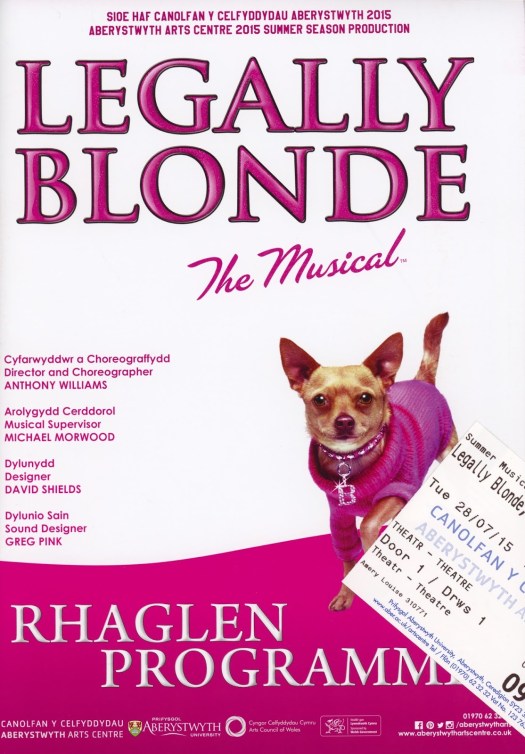
Okay, I am blond, gay and European. So it isn’t all that difficult for me to relate to this year’s summer season offering at the Arts Centre here in Aberystwyth. “Positive” and “Omigod You Guys,” it’s Legally Blonde: The Musical. Ever since I relocated, for love and legal reasons, to this little Welsh town – from an island, no less, that has Broadway running through it – I have not missed a single one of these seasonal spectaculars. After all, they are often the only indication that summer actually takes place here. And since that very first show – which was Oliver! back in 2005 – I have been coming back to the scene it would be a crime to miss.
I’ve also seen the summer season grow up over the years, and the characters along with it, from a criminally mistreated but dutifully hoofing and oh-so-adorable Victorian orphan to a stylish, twenty-first-century Harvard Law graduate who seems to be fighting a lost cause but ends up winning her first case and her true love besides.
In Legally Blonde, justice is served as in Dickensian days, except that what you deserve is no longer dished out as a helping of destiny. I won’t say that either way is “So Much Better” than the other – for entertainment purposes, at least – but it sure is about time to have, at the heart of it all, three persevering females who don’t have to suffer Nancy’s fate so that the Olivers of this world can enjoy the twist of their own.
Legally Blonde does its part to “Bend” if not quite “Snap” the long string of boy-meets-girl plots of theatrical yesteryear; at the same time, it cheekily pays tribute to the ancient laws of Western drama, right down to its cheerleading Greek Chorus. The conventions are not discarded here but effectively “Whipped Into Shape.” And what it all shapes up to be is an updated fairytale of boy meets girl in which girl ditches boy since boy doesn’t meet the standards girl learns to set for herself.
The lads, meanwhile, perform parts traditionally forced upon the ladies: they are the chosen or discarded partners of the women taking charge. Unless they are objectionable representatives of their sex, like the opportunistic Warner Huntington III (convincingly played by Barnaby Hughes), the men of Legally Blonde are mainly paraded as sex objects, flesh or fantasy. Exhibit A: stuff-strutting Kyle (inhabited by a delivering Wade Lewin). Exhibit B: gaydar-testing Nikos (gleefully typecast Ricardo Castro, returning to Aberystwyth after last year’s turn as Pablo in the divine Sister Act). Come to think of it, even the two dogs in the show are male – and how well behaved these pets are in the hands, or handbags, of the women who keep them.
Not that it looks at first like the women have a clue or a fighting chance. I mean, how can a gal be oblivious for so long to the connubially desirable qualities of gentle, reliable if fashion-unconscious Emmett Forrest (played by David Barrett, who was unmissable as Mr. Cellophane in the Aberystwyth production of Chicago)? That Elle Woods ultimately finds her way and gets to sings about it is the so not gender-blind justice of Legally Blonde.
And that we side with the spoiled, seemingly besotted sorority sister is to a considerable degree owing to Rebecca Stenhouse’s ability to make Elle mature in front of our eyes, from bouncily naïve and misguided to fiercely determined yet morally upright. And, as her character gets to prove, a valedictorian is not just Malibu Ken’s girlfriend in a different outfit. Legally Blonde demonstrates beyond the shadow of a doubt that you can be pretty and “Serious” in pink, even though I, personally, have failed on both accounts.
Depending on Elle’s success in getting her act together is the life and career of Brooke Wyndham (energetically played by endorphin-level raising Helena Petrovna), a celebrity on trial whose fitness empire is endangered by a dirty secret of a potential alibi. And if you are a cynic out for a hanging, just wait and see what Brooke (and Petrovna) can do with a piece of rope.
As it turns out, Brooke does not have to make a case for orange being the new pink, which of course was the old black. Ultimately, not wardrobe but a serious case of TTP saves the day, for which the production hairdresser can take some credit. Follicles play nearly as big a part in Legally Blonde as in Hairspray, to name another property Aberystwyth Arts Centre has laid its skilled hands on in recent years. And if that production had a showstopper in “big, blonde and beautiful” Motormouth Maybelle, Legally Blonde has down-but-not-out stylist Paulette Bonafonte, a role Kiara Jay makes her own with warmth, knowing and extensions in her voice that reach from here to “Ireland.”
Legally Blonde is not without its share of injustices. It takes a seasoned professional like Peter Karrie to accept a plea bargain of a part that allows him to be the villain of the piece but denies him the moment his Phantom-adoring followers may have been hoping for. It was Karrie I saw in that memorable Oliver! production, and he is back here as Professor Callahan, a suave shark with a nose for “Blood in the Water.” Like Fagin, he is a law unto himself; but unlike Fagan, the professor is ill served by a book that bars him from tunefully “Reviewing the Situation” once he gets his just deserts. Not that you won’t be gasping at the scene that constitutes his downfall.
Now, had I a Manhattan-sized “Chip on My Shoulder,” I could object that, if “What You Want” to produce is a musical, you might consider putting a few instruments back into the pit. I mean, with sets as swanky as Acapulco, why should the singing be practically a cappella? The overture out of the way, any such objections are largely overruled, given the plain evidence that these troupers hardly depend on orchestral crutches. “Break a leg” to all of them – dancing, skipping and rollerskating – for keeping the pace brisk and making Legally Blonde such an infectiously high-spirited show.
This was the first season I attended as a legally married blond, gay European – and I think it is no overstatement to say that, for all their heterosexual pairings, shows like Legally Blonde have helped to take on patriarchal bullies, to rethink masculinity and what means to “Take It Like a Man.” It’s not the American flag alone that is prominently on display here. Whatever your angle, I can bear witness to the fact that, by any standard – gold, platinum blonde, or otherwise – the Aberystwyth Summer Season is in the pink.






 Harry Heuser
