โ€œI’ve Got a Little Listโ€ (and the Hot Mikado Isnโ€™t on It)

At the risk of sounding like a loser at a Vegas spelling bee, I am a serious eye roller. Like a roulette wheel on an off night, each circulation marks the extent of my displeasure. The other night, I was really taking my peepers for a spin. Judging from such ocular proof, you might have thought that more than eyeballs were about to roll. Indeed, it seemed as if I were going to face the Lord High Executioner himself. Instead, we were merely going to a production of The Hot Mikado. I just couldnโ€™t warm to the idea of going camp on a classic that seems least in need of burlesqueโ€”or Berlesques, for that matter. Not that this stopped middle-aged troupers like Jack Benny, Bob Hope, and Groucho Marx to play โ€œThree Little Maidsโ€ (as part of a war relief benefit broadcast); but, at least, those tuning in were spared the visuals.

If I was less than enthusiastic, it was mainly on account of Charleyโ€™s Aunt. That dubious Victor/Victorian dowager had way too many nephewsโ€”and โ€œthey’d none of them be missed, they’d none of them be missed.โ€ Cross-dressing has long been on the none too little list of circus and sideshow acts that are more of a source of irritation than of hilarity. One strategically placed banana peel does more for me than two oranges nestling in a bed of chest hair. Itโ€™s a fruitโ€™s prerogative.

The origins of my aversion date back to the time when I began to realize that what I needed to get off my chest one day was something other than the fur I was not destined to grow in profusion. I was about twelve. Still without a costume on the morning of the annual school carnival, I let my older sister, who was as resourceful as she was bossy, talk me into wearing one of the skirts she had long discarded in favor of rather too tight-fitting jeans. Being dressed in my sisterโ€™s clothes was awkward for me, considering that I was fairly confused about my gender to begin with, certain only about the one to which I was drawn. More than a skirt was about to come out of the closet, and I was not equipped to deal with it.

Responding to my calculatedly nonchalant remark that the costume was some kind of last-minute ersatz, our smug, self-loving English teacher, Herr Julius, told the assembled class that, during carnival, folks tended to reveal what they secretly longed to be, which, apparently, went well beyond the common desire not to be humiliated. No wonder Herr Julius did not bother to don a mask other than the one with which he confronted us all the scholastic year round.

Matters were complicated further by my wayward anatomy. Letโ€™s just say that it didnโ€™t require oranges to make a fairly convincing girl out of me; I was equipped with fleshy protuberances that earned me the sobriquet โ€œbattle of the sexes.โ€ I wondered whether I was destined to shroud myself in one pretense in order to drop another. That, in a pair of coconut shells, is why cross-dressers and any such La Cage faux dollies were never to become my bag. And Iโ€™ve got a lot of baggage.

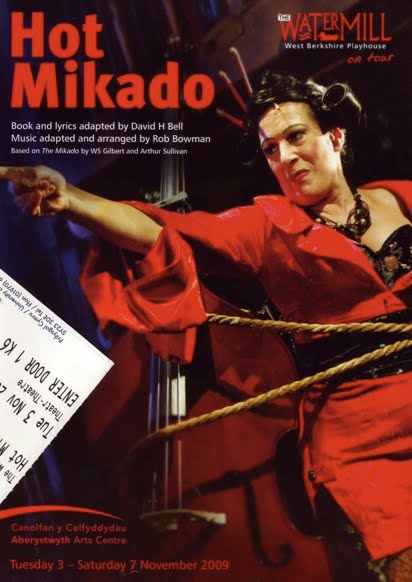
What has that to do with The Hot Mikado, the show I was so reluctant to clap my eyes on? As it turns out, not very much. I had been mistaken about the gender of the performer playing Katisha, the character on the poster (pictured above) that was advertising the Watermill production I caught at Aberystwyth Arts Centre.

Far from being some newfangled cabaret act, The Hot Mikado is seventy years old this year. Appropriating presumably WASPish entertainment for a younger and less exclusive audience, it was first performed in 1939 with an all-black, extravagantly decked out cast headed by the legendary Bill โ€œBojanglesโ€ Robinson in the title role. The currently touring Watermill productionโ€”which is soon to conclude in Girona, Spainโ€”updates the carnivalesque spectacle in retro-1980s colors, with Manga and movie inspired costumes, as well as assorted references to Susan Boyle and British politics. The music is still jazz-infused Gilbert and Sullivan.

Set โ€œsomewhere in Japanโ€ and produced at a time when Mr. Moto was forced to take an extended Vacation, the anachronistic Hot Mikado was all jitterbug without being bugged down by pre-war jitters. It is outlandish rather than freakish, amalgamated rather than discordant, qualities reassuring to anyone who has ever felt mixed up or unable to mix. A few bum notes aside, the production was hardly an occasion for any prolonged orbiting of orbs. The joyous spectacle of it kept even my mindโ€™s eye from rolling, from running over the bones, funny or otherwise, that tend to tumble out of this Fibber McGeean closet of mine . . .

Related recordings
Greek war relief special (8 February 1941), featuring Frank Morgan, Bob Hope, Jack Benny and Groucho Marx singing songs from The Mikado
โ€œHollywood Mikadoโ€, starring Fred Allen (11 May 1947)
Chicago Theater production of โ€œThe Mikadoโ€ (22 October 1949)
The Railroad Hour production of โ€œThe Mikadoโ€ (5 December 1949

โ€œ. . . from a civilized land called Walesโ€: A Puzzlement Involving The King and I

I rose before the sun, and ran on deck to catch an early glimpse of the strange land we were nearing; and as I peered eagerly, not through mist and haze, but straight into the clear, bright, many-tinted ether, there came the first faint, tremulous blush of dawn, behind her rosy veil [ . . .]. A vision of comfort and gladness, that tropical March morning, genial as a July dawn in my own less ardent clime; but the memory of two round, tender arms, and two little dimpled hands, that so lately had made themselves loving fetters round my neck, in the vain hope of holding mamma fast, blinded my outlook; and as, with a nervous tremor and a rude jerk, we came to anchor there, so with a shock and a tremor I came to my hard realities.
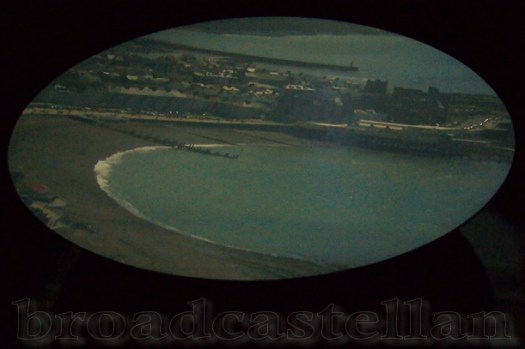
With those words, capturing her first impression and anticipation of a โ€œstrange landโ€ as, on 15 March 1862, it came into partial viewโ€”the โ€œoutlookโ€ being โ€œblindedโ€โ€”aboard the steamer Chow Phya, Anna Harriette Leonowens commenced The English Governess at the Siamese Court (1870), the โ€œRecollections of Six Years in the Royal Palace at Bangkok.โ€ The account of her experience was to be followed up by a sensational sequel, Romance of the Harem (1872), both of which volumes became the source for a bestselling novel, Margaret Landonโ€™s Anna and the King of Siam (1944), several film and television adaptations, as well as the enduringly crowd-pleasing musical The King and I.

Conceived for musical comedy star Gertrude Lawrence, the titular โ€œIโ€ is currently impersonated by Shona Lindsay, who, until the end of August 2009, stars in the handsomely designed Aberystwyth Arts Centre Summer Musical Production of the Rodgers and Hammersteinโ€™s classic.

The title of the musical personalizes the story, at once suggesting authenticity and acknowledging bias. Just as it was meant to signal the true star of the original productionโ€”until Yul Brynner stole the showโ€”it seems to fix the perspective, assuming that we, the audience, see Siam and read its ruler through Annaโ€™s eyes. And yet, what makes The King and I something truly wonderfulโ€”and rather more complex than a one-sided missionaryโ€™s taleโ€”is that we get to know and understand not only the Western governess, but the proud โ€œLord and Masterโ€ and his daring slave Tuptim.

Instead of accepting Anna as model or guide, we can all become the โ€œIโ€ in this story of identity, otherness and oppression. Tuptimโ€™s experience, in particular, resonates with anyone who, like myself, has ever been compelled, metaphorically speaking, to โ€œkiss in a shadow,โ€ to love without enjoying equality or protection under the law. Tuptimโ€™s readily translatable story, which has been rejected as fictive and insensitive, is emotionally rather than culturally true.

โ€œTruth is often stranger than fiction,โ€ Leonowens remarked in her preface to Romance of the Harem, insisting on the veracity of her account. Truth is, truth is no stranger to fiction. All history is narrative and, as such, fictionโ€”that is, it is made up, however authentic the fabric, and woven into logical and intelligible patterns. Whoever determines or imposes such patternsโ€”the historian, the novelist, the reporterโ€”is responsible for selecting, evaluating, and shaping a story that, in turn, is capable of shaping us.

Tuptimโ€™s adaptation of Uncle Tomโ€™s Cabin, which strikes us at first strange and laughableโ€”then uncanny and eerily interchangeableโ€”in its inauthentic, allegorical retelling of a fiction that not only made but changed history, is an explanation of and validation for Rodgers and Hammersteinโ€™s sentimental formula. Through the estrangement from the historically and culturally familiar, strange characters become familiar to us, just Leonowens may have been aided rather than mislead by an โ€œoutlookโ€ that was โ€œblindedโ€ by the intimate knowledge of a childโ€™s love.

Strange it was, then, to have historicity or nationality thrust upon me as Anna exclaims, in her undelivered speech to the King, that she hails โ€œfrom a civilized land called Wales.โ€ It was a claim made by Leonowens herself and propagated in accounts like Mrs. Leonowens by John MacNaughton (1915); yet, according to Susan Brownโ€™s โ€œAlternatives to the Missionary Position: Anna Leonowens as Victorian Travel Writerโ€ (1995), โ€œno evidence supportsโ€ the assertion that Leonowens was raised or educated in Wales.

Still, there was an audible if politely subdued cheer in the Aberystwyth Arts Centre auditorium as Anna revealed her fictive origins to us. Granted, I may be more suspicious of nationalism than I am of globalization; but to define Leonowensโ€™s experience with and derive a sense of identity from a singleโ€”and rather ironic reference to homeโ€”seems strangely out of place, considering that the play encourages us to examine ourselves in the reflection or refraction of another culture, however counterfeit or vague. Beside, unlike last yearโ€™s miscast Eliza (in the Arts Centreโ€™s production of My Fair Lady), Anna, as interpreted by Ms. Lindsay, has no trace of a Welsh accent.

As readers and theatergoers, we have been โ€œgetting to know you,โ€ Anna Leonowens, for nearly one and a half centuries now; but the various (auto)biographical accounts are so inconclusive and diverging that it seems futile to insist on โ€œgetting to know all about you,โ€ no matter now much the quest for verifiable truths might be our โ€œcup of tea.โ€ What is a โ€œpuzzlementโ€ to the historians is also the key to the musical, mythical kingdom, an understood realm in which understanding lies beyond the finite boundaries of the factual.


Related writings
“By [David], she’s got it”; or, To Be Fair About the Lady
Delayed Exposure: A Man, a Monument, and a Musical

Related recordings
โ€œMeet Gertrude Lawrence,โ€ Biography in Sound (23 January 1955)
Hear It Now (25 May 1951), which includes recorded auditions for the role of Prince Chulalongkorn in The King and I

โ€œ. . . and all the ships at seaโ€: A Kind of Homecoming

This is not going to be one of those โ€œthe dog ate my homeworkโ€ sort of posts, which are as much an excuse for not writing as they are a woeful excuse for writing anything at all. Besides, I could hardly blame Montague, our terrier, for keeping me from keeping my journal. Rather, it is the home work that has done the biting, gnawing and tearing at the hours I would otherwise earmark for sinking my incisors into stale pop-tartsโ€”you know, those cultural marginalia with which I am wont to occupy my mind.

While I have rarely been all at sea when it comes to the leisurely pursuit of gathering and examining pop-cultural jetsam, my mind does not take to creative recycling when my limbs are aching after having performed some burdensome chore; and these past three months, my limbs have had quite a workout. We have been readying our late-Victorian house in the Welsh seaside town of Aberystwyth for its present trio of occupants, only the four-legged one of whom appears to be as blithe and sprightly as of old, albeit saltier.

We have moved in at last; and even though much remains to be done to make and keep the place shipshape, especially now that the house guests are checking in and up on our work, the sofas and easy chairs are in place from which to let out a defiant โ€œLater!โ€ and take off instead in further explorations of the airwaves or some such neglected channel.

The waves! Even though you would have to climb to the top floor of our house to get a glimpse of the bay, the surf and the seagulls are very much part of the enveloping soundscape. I suspect that the sights and sounds of the sea are going to feature prominently in subsequentโ€”and decidedly more frequentโ€”entries. It was not quite so easy for me to work the business of scraping wallpaper into my reflections; but the sea is another kettle of fish altogether.

So, โ€œGood evening Mr. and Mrs. America, from border to border and coast to coast and all the ships at sea,โ€ as famed newscaster and lexicon-artist Walter Winchell used to sayโ€”and which greeting I extend to Mr., Mrs., and Ms. Internet surfer the world overโ€”โ€œLet’s go to press . . .โ€


Related writings (featuring Walter Winchell or an Impersonator)
โ€œBeing But Blogmad North-Northwestโ€
โ€œAmelia Earhart Is Lateโ€
โ€œOld-time Radio Primer: B Stands for broadcastellanโ€

Never Mind "Local Color"โ€”That’s a Bruise!

Last week, my best friend was in town for a visit. Ever since I left our native Germany some twenty years ago to live abroad (first in the US, now in the UK), our time together has been short and rare. I have learned to accept the brevity of our reunions; but treating them as special occasions has often bothered me. Not that it would be a waste of time just to flop and chat; then again, that is what we do apart almost daily while on the phone with each other. So, as if our get-togethers werenโ€™t special enough, I somehow feel obliged to make my friendโ€™s journeys here worthwhile by planning something out of the ordinary.

This time around, though, there was less time and still less money for the โ€œspecial,โ€ given that most of our hours and pounds are being spent on renovating our house in town. Okay, so I tried to pass off a seven-hour roundtrip in a van to pick up a bathtub as a sightseeing tourโ€”but much of my German friendโ€™s visit was passed in the appreciation of local color: the blue bells, the silvery sea, and the lush greenery of nearby Hafod, a Picturesque, man-made landscape that was an inspiration to Britainโ€™s Romantic poets.

Then there was a hike up Constitution Hill just behind our future home to look through the lens of the camera obscura (pictured), presumably the biggest in the world. Yes, there is plenty to see in Aberystwyth. As one Victorian traveler expressed it, it is worthwhile coming here just to see the sunset.

So much for the daytime highlights. What about evening entertainment? How fortunate, I thought, that the local cinema was screening films of local interestโ€”a Welsh-language picture about a 1970s comedy act that hit it big in the Valleys but dreamed of Vegas (Ryan a Ronnie) and a British biopic about Michael Peterson, a man born in this very town. Not a dignitary, mind, but a celebrity nonethelessโ€”a nonentity of guy who, lacking all other ambitions, reinvented himself as Charles Bronson, thug.

Nicolas Winding Refnโ€™s Bronson (2009) is not a traditional biography. It is no more a character study than Friday the 13th, even though it is more concerned with its own glamour than with the ugliness of its subject. The film does not attempt to debate whether nurture or nature (the radioactive Irish Sea, say) turned a boy into a beast, to explain what went wrong along the way to a maturity unreached.

Bronson makes no mention of Petersonโ€™s birthplace, which, given the violent subject, must be a relief to those engaged in trying to sell the town as a seaside resort. Besides, the home Peterson made for himself is solitary confinement, in which he spent most of his life. Thirty years and countingโ€”without a murder charge to his discredit.

The filmโ€™s homophobia asideโ€”its muscular, naked, supposedly โ€œunadulteratedโ€ violence comes across as less freakish than the cultured, artistic and presumably fey who seek to entrap, educate, or exploit Petersonโ€”Bronson is most disturbing in its refusal either to accuse or excuse the man. It simply displays, thereby giving its yet living subject precisely what itโ€”along with the publicโ€”appears to crave most: celebrity. It is a nightmarish picture of a good-for-nothing who achieves fameโ€”like a roid-raging Paris Hilton (High-security Hilton?)โ€”without doing anything deserving of our notice, let alone our praise.

Bronson is the anti-Elephant Man: โ€œI am not a human being,โ€ he seems to insist, โ€œI am an animal.โ€ He is a sideshow act entirely satisfied with his own conspicuous marginality.

If the film argues anything, it is that our inability to pin Peterson down is what terrifies us most, what compels us to watch and forces the authorities to keep him under lock and key. With this makeshift thesis, the shallow if stylistically intriguing Bronson, which favors art direction over the use of a moral compass, attempts to justify its approach, making a virtue out of its superficiality by denying us access into the mind it is incapable of penetrating.

I took my visitor to see Bronson in hopes of catching a glimpse of our little town and of learning something about its darker past. Instead of shades of local color, though, I was dealt a rather nasty shiner.

"Milkman" in the Attic

โ€œLook, sonny, weโ€™re up here for work. Weโ€™ve put this attic off, and put this attic off. Now that weโ€™re here, letโ€™s make every minute count.โ€ That was the voice of reason Rush Gookโ€”and several million radio listeners besidesโ€”heard on the day (18 August 1942, to be precise) that mom Sade decided it was time to tackle that stuffy space under the roof of the โ€œsmall house half-way up in the next block.โ€

Our attic, revealing the age of our house

As anyone familiar with Paul Rhymerโ€™s Vic and Sade could guess right off, there was more room for doubt than reason that the task would be accomplished, and that, when the brief visit with the home folks was over, said space would be any more disorganized than it was before the job got underway. You could expect more order, method and sanity sticking your head into Fibber McGeeโ€™s closet.

Now, Iโ€™m not being etymologically sound here, but it is probably no coincidence that attics are just a single consonant removed from anticsโ€”and that is just what you should expect to find while up there, even if it is antiques youโ€™re after.

Our new old house has not one but two attic spacesโ€”and in the smaller of these we found ourselves confronted with some kind of time capsule. Only, it wasnโ€™t quite the right time.

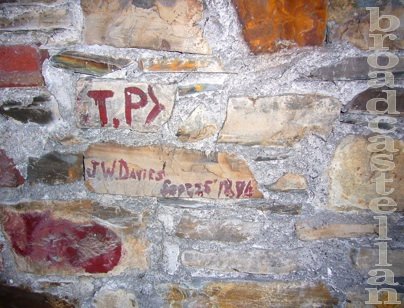
The graffiti on the wall suggests that construction was pretty much completed by September 1896, which was probably the last time the roof space was clutter free. Not that I want it to be barren of memories, mind.

Given the age of the house, I was kind of hoping for a family skeleton. Romantic novels of the Victorian age suggest that the darkest secrets are best kept just below the roof, rather than being crammed into the proverbial closet. Jane Eyre’s Bertha Mason comes to mind, and that seminal study on the subject (Gilbert and Gubarโ€™s Madwoman in the Attic).

The Benny Hill album

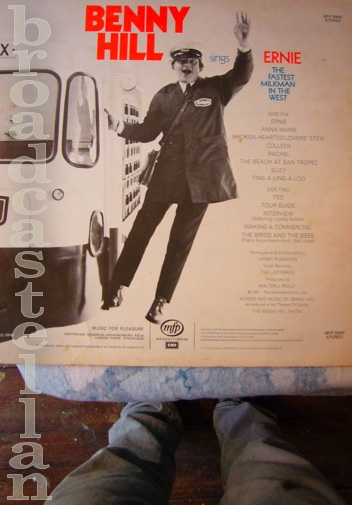
Instead, we were treated to โ€œBenny Hill Sings โ€˜Ernie, the Fastest Milkman in the West.โ€™” Not exactly a Victorian treasureโ€”but at least Ernieโ€™s story has the proper romantic ingredients: lust, rivalry, and premature death (a โ€œstale pork pie caught him in the eye and Ernie bit the dustโ€); there is even revenge from the beyond, as the milkmanโ€™s โ€œevil-lookingโ€ successor, Two-Ton Ted from Teddington, is denied the pleasures of his wedding night:

Was that the trees a-rustling? Or the hinges of the gate? / Or Ernie’s ghostly gold tops a-rattling in their crate?

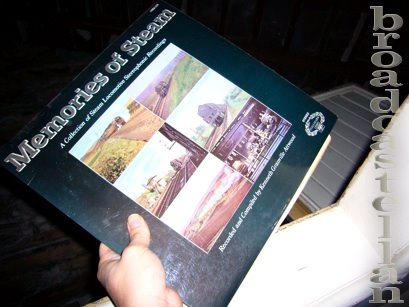
The cleanup sure slowed down once I came across that discarded collection of vinyl, the highlight of which, to me, is a curiosity labeled โ€œMemories of Steam.โ€ The locomotives on the cover could not deceive anyone into expecting the tell-all record of an inveterate Lothario; but I was thrilled nonetheless, transported back to the days when, as a boy, I was given an album of collected noises that led me to stage my own audio dramasโ€”signifying nothing to anyone else, but chock-full of sound and fury. Come to think of it, that one record may well have laid the tracks that, long and winding though they were, earned me a doctorate . . . just the kind of certificate to relegate to the space I had just visited.

Another find in the attic

Yep, even a climb up to an attic filled with the leavings of previous inhabitants leads me no further than some dim corners of my own memory. Unlike Sade and Rush, I do not have to wait for crazy Uncle Fletcher to disrupt the tasks at hand with one of his dubious recollections (โ€œSadie, do you remember Irma Flo Kessy there in Belvidere?โ€ She was a โ€œpeevish womanโ€ who “used to have a little habit of slappinโ€™ her husbandโ€™s face in publicโ€). I can count on my own past to traipse close behind and creep up on me.

This time, though, the detour into those mental crevices was a welcome and trouble-free one. Down below, rooms hung with ghastly wallpaper were waiting for a hand attached to my aching body . . .

Related recordings
โ€œCleaning the Attic,โ€ Vic and Sade (18 August 1942)

Related writings
“The Home Folks Are Moving In”
โ€œHome Folks Lose Ground to Plot Developers”


"By [David], she’s got it"; or, To Be Fair About the Lady

Having spent a week traveling through Wales and the north of Englandโ€”up a castle, down a gold mine, and over to Port Sunlight, where Lux has its originsโ€”I finally got to sit down again to take in an old-fashioned show. That show was My Fair Lady, a production of which opened last night at the Aberystwyth Arts Centre, where each summer a musical is put on for the amusement of the locals and the visitors to the seaside town a few miles east of which I now reside. These productions, the aforementioned Oliver!, Fiddler on the Roof, and West Side Story among them, tend to be quite ambitious in their choice of Broadway and West End fare, titles likely to raise expectations higher than any theatrical curtain falling on them, whether to the relief or regret of the assembled crowds. The present Lady is no exception.

According to lore shared by Michael Kantor and Laurence Maslon in Broadway: The American Musical, even Oscar Hammerstein gave up on the idea of showtuning Shawโ€™s Pygmalion, advising fellow songwriter and radio alumnus Alan Jay Lerner against it. โ€œJust You Wait,โ€ the librettist thought and, to the delight of millions, he and his partner, Frederick Loewe, got on with the show that not only opened on Broadway in 1956 but refused to close for several seasons, proving an enduring popular and critical success.

Now, I did not expect a performer equal to Julie Andrews or Audrey Hepburn when I took my seat and glanced at the program. Indeed, I was never fond of the former or of the film version starring the latter. I had read in the local paper that two leading ladies were taking turns during the month-long run and that the showโ€™s director, Michael Bogdanov, was yet to determine which one of them would perform on opening night. The Lady in question was Elin Llwyd, a graduate of the Royal Welsh College of Music and Drama. Sure, a Welsh lead for a part requiring a Cockney accent transformed into an English that would both please and fool high society as being the genuine article. Iโ€™m a far more โ€œOrdinary Manโ€ than Professor Higgins professes to be; but, having lived among the Welsh for some time now, I can tell a Cymru tongue from an English one when it is stuck out at me from a reverberating stage.

โ€œThe English have no respect for their language,โ€ the Irish playwright (heard here introducing himself) deplored in his Preface to Pygmalion. Neither have theatrical directors, it seems; or, rather, they do not appear to have much respect for the ear by which they mean to drag audiences into the realm of make-believe. Mind you, the production is being coy about the filiations of Eliza, casting fellow Welshman Ieuan Rhys as her father and throwing in a few self-conscious references about the culture and language. Still, no matter how ably supported and otherwise capable, the slate-hewn Galatea taking center stage faces the well-nigh impossible task of faking not one accent, but two; and, as her acting became more energetic and engaging during the second act, Welsh got the better of the flower girl from the slums of Lisson Grove, London, whom a conceited gentleman scholar wagers to unveil as one of his kind by chiseling at her accent. โ€œBy George, sheโ€™s got itโ€? By David, she couldnโ€™t get rid of it!

“Ah-ah-ah-ow-ow-ow-oo!” A few years ago, I was incapable of discerning what now spoke so clearly against the effort to suspend my disbelief. I have spent most of my adult life being cast as a foreigner based on the sound of my utterings. Often, I was made to feel like an imposter, earmarked as one supposedly pretending to be American or English while invariably exposed by a slip of my wayward Teutonic tongue. Given my accentual trials, I am drawn to stories like Eliza Doolittleโ€™s . . . or Elin Llwydโ€™s.

Patois may be less restricting and defining these days; but, for a play like Pygmalion or its tuneful remake to ring true, phonetic distinctions should not be leveled along with the social discriminations they beget. In this case, equal opportunity spells a missed one. Besides, it just ainโ€™t fair to the memory of the vernacularly challenged ladies and lads whose speech was not equal to their ear.

Pulp: A Tissue of Lies

In the house I now call home, I am surrounded by a great many works of art, from oils and etchings to ceramics and stained glass. When I moved in the walls were already crowded with images; and I felt strangely if understandably disconnected from them and my new surroundings. For this simple reason, our Welsh cottage soon came alight each evening in the ersatz glow of moving images imported from the Hollywood of the 1930s, โ€˜40s, and โ€˜50s (a few exceptions notwithstanding). These pictures are projected onto a blind behind which unfolds the celebrated beauty of the Welsh landscape which, on a cloudless night, is more silver than the screen. For weeks after moving here from New York City (back in November 2004), a move worthy of a Daphne du Maurier thriller, were it not for my genial partner, I was unable to draw the blinds without bursting into tears, no matter how serene the scenery (our living room view being this or, as the season changes, that).

Not that there werenโ€™t objects in the house to which I could relate. In our library, for instance, I am greeted by the no-one-else-likes of Chaucer and Shakespeare (who, along with Francis Bacon, are being sent from room to room, with Bacon now diurnally aglow in the window of our bedchamber). These stained-glass likenesses were installed for the very purpose of making me, a former literary scholar, feel welcome, familiar, and understood. It is in the attic that I am harboring the rather more lowbrow art churned out by Hollywoodโ€™s advertising machinery, all of which feature my favorite leading lady, Ms. Claudette Colbert. The most recent acquisitions to my collectionโ€”a Valentineโ€™s treatโ€”are these two posters for The Secret Fury (1950), a thriller whose fierce but fallacious (and ultimately pointless) pushing I previously discussed after getting my hands on this piece of promotional literature.

The smattering of rousing captions that accompany the images sure smacks of desperation. How do you sell a forgettable thriller as a must-see? You resort to words and phrases like โ€œkillโ€ and โ€œcold blood, โ€œevilโ€ and “insane,” โ€œmurderโ€ and โ€œmonstrous secretโ€ to align the indifferent material you are pushing with the neo-gothic literature known to sell. In radio dramatics, no words were more prominent than โ€œmurderโ€ and โ€œdeath.โ€ โ€œLoveโ€ doesnโ€™t sell half as well as death. โ€œSexโ€ might, but radio was too cautions to go where most mindsโ€”and the species at largeโ€”are on a regular basis. To this date, US entertainment is more tolerant of mutilation than titillation, owing chiefly if indirectly to the violence that is religion.

Even though its solution relies on a prominent visual clue, The Secret Fury was produced on radio by the Screen Guild. A recording of the broadcast is no longer extant; but a picture of its leads, Colbert and Robert Ryan, posing with the script appears in David R. Mackeyโ€™s Drama on the Air (1951). I donโ€™t mind being taken in; in fact, looking at poster art like that (or this one for Colbertโ€™s Sleep, My Love), I am approaching the dramatic territory of the radio thriller. I am being given just enough clues to let my mind’s eye imagine a pretty sensational picture.

In My Library: Emlyn (1973)

Like the man in the old Schlitz commercials says, โ€œI was curious.โ€ So, earlier this week, I went to the local second-hand bookstore in search of George, an autobiography of actor-playwright Emlyn Williams. It had been recommended to me at the recent Fflics film festival here in Aberystwyth as the insightful source of The Corn Is Green, a play and movie about the relationship between a Welsh student and his English teacher. The shelves of Ystwyth Books (shown here in a picture I found on flickr) are well stocked with titles on Welsh history and culture.

Not that titles about Hollywood or radio are wanting. In fact, the first purchase I made in this country shortly after moving here in November 2004 was made in that very store. It was a book on radio writing that had just come out (new releases can be found downstairs). Radio writing? In 2004? There was a chance, I thought, that I might feel at home here, eventually.

Anyway, there was no sign of George. The shop’s new proprietor offered to descend into the basement to check the inventory with which he is as yet not entirely familiar. After a few minutes, he emerged with Emlyn, subtitled a “Sequel” to George. Would I want it, not having been introduced to George (Williams’s other first name)? I opened the book, and it seemed to speak to me and anticipate my doubts:

I don’t think I’ll read thisโ€”it says it’s a sequel and I didn’t read the first one so I’d feel out of it from the first page . . .

And even if you did read โ€œthe first one,โ€ your mind needs refreshing. It is up to me to ensure that the reader need know nothing of George by supplying rapid salient information about my life up to April 1927.

An author so forthright and accommodating deserves to be given a chance, I thought. Then I read on, sensing that what I wanted to learn from and about the playwright of Night Must Fall (and He Was Born Gay) was something he might not wish to share:

Before I do so, one thing: at the moment when I embarked on the โ€œfirst oneโ€ I decided I would travel no further than the age of twenty-one, feeling that while a writerโ€™s first two decades might be of interest, the third must present a formidable task. ย Can he be as honest about it?

I knew that without honesty the story would deteriorate into a parade of professional ventures interspersed with cautious anecdotes. ย The alternative must be a marriage between Candour and Taste, with the continuous likelihood of one partner pushing the other out of bed; even then, it would have to be a different book.

A “different” book. That is just what I expect from a self-conscious gay Welshman with a penchant for serial killers. Will he be honest about “it”? Will he lie in bed with Candour or lie about his bedfellow with Taste? Is this autobiography apologia or play-acting, an author-actorโ€™s chance to don masks of his own design? We think of truth as being naked; but the act of self-exposure, the dropping of guises, the whole tease of the strip itself is performance.

Now, Emlyn, subtitled A Sequel to George, is one of those memoirs whose author is kind enough to provide an index, allowing those as impatient as I am to extract from the text what interests them most without having to go to so many parties, rehearsals, and opening nights. The first thing on my mind was not the open secret of Williams’s private life, but anything relating to Night Must Fall, the thriller I had seen on stage during the centenary of Williams’s birth back in 2005.

Williams recalls how the play came about and how, during a party at the house of fellow actor-playwright Frank Vosper, he discovered that his host appeared to be writing a similar thriller, also involving the case of murderer Patrick Mahon. Vosper’s play was titled Love From a Stranger, an adaptation of Agatha Christie’s story “Philomel Cottage.”

Murder must out. Must Mr. Williams?

Silenced Movie: The Life Story of David Lloyd George (1918)

Generally, we don’t regard our movie comings and goings as once-in-a-lifetime events, no matter how extraordinary the experience. In fact, we are inclined to opt for a rerun if a film manages to make us wax hyperbolic in our enthusiasm for it. To be sure, not many moving images have this force; nowadays, they are so readily reproduced, so instantly retrieved, that many of us won’t even bother to sit down for them, knowing that they can be had whenever we are ready for them. We miss out on so much precisely because we are comforted to the point of indifference by the thought that we do not have to miss anything at all. When I write “we,” I do number myself among those who are at-our-fingertipsy with technology. Last weekend’s screening of The Life Story of David Lloyd George at the Fflics film festival here in Wales was a reminder that films can indeed be rare; that they are fragile and subject to forces, natural and otherwise, that cause them to vanish from view.
The Life Story of David Lloyd George was produced in 1918; directed by the prolific but less-than-acclaimed British director Maurice Elvey. Now, I do not quite share the view that the hugely prolific Elvey was a hack. His talkie The Phantom Fiend (1932), with Hitchcock’s Lodger Ivor Novello may not be a cinematic masterpiece; but for all its technical flaws it nearly as experimental as Hitchcock’s version of the old Jack the Ripper thriller. Aside from Novello’s piano playing, Elvey makes great and at times reflexively sly use of the telephone, as he readies the silent version for sound. More accomplished still is Elvey’s second version of Hindle Wakes (1927), a bleak working class melodrama I mentioned here previously.

Like Hindle Wakes, Life Story was partially shot on location in Wales; but in the latter film, the scenery is no mere backdrop for romance, of which the documentarian if propagandist Life Story is almost entirely devoid (notwithstanding the sentimental scenes involving Lloyd Georgeโ€™s relationship with his daughter, portrayed by Hitchcockโ€™s partner Alma Reville). It is the soil in which flourished the career of a British Prime Minister (pictured), the reformer they called the “Welsh Wizard.”

Elvey begins his biography of Lloyd George very nearly ab ovo by presenting us with a shot of his birth certificate. Life Story strives to be historically accurate, but is unapologetically propagandist in its portrayal of the Prime Minister’s accomplishments during the days of the Great War, near the conclusion of which the film was produced. The final image is of Lloyd George (portrayed by Norman Page) looking at his audience, insisting that there must not be another war.

His audience? That, of course, is the crux, the tragedy, and the mystery of Elvey’s D. W. Griffithean epic: it was never publicly screened during the Prime Minister’s lifetime, never referred to by those involved in its making, and discovered not until the mid-1990s, at the home of Lloyd George’s grandson. As film historian Kevin Brownlow remarked in his introduction of the film at the Fflics festival, it is equally astonishing and deplorable that no documentary has as yet been attempted to investigate the film’s disappearance and the silence surrounding it for nearly eight decades.

The Life Story of David Lloyd George is soon being released on DVD, another rarity to become widely available and largely ignored; but it was the bravura performance of silent film composer Neil Brand, whose dramatic underscoring of the cinematographically not always compelling 152-minute biopic made for a once-in-a-lifetime theatrical experience.

Twenty Men Singingโ€”But Why?

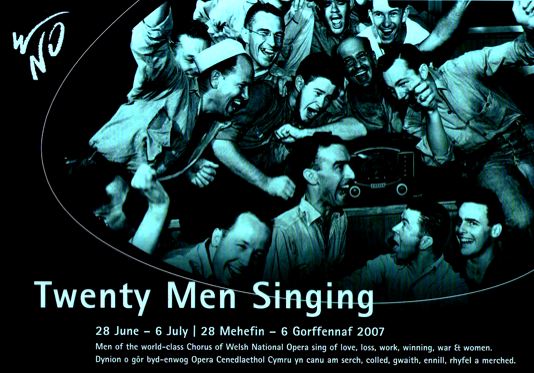
There they stood last night, singing a cappella, performing songs from Schubert to South Pacific, from the 13th-century Middle-English “Sumer Is Icumen In” to Alfred Schnittke’s “Adam Sat Weeping at the Gates of Paradise,” which premiered in 1988. Twenty they were; men of the Welsh National Opera, touring Wales with their aptly titled program Twenty Men Singing. Some of their sonic offerings were tonic, many (and for my taste rather too many) of them somber, reverent, and brooding.

Why were they singing? To amuse themselves, to entertain others, to earn a few quid or to enjoy the applause of an appreciative crowd? Why sing in unison when what you want is to stand out? If, indeed, that is what you want.

According to the program notes, those Twenty Men Singing explore just that: why men raise their voice together in song, whether to celebrate life, to protest or lament. In song, a hoped for unity is being realised in sonic unison. A chorus of disapproval is formed in resistance to voices and actions that may threaten community. Leoลก Janรกฤek’s “Sedmdesรกt tisรญc” (1909), for instance (as translated by John Binias), many-voices the pressures inflicted on the national identity of a Czech bordertown by neighboring but less than neighborly Germans and Poles:

70,000 graves they dig for us
Outside Tesin
Beg for help from heaven
Herded like cattle
Like cattle we gaze about
Our own slaughter [ . . .].ย 

Let our voices thunder out: [. . .].
Before we are finished [. . .].

This Saturday, performers around the world are singing to bring awareness to what may well be the greatest threat to humanity, regardless how much religion and nationalism, how much faith and terror (and the terror of faith) are being exploited by those who make a fortune keeping us at war with one another.

On this day of Live Earth, festivities that coincide with the anniversary of the London suicide bombings of 2005, we are asked to consider the terra we share, not the terror that divides us, to let “our voices thunder out” before we are “finished.” I cannot think of a better reason for joining a chorus.