“Uneasy Threshold”: The Old Dark House (1932), “wildest Wales” and the Benighted Kingdom

Much has been said about the titular edifice of Universal Studio’s 1932 melodrama The Old Dark House, the third in the series of films I am screening as part of my Gothic Imagination module at Aberystwyth University.  Directed by the queer English Great War veteran James Whale, and adapted from J. B. Priestley’s 1927 novel BenightedThe Old Dark House is often argued to be a commentary on Imperial Britain during the so-called interwar years (that is, the period between the two World Wars, Britain having been involved in plenty of other international conflicts besides): an ancient but crumbling family home – run by aging and morally corrupt imbeciles and cut off from the world by water.  It has been called, more than once, a “metaphor for … England.”

And yet, the story is not set England but in Wales, and the novel and film alike exploit and perpetuate the stereotypes of what, presumably, constitutes Wales and sets it apart from neighboring England: the wild, the uncivilised, the superstitious and unenlightened.  Wales, according to Priestley and Whale, is gothic territory.  It is the stuff of romance – or the English definition of romance – meaning that when the English want to go primitive, they think Wales.

Here is what the dreamer Penderel, himself a war veteran, says about Wales as he is being driven around in his friend’s motorcar one dark and dismal night:

I don’t want to go to Shrewsbury.  I don’t particularly want to go anywhere.  Something might happen here, and nothing ever happens in Shrewsbury, and nothing much on the other side of Shrewsbury.  But here there’s always a chance.
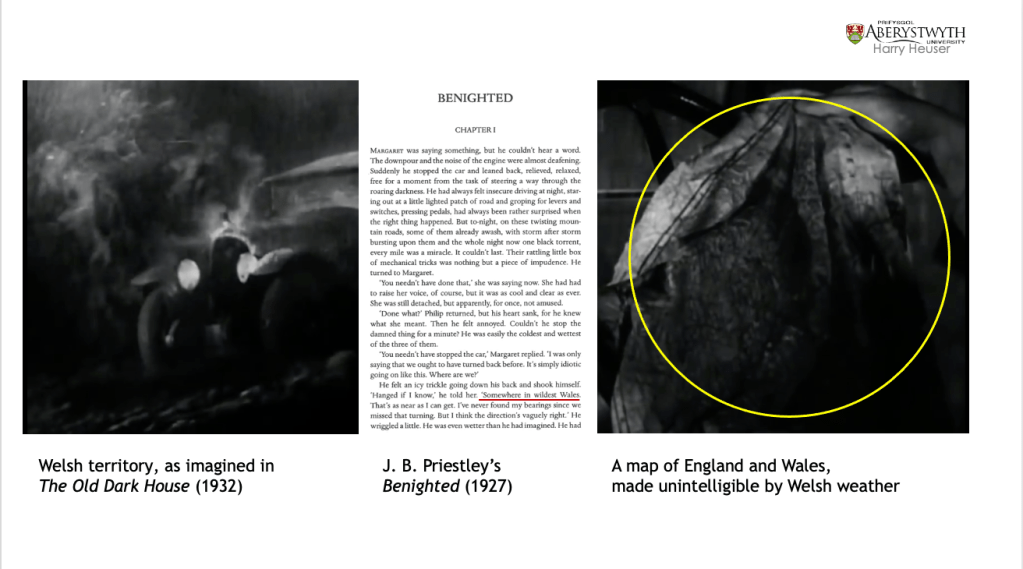
The Hollywood ending aside, the film is remarkably faithful to the novel, retaining much of Priestley’s dialogue.  While I am not sure just how many US American viewers back then would have understood the reference to the border that Shrewsbury represents, both Priestley and Whale would have known that, when the name “Shrewsbury” is dropped, the meaning “borderline” is implied.  Arriving at Shrewsbury – and this is the party’s intention – means traversing the Welsh Bridge over the Severn and arriving back in England.

The party in question – Penderel and his friends, the married and bickering couple Margaret and Philip – has lost its way in what Priestley lets Philip describe as “wildest Wales.”  The colonial attitudes toward Wales as both enchanted and benighted – as a place where there is ‘always a chance’ – the chance of an improvement in infrastructure excepting – are at the heart of this modally gothic narrative.

When the drunkard Welsh butler Morgan opens the door upon their unannounced arrival, he “produce[s] from somewhere at the back of his throat, a queer gurgling sound” that Penderel cannot translate.  Priestley tells us that “Penderel knew no Welsh.”  And yet, he says with confidence, in the book and film version alike, that “Even Welsh out not to sound like that; it was as if a lump of earth had tried to make a remark.”

Wales, to be sure, was just that to England, or many in England, a mute lump of Earth to be exploited for its resources.  It is not Wales that is gothic – or Gothic – but the perspective of the English that, fascinating as they may be with the wildness of Wales – impose their views on the nation they invade like “travellers in a foreign country,” as Priestley has Penderel see it.

Morgan, as we soon learn, cannot communicate in any spoken language.  He is a personification of Wales infantilised, gesturing like “some prehistoric monster.”  Wales, the source of mined ore – of coal and slate and lead, silver and gold – as well as Water, was often seen as little more than potential to be unearthed and funnelled for the benefit of England. The tradition was deemed to be expendable.

In The Old Dark House, as in Benighted, the nightmare vision makes way for daylight.  What we experienced was a Phantasmagoria staged by the visiting English.  The travelers depart, whether enlightened by what they experienced or just glad to have survived it.  The perspective of the hosts is not considered.

Hollywood would return to a fairy-tale Wales in The Wolf Man a decade later, in which Welsh landscape and culture, rendered unrecognisable, become the other when England was seen as the real, the upholder of values, in its fight against fascism.  To this day, visitors prefer to be enchanted by Wales, an old dark house whose perceived darkness is to a large extent a product of an English or Anglo-American imagination.
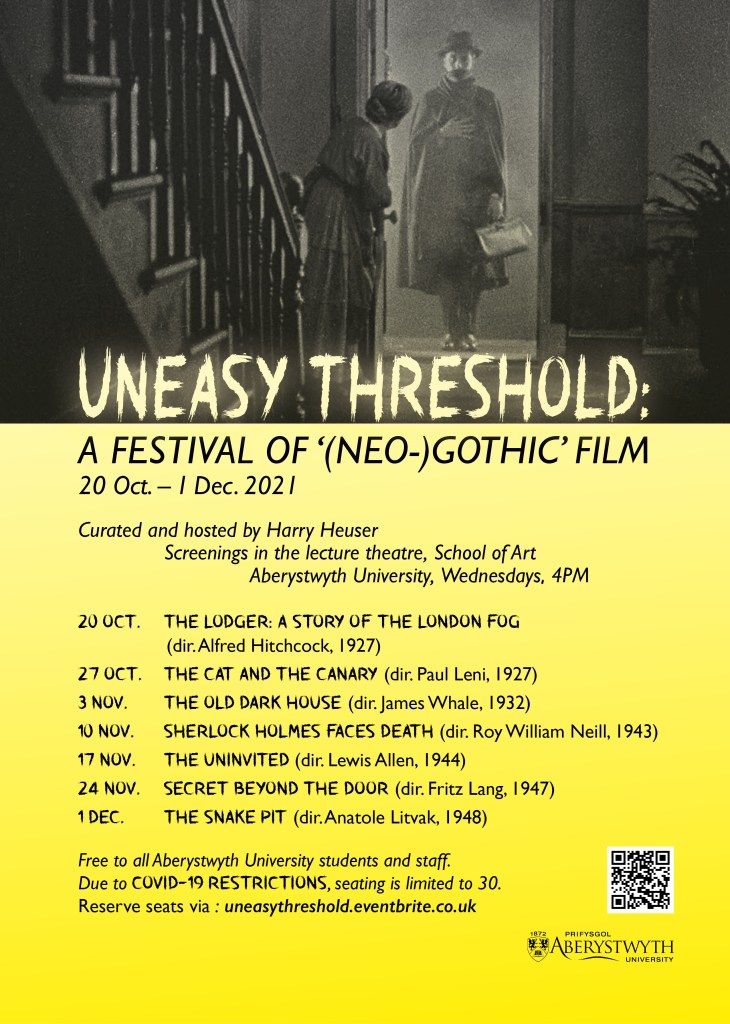
“Uneasy Threshold”: The Cat and the Canary (1927), Mammy Pleasant and the Outsider Inside

Nothing is innately trifling.  As I put it once, when I had the nerve to make a public display – in a museum gallery, no less – of the mass-produced ephemera I collect, ‘Trivia is knowledge we refuse the potential to matter.’  Now, some products of culture are more resistant than others to our realization of them as worth more than a fleeting glance, if that.  Exerting the effort to make them matter may feel downright perverse when there are claimed to be so many more deserving candidates for appreciation around.

When looking out for something to look into, I invariably draw on my own sense of otherness, of queerness.  It is not altogether by choice that I am drawn to the presumed irrelevant.  My perceived marginality is both the effect and the cause of my attraction to the margins.  What matters – and according to whom – is always worth questioning.  That is why I created Gothic Imagination, an alternative art history course I teach at Aberystwyth University.

To augment the weekly lectures and seminars, I created a series of film screenings for my students further to explore the territories of the visual ‘gothic’ beyond literary genre Gothic and the Gothic as an architectural style.  The second film in the chronologically arranged series, The Cat and the Canary (1927), is, for all its technical and cinematographic achievements, a rather undemanding old chestnut.  In part, such a view of it is owing to our belatedness of catching up with it, now that much of it strikes us as a grab bag of narrative clichés.

Well, those clichés were up for grabs even back in 1927, as the film draws on its audience’s familiarity with murder mysteries and stage melodramas.  Like Seven Keys to Baldpate before it, The Cat and the Canary is parodic and self-reflexive.  It play with conventions and our awareness, even our weariness, of them.  The Cat got our tongue firmly in cheek; and as much as we may feel sticking it out at the derivative claptrap to which we are subjected, we are encouraged to appreciate that the film anticipates our response, that it is one step ahead, dangling our tongue cheekily in front of us like a carrot intended to keep us playing along.

Is it only a single step ahead? Ahead of what? Is it ahead, retro or perhaps even reactionary? The Cat and the Canary is postmodern before there was a word for it.  Like any adaptation of a text I have not caught up with, it also makes me wonder just how what we get to see has evolved and how the film, in addition to interpreting its source material cinematically, questions, edits and revises that material as well.

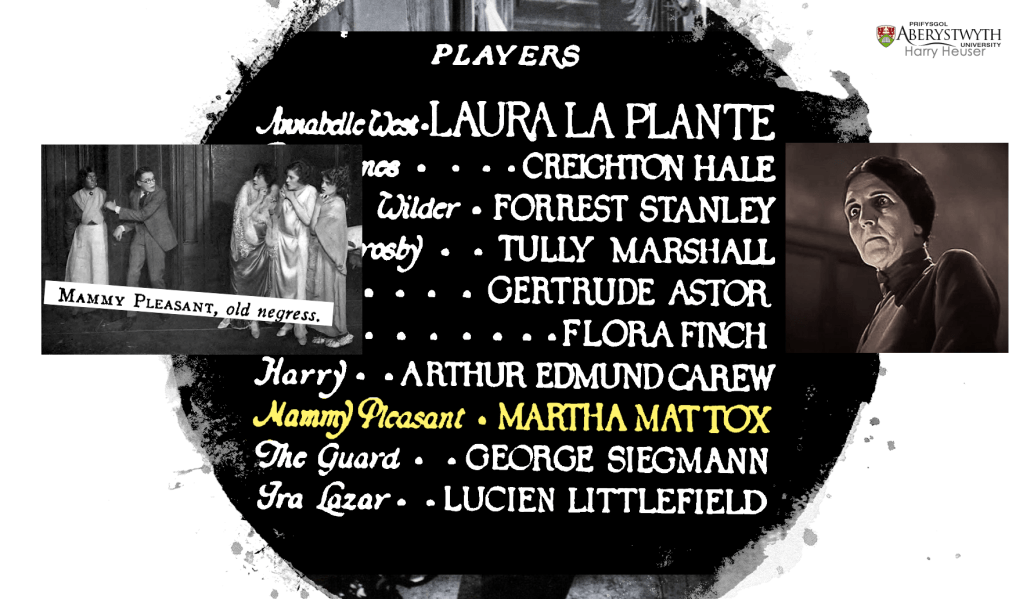
One revision draws attention to itself in the credits – and it made me aware of the consequences the seemingly inconsequential can have.  I am referring to the character Mammy Pleasant, a housekeeper played in the film by the scene-stealing Martha Mattox.  Given that The Cat and the Canary was released in the same year that The Jazz Singer stridently hammered a sonic nail in the coffin of silent film – at times simply by dragging said nail screechingly across the surface of an eloquent body of work shaped over a quarter of a century – the reference to the ‘Mammy’ legend stood out like a discordant note.

A slide from my introduction to the screening

What is ‘Mammy’ about Mammy Pleasant, particularly when the role is performed by a white female actor? The 1922 stage melodrama by John Willard, who also acted in the play on which the film is based, describes the character as an ‘old negress.’  Not that Blanche Friderici, who originated the part on the stage, was black.  She performed it in blackface.  

As The Jazz Singer and other early sound films such as the ‘Amos ‘n’ Andy’ vehicle Check and Double Check (1930), blackface and minstrel shows were very much part of Western popular culture at the time, and they were not effectively challenged – that is, were not permitted effectively to challenge – until decades later.

And yet, the film does not partake of that tradition, retaining the character’s name only.  In the play, Mammy Pleasant is a servant who has gained enough independence to choose whether or not to serve the future heir to the fortune of her deceased employer, as is clear from this exchange with the family lawyer, Roger Crosby, prior to the reading of the will:

Crosby.  Six! All the surviving relatives.  By the way—Mammy—your job as guardian of this house is up to-night.  What are you going to do?

Mammy.  It all depends.  If I like the new heirs—I stay here.  If I don’t—I goes back to the West Indies.

There is no such exchange in the film, and the ethnicity of Mammy Pleasant is not made central to the characterisation, which in the play is rooted in stereotypes surrounding superstitions to be rooted out in the act of ratiocination.  The Cat and the Canary is, after all, not a Gothic romance but a whodunit in which weird goings-on are shown to have a logical, albeit preposterous, explanation.  

The name Mammy Pleasant, in Willard’s play at least, carries with it a reference to an actual person – the businesswoman and abolitionist Mary Ellen Pleasant, who, by passing as white, managed to become the first African American millionaire.

In the stage play, produced nearly two decades after Pleasant’s death in 1904, the reference is facetious and derogatory.  Mary Ellen Pleasant, who lost the fortune she had made and shared as an activist, and whose character was destroyed when her passing as a white cook and landlady was exposed, is misremembered in the film as a not altogether trustworthy and slightly threatening outsider operating on the inside of a dead white millionaire’s mansion.

Why did the reference remain? How many viewers back in 1927 would have recognised it as a reference to Mary Ellen Pleasant? And how many would have found comic relief in what might have been some sort of white revenge fantasy that renders Pleasant odious while keeping her in her supposed place?

It is a gothic reading, as opposed to a reading of the gothic, that refuses to privilege the center and, imagining alternatives, lets the canary chase the cat for a change.  An unlikely scenario, to be sure; but to expose what is cultural it is useful to conjure what is unnatural.

“Uneasy Threshold”: The Lodger (1927), Trespassing and the Unhomely

I am not an academic.  I am a human being.  That’s not just me misquoting The Elephant Man.  It is a cri de cœur expressive of what is at the core of my identity as a creative person who happens to have transmogrified into an art history lecturer. To interrogate what that even means, I teach “Gothic Imagination” at the School of Art, Aberystwyth University. 

As part of that class, I present an extracurricular series of film screenings exploring the boundaries of the ‘gothic’ beyond the furnishings of the genre ‘Gothic.’  That ‘gothic’ is a term so broadly applied and ill-defined as to render it practically useless is a by now thoroughly predictable way of opening a debate about its practical uses.  Then again, the gothic has little to do to with practicalities.  

I have no intention to make the term, “salonfähig,” that is, reverting here to my native German, to make it acceptable or viable in an academic setting.  Rather, I use the word, which I am applying to visual culture instead of literature, to contest progress or avant-garde narratives traditionally espoused by academies in order to suggest alternative histories and alternatives to the teaching of art history.  Attention to the popular, presumably lesser arts is essential to this strategy.

The first series of screenings, coinciding with my previous iteration of “Gothic Imagination,” was titled “Treacherous Territories.” The phrase was meant to capture that challenge of defining and the dangers of inserting a mutable term such as ‘gothic’ into the lecture theaters and seminar rooms that cannot quite accommodate, let alone confine it. 

The current series, “Uneasy Threshold,” continues that playful investigation.  What, for instance, carries a mystery or a romance over the threshold of ‘gothic’? What is that threshold? And what is the ‘gothic’ interior – the environment in which ‘gothic’ may be contained both as a subject for discussion and as an experience to be had by the viewer of, say, a crime drama, a thriller, a film noir or a horror movie?

As a literary genre, the Gothic began in and with a house – in Strawberry Hill and with the Castle of Otranto, both conceived by Horace Walpole long before Frankenstein, Jekyll/Hyde and Dracula came onto the scene.  Those names are on the letter box of the Gothic mansion of our imagination, and I do not mean to evict their bearers; but might there be room as well – be it a closet, a cellar or a boudoir – for a few hundred other, less usual suspects, such as the title character of The Lodger (1927)?

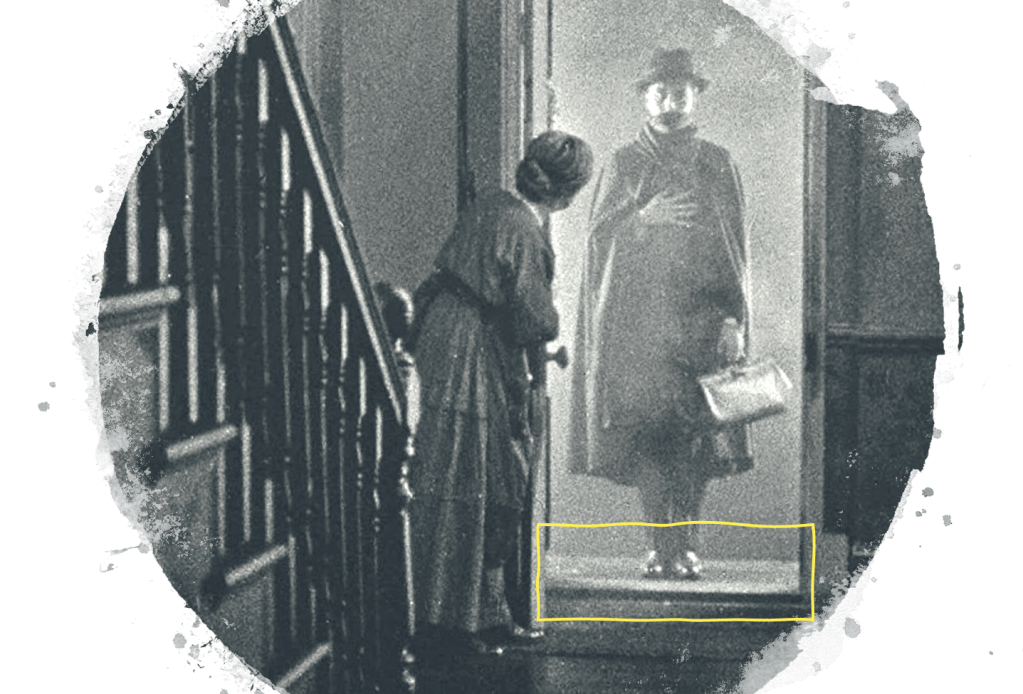
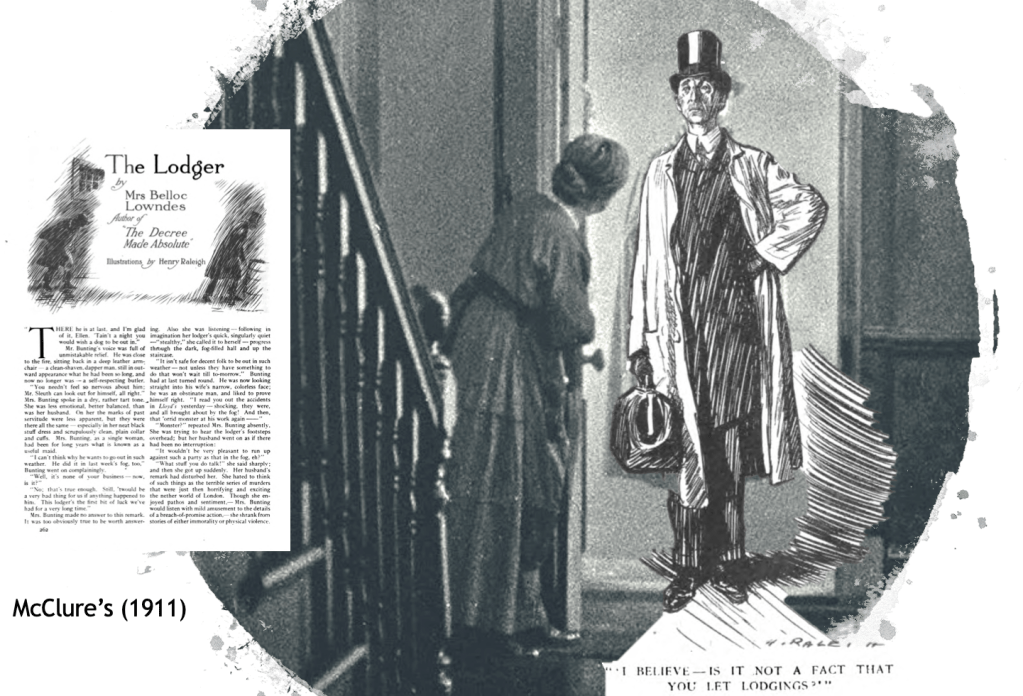
The Lodger insists on moving in on the party assembled at the Gothic castle, just as the Lodger – who may or may not be a serial killer called The Avenger – emerges out of the fog. edges himself into the home of the Buntings, and comes to preoccupy their thoughts and nightmares.  Invited, perhaps, but deemed suspect or queer all the same.

When the Lodger first made his appearance, in 1911, in a short story by Marie Belloc Lowndes, the figure was already lodged in the collective consciousness of urban dwellers who, like the author, were old enough to recall the Whitechapel Murders of 1888 or else were raised with the legend of Jack the Ripper, an alternative to a nursery rhyme all the more terrifying for having neither rhyme nor reason.

The Lodger transforms the story, which Belloc Lowndes turned into a novel, by pouring more sex into the mix.  That the layered cake did not quite rise to Hitchcock’s satisfaction was, legend has it, due to the casting of Ivor Novello in the title role: a queer Welsh matinee idol who, Hitchcock argued, was not allowed to get away with murder but was to be pronounced blameless by virtue of his status as a star. 

Whether or not that is the true reason for the direction the movie adaptation takes, it does not make the story any less intriguing – or gothic.

The Lodger is the story of a home that becomes “unhomely” – German for “uncanny.”  The lodger is no architect or bricklayer; rather, he transforms the dynamics of the group of people dwelling in the house he enters.  Blameless he may be, but he is an Avenger all the same, as Sanford Schwartz points out in “To-Night ‘Golden Curls’: Murder and Mimesis in Hitchcock’s The Lodger” – not the killer, but the victim of the killer avenging her death, a victim-turned-vigilante who, misunderstood, dreaded and feared, becomes the subject of her other lover’s revenge. 

 It is the other, ostensibly sane and safe lover, a police officer, who trespasses – who abuses his power – to trap the innocent man who threatens his supremacy as a prospective husband. The handcuffs he suits to his own pursuits prove harmful to his lover’s trust and nearly cause the death of his rival even after that rival is proven innocent of crime.

The Lodger is gothic as James’s Hogg’s The Private Memoirs and Confessions of a Justified Sinner (1824) is Gothic.  It is a story of injustice and sanctioned tyranny.   Like Frankenstein’s creature, the Lodger is hunted and tormented. Law, reason and morals are being questioned; and the pillars of civilisation are proven to be unsafe as houses.

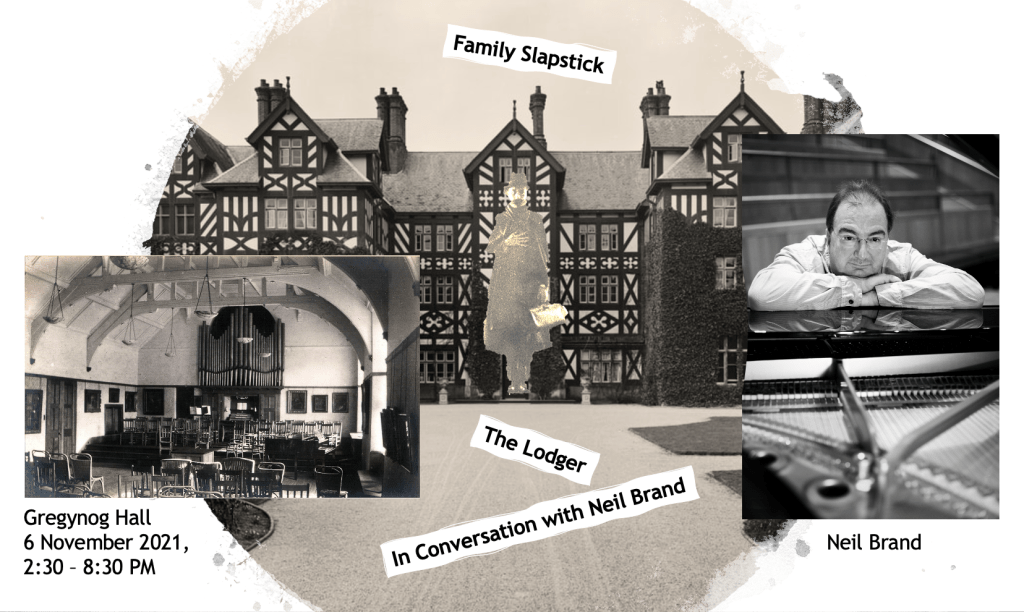
The next time I am (re)viewing The Lodger, the film will be accompanied by Neil Brand at Gregynog Hall, 6 Nov. 2021, when I shall be in conversation with the playwright-composer about silent film music and the language of pre-talkie cinema.

Destinées Imagined: Film Stills and Storylines

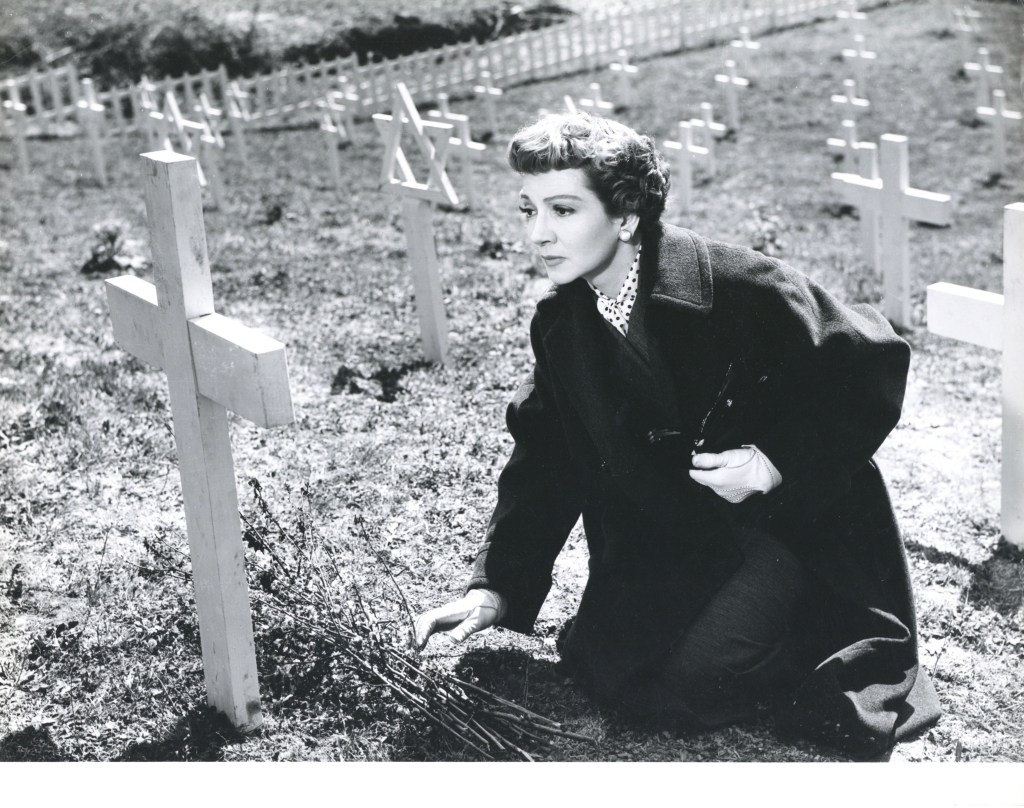
The most recent additions to my collection of movie memorabilia – and of images featuring the likeness of stage and screen actress Claudette Colbert (1903 – 1996) in particular – are stills for the 1954 motion picture Destinées.  The French-language film, released in Britain as Love, Soldiers and Women and in the United States as Daughters of Destiny, is one of the few works in the Colbert canon that I have not yet seen.  Rather than relying entirely on plot synopses provided by Colbert biographers William K. Everson, Lawrence Quirk, and Bernard F. Dick, I am imaging and imagining the film’s story, or, rather, the story told in one of the three vignettes that constitute Destinées.

Even before I determined on an order for the five film stills, what came across is that this is a story about absent men and relationships between the women they left behind.  From the image I chose to begin my stills-inspired version of the story, I can tell that Destinées is as much about the future as it is about the past: fate, fatality and a fatalism to be challenged.  The number of aligned grave markers, impersonal yet collectively inspiring awe, distinguish this site as a war memorial.  This woman might be a war widow.

What stands out in the field of Christian crosses is the prominently positioned star of David behind her, suggesting a memorial to those who were killed during the Second World War.  Either the narrative of this mid-1950s film is set in the recent past or Colbert’s character, for whatever reason, is only belatedly coming to terms with her loss.  She may have come to bury the past, or else to uncover it.  

Continue reading “Destinées Imagined: Film Stills and Storylines”

Little Lady Hee-Haw; or, A Temple Fit for Goebbels

On my only trip requiring an overnight bag during this stay-at-home summer, my husband and I drove from our patch on the west coast of Britain to the thoroughly overcrowded Cotswolds and, upon my urging, made a stop-over at the Welsh town of Hay-on-Wye, an internationally renowned haven for second-hand book lovers.  Now, musty old volumes and COVID-19 do not quite go together – or so I thought – considering that retail spaces generally set aside for them are rarely supermarket-sized.  However, Hay, which depends on the trade, managed to make it work; and, meeting the moment by donning a mask, I got to enjoy an afternoon of socially distanced and sanitized hands-on browsing.

Not that I walked away with any tomes of consequence.  While at the Cinema bookstore – a shop not limited to publications related to motion pictures – I discovered a nook stacked with a curious assortment of ephemera: German movie programs of the 1930s.  I am not sure how they ended up in a Welsh bookshop – but that dislocation may well have extended their shelf life … until a German such as I came along and took an Augenblick to sift through them.

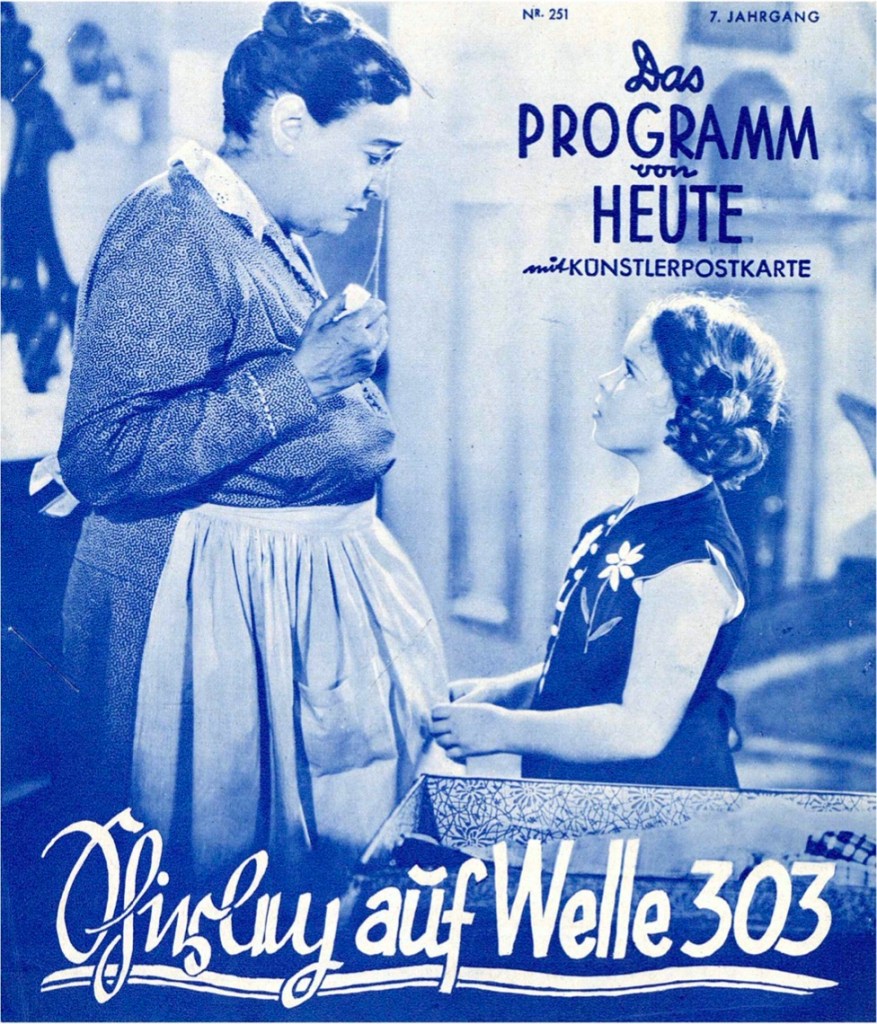
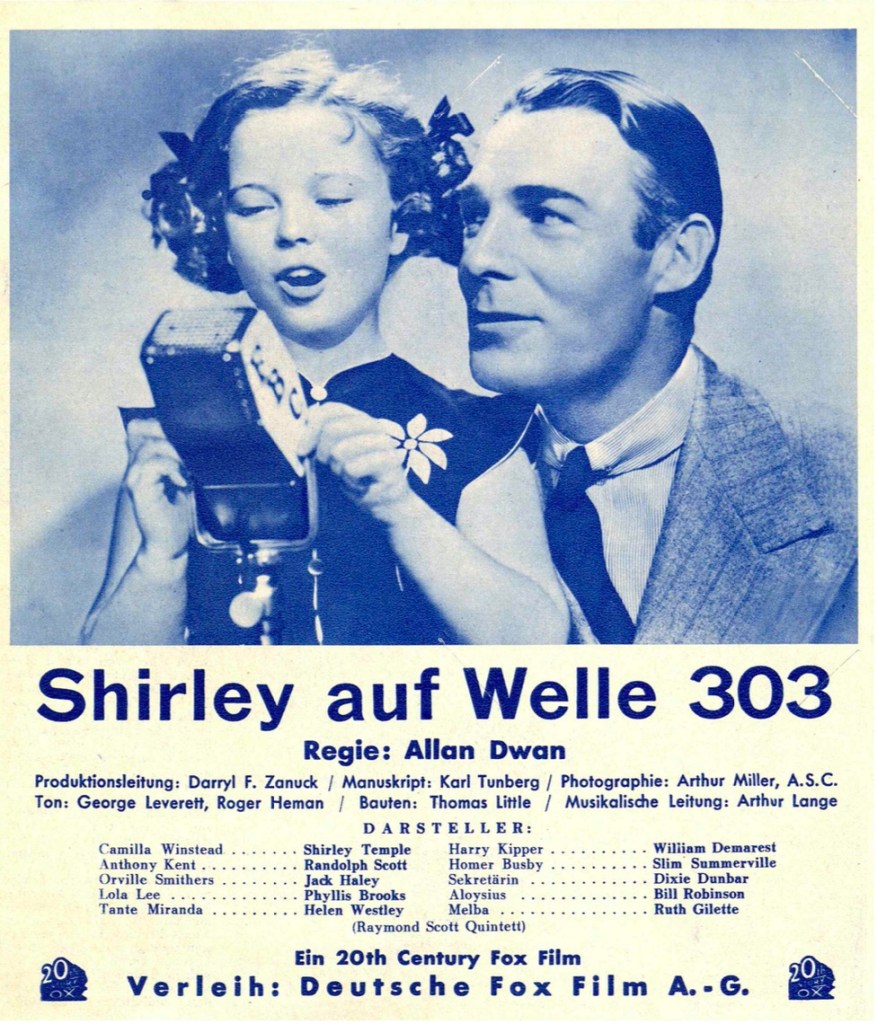
The program pictured above, dating from 1937, left me puzzled for a while.  I am familiar with many of Shirley Temple’s features – but I did not recall any among them bearing a title remotely like “Shirley auf Welle 303,” or “Shirley over Station 303.” So, I picked up this fragile brochure, and a few others besides, if mainly to tap their potential as pop cultural conversation pieces.

The film being deemed worthy of commemoration is Rebecca of Sunnybrook Farm, a DVD of which is gathering dust in my video library.  The title refers to an early twentieth-century children’s literature classic, although the movie version bears so little resemblance to it that it could hardly be considered an adaptation.  Not that the title of the novel would have resonated with German audiences. Meeting this challenge, the marketing people at Fox came up with a new one that might sound more relatable.

I suspect that the servants of the Nazi regime would have objected to the name of the titular character as well, being that Rebecca is Hebrew in origin, meaning “servant of God.” Shirley, on the other hand, was a household name, Ms. Temple having charmed audiences around the world since at least 1934. Like the titles of several other Shirley Temple vehicles released in 1930s Germany, the German version of Rebecca of Sunnybrook Farm therefore bears the first name of its star. Only Heidi stayed Heidi, rather than being translated into “Little Swiss Miss Shirley.”

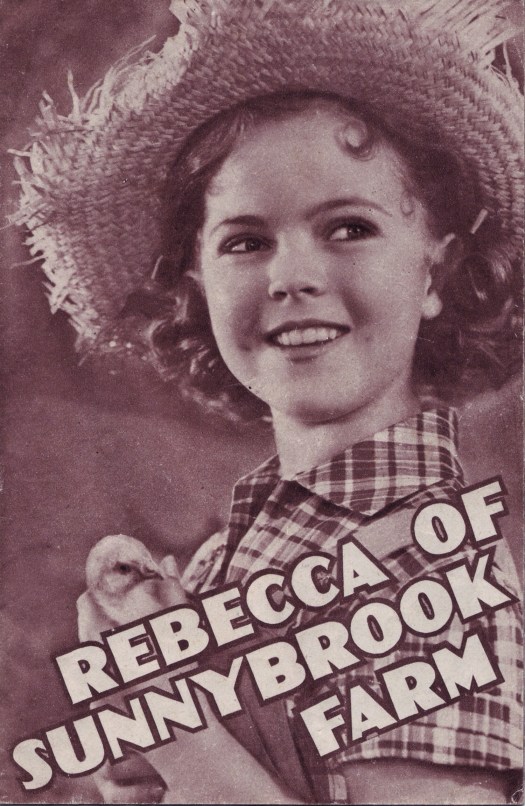
A contemporary British program for the same film, also in my collection.

And yet, the effort to make the film seem more relatable to Nazi Germany’s picture-goers nonetheless resulted in a title that was out of touch with Fascist reality. In 1938, when the film was released in German cinemas, the idea of using radio transmitters for your purposes – or for the purpose of exploiting a child for your own purposes – was inimical to state-controlled broadcasting. On the air, it was always “Germany Calling,” a phrase famously used by the aforementioned Lord Haw-Haw beginning in 1939.

Germans would have struggled in vain to twist the dial and hit on a broadcast like Shirley’s, or they would have paid a price for such twisting.  Many of them listened via the Volksempfänger, a mass-produced receiver that was always tuned in to the Führer’s voice.  Imagine staying tuned to Fox News all day.  Then again, so many who do have the choice not to still do nonetheless, not unlike those who were complaisant during the rise of Fascism in Germany.

The change in title – and the recontextualization it achieves – is peculiar, and only a performer as innocuous as Shirley Temple could have gotten away with what otherwise would have been downright seditious: seizing the microphone and taking to the airwaves in a makeshift studio set up in a remote farmhouse.  Perhaps, the titular bandwidth – 303 – was to signal that Shirley’s broadcast had been sanctioned after all, 30 January 1933 being the date Hitler came to power. In the Third Reich, three was heralded as the charm.

For decades, the German film industry did wonders – or, rather, wilful damage – to international films with its dubbing of their soundtracks; voicing over and voiding the content of the source, there were many opportunities to ready a film more substantive than Rebecca for consumption in Nazi Germany.  I do not recall seeing this movie in my native language, although I do remember a festival of her films airing on West German television in the late 1970s.  Not that watching Rebecca of Sunnybrook Farm in the original is an experience I am eager to repeat, clobbered together a vehicle for an overhyped and overworked child star about to wear out her welcome that it is. Variety dismissed the film at the time as a “weak story,” “indifferently acted and directed,” while claiming its lead to be “at her best.”

The German program does little more than summarize the plot as well as state the principal actors and main players behind the scene of the production; I am sure someone checked whether producer Darryl F. Zanuck was Jewish, which he was not. What struck me about the program was that it mentions the word ‘propaganda’ twice in the first paragraph, where it was used as a substitute for advertising (in German, “Werbung” or “Reklame”).  Sending up the excesses of US consumerism while promoting the ostensible virtues of country living, this trifle of a film – distributed in Nazi Germany by the enterprising and accommodating “Deutsche” Fox – could serve as a vehicle for anti-American propaganda at a time when increasingly few US films were granted a release in Germany.

By making such trifles, and by marketing them for distribution in Nazi Germany, the US film industry contributed to the rise of Fascism, which, only after the attack on Pearl Harbor, Hollywood films began to confront with a suitably glossy vengeance. By that time, US films were banned in Germany, and Shirley Temple ceased to be a leading lady – at least in motion pictures.

‘Mystique’ Isn’t the Word for It: The Cool Warmth of Claudette Colbert

‘In the Hollywood of the thirties and forties, dominated by elegance, glamour production expertise and lush escapism,’ the film historian William K. Everson wrote in the 1970s, ‘Claudette Colbert was one its most representative stars.  Despite her natural skills and theatrical background, she – or the images that came to be Claudette Colbert – was essentially a Hollywood product.’

The reference to her ‘theatrical background’ aside, this could be said about any number of Hollywood stars – male of female – of the studio era.  Colbert, who was born on this day, 13 September, in 1903, was a particular ‘product’ of an industry committed to generating lucrative multiples by manufacturing the one-of-a-kind: the unique personality that filled screens and auditoria of movie theaters around the world. So what, if anything, distinguishes Colbert from her peers?

Everson goes on to describe Colbert as ‘sleek, svelte, sophisticated and chic […].  But she was also warm, vivacious and possessed of both charm and a sense of humor – qualities that can’t be mass produced, no matter how complicated the machinery.’

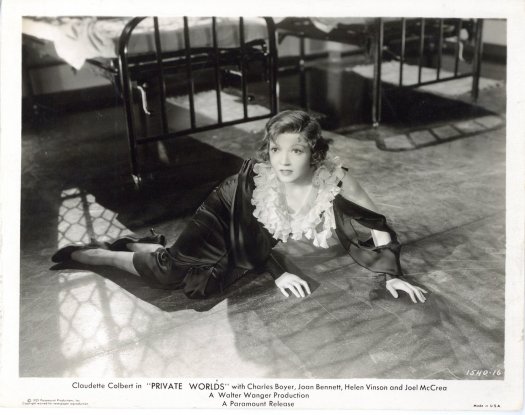
Publicity still, Private Worlds (1935)

To a Colbert enthusiast such as myself, this certainly rings true – and the attributes ‘warm’ and ‘vivacious’ are especially felicitous when applied to descriptions of the energy with which Colbert invests her roles – a kind of cocktail party gaiety that, whatever the state or root cause of intoxication, is rarely brash and, however much of an effort it may be, as written into a script or demanded by a director, is so transparently genuine and uncontrived that it makes me feel I am in the presence of the very life of the party, and of belonging, even if Claudette’s character just crashed one, as in Midnight.

The other night, I watched Sleep, My Love, a melodrama in which laughs are in short supply, and what struck me as most distinctly Colbert about an otherwise generic thriller of the Gaslight school was seeing her tormented character on a night out with an admirer, getting soused at a wedding, while her husband is plotting to drive her out of her mind by adulterating her cocoa. This woman will lose her man before she loses her marbles.

What Everson refers to as the ‘Colbert Mystique’ is really no ‘mystique’ at all.  The quality Colbert brought to the screen was approachability, a glamour that wasn’t a glare.  She is neither aloof nor in your face while out of reach in her improbable but never impossible elegance.  That approachability did not quite amount to vulnerability, however, as most of her performances – certainly most of her best, excepting Three Came Home – are subdued rather than raw.  When asked to lose her cool, to get what used to be called hysterical, as in her none too Secret Fury in the film of that title, she seems to be filling in for another actress; she is simply not Claudette. For the most part, though, when Colbert lets her hair down on the screen, or had reason to tear it out, her bangs require only minor adjustments to be put back in place – and Hollywood dictated that it, and the woman donning the do, had to be back there in that designated up-to-Production Code place before long.

Sure, there might be a wisp of straw in her hair, but we don’t get access to the hayloft where, her laugh suggests, it happened all right; and we are certainly not encouraged to feel entitled to an entire sheaf of evidence.  Growing up gay – and knowing I was gay when I was very young without knowing how to let it be known – I found Colbert’s subtlety more relatable than the sass of dames, the fire of Jezebels, or the lure of sirens whose appeal brought on awkwardness and shame rather than arousal in me.  This woman would not crack like Susan Hayward, snap like Bette Davis or claw for it like Crawford.  She would end up all right, and often owing to her strength, wit and endurance.  Granted, having Hattie McDaniel at hand to massage your tired feet doesn’t hurt.  But, hired help or none, Colbert’s heroines keep their cool while exuding a warmth that no flamethrower can supply.

There really isn’t any ‘mystique’ there; glamour, yes, and power, but no mystery.  Even in matters of sex, as I found most comforting watching Colbert while coming of age in the era of AIDS, Colbert suggests that there need be no mystery at all.  When Colbert insists that ‘sex has everything to do with it’ – as one of her characters does in The Palm Beach Story, she doesn’t coo it like West or croon it like Dietrich – she says it flat out, with a conviction born of experience.  She’s been there, done that, but she keeps the t-shirt neatly folded in a drawer reserved for her lingerie, which she teaches Miriam Hopkins to ‘jazz up’ in The Smiling Lieutenant.

To this day, I collect Claudette Colbert memorabilia, which I display online.  The latest addition to my collection is the above publicity still for Private Worlds (1935), for which Colbert received an Academy Award nomination.  This is not the portrait of a fallen woman.  We know Colbert’s character will get up, straighten her hair and return to work – as long, that is, as Hollywood permits her to have a career, as a ‘lady doctor,’ no less. Yes, that woman on the floor is a psychiatrist.

Colbert’s own private world was just that: private.  Back then, fellow stars could rely on the studio to provide them with a ‘private’ world to parade in public and a cover story to hide behind.  Today’s celebrities, unlike the stars of that bygone system, enjoy no such protection; nor, for the most part, do they seem to seek it.  We have surrendered our privacy, and having done so doesn’t make us feel more real to each other, much less to ourselves, more liberated or more loved.  The illusion Colbert pulls off on the screen is that we, or some of us, might have once had what I now sense lost: a kind of cool warmth that gets us through while drawing others toward us.

A Mighty Joe! But not without a plan …

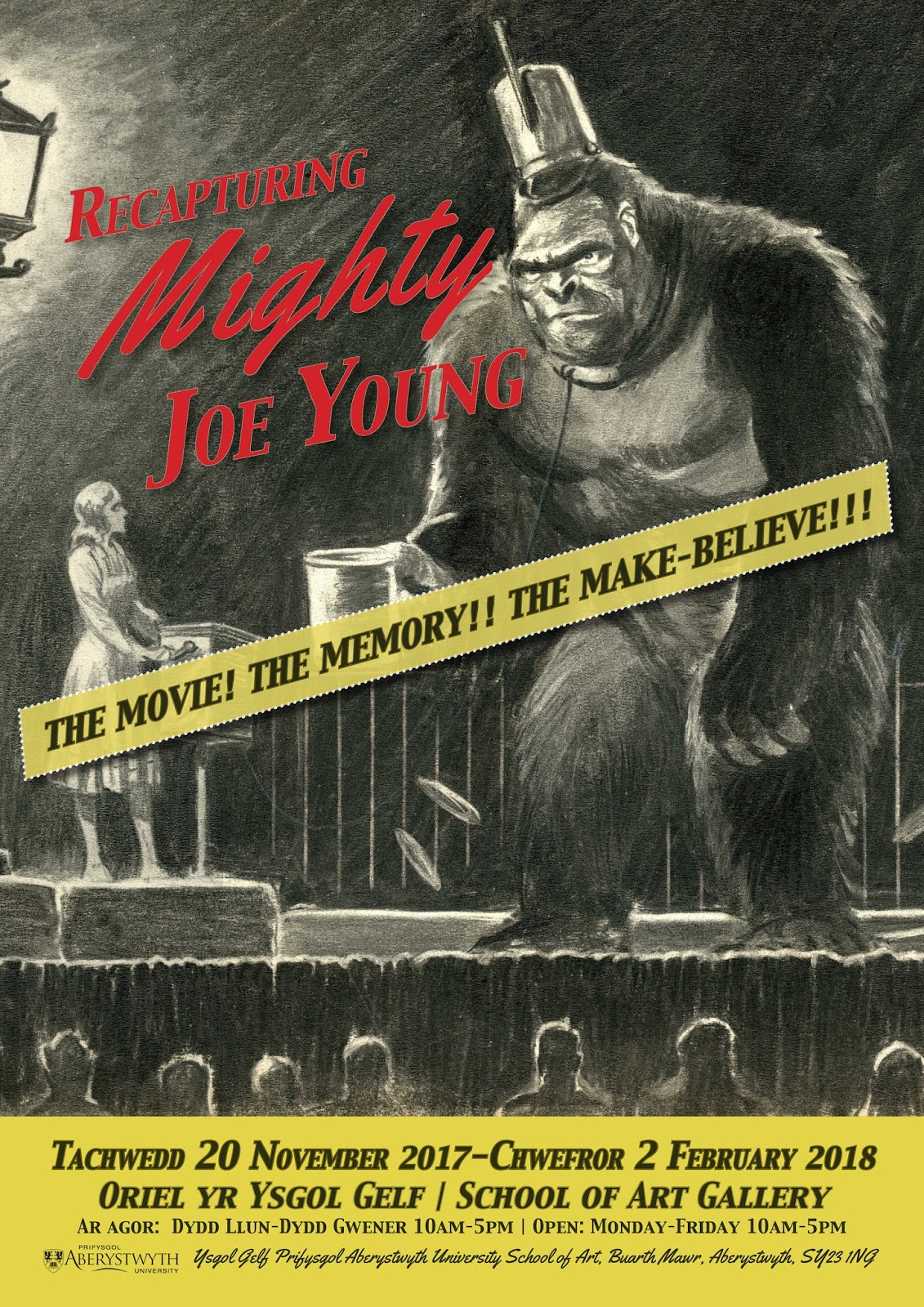
Poster design by Neil Holland
using a 1940s concept drawing for Mighty Joe Young
As announced in my previous post, I am staging the exhibition Recapturing ‘Mighty Joe Young’ at the School of Art, Aberystwyth University (see poster for details).

This is my introductory text panel for the show:

From adaptations of Edgar Allan Poe’s “Murders in the Rue Morgue” (1841) to the latest installment in the Planet of the Apes saga, non-human primates have played a prominent part in the evolution of motion pictures. Ridiculous and sublime, they act as uncanny doubles of our uncouth selves.

 
Until well into the 1980s, silver screen simians were often aped by actors in hairy suits. A memorable exception is the original Kong, the uncrowned King of Skull Island. Mighty Joe Young (1949) is one of his descendants.
 
Joe was brought to life by the creative team responsible for King Kong (1933) and its sequel, Son of Kong (1933). The large volume displayed in the centre of the gallery is Joe’s baby album.
 
The album commemorates the collaborative efforts that earned Mighty Joe Young an Academy Award for Special Effects. Showing off the tools and tricks of the trade, it contains documentarian photographs as well as drawings and watercolour paintings by Willis ‘Obie’ O’Brien, the film’s ‘Technical Creator.’  The album also records the work of Obie’s apprentice, Ray Harryhausen, whose name became synonymous with pre-CGI fantasy film and stop-motion animation.
 
The album is on public display for the first time. It was compiled retrospectively, probably by a member of the crew.  Along with hundreds of books and journals, it was bequeathed to Aberystwyth University by the film historian Raymond Durgnat (1932–2002), to whose legacy this exhibition pays tribute.
 
Surrounding the album are posters, promotional materials as well as 1940s concept drawings for animated movies produced by Walt Disney and Fleischer Studios. Also on show are prints by Gustave Doré and John Martin.  Their fantastic and awe-inspiring images were precursors of cinematic spectacles. Both O’Brien and Harryhausen referenced them in their work.
 
As a curator, educator and writer, I aim to promote interconnections between the arts as well as the creative industries and academic disciplines devoted to them. Instead of imposing a context in which our album might be contained, I let it take over the gallery to disclose its stories and open new associations.
 
The public is invited to shape this evolving display by sharing responses to Joe in animation workshops scheduled during the show’s run. Like the homage in Lego you encounter in our gallery, the videos created in those workshops will become part of this exhibition.

She Said It in English: Olympe Bradna (1920-2012) on Men, Mikes and Milk

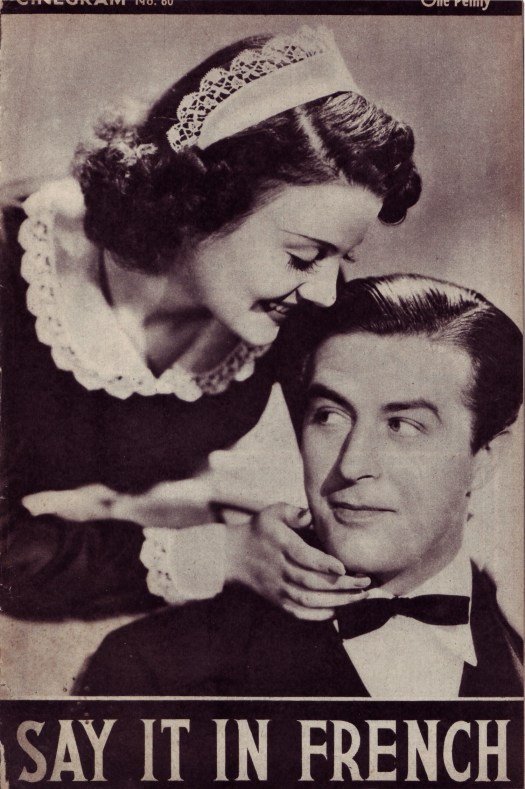
Olympe Bradna is a diplomat of the first rank!” So declared the editors of Cinegram in an issue devoted to Say It in French.  In that now largely forgotten romantic comedy, Bradna co-starred as a French student who impersonates a maid to be close to an American lover (played by Welshman Ray Milland) expected to marry a millionaire’s daughter (Irene Hervey) to save his father’s business.  

The cover of Cinegram No. 60, from my collection

Maybe that sounded better in French, in which the comedy was first staged under the title Soubrette. Never mind.  The “petite morsel of feminine allure,” so the Bradna legend goes, had “only been kissed by two men during her whole lifetime”—that lifetime amounting to eighteen years back in 1938. 

One year into her brief Hollywood career, Bradna had overcome her “anxiety and embarrassment” and forgotten about her vow that she “would never kiss” at all, “either on the screen or off, until she had a ‘steady’ beau.”  Having been teamed with both Milland and Gene Raymond (in Stolen Heaven), the actress was “all in favour” of on-screen romance; but, when asked whose lips she preferred, the teenager refused to kiss and tell. “If I did that, it would be, how do you say? ‘propaganda.’”

In the context of European pre-war clamour and the business of Hollywood glamour, the word choice is peculiar, especially since Cinegram was a promotional effort aimed at British audiences.  It is a telling statement, too, as it suggests Bradna’s questioning of the role she was expected to play in the propagation and exploitation of her own image.

Far from naive, the French-born performer knew all about the real world of make-believe, which is why, in her future pursuit of “real romance,” she was determined to “go outside the show business.”  In the early 1920s, her parents, Jeanne and Joseph Bradna, had a successful bareback riding act at the Olympia Theater in Paris, after which venue Olympe was named and where she made her stage debut when she was not quite two years old.  Hence, I suppose, her expressed need for security: “[A]ctors are fellows with uncertain jobs.  They’re generally honest, gay, intelligent and interesting, but they lack that quality of stability that is so important to a girl who wants to establish a home.”

Presumably, she said all this in English, rather than in her native tongue.  When she first set her dancing feet on the United States as a member of the Folies Bergère and subsequently performed at New York’s French Casino, she was so dismayed at her “lack of English that she determined to learn to speak the language properly.  She succeeded so well,” Cinegram readers were told, “that when it came to making this new picture she had to put in several weeks of hard work under a French tutor to get her French back to standard.”  A Hollywood standard, that is.  After all, in romantic comedy, a French accent was as desirable as a maid’s uniform.

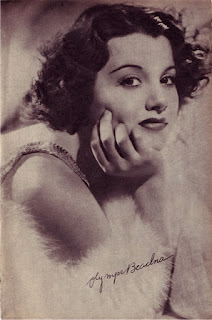
Bradna in Cinegram No. 60

Bradna’s language skills were put to the ultimate test when, on 14 November 1938, she went behind the microphone for the Lux Radio Theater production of “The Buccaneer,” co-starring Clark Gable as French pirate Jean Lafitte; but her part was suitably Old-World, and all over the map besides, to account for any foreignness in her speech.  Bradna assumed the role of Gretchen, which had been played on screen by the Hungarian-born cabaret artist Franciska Gaal.  “Oh, I don’t know how I sound, Mr. DeMille,” Bradna said to in the nominal producer of the program during her scripted curtain call, “a Dutch girl with a French accent in an American play.”  Supported as she was by Gertrude Michael and Akim Tamiroff, both of whom enriched American English with peculiar accents and inflections, she hardly stood out like a sore tongue.

Not that Bradna, who appeared on the cover of the 27 July 1938 issue of Movie-Radio Guide, was a stranger to the microphone.  According to the March 1938 issue of Radio Mirror, Paramount Pictures “put her into five consecutive radio guest-spots for a big build up—but without giving her a nickel.”  Perhaps, DeMille would not have given her a nickel, either, for the privilege of making it into a Lux-lathered version of The Buccaneer, one of his own productions, nor given her an opportunity to promote her latest picture, Say It in French, had he known what British Cinegram readers gathered by flicking through their souvenir program for Say It.  Bradna, they were told, had “startled experts by announcing that the secret of her facial complexion [was] a daily buttermilk massage.”

The makers of Lux Toilet Soap could not have been pleased at Bradna’s insistence, fictive or otherwise, that buttermilk was “all” she needed: “My skin may be ever so parched and dry before the routine, but afterwards it is as fresh and smooth as I could want!

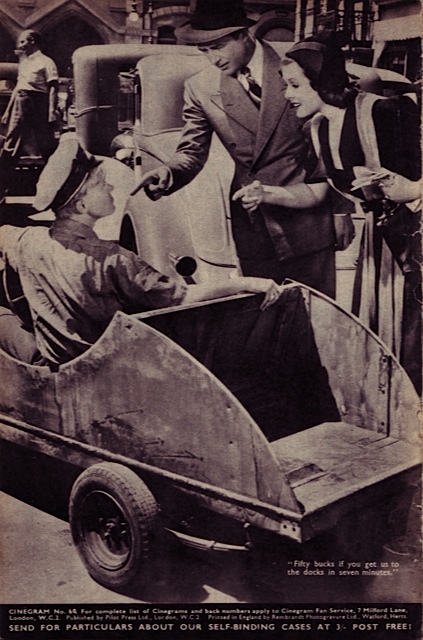
Say It: A rickety vehicle

Wally Westmore, Paramount’s make-up chief, reputedly explained that the “secret”—an age-old French recipe for a youthful complexion perhaps not quite so difficult to achieve at the age of eighteen—lay in the rich oil content of buttermilk, which had the same “softening and freshening effect upon the skin as the most elaborate and expensive preparations used by the stars.”  That, of course, was just the claim Lever Brothers were making each week on the Lux Radio Theater, which might explain why Ms. Bradna was never again heard on the program, whose stars were handsomely remunerated for their implied or stated endorsement of the titular product.  Perhaps, Bradna was not “a diplomat of the first rank” after all . . .

Olympe Bradna died on 5 November 2012 in Lodi, California.

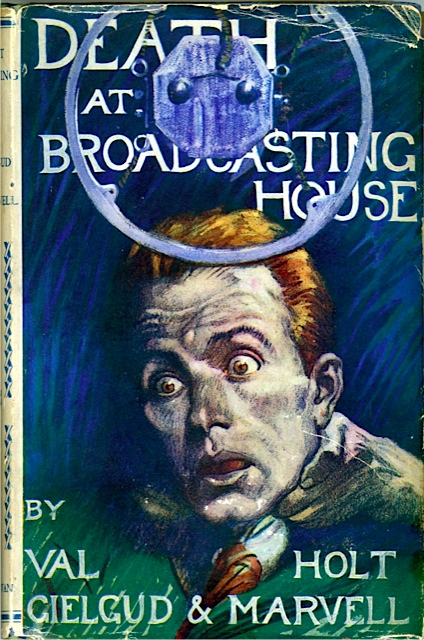
“. . . a dam’ good shake-up”: Death at Broadcasting House

“Snobbish nonsense!” says one shabbily dressed young Londoner to another as they observe a man in a starched shirt and dinner jacket enter Broadcasting House.  The man, they reckon, is an announcer about to go on the air, unseen yet meticulously groomed and attired.  At the sight of which pointless and paradoxical propriety they sneer: “That whole place wants a dam’ good shake-up.”  A “dam’ good shake-up.”  That, in a coconut shell (to employ the most sound-effective nut in the business of radio dramatics), is what Val Gielgud and his collaborator Holt Marvell (the fanciful penname of fellow broadcaster Eric Maschwitz) set out to perform in Death at Broadcasting House (1934), a murder mystery set in and temporarily upsetting the reliable, predictable and frightfully proper BBC.  Although I had know about it for quite some time, I just finished reading it;  turns out, it’s a “dam’ good” page-turner, and a compelling commentary on the marginality, the relative obscurity of radio dramatics besides.
 
“There’s not a drop of good red blood about the whole place.  Robots engaged in the retailing of tripe! That’s broadcasting!” one of the above sidewalk critics of the tried and generally trusted institution declares.  It is clear, though, that Gielgud and Maschwitz did not side with the two self-styled “communists.”  The authors were BBC employees and not about to stage a revolution.  The “shake-up” was strictly a matter of maracas, a means of making some noise for their own undervalued accomplishments rather than spilling the beans without which those maracas would become utterly useless as instruments of ballyhoo.
 
Sure, broadcasting plays—minutely timed, meticulously rehearsed and intensely scrutinized—were far more mechanic than any other form of dramatic performance.  Yet, as Gielgud insisted in one of his many articles on radio drama, “[i]n spite of [its] machine-like qualities” and “in spite of the lack of colour and applause, the work has a fascination of its own.” That the multitude for whom these performances were intended showed so little gratitude was frustrating to an actor-director like Gielgud, who sarcastically remarked a few years earlier that dismissive reviews in the press suggested, at least, that the broadcast play had “passed the first and most depressing stage of development—the stage of being entirely ignored.”  By 1934, it had clearly not advanced to a stage that could be deemed legitimate.
 
What better way to gainsay those naysayers than to spill some of that “good red blood” or to stir it properly and to make it run hot and cold by turns.  “A killing! In Broadcasting House, of all places! Good God!” is the response of General Sir Herbert Farquharson, the corporation’s fictional Controller.  He has just been informed that an actor was done away with during the production of a live broadcast.  “My god, sir,” the director of that play exclaims, “do you realize that everyone who heard that play must have heard him die? That makes it pretty unique in the annals of crime.”
 
That most folks tuning in thought little of it—that they believed it to be part of the drama—is owing to the fact that the murder was committed right at the moment when, according to the script, the character played by the victim was scheduled to breathe his last.  A crime at once prominent and inconspicuous—like most radio dramas, performed as they were without a studio audience.  After all, even the Controller, at the time of the murder, was attending a variety program staged in the specially designed Vaudeville Studio instead.
 
Death at Broadcasting House is the self-conscious performance of two radiomen, Gielgud and Maschwitz, fighting for the recognition that, for the most part, eludes those working behind the scenes—especially the folks behind the scenes of a largely invisible business.  Their book, as they so slyly state, was “dedicated impertinently … to those critics who persistently deny that the radio pay exists, has existed, or ever can exist.”  Radio plays existed, all right, but, for the most part, they died as soon as they were heard, if they were heard at all.
 
Unless, of course, they were blattnerphoned. “Blattnerphone?” the puzzled inspector exclaims.  “Yes,” the BBC’s dramatic director, Julian Caird, explains:
 
“It’s a way of recording a programme on a steel tape so that it can be re-transmitted.  We have to do a good deal of it for Empire work.” […]
 
“You mean we can hear that actual scene over again?”
 
“We can hear that scene,” said Caird, “not only over again, but over and over again.  As often as you like.  I wonder if the murderer thought of that?”
 
Probably not.  Unless he numbers among the initiated few, folks like Caird—and Gielgud—who have their fingers at the controls, conjurers who don’t mind revealing some of their tricks to demonstrate just how powerful they are.
 
“The curious thing about the case what that it was both extremely simply and extremely complicated,” the inspector wraps up the business of detection.  “It was extremely complicated only because it took place under very remarkable conditions—conditions which you wouldn’t find repeated anywhere else, and for which, of course, there was absolutely no precedent.”  The same applies to Gielgud and Maschwitz’s fiction. However witty and engaging, the whodunit is entirely conventional. It is the setting, the broadcasting studio, that makes it unusual.  The setting, thus, becomes the star of the production—a star without whose presence the show simply could not go on.
 
Indeed, the crime depends on the complexity of British radio production to be in need of detection.  In American broadcasting, by comparison, all actors gathered in the same studio, a congregation that would render the unobserved strangling of one of them not only improbably but impossible.  At the BBC, however, plays were produced using a multiple studios, a complex approach Gielgud’s stand-in explains thus:
 
[T]he chief reasons why we use several studios and not one, are two.  The first is that by the use of separate studios, the producer can get different acoustic effects for his scenes….  Secondly, the modern radio play depends for its “continuity” … upon the ability to ‘fade’ one scene at its conclusion into the next.  You can see at once that there must be at least two studios in use for these “fades” to be possible.  In an elaborate play, therefore, the actors require as many studios as the varying acoustics of the different scenes require, while … sound effects have a studio of their own, gramophone effects one more, and the orchestra providing the incidental music yet another separate one.
 
Anyone who has ever listened to an American radio play of the 1930s, such as the ones produced by the Columbia Workshop, knows that no such complex arrangements are needed for the effective use of multiple fades and changes in acoustics.  Death at Broadcasting House is a defense of the British system.  It turns the multi-studio approach into something to be marveled at—an arcane system fit for a mystery, a puzzle whose solution requires the expertise of the initiated and thus vindicates the existence of the men masterminding the business with their hands firmly on that most complex of all pieces of broadcasting equipment: the dramatic control panel, which, Gielgud enthused elsewhere, enabled the director “to move at will, both in time and space, as simply as if he were travelling on the fabled magic carpet, and to take his audience with him.”

Some Like it . . . How? Youth, Vampires, and Marilyn Monroe

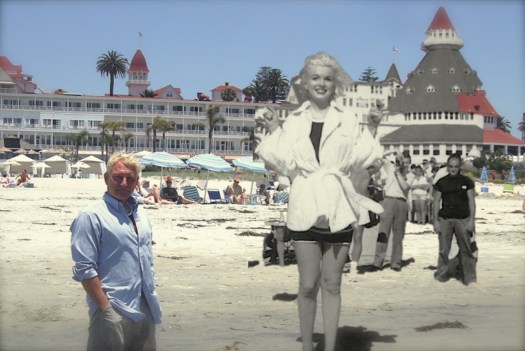
Del Coronado mirage

There I stood, in the shimmering sands of Coronado Beach, California. I had come, of course, to see the famous Hotel—and to share the views once taken in by Marilyn Monroe during the filming of Some Like It Hot. Marilyn was here. Now I was.

Footsteps. Sand. The old hourglass. I won’t indulge in such clichés here; but there is something pathetic about this kind of out-of-sightseeing, this belated catching up and impossible reaching out to which I am prone. The inclination to seek out what is long gone is more than morbid curiosity: it is an approach to life as a retreat from living in which even the here-and-now becomes dreamlike and chimerical. How did this get to be my way of not facing the world?

Marilyn Monroe died before I was born; yet her life and times became a fascination of my teenage years.  Mine were not erotic fantasies.  I did not long for her body.  Nor did I think of her as being gone.  She was never absent for long from the television screen, ever present on the iconic posters I pinned onto the wall above my bed.  Records spinning on the old turntable, her voice filled my room. I had no regrets about never being able to meet her in the flesh; rather, it was a relief.

The wonder of her incorporeal existence made living in the body I loathed more tolerable; and it made the physical relationships I dreaded easier to contemplate in the abstract.  Marilyn—and we call her by her first name because she is more familiar than famous, more girl than goddess—was not some facile paradox: “I Wanna Be Loved by You” and “I’m Through with Love” she sings in the same movie, expressing the hurt and hunger that are far from mutually exclusive.

Our teenage selves are preoccupied with the demands that both nature and society make on us, propositions and impositions captured in that horrible phrase haunting and taunting us until death: “grown up.”  As a response to and rejection of the implied threat—the finality and premature stunting of our infinite potentialities—Marilyn’s afterlife was as much a reproof of society as it was a society-proof alternative: a twilight life, expired and undying, bright though snuffed out, a fragile, indomitable spirit-presence in whose shadowy glow I could luxuriate, just as many a young person nowadays revels in the gothic gloom inhabited by zombies and vampires, except that my imaginings transported rather than dispirited me.

No doubt, this twisted bent of casting myself into times preceding my birth is born of a desire to bring forth alternate selves of mine without having to bear the vagaries of the present or the uncertainties of the future.  Like a life presumably squandered in reverie, bending the past to our will is a testament to a vestigial will power—or would-be power—in which the retrospective becomes invested with the prospect of an ever glimmering what if . . .