
Radio at the Movies: To Please a Lady

She played tougher than anyone else in pictures, and she was better at it. She could get a guy to fall for her and a fall guy to do anything for her, be it to lie, cheat, or kill. To please her was a dangerous game; but to displease her was a deadly one. She could make puppets of men; Charlie McCarthy was just target practice. I’m talking Barbara “Baby Face” Stanwyck, of course, the kind of social climber who shoved the ladder right into the face of those far from selfless fellas who lined up to give a gal a helping hand. In To Please a Lady (1950), Stanwyck proved that her very lips could kill. Well, as newspaper columnist Regina Forbes, Stanwyck had the means to finish the job properly: a microphone, a broadcasting studio, and a weekly radio program.

To Please a Lady makes you wonder what Stanwyck could have done with a regular radio broadcast; she certainly could have out-Hoppered—and, out-Hoopered—Hedda, who simply didn’t have the voice to match her name. That said, Regina Forbes is not quite as eager as Hopper to pick up any name dropped in her lap.

“But you can’t go to Newark tonight,” her secretary exclaims as Forbes rushes out to get a story that piqued her interest. Never mind that she already had an appointment with “Margaret.” “What about Margaret?” Forbes asks. “You know,” she is reminded, “the one who sings.”

That, if you require a footnote, is a reference to the aforementioned Margaret Truman, the President’s daughter. And Forbes had no qualms about standing her up to get the dirt on a disgraced speed racer (smug-as-ever Clark Gable), who, like Forbes, stops at nothing to be first at the finish line.

To Please a Lady is a contrived story, and one that is told none too well. So, as the camera follows Gable for another spin around the track, you get to fantasize about Stanwyck’s voice and the radio and . . . hang on, there’s Ted Husing. Best known for his sportscast, the CBS announcer was also heard on an early Eddie Cantor program and its successor Rhythm at Eight, starring Ethel Merman; an excerpt of a routine for the latter is reprinted in Husing’s book Ten Years Before the Mike (1935).

Of the “grand trouper” Merman, Husing says:

While admitting that television will double her value as a radio performer, I still think she is radiates personality over the air. Her speaking voice is vibrant with health and youth, and is highly individual, while her singing tones are thrilling. What more can you ask of a radio personality?

Television doubling the value of a radio performer? Obviously, this was written before radio took the corner around which it was assumed to be lurking all those years. And when it got there, round that bend, it crushed the competition. While radio was still not yet quite defeated as a dramatic medium back in 1950, there are signs of an impending crash in To Please a Lady.

Forbes may still have her radio program, and Gable as an avid listener, but she gets her news from television, which introduces her to Gable’s mug and convinces her to rush out to interview him. She may still be in a position to knock them dead with the lashings of her tongue—inducing one of her victims to commit suicide—but it is television that is giving her ideas.

Voices like Husing’s were fast becoming a mere adjunct to the flickering images on the small screen, filled as it was with the dust in which it left the art of giving you a mind’s eye view of it all through speech alone. You know, the thousand-and-one words it presumably takes to approximate a single picture.

My Eyes Are in My Heart, Husing told his former listeners in his second autobiography, published in 1959. And so they were. The book was written after he had gone blind. Stanwyck, around that time, was embarking on a career as a television actress and personality, which, aside from guest appearances, ranged from hosting an anthology series bearing her name to playing matriarch Victoria Barkley on The Big Valley. By then, plays for listening had all but vanished from US radio.

Why Carry a Torch for Joan When She Puts Her Career to It?

I have always been fortunate in having what is now conveniently termed a gaydar. Long before I knew what I could long for, long before I even dared longing, I simply knew or sensed what what was. What was what I was, that is. I looked into Raymond Burr’s eyes or listened to disco divas like Hazell Dean and, somehow, I could relate. Not to whatever their lines or notes were, not to the label that may nor may not become attached to their names, but to the individual behind or beneath, to the one who agreed to perform what was deemed suitable for mass reproduction. Ours was, is—and, I suppose, has to be—a society of re-producers, a society that accepts those who do not reproduce only as long as they churn out plenty of product and generate heaps of dough.
For all my queer gifts, which somewhat fail me here in Britain, where every other male seems somehow gay to me (gay, I say, not desirable), I never developed a sense of camp. I resent camp. To me, it is an act of wilful misreading, and that is empowerment at too great an expense—somebody else’s. You need to read the lines first before you can sneak between them, let alone get palimpsestic. After all, it is not that there has never been anything other to read, hear or see than the conventional, the traditional that then is mercilessly turned into—or, if you will, exposed as—travesty. There is always some code that permits you to identify—and identify with—a designated misfit or underdog, a guise for what you might feel yourself to be. Perhaps I am old-fashioned that way; but I do not insist on breaking something to pieces if it does not bend toward me.

I welcome melodramatic manipulation. I let it happen. It is an openness I bring to the popular arts, however cloaked in conventions and coded accordingly. How irritated was I when, during a screening of Douglas Sirk’s Imitation of Life at New York’s Public Theater, the audience started to snicker and swoon at the sight of Lana Turner’s admittedly fabulous sunglasses. I was absorbed in the to me already familiar action. I recall my father, a Hemingway-gone stoic who would rather die an alcoholic (which he did) than admit to being vulnerable, reduced to tears at the conclusion of the movie. And I respected him for that. If you cannot get drawn in at least once, just withdraw. I see no use in intellectual exercises removed from any felt engagement with the arts.

Sometimes, though, no involvement can be forced, no manipulation willed. You are being pushed or taken aback too far to venture an approach. Last night, for instance, I caught up with Torch Song (1953) and could only gape in disbelief at the misfireworks before me. I very nearly felt guilty watching the carnage as Joan Crawford goes into her blackface “Two-Faced Woman” routine as if this wreck of a vehicle were another Band Wagon. It is the self-destructive act of a perfectionist too delusional to notice the damage this would mean to what was left of her career.

However removed from any sense of reality, the story is remarkably close to the star’s own Hollywood history, reflective of her state and status then, of her demise as a leading lady which this film, in turn, accelerated. All the while, though, Crawford failed to elicit my compassion; her earnest and joyless quest for perfection turns Torch Song into a stilted, lifeless performance.

Torch Song is not quite Trog; but for all its glossy production values, it is monstrously inept. Crawford’s humorless performance is as uncomfortable to watch as the carefully choreographed moves of a dancer too focused on getting the steps right to notice the misstep of it all, too fixed on the floor to see where it is going.

Torch Song is, at best, a rehearsal—a rehearsal of a swan song recorded in the act of drowning. If only there had been room for a tongue in Crawford’s cheek, the dire melodrama leading up to the supposed triumph of “Two-Faced Woman” would not have been quite so jaw-droppingly awful. Even the film’s reflexivity does not improve matters, since the entire production is self-delusional rather than self-conscious. Torch Song is all about Crawford, not All About Eve. It may be concerned with the staging of a show and the dropping of masks; but even what is going on behind the scenes is all cardboard and paste.

It seems to me that Torch Song came about twenty years too late for Crawford. I don’t mean that she was too old for the part. Like Madonna, who turns fifty today, Crawford had an amazing figure on which rested the head of a business-hardened professional. To bowdlerize Sheridan, the trunk’s modern, ‘tho the head’s antique. No, it isn’t a question of Crawford’s fitness, but of the datedness of the material, a grab bag of hand-me-downs it would be generous to describe as contrived.

The only genuine article in the entire production is Marjorie Rambeau, who was both old and bold enough to play Crawford’s mother, imbuing her few moments on the screen with a wit and restrained sentimentality reminiscent of parts that often went to Thelma Ritter.

Today, Torch Song is considered classic camp, a status not reflected in the tepid reception from Internet Movie Database voters. Being among them, and having rated some 160-odd pictures so far, I am puzzled as to how to judge this unspectacular if spectacularly misjudged production. I am almost beginning to envy Michael Wilding’s character, a blind man to whom Crawford’s Gypsy Madonna appeared as the remembered image of her promising and glorious past; but then I keep thinking: Joan, as flattered as you might have been by the invitation to work once more at the studio that made you a star, you should not have taken those steps like a blissfully oblivious Norma Desmond. You were never away from Hollywood long enough not to know your place there. If only you had slipped and cracked a smile for all those people out there, in the dark, I would have been happy to carry the torch.

“How’dja Like to Love Me?”: Baby Rose Marie Turns . . . She Is . . . Well, Here She Is!

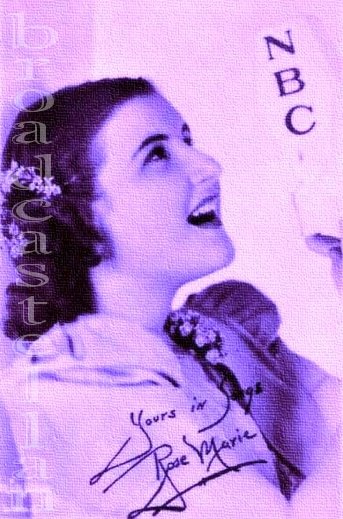
I couldn’t believe my eyes. I couldn’t believe my ears, either. That is how I felt when I first watched International House (1933) and saw the sensational Baby Rose Marie belting out “My Bluebird Is Singing the Blues.” Watch out, Shirley Temple, I thought, this kid has got a little more octane; she’s more Maker’s Mark than Little Miss Marker, more moonshine than Sunnybrook. Today, that kid is celebrating her ( )th birthday. Her shoes may be on display at the Smithsonian in a few weeks; but, later this year, she is also going to be back on the screen—in a movie adaptation of the musical revue Forever Plaid. To find out more about the wunderkind from her own lips, I am tuning in to the first installment of a five-part interview with Rose Marie, recorded in 1999.

The interviewer, one Karen Herman, is about as dense as a pea souper, only far less absorbing; but the quondam phenom doesn’t seem to be phased by it, brushing aside or simply ignoring what she does not care to hear or answer: “Age is only good with wine and cheese,” she responds when Herman quizzes her on her date of birth, something “Baby” had to deal with right from the start of her career.

She also had to deal with doubters like me who, listening to her, imagined a rather more mature performer. “I never sounded like a child. I never had a Shirley Temple voice. Always had a Sophie Tucker type of voice,” Rose Marie commented. Now, that is a problem for a performer who is not seen. Sure enough, the singer-actress recalls, “people started writing in letters saying ‘that’s not a child, that’s a thirty-year-old midget.'” So, the alleged midget was sent on tour around the country.

Very little of Rose Marie’s many years on NBC radio is extant or readily available today. A clip from the 14 March 1938 broadcast of the Baby Rose Marie Show may be found here. Among the number is the catchy “How’dja Like to Love Me?” from College Swing (1938). Nearly a decade later, in 1947, “the little tyke who used to be in movies and on the air” was featured on Command Performance, hosted by a cheerfully daft Ken Niles, who was looking forward to holding her in his lap once again. Ginger Rogers set him right by describing Rose Marie to listeners as a “grown-up, luscious, attractive blonde.” “Well . . . ?” Niles replies rather salaciously and invites the guest to come up to his apartment to look at his rattles.

Mercifully cutting short the patter, Rose Marie sings “My Mama Says No, No” and, later in the program, goes back to the year 1926 BS (“before Sinatra) and does a swell Jimmy Durante impression (also heard on Durante’s own show).

This anniversary strikes me as just the occasion to reopen my Gallery of Radio Stars . . .

Fight . . . Headache . . . Three . . . Ways

I’m fighting them any which way I can. Headaches! This time, though, nothing seems to work. And all the while, during a very nearly sleepless night, I’ve been torturing myself, thinking of the old Bromo-Seltzer train and its insistence that listeners to those Bromo-Seltzer sponsored programs “fight . . . headache . . . three . . . ways.” That meant taking care of stomach upset and jangled nerves into the bargain. Jangled nerves? I don’t know, but somehow that train whistle is the last thing you want to hear when you are under the weather (or whatever is firing up that blasted steam engine in my cranium these days).

The Bromo-Seltzer train was a menace, if you ask me; but it was also a marvel. It came to life through the magic of Sonovox, one of those fabulous if artistically insufficiently explored sound effects devices used in 1940s film and radio, where it was largely relegated to commercial duties. Its potential becomes no more apparent than in those insinuating drops of water dripping on A Letter to Three Wives (discussed here). As Time magazine described the invention in its 24 July 1939 issue, a recorded sound is “fed through wires to two little biscuit-shaped gadgets which are placed on each side of the throat against the larynx. These gadgets transmit the sound vibrations to the larynx, so that the sound comes out of the throat as if produced there.”

For comic effect, the novelty was used in the comedy-thriller You’ll Find Out (1940; mentioned here) and Disney’s Dumbo (1941). The Sonovox was also heard in The Falcon and the Co-eds (1943), and, rather more hauntingly, in the Joan Crawford-starring melodrama Possessed (1947; mentioned here). The swan song for the Sonovox appears to have been The Good Humor Man (1950), as a fellow web journalist shares it here, with a clip from the film.

The other day, I caught another glimpse of the Sonovox in operation while watching the The Reluctant Dragon (1941), a promotional tour of the Disney Studios filmed during the making of Dumbo, which was released early the following year. The proxy visitor taking the tour on our behalf is Algonquin Round Table wit Robert Benchley (pictured).

Tonight, though, it had better be a silent movie. Why not a stroll in Hitchcock’s Pleasure Garden, (1925)? After all, it is Alma Reville’s birthday.

Twice Behind the High Wall; or, It’s Not the Sane on the Radio

Every once in a while I catch a sound and solid studio era thriller that has heretofore escaped me. One such welcome find is the Curtis Bernhardt-directed High Wall (1947) starring the dark and deadly serious Robert Taylor as an amnesic who finds himself in an asylum for the criminally insane for a murder he may or may not have committed. Initially refusing treatment for fear of having his guilt confirmed along with a sanity that could prove the death of him, he is soon faced with evidence convincing him that he is not beyond hope and sets out to mount the titular structure and leave no stone unturned in an attempt to emerge a free, upright man and levelheaded parent.

In this process of tearing down the wall that silences him, Taylor’s character is supported by a member of the staff (Audrey Totter), but all the while impeded by the to him unknown schemer who laid those bricks and is determined to make them insurmountable (Herbert Marshall).

In the architecture of High Wall, the three figures operate with the predictability of trained mice. We know—and are meant to know—that Taylor is innocent, that Totter will be so unprofessional as to confess her love for him, and that Marshall has erected the High Wall to cover up his own guilt. Knowing as much makes us the privileged observers of a neat and well-staged rehabilitation drama, a character study of the three mice in a maze that begins to crumble and lose some of its high tension only after the wall has been taken. A solid suspense drama, nonetheless.

Suspense. That is precisely where I had previously hit upon this High Wall, or, as it turned out, some rudiments thereof. The title rang a bell loudly enough to make me check for such a radio connection. Produced on 6 June 1946, eighteen months prior to the release of the film, “High Wall” presents a similar situation but an altogether different outcome.

Both radio version and screen adaptation were based on a story and play by one Bradbury Foote (the motion picture also credits Alan R. Clark). Subsequently, the film that was a radio play that was a stage play and story was reworked anew as a radio play. Starring Van Heflin and Janet Leigh, the remake was soundstaged in Lux Radio Theater on 7 November 1949.

Unlike, say, Sorry, Wrong Number, the property remains sound whether it is thrown onto the big screen or pulverized into thin air. Nothing about the motion picture suggests that what we see has been remodeled from a stage set; likewise, the radio play is so much in keeping with the Suspense formula that it might well have been an original radio drama, written especially for the series.

Those at work in structuring and reconstructing both High Wall, the film, and “High Wall,” the radio play, clearly understood the limitations and potentialities of the media for which the product was headed. Whatever his initial idea, Foote did not insist that his words were written in stone.

So, rather than arguing which version is superior, I noted the differences between the Suspense drama and the screen thriller. On the air, the story is decidedly more noir than on the screen. It is more concerned with the demoralizing than with morals; less involved in the cure than in the kill. It draws us in, behind that wall, without signaling a way out. No outline of romance and redemption; no hope foreshadowed. Just the shadow of which we are puppets.

Whereas High Wall is concerned with a man’s struggle to clear his name, “High Wall” deals with a man who barely remembers it. That he is telling us his own story does not make him any less suspicious. Why did he end up in an asylum? Or is he merely stonewalling? We need to know that before we can feel at ease about taking his side.

The omniscient film narrative provides us with a villain whose workings are clear to us before they become known to the main character. In the radio play, we don’t know any more than an apparent amnesiac whose mental state and progress are uncertain. As it turns out, what he doesn’t know might just kill you!

Pardon Me, I’m With "Stupid"

I don’t know what possessed me when, on a trip up to Manchester last week, I walked into a store and purchased a 21-DVD box set of shorts and feature films starring Messrs. Laurel and Hardy. Silent two-reelers, early talkies, as well as their reworkings in Spanish and French. Even rediscovered snippets of a German version of Pardon Us titled Hinter Schloss und Riegel. I guess, discovering Oliver Hardy’s feminine side a few weeks ago up in Ithaca, New York, and stumbling upon Hal Roach’s grave in nearby Elmira got me into this fine mess.

As mentioned earlier, I generally turn to Harold Lloyd for laughs generated by flying pies, pratfalls, and assorted pickles. After years of copying earlier masters, Lloyd hit on just the right formula with his clever combination of slapstick, wit, and romance. None of the sentimentality that makes the coy and ingratiating Chaplin such a turn-off for me.

Sure, the romance in Lloyd movies is of the old boy-meets-girl variety. By comparison, the emphasis in the works of short-tempered Mr. Hardy and his feeble-brained pal is on male bonding. Years ago, I taught a course examining definitions and boundaries of friendship in American culture. I might well have included this odd couple in my discussions. What, besides a chance at getting even after suffering insult and sustaining injury through mutual ineptness, kept those two together?

Shorts like “Helpmates” reveal that Hardy did not have a happy home. Well, by the end of it, he does not have much of a home at all, once Laurel, the home wrecker, is through with his botched efforts to assist in cleaning up after a wild party held in the absence of Hardy’s formidable missus. “Our Wife,” in turn, suggests that Laurel and Hardy are best wed to one another; and “Their First Mistake” shows them as a couple raising the baby Hardy adopted to keep his marriage from falling apart. Too late. Returning with the infant, Hardy discovers that he has been abandoned by his wife, who accused him of thinking more of Stan than of herself. “Well, you do,” Laurel agrees. “We won’t go into that!” his friend retorts.

No doubt, their violent, destructive streak is their way—and Roach’s as well as America’s—of dealing with men having feelings for one another in a manner that might be deemed bad mannered or puerile, but that does not raise suspicion in mainstreamed minds. Their Tom-and-Jerry-foolery was a precursor to those 1980s buddy movies. Screwball comedy without the girl.

“Should Married Men Go Home?” another of the pair’s outings invites viewers to debate. I did not ponder such questions much when last I watched Laurel and Hardy in action. I had never even heard the two of them speak in their native Englishes. What I heard them say had been in German, in which language they are known as “Dick und Doof” (Fat and Stupid). Not the kind of sobriquets to instill respect for their craft or encourage intellectual engagement.

Well, it was I who ended up looking pretty “doof,” staring at various screens on which I expected Laurel and Hardy to appear. “Me and My Pal,” the title selected for this evening’s small-screening, simply refused to emerge in anything other than an unintelligible mosaic of greenish pixels. So far, my picture of their relationship, its secret and extent, is hardly much clearer than that . . .

Blood, Sweater Girl, and Tears: “A Night with Johnny Stompanato”

I’ve just been tuning in to “A Night with Johnny Stompanato,” an original radio play by British director-playwright Jonathan Holloway, which you may access via BBC’s iPlayer until 18 July 2008. Based on “real events, newspaper reports, and FBI files from the years 1957 and 1958,” this hourlong docudrama recounts a sordid chapter in the life of screen legend Lana Turner, whose teenage daughter, Cheryl, stabbed to death the titular character, the star’s possessive mobster boyfriend. “Real events?” Turner purrs. “Yeah, I guess. Personally, I’ve rarely met a man who could tell the truth when a lie would do.” So, this time around, Lana gets to tell her own story. With us, the radio audience as jury, she is going to court for us—which is to say, she’s going to court us—all over again.

Can Turner give the performance of her life now that her own life is at stake? Let’s be frank, the former Sweater Girl was neither known for her realist acting nor for her vocal talents, as I previously remarked here. Tuning in to Turner is not likely to make you turn on to her. There wasn’t enough “It” in her timbre to make Lana’s figure appear before your mind’s eye as you listen to Suspense thrillers like “Fear Paints a Picture.” In this Imitation of Lana, Laurence Bouvard is ably substituting—and, I found, vocally improving on—the departed screen icon, who never sounded as confident behind the microphone as she looked in front of the camera. You might say that Bouvard sounds more convincing than Turner—even though, to me, “the real Lana” has an oxymoronic ring to it.

Now, my days of thrilling to trash like Hollywood Babylon are long gone, as are my experimentations in hairstyles inspired by Lana’s late 1950’s coiffure. Still, I was looking forward to this racy little number. Unfortunately, it turned out to be rather dull—which is quite a feat, considering the material.

On the face of it, “A Night with Johnny Stompanato” is not unlike one of those femme fatale yarns produced by Suspense, in which tough-talking dames give you the lowdown on a crime they were involved in, until the first-person narration makes way for a dramatization of past events. In short, the past becomes present at pivotal moments in the story. The same formula is used by Holloway, except that the playwright dramatizes the court scenes, which in themselves are retellings, with Turner commenting on the proceedings. In other words, he lets the leading lady attest too much, so that we are told what has happened rather than permitted to overhear it.

One of the most dramatic moments of “A Night with Johnny Stompanato” involves Turner, then shooting Another Time, Another Place in London, attempting to have her increasingly violent lover deported. From her dressing room at the studio, Turner calls Scotland Yard but, “as bad luck had it,” Stompanato was trying to reach her “at the same time.” Sorry, Wrong Number came to mind; but that was my mind, not the playwright’s. Instead of dramatizing this potentially thrilling call, Holloway has Turner recall it for us in retrospect:

The dumb English broad on the switchboard opened the line for him, and he listened in on everything I said to the police. The detective put down the phone, and John’s voice came straight out of the earpiece. I practically dropped dead on the spot.

The dropping dead, though, is acted out for us, with prolonged gurgling and some heavy breathing. Stompanato’s silencing comes as a relief. As impersonated—or caricatured—by John Guerrasio, he sounds about as charming and enigmatic as Allen Jenkins.

“You know,” Turner confides in us at the conclusion of her report,

the most amazing thing about the whole Johnny Stompanato business? That I didn’t learn from it. Just kept right on getting involved with men . . . and having a really bad time getting uninvolved. I never learned from my mistakes, which, I am told, is what makes us different from the animals. Nope. I just kept right on making them.

The same goes for radio playwrights, I suppose; “instead of being dramatic, with action in the now,” aforementioned writing instructor Luther Weaver complained about 1940s radio serials, their narration “offers a post-mortem on what already has happened.” Don’t get me wrong. I am grateful to the BBC for trying to keep radio drama alive (a new adaptation of Cheever’s short story “The Enormous Radio” is being broadcast on Wednesday); but, as “A Night with Johnny Stompanato” demonstrates, dialogue alone does not constitute drama. There’s more tension in one of Lana’s discarded sweaters.

Going Ithaca; or, A Hardy Welcome

Traveling through Upstate New York on a weekend in summer without having called ahead for reservations is like entering a lottery with money you owe to a loan shark with particularly keen nostrils. It is a heck of a gamble. While not the Vegas type and averse to mixed metaphors, I prefer vacationing without a safety net; but to the one driving and hoping for a bedpost instead of yet another signpost pointing to some rural spot barely traceable on the map it can be rather a pain in the hard-pressed posterior.

“There’s no room to be had in Ithaca,” we were warned one stormy evening by the proprietor of a second-hand bookstore in Dryden, a little town in the Finger Lakes District. That was Saturday, 21 June, which happened to fall on the second day of this year’s Ithaca Festival, the weekend Ithacans set aside to celebrate themselves and, by so doing, apparently draw considerable crowds to augment their population so as to justify every overpriced motel bed in town.

We had experienced difficulties with accommodations (make that impossibilities) on the previous night up in Saratoga Springs, where even the bedbugs were lining up for the tiniest of places to flop due to some rock concert of which we, who would much rather listen to a piano being tuned by Florence Foster Jenkins, were altogether, though not, as it turned out, altogether blissfully unaware.

Well, there was a room to be had in Ithaca. And not just a room, but a view, as well. That view, at some remove from the rather fancifully named Meadow Court Inn, was up in the balcony of the old State Theatre. We were being treated, free of charge, to a screening of a silent movie shot on location in Ithaca, which, as Aaron Pichel informed us in his extensive notes on the film we were about to see, was a center of motion picture production during the early days of narrative filmmaking.

Directed by the brothers Leopold and Theodore Wharton, The Lottery Man (1916) features a young Oliver Hardy (shown above) in the role of Maggie Murphy, a cheerful maid who ditches a chance at riches for the fellow servant she loves.

The audience at the old State Theatre was largely local. We could tell by their cheers. They recognized buildings and streets (pointed out to us in the program) and expressed themselves appreciative of this off-Hollywood production in the mounting of which several long since departed townspeople had been actively involved both behind and in front of the camera.

Based on a Broadway stage success of the same title and starring two of the original cast members of the 1909-10 production, The Lottery Man is a clever little farce that tells the story of an impecunious but resourceful college student who offers himself as prize to any woman daring or desperate enough to purchase a dollar ticket, only to realize that he has fallen in love and is jeopardizing a chance at matrimonial happiness by attempting such a money-raising stunt.

Among the luckless and disgruntled ticket holders shown in a climactic crowd scene were quite a few poorly disguised males, which brought to mind the recent policy changes in the State of New York owing to which the state of matrimony no longer demands that an Oliver in search of a husband either pose as Olivia or propose to one instead.

The little known and seldom shown Lottery Man, which, as of this writing, has yet to receive five votes on the Internet Movie Database, was ably accompanied that night by the jovial Philip Carli (pictured), one of a rare but according to him far from threatened breed of entertainers. The fact that we number among our friends a silent movie composer/accompanist who wrote a radio play-turned-television drama about Laurel and Hardy added further significance to this unexpected outing at the end of a long drive along the Mohawk and down Cayuga Lake.

Sure, the moviegoing experience might have been enhanced by the presence of a projector (the film was screened digitally); but I, for one, was glad to have been part of this special event at a night on which we could have hoped for nothing more than a roof over our chowderheads.

As Their Own Words: The "Colorless Green Ideas" of Sleep Furiously

How strange, I thought, sitting in the darkened auditorium of our local art house movie theater. Here I am, watching a film capturing the world around me—my immediate environs, the people who are now, in terms of proximity, though not, generally, of propinquity, my neighbors. Looking on once again brought home just how removed I am from the lives and experiences of the people shown on the screen, insisting instead on reliving my recent trip to New York, city and state.

That one of them is a friend, and that the film’s director is her son, only added to the sensation of not being truly part of the networks of people among whom I now happen to reside, that I seem to be less part of the land than our terrier, Montague, leaping in the fields.

The film was Gideon Koppel’s Sleep Furiously (2007), one of the official selections screening at this year’s Edinburgh Film Festival. You might call it a documentary; but it really is more precisely a document, meaning that no documentarian vision is imposed on what we are being shown. While the images of rural life in Wales are reminiscent of Humphrey Jennings’s aforementioned Silent Village, Sleep Furiously does not extract a message from what it examines, other than articulating an apparent respect for the life depicted. It captures what some argue to be endangered; it preserves what some fear to be fading. Beyond that, however, the film does not so much as construct a syntactic unit from the words it permits us to overhear.

The seeming randomness of Sleep Furiously (whose title is derived from Noam Chomsky’s famous grammatical yet nonsensical sentence) invites us to study each moment, each figure in the landscape as so many nouns and verbs. It is an encyclopedia of a place, not a social commentary.

The camera is mostly static. It is the people, the landscape and the living things in it that are in motion; and it is this movement within the frame that compels us to keep watching: a library van creeping up and down narrow countryside lanes, people busy at their day’s work, farm animals giving birth, raindrops gliding along a washing line. We are encouraged to look at snapshots, rather than judge or ponder the judgment of a curator who, by comparing and setting aside, is out to assign a definite space to each artifact with the intention of fixing a meaning beyond that each shot may either have intrinsically or hold for us, the individual spectators. Instead, the people we meet speak for themselves without posing or being imposed upon.

Freed from the burden of being representative types, mere manifestations of a director’s position of manifesto, the individuals we meet come alive; and however insignificant they might be to the world at large, their words and image become memorable. It is the lens and the microphone that communicate and let communicate, that extend the hidden community in which they dwell.

For once, I got to see the life in the cottages and farms all around me, disconnected as I remain from most of them and they from me. And, next time I see our friend, Pippi Koppel, I can tell her: hey, I never knew that about you—that you put a dead owl into your freezer and mailed it off to a taxidermist; that you renewed your library copy of Glorious Cakes; that you introduce children to the art of pottery; or that you place stones upon your husband’s grave . . .

I sensed that, beneath the syntax those who look on or judge without bothering to look construct out of our lives, we are all word made flesh. Most of us aspire to being nouns, to being somebodies, while others are adjectives, enriching or changing the lives of those on whom they depend for their own meaning.

The lucky ones are verbs: those who make, who mean, who matter without being mere complements of someone else’s sentence. Unless we are prepared to remain a question answerable to others—Happy? Misfit? Either … or?—we had better work at being and creating. Try! Continue! Change! That, not simply syntactically speaking, is imperative!

“Jumping Niagara Falls”; or, She’s Pushy, for a Corpse

Among the fifty-eight movies I added to our video library while shopping in New York City is the 1948 film adaptation of Lucille Fletcher’s radio play Sorry, Wrong Number. Fletcher penned the adaptation as well, despite her previous remarks about the merits of her original script. “I wrote ‘Sorry, Wrong Number,’” she was quoted in a 1948 anthology of Plays from Radio, “because I wanted to write a show that was ‘pure medium,’ something that could be performed only on the air.” And yet, “Sorry” has been reworked for stage and television and turned into both film and novel. If the original play is “pure medium,” Anatole Litvak’s melodrama is a Sorry adulteration. Just how much of a narrative muddle it is becomes clear when the screenplay was returned to the airwaves as a presentation by the Lux Radio Theater on 9 January 1950.

The thrill of the original lies in what Matthew Solomon refers to as its “narrative isochrony,” that is, the congruence of elapsed airtime and the clock ticking away the last minutes in the life of the central character. Instead, Sorry is marred by too many flashbacks and too much background story for what is essentially our witnessing of the inevitable death of someone we cannot wait to shut up.

Fletcher invites us to rethink Mrs. Stevenson’s role of a victim and permits us to enjoy tuning in to the well-scheduled execution of a perfect monster. In her screenplay, however, the playwright attempted to elicit feelings for a woman we’d much rather strangle, to make us waver between sympathy and condemnation. Mrs. Stevenson now has a first name and presumably a heart, however weak.

Alfred Hitchcock might have agreed with this revision, considering that the audience experiences suspense more keenly if the character is sympathetic. Fletcher also adds a moment of doubt as to Mrs. Stevenson’s fate by suggesting that her executioner might also become her rescuer.

At the same time, though, the film, unlike the radio play, compromises its point of view, letting the camera glide through Mrs. Stevenson’s room and giving us eyes to see the world beyond instead of keeping us close to the invalid who is being given a pair of wobbly legs just strong enough to make us wonder about her condition and chances of survival. Film insists on showing, even if the most compelling sight is the emotional state as written in the face of a person reduced to being all ears.

At any rate, Mrs. Stevenson died, eventually and unsurprisingly. Or did she? While on our trip upstate, recalled in the current entries into this journal, I was reminded of “Jumping Niagara Falls,” the unlikely sequel to Fletcher’s rather conclusive thriller. In it, Mrs. Stevenson is out for revenge—from the grave as her husband Elbert goes off to the Falls with a woman young enough to be his granddaughter. What’s left of Mrs. Stevenson is nothing more than what we get when we first encounter her—a voice, which insists on making itself heard on the telephone, the radio, and (or perhaps solely in) the mind of the man who masterminded her murder.

That voice, in the 1999 sequel (by Brian Smith and George Zarr) is Claire Bloom’s. To me, though, as to anyone loving radio, the voice of Mrs. Stevenson belongs to none other than the aforementioned “First Lady of Suspense.” Equipped with Moorehead’s larynx, Fletcher’s celebrated harridan might have us all over in a barrel.