“Could She Kiss and Kill . . . and Not [Be] Remember[ed]”

Well, it had been a few years since the movie-going public lined up for a helping of The Egg and I (1947), the back-to-the-farm comedy that proved to be Claudette Colbert’s last major screen success. Still in print today, the non-fiction bestseller by Betty MacDonald on which the franchise-hatching hit movie is based has just been selected as BBC Radio 4’s Book at Bedtime (for a 1947 radio drama version starring Ms. Colbert and her co-star, Fred MacMurray, click here). Considerably less enthusiasm was generated by Mel Ferrer’s The Secret Fury (1950), a box office egg that, even upon delivery, was anything but farm fresh.

In 1944, Colbert left Paramount, the studio that had shaped and protected her image—spirited, smart and sophisticated, after initial siren turns in DeMille features. Despite being a shrewd businesswoman, the by then middle-aged actress stumbled from one middling project to another, playing roles emblematic of an identity in a state of crisis and a career in uneasy flux: a crime-solving nun, a terrorist-beset Planter’s Wife, a Texas Lady. Even her outstanding performance in Three Came Home (1950), for the ordeal of filming which she lost her chance at starring in All About Eve, had gone largely unnoticed.

The Secret Fury, the hysterical melodrama she starred in next, was filmed at a time when audiences were being swept away by a new wave of crime stories that were tough, gritty and low on frills. Unconvincing and anachronistic, it is an irritatingly contrived variation on one of those neo-gothic mysteries in which newlywed heroines distrust their brain much rather than those who stand to gain from addling it.

As if to compensate for the mediocre material or to suit her acting to the overwrought plot, the refined and often reserved Colbert was, for once, woefully overacting. Two years earlier, she had played a similar role in Douglas Sirk’s Sleep, My Love (1948)—the thrills-promising poster for which I acquired last fall—and audiences had reason to be less than embracing of mature (if immaturely acting) women who put their lives and careers in peril by marrying into the wrong families or listening to the advice of their Hollywood agents.

When The Secret Fury was sold to theaters in Britain, it was promoted with the help of the Exhibitors’ Campaign Book pictured above. The latest artifact to have made it into my collection of Colbert memorabilia, it affords a fascinating glimpse at the industry’s marketing machinery. Aside from offering cinema displays and providing advertising copy to be fed to the press, it encouraged exhibitors to adopt various strategies of getting a potential audience excited about the motion picture. Suggested activities were contests in which audiences were asked to match Colbert’s eyes, to share their wedding pictures, or accurately to recall recent events in their lives (something Colbert’s character struggles to do in the film).

Another “stunt” to create interest in the film was this “Visualised Brain Test Reaction, followed by the instructions:

Make an enlarged copy of this graph to serve as a teaser display in the theatre foyer, along with an explanatory caption and film credits. Lead off with a display caption: “Did these brain waves reveal the truth of her mysterious week-end?”

Meanwhile, my own head is gradually clearing after a recent fever; no longer content to feast on television sitcoms, I am going to take in one of Colbert’s earlier comedy triumphs . . . the wintersporting romantic triangle I Met Him in Paris (1937). As DeMille pointed out in his introduction to the radio adaptation another Colbert comedy, The Gilded Lily (produced by the Lux Radio Theatre on this day, 11 January, in 1937), the actress had been somewhat of a “starmaker.” Those who were allowed to throw their arms around her became leading men in their own right, as had Charles Boyer and Gilded Lily co-star MacMurray. Back then, Colbert had her pick of roles and other halves, and brains enough to go for the right ones.

Impractically Mine

Well, I have returned from New York and am off to London in the morning. In between, I celebrated Christmas in Wales. It was during this period of gift giving that I was presented with the fedora pictured here. Now, I am not one to don fedoras; nor am I a connoisseur of millinery craftsmanship. The giver is nonetheless someone intimately familiar with my fancies and foibles, someone who knows just how to press all the right soft spots. According to the certificate in the hatbox, the piece of felt in question, of Italian manufacture, was once in the personal collection of Claudette Colbert. Not in her heyday, mind you, but during the mid-1980s, about the time she appeared on stage in the revival of Aren’t We All? in London and New York.

What is the history of that hat? Did Colbert ever sport it? When, where, on what occasion? I am not generally among those who gawk at garments or marvel at the sight of items that may or may not have been in the possession of a noted so-and-so. My immediate, more prosaic question is: what am I going to do with it?

The fedora is no doubt the most peculiar item in my collection of Colbertiana, which, a few Christmas ornaments and paper dolls aside, consists chiefly of photographs and posters (the one shown here being the most recent addition). The task of mounting them notwithstanding, prints like this one are far easier to showcase than a hat, the sight of which causes me a slight unease, lest I should be wrongfully accused of having gone as mad as a hatter in my enthusiasm for its ostensible wearer.

And yet, I am suffering from an acute shortage of walls to hang pictures from or bang my bare head against. I refuse to put the fedora back in its box, though. There is no joy in keeping from view what gives me pleasure to have about me even if it might give others the wrong idea about me . . .

“Yak”: Listening to the Chief of the Daredevils, on His Birthday

Well, talk about stunt broadcasting. I am listening to Daredevils of Hollywood, an obscure series of radio documentaries of sorts, syndicated and transmitted in the United States during the late 1930s. Daredevils celebrates the achievements of those doubles who took it on the chin or jumped off cliffs for the likes of John Wayne and Clark Gable. Chief among them was Yakima Canutt (a tribute page devoted to whom you will find here). Former rodeo star Enos Edward “Yak” Canutt was born on this day, 29 November, back in 1894 (or 1895, according to the Internet Movie Database; or 1896, if the Wikipedia is to be relied upon). His seven decades spanning resume as a double, stunt coordinator and second unit director includes many of the films I have enjoyed over the years, blockbusters like In Old Chicago (1937), the to Canutt very painful Boomtown (1940), and the seminal Stagecoach (1939), a kind of fast moving Grand Hotel on wheels. Canutt did “any stunts except those with animals,” all horses aside.

Now, I am fairly allergic to tumbleweed and, however partial to whiskey, generally avoid the Republic saloon scene; I am more of a Paramount kind of guy with a soft spot for Warner Bros., even though one unlikely Texas Lady (star of the aforementioned Boom Town) is prominently displayed in my room, locally known as the Claudette Colbert Museum. No matter how many I might have pulled in my lifetime, I have little to say about stunts other than what I learned from Lee Majors and his sidekick Howie in The Fall Guy.

After the death of the Academy Awarded stuntman in 1986, Alistair Cooke devoted a “Letter from America” to his life and art, convinced that not one in ten thousand listeners had ever heard of Canutt, no matter how often his name had appeared in the credits of Hollywood films as diverse as Gone With the Wind and Ben-Hur. The fate of the stuntman, a profession largely done in by CGI, was to remain invisible. So, it is hardly a surprise that there is no mention of “Yak” in my undergraduate Stagecoach essay “How the West Was One.” That is where the radio comes in; it hands me the candle to put on King Canutt’s cake.

Programs like Daredevils of Hollywood are the Wikipedia of the pre-digital age. They are just as reliable or maligned; but they are far more intimate in the gossip they whisper in your ears. They introduce me to so much I would have otherwise missed out on, so much I am apt to overlook rather than look up. How thrilling it is to hear the voices of those behind the scenes. And, as it turns out, Canutt was quite the storyteller.

The script permitting, he sure could, you know, yak about the “tragic,” the “funny” and the “sometimes annoying” aspects of his work—if only the announcer had not felt obliged to cut him off for the sake of commerce. Then again, Canutt knew all about commerce. He risked his life for it.

"Well, excuse me for living, Anita Bryant"

Most of us have what in common parlance is known as baggage. If you were to rummage through mine, you’d come across a few reels of film. Moving images that get pushed around like a burden too heavy to carry, celluloid that somehow came to deposit itself under the by now leathery skin of my much travelled case. One such movie, to me, is Robert Wise’s I Want to Live (1958). Few moments in film made a greater impression on me than Susan Hayward’s final scenes in this hysterical nightmare of a melodrama, which I first saw when I was a child of seven or eight (we have so few accurate records for experiences such as watching television).

I was staying with my grandmother who saw it fit to sit me in front of the tube all day, flicking between the two available channels, and letting me “gorge and guzzle” like an Augustus Gloop picking the plate of Mike Teavee until I had to be taken back to my parents after developing a fever from the exposure to all those images flashing before me. I have not watched I Want to Live since. Since last night, that is.

Violent and brash, I Want to Live is hardly what you might call family fare; here in Britain, it still carries an advisory label suggesting the age of fifteen as the appropriate time for exposure. How terrifying it was for me, the boy I still know, to witness the execution of a human being, the slow death by poison staged with minute precision. There was that phone that would not ring, that call that would not come. After all these years, I was convinced it would be ringing, after all, if only too late to save the life of Barbara Graham (played by Susan Hayward, pictured above).

As I said, I had not seen this film since that first time. Along the way, I heard it mentioned, gradually realizing it to be an iconic picture, a title in scarlet lettering, the kind of incendiary pulp to which the likes of me are drawn. I knew early on what “the likes of me” were; but I was as yet unfamiliar with the secret language shared among my kind, something understood.

Years later, living in New York, I caught a rerun of the Golden Girls, the sitcom to which I, a non-immigrant German studying in the US, owed much of my colloquial English. There was Sophia Petrillo, locking herself up in the bathroom, upset that her daughter Dorothy does not approve of her wedding (to her Jewish boyfriend, Max Weinstock). The caterer storms in, overhearing the reconciliation of elderly mother and grown-up child. “This is more moving,” he breaks out, “than Susan Hayward’s climactic speech in I Want to Live.” “You’re ready to fly right out of here,” sneers Dorothy’s roommate Blanche at the sight of this Pangbornian display. “Well, excuse me for living, Anita Bryant!” the insulted caterer fires back.

I am with the caterer. In fact, I have been with the caterer and their friend Dorothy since I was about five. Perhaps, this is why I responded so strongly then to what the film claims to be a wrongful sentencing, the incarceration and sacrificing of an exuberant outcast. Not that I am trying to hand out psychoanalytic cheese puffs here.

Still, it was strange to revisit Graham’s final moments last night, so many decades later, seeing myself watching an old movie, still recognizing that boy. What was my grandmother thinking? It struck me that this was the woman who, years later, told me that she knew about the concentration camps and the gassing of the Jews. The same woman who refused to talk to or correspond with me after it had become clear that I was to remain a caterer and would never have that wedding.

There she sat with me, watching a woman going into the gas chamber. Was she reminded of the many deaths she had condoned? Was there a secret chamber of her heart into which no poison could rush? Would she have turned the switch on me and my pink triangular kind?

As if any underscoring of such melodramatic excesses were needed, Graham went out with a bang. Not just metaphorically. The lamp of our movie projector (one of those $500 bulbs) imploded just before she was led to that chamber. There won’t be any screenings for a while, except for those pictures that keep flickering on the back of my eyelids, reels in the baggage to be pushed around until it is time for me to push off . . .

The Slaughter of Beowulf; or, Grendel’s Momma Still Kills Them in Hollywood

Well, I have not quite recovered from the horror that is Robert Zemeckis’s Beowulf, whose feats and defeat I witnessed at the local movie house yesterday evening. When I say “horror,” I do not refer to the digital violence that turns the screen’s silver to red; I mean the harm done to poetry. The manuscript of the old-English poem was very nearly destroyed in a fire back in 1731; but it was not spared the fate of being torn to shreds by corporate Hollywood. Visualizing a poem is worse than giving an a cappella number the orchestral treatment. It renders the magic of the spoken word powerless, especially if the poet’s tongue is being digitally removed and substituted by the kind of mouthings you expect to hear in a direct-to-video action flick, circa 1984.

Now, I did not see the 3D version; but this would hardly add dimension to the characters, who, in this kind of digital motion capture animation, remain as expressionless as the Botoxed cast of Desperate Housewives. What is the point of hiring potentially great actors only to replace their bodies with lifeless, charmless animation? Robin Wright Penn’s Queen Wealtheow is a taxidermist’s vision of Bo Derek, while Anthony Hopkins’s King Hrothgar is imbued with the emotive powers of a garden gnome. Apparently, even a man’s age spots are beyond the skills of current CGI designers.  Then again, nobody remembers age spots in Hollywood.

Not that the voice talents could improve matters; at least not in the case of John Malkovich, who proved conclusively that he is unfit for such disembodiment.  You could almost hear the script in the hands you never got to see.  And while an attempt was made to recreate Old English in the laments of Grendel, the spoken word was not given a fighting chance to create an image in the mind’s eye.

The world of Beowulf has to be adapted to remain intelligible; but you are better off with Seamus Heaney as a guide:

In off the moors, down through the mist-bands
God-cursed Grendel came greedily loping.
The bane of the race of men roamed forth,
hunting for a prey in the high hall.
Under the cloud-murk he moved toward it
until it shone above him, a sheer keep
of fortified gold.

The new and improved Beowulf is about as poetic as a Mr. Clean commercial reconceived as a slasher movie (the Grim Sweeper?).  It is both vulgar and prim, showing you severed limbs but stopping short of giving you a glimpse of a man’s part, in a striptease that was tongue-in-cheekier in the coy cover-ups of Austin Powers and the Simpsons Movie.

Beowulf is truly a sorry spectacle, an ersatz best sat out.  Whatever the reasons for the no-shows, it is gratifying that this would-be behemoth has proven so toothless at the box office.  Watching it, I felt as if I had entered a computer game whose object it was to do in rather than do literature and to shout down the curse that, to the perpetrators of such high-infidelities, is the imagination of a reader lost in a line of poetry.

All Strip, No Blushing

Well, I may be two decades too late, but I shall enter it anyway. The hue and cry about Dick Tracy, or, rather, the outcry about his hue. Should a comic strip, once adapted for the screen, be flickering in shades of gray or flash before you in spanking Technicolor? Are strips quintessentially monochrome, or is their melodrama best played out in red, yellow, and blue? The latter approach was taken by Warren Beatty and the creators of the 1990 Tracy picture, which did fair business at the box office, but had a production design that proved disastrous for merchandizing. Disney stocks fell, as I recall; and I don’t think Madonna was to blame. Was it a mistake to put rouge on the old squarejaw? Was there much darkness in Chester Gould’s creation to begin with?

Sixty years earlier, on this day, 21 November, in 1947, radio listeners tuned in to follow Tracy on the “Case of the Deadly Tip-Off,” a mystery involving the disappearance of Slim Chance, America’s most famous radio commentator. Apart from its intriguing premise, the requisite cliffhanger (the 21st being a Friday), and a punoply of cartoonish names), the radio serial has little comic strip appeal; its voice talents and effects artists seemed particularly listless that day.

Rather than being stultified by such dross, I clapt my eyes on the more promising sounding Dick Tracy Meets Gruesome (1947), which stars Boris Karloff opposite 1930s movie serial Tracy Ralph Byrd. It is a follow-up to the 1945 return of Dick Tracy, a somewhat anticlimactic adventure whose cast was headed by the colorless Morgan Conway. It is comic strip week here at broadcastellan, you know. Besides, I am pretty much scraping the bottom of my “100 Movie Pack” of “Mystery Classics,” a DVD set I snatched up on a trip to Gotham earlier this year.

What struck me upon screening this otherwise undistinguished 1945 thriller was its noir lighting and the occasional noirish camera angle. However carelessly inked the script, the thrills were augmented by a chiaroscuro I did not expect from a comic feature. The shadows looked particularly intriguing when cast like doubt upon the face of the ever-suspect Milton Parsons, a ghoul of a supporting player I enjoy reencountering in the darker alleys of popular culture.

Meanwhile, as I am preparing for my next escape to Manhattan, anticipating to have my entertainments curtailed by the current stagehand strike, I noticed that the earlier Dick Tracy serials are now being shown at the Museum of the Moving Image in Astoria, where, on my previous visit (in June 2007) I took in an episode of Spiderman.

I wonder whether the producers of The Shadow are going to follow in the footsteps of Beatty’s Tracy or model their version on the glossy treatment of the failed 1994 resuscitation of Lamont Cranston (a glimpse of whom, as impersonate by Alec Baldwin, I caught last night on ITV 3). Being no expert in the field, I always considered comic strips to be bright (and was pleased to meet Blondie in such splendid color); but, emerging from the shadow of the darksome Deathridge and the sinister Splitface, it is . . . back to the drawing board.

Graphic

Well, what do we mean when we say that a story (a book or movie or play) is “graphic”? Do we refer to the mode of depiction or to the matter depicted? Does it describe a work of art that is especially vivid or particularly morbid? These days, the term is both a warning label and a genre marker. It is designed to signify horror, which, distinct from terror, details rather than insinuates violence. When applied to print media, it signals a superior kind of picture story, something set apart from the comic by virtue of its mature themes or adult language (regardless of how immature “adult” language may often be).

The first picture book I came across that warrants the label “graphic” in both respects is Art Spiegelman’s Maus. It is a biographical account of Jewish life in fascist Germany, the horrors of the concentration camps, and a storyteller’s struggle to grapple with such memories as recalled by a close relative.

To depict the Holocaust in drawings of half-human animal figures is a daring project to begin with. It takes on the tradition of the fable and renders concrete what constitutes the dehumanization suffered under totalitarianism. On the one hand, Maus de-Disneyfies the fable, which, for centuries, had served as a coded moral tale not restricted to children or petty lessons in table manners. On the other, more bloody hand, it takes the figures of the fable out of their abstract realm and places them into concrete historical settings.

I was reminded of Spiegelman’s Maus last night when I went to see Die Fälscher (2007), a German film set in a concentration camp. Die Fälscher (translated as The Counterfeiters, tells the story of Jews forced by the Nazis to forge foreign currencies in an attempt to ruin the enemy’s economy and finance the ruinous Wirtschaft at home. For the conscripted Jews, foremost among them a highly talented criminal, it means survival and relative safety as well as an act aiding the system that has isolated, degraded and singled them out for extinction . . .

Like Maus, Die Fälscher deals with the guilt of those who forge a future for themselves in a world that insists on their pastness; it is a graphic story of craftsmanship drawn upon for the art of survival. The pen is mightier then the sword, Bulwer-Lytton famously remarked; its true test, however, lies in countering an army of erasers . . .

Dark Echoes

Well, perhaps I am a medium. Perhaps, broadcastellan is more than a mere series of ever so slight and seemingly inconsequential messages. Or, perhaps, this is simply another one of those alleged coincidences I have been pondering, on occasion, with the author of those Relative and to me altogether relevant Esoterica. Two days ago, I shared a make-up chart from the celebrated House of Westmore. Apart from being a fascinating artefact, remotely related to my topic of the day, I thought it was neither here nor there—that realm in which I often find myself while exploring the out-of-date everyday. This evening, though, I learned that another branch of that fruitbearing family tree, Monty Westmore, has died off at the age of 84. Westmore, who was Joan Crawford’s personal makeup artist during the latter part of her career, was still active in the 1990s, working on blockbusters like Jurassic Park.

Last night, I watched what I believed to be the altogether inconsequential College Swing (1938) starring Bob Hope, Martha Raye, Betty Grable, along with a handsome and ever so handy handbag serving as a radio receiver, and that celebrated comedy team of Burns and Allen (aforementioned), who enjoyed such popularity that they were called upon to sell the Paramount feature in the film’s trailer. Today, I learned that Ronnie Burns, the adopted son of Burns and Allen—who frequently featured on his parents’ 1950s television series—passed away on 14 November 2007 at the age of 72; he was three years old when College Swing was shot.

“In the midst of life we are in death,” I thought, without the slightest ambition of being original. It seems there really is no such a mode as escapism; there is no signing off, as long as we acknowledge that the signs and signposts of old lead us straight into the present day. To the receptive mind, any old vehicle has the power to drive us home; everything connects, if only you let it, and even the remotest piece of formerly popular culture will insist on rendering itself significant . . .

“Isn’t she nice?”: Laraine Day (1913-2007) on the Air

Well, the first thing I thought of when I heard about the passing of screen actress Laraine Day on 10 November 2007 was this remark by Alfred Hitchcock, who directed her in Foreign Correspondent (1940): “I would have liked to have a bigger star.” He could not have been faced with a brighter one. Best known in the 1940s for her recurring role of nurse Mary Lamont in a series of Dr. Kildare movies, Day (seen left in a picture taken from my copy of the 3-9 January 1942 issue of Movie-Radio Guide) was as bright as her name suggested. There seemed to be no edge from which to push to her into more ambitious performances. She was just so darn nice . . . at least until she was forced to give back that pretty Locket.

In The Locket (1946), Day’s cheerful personality is being cleverly exploited to make audiences wonder whether her character, Nancy, is really as charming and uncomplicated as she seems. “She is nice,” a woman attending Nancy’s wedding observes. “She’s lucky,” another guest replies. “If you’re nice, you have to be lucky,” the first one counters, only to be dealt with the riposte that “[i]f you’re lucky, you can afford to be nice.”

Nancy can afford to be nice, however little happiness being a good girl managed to get her as a child; but is she just Mrs. Lucky to have landed such a well-to-do husband, or has her not being quite so nice something to do with it? The Locket, in which Day stars opposite Robert Mitchum, Brian Aherne, and Gene Raymond, is Hitchcock’s Marnie without the sex angle. It is a dark, labyrinthine thriller that casts welcome shadows on the brightness of Ms. Day.

Before making her frequent US television appearances, hosting her own program, Daydreaming with Laraine (1951), and starring in a number of Lux Video Theater productions, Day was heard on the Lux Radio Theater in recreations of her screen roles in Mr. Lucky (1943) and Bride by Mistake (1944). She was also cast in a number of original radio plays produced by the Cavalcade of America (such as in “The Camels Are Coming,” opposite her Foreign Correspondent co-star Joel McCrea).

On Biography in Sound, Day let listeners in on the home life of her husband, Brooklyn Dodgers manager Leo Durocher, with whom she also appeared on Tallulah Bankhead’s Big Show (4 February 1951), in which Day’s clean image was contrasted with that of her irascible husband:

Bankhead: Well, I must say, Laraine, that being the wife of a stormy baseball manager doesn’t seem to have changed you very much.  You still have that fresh, lovely, scrubbed look.

Day: Why shouldn’t I look scrubbed? Every time we have an argument, Leo sends me to the showers.

Considering that Day’s projected identity resembles an ad for toilet soap, it is not surprising that she made several return visits to the Lux Radio Theater. Introduced as “ever lovely” by Mr. DeMille, Day enjoyed a rather more interesting vehicle than her own comedies in the mystery “The Unguarded Hour” (4 December 1944).

In that adaptation for radio (of a movie based on a stage drama that itself was an adaptation), Day plays a valiant wife who tries to protect her husband from a scandal of which he is unaware. His words, uttered by co-star Robert Montgomery, capture what is the Laraine Day persona:

How do you think I came to worship you? Because you’re so pretty? Because you win large silver cups jumping horses or play good bridge? No, darling.  You have what’s called quality.  It’s kindness, it’s generosity, that makes all the rest of us feel just a little shoddy.

Imitation of iLife; or, Right Now, I’d Settle for a Copy

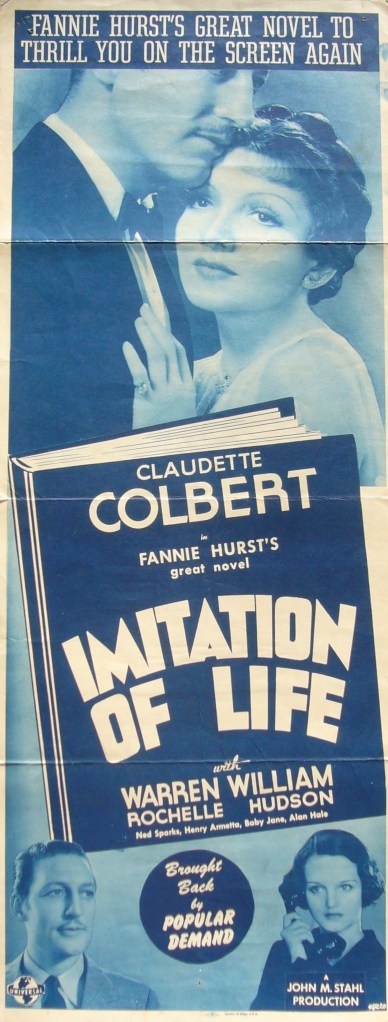
Well, never mind. I would have liked to conclude my week of listening; but I am preoccupied this evening. My old Mac seems to have given up the ghost last night—or at least it refuses to give up my files. I had been iRecording “The Expedition of Humphrey Clinker,” when my Mac began to act up. Clinker, indeed, to pick up a word of thoroughly pre-Victorian crudeness! As of now, my library of recordings and images seems to be irretrievably lost. It has been about two and a half years since the last blackout, and I don’t seem to have learned a thing. If only I had taken the time to burn a few DVDs. So, I am just going to share this latest addition to my collection of Claudette Colbert memorabilia, which arrived here earlier this week as a loving gesture to mark the third anniversary of my move here to Wales.

What I noticed right away when I looked at the poster was that no mention is made of Colbert’s Imitation of Life co-star Louise Beavers in this announcement of the film’s rerelease. That just takes the pancake, doesn’t it? After all, Beavers plays Colbert’s business partner on whose recipe the entire venture depends as much as on Colbert’s savvy to sell it. Promoters of the film were apparently less inclined to tackle race relations as the picture’s distributors. Sometimes, beautiful images tell an ugly story. An old story, too, of art imitating life . . .