
On This Day in 1939: Pearl S. Buck Gets Into the “Patriot” Act

I had intended to spend much of today al fresco, our long-neglected garden being in serious need of attention. Dragging the old lawnmower out of hibernal retirement a while ago, I had managed to knock over a can of paint and, the spilled contents being blue, very nearly ended up looking like a Smurf in the process. No sooner had we unleashed the noisy monstrosity, engulfed in a cloud of smoke, than one of its wheels broke off, which immediately put a stop to my horticultural endeavors. It is to the latter mishap on this Not-So-Good Friday and the fact that I am all thumbs (none of which green) that you owe the questionable pleasure of this entry in the broadcastellan journal.

An afternoon’s dilly-dallying among the daffodils may be just as escapist an act as tuning in an old radio program. In either case, however, it is difficult to get very far away from the news of the day, headlines so maddening and haunting that there is little relief even in irreverence, in mocking those among our political leaders who turn a blind eye to the signs of the times or who succeed in nothing more than in making enemies and alienating their allies.

Are we to believe, are we to accept that a nuclear attack from Iran is to be expected and that a pre-emptive raid is therefore necessary? Is it impossible to win a war—on terror, no less—without waging one? Is it possible to win (in) any violent conflict? On this day, 14 April, in 1939, Nobel Prize winning author Pearl S. Buck (pictured above) appeared on the Campbell Playhouse to address this very question.

Orson Welles, the official producer of this weekly radio series featuring adaptations of stories, plays, and motion pictures, had chosen Buck’s latest novel, The Patriot, as the “best new book for April” and presented a dramatization of the narrative starring Anna May Wong. Shaking hands with Welles and Wong during the curtain call, Buck was invited to comment on the “situation in the east,” the Chinese-American war that may have seemed even more remote, incomprehensible, or irrelevant to Americans than the crises in Europe. Welles inquired whether it was possible to sympathize with China and Japan alike in this conflict. To this, Buck responded:

When one has had experience of many wars, one comes to see that the pattern is always the same. No matter who is the aggressor and who is attacked, both are victim and both lose in the end.

To be sure, such a remark would not have been welcomed some two and a half years later, when the US felt compelled to enter the Second World War after the bombing of Pearl Harbor. Yet patriotism might find expression other than jingoist speech and the complexities of war called for responses other than simple slogans. Realizing the significance of radio as a means of connecting (with) the world and addressing far-reaching political and humanitarian crises, Buck decided to become a radio dramatist herself.

As Erik Barnouw relates in his Media Marathon, Buck enrolled incognito in his class (Radio Writing U2) at Columbia University to prepare for a proposed series of plays titled America Speaks to China. During the Second World War, she went on to write a number of propaganda plays about Asian-Americans and the relationship between East and West.

Today, perhaps, more people are beginning to discern the pattern Buck pointed out. And, once again, the definition, the concept of the patriot is changing: the action hero, the go-getter of few words now seems infinitely less desirable and rare than the thinker who not only knows how to use each word effectively but can be trusted to keep it.

On This Day in 1938: Jefferson Tribute Turns Infomercial . . . "through chemistry"

Well, I’ve only been back some forty-eight hours, but the sunny interlude in Cornwall, so poorly captured by my camera, already seems a distant memory. It was Thomas Jefferson—born on this day, 13 April, in 1743—who argued that travelling makes “men wiser, but less happy.” Is this true? “When men of sober age travel,” Jefferson claimed, they may gather useful knowledge, but “are subject ever after to recollections mixed with regret; their affections are weakened by being extended over more objects; and they learn new habits which cannot be gratified when they return home.” Should we limit our exposure to the world by concentrating on what is closest or by selecting a specific if narrow field of inquiry whose soil we continue to till skilfully to reap a rich harvest?

My field, of course, is so-called old-time radio, and I seem to take the fruits of my research along with me or take soil samples wherever I travel. Jefferson would not have approved of my preoccupation with American radio drama and with western popular culture in general, since he held storytelling in rather low esteem:

A great obstacle to good education is the inordinate passion prevalent for novels, and the time lost in that reading which should be instructively employed. When this poison infects the mind, it destroys its tone and revolts it against wholesome reading. Reason and fact, plain an unadorned, are rejected. Nothing can engage attention unless dressed in all the figments of fancy, and nothing so bedecked comes amiss. The result is a bloated imagination, sickly judgment, and disgust towards all the real businesses of life.

Now, in the 20th century, it was beginning to become clear that the “real businesses of life,” as interpreted by Americans, was big business: producing goods, advertising them, generating sales and making profits. So, when Jefferson was being celebrated some 195 years after his birth, his life, too, was turned into a promotional opportunity. The opportunist, in this case, was the du Pont company, who, in order to improve their image as a wartime profiteer, came up with the slogan “Better living through chemistry” and sponsored a series of historical radio dramas called Cavalcade of America. It is a fascinating merger of history, entertainment, and advertising I’ve explored in my dissertation and previously discussed here on several occasions.

On this day in 1938, Jefferson’s connections to the du Pont family were thoroughly exploited to suggest that, like Jefferson—the founder of the University of Virginia—the du Pont Company was chiefly interested in educating America, rather than amassing riches from the manufacture of gunpowder.

In “Thomas Jefferson, Pioneer in Education,” the future US President meets Pierre Samuel du Pont de Nemours (1739-1817), a French economist whose son, Eleuthère Irénée turned to gunpower manufacture during the volatile and dangerous days of the French Revolution. No mention is made of the source of the du Pont fortune, leaving listeners with the impression that the du Pont clan were a group of benevolent scholars who admired the United States chiefly for its advancements in education.

Children in the United States, the old Monsieur du Pont told Jefferson in the Cavalcade‘s version of history, “are encouraged to read and comment. Controversy has developed argumentation and given room for the exercise of logic. This country has a large proportion of moderately well-informed men. But that does not mean that the general education cannot be improved. And if improvement is a possibility, it is a duty.”

To underscore this message, a great-great grandson of papa du Pont seizes the microphone for a curtain call, in which it is suggested that his family played a substantial role in American education. Cited for “good taste in advertising,” the Cavalcade program, much reviled by erstwhile contributors like the aforementioned Arthur Miller, seems to have counted on the “moderately well-informed” and done its share to remove all traces of “controversy” and “argumentation” from the cleverly crafted infomercials it passed off as history lessons. Was this “better re-living through chemistry”?

Wouldn’t You Rather Have . . . “picked up Anna May Wong at the Park Wilshire”?

There are days when you are in desperate need of vicarious living. While the world marvels at the latest solar eclipse, you wonder whether there’ll be any sun at all his spring, the prospects for your upcoming trip to Cornwall looking decidedly grim. So, you grab a book from your shelves and, presto, you assume the identity of some personage whose existence strikes you as being rather more colorful than your own present self. I wouldn’t have minded trading places with a certain Val Gielgud, who, on this day, 29 March, in 1938, “as nearly as possible passed out over the soup!” I should add that the soup was served at the home of Isabel Jeans, Hollywood actress, and that Mr. Gielgud, brother of distinguished thespian John Gielgud (whom I heard only last night in a 1951 radio production of Hamlet) and a noted radio writer-director in his own right, was on a month-long tour of Tinseltown.
Now, I’ve never been much of a namedropper, being that the only vintage Hollywood notable I’ve been around for any longer period of time was stage and screen actress Viveca Lindfors, whose dog Willie I used to walk during my college days in New York City. I’ve got pictures of the dog, but no mementos of his owner, save for a few messages she left on my answering machine. Gielgud, on the other hand, found himself surrounded by luminaries and duly recorded each encounter in his 1938 diary, excerpts of which he later shared publicly in his biography Years of the Locust. When he was not nearly passing out in a bowl of soup, he was dining or gambling or drinking among the late greats of the motion picture industry.

“So this is Hollywood!” Gielgud exclaimed upon his arrival in Beverly Hills on 26 March 1938. He was visiting his friend, Eric Maschwitz, a novelist-playwright then at work on an adaptation of Goodbye, Mr. Chips. “One’s first impression,” Gielgud noted,

is of a place without form and void, sprawling, unfinished; a forest of oil-derricks; wide roads and fast cars; low houses; far more lights than Budapest, infinitely less effective. Whirled up to Beverly Hills, where Eric has a charming little house that belongs to [screenwriter] John Balderstone. Our nearest ‘stellar’ neighbour in Rodeo Drive—nomenclature perfect—is Rosalind Russell, who has a big house about two blocks away, marked by a police patrol. Fears of Kidnapping or just Publicity?

In this manner the diary continues. On 17 March, Gielgud recorded having had lunch “at a tennis club, where Cesar Romero, looking regrettably unshaven, was playing backgammon with a concentration that seemed [. . .] excessively gloomy.” He then went on to dine at “‘La Maze,’ where among other people were Greer Garson and Tilly Losch.” Tilly Losch? Okay, I had to look that one up. Turns out, she was a Viennese-born actress-ballerina who played Lotus in The Good Earth. From there Gielgud sauntered over to the “Clover Club—dancing and gambling—which reminded [him] of a cross between a Corner House and one of the minor circles of hell. Charles Bennett and his wife, and [Henry] Wilcoxon among others. Dolores Costello, looking tragically passee, Claire Trevor, and various large-size executives with remarkable names represented the Studios. Most people were quite simple and normally drunk.”

On 28 March, Gielgud lunched at the Brown Derby, where he met director Lewis Milestone. In the evening, Eric “collected a party [ . . ] of people whom [Gielgud] had at one time or another known in London: Isobel Jeans [is it Isobel or Isabel, now?], looking as always just out of a band-box; Reggie Gardiner, of train-imitation fame; Heather Thatcher; Greer Garson, very decorative in a pink hat and green gloves.”

In the days to follow, he also spent some time on the MGM lot, where, as he put it, “[o]ne expected to run into Garbo or Shearer or Tracy any moment—and had to be contented with a sight of Robert Young.” Sure, he was less than impressed when being “introduced to John Barrymore, who looked pathetically old and flabby,” but he also got to shake hands with the “certainly most decorative” Dorothy Lamour, “that admirable actor Lloyd Nolan,” and “Una Merkel, who turned out to be as amusing in real life as on the screen, with the most charming manners to boot.”

Within a few weeks, the visitor from Britain got to drive around town alongside glamorous Anna May Wong, with whom he is pictured above. The lucky devil! I’d sure have risked conking out in a bowl of wontons for a few afternoons with Ms. Wong.

On 21 April 1938, Gielgud left Hollywood for New York City, where, on 30 April, he directed his play “Fours into Seven Won’t Go” for the Columbia Workshop. I don’t always agree with Gielgud’s view of American radio, or America in general. In fact, I find his attitude rather haughty and his dismissals too sweeping; but I sure envy his Hollywood excursion, of which I might have more to write anon, should I find myself in need of another dose of hobnobbing by proxy . . .

"This . . . is London": Approaching Edward R. Murrow

I have returned from my latest London trip; my stimulated mind is filled with assorted impressions that I now ready for recollection in relative tranquility. Rather than pouring out those impressions like the content of an overstuffed suitcase, I shall meet the challenge of assembling them into a sequence of composite portraits, portraits not so much of myself but of the experience of gathering ideas and collecting thoughts. You might call this manipulation of the everyday a form of “method living”: a mental aligning and creative channelling of life’s vast, fleeting, and potentially overwhelming influences into something resembling a design of my own making.

There is to me nothing more thrilling than the tracing of a pattern in the patched-up fabric of the everyday. Granted, I often impose such a design by snipping off too many of the loose ends and by choosing that to which I expose myself with rather too thorough discrimination, by excluding the ill-fitting piece or neglecting the odd thread. Yet the satisfaction of finding sameness where others might only detect difference is not necessarily the program of a narrow mind. I try to do as much stitching together as I do selecting or cutting away. Atropos, Clotho, and Lachesis—I intend to do the handiwork of all three fates.

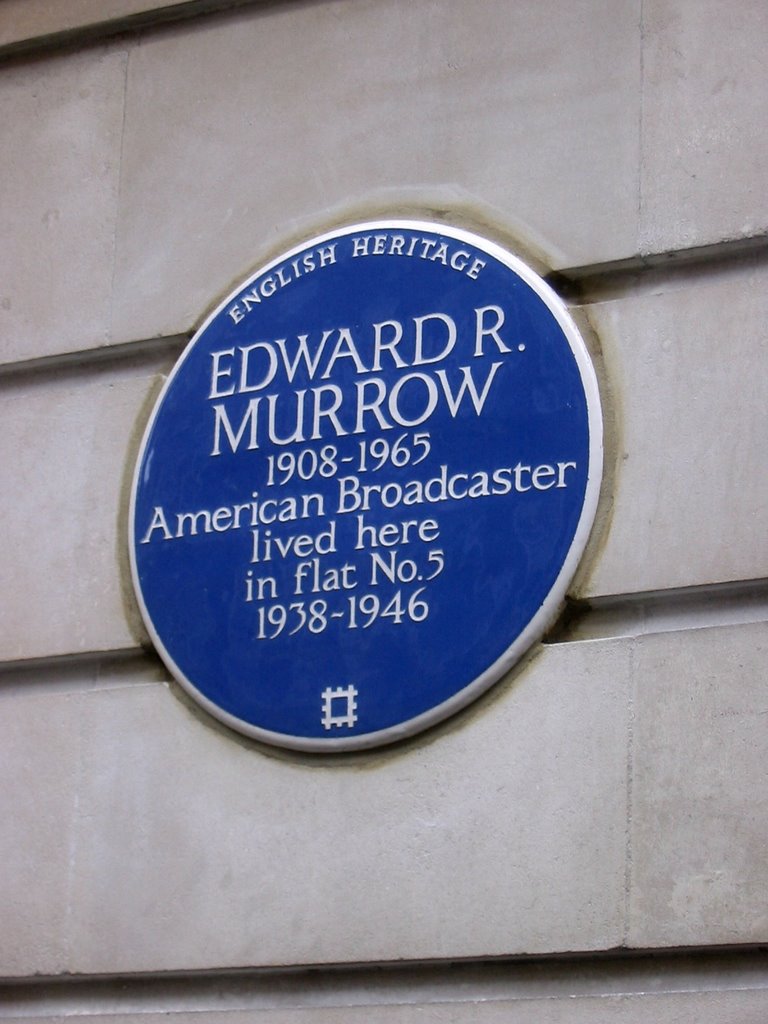
One of the threads I chose to follow during my wanderings through the maze that—compared to the comforting simplicity of New York City’s map—is sprawling London was the career of American journalist Edward R. Murrow. In his late 1930s broadcasts from London, Murrow had encouraged Americans to connect with world affairs by bringing the hardship of those under Fascist attack home to radio listeners who, in the confines of their living rooms, might have imagined themselves immune to such devastating influences. Later, he exposed fascism of another kind in his commentaries on misguided patriotism and undemocratic perversions of unity.

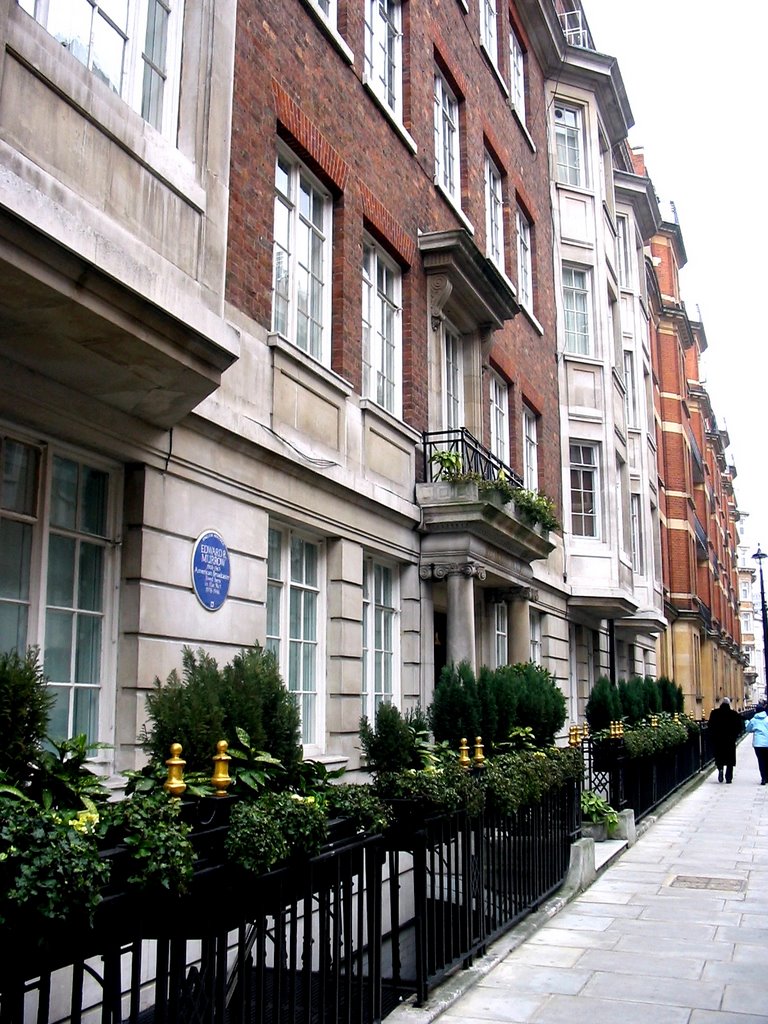
After a brisk two-hour walk from South Kensington, across Hyde Park, I arrived at Murrow’s former residence in Marylebone, not far from the British Telecom tower. I took a few photographs and walked on. I experienced no great stirring of emotions, let alone a spiritual connection. Yet the site itself, along with the act of finding, approaching and appropriating it pictorially became part of a design, enforced by the screening of Good Night, and Good Luck. my mate and I attended a day later. It had not been altogether planned that way; indeed, I was surprised to find the film to be still in such wide circulation.

The quietly impressive motion picture and my altogether unremarkable photographs do not so much amount to a biographical composite sketch of Murrow, a man who shaped history by recording it. Rather than capturing his past they suggest his presence—or our need for it.

Much of what Murray reflected upon in his broadcasts—even in reminiscences such as this one from 3 December 1944—is anything but dated, if only you permit yourself to look beyond the names of places and persons and weave his expressions of hope and fear into the fabric of our current wars and crises:

You remember those mean streets in London where so many died; the men stretching canvas over holes in roofs and walls, trying to patch things up before the winter comes, anything to keep out the rain and cold.  At the airfield you remember that it was just here you watched Mr. Chamberlain descend from his plane when he came back from Munich, waving his written agreement with Hitler and talking about peace in our time.  That was such a long time ago. And you wonder when there will be peace again and what it will be like. . . .

You recall all the talk of a better world, a new social order, a revolution by consent, that marked the desperate days, and you realize that talk of equality of opportunity, of equality of sacrifice, of a peace based on something other than force, comes more readily to the lips when disaster threatens.  There isn’t so much of it now [. . .]. 

Europe for a long time will be concerned with the urgent problems of day-to-day existence. The fundamental economic and social conflicts will not have been settled by this war. [. . .] 

For years after this war Europe will be in torment and [ . . . ] you wonder what part America will play in it all.  In battle and in production we have been magnificent.  We have delivered the planes, tanks, guns and ships and the men to fight with them.  The evidence of our strength can be found all around the world.  We’re not as tired as the others.  Our industrial plant is undamaged.  Our homes have not been blasted.  We enjoy security and relative comfort and our responsibility is frightening, for Europe will look to us—not for charity, advice or admonition, but for an example.  Democracy hasn’t been very fashionable over there in recent years and there are many who doubt that it can survive the strains and stresses of peace. . . .

Is democracy still “fashionable” anywhere? Is it the gear of choice or an imposed uniform that ceases to be fashion by resembling fascism? Has the current war on terror (or the terror of war) done much to preserve it? Are we still talking about a “peace based on something other than force”? The patterns we discover when engaging with the so-called past are often disturbing rather than reassuring. And yet, to ignore them, to refuse recalling them into our everyday, might be more disturbing still—a wilful refusal to connect that, far worse than passivity, is a violent act of tearing apart the fabric along with its flawed design.

White House Warnings, the Iran "Challenge," and the Art of Recycling Words for the Atomic Age

Only yesterday I was leafing through my dusty copy of Rogues’ Gallery: The Great Criminals of Modern Fiction. Granted, the story of pickpocket Thubway Tham (discussed in my previous journal entry) was anything but “great,” the dubious gentlemen among whom he appears in this anthology, figures like Raffles or Arsene Lupin, being far worthier of the appellation. Putting the book aside and glancing at today’s headlines, I got to thinking about those real-life acts of roguery and their perpetrators, thieves and tricksters fit for a place in that proverbial gallery.

Without being facetious, I think that most of us are eager to put certain politicians right up there with confidence men, embezzlers, and racketeers. Unlike fictional smugglers, highwayman, or cardsharpers, however, our misleading leaders rarely inspire cloak-and-dagger romances, at least not while they are still in office. Their potential to do harm to a far greater number of people than any pirate of old renders them too treacherous to be enchanting, and too powerful to be defused by mere ridicule. That we might have contributed to their ascent—either by having been taken in by their words or by having stood aside while others made what we’ve come to suspect as the “wrong” choice—only drives home that the joke, if ever it was one, is decidedly on us.

In the United States, the people’s trust in their political leaders may be reaching a new low these days, giving way to an indiscriminate, haphazard scepticism that could potentially be more hazardous than the actions that triggered it. So, hearing the latest White House warning about the Iranian nuclear program, I wonder who among us, the citizens or allies of the US, is willing to accept or heed it. Is it a danger real or imaginary, pre-existing or newly conceived in the act of pronouncing it true? What’s more, is not even a manufactured threat a concrete one nonetheless, whether as propagandist tool or diplomatic blunder?

Thinking this, I was reminded again of “Air Raid,” a verse play for radio by Archibald MacLeish, a big name in American poetry and pamphleteering. “Air Raid” is a didactic drama about an unheeded warning. Now, as I remarked when I commemorated the anniversary of the its premiere, the play was originally an appeal designed to caution US citizens against isolationism. Confronting the public with an enactment of a deadly attack on civilians, MacLeish went so far as to suggest that those who lose their lives to wartime terror are responsible for the consequences of their inaction.

However questionable his achievement, the anti-fascist cause that motivated its author was a noble one. “Air Raid” suggests that the greatest threat facing a people is not posed by foreign aggressors or domestic demagogues, but by an attitude of indifference to or ignorance of the political affairs makes the public vulnerable to acts of suppression and obliteration. Yet, like all propagandistic speech—and the melodramatic vehicles in which it hits its target audience—these words of caution were readily coopted.

On this day, 10 March, in 1956, nearly two decades after its first broadcast, “Air Raid” was restaged by the CBS Radio Workshop. The same words poured once more from the speakers—but their context had changed entirely. Now the play had the stamp of the Eisenhower years pressed upon it, the gullibility of the public being relied upon rather than challenged with the announcer’s insistence that “Mr. MacLeish’s prophesy” had become “grim reality” in an age of “guided missiles” capable of “nuclear destruction.”

“Learn what you can do to increase your chances of survival,” the program’s announcer implored listeners at the close of the broadcast: “Contact your Civil Defense Office.” As American families retreated into their picket-fenced homes—or into dreams of such—they were left with the impression that the world outside the United States was evil and that their leaders had solely their safety, rather than profits, in mind. It was thus that the lucrative armament of the cold-war years was being justified. MacLeish’s warning had become “grim reality,” all right—so much so that the public was not to appreciate his original message.

So, given that we have mostly familiar words of warning to go by once more, how can we determined the honesty or falsehood of those who utter them? Does the present truth lie in the perceived deceptions of the past? And how far should we remain willing to listen with the generosity of an open mind—instead of hiding behind the reflecting shield of satire—to keep an essentially sound and worthy political system such as democracy from falling apart?

On This Day in 1942: The Wannsee Konferenz Maps Out the Final Solution

An engagement with old-time radio need not be an escape from the world; it can be a return to the very realities we may have been desirous to avoid or void altogether. Listening to recordings of historical broadcasts can become a confrontation with the past, its representation, and, in the act of relating, with the present itself. Today, for instance, marks the anniversary of the Wannsee Conference at which, on 20 January 1942, the fate of eleven million European Jews was being debated and decided upon with the matter-of-factness and statistical precision known as the “final solution” (the minutes of which genocidal get-together can be found here). Few radio playwrights were as committed to representing the Jewish experience as Morton Wishengrad, whose 1942 play “The Battle of the Warsaw Ghetto” is as chilling and relentless as the calculated cruelty of the master(race)minding behind the massacre on which it comments.

Wishengrad, a prolific and politically engaged playwright whom noted radio actor Joseph Julian once called the only writer beside Corwin to have created a “body of radio literature that deserves a perennial life,” lets the record speak for itself in his chilling echo of fascist calculating and cataloguing—of a nation’s counting, counting down, and accounting of murder millionfold. In “The Battle of the Warsaw Ghetto,” first heard on NBC on the eve of Yom Kippur in 1943, the personal story of a holocaust victim, related from the grave, is reinforced by the sound of “black trucks” rolling out of the Ghetto to the concentration camps, by the three voices of fate (the three fates?) calling up the facts with a statistical precision that echoes the calculated ruthlessness of the acts planned and committed:

VOICE I. July 22, 1942.
VOICE II. Six thousand two hundred and eighty-nine.
VOICE III. Destination . . . Tremblinka.
VOICE I. July 23rd.
VOICE II. Seven thousand eight hundred and twenty.
VOICE III. Destination . . . Oswiantzem.
VOICE I. July 24th.
VOICE II. Seven thousand four hundred and forty-four.
VOICE III. Destination . . . Belzec. 

(Biz: Voices and truck sounds hold under narrator.) 

NARRATOR. Done with method, precise, efficient, recorded.  To Tremblinka, Oswiantzem, Belzec, Sobibor, Majdany—a lethal gas chamber, an electric furnace, a poison pit, an execution field, a cemetery.  And add also ten thousand brave, hopeless, tragic men who seized sticks and stones and knives and bare fists and charged the tanks and tried to halt the trucks.  Add their bodies to the list for the ten days of June, 1942. Make your total and then add two precise, methodical, documented months in August and September, 1942.  Reckon it.  Do it carefully.  You cannot do it on your fingers.  No! Let me give you the sum.  Listen, 275,954 fewer bread cards in the Ghetto! Swift, accurate, final.  Quicker than typhus, surer than hunger.

The records of the Wannsee Konferenz became instrumental in the gathering of evidence for the Nuremberg Nazi trials, another somber occasion dramatized on 16 October 1946 by playwright Arnold Perl, whose docudrama “The Empty Noose” suggested that, while the masterminds of the Third Reich had been hanged, the thoughts behind their actions were still very much alive, both in America and abroad. The regularly scheduled whodunit The Adventures of Ellery Queen was not heard that night.

“The medium needs writers who have something to say about the culture,” Wishengrad remarked in his foreword to The Eternal Light, an anthology of scripts from the series. Old-time radio drama also deserves listeners who take in and respond with their ears and minds open.

On This Day in 1942: Bette Davis Gives Birth to Arch Oboler’s “American”

The retrograde activity of keeping up with the out-of-date seems generally ill-suited to blogging. I doubt whether to keep looking back—and looking forward to doing so as I do—is such a forward-looking thing to do. A blog signifies little to most readers if it cannot bring them up-to-date on its declared subject matter, be it popular culture, politics, or fly-fishing. I have often felt compelled—and more often been compelled by others—to defend my engagement with the outmoded; indeed, the first comment left for me in the Blog Explosion directory was a terse “why?”

The answer, if I felt obliged to dignify such a monosyllabic and misologic remark with a reply, is this: I enjoy the challenge of discovering the relevance of a cultural artefact or an obscure piece of writing not created with me or my present in mind, and debating to what degree my thinking and being might be indebted to the attitudes reflected in such products. Besides, not being able to relate or connect to the supposed bygone is a personal loss, and, given the potential of history repeating itself, often a dangerous one at that.

Now, it would require some degree of mental obduracy or lack of imagination not to be able to relate to “An American Is Born,” a play that aired on US radio on this day, 19 January, in 1942. After all, “An American Is Born” deals with persecution and immigration in wartime, which makes it eminently topical. It is also a deliberate and unabashed work of propaganda, composed at a time when the word did not yet carry quite as negative a connotation as is attached to it these days.

Just how accepting would today’s audiences be of a play like “An American Is Born”? How likely would they find it produced and disseminated by the mass media?

“An American Is Born” was adapted by radio playwright Arch Oboler from a novella by Peter Jefferson Packer and Fanya Lawrence Foss. Written when the US had not yet entered World War II, and first sound-staged in late 1940 with Elisabeth Bergner in the lead, it was again produced a little over a year later for the Cavalcade of America program, with Bette Davis heading the cast. Clearly, this “American” was reborn to be recruited for home front duty.

In the 1942 production, Davis, who was one of Oboler’s favorite leading ladies, played opposite the versatile radio actor Raymond Edward Johnson. Johnson and Davis took on the roles of Czech immigrants Karl Kroft and his pregnant wife Marta. Their US visa having expired, the young couple cross the border to Mexico, where they wait for their quota numbers to come up. “With the left foot first,” Marta insists as they touch Mexican soil. “That means we’ll be back soon.”

Marta, whose father fought for democracy in her native Prague, desires nothing more than for her child to “be an American from his first cry.” In a “world gone mad with the ravings of little men, he should be born in a country that remains sane and firm. A country that believes that man, as an individual, has certain inalienable rights.”

Initially as idealistic and hopeful as the speech Oboler puts in her mouth, Marta is confident that their stay will only last a few days; but she is soon undeceived about the process of immigration. For those waiting, the weeks and months across the border are filled with uncertainties, threatened by corruption, extortion, and political persecution.

When a fellow European offers to assist the young couple, Marta little suspects that he is a member of the Gestapo. She is unaware as well that her openness about her father’s political convictions endangers the lives of her parent and her unborn child.

Another immigrant who is thus intimidated commits suicide, but not before doing away with the enemy in their midst. At the risk of her own life and that of her unborn child, Marta manages to convince Karl to make a run for it. As the title suggests, the two find their way across the border to the US, where their child takes the first breath of freedom as an American citizen.

When was it that such an overtly propagandistic melodrama last reached a large American audience? The 1991 movie adaptation of the Reagan-era bestseller Not Without My Daughter comes to mind, a film in which even a Coca-Cola sign in a Turkish bordertown was greeted as a herald of US American freedom. Seeing it as an international student living in New York City, I thought the film distressingly simplistic, shamelessly manipulative and, in the context of the Gulf War, rather nauseating at the time.

Are narratives like “An American Is Born” rarer now because Americans have less to be proud of as a nation or because today’s purveyors of popular culture, with an international market in mind, doubt that the brand of one-message-suits-all patriotism can still reach a sizeable enough audience to make it pay off.

US network radio did much to hold a nation together, both during the Depression and the Second World War. I suspect, especially on the subject of immigration, this is no longer a role the media are ready, willing, or even able to play.

What Those Who Remembered Forgot: Shelley Winters (1920-2006) on the Air

From Mary Pickford to Marilyn Monroe, every actress who made a name for herself in Hollywood made use of the promotional facility of radio to keep that name on the minds and lips of American moviegoers. Winters’s radio credits include appearances on notable dramatic programs such as Screen Director’s Playhouse (5 June 1949), Stars Over Hollywood (22 November 1952), and the Lux Radio Theatre (5 January 1953). In comedic turns, she was heard as a guest on the Martin and Lewis program (16 November 1951) and played an unlikely Valentine for Archie on Duffy’s Tavern (16 February 1950).

The recent passing of Academy Award winning actress Shelley Winters compelled me to inaugurate a new column, a recurring feature I shall call “What Those Who Remembered Forgot.” The title is meant to suggest that the obituaries of people active in Hollywood during the 1930s, ‘40s, or early to mid ‘50s, often omit references to their work on radio—the single most important source of home entertainment in the United States prior to the ascendancy of television.

The BBC’s obituary of Shelley Winters is no exception. It informs readers that Winters’s “television appearances spanned several decades,” but has not a word to spare on the actress’s radio performances, a dozen of which are listed in David Goldin’s invaluable database of old-time radio recordings.

In what appears to be her first dramatic role in a piece written especially for radio—Family Theater‘s “Throw Your Heart in the Ring” (27 April 1949)—Winters plays Maggie, a city nurse who proudly claims never to have broken a rule, but at last breaks her own record when she finds herself torn between acting by the book and following her heart.

Told about a man in need of her assistance, she comes to the aid of an aloof, gun-carrying stranger apparently hiding from the law. He might be a killer; but Maggie decides to violate regulations by not reporting the case while she treats the initially ungrateful patient secretly in his hotel room. As the two get to know each other, and as she learns the truth about him, she manages to convince the disheartened man to face his own responsibilities.

A forgettable play? Perhaps. Yet it is the medium we are apt to forget along with such performances, thereby denying ourselves not only access to a marginal aspect of an actor’s career, but the appreciation of her craft as it unfolds beyond her physical presence. Here, Winters is all voice; and so strong is the hold images have over most of us that we find it difficult to engage in this disembodiment, as if a voice without a body were somehow not the real thing, artistically insubstantial—in a word, immaterial.

On This Day in 1959: A Ghost of Crises Past Shares "A Korean Christmas Carol"

Yesterday, we took the train up and across the border to Birmingham, England, to see the exhibition Love Revealed: Simeon Solomon and the Pre-Raphaelites at the Birmingham Museum & Art Gallery. Deceptively saccharine, the title of this show (borrowed from Solomon’s fanciful dream narrative “A Vision of Love Revealed by Sleep”) also refers to the Victorian artist’s troubled life, to the disclosure of his secret and the end it meant for his career as a commercially viable painter.

There was nothing sensationalistic about this staged revelation; and even though Solomon’s paintings and drawings do not always stand up particularly well when placed alongside the works of his better known contemporaries, “Love Revealed” did not leave me with the impression that this rather obscure artist is being deemed due for a revival chiefly because certain academics with an agenda think his private life under public scrutiny, his outing and ousting, fascinatingly queer or historically significant enough to warrant such a tribute. The past may come back to haunt us—but it may also be revealed, at last, in a light that is different without being garish.

Christmas, of course, is just the time to conjure up haunting spirits; the telling of ghost stories during the season when days are darkest is a tradition in Britain, Dickens’s “A Christmas Carol” being the most famous of them all. On US radio, updates of Ebenezer Scrooge were attempted on programs as diverse as Blondie (“Scrooge,” 15 Dec. 1939), The Six Shooter (“Britt Ponset’s Christmas Carol,” 20 Dec. 1953), and the syndicated propaganda series Treasury Star Parade (ca. 1942), in whose seasonal offering, “The Modern Scrooge ($18.75),” the reformed old miser becomes an air-warden.

The past was not always the exclusive domain of pastiche, however. On this day, 20 December, in 1959, a rather more gritty ghost story was presented by Suspense, an anthology of radio thrillers heard over the Columbia Broadcasting System in the United States between 1942 and 1962. Titled, “A Korean Christmas Carol,” the play tells the strange tale of an American soldier stationed in Korea, Christmas 1958.

On his way to Seoul, he picks up a hitchhiker, a fellow soldier who relates his own experience fighting in Korea some seven Christmases earlier. Insensitive to the icy weather and oblivious to the cigarette smoldering between and singeing his fingers, the stranger seems to be dwelling wholly in the past. When he steps out of the car and disappears into the darkness, he leaves behind his AWOL bag, forcing his listener to follow his path. But instead of taking him straight to some barracks or military installation, the path leads to a secluded orphanage. It is here that the ghosts of Christmas past, present, and future crowd in on our haunted storyteller.

Featuring the non-traditional holiday sounds of fierce machine gunfire, the play opens and closes with a choir of Korean children—the orphans of the war to whom the mysterious hitchhiker, himself a casualty of war, sets out to deliver a bag of toys by turning the driver-narrator into his earthly messenger. Having died to save his comrades, he now returns to remind and guide his countrymen to look after the offspring of those whose lives he took.

“A Korean Christmas Carol” is a story of sacrifice and redemption, a story of making amends—a story of love revealed in a vision of death. Will the present war on terror produce or inspire any such ghost stories to be shared underneath the Christmas tree in the decades to come?

On This Day in 1940: As War Is Waged Overseas, Stephen Vincent Benét Romances an "Undefended Border"

Just a little while ago, I was following Jack Benny and Mary Livingstone into a Beverly Hills department store, where, on this day, 18 December, in 1949, they found themselves in a stampede of bargain hunters. As the doors of the emporium opened, the valued customers were greeted with a whip and shouts of “mule train, mule train”—a regular muletide treat.

Accounts of penny-pinching Mr. Benny as a latter-day Scrooge tasked with the challenge of Christmas shopping were a seasonal feature on US network radio. Having had a few chuckles, but not enough material for this online journal, I continued to raid my library of scripts and recordings and came across a play I hadn’t read or heard in a while. It’s a play for all seasons, but one conveying a message particularly well received toward the end of the year: the promise—and the reality—of peace.

The play is “The Undefended Border” by Pulitzer Prize winning poet Stephen Vincent Benét. Written especially for radio, it was first heard on the Cavalcade of America program on 18 December 1940—about a year before the US entered into war with Japan and Germany. As I discuss it in Etherized Victorians, my doctoral study on old-time radio, both networks and sponsors were squeamish about any overt commentary on the war then being waged in Europe. Broadcasters were not permitted to play “advocate,” to endorse an anti-isolationist position, or any other political position, for that matter.

Engaged in a comprehensive campaign to adjust its corporate image in the wake of a report about the company’s profiteering during World War I, the DuPont company commissioned an advertising agency to design a series of historical dramas dedicated to telling American stories of peace and progress. A well-respected writer of historical and patriotic verse, an author whose death in 1943 was argued by one contemporary critic to be “an even greater loss to radio than to poetry,” Benét was just the man to deliver such a message—but not without indirectly signalling his support for Britain in the war against fascism.

“The Undefended Border” celebrates the peace between the United States and Canada. Both countries were at war in 1812; but there existed friendships between those living along the border. Benét tells of such a friendship and how it encouraged an American citizen to go on mission to Washington to urge the Acting Secretary of State, Richard Rush, and the representative of the British crown, Sir Charles Bagot, to create a border that would foster rather than endanger friendly relations between the neighboring countries.

“All over the world, there are borders between countries,” Benét begins his play, narrated by character actor Raymond Massey:

They may be rivers or mountains—they may be nothing more than lines on a map.  But, in time of war, they are ravaged land—No Man’s Land.  And, in time of peace, the guns still look at each other. Between the wars, the grass grows back again, but sometimes it doesn’t grow for long.  And there are always soldiers.

But from New Brunswick to Puget Sound there runs a border between two great nations of proud people, individual people, people with their own customs and beliefs and ways, and that border has not one fort, not one ship of battle, not one hidden or usable gun.  There is a lone cannon.  And they point it out to tourists as a memory of the past.

The Rush-Bagot Agreement was signed in April 1817, and the two countries went on to create a “great house of freedom.” Was it the doing of that one farmer who travelled on foot to Washington to have his say?

Can the spirit of Benét’s play endure? Or will it be the doing of today’s anxious politicians to tear down our freedoms by putting up new fences? Love Thy Neighbor, I say. Just don’t ask for assistance from stubbornly feuding misers like Mr. Benny.