‘I Think or Not to Be’: Getting All Cogitative Halfway Through The Murder of My Aunt

So historical, I probably won’t finish it.

I have long come to the conclusion that I never quite know what I will say next.  I am determined however, that whatever I say last shall be more memorable than anything I said first or during any of the intervening years, which is probably not saying much.  

So that I don’t end up mouthing what has already been said, I am brushing up on notable quotations to discard.  Like ‘I think or not to be,’ for example, which has already been said first by at least two different people.

I also need to brush up on history – roughly from the Common Era to the somewhat less common Golden Age – which is decidedly more challenging, as history mainly consists of memorable things said by people who do not trouble themselves to say them memorably,  which is why I tend to recall facts largely fictitiously, to say the least.

The vast majority of histories, especially those I have not consulted, are altogether too long, I find.  Things are blow out of all epic proportions, with dates, names and crowned heads – some heavy, some severed – thrust at you, relentlessly (they) and unawares (you), in both quick and bloody succession, ‘succession’ often being synonymous with ‘bloody.’  The saying ‘Uneasy lies the head that facts wear thin’ comes to mind, if vaguely. 

At any rate, I am apparently not epicurean enough – or is ‘epidural’ the word? – which is to say that I have been numb to the pleasures of history since birth, an event that occurred so long ago that I have forgotten most of that, too (that last ‘that’ being different from any other ‘that’ in that sentence).  I am of an epigrammatical persuasion myself, although more so in my reading than in my writing, I have been told.

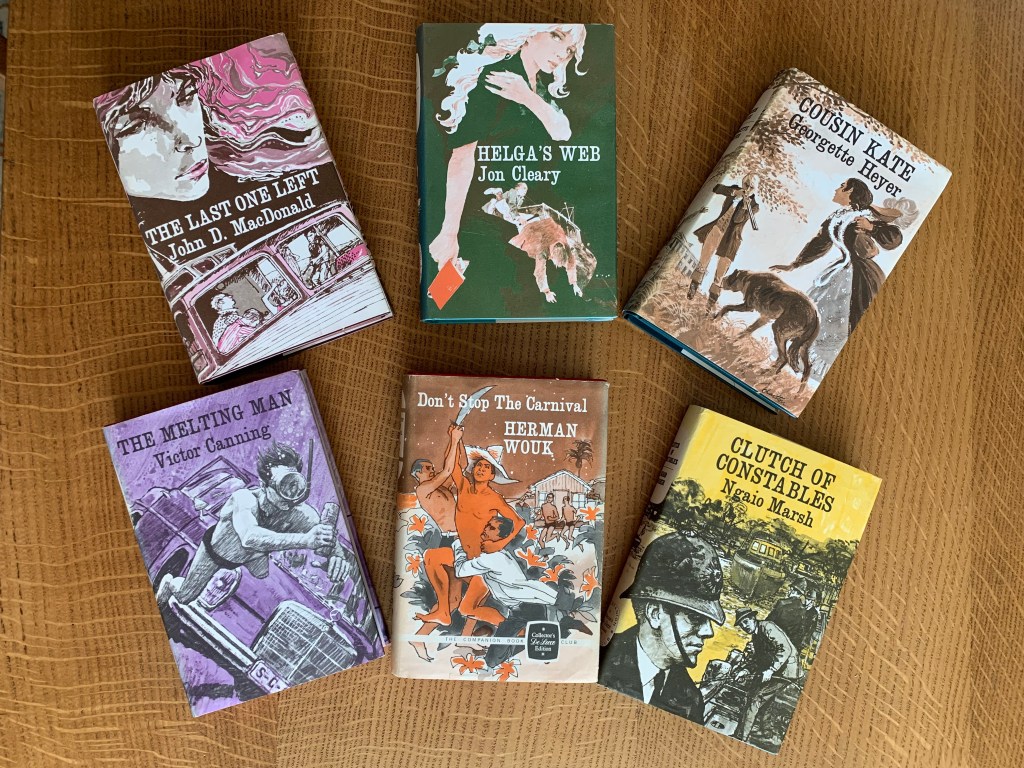
Speaking of which (reading, I mean): I was turning the pages of The Murder of My Aunt (1934) the other day (Thursday, I think), and I was reminded by its almost forgotten author, Richard Hull, of a history to end all histories – at least British ones, which used to cover more ground than latterly, with more shrinkage more likely than not.  To think that it took a work of detective fiction like Hull’s – which is not, by the way, a continuation of and fatal conclusion to Travels with My Aunt – to point me to a history in which wit is the very soul of brevity, to paraphrase somewhat!

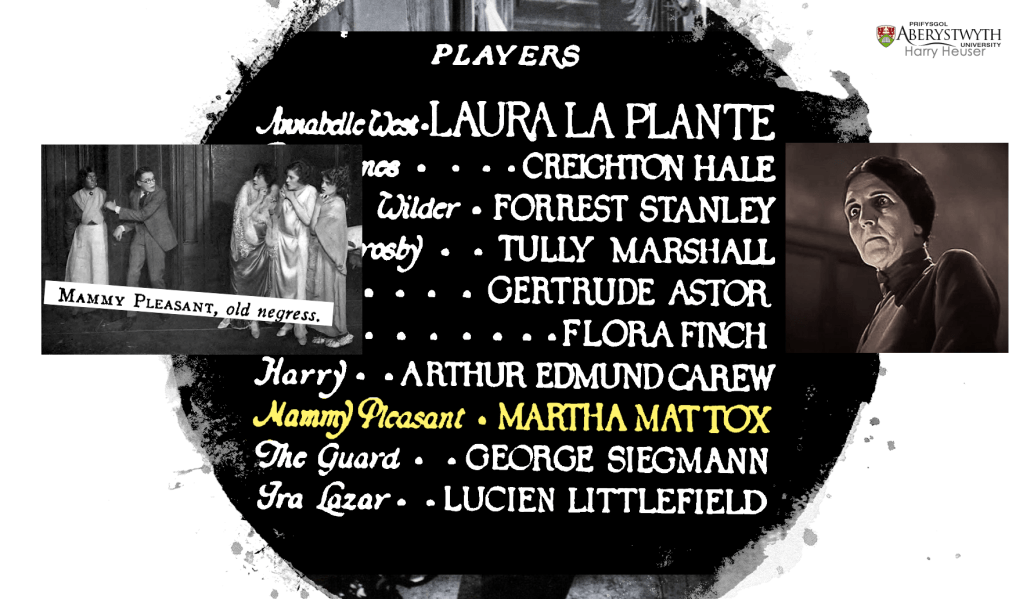
Anyway, according to the narrating nephew of that titular relation, the latter, while yet living (in Wales, no less, to which I can relate, albeit reluctantly at times), had ‘been reading some absurd comic history of England, full, I gather, of elementary humour of the schoolboy variety.’  Apparently, the aunt enjoyed that ‘history’ so much that she named her two dogs after two men – the great and the good – mentioned therein. Just wherein that was the author lacks the accuracy and goodness to state.

The two dogs, meanwhile, are Athelthral and Thruthelthrolth.  After several failed attempts at spelling those names correctly, I scoured the internet, filthy place that it is, to discover that they refer to two ancient rulers that most histories have consigned to oblivion, a state that rulers generally make considerable efforts not to end up in, opting – vainly, as it turns out – for largely unread tomes instead.  

How could I have never heard of Athelthral and Thruthelthrolth, or, having heard, not recall them by name? I am not a native of any of the British Isles, I should point out in my defense – a word, incidentally, that I insist on not spelling with a ‘c,’ as many British people do, unless they are students of mine, in which case they generally do not concern themselves with spelling at all.

But I divagate, as only the Latin still say now.  The point is that the history the aunt made such good use of is 1066 and All That and that it is so good I am quite rooting for her now, even though her survival would make Hull’s ostensible Murder mystery somewhat less of one.  What I like most about 1066 – as a book, not a date – is that it is a) short, b) determined to be memorable (a word frequently used by the authors, Sellar and Yeatman), and c) interspersed with ‘tests’ to help me remember what I just read. 

About Athelthral and Thruthelthrolth, for instance, it asks readers:

Have you the faintest recollection of

1) Ethelbreth?
2) Athelthral?
3) Thruthelthrolth?

I puzzled for a while, but found the next question encouraging: ‘What have you the faintest recollection of?’ Indeed.

1066, somewhat confusingly, was written quite a few years later than its title suggests and published not until 1930, when it must have been hit so hard by the Depression (the great and not so good) that it disappeared under the rock it came to share with me, eventually.  Just before that happened, if ever it did, the book was highly regarded by H. V. Kaltenborn, who, in turn, was a big name in the history of radio, which is the only history that I have not only read but written, a fact that should be reassuring to at least someone, surely.

To get back to those last words of mine, for the breathing of which I am rehearsing at present without any particular urgency. Clearly, I need to cross out another two as unusable: Athelthral and Thruthelthrolth.  Had I thought of them to begin with, I would have been confident that they had not already been uttered.  Not that I am quite capable of uttering them, at least not with any great confidence or without a tissue to hand.

No matter.  I am undaunted by the challenge of having those last words ready for folks to go gentle on me on my last good night.  After all, who was it that said ‘Fools brush past where angels fear to sled’? Rosebud, I think.  Which reminds me to check whether he was Plantagenet or the House of Elsa Lanchester.  I am hoping 1066 and All That will have all the answers.

[This was my eight hundredth post. Most of the others are equal to however you might find this one to be, should you happen to find it at all.]

Destinées Imagined: Film Stills and Storylines

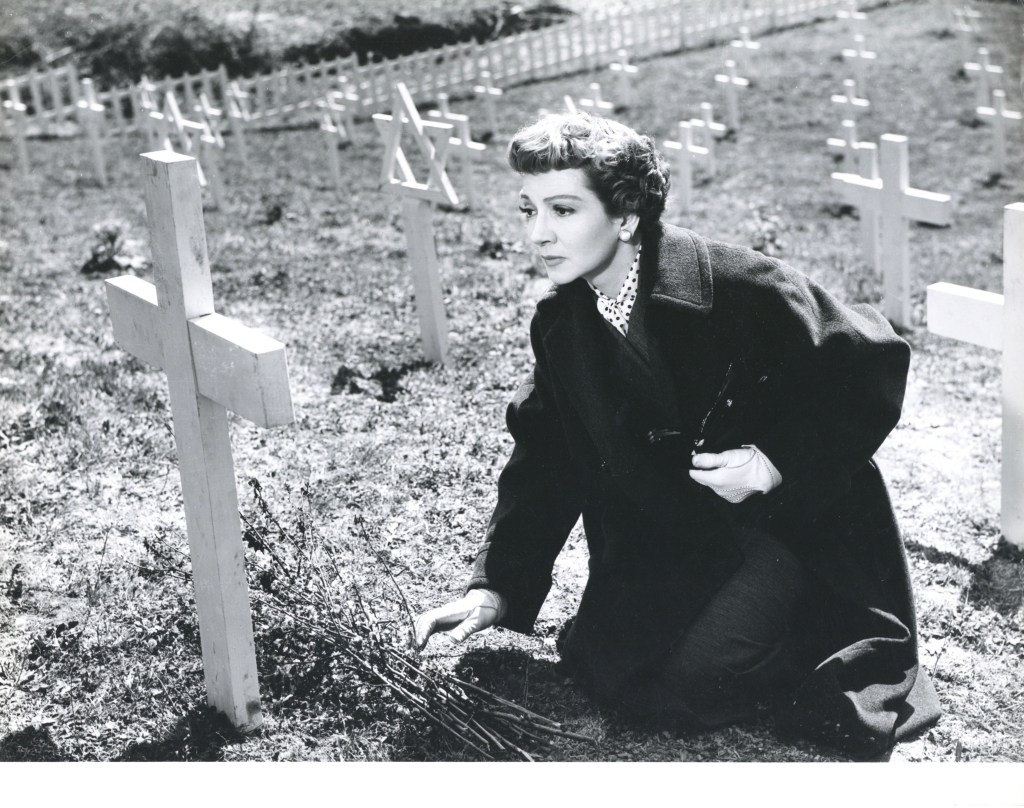
The most recent additions to my collection of movie memorabilia – and of images featuring the likeness of stage and screen actress Claudette Colbert (1903 – 1996) in particular – are stills for the 1954 motion picture Destinées.  The French-language film, released in Britain as Love, Soldiers and Women and in the United States as Daughters of Destiny, is one of the few works in the Colbert canon that I have not yet seen.  Rather than relying entirely on plot synopses provided by Colbert biographers William K. Everson, Lawrence Quirk, and Bernard F. Dick, I am imaging and imagining the film’s story, or, rather, the story told in one of the three vignettes that constitute Destinées.

Even before I determined on an order for the five film stills, what came across is that this is a story about absent men and relationships between the women they left behind.  From the image I chose to begin my stills-inspired version of the story, I can tell that Destinées is as much about the future as it is about the past: fate, fatality and a fatalism to be challenged.  The number of aligned grave markers, impersonal yet collectively inspiring awe, distinguish this site as a war memorial.  This woman might be a war widow.

What stands out in the field of Christian crosses is the prominently positioned star of David behind her, suggesting a memorial to those who were killed during the Second World War.  Either the narrative of this mid-1950s film is set in the recent past or Colbert’s character, for whatever reason, is only belatedly coming to terms with her loss.  She may have come to bury the past, or else to uncover it.  

Continue reading “Destinées Imagined: Film Stills and Storylines”

What Was I Thinking?: English 101, Phil Donahue and the Politics of Identity

I started college in the spring of 1991.  I had been visiting New York City since April the previous year, returning only once to my native Germany to avoid exceeding the six consecutive months I could legally stay in the US on a tourist visa.  The few weeks I spent in the recently reunited Vaterland that October had been difficult to endure, and for years I had nightmares about not getting back to the place I thought of as my elective home, the realities of the recession, the AIDS crisis, Gulf War jingoism and anti-liberal politics notwithstanding. 

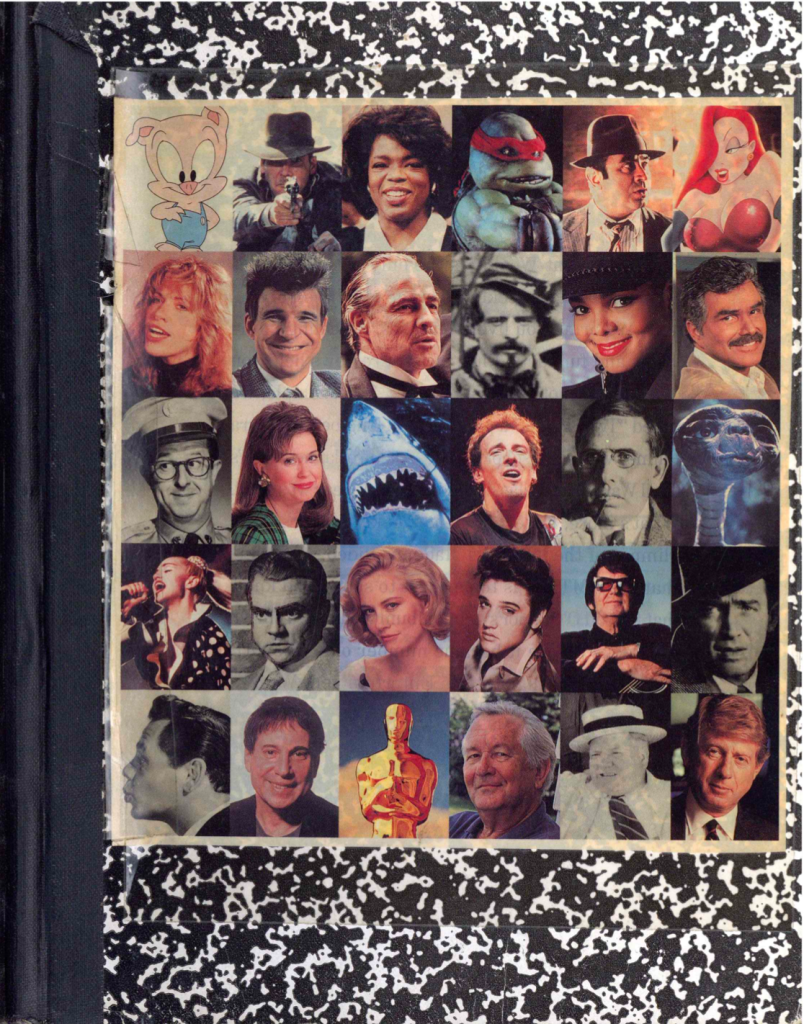
The cover of my 1991 journal, with an image collage
borrowed from a copy of Entertainment Weekly

I was determined not to repeat the experience of that involuntary hiatus once the next six-month period would come to an end.  A close friend, who worked at Lehman College in the Bronx, suggested that I become a student and generously offered to pay my tuition for the first year.  We decided that, instead of entering a four-year college such as Lehman, I should first enroll in classes at Borough of Manhattan Community College (BMCC), an option that would cut those “foreign” tuition fees in half.

Having gotten by thus far on my better than rudimentary German high school English, I had doubts nonetheless about my fitness for college.  My first English instructor, Ms. Padol, was both exacting and reassuring.  She worked hard to make her students try harder.  Not only did she give us bi-weekly essay assignments, and the chance to revise them, but also made us keep a journal, which she would collect at random during the semester.

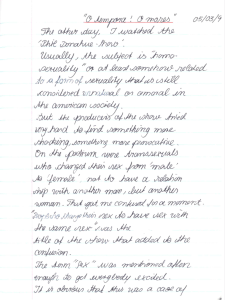
“This requirement for my English class comes almost as a relief,” I started my first entry, titled “A journal!” That it was only “almost: a relief was, as I wrote, owing to the fact that, whatever my attitudes toward my birthplace, I felt “so much more comfortable in my native language.” Back then, I still kept my diary in German.  

What I missed more than the ability of putting thoughts into words was the joy of wordplay.  “My English vocabulary does not really allow such extravaganzas,” I explained, “and even though the message comes through – in case there is any – the product itself seems to be dull and boring to read.”  This reflects my thoughts on writing to this day.  To paraphrase Gertrude Stein, I write to entertain myself and strangers.

In the days of the lockdown – which were also a time of heightened introspection – I scanned the old journal to remind myself what I chose to entertain notions of back in 1991.  Many entries now require footnotes, if indeed they are worthy of them: who now recalls the stir caused by Kitty Kelley’s Nancy Reagan biography? Not that I had actually read the book. “Nobody will use this book in a history class,” I declared. Being “a compilation of anecdotes” it had “no value as a biography.” Autobiography, being predicated on the personal, cannot be similarly invalidated, as I would later argue after taking a graduate course in ‘self life writing’ with Nancy K. Miller at Lehman. What I knew even in 1991 was that a journal was not a diary.

Unlike the diary, the journal provided me with a chance to develop a writerly persona.  I was playing the stranger, and what my reader, Ms. Padol, may have perceived to be my outsider perspective on what, in one entry, I called the “American waste of life” was in part my rehearsal of the part I thought my reader had reason to expect from me.  However motivated or contrived, that performance tells me more about myself than any posed photograph could. 

In an entry dated 3 May and titled “O temporaO mores!” I shared my experience watching Donahue, a popular talk show at the time, named after its host.  The broadcast in question was “People Who Change Their Sex to Have Sex with the Same Sex,” the sensationalism of which offering served as an opportunity to air my queer views as well as the closet of a journal that, for all its queerness, opened by lexically straightening my life by declaring my partner to be a “roommate.”

After expressing my initial confusion about the title and my indignation about the “exploitation” of the subject, I considered my complicity as a spectator and confronted the narrow-mindedness of my binary thinking:

Like the audience in the studio I asked myself why anybody would go through such a procedure only to have a lesbian relationship.

But then I realized that this is really a very shallow, stupid and yet typical question that shows how narrow-minded people are.

It also reflects ongoing intolerance in this society.

The woman in question made it clear that there is a difference between sexual identity and sexual preference.  When a man feels that he is really a woman most people think that he consequently must be a homosexual.

I refer to myself in the journal as gay.  What I did not say was how difficult it had been for me to define that identity, that, as a pre-teen boy I had identified as female and that, as a teenager, I had suffered the cruelty of the nickname “battle of the sexes,” in part due to what I know know (but had to look up again just now) as “gynecomastia”: the development of breast tissue I was at such pains to conceal that the advent of swimming classes, locker rooms and summer holidays alike filled me with dread.  I had been a boy who feared being sexually attractive to the same sex by being perceived as being of the opposite sex.

Reading my journal and reading myself writing it thirty years later, I realise how green – and how Marjorie Taylor Green – we can be, whether in our lack of understanding or our surfeit of self-absorption, when it comes to reflecting on the long way we have supposedly come, at what cost and at whose expense.  We have returned to the Identity Politics of the early 1990s, which I did not know by that term back then but which now teach in an art history context; and we are once again coming face to face with the specter of othering and the challenge of responding constructively to difference.  I hope that some of those struggling now have teachers like Ms. Padol who make them keep a journal that encourage them to create a persona that does not hide the self we must constantly negotiate for ourselves.

There is no record online of a Ms. Padol having worked at BMCC.  Then again, there is no record of my adjunct teaching at Lehman College from around 1994 to 2001, or at Hunter College and CUNY Graduate Center thereafter.  The work of adjuncts, and of teachers in general, lives on mostly in the minds and memory of the students they shaped.

I was more surprised at not finding any references online to that particular Donahue broadcast, except for a few mentions in television listings – two, to be exact.  The immediate pre-internet years, that age of transition from analog to digital culture, are a time within living memory to the access of which a minor record such as my English 101 journal can serve as an aide-memoire.  Whatever the evidentiary or argumentative shortcomings of anecdotes, by which I do not mean the Kitty Kelleyian hearsay I dismissed as being “of no value,” historically speaking, they can be antidotes to histories that repeat themselves due to our lack of self-reflexiveness.

Those of us who have been there, and who feel that they are there all over again – in that age in which the literalness of political correctness was pitted against the pettiness of illiberal thinking – can draw on our recollections and our collective sense of déjà vu to turn our frustration at the sight of sameness into opportunities for making some small difference: we are returning so that those who are there for the first time may find ways of moving on. Instead of repeating the question in exasperation, we need answers to “What were we thinking?”

Forecasts in Hindsight: Wrongly Predicting the 1948 Presidential Election

As my motto ‘Keeping up with the out-of-date’ is meant to suggest, I tend to look toward the past; and yet, I resist retreat.  Retrospection is not retrogressive; nor need it be it a way of reverencing what is presumably lost or of gaining belated control over what back at a certain time of ‘then’ was the uncertainty of life in progress. I am interested in finding the ‘now’ – my ‘now’ – in the ‘then,’ or vice versa, and in wresting currency from recurrences.

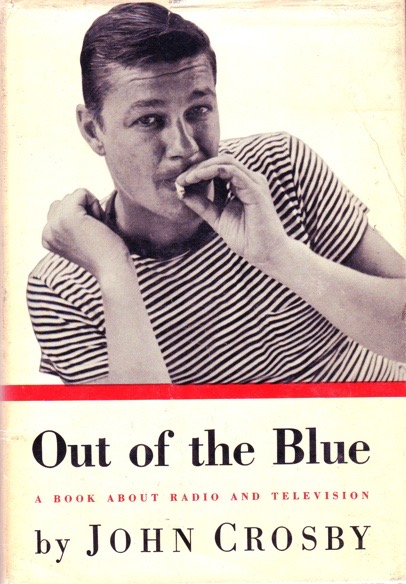
Many articles in Crosby’s column made it into this 1952 volume, which is on my bookshelf. The item discussed here did not.

I also tend to look at the ephemeral and everyday, the disposable objects or throwaway remarks we think or rather do not think of at all and dismiss as immaterial and obsolete, as too flimsy to carry any weight for any length of time.  Take an old syndicated newspaper column such as John Crosby’s “Radio in Review,” for instance.  Back in November 1948, Crosby, whose writing was generally concerned with programs and personalities then on the air, commented on a US presidential election that apparently no one, at least no one in the news media, had predicted accurately.  “Dewey Defeats Truman,” the headline of the Chicago Daily Tribune erroneously read on 3 November that year. Having listened to the words dispensed over the airwave on that day after – or, depending on your politics, in the aftermath of an election that paved the way for another term for President Harry S. Truman – Crosby noted:

‘Perhaps never before have such handsome admissions of error reverb[e]rated from so many lips with such a degree of humility as they did on the air last week.’  Truman had been in office since the death of Franklin D. Roosevelt in 1945; but in 1948, he had confirmation at last that the public – or the majority of those who made their views public and official – agreed that he belonged there.  As Crosby pointed out, even seasoned political commentators had predicted a Republican victory.

‘[T]here probably never has been an election post-mortem in which the words “I told you so” were not heard at all,’ the columnist remarked, adding that ‘if they were said, [he] didn’t hear them.’  To his knowledge, ‘[n]o professional commentators … told anyone so.’

Among those who, according to Crosby, got it more wrong than others was the ultra-conservative broadcaster Fulton Lewis Jr., an opportunist and influencer who, Crosby remarked, had gone ‘far beyond’ his fellow commentators by predicting ‘Republican victories in states where most observers foresaw a seesaw battle.’  

Speaking from the secular pulpit that was his radio program, Lewis ‘fully admitted his wrongness’ after the fact, Crosby noted, reading aloud the messages he received from listeners who ‘invited him to drop dead,’ to ‘throw himself’ into Chesapeake Bay, or to ‘go soak his head in a vinegar barrel.’  Far from remorseful or self-deprecating, such revelling in controversy is representative of right-wing provocation as we experience it to this day.  

A question not posed by Crosby is whether future Barry Goldwater supporter Lewis simply got it wrong – or whether he predicted wrongly to demoralise Truman’s supporters by suggesting that a Republican landslide was a foregone conclusion. Given Lewis’s known bias, the miscalculation was obviously not calculated to rattle Truman supporters out of complacency. So, a question worth asking now not how commentators got it so wrong, but why.

Lowell Thomas, a conservative commentator courting an audience of both major parties, insisted that he had not predicted the election but that he had merely ‘passed along the opinions of others.’  Thomas added, however, that, had he made a prediction, ‘he’d have been as wrong as everyone else.’  Unlike Lewis, this statement suggests, Thomas distinguished between reportage and commentary, the line between which was drawn no more clearly in 1948 broadcasting than it is in today’s mass media, discredited though they are as ‘legacy’ and presumably obsolete by the social media weaponizing political right.

Reporter Elmer Davis who, also unlike Lewis, was critical of then on-the-rise Senator Joseph McCarthy, a Democrat who turned Republican and opposed the Truman presidency for being soft on Communism,  provided this statement to his listeners: ‘Any of us,’ he said, ‘who analyze news on the radio or in the papers must hesitate to try to offer any explanation to a public which remembers too well the lucid and convicing explanations we all offered day before yesterday of why Dewey had it in the bag.’  Commentators had ‘beaten’ their ‘breasts’ and ‘heaped ashes’ on their heads since the election, Davis told his audience; but they still looked ‘pretty foolish’ and should probably wait some time before sticking their ‘necks’ out again.

‘Cheer up, you losers,’ veteran newscaster H. V. Kaltenborn declared on his radio program, ‘It isn’t so bad as you think.’  The peculiar mash-up of scoffing, commiserating, mind-reading and prognosticating did not escape Crosby, who wondered just what went on in the ‘mind’ of someone who, more than having misjudged who lost, might himself have lost it.

The ‘explanations as to why President Truman won were almost as identical as the pre-election prediction that he wouldn’t,’ Crosby observed, namely that the nation ‘liked an underdog.’  Just how much of an ‘underdog’ can a presidential incumbent be? Playing one on TV would prove a winning formula for Donald Trump, at least, and the kind of doghouse he managed to furnish for himself, which is so unlike the residence some of us envision as rightfully his, provides support of that theory.

Summing up the state of desperation among commentators, Crosby stated that ‘many’ of them derived rather ‘odd comfort’ from the fact that US ally turned adversary Josef Stalin, who likewise incorrectly predicted a win for Republican candidate Thomas E. Dewey, ‘had been just as wrong as they were.’

Sure, there is momentary relief in Schadenfreude, seeing those who got it wrong having to admit – or trying to avoid admitting – the fact that, in hindsight, they were demonstrably wrong, and, being wrong, on the wrong side of the future.  And yet, getting it wrong may also be evidence of wrongdoing, of deceit and deviousness.  As someone relegated to the sidelines, I can offer only one reasonable piece of advice to those who prefer a Truman over a Trump: pay attention to but do not trust folks who are determined to convince you that your vote does not matter much by declaring the game to be over when it is still afoot.

Joan Blondell in Dachau

I am no historian. At least not in a traditional facts-and-figures sense. Early in life, I became doubtful of efforts to account for the present by recounting the past of a place or a people. Growing up – and growing up queer – in Germany during the 1970s and 80s, I was not encouraged to find myself in such accounts.  After all, how could I have developed a sense of being part of a national history? The present did not make me feel representative even of my own generation, while the then still recent past was presented to me as the past of a different country. A different people, even. A people whose history was not only done but dusted to the point of decontamination.

Visiting Dachau, June 2015

That many of those people – those old or former Nazis – were all around me and that the beliefs they held did not get discarded like some tarnished badge was apparently too dangerous a fact to instill. Pupils would have turned against their teachers.  Children would have come to distrust their parents. They might even have joined the left-wing activists who were terrorizing Germans for reasons about which we, endangered innocents and latent dangers both, were kept in the dark.

As I have shared here before – though never yet managed adequately to convey – I left Germany in early adulthood because I felt uneasy about my relationship with a country I could not bring myself to embrace as mine. It’s been a quarter of a century since I moved away, first to the US and then to Wales.  For over two decades, I could not even conceive of paying the dreaded fatherland a visit. 

Eventually, or rather suddenly, that changed. In recent years, I have found myself accepting offers to teach German language, history and visual culture, assignments that made me feel like a fraud for being second-hand when imparting knowledge about my birthplace.  I realized that I needed to confront the realities from which I had been anxious to dissociate myself.

Beaten to death, silenced to death”:
A memorial to the homosexuals killed during
the Nazi regime, made in the year I came out.

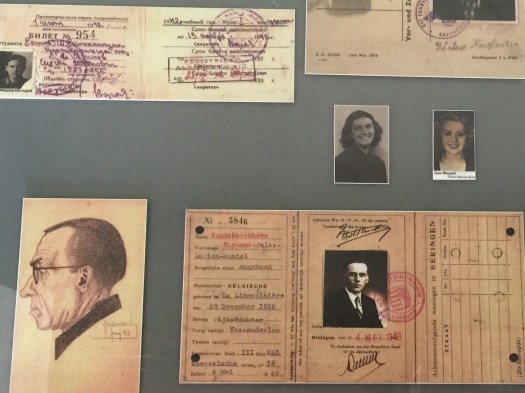
This summer, I visited the Dachau concentration camp for the first time.  There, in the face of monumental horrors, I was drawn to one of the smallest and seemingly most inconsequential object on display: a cigarette card featuring the likeness of 1930s Hollywood actress Joan Blondell.

Dates and figures are no match for such a fragile piece of ephemera. To be sure, the macabre absurdity of finding a mass-manufactured collectible—purchased, no less, at the expense of its collector’s health—preserved at a site that was dedicated to the physical torture of real people and the eradication of individuality could hardly escape me.

But it was not this calculated bathos alone that worked on me.  It was the thought that I, too, would have collected such a card back then, as indeed I do now. Investing such a throwaway object with meaning beyond its value as a temporary keepsake, I can imagine myself holding on to it as a remnant of a world under threat.

Lives taken, identities recovered at Dachau.
Unexpectedly, a picture of Joan Blondell

Looking at that photograph of Joan Blondell at Dachau, it was not difficult for me to conceive that, had I been born some forty years earlier, I might have been sent there, or to any one of the camps where queers like me were held, tortured and killed.  That minor relic, left behind in the oppressive vastness of the Dachau memorial site, speaks to me of the need to take history personal and of the importance of discarding any notion of triviality. For me, it drives history where it needs to hit: home—home, not as a retreat from the world but as a sense of being inextricably enmeshed in it.

Joan Blondell, meanwhile, played her part fighting escapism by starring in “Chicago, Germany,” an early 1940s radio play by Arch Oboler that invited US Americans to imagine what it would be like if the Nazis were to win the war.

Figured Speech: De-monstrating Lord Haw-Haw

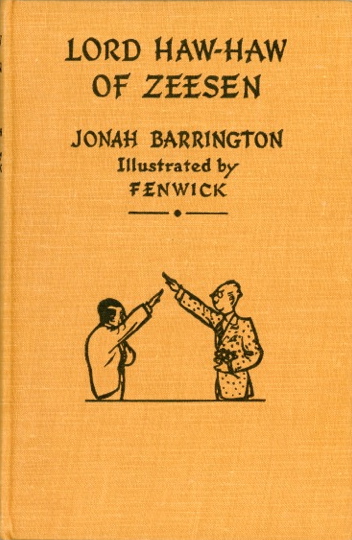
When I picked up this slim and curious volume, Lord Haw-Haw of Zeesen (1939), at an antiquarian bookstore in the Welsh border town of Hay-on-Wye, I was puzzled, to say the least.  I mean, I had heard about—and had listened to recordings of—the notorious Lord Haw-Haw, the fascist broadcaster whose role it was to demoralize the British, to make them turn against their own government by convincing them that to side with the so-called Third Reich was the safest, surest way to march forward. Yet here was a book—written pseudonymously by a journalist calling himself Jonah Barrington and cartoonishly illustrated by an artist who went by the name of Fenwick—that turned propaganda into satire by lending form and features to a voice of terror that was infiltrating the home front.

Yes, it is a curious performance—a biographical act of deflating a windbag, of knocking the stuffing out of a nameless, disembodied operative whose dangerous air of mystery was just plain hot by the time Barrington had laughed off the threat by calling it “Haw-Haw.”  Those in Britain who, like Barrington, had caught the bizarre broadcasts from station Zeesen in Germany began to speculate about the speaker.  In the absence of evidence, Barrington created a character that, to him, had already “become real”; and out of the polemics that “nightly pollute[d]” the British air, the journalist set out to weave “silly fancies.”

“Let me make one point perfectly clear,” Barrington added:

Although Fenwick and I have use our imagination in building up the home life and background of Haw-Haw and his fellow propagandists, the actual speeches credited here to them are given verbatim—exactly as broadcast from the stations Hamburg, Cologne and Zeesen (D.J.A).

Lord Haw-Haw of Zeesen defused a crisis by giving a ridiculous shape to uncertain things to come, by making preposterously concrete what had been potentially persuasive or at least dangerously ambiguous hearsay.  Filmmakers and journalists had parodied Nazi figures before—but the task of turning rhetoric into a figure of ridicule is a rather more complex strategy of counter-propaganda, especially since, in this case, print was rendering fictive what it had made definitive:

Haw-Haw in print needs stage directions, scene-setting and local colour.   And Fenwick needn’t think he’s going to sit back and do nothing, either.   You want the best of Haw-Haw, and we give it to you—drawings and all.

Best or worst, readers of Lord Haw-Haw of Zeesen were meant to get the better of him.

Gotham/Gothic; or, A Tale of Two Strawberries

Visiting Strawberry Hill

Much of what I know about English literature I learned in the Bronx.  The peculiar indirection of my path—a German approaching British culture by taking the Lexington Avenue Express—did not escape me then; and even though I had no doubt as to the qualifications of those who taught me, I decided, upon finishing my Master’s thesis on the Scottish essayist-translator Thomas Carlyle, to go after something that, geographically speaking, lay closer to my temporary home.  

Never one for obvious choices, I wrote my doctoral study on US radio drama, a subject that, however arcane, struck me as being rather more compatible with life in a Mecca for the enthusiasts of American popular culture among which I numbered.  It also made it possible for me to take advantage of some of the resources particular to Manhattan, the isle of Radio City.

Not that I considered studying British culture so far removed from the Globe Theatre, the Scottish Borders, or the wilds of Yorkshire to be much of a disadvantage, being that I had adopted a subjective mode of reading that favors response over intention, that explores the reception of a written work rather than tracing is origins.  Call it rationalizing, call it kidding yourself—I thought that I should make a virtue of vicariousness. 

Living in Britain now, I am rediscovering its literature through the landscape rather than by way of the library; and I am finding my way back to those old books by stepping into even older buildings.  One such book and one such building is Horace Walpole’s Castle of Otranto (1764), otherwise known as Strawberry Hill.

A most un-Gothic—but glorious—day at Strawberry Hill

Originally a small cottage in rural Twickenham, Strawberry Hill was transformed by Walpole into a gothic castellino; it also housed the author’s own printing press, although Otranto was published in nearby London.  The crenelated battlements were made of wood and needed to be replaced more than once in Walpole’s lifetime.  “My buildings are paper, like my writings,” Walpole famously declared, “and both will blown away in ten years after I am dead.” This could well have happened; but, despite the relative weakness of his materials—a spurious medieval romance and the less than solid additions to Chopp’d Straw Cottage—both survive today as a testimony to Walpole’s enduring influence on popular tastes in architecture and literature.

And yet, however exciting the experience, walking around Strawberry Hill after all those years of living and studying so close to Strawberry Fields, Central Park, brought home nothing more forcibly than that getting to the heart of the matter that is art is not a matter of inspection but of introspection. Stripped of most of its furnishings, Strawberry Hill is a tease. Beyond the stained glass windows and the restored façade, there is little left of Walpole’s story or his antiquarian spirit.  To be sure, even if Walpole’s library had not been emptied of the contents that makes and defines it, it would remain inaccessible to those looking around now without being permitted to touch and turn the pages.

Visitors to historic houses, like readers of fictions, must always be prepared to supply the fittings, to construct in their mind’s eye what the supposedly first-hand experience of seeing for ourselves can never make concrete and, therefore, never quite smash or supplant.  Where, if not in our reading, dreaming, thinking selves does the spirit of literature reside?

The audio guide at Strawberry Hill is a self-conscious acknowledgment of this sightseeing conundrum; it plays like a radio drama—my studies of which have not gone to waste altogether—that teases us with the voices of the dead and the echoes of their footsteps. Our own footfall, meanwhile, is muffled by the protective plastic coverings provided for our shoes at the entrance to the site.

Walpole’s paper house has been given a permanence in the midst of which I am reminded of the paper-thinness of my own existence.  What lingers is the anxiety of leaving here—or anywhere—without having left a trace at all.

Of “historical value”: Hitler’s “Best” Straight Talk and Other Continuity Types

As soon as I decided to make radio plays written in the United States in the 1930s, ‘40s and early ‘50s the subject of my doctoral study, I set out to scour New York City University libraries for scripts published during that period. My degree is in English, and I was keen not to approach broadcasting as a purely historical subject. The play texts and my readings of them were to be central to my engagement with the narrative-drama hybridity that is peculiar to radio storytelling. Whenever possible, I tried to match script with recording—but, to justify my study as a literary subject, I was determined to examine as many print sources as possible. One text that promised to provide a valuable sample of 1930s broadcast writing was Radio Continuity Types, a 1938 anthology compiled and edited by Sherman Paxton Lawton.

Back in the late 1990s, when I started my research, I was too focused, too narrow-minded to consider anything that seemed to lie outside the scope of my study as I had defined it for myself, somewhat prematurely. Instead, I copied what I deemed useful and dutifully returned the books I had borrowed, many of which were on interlibrary loan and therefore not in my hands for long. It was only recently that I added Radio Continuity Types to my personal library of radio related volumes—and I was curious to find out what I had overlooked during my initial review of this book . . .

Radio Continuity Types is divided into five main sections: Dramatic Continuities, Talk Continuities, Hybrid Continuities, Novelties and Specialties, and Variety Shows. Clearly, the first section was then most interesting to me. It mainly contains scripts for daytime serials, many of which I had never heard of, let alone listened to: Roses and Drums, Dangerous Paradise, Today’s Children. There are chapters from Ultra-Violet, a thriller serial by Fran Striker, samples of children’s adventures like Jack Armstrong and Bobby Benson, as well as an early script from Gosden and Correll’s Amos ‘n’ Andy taken from the period when the program’s format was what Lawton labels “revolving plot drama.”

Aside from a melodrama written for The Wonder Show and starring Orson Welles, I got little use out of Lawton’s book, mainly because I concentrated on complete 30-minute or hour-long plays rather than on serials I could only consider as fragments. Besides, I was not eager to perpetuate the notion of radio entertainment as being juvenile or strictly commercial.

Anyway. Looking at the book now, I am struck by Lawton’s choices. Never mind the weather report on page 346 or Madam Sylvia’s salad recipe. How about the editor’s selection of “Occasional speeches”? Historically significant among them are Franklin D. Roosevelt’s first inaugural, a “Welcoming” of Roosevelt by Getulio Vargas, President of Brazil, as well as Prince Edward VIII’s announcement of his abdication.

No less significant but rather more curious are Lawton’s “Straight Talk” selections of fascist propaganda by Benito Mussolini, Joseph Goebbels and Adolf Hitler: “Long live the National Socialist German Reich!” and “Now and forever—Germany! Sieg Heil!” Surely, such lines draw attention to themselves in a volume promising readers “some of the most successful work that has been done in broadcasting.” What, besides calling Goebbels’s “Proclamation on Entry into Austria” and Hitler’s “I Return” speech (both dated 12 March 1938) “straight” and “occasional,” had the editor to say about his selections? And what might these selections tell us about the editor who made them?

In a book on broadcasting published in the US in 1938, neutrality may not be altogether unexpected, as US network radio itself was “neutral”; but Lawton—who headed the department of “Radio and Visual Education” at Stephens College in Columbia, Missouri—seems to have gone beyond mere representations of “types.” Introducing a translation of Hitler’s speech, which comments on the reluctance of “international truth-seekers” to regard the new “Pan-Germany” as a choice of its people, Lawton argued it to represent “some of the best work of a man who has proved the power of radio in the formation of public opinion.” There are no further comments either on technique or intention. No explanation of what is “best” and how it was “proved” to be so. No examination of “power,” “public,” and “opinion.” It is this refusal to contextualize that renders the editor’s stamp of approval suspect.

The “continuity” Lawton was concerned with was of the “type” written for broadcasting—not the “continuity” of democracy or the free world. When he spoke of “historical value,” the editor did so as a “justification for a classification” of the kind of “continuity types” he compiled (among them “straight argumentative talks” by Senator Huey Long and Father Coughlin). And when, in his introduction, he speculated about radio in 1951 (“when broadcasting [would] be twice as old” as it was then), he did not consider what consequences the “best” and “most efficient” of “straight talk” might have on the “types” that were still “in common use” back in 1938.

Given its definition of “historical value,” it hardly surprises that Lawton’s anthology was not in “common use” for long. There was no second edition.

History Stinks (and Your Granny Didn’t Smell So Good Either)

I’ve long tried—and, you might say, failed and pretty much given up on—filling a gap in the construction of our cultural histories, most of which are entirely too preoccupied with images and their interpretation. Western culture may privilege vision over any other sense—but if you think that the past will unfold before your eyes simply by looking at graphics, photos or printed records, you’ve been led by the ear you aren’t using. It’s no use being so eye-minded as to forget all about lowbrow radio programming, for instance. After all, sound-only broadcasting had a greater influence on most folks living in the middle of the 20th-century than the press or motion pictures—certainly a greater influence than most scholars are prepared to acknowledge. Radio comforted and counseled, intimated and importuned. It brought the world home and played on our minds like no competing medium could.

Crooning, cajoling, and commanding attention, whatever talent stood at the microphone became part of a soundtrack to the everyday of millions of dial-twisters who took in or were taken in by the big bands and banter, by sermons, sportscasts, and soap operas. Radio sold products as well as ideas and ideologies. It excelled in telling stories, be they fictive, factual or false; and, if you let it, it keeps on telling them or telling you about them . . .

While I have long suspected the picture to be incomplete if we insist on looking at the past as a sequence of images, I never seriously considered that, aside from sound, there is a story, too, in the way we smelled. And yet, in my old hometown of Cologne, Germany, alone—the burg that gave us the word for all our attempts at olfactory cover-up—the romantic poet Samuel Taylor Coleridge once ‘counted two and seventy stenches.’

There would have been no soap—and no soap operas—if we didn’t have trepidations about not being quite fresh, anxieties that were over-ripe for commercial exploitation. In the US, tuners-in of the 1930s, ‘40s and ‘50s were constantly being alerted to the dangers of B-O, reminded to ‘Lux’ their ‘dainties,’ and told to gargle before putting their kissers to the test. Lest they could endure facing guilt by omission, listeners lathered up with products like White King toilet soap, the box tops of which they collected and sent in to broadcasters as ocular proof of their hygienic diligence, for which cumulative evidence they were duly awarded various prizes (or premiums).

For all the restrictions faced by press and broadcasting, advertising some sixty, seventy years ago, was certainly more in your (presumably unwashed) face than it is now. It sounds as if listeners-in back then were in far greater need of Lysol and Listerine. Could it be that our forebears required more frequent scrubbing because they were more likely to labor manually without having access to as much running water, cold and hot, than our more sedentary selves take for granted today? If so, did they really need to be reminded of their particular emanations?

Advertisers did not rest until the natural acquired the whiff of the common. The airwaves, though they were not permitted to be polluted by sounds suggesting most of the bodily functions to which we give vent in private, certainly were awash with voices alerting us of the social consequences of reeking to high heaven.

However fleeting, sound has not been an instant bygone ever since we succeeded in preserving it some 135 years ago. Granted, such records do not tell us the whole story of how people talked and what they had to say; but whatever we bottle as fragrance is even more likely to throw us off the scent in our quest for the real, something that complicates our efforts whenever we feel inclined to stick our nose into the past.

The irony that I am using a print ad to illustrate my point has not eluded me. It is an ad, no less, from a magazine catering to the radio listeners, consumers who were often told, as they waited for the advent of long-promised television, that only sight could complete the picture. It is a myth in which even radio broadcasters were complicit.

Sure, the picture of the past is always incomplete; it is as much a composite as it is a construct. Still, I prefer to keep augmenting my impressions of those yesterdays by lending an ear to the ticking of our clocks. If we keep on looking, and look on only, we might well be missing what is right under our noses …

Murder on the Cathedral Radio: Rudy Vallee and the WPA

”Whatever your own political views in the matter may be. . . .”

Diplomatic, cautious and propitiatory, those are hardly words you would expect to hear coming from the close-miked mouth of crooner Rudy Vallee, one of the 1930s most popular—and insipid—radio personalities. After all, Vallee was not emceeing America’s Town Meeting of the Air; his chief ambassadorial function was to promote middlebrow culture and represent the makers of a certain leavening agent. Yet that is just the preamble with which the old Vagabond Lover segued into the dramatic portion of the Fleischmann’s Yeast Hour, which, on this day, 25 June, in 1936 presented what sounded very much like an endorsement of one of the Roosevelt administration’s latest projects, notwithstanding Vallee’s assurance that the views of the program’s producers and sponsors—in contrast to the debates from the Democratic Convention broadcast elsewhere that evening—were “strictly neutral.”

The calculatedly catholic Fleischmann’s Yeast Hour took variety to the extreme that evening, featuring vaudeville song-and-dance duo Alan Cross and Henry Dunn, “Gags and Gals” cartoonist Jefferson Machamer (who would have liked to talk “sex” but was told that the subject was “never mentioned” on the air), comedian Bert Lahr (whom Vallee’s writers sent to the dentist), swing vocalist Midge Williams (referred to as a “small bundle of dark dynamite”) . . . and T. S. Eliot’s Murder in the Cathedral. Natch . . .

Murder had come to Broadway some three months earlier, in March 1936. As stated by contemporary critics Ernest Sutherland Bates and Alan Williams in their book American Hurly-Burly (1937), Eliot’s play “as offered by the WPA was finer than anything produced during the season at any price.”

Yet rather than merely extracting scenes from the celebrated drama, Vallee’s program offered a dramatization of a “true story” that had “happened only a little while ago,” namely the behind-the-scenes story of how the Broadway production was cast.

As Vallee’s writers have it, an aging stage actor enters the offices of the WPA, declaring: “I’m looking for a job.” He claims to have been in the acting profession for thirty-three years; but lately he has only been pounding the pavement in hopes of treading the boards again. He is referred to the Federal Theatre Project, where, by the kind of miracle that smacks of Victorian melodrama, he is greeted by producer-manager George Vivian, an old friend of his from his days in London’s West End.

Soon, the actor is given the chance, however slight, of auditioning for Broadway director Edward T. Goodman, who is still trying to cast the role of the Archbishop. As many listeners tuning in to the Fleischmann’s Yeast Hour would have known, the old actor got the part—and, as Bates and Williams summed it up,

gave a magnificent performance in the role of Becket.  When Murder closed he re-appeared with another splendid characterization in Class of ’29, but at the end of the season he was promptly reclaimed by the commercial theater.

That actor—playing himself in the broadcast version of his story—was Harry Irvine, who, aside from Murder and Class of ‘29, went on to appear on Broadway in several dramas by Maxwell Anderson, including Joan of Lorraine starring Ingrid Bergman and Anne of the Thousand Days starring Rex Harrison.

Vallee commented that “the sequel” to this story was “yet to be written,” by which he was not referring to any attempts to follow up Murder with Resurrection. “The name of Harry Irvine appears again,” Vallee predicted. “He is very much in demand now. You’ll see him in pictures before long. Hollywood is taking care of that.”

Irvine responded to these not entirely fulfilled prophesies and commented on his good fortunes by reciting one of his speeches from Eliot’s play:

We do not know very much of the future
Except that from generation to generation
The same things happen again and again.
Men learn little from others’ experience.
But in the life of one man, never
The same time returns. Sever
The cord, shed the scale. Only
The fool, fixed in his folly, may think
He can turn the wheel on which he turns.

As much as he was in the center of the Fleischmann’s Yeast Hour playlet telling his story, Irvine was little more than a cog in the wheel, an example of the “true story” extolling the wonders of the “relief project” that gave “the actor out of work” a “helping hand.”

“In the larger cities all over the country these past few months,” Vallee reminded his audience,

dark theaters have been opening, idle actors have been finding work.  Reason: The Federal Theatre Project, a branch of the Works Progress Administration in Washington.

So why, radio having benefitted most from the Depression and the closing of popular playhouses, did an ersatz revue like Vallee’s program now celebrate the policies through which actors returned to newly reopened stages? Well, considering that the Fleischmann’s Yeast Hour was an East Coast production—whereas Lux Radio Theater had just left New York for Hollywood and abandoned its Broadway format—it stood only to gain from the renewed activity along the Great White Way.

Given that the performers who appeared on variety programs of that period were deemed somebodies largely owing to the name they had made for themselves in other media, Fleischmann’s, far from being neutral, depended on its theatrical ties—and stage actors like Harry Irvine—to fill its weekly roster of acts.

Listening to slickly commercial variety programs such as the Fleischmann’s Yeast Hour, I realize that escapism is not so much a matter of production as it is a manner of consumption, a way of tuning out rather than tuning in. No form of entertainment, however trifling or shallow, can entirely escape the role an alert listener may assign to it—the role of telling us about the time in which it was created.