NBC, CBS, and Abe

On the eve of the 200th anniversary of Abraham Lincoln’s birth, I am once again lending an ear to the Great Emancipator. Franklin Delano Roosevelt may have been America’s “radio president”; but in the theater of the mind none among the heads of the States was heard talking more often than Honest Abe. On Friday, 12 February 1937, for instance, at least six nationwide broadcasts were dedicated to Lincoln and his legacy. NBC aired the Radio Guild‘s premiere of a biographical play titled “This Was a Man,” featuring four characters and a “negro chorus.” Heard over the same network was “Lincoln Goes to College,” a recreation of an 1858 debate between Lincoln and Democratic senator Stephen A. Douglas. Try pitching that piece of prime-time drama to network executives nowadays.

Following the Lincoln-Douglas debate was a speech by 1936 presidential candidate Alf Landon, live from the Annual Lincoln Day dinner of the National Republican Club in New York. Meanwhile, CBS was offering talks by Lincoln biographer Ida Tarbell and Glenn Frank, former president of the University of Wisconsin. From Lincoln’s tomb in Springfield, Illinois, the Gettysburg Address was being recited by a war veteran who was privileged to have heard the original speech back in 1863. Not only live and current, the Whitmanesque wireless also kept listeners alive to the past.

Most closely associated with portrayals of Lincoln on American radio is the voice of Raymond Massey, who thrice took on the role in Cavalcade of America presentations of Carl Sandburg’s Abraham Lincoln: The War Years; but more frequently cast was character actor Frank McGlynn.

According to the 14 June 1941 issue of Radio Guide, Lincoln “pop[ped] up” in Lux Radio Theater productions “on the average of seven times each year”; and, in order to “keep the martyred President’s voice sounding the same,” producers always assigned McGlynn the part he had inhabited in numerous motion pictures ever since the silent era. In the CBS serial Honest Abe, it was Ray Middleton who addressed the audience with the words: “My name is Abraham Lincoln, usually shortened to just Abe Lincoln.” The program ran for an entire year (1940-41).

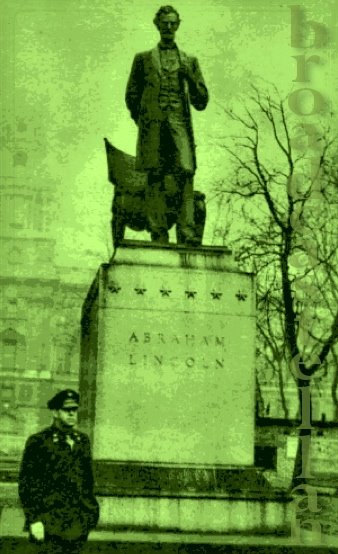
The long and short of it is that, be it in eulogies, musical variety, or drama, Lincoln was given plenty of airtime on national radio, an institution whose personalities paid homage by visiting memorials erected in his honor (like the London one, next to which singer Morton Downey poses above). Nor were the producers of weekly programs whose broadcast dates did not coincide with the anniversary amiss in acknowledging the nation’s debt to the “Captain.” On Sunday, 11 February 1945—celebrated as “Race Relations Sunday”—Canada Lee was heard in a New World A-Coming adaptation of John Washington’s They Knew Lincoln, “They” being the black contemporaries who made an impression on young Abe and influenced his politics. Among them, William de Fleurville.

“Yes,” Lee related,

in Billy’s barbershop, Lincoln learned all about Haiti.  And one of the things he did when he got to the White House was to have a bill passed recognizing the independence of Haiti.  And he did more than that, too.  Lincoln received the first colored ambassador to the United States, the ambassador from the island home of Billy the Barber.  And he was accorded all the honors given to any great diplomat in the Capitol of the United States.  Yes, the people of Harmony have no doubt that Billy’s friendship with ole Abe had more than a lot to do with it.

Six years later, in 1951, Tallulah Bankhead concluded the frivolities of her weekly Big Show broadcast on NBC with a moving recital of Lincoln’s letter to Mrs. Bixby. That same day, The Eternal Light, which aired on NBC under the auspices of the Jewish Theological Seminary of America, presented “The Lincoln Highway.” Drawing on poet-biographer Sandburg’s “complete” works, it created in words and music the “living arterial highway moving across state lines from coast to coast to the murmur ‘Be good to each other, sisters. Don’t fight, brothers.’”

Once, the American networks were an extension of that “Highway,” however scarce the minority voices in what they carried. Four score and seven years ago broadcasting got underway in earnest when one of the oldest stations, WGY, Schenectady, went on the air; but what remains now of the venerable institution of radio is in a serious state of neglect. An expanse of billboards, a field of battles lost, the landscape through which it winds is a vast dust bowl of deregulation uniformity.

Related recording
“They Knew Lincoln,” New World A-Coming (11 Feb. 1945)
Toward the close of this Big Show broadcast, Bankhead recites Lincoln’s letter to Mrs. Bixby (11 Feb. 1951)
“Lincoln Highway,” The Eternal Light (11 February 1951)
My Tallulah salute

Related writings
“Spotting ‘The Mole on Lincoln’s Cheek'”
”Langston Hughes, Destination Freedom, . . .”
A Mind for Biography: Norman Corwin, ‘Ann Rutledge,’ and . . .”
”Carl Sandburg Talks (to) the People”
“The Wannsee Konferenz Maps Out the Final Solution” (on the Eternal Lightproduction of “Battle of the Warsaw Ghetto”)

“. . . can’t help being here”: Edison, the Wireless, and I

No matter how small our voices, how slight our utterances, millions of us carry on making a record of ourselves and circulating it online. Long gone are the days in which autobiography was reserved for the supposed great and good; now, anyone can flaunt the first person singular, step into the forum and exclaim, “Here I am!” or “Hear me out.” Sure enough, here I go again. Never mind that my record is spun a little less frequently these days, short on that groove I am so slow to get back into. A case of dyspepsia rather than abject discontent. I sometimes wonder, though, in how far the ready access to self-expression and promotion is enabling us to believe that whatever we do or say is quite worth the sharing, that we need not try harder or trouble ourselves to aspire. Now that we can all have our names in lights, provided we supply our own low-wattage bulbs, are we becoming too apt to settle for the publicly unmemorable?

Back in the earlier decades of the 20th century, when folks were more ready to listen and less likely to be heard—by anyone beyond their circles of associates and relations, that is—exemplars were rather more in demand than they are nowadays. No mere American Idolizing, but a veneration of excellence that inspired attempts at emulation. In the 1930s, a decade that gave rise to superheroes and uber-egos—even a glossy magazine like Radio Guide encouraged its readers to aim higher than that knob with which to twist the dial.

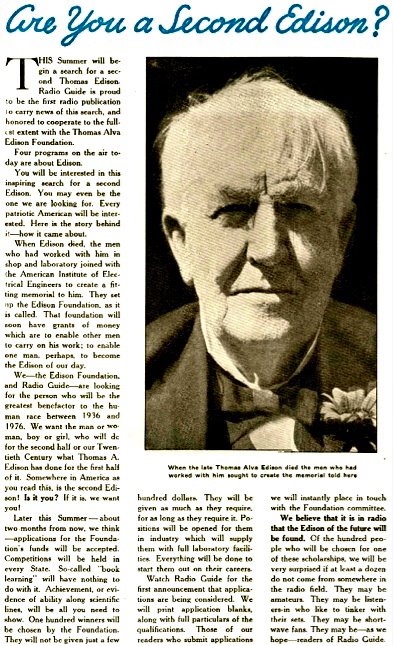
Aside from answering questions like “What’s Happening to Amos ‘n’ Andy?” or telling readers “Why Shirley Temple Can’t Broadcast,” the 4 July 1936 issue went so far as to look, jointly with the Edison Foundation,

for the person who will be the greatest benefactor to the human race between 1936 and 1976. We want the man or woman, boy or girl, who will do for the second half of our Twentieth Century what Thomas A. Edison has done for the first half of it. Somewhere in America as you read this, is the second Edison! Is it you? If it is, we want you.

I cannot imagine who would have the nerve to respond to such an appeal and forget all about Amos ‘n’ Andy, then rumored to be leaving the airwaves; nor shall I speculate what Edison might have said about this search for a worthy successor, a campaign published in a less-than-scientific periodical devoted to a medium about which, as Alfred Balk reminds us in The Rise of Radio (2006), the enterprising inventor of the phonograph was less than enthusiastic.

While alive, he was rarely talked of in connection with the medium in whose development he figured; yet he often featured in radio broadcasts of the 1930s and ‘40s. The Radio Guide in which the above call for genius appeared states that “[f]our programs on the air today are about Edison,” among them a biography heard over WCPO, Cincinnati.

On this day, 10 February, in 1947, on the eve of his 100th birthday (and some fifteen years after his death) Edison himself was propped behind the microphone, addressing the audience of the Cavalcade of America program. Titled “The Voice of the Wizard,” the conjuring act was performed by one of the Cavalcade’s freelance scriptwriters, Erik Barnouw, now best remembered as the foremost chronicler of American broadcasting:

“Hello … hello. This is Thomas Alva Edison.” It sounded as if the deaf scientist had picked up the receiver of a spirit telephone to make an urgent point-to-point call:

When I was still on earth, I invented that talk-harnessing machine to show how I felt about … well, occasions in honor of this and that.  But now […] I feel differently. Because in a way a broadcast like this is the climax of things I worked at.  In a way I can’t help being here.  This microphone, and the tubes in your radio—I had a hand in them.  So, when those tubes light up and bring you a voice from far off, in a way it’s me talking.  And then many radio programs are recorded, for schools, and for broadcasts overseas—all ideas that I fought for.  Because the inventions that I cared most about were those that would bring men’s voices across space and time.  So—I’d like to tell you the story behind those inventions.  A few words for a new age.

As I put it in Etherized Victorians, my dissertation on American radio dramatics, the play bridges, in only a “few words,” the invention of the telegraph, an instrument that in Edison’s youth was already “beginning to bind the world closer,” to the institution of American broadcasting and its contributions to a “new age” of peace:

You who, in a later age, have sat at crystal sets to pick up Pittsburgh or Kansas City, or who, during dark days of World War II have listened by short-wave to London under air attack, you will understand how a seven-teen-year-old boy felt, sitting at his telegraph instrument in Indianapolis.  There was already in that room a hint of the radio age […].

As Edison (equipped with the vocal cords of Dane Clark) expressed it in an exchange with his assistant and spouse-to-be, Mary Stilwell (voiced by Donna Reed),

[t]here are barriers between people—and countries—that we almost never break down. Now these things I’m working on, Mary—they’re for breaking down barriers. Talking machines, loud-speaking telephones, talking photography—we’ll have them all! Machines that talk across space and time [….].

The play suggests radio to be at once “talking machine” and hearing aid, a democratic communications apparatus by means of which “truth” is enunciated and disseminated. The institution of broadcasting is thus construed as the product and propagator of “the American Idea,” for which “the whole world is better off.”

We do not have to resort to thaumaturgy or otherworldly telephony to be “talking across space and time” these days; but I sometimes wish we were more receptive to the marvel of this means and expressed ourselves more grateful at the potentialities we so often squander by billboarding the trivial. While I can neither “help” being prolix nor “being here,” I am making some amends today by refraining from relating just why Shirley Temple could not broadcast …

(In)au(gu)ral History: Presidential Addresses, Past and Present

“We observe today not a victory of party, but a celebration of freedom—symbolizing an end, as well as a beginning—signifying renewal, as well as change.” With these words, John F. Kennedy opened his inaugural address on this day, 20 January, in 1961. Twenty years earlier, Franklin D. Roosevelt embarked upon his third term as US President by insisting that democracy was “not dying,” whatever the apparent threats upon it or the wavering trust in its vigor. He urged his fellow citizens to “pause” and “take stock,” to “recall what [their] place in history has been, and to rediscover what [they] are and what [they] may be.” Not to do so, he cautioned, would mean to “risk the real peril of inaction.”

Granted, as Harry S. Truman remarked in 1949, “[e]ach period of [US] history has had its special challenges.” Yet somehow, as I listened to these past auguries and reappraisals, they began to echo and respond to each other as well as to the fears, doubts and hopes of our present day. I do not mean to imply that such reverberations betray a certain hollowness in their ready replication or applicability; rather, they begin to sound familiar in unexpected ways.

Outside the context of its time—though not within the vacuum of ahistoricity in which no political speech can ring true or otherwise—passages from FDR’s 1941 address, for instance, brought to mind those terrifying—and terrifyingly uncertain—early days of the 21st century, particularly the repercussions the so-called war on terror has had for US politics and the way the Republic and all it stands for came to be perceived beyond its borders:

The life of a nation is the fullness of the measure of its will to live.

There are men who doubt this. There are men who believe that democracy, as a form of Government and a frame of life, is limited or measured by a kind of mystical and artificial fate that, for some unexplained reason, tyranny and slavery have become the surging wave of the future—and that freedom is an ebbing tide.

But we Americans know that this is not true.

Eight years ago, when the life of this Republic seemed frozen by a fatalistic terror, we proved that this is not true. We were in the midst of shock—but we acted. We acted quickly, boldly, decisively.

These later years have been living years—fruitful years for the people of this democracy. For they have brought to us greater security and, I hope, a better understanding that life’s ideals are to be measured in other than material things.

No doubt, Roosevelt was being somewhat self-congratulatory. Could a Republican successor to George W. Bush have made such a claim and been believed when suggesting that acting “quickly, boldly, decisively” back in 2001 has brought “greater security” or that the years have been “fruitful” ones for a democracy in which freedoms are being curtailed and surrendered in the dubious act of preserving them?

That “ideals are to be measured in other than material things” is an echo of the sentiments Roosevelt shared in his first inaugural address (4 March 1933), in which he told a Depression-stricken audience that the

[r]ecognition of that falsity of material wealth as the standard of success goes hand in hand with the abandonment of the false belief that public office and high political position are to be valued only by the standards of pride of place and personal profit; and [that]there must be an end to a conduct in banking and in business which too often has given to a sacred trust the likeness of callous and selfish wrongdoing.

The lesson, which each generation must learn anew, is, for the most part, not absorbed voluntarily; but this time around the “ideals” have been threatened along with those “material things” many find themselves divested of, partially as a result of failed policy and unchecked opportunism. It is this confidence in “ideals” as “truths” that the present administration is called upon to strengthen, so that the words of FDR, anno 1941, may once again ring true, namely that

[m[ost vital to our present and our future is this experience of a democracy which successfully survived crisis at home; put away many evil things; built new structures on enduring lines; and, through it all, maintained the fact of its democracy.

" . . . from numberless and nameless agonies": The Bill of Rights Remembered

I might as well end this year’s regular programming here at broadcastellan with a bang. This one was sure made an impact, heard by as many as sixty million Americans—at once. Subtitled “A Dramatic Celebration of the American Bill of Rights, Including an Address by Franklin D. Roosevelt,” We Hold These Truths made radio history on this day, 15 December, in 1942. It also made the most of history in the making.

“No other single dramatic performance [. . . ] ever enjoyed so large an audience,” author Norman Corwin remarked in his notes on the published script. The program was “[w]ritten at the invitation of the US Office of Facts and Figures” to commemorate the 150th anniversary of the United States Bill of Rights, which came into effect on 15 December 1791,; but it was already in the works when the attack on Pearl Harbor took place.

“In fact,” Corwin later recalled (in Years of the Electric Ear), “I was on a train travelling from New York to Hollywood, still working on the script when the attack on Pearl Harbor took place.” Now that the United States had entered the war, the broadcast became a rallying cry, a reminder of the rights it is the duty of all those who possess them to protect.

“To many listening Americans,” Movie-Radio Guide summed up in its 3-9 January 1942 issue,

the big “Bill of Rights” program broadcast over the Nation’s networks Monday, Dec. 15, was an utterly unforgettable event. To the many personalities who joined their talents to produce the program it was likewise a memorable privilege. Coming as it did at a time when it could not have meant mere to the nation, the broadcast brought America figuratively to its feet. A transcription of the superb dramatic production [. . .] will be preserved in the archives at Washington.

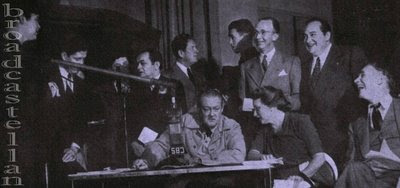
The cast, as shown above, included Orson Welles, Rudy Vallee, Edward G. Robinson, Bob Burns, James Stewart, Walter Brennan, Edward Arnold, as well as (seated) Lionel Barrymore, Marjorie Main, and Walter Huston.

According to the Movie-Radio Guide, “[o]ne of the highlights of the presentation was the performance of James “Jimmy” Stewart.” So moved was he by the reading that, at the close of the broadcast, he “pulled off his earphones” and “let down his emotions, excusing himself from the studio and reportedly breaking into tears in private.” No wonder, Stewart was called upon to introduce President Roosevelt, who addressed the public from Washington, DC. Upon this experience, the humble actor remarked: “Imagine a corporal introducing a Commander in Chief of the armed forces!”

"Bleiben Sie wohl und halten Sie sich munter": A Visit at Kaltenmeyer’s

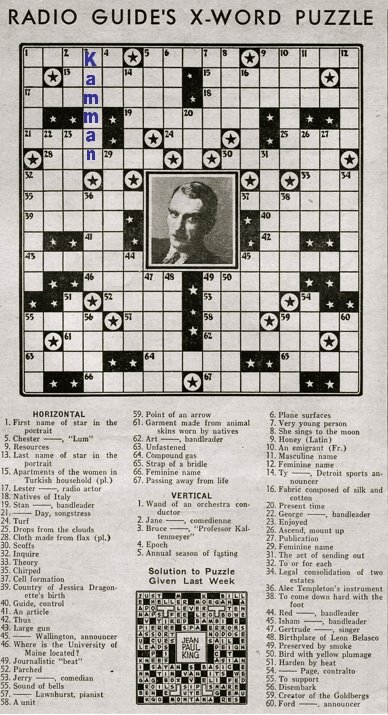
K A M M A N. I am sure a lot of readers of Radio Guide magazine would have found “Bruce ___, ‘Professor Kaltenmeyer” as easy a crossword puzzle clue as “Jane ___, comedienne” or “___ Wallington, announcer.”

From 1932 onwards, Bruce Kamman played the good-natured and much put upon teacher of the gang at Kaltenmeyer’s Kindergarten, a weekly comedy program that originiated from WMAQ, Chicago. Kaltenmeyer’s is one of those popular programs that have all but disappeared into thin air, the exception being the 12 December 1936 broadcast (which you may access on Jerry Haendiges’s invaluable “Same Time, Same Station” site). Reminiscent of and anticipating German schoolboy comedies like Heinrich Spoerl’s Feuerzangenbowle or Erich Kästner’s Das Fliegende Klassenzimmer (both 1933), Kaltenmeyer is a winsome trifle of a show. Each week, the Kindergarten opened with the catchy signature “Just for Fun”:

Kaltenmeyer’s starting,
Let’s all go to school.
In this kindergarten,
Where nonsense is the rule.

Indeed, much of it is nonsense, some of it song. Fibber McGee and Molly team Jim and Marian Jordan were featured on the program; until the fall of 1936, they were among the Professor’s international crowd of poopils. The 12 December 1936 broadcast (an excerpt of which was later rebroadcast on Recollections at Thirty) includes the somewhat incongruously wistful “Sweetheart, Let’s Grow Old Together” and offers at least one memorable pun involving the definition of the word “indisputable,” which one Kaltenmeyer’s rambunctious kids (adults all) manages to put into the following sentence: “Indisputable weather we’re having.”

It is Bruce Kamman’s voice, though, that adds “indisputable” charm to the nonsense. It is the kind of Sig Ruman-Frank Reichert voice—warm, avuncular, and too Jean Hersholt to be altogether ridiculously, let alone threateningly Teutonic. According to Francis M. Nevins’s The Sound of Detection, the Cincinnati-born Kamman, who entered radio as early as 1920, would continue his broadcasting career off mike, namely by producing and directing episodes of the Ellery Queen mystery-cum-celebrity quiz program.

Kamman’s days as Kaltenmeyer came to an end once the Germans began to wage war in Europe. In 1940, well before the United States entered the Second World War, Kaltenmeyer stopped saying “Auf Wiedersehen.” The character was removed from the Kindergarten, and what was left of the show folded soon thereafter.

I guess, when you make a career of sounding like Sig Ruman, you were expected to start shouting “Sieg Heil!” or hiss sinisterly and subsequently expire, rather than be permitted to send kindly greetings like “Bleiben Sie wohl und halten Sie sich munter” (“stay well and cheerful”) to the American people, whatever their heritage or dialect. Clearly “good old days” recalled in the theme song were over.

Now, let’s all go to back to the school that was radio and solve the puzzle . . .

“I hold no animosity toward the Jews”: The Father Coughlin Factor

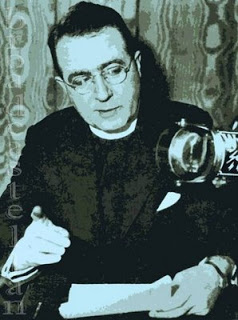
Listeners tuning in to station WHBI, Newark, New Jersey, on this day, 11 December, in 1938, were reminded that what they were about to hear was “in no sense a donated hour.” The broadcast was “paid for at full commercial rates”; and as long as they desired Father Coughlin into their homes, he would be “glad to speak fearlessly and courageously” from the Shrine of the Little Flower in Royal Oak, Michigan, from whence he spread what was billed as a “message of Christianity and Americanism to Catholic and Protestant and religious Jew.”

As Siegel and Siegel point out in their aforementioned study Radio and the Jews (2007), Father Coughlin was at that time increasingly coming under attack. In the fall of 1938, some stations no longer carried his weekly radio addresses, which had once been heard by as many as forty-five million US Americans. While anxious to defend himself, Coughlin was not about to recant or withdraw.

In his 11 December broadcast, he expounded again on his favorite subject, “persecution and Communism,” by which he meant the persecution of American Christians by Communist Jews. It was his “desire as a non-Jew,” Coughlin insisted, to tell his audience, including “fellow Jewish citizens,” the “truth.”

The adjective “religious,” attached as was by Coughlin only to Jew, not to Catholic or Protestant, was significant in his defense of his special brand of anti-Semitism, a distinction between “good” and “bad” Jews that enabled him to denounce “atheistic Jews” as Communists. “Show me a man who disbelieves in God, and particularly who opposes the dissemination of knowledge concerning God, and I will show you an embryonic Communist.”

In his condemnation of the “insidious serpent” of atheism as manifested in Communism, however, Coughlin made no mention of non-practicing Catholics or non-believing Protestants. According to his preachings, the Jew, rather than the Catholic or Protestant, was that “embryonic” Communist. No other religions got as much as a mention.

Ostensibly to “inform” listeners “what thoughts millions of persons are entertaining,” Coughlin argued that, in “Europe particularly, Jews in great numbers have been identified with the Communist movement, with Communist slaughter and Christian persecution.”

He urged American Jews—the “Godless” among whom were conspiring to do away with “the last vestiges of Christmas practices from our schools”—to disassociate themselves from the Jews in Europe at the very moment in modern history when the Jews in Europe were most in need of support from the free world:

O, there comes a time in the life of every individual as well as in the life of every nation when righteousness and justice must take precedence over the bonds of race and blood.  Tolerance then becomes a heinous vice when it tolerates the theology of atheism, the patriotism of internationalism, and the justice of religious persecution.

While “graciously admit[ing] the contribution towards religion and culture accredited to Jews”; while claiming to have spent “many precious hours” in the “companionship of the prophets of Israel,” Coughlin got down at last to the nastiness that was his business. As he put it,

when the house of our civilization is wrapped in the lurid flames of destruction, this is not the time for idle eulogizing.  When the house is on fire, its tenants are not apt to gather in the drawing room to be thrilled by its paintings and raptured by its sculpture, its poetry, its tomes of music or its encyclopedia of science, which are there on exhibit.  When the house is on fire, as is the house of our civilization today, we dispense with gratifying urbanities and call in the fire department to save our possessions lest they be lost in the general conflagration.

Any acknowledgment that the “conflagration” threatened the Jews more than the Christians so shortly after Kristallnacht—the atrocities of which he gainsaid in his 20 November 1938 broadcast—are relegated to the attic that are the dependent clauses of Father Coughlin’s rhetoric, which, in its far from courageous concessions, is as disingenuous and invidious as the language of Bill O’Reilly today.

Hollywood and the Three Rs (Romance, Realism, and Wrinkles)

A few months ago, I went to see a Broadway musical based on a television play by Paddy Chayefsky. Confronted with those keywords alone, I pretty much knew that A Catered Affair was not the kind of razzle-dazzler that makes me want to join a chorus line or find myself a chandelier to swing from. A Catered Affair is more Schlitz than champagne, more kitchen sink than swimming pool. Drab, stale, and too-understated-for-a-thousand-seater, it left me colder than yesterday’s toast (and I said as much then).

What made me want to attend the Affair was the chance to see three seasoned performers who, before being thus ill catered to, had been seen at grander and livelier dos: Faith Prince, Tom Wopat, and Harvey Fierstein, whose idea it was to revive and presumably update Chayefsky’s 1955 original. Last night, I caught up with the 1956 movie version as adapted for the screen by Gore Vidal. Similarly drab, but without the cliché-laden lyrics and with a more memorable score by André Previn; and starring Bette Davis, of course.

When we first see Davis’s middle-aged mother on the screen, she is performing her hausfrau chores listening to The Romance of Helen Trent, a radio soap opera that encouraged those tuning in to dream of love in “middle life and even beyond.” It was probably the quickest and most effective way of establishing the character and setting the mood. After all, Davis’s Aggie, whose own marriage is not the stuff of romance, is determined to throw her daughter the wedding that she, Aggie, never had. She is living by proxy, as through Trent’s loves and travails, a fictional character that makes it possible for Aggie to keep on dreaming.

Once again, I was thankful for my many excursions into the world of radio drama; but I also wondered whether the aging Ms. Davis and her far from youthful co-star, Ernest Borgnine, are giving me what Helen Trent promised its listeners back then: an assurance that life goes on past 35 (which, in today’s life expectancy math, translates into, say, 45).

I rarely watch or read anything with or by anyone yet living. It is not that I am morbid—it is because I prefer a certain kind of writing and movie-making. To me, whatever I read, see, or experience is living, insofar as my own mind and brain may be considered alive or capable of giving birth. So, when I followed up our small-screening of The Catered Affair by the requisite dipping into the Internet Movie Database, I was surprised to see that, aside from André Previn, three of its key players are not only alive but still active in show business.

The unsinkable Debbie Reynolds (no surprise there), the Time Machine tested Rod Taylor (next seen as Winston Churchill in Quentin Tarantino’s Inglourious Basterds), and the indomitable Mr. Borgnine, who has five projects in various stages of production. Not even cats can count on Borgnine lives. To think that, having played a middle-aged working man some five decades ago and still going strong today is both inspiring and . . . exasperating.

Why exasperating? Well, the media contribute to or are responsible for the disappearing act of many an act over the age of, say, fifty (or anyone who looks what we think of as being past middle aged, no matter how far we manage to stretch our earthly existence or Botox our past out of existence these days). You might repeat or even believe the adage that forty is the new thirty, but in Hollywood, sixty is still the same-old ninety. Sure, there are grannios (cameos for the superannuated) and grampaparts in family mush or sitcoms; but few films explore life beyond fifty without rendering maturity all supernatural in a Joan Collins sort of way.

Helen Trent and the heroines of radio were allowed to get old because audiences did not have to look at—or past—the wrinkles and liver spots. High definition, I suspect, is only taking us further down the road of low fidelity, away from the age-old romance that is the reality of life.

"We must be prepared for anything at any time": A Word from the Little Flower

Lying in bed last night, I was troubled by the sensation that, should I fall asleep, I might never wake again. I thought of what I would leave behind, and the catalogue of my accomplishments was so short that I was forced to change the subject for want of material. It was a rare moment of anxiety brought on by the dizzying headache that, I presume, is one symptom of a five-week-old cold I cannot seem to shake. I wonder how many folks, even in the best of health, had that feeling back in December 1941 when, instead of mind’s eyeing the seasonal shop windows, they were confronted with the likelihood that their world was coming to an end.

The raid on Pearl Harbor on this day, 7 December, in 1941, forced many Americans to reexamine their life or, perhaps, examine it for the first time. Wondering about the future and their part in shaping it, civilians no doubt asked of themselves what, if anything, they might be able to contribute, although we should not rule out that some were busy conceiving ways of avoiding any such contributions.

I well recall that feeling of utter worthlessness during the days following the attack on the World Trade Center, when I dutifully took the train (or the bus, or whatever mode of transportation would run) up to the Bronx to teach college students not to split their infinitives or dangle their modifiers. In light of the deadly strike and the uncertainties ahead, making my mark in red ink struck me as petty and pointless. The most troubling sight, the most nauseating response was anything suggesting “business as usual.” It was not so much reassuring as offensive, this make-believe of “life goes on.”

In his radio address to the people of New York, Mayor Fiorello La Guardia, known as the Little Flower, still had to bring home that business in the city was going to be far from usual. Being that the city itself had not come under attack and there were no immediately signs of violent change, many of those tuning in to WNYC had to be reminded of the urgency of the situation and its possible effects on a city thousands of miles from either Hawaii or Europe.

“I want to warn the people of this city that we are in an extreme crisis,” La Guardia addressed the public:

Anyone familiar with world conditions will know that the Nazi government is masterminding Japanese policy and the action taken by the Japanese government this afternoon. It was carrying out the now known Nazi technique of murder by surprise. So there is no doubt that the thugs and gangsters now controlling the Nazi government are responsible and have guided the Japanese government in the attack on American territory and the attack on the Philippine Islands. 

Therefore, I want to warn the people of this city and on the Atlantic coast that we must not and cannot feel secure or assured because we are on the Atlantic coast and the activities of this afternoon have taken place in the Pacific. We must be prepared for anything at any time.

While ordering “all Japanese subjects to remain in their homes until their status [was] determined by [the] federal government,” La Guardia urged citizens to be “calm,” arguing that there was “no need of being excited or unduly alarmed.”

Listening to such historical recordings, I imagine myself in the moment, imagine the bewilderment of those who had stayed out of world politics, the irritation of those to whom such a disruption of the holiday season meant inconvenience or financial loss, the immigrant who would be subjected to the suspicion and the hatred of their neighbors.

Perhaps it is my own sense of historical insignificance that makes it possible for me to imagine what it was like to wake up on the morning of Monday, 8 December 1941, of feeling the burden of living, and of taking on the challenge of translating such an onus into a chance to matter, if only for a little while—to be prepared for death as well as life.

"Everybody talks too much": Dylan Thomas and the Long-Lost "Art of Conversation"

“To begin at the beginning.” Thus opens what is undoubtedly the most famous of all plays written for radio: Under Milk Wood, by Welsh poet Dylan Thomas. BBC radio first produced the play in January 1954, with fellow Welshman Richard Burton in the role of the narrator. It had been previously performed in New York, shortly before Thomas’s death in November 1953 (which is the subject of a new book, Fatal Neglect by David N. Thomas, whose previous biography was the source for the motion picture The Edge of Love. Thomas’s poetry is still widely read today; but little is known generally about his other works for the wireless, about which there is generally little talk these days.

Thomas’s most popular story, “A Child’s Christmas in Wales” (published posthumously in 1955) was originally written for radio, as may be deduced from the attention Thomas’s pays to descriptions of sounds and voices, from the “most unducklike sound, a mewing moo that an ambitious cat might make who wished to be a cow” to that “small, dry voice, like the voice of someone who has not spoken for a long time,” a “small, dry, eggshell voice from the other side of the door: a small dry voice through the keyhole.”

Indeed, as I learned from Douglas Cleverdon’s introduction to the Folio edition of Under Milk Wood, Thomas had been on the air, whether as poet, critic, or actor, since 1939. Among his broadcast features is “Return Journey” (1947), a precursor to “Mad Town” (as Under Milk Wood was initially titled); it has been published in the anthology Wales on the Wireless (1988). Earlier this year, another play for voices by Dylan Thomas has been discovered and is now being given its first production on the air. Titled “The Art of Conversation,” it is available online until 9 December.

The title is somewhat misleading, since the play is really about shutting up. It is a Second World War propaganda piece, commissioned as part of a “Loose Lips Sink Ships” campaign, the sort of cautionary talk on the virtue of silence exemplified in the US by mystery writer Mignon Eberhart’s “The Enemy Is Listening” (Cavalcade of America, 7 June 1943). In it, a sinister voice (Everett Sloane’s) replies to remark that no “real American intends to give information to the enemy,” that

sometimes, sometimes someone forgets.  A word overheard and repeated. A small fact passed on to someone else may mean little to you.  It may mean nothing to the person to whom you repeat it.  But the third or the fourth person or the tenth or the twentieth may be your enemy. Your enemy.

Thomas’s “The Art of Conversation” is a rather more subtle performance. It permits us to indulge in the excesses of talk by Britain’s most celebrated conversationalists, only to remind us that there are times when—and subjects about which—the word should be “mum.” “I don’t think you’ll find Mr. Hitler with a little notebook under our table, do you?” one careless talker quips; but, just to be on the safe side, the idle talk that ensures is being censored.

Like Eberhart, Thomas weaves a web of compromising voices; yet he dispenses with melodrama and, indeed, as is typical of his compositions, with plot altogether. Instead, he opts for an informal lecture (replete with audience) punctuated by “the lantern slides of sound”: a multitude of voices, some distinct, others choric. All are preliminaries and subject to shushing:

Hundreds of odds and ends of hundreds of hearsays and rumours may, and can, be brought together into such a pattern that a whole Allied enterprise is thwarted or destroyed. A wagging tongue may sink a ship; a stray word over a mild-and-bitter may help to murder children.

However chatty and playful, “The Art of Conversation” eventually gets down to business and brings its message across; at least, it might have done, had it not disappeared for decades—apparently before it was ever broadcast. According to the current issue of the Radio Times, there is no evidence that the play was intended for radio; but you need only to listen to know that it could have hardly been written with any other medium in mind.

Alison Hindell’s belated production slightly condenses the original script (available here in its entirety), but otherwise takes few liberties with Thomas’s prose and directions; a 1920s “nigger” is turned into “negro,” a concession to our politically corrected sensibilities. Few US radio dramatists were treated with such respect.

The single exception is the rather pointless addition of an opening line that is not part of Thomas’s “Art,” but the famous introduction to Under Milk Wood, quoted above. No doubt, the presenters intended to draw the famous poet into his forgotten “Conversation,” so as to validate this lesser performance; but, instead of indulging in such self-conscious reverberations, they should have left themselves out of it, especially since there is enough of Thomas in it to make the lecture worth our while.

If only a discovery like this could get us talking again about radio . . .

Yola (Not Quite Lola); or, The Blonde Who Bombed

Germany. 1932. Another young screen actress is lured from the thriving UFA studios to the motion picture colony in California. Her name was Anna Sten. She was born one hundred years ago (3 December 1908) in what was then Russia. According to Deems Taylor’s Pictorial History of the Movies, Sten was thought of as “another Banky [aforementioned], Garbo, or Dietrich.” Highly, in short. The man who did the thinking was Samuel Goldwyn; and soon after, he must have thought, “What was I thinking!”

European beauties were all the rage in the early 1930s Hollywood. It was a peculiarly anachronistic fad, considering that the talkies called for clear diction, however exotic the looks of the actress from whose mouth the sounds poured into the still imperfect microphones. Beauty, Taylor’s 1948 update of his compendium to motion pictures conceded, Anna Sten “undeniably” possessed; but her “all-too-Russian” accent was better suited to comedy than to tragedy.” Surely, a Russian accent need not be no impediment to melodrama; rather, this non sequitur signals that, by the mid-1940s, Russians were deemed too dangerous or dubious to be romantic leads in Hollywood and were more safely marketable as so many eccentric cousins of Mischa Auer.

When Sten’s first three movies misfired, Goldwyn sensed that the eggs this Kiev chick laid were not golden. By 1935, her leading lady period was effectively over. Still, two years after her last Hollywood flop, the notoriously diction-challenged Sten was given another shot at stardom . . . by stepping behind the microphone of the most popular dramatic show on the air: the Lux Radio Theater. The show’s nominal producer, Cecil B. DeMille, was called upon to remind an audience of millions (most of whom potential moviegoers) why Sten was still a star; no Banky, but bankable:

I first saw Anna Sten in one of the most effective scenes ever filmed.  It was in a foreign production with Emil Jannings [Robert Siodmak’s Stürme der Leidenschaft (1932)].  Determined to place her under contract, I started negotiations for the service of this very young girl who had starved with her parents in the Ukraine to become one of Europe’s most glamorous stars.  Then, one day, Samuel Goldwyn invited me to his office to ask my opinion of an actress he just signed.  The actress was Anna Sten.  I was greatly disappointed to lose her, but tonight have the privilege of presenting her in a DeMille production.

The “production” was an unusual one for Lux, a program best known for its microphonic telescoping of Hollywood pictures. Sten was cast in yet another variation on George Barr McCutcheon’s Graustark, that popular, sequel-spawning romance of the early days of the last century. Sten had not appeared in the screen version; indeed, the property was never revisited after the end of the silent era, when last it served as a vehicle for comedienne Marion Davies. By 1937, Graustark was pretty much grave stench. Was Sten being condemned to suffocate in it?

Not quite. The Lux version (8 February 1937) made no attempt at fidelity to the original. Like many romances written or rewritten in the wake It Happened one Night, Graustark was given a screwball spin. Clearly, this radio production was designed to test how Sten’s comic appeal. For this, the air waves were an economically safer testing ground than the sound stage. Besides, it forced the foreigner to prove her command of the English language, albeit in a role demanding an eastern European accent. Sten is delightful (and altogether intelligible) in the role of Princess Yetive; but the broadcast did nothing for her career.

Commemorating Sten’s 100th birthday (she died in 1993), I am turning to her final pre-Hollywood effort, the musical comedy Bomben auf Monte Carlo (1931), from which all the images here are taken. As the bored Princess Yola, a not-so-distant cousin of Yetive, Sten plays opposite German screen idol Hans Albers, the sea captain whom she employs and pursues, using the manual How to Seduce Men as a guide. It is the kind of screwball material that would have served her well overseas. Also in the cast are Heinz Rühmann (last seen here) and Peter Lorre, whose voice remained an asset in Hollywood, and the lively tunes of the Comedian Harmonists (who also appear on screen). This one bombed in name only, however monstrous the title in light of German air attacks on Spain in 1937 . . . shortly after Sten’s first and final Lux broadcast.

It was not so much Sten’s diction that caused her fall as it was the rise of a stentorian dictator. The Old World that Sten had been called upon to represent was fast disappearing; and whatever was distant and foreign soon ceased to be exotic, glamorous, or desirable.