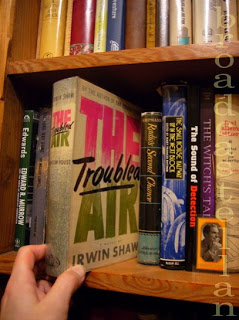
Whodunit, Mr. President?

This seems to me just the day to hear about Messrs. Polk and Harding, to listen to the words of Franklin Pierce and Chester Alan Arthur. During the late 1940s and early ‘50s, they were all brought back to life via that great spiritual medium, the wireless. For little less than half an hour at a time, they wafted right into the American home, which, a decade earlier, had been accustomed to so-called Fireside chats from an above determined to come across as being among.

The announcer promised “little known stories of the men who’ve lived in the White House. Dramatic, exciting events in their lives that you and I so rarely hear. True human stories of Mr. President.” The voice channeling those departed leaders belonged to Edward Arnold, whose services were duly acknowledged. Withheld, however, was the name of the titular character he portrayed, so that the public was called upon to guess the identity of each week’s Presidential candidate.

Who, for instance, uttered the promise “If I am elected to this office, which I do not seek, I will not be a party president. I will be a president of all of the people”? Perhaps, it has been uttered rather too often since to make it obvious that the speaker was meant to be Zachary Taylor. “Men will die,” another phantom president exclaimed, “but the fabrics of our free institutions remain unshaken.” Another familiar rallying cry, commonly uttered during times of war or the preparation thereof. It is a line that rings hollow in an age in which war is being waged on terror, at the expense of the freedoms it is ostensibly designed to protect.

Who stated, rather mixed metaphorically, “In the newspapers I can read the handwriting on the wall. I am a complete failure as President of the United States”? Welcome words of contrition and humility we don’t often get to hear from our elected officials, especially those resolute ones who insist on staying the course. And who declared “I am not responsible to the Senate and I am unwilling to submit my actions to them for judgment”?

In concept, at least, Mr. President (1947-53) has all the appeal of a mystery program, even though its producers did not go so far as to call their stories whodunits.

“Ich weiss . . .”: The Certainties of Zarah Leander

“Es ist unmöglich, von Edgar Wallace nicht gefesselt zu sein,” the German translation of a famous publisher’s slogan goes. Never mind the author, whose name, to me, is synonymous with a long series of neogothic film shockers produced in Germany from the late 1950s to the early ‘70s, starring, the enigmatic Klaus Kinski aside, the by then soured crème de la crème of German cinema. It is not the author or the actors but the catchphrase that came to mind today. The original—the assertion that it is “impossible not to be thrilled” by said writer—is decidedly less expressive.

But then, English so often is, compared to the directness of the emotionally charged German language, whose dictionary, largely free from sterilizing Latin, lays meaning bare like a wound bleeding with the memory of deeply felt sensations. “Sehnsucht,” “Weltschmerz,” “Leidenschaft”—I know of no equivalent vehicle in the English lexicon with which to convey quite so forcibly the shattered frame of an agitated mind! The exclamation point, an expedient in punctuation to which I rarely permit myself the resorting, is meant here to imply at once the passion evoked by the German and the frustration of approximating it as my mother tongue sticks itself out at me.

Let us not get tongue-tied. “Gefesselt” loosely translates into “captivated” or, so as not to be loose about what is tight and binding, “tied up” and “enthralled.” What could be more enthralling than the timbre of Zarah Leander? Who could capture longing better than she? Enthralling, yes; but listening to Leander, I can feel rope burn—the sensation of struggling to loosen a restraint. A desire to put a name and voice to my feelings (described in the previous post) compelled me to go in search of her online, the internet being a lifeline for those who, like me, have struggled and failed to sever their ties from the culture into which they were born.

Leander, of course, was a leading lady in Third Reich cinema. As such, her voice and image are both riveting and repulsive to me. Like my present wavering and uncertainty, the figure of Zarah Leander, spellbinding as it may be, spells ambiguity and contradiction. To begin with, Leander was not German; she had Jewish ancestry; a homosexual friend wrote some of her best-known songs. And yet, she was in the service of fascism, implicated in song, as the jolly crowd of Nazis listening and swaying to one of her signature tunes, “Davon geht die Welt nicht unter” in this clip from Die Grosse Liebe (1942) drive home.

Knowing this, I still feel like the blond boy sitting by her side as she teases him that he could not possibly know the most basic sensations—the smell of hazelnuts or an icy wind against one’s cheeks (a song performed, no less, in in a film by the man who would be Douglas Sirk). Wrapped up in her presence, “Schatten der Vergangenheit” (shadows of the past) are crowding in on me.

Zarah Leander is telling me more about myself than I have had the guts to digest at times. By the 1970s, she had become a queer icon, appropriated by the crowd that the regime she tacitly endorsed used to send off to the camps. “Kann denn Liebe Sünde sein?” (Yet can love be sin?) she famously sang, which became—or indeed was conceived as—a song of gay longing. I did not want to be reminded of that liberation, either. In the confusion of a childhood spent in the awareness that I would be unlike the men who desire women sexually, there was no assurance in the taking possession of her in the name of the love then thought of as having to remain unnamed.

Tonight, Leander’s performances are strangely reaffirming. There is “something understood” in her voice, in the lyrics and their delivery. She knows, her character claims in this song, of a future miracle (“Ich weiss, es wird einmal ein Wunder geschehn”), in her voice a conviction her tears seem to belie. I have no need of miracles. Instead, I glory in the wonder of feeling intensely, of being alive to my conflicting emotions, my fears and longings. Recognizing those feelings, I suddenly know myself again . . .

Magnetic Realism: Norman Corwin’s One World Flight

Well, it kept Bing Crosby on the air; but it also made that air feel a lot staler. Magnetic tape. Its introduction back in 1946 was a recorded death sentence to the miracle and the madness of live radio. Dreaded by producers of minutely timed dramas and comedy programs, going live had been the life or radio. Intimate and immediate, each half-hour behind the microphone had the urgency of a once-in-a-lifetime event. Actors and musicians gathered for a special moment and remained in the presence of the listener for the express purpose of being there for them and with them, however far away. They made time for an audience that, in turn, was making time for them. In a world of commerce in which democratic principles were reduced to the ready access to cheap reproductions, the quality of being inimitable and original was fast becoming a rare commodity indeed. The time for the magic of the time-bound art, the theater of the fourth dimension, was fast running out.

And yet, in the right hands, this new technology also meant innovation. It held the promise of unprecedented access to an unscripted and unrehearsed reality, the kind that live broadcasting scarcely approximated but often faked. One such groundbreaking program was Norman Corwin’s fourteen-part documentary One World Flight, which premiered on this day, 14 January, in 1947.

As I discuss it at length in Etherized Victorians, my doctoral study on so-called old-time radio, Corwin had played with the idea of taking listeners around the world in flights of fancy like “Daybreak”; he had created the illusion of on-the-spot reportage in dramatic series like Passport for Adams. Journalistically speaking, One World Flight was the real thing.

As a recipient of the first annual One World Award commemorating Wendell Willkie’s diplomatic tour in 1942, Corwin spent four months circling the globe, gathering one hundred hours of interviews, indigenous sounds, and ethnic music. “Here is real documentary radio,” playwright Jerome Lawrence declared in his introduction to a published transcript of the first program; “[r]adio from a shiny chrome studio at Sunset and Vine or at 485 Madison [was] kindergarten stuff in comparison.”

One World Flight presented a post-war world in turmoil, at once a strange new world of opportunity and a breeding ground for hatred and conflict. Corwin’s editorial scissors did not snip away what his tape had managed to capture, even though the voices of hope were given a prominent spot. The future prime minister of India is heard calmly expressing the belief that “freedom for one world” lies in the acceptance of the fact that people and nations “are not alike,” that “everybody is not the same,” and that otherness does not imply inferiority.

One World Flight provides aural proof in support of this sentiment, “moments out of interviews with people high and low; optimists, pessimists; liberals, fascists, communists; stevedores, prime ministers.” According to Corwin who also narrated, the “profoundest things” were not always said by “presidents and premiers,” but by “ordinary” and “humble people.”

Among the “actually recorded” speakers are an Italian woman despairing over the loss of her family during the bombardment of her village; a Filipino girl dismayed that Truman did not drop the atomic bomb on Russia; a Russian newspaper editor who warns that fascist conflagrations begin with a spark; and an Australian accountant cautioning against the advancement of the “colored races,” a “Frankenstein monster” that would “turn on” and “devour us, like the Japanese.” Replacing his idealized—and idealizing—microphone with a magnetic wire recorder, Corwin picked up ideological dissonance where he had hoped for “testaments of agreement.”

To Lawrence, these recordings, though not always “Magnavox-clear,” were of an “authenticity” that was “startlingly refreshing to a fiction-tired radio listener.” He defied his readers to “sit down at a typewriter and compose such simple, straightforward literary dynamite” as was set off on One World Flight.

“Without the tape recorder one wonders if radio would be the exciting instrument it is today,” remarked one radio critic, citing as exemplary The People Act (1952), a short-lived series of community documentaries that relied entirely on taped interviews and speeches. Such uses of magnetic tape remained the exception, however; the increasing reliance on recorded material resulted instead in the prefabrication of formerly live programming and the institution of summer reruns, a new efficiency in network broadcasting that spelled artistic impoverishment rather than renewal.

". . . between the zodiac and Orson Welles": A Play Scheduled for Pearl Harbor

Well, it wasn’t exactly business as usual on this day, 7 December, back in 1941. Mind you, lucre-minded broadcasters tried hard to keep the well-oiled machinery of commercial radio running. There were soap operas and there was popular music, interrupted in a fashion rehearsed by “The War of the Worlds,” by updates about the developments of the attack on Pearl Harbor (previously commemorated here). Unlike on the day now known as 9/11, when advertising came to an immediate standstill to make way for propaganda and regular (that is, commercial) programming ceased for hours and days to come, radio back then was slow to adapt. There was no precedent; and, having ignored the signs of the time, not much preparation.

Minding the business of its sponsors, broadcasters had no master plan for a response to the masterminds behind the plans for the master race and its allies. It was, however briefly, overmastered; or flummoxed, at least. For an industry relying on minute timing, the attack and subsequent declaration of war were most inopportune. Big business was, for the most part, not behind a war that would translate into major financial losses.

Until that day, broadcasters had counted on being inconsequential; it was the commerce stimulated by the sales talk punctuating the chatter and musical interludes proffered “in the public interest,” that mattered.

The Screen Guild was fortunate. After previous crowd pleasers like “Penny Serenade” and “If You Could Only Cook,” the Gulf Motor Oil sponsored Hollywood-rehash factory had scheduled a play that just fit the bill. For that fateful night it had prepared a live production of Norman Corwin’s “Between Americans,” previously staged in June 1941. “By one of those mystic and infallible arrangements between the zodiac and Orson Welles,” the playwright would recall, this broadcast was the

first uninterrupted half-hour on the CBS network after the bombing of Pearl Harbor. All afternoon the news had come pounding in—comment, short-wave pickups, rumors, analyses, flashes, bulletins. Programs of all kinds were either brushed aside or so riddled by special announcements that they made no sense. But by 7:30 PM EST all available news on the situation was exhausted, and the Screen Guild, which had long ago scheduled “Between Americans” and Welles for this date, was given clear air.

According to Corwin, the greatest living American radio dramatist, indeed the greatest radio playwright of any time anywhere (whose 97th birthday I celebrated here), the “staggering news of the previous hours made the show far more exciting than it had any right to be.” The studio audience reacted enthusiastically, a response the playwright attributed to the moment, rather than to anything of moment in his play.

A war only four hours old is an emotion, an intoxication, a bewilderment [. . .]. People felt reassured by it. They heard the piece as a statement of faith. They were moved; they laughed extra loud; they applauded like mad when the show was over. I am certain it was Pearl Harbor that made the show so electric that night, and not so much the work of Welles, Corwin, or Harry Ackerman, who directed it.

“Between Americans” had not been prepared for the day; indeed, it had been produced five months earlier, with actor Ray Collins (whose voice Welles regarded as the best in the business) as narrator. According to Corwin, who is none too fond of the play, there were some 22,000 requests for scripts and rebroadcasts. No wonder, with lines like these:

You ever asked yourself what America means to you? Does it mean 1776? “Columbia, the Gem of the Ocean”? Big business? The Bill of Rights? Uncle Sam? Chances are it means none of these things. Chances are it means something very personal to each of you. Something close to your heart, which you’d miss like the very blazes if you were stranded abroad. It might have nothing to do with quotes from Madison or Acts of Congress. It might be just the feeling of crisp autumns in New England and the smell of burning leaves. It might be the memory of the way they smooth off the infield between the games of a double-header. It might be a thing as small as your little finger [that is, a cigarette].

“Big business” and personal memories. They merge at the moment of listening. Big business counted on that.

The 7 December 1941 program is a fascinating record of an industry coming to terms with the role it was called upon to play. The commercial structure remained remarkably intact; but the play was being shrewdly exploited as “one of the most timely programs ever heard on the Gulf Screen Guild Theater:

Broadcast at any time, we believe this program would make every American’s heart beat a little faster, make him hold his head just a little higher. But since the tragic and foreboding news that came today, this program, “Between Americans,” now becomes an American Odyssey. In just a moment, our story will begin.

“But first,” listeners had to hear the words from the sponsor, who had this topical message prepared for the occasion:

Right. And here is an easy way to change from a pessimist into an optimist. If you are wondering now how long you may have to keep your present car, and wondering too if it will last, if it will stay in good condition, just look on the bright side of the picture. Remember, when you give the wearing parts of your car good protection that helps it stay young and act young a long, long time. So, give your automobile the modern method of lubrication . . .

Yes, radio was a well-oiled machine . . . until the rationing of its parts set in.

A Soundtrack for the Silent Era

Well, I am all ears again. After the visual assault described in the previous post, this constitutes a welcome reining in of the senses. Not that the experience is a tranquil one. I am listening to the sounds of war . . . the Great War. Presented by BBC security correspondent Frank Gardner, “The Sounds of Flanders” (available here until 30 November), introduces listeners to a collection of rare phonograph recordings produced for the domestic market in Britain, the “first form of saleable audio propaganda”—patriotic speeches, rousing songs, and soundstaged re-enactments of warfare.

The recordings, which include dramatizations of an air raid on an English coastal town and the attack on the RMS Lusitania made just weeks after the ship’s sinking, were unearthed by broadcast historian Tim Crook, who calls them the earliest surviving example of audio drama produced in Britain.

Not all of it was produced for the local market; apparently, some of these recordings were intended for an American audience in an attempt to rally support for the Great War. It clearly anticipates the shortwave transmissions of World War II, as described in Charles J. Rolo’s 1942 study Radio Goes to War (of which I am fortunate to have added to my library above copy signed by its author). As Rolo put it,

[radio]went to war on five continents shortly after the Nazi Party came to power in Germany. In eight years it has been streamlined from a crude propaganda bludgeon into the most powerful single instrument of political warfare the world has ever known. More flexible in use and infinitely stronger in emotional impact than the printed word, as a weapon of war waged psychologically radio has no equal.

According to Rolo, “Nazi tacticians, unhampered by the deadweight of outdated traditions, had taken to heart the lessons of the last war and were elaborating for the future a strategy of war waged psychologically.” As “The Sounds of Flanders” suggests, those strategies may well have originated in the United Kingdom, even though the audio recordings were apparently not made by any branch of the government (a point in need of clarification).

As in the case of the electrophone wirecasts from the London stage during the reign of Queen Victoria (discussed here), those phono-graphic records antecede the first experimentations in broadcast theatricals, which began in the early 1920s.

Programs like “The Sounds of Flanders” help to restore the soundtrack for a generation that today is largely thought of as silent.

Graphic

Well, what do we mean when we say that a story (a book or movie or play) is “graphic”? Do we refer to the mode of depiction or to the matter depicted? Does it describe a work of art that is especially vivid or particularly morbid? These days, the term is both a warning label and a genre marker. It is designed to signify horror, which, distinct from terror, details rather than insinuates violence. When applied to print media, it signals a superior kind of picture story, something set apart from the comic by virtue of its mature themes or adult language (regardless of how immature “adult” language may often be).

The first picture book I came across that warrants the label “graphic” in both respects is Art Spiegelman’s Maus. It is a biographical account of Jewish life in fascist Germany, the horrors of the concentration camps, and a storyteller’s struggle to grapple with such memories as recalled by a close relative.

To depict the Holocaust in drawings of half-human animal figures is a daring project to begin with. It takes on the tradition of the fable and renders concrete what constitutes the dehumanization suffered under totalitarianism. On the one hand, Maus de-Disneyfies the fable, which, for centuries, had served as a coded moral tale not restricted to children or petty lessons in table manners. On the other, more bloody hand, it takes the figures of the fable out of their abstract realm and places them into concrete historical settings.

I was reminded of Spiegelman’s Maus last night when I went to see Die Fälscher (2007), a German film set in a concentration camp. Die Fälscher (translated as The Counterfeiters, tells the story of Jews forced by the Nazis to forge foreign currencies in an attempt to ruin the enemy’s economy and finance the ruinous Wirtschaft at home. For the conscripted Jews, foremost among them a highly talented criminal, it means survival and relative safety as well as an act aiding the system that has isolated, degraded and singled them out for extinction . . .

Like Maus, Die Fälscher deals with the guilt of those who forge a future for themselves in a world that insists on their pastness; it is a graphic story of craftsmanship drawn upon for the art of survival. The pen is mightier then the sword, Bulwer-Lytton famously remarked; its true test, however, lies in countering an army of erasers . . .

Memorials War; or, Names Are Dropped Faster Than Guns

Well, is anyone else having a hangover? This, after all, is the day after. All over Britain, people of all ages could be observed last weekend pinning poppies on their apparel, in observance or remembrance of . . . what? War? The end or the ends of it? The heroes who fought battles or those who forged peace? Or did they simply try to remember to bin that doubtful ornament of imitation flora once Remembrance Sunday had made way for another week of everydays? The period of oblivion has set in as scheduled. No doubt, the swastikas splashed days earlier on the local cenotaph here in Aberystwyth have long been expunged.

It seems that, instead of looking around, we tend to look back, probably without learning a thing about our present selves. As I tried to express it when last we were through observing Armistice Day, I am ill at ease about those fixed periods set aside for collective reflection. Not that there are any memorials in Germany, where I grew up, an absence of tributes that serves as a reminder to me that what is to be brought chiefly to mind here is national honor, not international horrors.

I am uneasy, too, when faced with responses to war as expressed by one of the readers (of this recent journal entry) with whom pride seems to go before considerations about those who fall on the other side. As the current conflict in Iraq demonstrates, blind followers are still falling for the kind of arguments for which thousands must fall, determined to stick to their guns no matter how devastating their discharges have proven to be.

Here in Britain, big gun names are being rolled out for the occasion, dropped like bombs whose aim it is to awe rather than make a political impact. Such, at least, is the rationale behind the decisions of those who stage the ratings war. Daniel Radcliffe, for instance, who is best known for having landed the title role in the Harry Potter series, appeared last night in the television drama My Boy Jack, playing the teenage son of Rudyard Kipling, the patriotic author who used his pull to push his offspring into battle, despite the young man’s visual impairment. Private Potter did not even have to drop his trademark eyewear.

Now, I chose not to follow this televised memorial on ITV. I decided instead to screen Lewis Milestone’s All Quiet on the Western Front (1930), which, rather than seeming dated or coming across like a costume drama, has lost none of its documentarian urgency, couched as its pacifist message is in symbolism. Unlike “Armistice Day,” a sentimental radio play of the same period (brought to you courtesy of OTRCat.com), All Quiet still asks the questions we must insist on asking ourselves: Why and what ought we to remember? What are the agenda of those who recall, those who call on us to hear roll calls?

Too apt to look upon history as representations of what is dead, gone, and past restoring, we fail to take note of the dying of our days, the necrology of our present lives, and the deaths that are owing to our blindness and silence.

Napoleon Solo Dynamite: Robert Vaughn “Behind the Iron Curtain”

Well, it wasn’t exactly the Summer of Love, back in 1968, when American film and television actor Robert Vaughn, then known to millions of Americans as “Napoleon Solo” came to Czechoslovakia to play a Nazi officer in The Bridge at Remagen. Four decades later, Vaughn got the opportunity to share his experience in Tracy Spottiswoode’s radio play “Solo Behind the Curtain.” The play aired last Monday on BBC Radio 4.

Now, Spottiswoode told me about “Solo” some 18 months ago when we sat in the kitchen of her Cardiff home (as mentioned here, in passing); by now, I had almost given up on ever getting to hear it, especially since I have visited Prague in the meantime and dined at the Cafe Europa on Wenceslas Square, where Vaughn enjoys a cool drink and the warmth of late spring as the play opens.

In a nod to Vaughn’s most famous role, “Solo” comes on like a 1960s spy thriller, with suave Vaughn feeling “pretty sure” that he was “being followed. In those days, there was nothing surprising in that. An American in an Iron Curtain country, during the Cold War. It would have been unusual not to be followed. What was surprising, though, was just how pretty she was.”

Her name is Pepsi (wonderfully portrayed by Serbian actress Vesna Stanojevic), and she is used to being called “bubbly.” Perhaps it is her blood (Pepsi’s father was American communist who, in a moment of nostalgia, named his daughter after the soft drink he could no longer enjoy in his wife’s homeland of Czechoslovakia). The smart if malapropism prone young woman, who serves as the crew’s interpreter, is proud of her country’s relative freedom, but eager to leave with the Americans as those freedoms are being crushed.

Vaughn is an excellent narrator, as his father Walter had been, back in the mid-1940s, when he narrated wartime propaganda plays like “Assignment USA” for the series Words at War, aside from appearing on thriller programs like Murder at Midnight and Gangbusters.

Unlike his father, Vaughn was busy exposing propaganda, rather than delivering it. During the time of the filming, he was at work on his doctoral dissertation, which was later published as Only Victims: A Study of Show Business Blacklisting. As you will hear, it very nearly got lost as a peaceful spring gave way to a bloody summer.

His is not the voice of a 35-year-old, to be sure; but Vaughn draws you into his story all the same as he recreates his experience shooting in Czechoslovakia . . . until the shooting began in the streets. In August 1968, a short period of reformed communism under Alexander Dubček, known as the Prague Spring, came to an end as Soviet tanks rolled into the city. Not that Vaughn was ready to say U.N.C.L.E. and get stranded in a country hostile to the west in general and a film crew in particular, engaged as it was in firing explosives and blowing up things to restage a war for maximum box office impact.

Brandishing the Pen: The War of “Seeing It Through”

Well, this is Guy Fawkes Day (or Bonfire Night) here in Britain. I am hearing the fireworks exploding as I write. Last year, I dragged Tallulah Bankhead into the Popish Plot; but it really seems an occasion to handle something explosive. To write about war and propaganda, or the war of propaganda, for instance. Bonfire Night coincides with the third anniversary of my move to Wales. So, I might as well write about something relating to the Welsh. And since this 5th of November is also the first day of the WGA (Writers Guild of America) strike that is intended to cripple the television and motion picture industry in the US, I might as well express my solidarity by turning a deaf ear to overseas media and lend a keen one to the voices of Britain.

Propaganda, a Welsh Prime Minister (pictured), and a group of famous authors including H. G. Wells, Thomas Hardy, and Arnold Bennett—“Seeing It Through” promises nothing less.

“Seeing” is the latest radio play by Neil Brand—last seen here in Wales accompanying The Life Story of David Lloyd George (1918). Dining with the writer, I remarked that, these days, the BBC seems most interested in airing biographical or historical drama. No exception is today’s Afternoon Play on BBC Radio 4, Tracy Spottiswoode’s “Solo Behind the Iron Curtain” (starring Robert Vaughn as himself, caught in revolutionary Prague anno 1968, and reviewed in my next entry into this journal). What sells these days are purportedly true stories, opportunities to eavesdrop on prominent, eminent or at any rate historical personages.

If it is to fly, the drama of the air is expected to have weight, especially now that such texts are generally being relegated to the footnotes of popular culture. Those in charge of allotting time for aural play try to salvage a dying art gasping for air by turning recorded sound into sound records and reducing storytelling into a substitute for oral history. A footnote-and-mouth disease is contaminating the airwaves, a corrupting influence in the theater of the mind for which there exists no talking cure. For the record, Brand has not so much caught the disease than braved it.

Cinematic in its architecture, in its designs on the mind’s eye, “Seeing It Through” opens like a house of worship, resounding with a hymn whose words are based on John Bunyan’s Pilgrim’s Progress, written in imprisonment: “He who would valiant be / ’gainst all disaster, / Let him in constancy / follow the Master.”

The music gives way to the sounds of a crowded auditorium and the words of one of the most famous British writers of the late 19th and early 20th century. None other than the man who invented The War of the Worlds: “You know me. My name is H. G. Wells,” the novelist addresses a conservative crowd and is very nearly booed off the stage, clearly not the master of his domain.

Wells was hoping to lend support to Charles Masterman, a liberal politician to whom we are introduced as he tries to promote welfare reforms. A gifted orator, Masterman disappears from the public stage to become the mastermind or mouthpiece of the newly established War Propaganda Bureau, Britain’s response to German duplicity. “There is no such thing as a clean war,” future Prime Minister David Lloyd George warns the radical idealist. “Then, Masterman replies, “we should create one.”

Rallied to aid him are the leading novelists of the time, including Arthur Conan Doyle, Chesterton, Hardy, Galsworthy and Bennett. As Wells is heard expressing it: “The ultimate purpose of this war is propaganda, the destruction of certain beliefs, and the creation of others.” Unlike the radio propaganda penned by US playwrights, poets, and novelists in the 1940s (as discussed here), their activities in publicizing an unpopular war was being kept a secret until well after armistice was declared.

As is revealed in a well-soundstaged scene symbolizing Masterman’s struggle to navigate the moral maze of a publicly invisible office, the alcoholic in charge gets lost in the structure he is meant to control. Trying to find his way, he relies on the guidance of a suffragette who once dared to toss pig’s blood in his face and whose brother is facing a breakdown on the front that she assisted in putting up: “I’ve learned,” she tells Masterman, that “there is no truth where war is concerned, except one: that the greatest cruelty is to let it go on when it could be stopped.”

She, too, operates under the influence, hers being Frances Stevenson, personal secretary, mistress, and future wife of Lloyd George, a woman Wells calls the “sphinx that guards the labyrinth of Whitehall.” It is in this nexus of oblique channels and hidden agenda that the lives of thousands are rewritten and expended.

That this is not merely a war of the words is demonstrated in noisy reports from the front and driven home in a sequence reminiscent of Howard Koch’s adaptation of Wells’s science fictional War: as London faces its first air raid, the weaponizers of words, Wells among them, look on and listen in the dark, Masterman speechless, his master’s voice overmastered: “If they’re smart, [the British public will] never trust any of us again.”

“Seeing” is a challenge to the audience. Instead of recounting an old if little known story, Brand puts listeners right a history in the making, thereby inviting us to draw parallels between the so-called Great War that was and the nominal anti-terrorism of the present, a war that some demand we see through while others struggle to see through it. Trying to make sense of the spin you will find yourself in, the acts of betrayal and false assurances you will overhear, you may feel yourself in need of another voice “Seeing [You] Through.” As in all history lessons that matter, this voice will have to be your own . . .

No Headstone, No Regrets

How do you survive the ordeal of executing the killing of some 140,000 people and counting. Perhaps, by counting on facts and figures to counter or discount any accounts of fatality and disfigurement; by recounting to myself, for decades to come, that I could not be held accountable, having merely carried out orders as someone to be counted on; or by counting the praises bestowed upon me by those of my countrymen I would be pleased to encounter, for having been instrumental in ending a war that, without my precise handling of the instruments, might have ended the lives of countless more.

Paul Warfield Tibbets, Jr., the commander of the Enola Gay, whose idea of a loving tribute was to name after his mother the B-29 out of whose womb “Little Boy” dropped onto the roofs of Hiroshima, insisted that he had “no regrets” about the outcome of his mission, that he slept “clearly every night.” Clearly, he won’t be counting sheep, or charred bodies, tonight. Mr. Tibbets, the world took note, died today at the age of 92.

When I came across that announcement, I was reminded of “14 August,” a radio play by poet-journalist Norman Corwin (previously discussed here to mark the 60th anniversary of VJ Day). With it, Corwin sought to assure Americans that “God and uranium” had been on their “side,” that the “wrath of the atom fell like a commandment,” and that it was “worth a cheer” that the “Jap who never lost a war has lost a world; learning, at some cost, that crime does not pay.”

Broadcast on VJ-Day, “14 August” asked listeners to remember those Americans “dead as clay” after defending “the rights of men,” after “fighting for “people the likes of you.” No mention was made of the Japanese whose lives were turned to ash in the streets of Hiroshima; no words uttered to suggest that achieving peace at such “cost” might, too, be considered a “crime” for which someone other than the dead might have to pay.

I am reminded, too, of the aforementioned radio writer-historian Erik Barnouw, who, upon learning that the US government had “seized and impounded” reels of film shot in Hiroshima (and Nagasaki) by Japanese cameramen (headed by Akira Iwasaki), the reported return of which to Japan in 1968 led Barnouw to produce the documentary Hiroshima-Nagasaki, 1945 (1970). Reviewing the long-suppressed footage, Barnouw commented (in Media Marathon [1996]):

The material we saw had been organized in sequences, which included “effects on wood,” “effects on concrete,” “effects on internal organs,” and so forth, as though scientific questions had determined the shooting.  Other sequences showed grotesque destruction of buildings and bridges.

Finding only a “few sequences of people at improvised treatment shelters,” Barnouw was “troubled” by the “paucity” of what he referred to as “human effects footage.” Who could be counted on to tell the stories so often unaccounted for in the records of history?

The Allies’ fight against the Axis was a worthy cause; what is unworthy of those who lost their lives on either side is a victor’s sweeping dismissal of any consequences other than victory and the suppression or outright erasure of documents suggesting trauma rather than triumph.

VJ Day was hardly an occasion to show compassion for the defeated enemy, you might say, and that it is understandable that relief about the end of the war expressed itself in levity (as heard on the Fred Allen Show from 25 November 1945, a clip of which is featured in the above video [since then removed]).

To consider it appropriate, some thirty years later, to restage the Hiroshima bombing for a Texas air show; to insist, another thirty years on, that it is a “damn big insult” to acknowledge the sufferings of those who were killed for however worthy a cause, as Mr. Tibbets has done, strikes me as a failure to rival the inhumanity that is the success of Hiroshima.

Having long refused to draw attention to the death of thousands, Mr. Tibbets decided to make his own farewell a gesture of self-erasure. He had the foresight to request that no headstone be placed on his burial site, predicting that his contempt or disregard for others might tempt those ignored by him to turn his final resting place into a stage for protest.

Mr. Tibbets, it seems, was one to shun debate. Perhaps, a remarkably headstrong patriot like he deserves nothing more than our respect for his final wish: a vanishing act in keeping with a life of denial, a grave as unmarked as those of the victims unremarked upon.

“No regrets.” It is these words, and the words of those who call resolve what is a lack of compassion and an unwillingness or inability to countenance doubt, that we must mark, lest we are prepared to mark the occasion of another Hiroshima . . .