
“War of the Worlds”: The Election Edition

View from a London bus, 2005

Teaching undergraduate English in the Bronx while researching my dissertation on old-time radio, I found it difficult if necessary to relate nightly study to daytime work in the classroom.  I did not want to be one of those educators who think of their ‘job’ as an educator as being at odds with—or in the way of—an academic careers, success in which is largely dependent on self-promotional efforts rather than years of service.

Reluctant instructors tend to become resentful of their charge, a feeling that is hardly conducive to the far from mutually exclusive activities of teaching and learning.  Writing this journal has been a way of vindicating my approach, of coming to terms with my inability to squeeze the most out of the degree I earned.  broadcastellan is not a series of unheard lectures, but a record of my enthusiasms.

Now, where was I going with this? Ah, yes.  “The War of the Worlds,” the infamous “Panic Broadcast” that was first heard on this day, 30 October, in 1938. The Mercury Theater’s iconic dramatization of Wells’s futuristic parable and the resulting Hullabaloo (also the title of a 1940 musical comedy inspired by the event) provided me with a rare opportunity to forge a connection between classroom and study.  “The War” was the first recording of a radio play I shared with my students, whose listening experience was followed by the inevitable question whether such a performance could still hornswoggle us today.

Being that one of my enthusiasm is American radio drama, I have already discussed the Mercury Theater production and its rival broadcast on previous occasions. Tonight, though, “The War of the Worlds” comes to a mind that is about as uneasy as the minds of those tuning in back then.

Not surprisingly, most of my students argued that we are too sophisticated nowadays to fall for such claptrap.  There is more access to alternative media, more awareness of what is going on around the world.  However comforting it might be to think so, I have never permitted myself to share this view.  I do not conceive of the past as being inferior to the present by virtue of some supposedly natural progression.

Sure, you might snicker at preposterous styles and passing fads.  You might say, in hindsight, that certain political decisions were wrong and that those living in the past should have seen things coming. In short, there are any number of ways to demonstrate your ostensible superiority to folks back then.  Doing so, however, you should have the honesty to admit that your argument is designed to make yourself feel better about the uncertainties and anxieties of the present.

I do not hold with those who look at past generations as an older, hence inferior, model of themselves.  I reject the notion that there has ever been what is frequently referred to as “innocent” times.  Retrospection breeds contempt.  Too often, it is an act of distancing yourself from events that the present, if properly inspected, proves to be not altogether beyond the possibility of recurrence.

So, could something akin to the headlines-making broadcast be restaged tonight and elicit a similar response, a response frequently attributed to the threat of war that was about to shatter hopes of stability, peace, and prosperity? Are we not on edge enough now to have reached the point of sustainable gullibility? Or are cynicism and apathy an adequate shield against deception?

Have not many of us lived a myth constructed by those who benefit from our desire to believe in something, be it a falsehood about terror and the war on it, be it the promise of economic progress to which every aspect of our existence is made subordinate? The times, it seems, are ripe for a shake-up.

One reader of the so-called panic broadcast, Peter Lowentrout, suggests that listener belief in an attack from Mars was rooted in a “loss of spirit,” the 1920s and 1930s having been “decades in which the influence of secularization peaked in our general and elite cultures.” Are we more eager to believe in a hoax if we are incapable of or reluctant to believe in anything else? Or is a return to faith a prerequisite for a susceptibility to apocalyptic visions?

In a way, the “panic” is itself an historical construct; its extent has been exaggerated to permit us that look of superiority we tend to cast on the past.  Yet what about the present fear change and its mongers, those who look upon of the presidential candidates as a false Messiah and claim him to be alien to the economic needs of an ailing nation, if not downright hostile to those intent on clinging to a status quo that hardly seems worth maintaining?

What about those who think of ecological crises as a matter of fate or charlatanry rather than challenge and opportunity; and who, by claiming it to be either inevitable or false, go on living as if their individual conduct had no influence on the future of this planet? What about those who are disillusioned by the stock market, yet feel threatened by concepts of alternative living that involve something other than the amassing of greenbacks?

Orson Welles’s introductory remarks, at least, are readily applied to our present condition:

With infinite complacence people went to and fro over the earth about there little affairs, serene in the assurance of their dominion over this small spinning fragment of solar driftwood which by chance or design man has inherited out of the dark mystery of Time and Space.

At present, I find it difficult to think of anything other than the US election, which is what reminded me of the challenge I faced in the classroom, the challenge I am facing when keeping a journal that attempts to keep up with the out-of-date? To find relevance in the past and to relate it to the uncertainties that constitute my present, that is the challenge.  

While I have no official say in the matter, I shall have certainty next Wednesday.  On that day, I may even have renewed confidence in the democratic West; but certain and confident is not who I am tonight . . .

Go Tell Auntie: Listener Complaints Create BBC Drama

“The next programme contains some strong language which some listeners may find offensive.” That disclaimer, apparently, is not enough to keep old Auntie (the BBC) out of trouble with the strongest censors out there: the public. Several thousand listeners (or, roughly, one percent of those who tuned in) voiced their complaints about a broadcast in which British pop-culture personalities Russell Brand and Jonathan Ross made prank phone calls to Andrew Sachs, an actor mainly remembered for being a cast member of Fawlty Towers. It all happened on 18 October—but the force of those faded soundwaves is just beginning to make itself felt in a sweep of ever more dramatic repercussions. Never mind rolling waves. It’s heads now.

Here is what happened: Sachs was to appear on Brand’s radio program; when the guest backed out, the host and his guest, Jonathan Ross, left a number of rather obscene messages on the no-show’s answering machine. Encouraged by Ross, Brand revealed, in no uncertain terms, that he had intercourse with Sachs’s granddaughter, who is in her twenties. “If he’s like most people of a certain age,” Ross quipped about Sachs,

he probably got a picture of his grandchildren when they’re young right by the phone. So while he’s listening to the messages, he’s looking at a picture of her about nine on a swing . . .

. . . and thinking, if I may complete the sentence, what nerve those two men at the mike have to alert the masses to her change of playground.

Listener protest compelled the BBC to suspend both Ross and Brand; their respective programs on radio and television will not air until the matter has been thoroughly investigated, the director general of the trust governing the corporation announced. Apparently, even the Prime Minister has gotten involved in the matter by issuing a statement condemning such uncensored reality-meets-insult comedy on the air.

Today, 29 October, Brand resigned, offering the following apology:

I got a bit caught up in the moment and forgot that at the core of the rude comments and silly songs were the real feelings of a beloved and brilliant comic actor.

Rarely have a few dirty words and evidence of poor taste so outraged a vocal minority of a United Kingdom also known as Little Britain. That, incidentally, is the title of another BBC program, and hardly one bespeaking British wit and cultural refinement. Aside from reassuring me that folks still listen to the old wireless, that radio it is more than a source of ambient noise by which to work and play, the whole case (detailed in this BBC timeline) brings home how much power those private individuals among us wield who make their opinions as public as the chatter to which they object.

The output of the media, like the outcome of elections, is determined both by the silent many who let things happen and the outspoken few who do not; but, if it is change you are for or after, remember this: it requires far fewer naysayers to kick Auntie than it takes to shift Uncle Sam.

Politics and Plumbing

Doesn’t Republican rhetoric sound tired these days? The material isn’t fit for Vaudeville. The same old folksy (make that fauxsy) references to the mythical Joe Sixpack or average Joe, plumbing and otherwise. Shouldn’t that at least be the average José by now? It all strikes me as so 1950s in its white picket-fenced-in parochialism. Tuners-in are treated to the same bromidic anecdotes that are meant to stand for what supposedly matters or to distract from what truly does.

To candidates like McCain and Palin, what matters surely isn’t the presumably average Joe or Jane, at least not as anything other than statistical figures adding up to a sufficient number of votes. What matters to Republicans is the maintaining of a status quo serving those at the top who, if they deem it fit, let a few crumbs fall from the table at which few sit and most serve. Republicans tend to appeal to our meanest instincts, greed and selfishness, for which reason they rely on the lowest common denominators in their campaign speeches and their less-than-reassuring assurances.

No new taxes? “Read my lips,” perchance? The line is familiar, even if the letdown seems to have been forgotten by most. Less government? Tell that to the average Janes whom you deny control of their own bodies and destinies. I, who might have been a US citizen by now had it not been for conservative politics, would rather have big government than a world controlled by large corporations whose profit-marginalization of humanity is not only harming national economies but, what should be more important to us than mammon, our shared, global ecology.

Joe the Plumber? Sure, he exists. That does not make the figure any less of a fiction, a campaign speech commodity. Listening to the final Presidential debate, I was reminded of a certain “expert plumber” who stood up against a ruthless politician clawing himself into office; a cat, no less. Back in 1940, when socialism was not quite the dirty word that it is today, playwright Arthur Miller (a revival of whose All My Sons opens on Broadway tonight) created such fierce opponents in his radio fantasy “The Pussycat and the Expert Plumber Who Was a Man” (previously discussed here).

Tom, the Pussycat in question, is a questionable campaigner who shrouds his feline identity in threats and promises; he gets elected mayor in a nasty contest relying on the exposure of past wrongs in the lives and careers of elected officials, however irrelevant such revelations might be to the act of governing.

Tom aspires to the Presidency . . . until he is confronted by a fearless plumber, a citizen who exposes him for the sly customer he really is. Beaten, Tom returns to his home. The “difference between a man and a cat,” he concludes,

is that a cat will do anything, the worst things, to fill his stomach, but a man . . . a man will actually prefer to stay poor because of an ideal. That’s why I could never be president; because some men are not like cats. Because some men, some useful men, like expert plumbers, are so proud of their usefulness that they don’t need the respect of their neighbors and so they aren’t afraid to speak the truth.

As long as there is cream there will be cats that keep their paws on it while they purr about prosperity for all. Send in some stout-hearted plumbers who refuse to be campaign fodder and, rather than having pulled the fur over their eyes, set out to realize the ideal of draining the arteries in which the cream is clotting. And don’t let cream-licking felines make you believe that an ideal such as this is nothing but the stuff of pipe dreams . . .

Holocaust Ending: The Boy in the Striped Pyjamas

“Enjoy the movie.” That is the response we get when we tell friends and acquaintances that we are on our way to the cinema. And while it is true that we generally seek enjoyment, whether by looking at separated lovers or severed heads, movie-going can be a disconcerting, unsettling event well beyond the shocks and jolts provided by horror and romance. The Boy with the Striped Pyjamas (a British film in its British spelling), is likely to be such an experience to anyone with a pulse and a sense of humanity ready for the tapping. To me, it was nothing short of devastating. I am not resorting to hyperbole when I say that I was rendered speechless; those accompanying me can attest to my disquietude. It has been a decade since last I watched a film (Saving Private Ryan) that has stirred and traumatized me to such a degree that, coming out of the theater, I felt sick to my stomach. No wonder. I had just been coerced into walking straight into the gas chamber of a concentration camp.
Whimsical and naïve, The Boy with the Striped Pyjamas is a suitably misleading title for a story that is out to challenge and deceive you. It is not your traditional Hollywood response to the horrors of the Third Reich, which is why I refer to the film’s conclusion as a Holocaust ending. Hitchcock might have voiced his objections, as he did in the case of his own Sabotage (previously discussed here); but the dark twist in Mark Herman’s melodrama is no cheap device to rattle your nerves: it is both heart wrenching and thought provoking, as the emotions it elicits will be mixed, depending on whose life, whose position you examine: those engaged in the horror or those consumed by it.

The Boy with the Striped Pyjamas is largely told from the perspective of a child, which is to say that it casts a familiar and much examined world into a twilight of the uncanny—the known revisited as the hazily uncharted in the act of exploration. The Boy is about as un-Hollywood in its exploration of childhood and fascism as Pan’s Labyrinth—and similarly gruesome. In its final scenes, in which terrified parents run through the woods in search of their son, it resembles the horror of a Grimm’s tale before Disney got his fingers on it.

The Boy is uncompromisingly bleak. The title character, as you might have guessed, is a Jewish child in a Nazi concentration camp. As I was reminded on a recent visit to Riga, Latvia, the camp uniform does indeed resemble old-fashioned sleep ware, a comparison all the more poignant if we consider that the camps were the final resting place for most of its inmates.

The central character, though, is the son of a Nazi officer. Eight years old, he is unaware of what is going on beyond the walls of his austere new home, the one to which his family moved from Berlin after his father was assigned with the supervision of the nearby concentration camp. To the boy in his cheerless isolation, the camp is farm, a lively community where he might make new friends. Day after day, he ventures through the woods to the electric fence behind which he descries a boy is own age, a fellow whose life seems mysterious and exciting to him. Why should he accept that his new playmate is separated from him? Why not ignore or overcome this barrier? Why not wear “striped pyjamas” to be just like his new friend?

We have the answers to those questions; history provided them, and everyday life often confirms them. We know what happened. We might even know what is going on right now. Some of us know and are ready to confess to the limits of our humanity, the margins beyond which fall those whom we consider in the abstract of numerals rather than as individuals. The Boy is too intimate a story to be called metaphorical. We are being sentenced to death, and the film’s ending is our own. Facing it, we realize that beyond knowing lies the challenge of understanding.

He Calls Them As He Hears Them: Joseph Julian Remembers

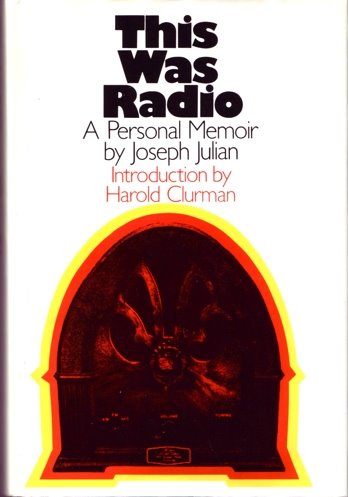
“The small but rich body of radio literature, which [Norman Corwin] brought so lovingly to life, lies languishing in a few libraries and second-hand book shops, under the titles Thirteen by Corwin and More by Corwin—a great shame and deprivation for the present generation!” My sentiments, entirely. Not my words, though, which is why I had to slap quotation marks on them. The man who said so was Joseph Julian, a once highly acclaimed and sought-after radio actor who starred in a number of plays written and directed by Corwin during the early-to-mid 1940s. Today, Julian’s memoir, a copy of which I recently added to my own library of out-of-print books on broadcasting, is one among those “languishing” volumes, a forgotten voice from a medium whose dramatic potentialities have remained largely unsounded since the late 1950s.

This Was Radio came out in the mid-1970s, a time widely deemed ripe for a reassessment of the aural medium and its derelict theater of the mind. Rather than waxing nostalgic—thereby squeezing the last few bucks out of a defunct business which, back then, most American adults still recalled experiencing first-ear, and fondly at that—Julian takes readers on a trip down memory lane that leads into neighbourhoods they would not get to hear about on an official tour.

His Corwinian class acts aside, Julian appeared on thriller programs like The Falcon, The Shadow, Inner Sanctum, Mr. Keen, Broadway Is My Beat, and The Mysterious Traveler. He was first heard on The March of Time, but as an also-ran-off-the-mouth, in re-enactments that called for crowd scenes. Briefly, he served as a sound man, during which stint he learned what noise a human body produces when it is turned inside out.

I can imagine just what kind of sounds emanated from Julian when he learned that the same thing was happening to his career. An established actor by the early 1940s, Julian remained highly successful throughout the decade, until, in 1950, his name appeared in Red Channels. His career as a radio actor declined rapidly; by 1953, his annual income had dwindled to a mere $1630.

Barred from work at CBS, Julian fired back by filing a lawsuit for libel. Character witnesses during Julian’s 1954 trial were Edward R. Morrow (last talked of here) and the aforementioned Morton Wishengrad. It was “an ugly period in American life and in mine,” Julian comments. His “urge” was “to skip over it”; but he felt a

responsibility as a victim to record some of what [he] went through. A whole new generation hardly knows that such a thing ever happened. But the fact is it could easily happen again if we relax our vigilance in defending our freedoms. Control of broadcasting is one of the first major objectives of those who would take them away.

His lawsuit was dismissed; thereafter, Julian virtually unemployed until William Fitelson, a theatrical lawyer and executive producer of the Theater Guild’s US Steel Hour television series staged one of the actor’s own plays in December 1954. Julian’s fortunes changed as quickly as they had declined; and he once again “getting calls for radio acting jobs.”

Without bitterness, Julian tells it as it is. About Myrna Loy, for instance, he remarks that, “if she had to win [her radio] role in a competitive audition with radio actresses, she wouldn’t have been there. Her voice, isolated from her other attributes, was dull and flat. She was selling her name, not her art.” More problematic still was it to perform a dramatic scene with Veronica Lake, who had such a weak, wispy voice” that the sound engineer could not get her and Julian “in proper balance.”

Lake was handed a “separate microphone across the stage” so that the engineer could “could mechanically raise her voice level to mine.” However effective for listeners at home, her faraway whispers had Julian straining to hear his cues. “Especially since they had her facing front so the audience could see her famous peek-a-boo hairdo. Hardly the way to play an intimate love scene with a lady!”

Of the notorious Hummerts, who “grimly dominated their empire” of soap operas, Julian remarks:

There was something darkly foreboding about [them].  Their stiff presence always evoked a sense of insecurity.  And with good reason.  They had a reputation for firing actors who incurred their slightest displeasure.  And authors.  When Mrs. Hummert once told a writer that she wanted “God” on every page of a script, and his answer was “Who will we get to play Him?” he was fired on the spot.  And whey you were fired from one of their shows it was a catastrophe.  It meant being banned from all their nine or ten others that might be on the air at any given time.

Call him fortunate or not, Julian continued to act on the air well into the medium’s decline. On this day, 4 October, in 1959, he was heard on Suspense, one of radio’s last remaining drama anthologies, in the routine thriller “Room 203.” It is a far cry from Julian’s greatest work; but these days, almost any cry uttered on radio seems distant.

Beyond M: Douglas Sirk’s Zu Neuen Ufern (1937)

No, I don’t mean “N”—even though “N” for Nazis would be a good way to begin any survey of German films produced in the years following the release of Fritz Lang’s classic thriller. The aforementioned Blaue Engel aside, M is perhaps the only German film of the 1930s and ‘40s with which cinéasts the world over can be expected to be familiar. That much more attention is paid to German silent films than to any talking picture produced in Germany before Fassbinder achieved international success is owing, to some degree, to the Teutonic tongue and the aversion Americans have to dubbing and subtitling.

Another reason for the relative obscurity of classic German cinema is that the US set the standard for commercially viable motion pictures after the silent era came to an end; and few international films could rival the production values to which moviegoers growing up with MGM or Paramount spectacles were accustomed.

Politics, of course, are another key factor. Fassbinder’s 1970s melodramas no doubt appealed to many disenchanted Americans due to their working-class, liberal tendencies, which for an intriguing alternative to the newly emerging, vacuous blockbusters that carried on the tradition of formulaic filmmaking after the production code had been retired in the mid-1960s.

Fassbinder and Werner Herzog aside, what happened between M and Das Boot (1980), the first truly popular German post-World War II film in the US? Or, to narrow it down to the period between the end of the Weimar Republic in 1933 and the establishment of the Federal Republic of Germany in 1949, what kinds of films were produced in Germany when the Reich lost most of its artistic talents to the United States? Over then next few months I am going to look at a number of German movies of that era, beginning with Zu Neuen Ufern (1937) starring the aforementioned Zarah Leander.

Zu Neuen Ufern (meaning “To New Shores”) is a costume drama directed and co-written (or, rather, adapted) by a filmmaker who would become one of Hollywood’s foremost melodramatists: Douglas Sirk (then working under his German name, Detlef Sierck), an artist admired and understood by Fassbinder, who not only emulated Sierck but made him relevant to a 70s audience.

When Zu Neuen Ufern was released in New York—in the German enclave of Yorkville—a New York Times reviewer remarked upon Sierck’s “smooth” direction of a movie full of “highly interesting scenes.” What makes the film most interesting today is not its smoothly plotted series of incidents but its brooding theme of lost liberty and constraint.

The film is set in early Victorian England and New South Wales; one is a prison of conventions, the other a penal colony. Leander’s character, the scandalous yet popular actress Gloria Vane, has taken the blame for a forgery committed by her financially desperate lover, Sir Albert Finsbury, and is sentenced to serve seven years in an Australian penitentiary.

The only way to shorten the sentence is for the prisoners to correct the shortage of women by accepting the marriage proposal of an eligible local. Gloria reluctantly condescends to being wed to an Australian farmer—only to back down and go in search of her lover, who fled to Australia prior to Gloria’s trial and has remained ignorant of her fate.

Having achieved success in the military, Albert is about to marry the governor’s daughter. Gloria, who has learned about the wedding, confesses to Albert that her love for him has been exhausted, upon which the hapless lover commits suicide . . . on the very day of the wedding the thought of which he can no longer endure. Finally recognizing the kindness of the farmer responsible for her release from the prison to which she, in a moment of utter despair, vainly attempts to regain entrance, Gloria marries her liberator.

High melodrama, in short, but admirably underplayed by the remarkably restraint Leander, who does not give her scenes the full treatment for which her compatriot, Garbo, became famous. Its sensational plot notwithstanding, Zu Neuen Ufern is neither cheap nor hysterical. Underscored by Leander’s songs—the haunting “Ich steh’ im Regen” and the sly “Yes, Sir!”—the theme is that of futile longing, of wishing to belong and not being able to exert one’s free will in the pursuit of happiness. It is the nightmare vision of an artist at odds with an increasingly restrictive regime. Sierck was looking for a new “Ufer” and an artistic world beyond UFA, the Nazi-sanctioned studio that produced his films.

To be ”vom anderen Ufer” is a colloquial German term for being beyond traditional marriage, for being set apart if not forcefully transported to the other side for one’s deviance from or defiance of the norm. Neither shore provides a safe harbor. Meanwhile, a common word used in Nazi Germany for aberration in art and nature, “entartet.” is uttered by an unsavory character complaining about the thinness of the female prisoners he has come to inspect in hopes of matrimony.

Sierck seems to adopt the language to pervert the perverse in the society from which the film is only superficially removed. Putting his heroine on display in court, on the stage, and behind bars, he constructs a theater of desire in which a valiant creature like Gloria Vane—who at one point is being pelted with rubbish for singing with feeling after she spots her lost love in the audience—struggles to keep her integrity at the loss of liberty and love.

Douglas Sirk eventually achieved great success on Western shores, yet was forced throughout his career to remain guarded in rendering what could, at best, be an Imitation of Life. In Zu Neuen Ufern, that imitation is the compromise Gloria finds in turning a marriage of convenience into an alternative for solitude, imprisonment, or death.

” … from hell to breakfast”: H. V. Kaltenborn Reporting

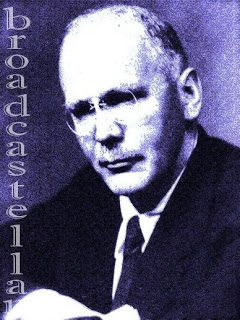
Listening selectively to US broadcast recordings of the 1930s, ‘40s, and ‘50s—the period often referred to as the radio’s golden age—I often neglect the kind of program that, during the late 1930s was fast gaining in significance as millions of Americans, many of whom were immigrants from Europe and Russia, were following reports from the Old World they had left. On this day, 22 September, in 1939, news commentator H. V. Kaltenborn kept CBS listeners abreast of the situation in Europe, paying special attention to the politically unstable kingdom of Romania.

As I learned yesterday, reading My Eyes Are in My Heart by aforementioned radio announcer Ted Husing, the King and Queen of Romania were savvy people not averse to selling out or forging lucrative alliances. On a tour of the United States back in 1926, Queen Maria of Romania, made a splash in the advertising world, agreeing to appear on radio, promote products, and be seen shopping in certain stores, all for the right sum of money.

Romania had one particularly valuable commodity, and the country, still neutral in the fall of 1939 was keen on keeping good relations with the nation that was about to swallow the continent. On 21 September, premier Armand Călinescu was assassinated by Romania’s fascist Iron Guard and Gheorghe Argeşanu, former Minister of War, was named as his successor. Here is how Kaltenborn (whose German title would have been Baron von Kaltenborn-Stachau, had he not been born and raised in Wisconsin) described the situation to American listeners:

That means that they are going to have a military government, as strong a government as King Carol [II] could possibly create, and it needs to be strong in view of the situation faced by imperiled Romania. Russian armies are menacing from the north.  German armies are menacing from the west.

While Russia was anxious to regain territory lost to Romania after Germany needed Romanian oil, Kaltenborn explained; and in trying not to offend either giant, Romania was on the brink of becoming another Poland.

Speaking rapidly and with animation, Kaltenborn occasionally stumbled in his commentary; he generally used notes rather than a prepared script, a technique that lent urgency to his reportage.

By 1939, he was a veteran, his beginnings in broadcasting dating back to 1922 (as you will learn listening to this Recollections tribute from 3 April 1957). As early as 1926, he had remarked upon “Radio’s Responsibility as a Molder of Public Opinion,” upon radio’s role as the Fifth Estate. “Public opinion is the king of America, and radio must assume a more conscious responsibility as democracy’s kingmaker,” he had cautioned.

World War II had only just begun; but news analysts like Kaltenborn were preparing the ignorant, the indifferent, and the isolationists for the inevitable, however tentative and cautious they were in their warnings:

I spent a good part of yesterday in Washington, I interviewed members of the Cabinet, outstanding leaders of the Senate, some of the most outspoken leaders of the opposition to lifting the embargo [against sending military aid to European countries facing threats from Germany and Russia, an embargo maintained as part the US Neutrality Act that FDR had urged Congress to repeal on 21 September], and got a picture of the atmosphere of Washington.  There is general apprehension in Washington that somehow, in some way, in spite of our not wanting it, that the country may be pushed towards war.

“Let those who seek to retain the present embargo position,” Kaltenborn insisted,

be wholly consistent and seek new legislation to cut off cloth and copper and meat and wheat and a thousand other articles from all the nations at war.  I seek a greater consistency through the repeal of the embargo provisions and a return to international law.

Kaltenborn then read a bulletin from the United Press, which stated that the isolationists in the Senate intended to fight the President on the embargo repeal “from hell to breakfast.”

Recordings of broadcast news and commentaries like this (which you may find in this invaluable Old Time Radio Researchers Group compilation), bring to life a time of fear and uncertainty without an awareness of which classic radio plays like “The War of the Worlds” cannot be fully understood.

To Hear, to Belong, to Submit: The Volksempfänger Turns 75

Nowadays, the concept of not having a voice is so alien to most of us Westerners that we fool ourselves into believing that what we are saying is of consequence, that because words are sent into the world they may also change it. We are too used by now to telecommune via phone or internet that the one-sidedness of broadcasting strikes us as downright barbaric. Why listen and be still when we can chatter and twitter, why take in a thought when we can put out a great deal of thoughtlessness with the greatest of ease? Publishing online or opining about world events on our slick mobiles, we are apt to believe that we have the world at our lips and by the ear. We are given gadgets—or, rather, we purchase them at considerable cost—that encourage us to exhaust ourselves in gossip while permitting others to check that our talk is indeed idle.

The talking disease is the talking cure of our modern society: the comforting illusion of having the power to say anything, anytime serves a system that, if our words mattered, would have to resort to more drastic acts of silencing.

Back in early 1930s Germany, Bertolt Brecht rejected radio as a distribution apparatus, a machine through which the few addressed the many, generally in the guise of speaking on their behalf. The German for broadcasting itself is misleading.  “Rundfunk” (literally, sparking around) hardly captures the one-sidedness of transmission. Brecht was looking forward to the day in which broadcasting could be a system of exchange, the kind of wireless telephony now available to us, at least technologically speaking.

Instead, German radio cut off all means of response other than compliance. It removed from the dial any voices that might utter second opinions. Effectively, it removed the dial itself by tuning the public to the official channel, and to that channel alone. Today, 18 August, the Volksempfänger turns 75. It was not simply the furniture of fascism.  It was its furnisher.

The Volksempfänger (the people’s receiver) fed Germans with whatever was in the interest of the Reich, that is, the governing body rather than anybody being thus governed. This privilege of being talked down to, of being shouted at and being shouted down, was offered at a discount—a discount that ended dissent in the bargain. Dictatorships, after all, depend on dictation.

Brecht had reason to be wary of broadcasting, a means of listening that precluded response. Does not the German language suggest that the German people are prone to being led by the ear? The German for “hearing” is “hören,” a related form of which is “horchen.” Both are the root of a great many words, and some weighty ones at that.

Take “gehören,” for instance, which means to belong, while “verhören” means to interrogate. “Hörig sein,” in turn, means “to be submissive,” and “gehorchen” means to obey. “Auf jemanden hören” means to pay heed. Remove the “jemand” (the anybody), and you have “aufhören,” which means to end, as free speech did when the Volksempfänger became cheaply available to anybody.

Today, we have the opportunity to receive as well as broadcast. We can take in hundreds of channels and put out millions of words. It calms many of us to the point of not speaking up. We can, therefore we don’t. A system that does not take the microphone away from us, that permits us to air our concerns, must be fair system. Why listen to anyone who tells us otherwise? Well, “Wer nicht hören will muss fühlen,” a German saying goes. Its meaning? Those who don’t listen shall feel the consequences.

Scotland Backyard

Right now, there are some 17,500 files in my iTunes library, ranging from 2 ½-hour productions of Shakespeare’s Cymbeline and Tom Stoppard’s Rock ‘n’ Roll to clips of speeches by Himmler and Goebbels.  I was a little concerned about those speeches when last I traveled to the US.  Just days prior to my departure, it was announced that, outrageous as it sounds, the US reserves the right to inspect any laptop and download its content for inspection.  What might those Nazi soundbytes have told some officious, uniformed ignoramus about myself, my politics, and my objectives once on American soil?

Anyway, I don’t even know just what kinds of trash or treasure are stored in my archive of sounds, given the vast number of recordings on my hard drive.  Most of these files I assume to have little or no connection to my everyday life here in Wales.  Much of it is commercial and, commercials aside, rather generic pulp.

Last weekend, though, while going through and editing those titles in my library, I came across a surname of a character in a thriller program that reminded me of a framed drawing on display in our living room.  How strange it seems, pulling the blinds in the morning (if I get up that early) to be looking at the image of an axe murder; but there he is, the notorious Buck Ruxton, right before my eyes whenever I glance to the left of our view of the Welsh hills.  And there he is again, in my virtual library, alongside Our Miss Brooks and The Lone Ranger.

The play in question was produced in the late 1940s or early 1950s as part of the syndicated series The Secrets of Scotland Yard.  It tells of an Indian physician who murdered his wife and chopped her into what the narrator describes as “two hundred all but unidentifiable parts.”  When last I was up in Lancaster, the English town where the not-so-good doctor lived and practiced, I even came across a pub named after him.

Now, we happen to have in our collection two of Eric Fraser’s original ink drawings for the “Case of the Jealous Doctor,” an article about the Ruxton case that was published in the 12 November 1949 issue of Leader Magazine.  The case itself dates back to 1935.  Fraser, as you can see, relished in the sensational character of the murder and the trial, but, unlike the producers of Secrets of Scotland Yard approached his commission with a wry, dark sense of humor.

Listening to the dramatization, I was amazed just how minutely the murder—its background, execution, cover-up and detection—was being reconstructed.  To be sure, it features one of the worst impersonations of an Indian, which is about as sensitive as the Leader article in its claim that, “behind” the Ruxton case “lay the failure of an Oriental to adapt himself to the Western world.”  In other respects, though, the writers and producers of the radio play seem determined to be as painstakingly accurate as possible.

I don’t suppose any American listener to Secrets (produced in Britain, but sold to international markets) would have appreciated this kind of attention to historical, regional detail.  Nor would I, had I not heard about the murder after being subjected to the image.  I would have assumed this radio play to be just another piece of sensational melodrama whose kernel of truth is drowned in a bucket of blood.

Most of all, though, I marvel at the link between the drawing and the recording.  Perhaps, I am still compartmentalizing my worlds too much, keeping apart what is distinct yet kindred.  I strikes me that, whatever subject you pursue, whatever object you admire, remote it may seem from your present surroundings (an apartness, perhaps, that attracted you to the subject to begin with), should not be assumed to have no relation to your everyday.

Sometimes it takes more of an effort to make the connection, and sometimes the efforts seem not worth your making; but every so often (as in this instance, or the time we went in search of a rock in a painting that now hangs in our bedroom or spotted that actress in a Hitchcock movie whose likeness we have on a piece of paper), you—or, I should say, I—get this thrill of being able to relate to an artifact in unexpected, even intimate ways.  It is then that I most appreciate the work of all those nameless or forgotten artists, writers, and researchers engaged in producing what you might dismiss as impersonal or workaday . . .

They [Got] What They Wanted: or, We Postpone This Wedding

Starting next week, I shall once again take in a few shows on and off Broadway. In the meantime, I do what millions of small-townspeople used to do during the 1930s, ‘40s, and early ‘50s—I listen to theater. Since the 1920, such makeshift-believe had been coming straight from the New York stage, whether as on-air promotion or educational features. Aside from installing an announcer in the wings to translate the goings-on and comings-in, it took the producers of broadcast theatricals some time to figure out what could work for an audience unable to follow the action with their own eyes. When that was accomplished, in came the censors to determine what could come to their ears. The censors were in the business of anticipating what could possibly offend a small minority of self-righteous and sententious tuners-in who would wield their mighty pen to complain, causing radio stations to dread having risked their license for the sake of the arts.

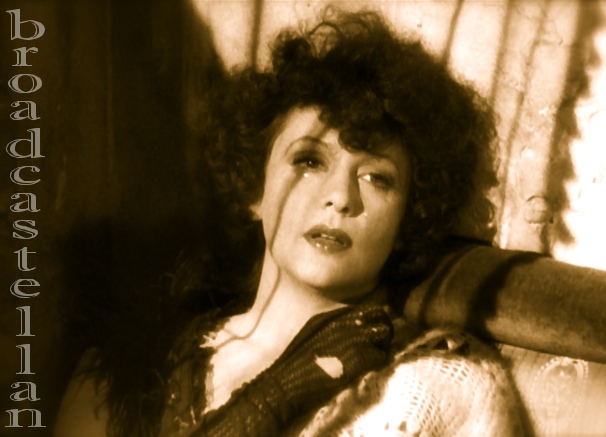
Few established playwrights attempted to re-write for radio. One who dared was Kenyon Nicholson, whose Barker, starring Walter Huston and Claudette Colbert delighted Broadway audiences back in 1927 (and radio audiences nearly a decade later). On this day, 19 May, in 1946, the Theatre Guild on the Air presented his version of Sidney Howard’s They Knew What They Wanted, with John Garfield as Joe, Leo Carillo as Tony, and June Havoc (pictured) as Amy.

Now, I have never seen a stage production of the Pulitzer Prize-winning They Knew; nor have I read it. Like most tuning in that evening, I would not have known about the tinkering that went on so that the story involving a doomed mail-order May-December romance could be delivered into American living rooms—were it not for Nicholson’s own account of what it entailed to get They Knew past the censors.

Nicholson got to share his experience adapting They Knew, one of his “favorite plays,” in a foreword to his script, which was published in an anthology of plays produced by the Theatre Guild on the Air. According to the inexperienced adapter, his “enthusiasm for the job lessened somewhat” as soon as he began to undertake the revision:

“Radio is understandably squeamish when it comes to matters of illicit love, cuckolded husbands, illegitimate babies, and such; and, as these taboo subjects are the very core of Mr. Howard’s plot, I realized what a ticklish job I had undertaken.”

After all, Messrs. Chase and Landry remind us, as the result of a single listener complaint about this adaptation of Eugene O’Neill’s Beyond the Horizon, which retained expressions like “hell” and “for god’s sake,” several NBC Blue affiliates were cited by the FCC and ordered to defend their decision to air such an offensive program. Nicholson was nonetheless determined “that there could be no compromise. Distortion of motivation as a concession to Mr. and Mrs. Grundy of the listening public would be a desecration of Mr. Howard’s fine play.”

It was with “fear and trembling” that Nicholson submitted his script. Recalling its reception, he expressed himself “surprised to find the only alteration suggested by the Censor was that Joe seduce Amy before her marriage to old Tony.”

The “only alteration”? Is not the “before” in the remark of the pregnant Amy—”I must have been crazy, that night before the wedding”—precisely the kind of “compromise” and “[d]istortion” the playwright determined not to accept? Nicholson dismisses this change altogether too nonchalantly as a “brave effort to whitewash the guilty pair!” Rather, it is the playwright’s whitewashing of his own guilt in this half-hearted confession about his none too “brave” deed.

The censors sure knew what they did not want those to hear who never knew what they did not get.