

It is not dotage but a momentary state of doting. Not the reliving of one’s own youth, however romanticized, but an imagining—or experiencing—of what it means to be very young while looking at objects or confronted with performances not created with me in mind. Not reverie, in short, but empathy. That is what I call “secondary childhood”—the state of being elsewhere in time and space, being young there while being here and quite otherwise. Listening to so-called old time radio programs produced in the US, for instance, I am keenly aware that I am entering worlds once inhabited by millions of children born in a country other than my German birthplace, past generations whose reflections are lost to us and, all too frequently, even to them—worlds the passage to which might have been blocked and obscured over time, but that might nonetheless be recoverable.
This recovery effort is quite distinct from the nostalgia of which I am so wary, the attempt of forcing oneself back through that passage and, failing to do so, creating one through which one may yet squeeze wistfully into a niche of one’s own making. It is quite another thing, to me, to set out to gain access to the worlds of other people’s childhoods, to tune in with one’s child’s mind open. I try not to make assumptions about audiences and their responses; instead, I try to become that audience by permitting myself to be played with so as to figure out how a game or play works.

As I have had previously occasion to share after a trip to Prague, I enjoy looking at old toys. Visiting the grand and rather austere neo-Norman castle of Penrhyn last weekend, on an excursion to the north of Wales, I was surprised to find, housed in that forbidding fantasy fortress, a corner devoted to a collection of dolls. Now, it seems perverse to be so drawn to the two stuffed animals pictured above, stuffed as Penrhyn is with exquisite furniture and impressive works of art (a Rembrandt, no less). I gather it was the bathos of it, the relief after having had greatness thrust upon me to be surprised by these unassuming and, by comparison, prematurely timeworn objects.
Turns out, the twin pandas in the straw hats are Wili and Wali, marionettes who co-starred in a long-running Welsh children’s program titled Lili Lon (1959-75). Upon returning to mid-Wales, where I now live, I immediately went online in search of the two; but, aside from a history of their creators, little can be found about them. I have become so accustomed to YouTubing the past that I was surprised to find no trace of Wili and Wali. No doubt, they still dwell in the memories of thousands who shared their adventures. I was not among them; yet, as is often the case when I come across titles of lost radio programs or fragments thereof, I imagine myself enjoying what is beyond my reach . . .

 So, Carole Lombard and Clark Gable got married on this day, 29 March, back in 1939. Ginger Rogers tied the proverbial knot with someone or other in 1929; dear Molly Sugden, whom most folks today know as Mrs. Slocombe, a woman closest to her pussy, was Being Served, be it well or ill, with a license to wed in 1958; and the to me unspeakable ex-Prime Minister Tony Blair proved that he had popped the question fruitfully by walking down the aisle with someone named Cherie. It is a time-honored institution, no doubt; and one that has protected many a woman before her sex was granted the right to vote; but it is concept I find difficult to honor and impossible to obey nonetheless (which explains my love for the first three quarters of the average screwball comedy, the genre in which Lombard excelled).
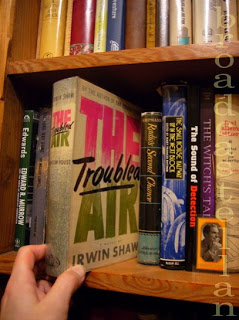 This being the birthday of novelist Irwin Shaw (1913-1984), I dusted off my copy of The Troubled Air (1951) to pay tribute to a radio writer who successfully channelled his anger and frustration by feeding it to the press, a rival medium that was only too pleased to get the dirt on broadcasting. Like his
  As usual, I am slow to catch up. A few years ago, the BBC relinquished the rights to televising the Oscars; and since we are not subscribing to the premium channel that does air them, I am relying on the old wireless to transport me to the events. So, here I am listening to …
  This seems to me just the day to hear about Messrs. Polk and Harding, to listen to the words of Franklin Pierce and Chester Alan Arthur. During the late 1940s and early ‘50s, they were all brought back to life via that great spiritual medium, the wireless. For little less than half an hour at a time, they wafted right into the American home, which, a decade earlier, had been accustomed to so-called Fireside chats from an above determined to come across as being among.
 Well, it kept Bing Crosby on the air; but it also made that air feel a lot staler. Magnetic tape. Its introduction back in 1946 was a recorded death sentence to the miracle and the madness of live radio. Dreaded by producers of minutely timed dramas and comedy programs, going live had been the life or radio. Intimate and immediate, each half-hour behind the microphone had the urgency of a once-in-a-lifetime event. Actors and musicians gathered for a special moment and remained in the presence of the listener for the express purpose of being there for them and with them, however far away. They made time for an audience that, in turn, was making time for them. In a world of commerce in which democratic principles were reduced to the ready access to cheap reproductions, the quality of being inimitable and original was fast becoming a rare commodity indeed. The time for the magic of the time-bound art, the theater of the fourth dimension, was fast running out.
 Well, it wasn’t exactly business as usual on this day, 7 December, back in 1941. Mind you, lucre-minded broadcasters tried hard to keep the well-oiled machinery of commercial radio running. There were soap operas and there was popular music, interrupted in a fashion rehearsed by “The War of the Worlds,” by updates about the developments of the attack on Pearl Harbor (
 Harry Heuser