“The First Radio Play Printed in America”: “Sue ‘Em” (1925) and the Ensuing Question of Legitimacy

A photograph published in the April 1926 issue of Radio Broadcast
showing a young John Huston (left) and fellow members of the Provincetown Players

Here I go again.  Another broadcasting centenary, another radio “first.”  This “First,” mind, is wrapped in quotation marks, as the claim is not mine.  I am not going to dispute it, either, or challenge someone else to have the last word in the old “Who’s on First?” routine.  I have been there before.

Picture it: Early 2024.  I am commemorating the one-hundredth anniversary of radio “drama” at an event I staged with British playwright Lucy Gough at the National Library of Wales.  I set out by acknowledging the widely held assumption that Comedy of Danger by playwright-novelist Richard Hughes was the “first” original radio play to be broadcast … anywhere.

The claim served as a hook.  It was designed to underscore the international significance of the event.  At the same time, I tried to justify its happening in Wales by drawing attention to the play’s Welsh setting and the playwright’s affinity with the country.  More important to me than arriving at a definitive answer to the vexed question of whether Comedy of Danger should be regarded as the “first” of its kind are the shifting definitions of the term “radio play” on which, to my mind, hinges the answer to that question—or rather, its unanswerability and ultimate pointlessness.

After all, it is difficult to say what is “first” in any field if the field itself is not clearly delimited first, or if the field is so limitless that it defies delineation in the first place.  In the case of “radio play,” Hörspiel (play for listening) or radio drama—relatively arcane though this field of study may be—definitions not only vary greatly but are often not even attempted.

When is a play a radio play? That is a question I have been asking for a long time in my musings on the wireless, and it is a question I keep asking myself.  “When is a play a radio play” strikes me as a more useful way of framing the debate than the more obvious question “What is a radio play?” because the former encourages us to avoid the most perfunctory of answers: A radio play is a play written for and/or heard on the radio.  

Sure, on the surface it barely scratches, that statement sounds reasonable enough.  But are all plays written and produced for radio broadcasting radio plays by default? Is it the medium, then, that makes a play—any play—a radio play?

Not that “radio” as we understand or know it these days bears a close resemblance to “radio”—as a receiver set, a system, and a phenomenon—anno 1925, the year when Sue ‘Em, proclaimed by its publisher to be the “first radio play printed” in the USA, successfully made a play for first place in a radio playwrighting contest.

Continue reading ““The First Radio Play Printed in America”: “Sue ‘Em” (1925) and the Ensuing Question of Legitimacy”

Static and Spirits: Anarchic Airwaves, Prohibition, and the Return of Philo Gubb, Correspondence School “Deteckative”

Illustration for “The McNoodle Brothers’ Radio Mystery” in Radio News, Sept. 1923

Philo … Gubb? Never heard of him.  Nor, in all my years—make that decades—as a reader of detective fiction, had I come across, or become aware of, Ellis Parker Butler (1869–1937), the writer who brought Philo Gubb—“a tall, thin man, with the face and gait of a flamingo,” a paperhanger with a hankering for “deteckative” work—into a flurry of being.  Not until recently, that is.

Generally, I do not mind stumbling onto what might have been got at with greater ease and efficiency through methodical research.  I am aware that any perceived surprise on my part—that “Eureka!”-inducing moment of discovery—may be owing to an absence of assiduity.  That said, some of the most memorable encounters are made by chance, along circuitous routes.

In the case of Ellis Parker Butler and his brainchild Philo Gubb, though, I regret not having made the acquaintance of either of them sooner, given that this particular route led me back, unexpectedly, to the early days of broadcasting, about which Butler had much to say that might have been of interest and use to me in Immaterial Culture, my study of so-called old-time radio.

Now, Immaterial Culture does not pick up on the story of broadcasting until the network days of the late 1920s.  To gain an understanding how radio evolved, a look at prehistoric transmissions, albeit largely in the absence of sound recordings, is nonetheless instructive.  You cannot expect to “get” the cream of old-time broadcasting if you neglect an inspection of the cat’s whiskers for traces of same.

“There is a [loose] cannon”: Stephen Vincent Benét’s “Undefended Border” Revisited

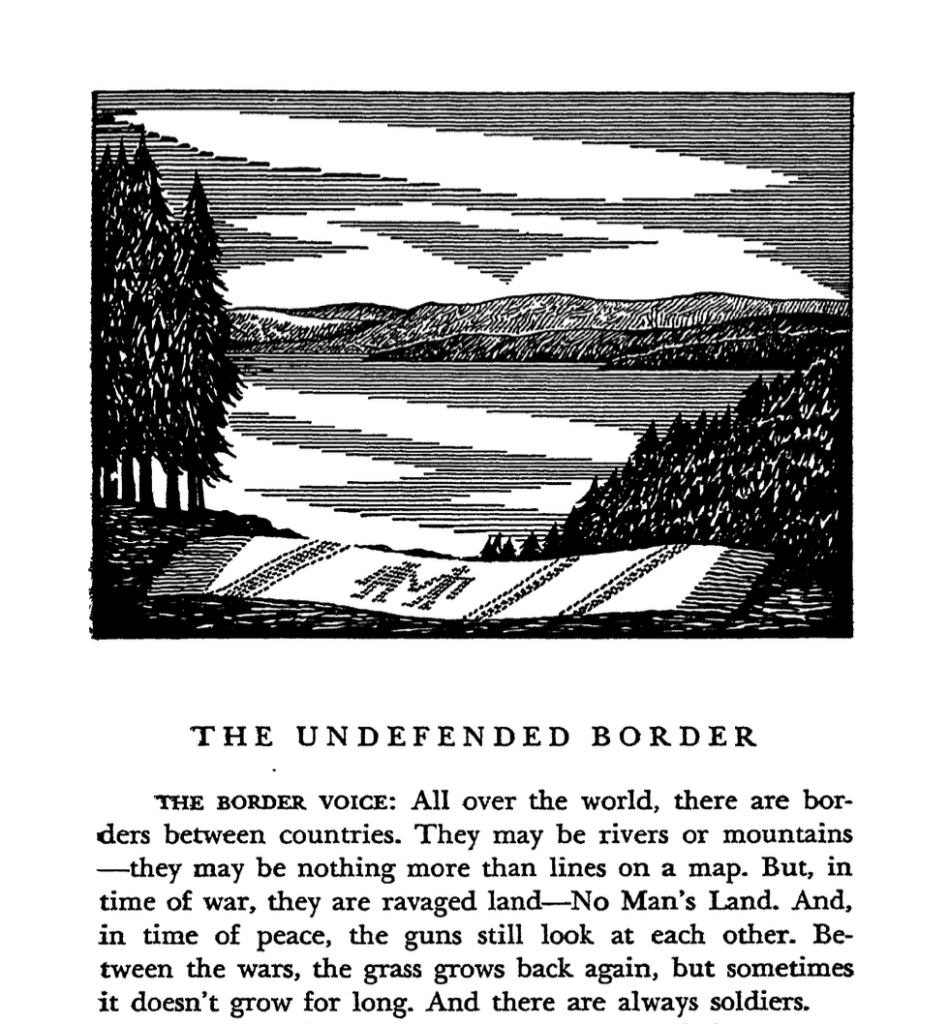
The published script as it appeared in We Stand United, an anthology of radio plays by Stephen Vincent Benét and “decorated” by Ernest Stock.

I commenced this journal back in 2005.   It was intended as a continuation of, and promotional vehicle for, my doctoral study “Etherized Victorians: Drama, Narrative, and the American Radio Play, 1929–1954.”  Its title, broadcastellan, was meant to declare me to be keeper of a vast Luftschloss—a neglected alcazar of the air, immaterially composed of numberless radio recordings I determined to play back.

As of this post, broadcastellan is nearing its twentieth anniversary.  While I do not take this as an opportunity, let alone an excuse, to reissue older posts, I nonetheless wonder: When history seems to be repeating itself, perhaps I may be justified to do the same, if only to demonstrate that not every “been there” necessarily translates into a feeling of “done that,” and that not all twice-told tales are a rehash—not, at least, when you approach them from a perspective that has profoundly, even fundamentally, changed along with the context, your life experience and your attitude toward the world.

I devoted one early entry to “The Undefended Border” (1940), a play by Pulitzer Prize-winning poet Stephen Vincent Benét (1898–1943).  Revisiting it now, in the age of the MAGA tariff wars and annexation threats, I cannot but think of the loose cannon that is recklessly flouting, or at any rate tarnishing, the legacy of the rusty “lone cannon” commemorated in Benét’s play.

Continue reading ““There is a [loose] cannon”: Stephen Vincent Benét’s “Undefended Border” Revisited”

“… I prefer to explain all differently”: A Specious Rationalization of the Criminal Impulse to Possess Forbidden Fruit in Eden Phillpotts’ “The Iron Pineapple”

The Bookshop by the Sea, where I purchased A Century of Detective Stories

The Welsh seaside town of Aberystwyth, where I live, has no shortage of bookstores, first-hand and otherwise.  At one of them—The Bookshop by the Sea, which sells both old and new volumes—I purchased, some time ago, A Century of Detective Stories.  Published in 1935, it is an anthology of crime and mystery tales introduced by G. K. Chesterton, whose outrageous “Fad of the Fisherman” I found occasion to discuss here previously.

Ystwyth Books, where I purchased Death by Marriage by E. G. Cousins on the day I posted this blog entry.

Trying to live up to its title, A Century of Detective Stories is a brick of pulp, and it is not easy to handle when you are reclining in a lounge chair hoping to catch those rare vernal rays that are the oft unfulfilled promise of summer on the typically temperamental and frequently bleak west coast of Britain.  

Oxfam Bookshop, Aberystwyth, where someone beat me to a large selection of Three Investigators books on the day of writing this entry.

Aberystwyth and its environs have, in part for that reason, been the setting of murder mysteries, among them the noirish detective series Hinterland and the quirky retro-noir novels of Malcolm Pryce.  And, as I am writing this, the place is a veritable crime scene, with local booksellers displaying mystery novels and hosting literary events dedicated to the art of murder.  It is all part of Gwyl Crime Cymru, billed as “Wales’ first international crime fiction festival.”

Waterstones, Aberystwyth, where I tend to purchase copies of British Library Crime Classics.

Meanwhile, I am still catching up with A Century of Detective Stories.  Selections include narratives by Edgar Allan Poe, Wilkie Collins and Marie Belloc Lowndes, as well as works by some of the biggest names in crime fiction written between the two World Wars: Agatha Christie, H. C. Bailey, Dorothy L. Sayers, and Edgar Wallace, to drop just a few.  The diversity of this collection is part of its strength and appeal.  Its title is nonetheless misleading.

Continue reading ““… I prefer to explain all differently”: A Specious Rationalization of the Criminal Impulse to Possess Forbidden Fruit in Eden Phillpotts’ “The Iron Pineapple””

“You Can’t Do Business With Hitler”: A “picture of Nazi trade methods” Re-Viewed in the Second Age of MAGA

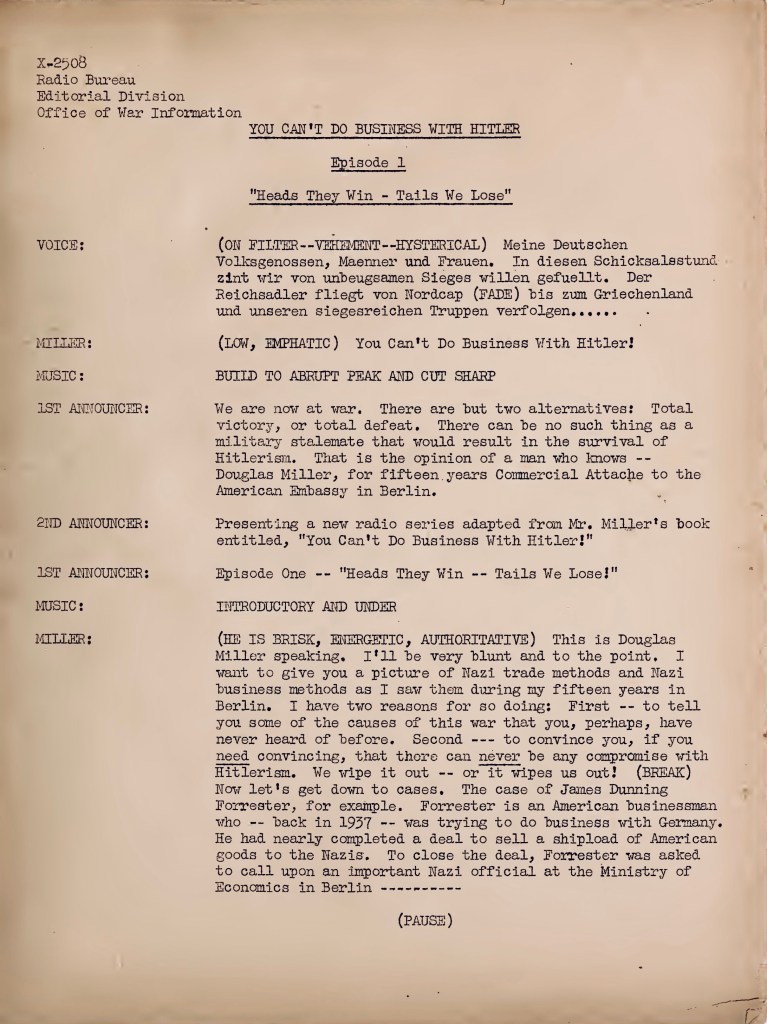
First page of the script for the first episode of You Can’t Do Business with Hitler

“This is Douglas Miller speaking. I’ll be very blunt and to the point.  I want to give you a picture of Nazi trade methods and Nazi business methods as I saw them during my fifteen years in Berlin.”  Intimate and immediate in the means and manner in which, in the days before television and internet, only network radio could reach the multitudes of the home front, the speaker addressed anybody and somebody—the statistical masses and the actual individual tuning in.  The objective was to persuade the US American public that “You Can’t Do Business with Hitler.”

The statement served as the title of a radio program that first went on the air not long after the US entered the Second World War in the aftermath of Japan’s attack on Pearl Harbor, an act of aggression that prompted the United States, and US radio, to abandon its isolationist stance.  Overnight, the advertising medium of radio was being retooled for the purposes of propaganda, employed in ways that were not unlike the methods used in Nazi Germany.

You Can’t Do Business with Hitler was also the title of a book by Miller on which the radio series was based.  Upon its publication, lengthy excerpts appeared in the July 1941 issue of The Atlantic Monthly, the editor of which introduced the article by pointing out that Miller had personally “observed German industry and particularly noted the ruthless determination with which it was directed after Hitler came to power.”

During the 1920s and ‘30s, Miller had served as Commercial Attache to the American Embassy in Berlin and had subsequently written an account of his experience.  In You Can’t Do Business with Hitler, he argued that his long record of service “entitle[d]” him “to make public some of [his] experiences with the Nazis and—after drawing conclusions from them, discussing Nazi aims and methods—to project existing Nazi policy into the future and describe what sort of world we shall have to live in if Hitler wins.”

Posting this—the 855th—entry in my blog, on the day after the national election in Germany in 2025, in which the far-right, stirred by Elon Musk and JD Vance, chalked up massive gains, and in the wake of the directives and invectives with which the second Trump administration redefined US relations with many of its global trading partners—I, too, am projecting, anticipating what “sort of world” we shall find or lose ourselves if “Nazi methods” take hold in and of western democracies.

Far from retreating into the past with a twist of the proverbial dial, I am listening anew to anti-fascist US radio programs of the 1940s to reflect on the MAGA agenda in relation to the strategies of the Third Reich regime, asking myself: Can the world afford to do business with bullies?

Continue reading ““You Can’t Do Business With Hitler”: A “picture of Nazi trade methods” Re-Viewed in the Second Age of MAGA”

“… unequal emission”: “Interference,” “Modern Wireless,” and the “Wilds of Electronia”

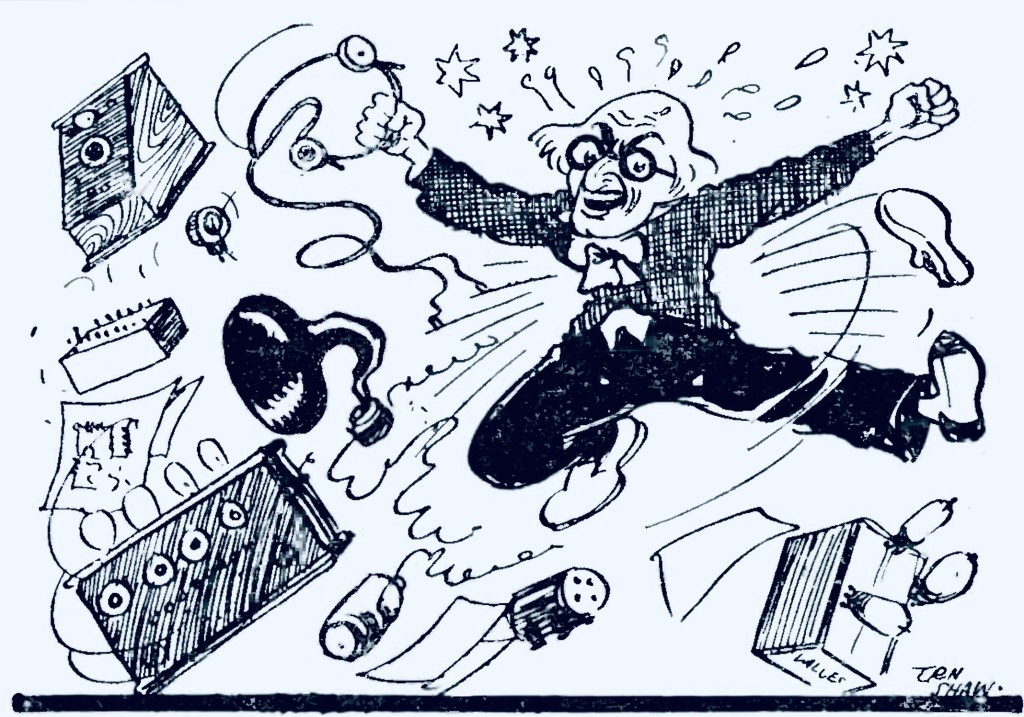
Illustration by Ern Shaw (Modern Wireless, Nov. 1924)

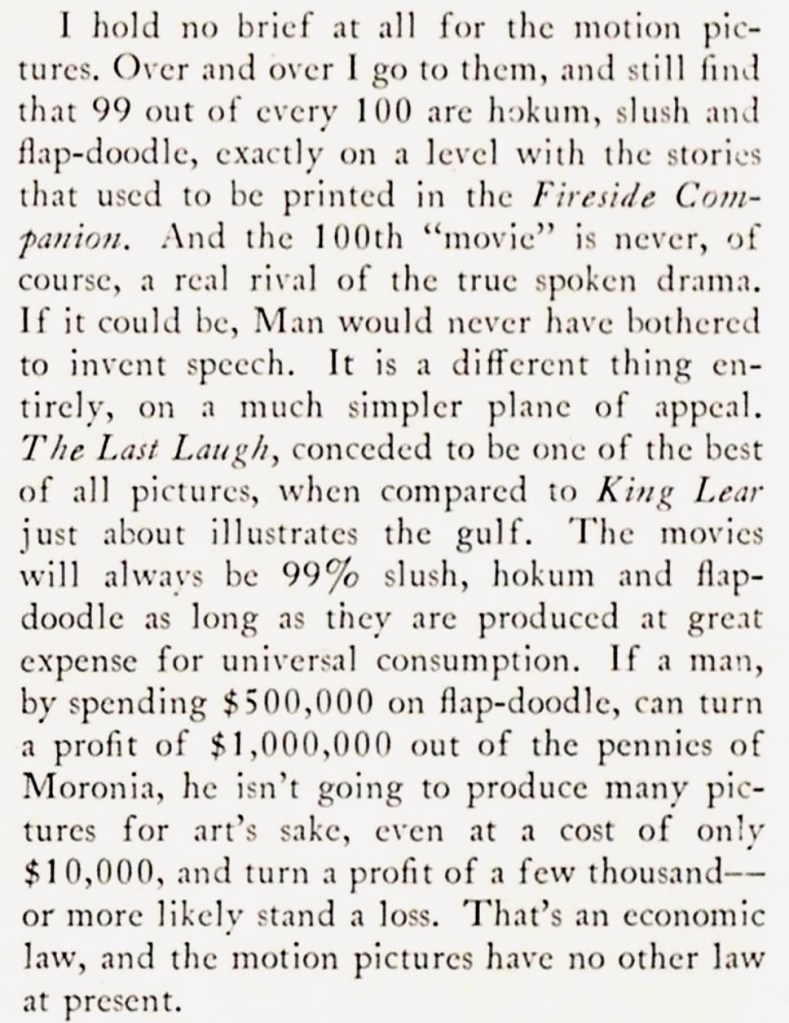
“Many plays have been broadcast, but none of them seems to me to have the pep that is needed to get not merely across the footlights but across the ether.”  Complaints such as this one are all too familiar to me; in fact, they were launched so frequently against radio culture that, years ago, they prompted me to contest them. 

To misappropriate the famous question posed by the feminist critic Linda Nochlin, I asked “Why Are There No Great Radio Writers?” The objective was not to find examples to the contrary—those queer, quirky and quicksilver exceptions that can serve to prove the rule—but to query the question itself as (mis)leading and to expose the biases underlying it.

Continue reading ““… unequal emission”: “Interference,” “Modern Wireless,” and the “Wilds of Electronia””

“The lights have gone out!”: Commemorating One Hundred Years of Plays for Radio

First slide of my presentation

Taking the radio play to the library has long been an ambition of mine, given that dramatic and literary works written for the medium of sound broadcasting occupy comparatively little space on the bookshelves.  Taking the first of its kind to a national librarythe National Library of Wales, no less—is a chance of a lifetime amounting to poetic justice.  Allow me to shed a modicum of light on that, and on my benightedness besides.

So that meaningful conclusions may be drawn from my peculiar challenge of commemorating one hundred years of radio dramatics in just a few minutes, it strikes me as essential that the centenary first be quartered, a fate I hope to escape on 22 February 2024, the date set for the event.

Continue reading ““The lights have gone out!”: Commemorating One Hundred Years of Plays for Radio”

Lying Down/Sitting Up: “Significant Othering” in Cat People (1942)

Never equals: Irena at Oliver’s feet

Cat People (1942) is a legendary and much-loved B-movie […] that, as Geoffrey O’Brien has argued in “Darkness Betrayed,” his notes on the Blu-ray release of Jacques Tourneur’s fantasy film, “manages, over multiple viewings, to break free from its own legend.”  Despite the fact that viewers—professional critics, academics and horror film enthusiasts alike—“have sifted every shot and every situation of this seventy-three-minute feature,” O’Brien adds, a “fundamental mysteriousness remains, a slippery unwillingness to submit to final explanation.”

There is no danger of that slippage into certainty happening here.  My mind, too, has a “slippery” nature.  It is resistant to, and indeed incapable of, any thought amounting to an “explanation” that could possibly be taken for a “final” solution—a terminal reasoning that, bearing my Germany ancestry in mind, has demonstrably shown to bring about and justify no end of horrors.  

A lack of understanding: Irena and Oliver

Cat People was produced at a particular time of uncertainty—and of particular uncertainties—about democratically enshrined equalities, about the limits of reason and the extent to which the stirring of irrational fear could be instrumental in the unfolding of millionfold death.  It is fantasy that, rather than being escapist, gets us to the core of uncertainties about the state of humanity, the doubtful definition and futurity of which, a year after the raid on Pearl Harbor and the end of US isolationism, many a cat got many a tongue.

Cat People is “fantastic” in the way the term was proposed by Tzvetan Todorov.  In his seminal study The Fantastic(1973), Todorov argues that the phrase “I nearly reached the point of believing” constitutes the “formula” that “sums up the spirit” he calls “fantastic.”  Perhaps, that thought, being proposed so declaratively and summarily, itself sounds rather too conclusive.  Subverting such reasoning, the “fantastic” exists only because it resists any summing up.  To grasp it in this way is to deny it.  Its existence is predicated on its elusiveness, on its perceived indeterminacy.

Continue reading “Lying Down/Sitting Up: “Significant Othering” in Cat People (1942)”

Flesh/Fur: “Significant Othering” in Island of Lost Souls (1932)

The index for volume 94 of Essays, Poems and Reviews, collected by George E. J. Powell. Aberystwyth University

Some years ago, researching the life of the Anglo-Welsh dilettante and collector George Powell of Nanteos (1842-1882), I set out to piece together whatever archival material I could get my hands on to gain access to the heart and mind of an eminently queer Victorian, a man who is now mainly known, if at all, as a friend of—and bad influence on—the poet Algernon Swinburne.

Powell bequeathed “all [he] possess[ed] of bigotry and virtue” to Aberystwyth University, where I teach art history and where, as part of my “Gothic Imagination” module, I screen films in the gothic mode on Wednesday afternoons.  For the third entry in “Significant Othering,” the current series, I chose Island of Lost Souls (1932), a pre-code Hollywood creature feature loosely based on The Island of Doctor Moreau (1896) by H. G. Wells.

Continue reading “Flesh/Fur: “Significant Othering” in Island of Lost Souls (1932)”

Mirror/Lamp: “Significant Othering” in The Old Dark House (1932)

The last time I approached that Old Dark House – the titular edifice of a 1932 Hollywood thriller directed by the queer English filmmaker James Whale and founded on a novel by the English social critic J. B. Priestley—my eyes were not focussed on any particular visual detail.  I was remarking generally on the house as a concretization of Priestley’s views on the condition of Britain after the so-called Great War, as the film and its source, Priestley’s Benighted (1927), are often understood: Interwar Britain as an empire haunted by its past and a kingdom lacking a vision as unifying as the largely unchallenged rule of its alleged heyday.

Never mind the map. Now entering gothic territory

Not that British moviegoers, let alone US American audiences, would have considered this perspective, partially obscured by the retitling of the property, as being essential to the experience of the fun house-ghost train atmosphere the film conjures.  Sure, the house, with its shadowy corridors, massive oaken doors and branching staircases, is as ill-lit as any old Gothic-fictional castle; but the unenlightened ones at the heart of this picture are its denizens, the backward, dim-witted and intractable Femms in whose midst we, along with a small group of unfortunate travelers, find ourselves.

Continue reading “Mirror/Lamp: “Significant Othering” in The Old Dark House (1932)”