“Uneasy Threshold”: Secret beyond the Door (1947), Room(s) for Doubt and Therapy for Bluebeard

‘I remember, long ago I read a book that told the meaning of dreams.  It said that if a girl dreams of a boat or a ship she will reach a safe harbor.  But if she dreams of daffodils, she is in great danger.’

Delivered by Joan Bennett in a low, velvety voice capable of turning balderdash into portent, those opening lines, from Secret beyond the Door, are the stuff of romance.  If you are otherwise inclined, and not amenable to gothic excess, they might strike you as stuff and nonsense.  And yet, whether you are buying it or not, what you are getting is not simply dreaming but rationalising. What you are getting is a man’s idea of family romance, packaged as what has been termed ‘ gothic romance film.’ Secret beyond the Door is a ‘women’s picture’ that frames a woman’s perspective so shrewdly that female audiences might believe they are the subject.

Just wherein lies the danger of daffodils? Not since Katherine Hepburn got to utter once more, quite out of context but now for posterity, that much derided declaration about the strangeness of ‘calla lilies’ did florid inconsequence have such an impact, the mystery surrounding ‘Rosebud’ excepting.  

There is only one other mention of daffodils in Secret beyond the Door, which has a rather less varied flora than Ophelia got to monologise about in Hamlet, shortly before drowning, even though lilacs play a prominent role. Yes, as Celia Lamphere discovers, ‘lilacs have something to do with it.’

‘[E]verything in romance seems potentially meaningful because its conventions evoke that stage of development where everything is perhaps meaningful,’ Anne Williams writes in Art of Darkness: A Poetics of Gothic (1995).  The opening voiceover sets us up for the kind of dreamworld you might expect from Frank Borzage, not from Fritz Lang, even though being Bluebeard’s wife, whatever the headcount, is no Seventh Heaven.

‘Like the Freudian uncanny,’ Williams says of the literary Gothic, ‘the conventions of romance reinstate primitive, pre-Symbolic modes of significance.’  Natalie Schafer’s comic relief aside, that fairy tale mood of romance is sustained in Secret beyond the Door until Celia exists, presumably murdered, and we learn that what we were being told, and what she gets to tell us, is not the story of Celia Lamphere but the story of her husband, the Bluebeard she, according to whatever logic there is in this post-war Hollywood fantasy, is expected to cure.

Daffodils belong, of course, to the genus ‘narcissus’ – and, not to soft-pedal matters, Celia’s husband is a narcissist preoccupied with the image he created for himself.  Unlike Ophelia, he is saved from drowning.

In Secret beyond the Door, gothic romance meets psychoanalysis, and Hollywood’s idea of a woman’s picture is revealed to be a psychological melodrama about the psyche of the emasculated male.  No doubt, men could relate to this picture, as they were reassured that what ailed them was not the trauma of war but the threat of being usurped by the women who were expected to wait for them once the fighting, at the front, at least, was over.

[T]he female protagonist tends to be both victim and investigator,’ Jerrold E. Hogle writes in the Cambridge Companion to Gothic Fiction (2002), citing as examples the ‘1940s cycle of “paranoid woman’s films” (e.g., Rebecca or Fritz Lang’s Secret Beyond the Door [1948]),’ films, he claims, in which ‘a wife invariably fears that her husband is planning to kill her.’  Yet despite Celia’s wedding day jiggers – ‘Suddenly I’m afraid.  I’m marrying a stranger, a man I don’t know at all’ – this does not describe the narrative that becomes central. 

Celia Lamphere remains in control for most of the story – at one point, she even offers to carry her new if frayed husband over the threshold – until she collapses in the fire set, by another woman, to her husband’s extravagant collection of felicitous ‘murder rooms.’  Celia’s role is to cure the man who might kill her.  She is his nurse, loving to the end even if it is the ending he, driven by an idée fixe, has in mind for her.

What Celia has to do – according to the perverse logic of Secret beyond the Door – is to sacrifice herself so that he may gain control of his life, which is also hers.  ‘[W]hereas the noir protagonist, and hence the subject of paranoia, is male, in the female Gothic paranoia is feminized,’ Hogle argues.  In Secret beyond the Door, which defies genre classification, the husband-killer is ‘feminised,’ a man dominated throughout his life by women, and his wife needs to surrender control – even at the risk of her life – to restore the manhood as Hollywood defines it.

On the surface of it, narratives like Secret beyond the Door improve on gothic romance films such as GaslightSuspicionExperiment Perilous or Sleep, My Love, in which women are tormented by the thought, justified or not, that the men to which they are married may not be the men they thought they wed.  However, when post-war films present us with stronger women – even professionals such as Ingrid Bergman’s character in Spellbound – those women only get to play doctor to their male patients if they are prepared to turn nurse once the treatment they administer is successful.  Scheherazade got a better deal.

The true secret beyond the door is that men hold the key, even though, in the 1940s, women are given the (wax) impression that they have temporary access to the corridors of power in Bluebeard’s patriarchal mansion.  After all, the book that once told Celia the meaning of dreams – and that promises a ‘girl’ that she ‘will reach a safe harbor’ when her supposed dreamboat comes in – was written by a heterosexual male.

“Uneasy Threshold”: The Uninvited (1944), the Sensed and the Understood

“Church-bells beyond the stars heard, the soul’s blood, / The land of spices, something understood.”  As I shared with members assembled for “Redefining the Sacred,” an English Literature class I took many years ago as a graduate student at CUNY, these lines from George Herbert’s “Prayer” never fail to get to me.  The last two words alone have more awe and wonder packed into them than I could hope to experience stepping into a gallery surrounding me with Sublime landscapes.  “[T]hey express both my longing and my not-belonging,” I wrote then.  

Trying to make sense and use of the “Sacred” for my queer atheist self, I reflected on my Protestant upbringing and that yearning for communion, for a community forged by a certain “something understood,” as experienced, or so I assumed, by the Catholic peers from whom I, along with half of my high school class, was segregated during religious instruction.  

Compared to the austerity of Protestantism – which in my family had congealed into a work ethic that made sweat and pain criteria for an entitlement to praise and recognition – the Catholics were joined in majesty and magic.  Wondering about it from without, I felt both suspicion and envy.

A still image of an animated presentation slide exploring Uneasy Freehold in the context of Uneasy Threshold

That is a roundabout, even misguided, approach to the make-believe of The Uninvited (1944), a Paramount picture based on the novel Uneasy Freehold (1941) by the Irish writer and Republican activist Dorothy Macardle (1889–1958).  But The Uninvited is a queer film in more than one sense.  It is a movie about absent mothers, false and true, and about siblings who, by taking possession of a possessed house, become caught up in a mystery whose solution may prove more destructive than a secret kept.

The Uninvited is a ghost story that at once meshes and transcends the tried Hollywood formulas of 1940s murder mystery, psychological thriller and so-called “gothic romance” to arrive at a hybrid in which solution does not mean death to belief by detection or psychoanalysis.  True, there is an end to a particular case of haunting – but the spirit can linger since it is not a spook that is a means to an end.

“The supernatural is dealt with seriously in this dynamic, suspenseful melodrama, chock full of fine acting that will hold audiences glued to their seats for its entire 93 minutes,” a reviewer of the Paramount picture The Uninvited predicted in the 5 January 1944 issue of Variety.  

Yet while the critic welcomed a movie that necromances what Blithe Spirit or Topper make light of without feeling heavy-handed or weighted down in the attempt, there was room for doubt as to its prospects.  “Once in, they’ll like it,” the reviewer declared, but getting audiences into the seats to stay “glued” there was less than a dead cert due to the film’s “unusual and controversial subject.”

What the trade paper hints at but refrains from stating, is the treatment of motherhood in The Uninvited, a treatment that is in keeping with the spirit of Dorothy Macardle, a politically engaged writer whose fictional freehold, haunted by two restless mothers, both past their final rest, is a metaphor for an Ireland in which the role of women in society was being codified and curtailed in the 1937 constitution.  

As Abigail L. Palko points out in “From The Uninvited to The Visitor: The Post-Independence Dilemma Faced by Irish Women Writers,” Macardle, proudly Irish though she was, saw her work as an activist and writer come under attack by a government whose constitution “recognises that by her life within the home, woman gives to the State a support without which the common good cannot be achieved.” 

The Uninvited gothicises this threat in its haunting of a young, motherless woman by a memory of what she believes to have been a good mother.  What sets her free is the exorcism of that spirit, disabusing her of a vision that kept her from maturing.

While none of that political context is retained in the film adaptation, The Uninvited nonetheless resonated with women who identified differently, so much so that concern was raised by the League of Decency at the time about its attracting “large audiences of a questionable type,” as Rhona J. Berenstein explored in “Adaptation, Censorship, and Audiences of Questionable Type: Lesbian Sightings in Rebecca (1940) and The Uninvited” (1944)” (1998). The Uninvited manages to negotiate the Production Code in such ways that the familiar specter of the Hays Office is does not have the ghost of a chance to spoil the party like an officious inspector who comes unbidden but must be accommodated.

Now, I did not know anything about the histories of Ireland, Hollywood or the Gothic/gothic when I first watched The Uninvited.  As is almost invariably the case, though, the film spoke to me about my own sense of otherness.  And even though I never watched it surrounded by an audience of “questionable types,” or friends of Cornelia Otis Skinner, it invited me to question what membership might mean. 

The moment I realised that the Fitzgeralds, the pair who happen upon and fall in love with a haunted house, are not husband and wife but brother (Ray Milland) and sister (Ruth Hussey), I sensed that the narrative of a young person (Gail Patrick) in search of answers about her mother would take me where fairy tales had taken me years earlier: a territory the navigation of which could make my everyday journey seem less treacherous as I came to terms with the inability to belong, the feeling of being a changeling in my parent’s house.  

Dreamlike without being unmoored, The Uninvited seemed to welcome me with a spirit of understanding, of “something understood.”

”Uneasy Threshold”: Sherlock Holmes Faces Death (1943) and the Demise of the Gothic

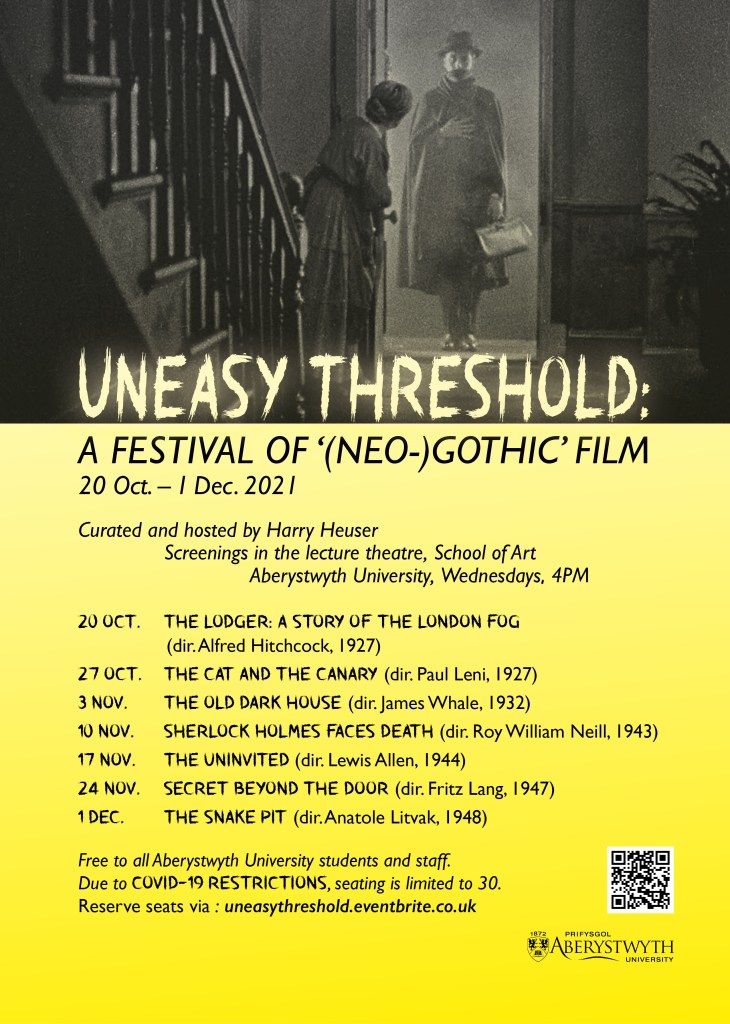
Just what is ‘gothic’? And how useful is the term when loosely applied to products of visual culture, be it paintings, graphic novels, movies or the posters advertising them? Aside from denoting a literary genre and a style of architecture, in which usages I recommend setting it aside by making the ‘g’ upper case, the term ‘gothic,’ understood as a mode, can be demonstrated to take many shapes, transcend styles, media, cultures and periods.  It can also be demonstrated not make sense at all as a grab bag for too many contradictory and spurious notions many academics, to this day, would not want to be caught undead espousing.  Those are the views I take on and the potentialities I test out with students of my module Gothic Imagination at the School of Art, Aberystwyth University.

As the gothic cannot thrive being crammed into a series of seminars, let alone been exsanguinated or talked to death in academic lectures, I created an extracurricular festival of film screenings to explore the boundaries of the visual gothic beyond genre and style.  The fourth film in the chronologically arranged series, Sherlock Holmes Faces Death (1943), demonstrates that the gothic struggles to thrive as well when its sublime powers are expended in a game of wartime chess.

The fourth entry in a series of Universal B-movies that began in 1939, prior to the end of US isolationism, as feature films, Sherlock Holmes Faces Death is a formulaic whodunit in which the gothic is an accessory to crime fiction, and in which suspects, some more usual than others, are lined up like cardboard grotesques for deployment in a mock-Gothic extravaganza executed on a budget.

Now, as a lover of whodunits and epigrams, I do not object to formula or economics.  I can appreciate budget-regard even when I long for that rara avis.  For the gothic, however, a cocktail consisting in measures equal or otherwise of solvable mystery and final-solution mastery is a cup of hemlock. Granted, the attempt to serve it and make it palatable to the public creates a tension of intentions that may well give motion picture executives and censors nightmares.

I discuss such messaging mixers in the context of radio plays in a chapter of Immaterial Culture I titled “‘Until I know the thing I want to know’: Puzzles and Propaganda,” in which Holmes and Watson also feature.

After all, at the same time the pair set the world aright in twentieth-century wartime scenarios, Holmes and Watson continued to solve crime in the gaslit alleyways of late-Victorian and Edwardian London, or suitably caliginous settings elsewhere in the British Isles, in pastiches in which Basil Rathbone and Nigel Bruce were heard on the New Adventures of Sherlock Holmes radio program that aired in the US at the same time:

As Sherlock Holmes director Glenhall Taylor recalled, the series was one of several sponsored programs whose “services were requested by the War Department.”  The charms of an imagined past were to yield to visible demonstrations of the responsibilities broadcasters and audiences shared in the shaping of the future.  To promote the sale of defense bonds during the War Loan Drives, Bruce and co-star Basil Rathbone appeared in “special theatrical performances,” live broadcasts to which “admission was gained solely through the purchase of bonds.”  (Heuser, Immaterial Culture 189)

To be sure, Sherlock Holmes Faces Death is less overtly propagandist than the previous three entries in Universal’s film series, all of which are anti-fascist spy thrillers.  Adapted, albeit freely, from a story by their creator, Sir Arthur Conan Doyle, the case they took on subsequently recalled the titular detective and his faithful sidekick from Washington, DC, and released them back into their fog-shrouded habitat in and for which they had been conceived.

And yet, whatever the setting, in motion pictures Holmes and Watson continued to face adversaries that were recognisably anti-democratic – stand-ins for the leaders of the Axis.  The villain of Sherlock Holmes Faces Death, diagnosed as egomaniacal by Holmes, is no exception. 

Much of the action of Sherlock Holmes Faces Death takes place in an ancestral pile that has been temporarily converted into a convalescent home for wounded soldiers.  Those inmates may have their idiosyncrasies, as all flat characters do, but, to serve their purpose in a piece of propaganda, they cannot truly be plotting murder, unless there are exposed as phoneys, in which case the reassurances of wartime service honored and government assistance rendered would be called into question.  

The unequivocal messages the Sherlock Holmes films were expected to spread in wartime did not allow for such murky developments.  A post-war noir thriller might sink its teeth into corruption; but the Sherlock Holmes series did not exhibit such fangs.

Variety thought this entry ‘obvious stuff.’ Less obvious to me, reading Variety, was
how much Ella Fitzgerald contributed to the success of the film at the box office.

Nor could the recovering soldiers be shown to be so mentally unstable as to kill without motive; according to the convention of whodunits, even serial killers like Christie’s Mr. ABC follow a certain logic that can be ascertained.  The heiress of Musgrave Manor may be momentarily distraught, the butler may be exposed as an unstable drunkard – but the soldiers, whatever horrors and shocks they endured on the battlefield, can only be moderately muddled.

Most of the recovering servicemen – in their fear of unwrapped parcels or their fancy for knitting – are called upon to provide comic relief, bathos being a key strategy of the domesticated gothic. In the Sherlock Holmes series, that is a part generally allotted to Dr. Watson, a role he performs even in this particular installment, in which his expertise as a man of medicine is put to use for the war effort. Inspector Lestrade serves a similar purpose, which is probably what made the ridiculing of military personnel seem less objectionable to sponsors, as it made them look fairly inconsequential to the crime caper unfolding. Aligning those men with Watson and Lestrade assists in eliminating them from the start as potential suspects.

While missing legal documents and cryptic messages are certifiably Gothic tropes, the gothic atmosphere in Sherlock Holmes Faces Death is fairly grafted on the proceedings with the aid of visuals. There are genre Gothic trimmings aplenty in – secret passages, a bolt of lightning striking a hollow suit of armor, and pet raven assuming the role of harbinger of death – but there is no real sense of menace as, guided by the infallibly capable hands of Sherlock Holmes, we negotiate with relative ease the potentially treacherous territory of a mansion as makeshift asylum and contested castle.

The climax, which tries to cast doubt as to Holmes’s perspicacity, plays out in a dimly lit cellar. It is here that the gothic could potentially take hold if the plot had not preemptively diffused the dangerous situation hinted at in the film’s title. The trap for the killer below has already been laid above-ground on the newly polished surface of a giant chessboard, in a display of strategy choreographed by Holmes himself. By the time the game moves underground, it is no longer afoot; rather, it is fairly limping along.

Gothic and propaganda can mix; genre Gothic fiction often served political purposes. Gothic and whodunit are less readily reconciled. Although John Dickson Carr tried hard to make that happen, often in an antiquarian sort of way, the Victorian Sensation novelists and the had-I-but-known school of crime writers come closer to achieving that.  But the handling of all three of those form or raisons d’être for writing – Gothic, whodunit and propaganda – by the jugglers employed here, at least, is not a formula designed to make the most of mystery and suspense. As I concluded in my discussion of the “identity crisis” of the wartime radio thriller, “propagandist work was complicated by the challenge of puzzling and prompting the audience, of distracting and instructing at once.”

Sherlock Holmes faces death, all right, but the demise he encounters is that of the gothic spirit.

“Uneasy Threshold”: The Old Dark House (1932), “wildest Wales” and the Benighted Kingdom

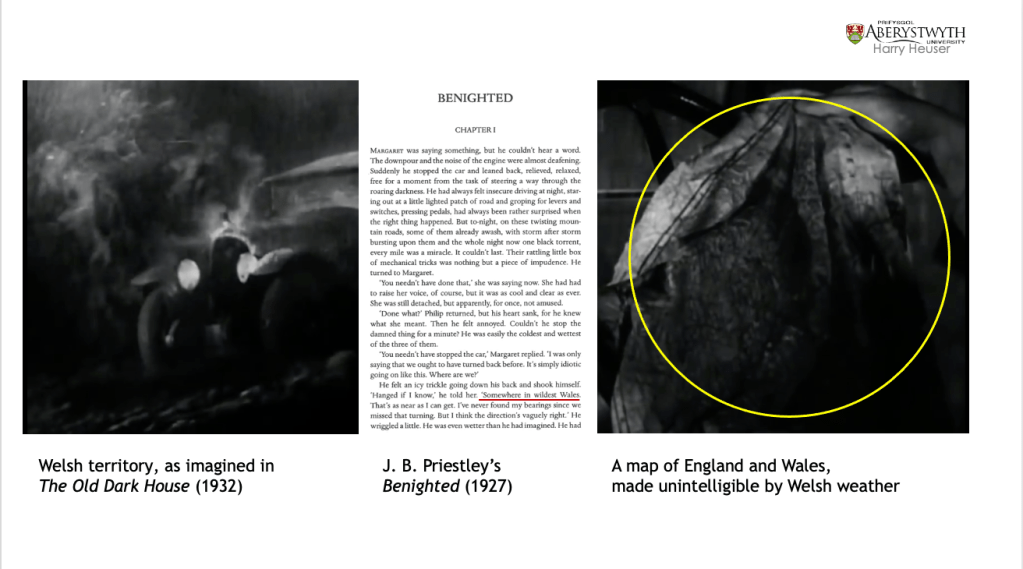
Much has been said about the titular edifice of Universal Studio’s 1932 melodrama The Old Dark House, the third in the series of films I am screening as part of my Gothic Imagination module at Aberystwyth University.  Directed by the queer English Great War veteran James Whale, and adapted from J. B. Priestley’s 1927 novel BenightedThe Old Dark House is often argued to be a commentary on Imperial Britain during the so-called interwar years (that is, the period between the two World Wars, Britain having been involved in plenty of other international conflicts besides): an ancient but crumbling family home – run by aging and morally corrupt imbeciles and cut off from the world by water.  It has been called, more than once, a “metaphor for … England.”

And yet, the story is not set England but in Wales, and the novel and film alike exploit and perpetuate the stereotypes of what, presumably, constitutes Wales and sets it apart from neighboring England: the wild, the uncivilised, the superstitious and unenlightened.  Wales, according to Priestley and Whale, is gothic territory.  It is the stuff of romance – or the English definition of romance – meaning that when the English want to go primitive, they think Wales.

Here is what the dreamer Penderel, himself a war veteran, says about Wales as he is being driven around in his friend’s motorcar one dark and dismal night:

I don’t want to go to Shrewsbury.  I don’t particularly want to go anywhere.  Something might happen here, and nothing ever happens in Shrewsbury, and nothing much on the other side of Shrewsbury.  But here there’s always a chance.

The Hollywood ending aside, the film is remarkably faithful to the novel, retaining much of Priestley’s dialogue.  While I am not sure just how many US American viewers back then would have understood the reference to the border that Shrewsbury represents, both Priestley and Whale would have known that, when the name “Shrewsbury” is dropped, the meaning “borderline” is implied.  Arriving at Shrewsbury – and this is the party’s intention – means traversing the Welsh Bridge over the Severn and arriving back in England.

The party in question – Penderel and his friends, the married and bickering couple Margaret and Philip – has lost its way in what Priestley lets Philip describe as “wildest Wales.”  The colonial attitudes toward Wales as both enchanted and benighted – as a place where there is ‘always a chance’ – the chance of an improvement in infrastructure excepting – are at the heart of this modally gothic narrative.

When the drunkard Welsh butler Morgan opens the door upon their unannounced arrival, he “produce[s] from somewhere at the back of his throat, a queer gurgling sound” that Penderel cannot translate.  Priestley tells us that “Penderel knew no Welsh.”  And yet, he says with confidence, in the book and film version alike, that “Even Welsh out not to sound like that; it was as if a lump of earth had tried to make a remark.”

Wales, to be sure, was just that to England, or many in England, a mute lump of Earth to be exploited for its resources.  It is not Wales that is gothic – or Gothic – but the perspective of the English that, fascinating as they may be with the wildness of Wales – impose their views on the nation they invade like “travellers in a foreign country,” as Priestley has Penderel see it.

Morgan, as we soon learn, cannot communicate in any spoken language.  He is a personification of Wales infantilised, gesturing like “some prehistoric monster.”  Wales, the source of mined ore – of coal and slate and lead, silver and gold – as well as Water, was often seen as little more than potential to be unearthed and funnelled for the benefit of England. The tradition was deemed to be expendable.

In The Old Dark House, as in Benighted, the nightmare vision makes way for daylight.  What we experienced was a Phantasmagoria staged by the visiting English.  The travelers depart, whether enlightened by what they experienced or just glad to have survived it.  The perspective of the hosts is not considered.

Hollywood would return to a fairy-tale Wales in The Wolf Man a decade later, in which Welsh landscape and culture, rendered unrecognisable, become the other when England was seen as the real, the upholder of values, in its fight against fascism.  To this day, visitors prefer to be enchanted by Wales, an old dark house whose perceived darkness is to a large extent a product of an English or Anglo-American imagination.

“Uneasy Threshold”: The Cat and the Canary (1927), Mammy Pleasant and the Outsider Inside

Nothing is innately trifling.  As I put it once, when I had the nerve to make a public display – in a museum gallery, no less – of the mass-produced ephemera I collect, ‘Trivia is knowledge we refuse the potential to matter.’  Now, some products of culture are more resistant than others to our realization of them as worth more than a fleeting glance, if that.  Exerting the effort to make them matter may feel downright perverse when there are claimed to be so many more deserving candidates for appreciation around.

When looking out for something to look into, I invariably draw on my own sense of otherness, of queerness.  It is not altogether by choice that I am drawn to the presumed irrelevant.  My perceived marginality is both the effect and the cause of my attraction to the margins.  What matters – and according to whom – is always worth questioning.  That is why I created Gothic Imagination, an alternative art history course I teach at Aberystwyth University.

To augment the weekly lectures and seminars, I created a series of film screenings for my students further to explore the territories of the visual ‘gothic’ beyond literary genre Gothic and the Gothic as an architectural style.  The second film in the chronologically arranged series, The Cat and the Canary (1927), is, for all its technical and cinematographic achievements, a rather undemanding old chestnut.  In part, such a view of it is owing to our belatedness of catching up with it, now that much of it strikes us as a grab bag of narrative clichés.

Well, those clichés were up for grabs even back in 1927, as the film draws on its audience’s familiarity with murder mysteries and stage melodramas.  Like Seven Keys to Baldpate before it, The Cat and the Canary is parodic and self-reflexive.  It play with conventions and our awareness, even our weariness, of them.  The Cat got our tongue firmly in cheek; and as much as we may feel sticking it out at the derivative claptrap to which we are subjected, we are encouraged to appreciate that the film anticipates our response, that it is one step ahead, dangling our tongue cheekily in front of us like a carrot intended to keep us playing along.

Is it only a single step ahead? Ahead of what? Is it ahead, retro or perhaps even reactionary? The Cat and the Canary is postmodern before there was a word for it.  Like any adaptation of a text I have not caught up with, it also makes me wonder just how what we get to see has evolved and how the film, in addition to interpreting its source material cinematically, questions, edits and revises that material as well.

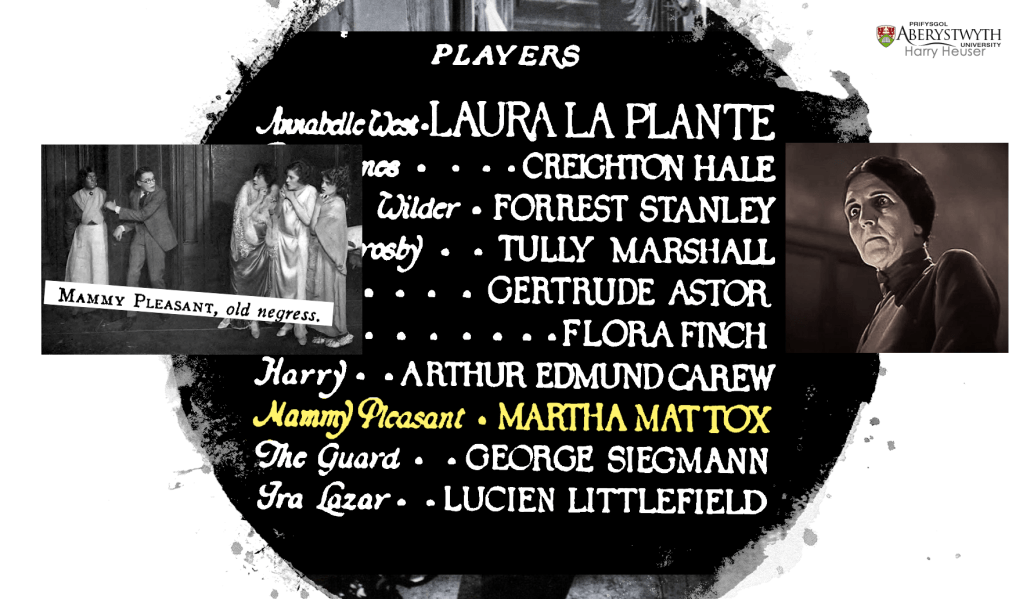
One revision draws attention to itself in the credits – and it made me aware of the consequences the seemingly inconsequential can have.  I am referring to the character Mammy Pleasant, a housekeeper played in the film by the scene-stealing Martha Mattox.  Given that The Cat and the Canary was released in the same year that The Jazz Singer stridently hammered a sonic nail in the coffin of silent film – at times simply by dragging said nail screechingly across the surface of an eloquent body of work shaped over a quarter of a century – the reference to the ‘Mammy’ legend stood out like a discordant note.

A slide from my introduction to the screening

What is ‘Mammy’ about Mammy Pleasant, particularly when the role is performed by a white female actor? The 1922 stage melodrama by John Willard, who also acted in the play on which the film is based, describes the character as an ‘old negress.’  Not that Blanche Friderici, who originated the part on the stage, was black.  She performed it in blackface.  

As The Jazz Singer and other early sound films such as the ‘Amos ‘n’ Andy’ vehicle Check and Double Check (1930), blackface and minstrel shows were very much part of Western popular culture at the time, and they were not effectively challenged – that is, were not permitted effectively to challenge – until decades later.

And yet, the film does not partake of that tradition, retaining the character’s name only.  In the play, Mammy Pleasant is a servant who has gained enough independence to choose whether or not to serve the future heir to the fortune of her deceased employer, as is clear from this exchange with the family lawyer, Roger Crosby, prior to the reading of the will:

Crosby.  Six! All the surviving relatives.  By the way—Mammy—your job as guardian of this house is up to-night.  What are you going to do?

Mammy.  It all depends.  If I like the new heirs—I stay here.  If I don’t—I goes back to the West Indies.

There is no such exchange in the film, and the ethnicity of Mammy Pleasant is not made central to the characterisation, which in the play is rooted in stereotypes surrounding superstitions to be rooted out in the act of ratiocination.  The Cat and the Canary is, after all, not a Gothic romance but a whodunit in which weird goings-on are shown to have a logical, albeit preposterous, explanation.  

The name Mammy Pleasant, in Willard’s play at least, carries with it a reference to an actual person – the businesswoman and abolitionist Mary Ellen Pleasant, who, by passing as white, managed to become the first African American millionaire.

In the stage play, produced nearly two decades after Pleasant’s death in 1904, the reference is facetious and derogatory.  Mary Ellen Pleasant, who lost the fortune she had made and shared as an activist, and whose character was destroyed when her passing as a white cook and landlady was exposed, is misremembered in the film as a not altogether trustworthy and slightly threatening outsider operating on the inside of a dead white millionaire’s mansion.

Why did the reference remain? How many viewers back in 1927 would have recognised it as a reference to Mary Ellen Pleasant? And how many would have found comic relief in what might have been some sort of white revenge fantasy that renders Pleasant odious while keeping her in her supposed place?

It is a gothic reading, as opposed to a reading of the gothic, that refuses to privilege the center and, imagining alternatives, lets the canary chase the cat for a change.  An unlikely scenario, to be sure; but to expose what is cultural it is useful to conjure what is unnatural.

“Uneasy Threshold”: The Lodger (1927), Trespassing and the Unhomely

I am not an academic.  I am a human being.  That’s not just me misquoting The Elephant Man.  It is a cri de cœur expressive of what is at the core of my identity as a creative person who happens to have transmogrified into an art history lecturer. To interrogate what that even means, I teach “Gothic Imagination” at the School of Art, Aberystwyth University. 

As part of that class, I present an extracurricular series of film screenings exploring the boundaries of the ‘gothic’ beyond the furnishings of the genre ‘Gothic.’  That ‘gothic’ is a term so broadly applied and ill-defined as to render it practically useless is a by now thoroughly predictable way of opening a debate about its practical uses.  Then again, the gothic has little to do to with practicalities.  

I have no intention to make the term, “salonfähig,” that is, reverting here to my native German, to make it acceptable or viable in an academic setting.  Rather, I use the word, which I am applying to visual culture instead of literature, to contest progress or avant-garde narratives traditionally espoused by academies in order to suggest alternative histories and alternatives to the teaching of art history.  Attention to the popular, presumably lesser arts is essential to this strategy.

The first series of screenings, coinciding with my previous iteration of “Gothic Imagination,” was titled “Treacherous Territories.” The phrase was meant to capture that challenge of defining and the dangers of inserting a mutable term such as ‘gothic’ into the lecture theaters and seminar rooms that cannot quite accommodate, let alone confine it. 

The current series, “Uneasy Threshold,” continues that playful investigation.  What, for instance, carries a mystery or a romance over the threshold of ‘gothic’? What is that threshold? And what is the ‘gothic’ interior – the environment in which ‘gothic’ may be contained both as a subject for discussion and as an experience to be had by the viewer of, say, a crime drama, a thriller, a film noir or a horror movie?

As a literary genre, the Gothic began in and with a house – in Strawberry Hill and with the Castle of Otranto, both conceived by Horace Walpole long before Frankenstein, Jekyll/Hyde and Dracula came onto the scene.  Those names are on the letter box of the Gothic mansion of our imagination, and I do not mean to evict their bearers; but might there be room as well – be it a closet, a cellar or a boudoir – for a few hundred other, less usual suspects, such as the title character of The Lodger (1927)?

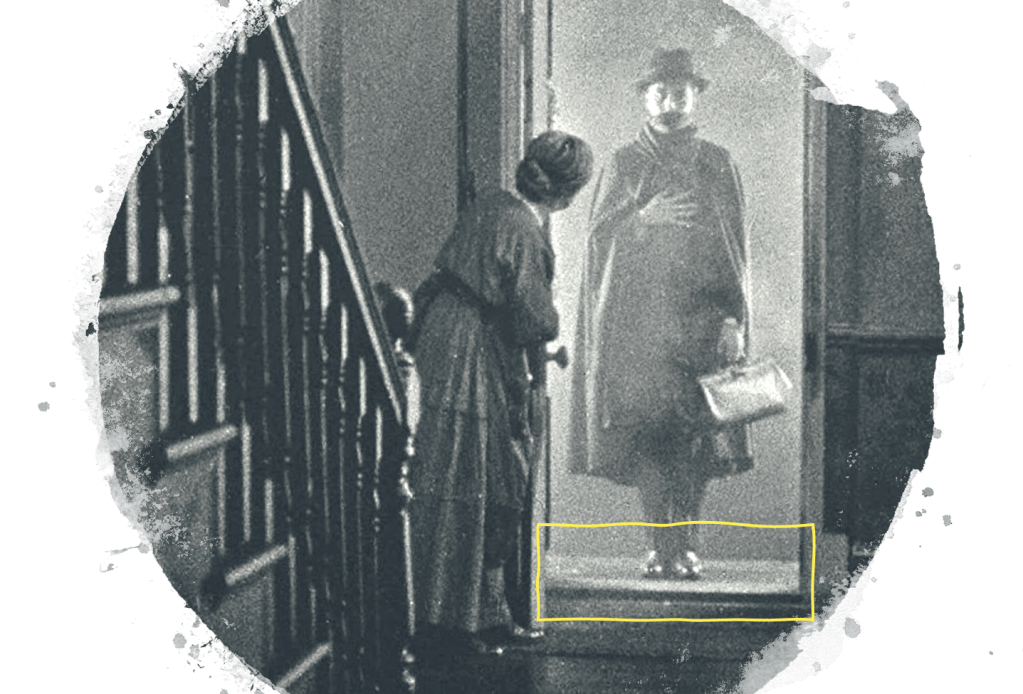
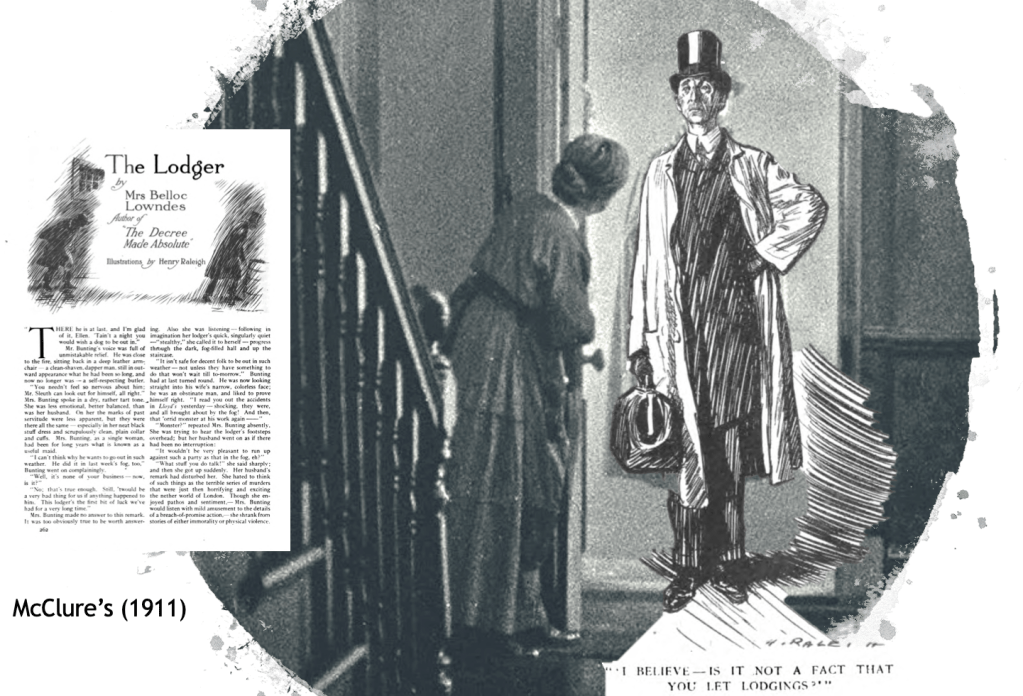
The Lodger insists on moving in on the party assembled at the Gothic castle, just as the Lodger – who may or may not be a serial killer called The Avenger – emerges out of the fog. edges himself into the home of the Buntings, and comes to preoccupy their thoughts and nightmares.  Invited, perhaps, but deemed suspect or queer all the same.

When the Lodger first made his appearance, in 1911, in a short story by Marie Belloc Lowndes, the figure was already lodged in the collective consciousness of urban dwellers who, like the author, were old enough to recall the Whitechapel Murders of 1888 or else were raised with the legend of Jack the Ripper, an alternative to a nursery rhyme all the more terrifying for having neither rhyme nor reason.

The Lodger transforms the story, which Belloc Lowndes turned into a novel, by pouring more sex into the mix.  That the layered cake did not quite rise to Hitchcock’s satisfaction was, legend has it, due to the casting of Ivor Novello in the title role: a queer Welsh matinee idol who, Hitchcock argued, was not allowed to get away with murder but was to be pronounced blameless by virtue of his status as a star. 

Whether or not that is the true reason for the direction the movie adaptation takes, it does not make the story any less intriguing – or gothic.

The Lodger is the story of a home that becomes “unhomely” – German for “uncanny.”  The lodger is no architect or bricklayer; rather, he transforms the dynamics of the group of people dwelling in the house he enters.  Blameless he may be, but he is an Avenger all the same, as Sanford Schwartz points out in “To-Night ‘Golden Curls’: Murder and Mimesis in Hitchcock’s The Lodger” – not the killer, but the victim of the killer avenging her death, a victim-turned-vigilante who, misunderstood, dreaded and feared, becomes the subject of her other lover’s revenge. 

 It is the other, ostensibly sane and safe lover, a police officer, who trespasses – who abuses his power – to trap the innocent man who threatens his supremacy as a prospective husband. The handcuffs he suits to his own pursuits prove harmful to his lover’s trust and nearly cause the death of his rival even after that rival is proven innocent of crime.

The Lodger is gothic as James’s Hogg’s The Private Memoirs and Confessions of a Justified Sinner (1824) is Gothic.  It is a story of injustice and sanctioned tyranny.   Like Frankenstein’s creature, the Lodger is hunted and tormented. Law, reason and morals are being questioned; and the pillars of civilisation are proven to be unsafe as houses.

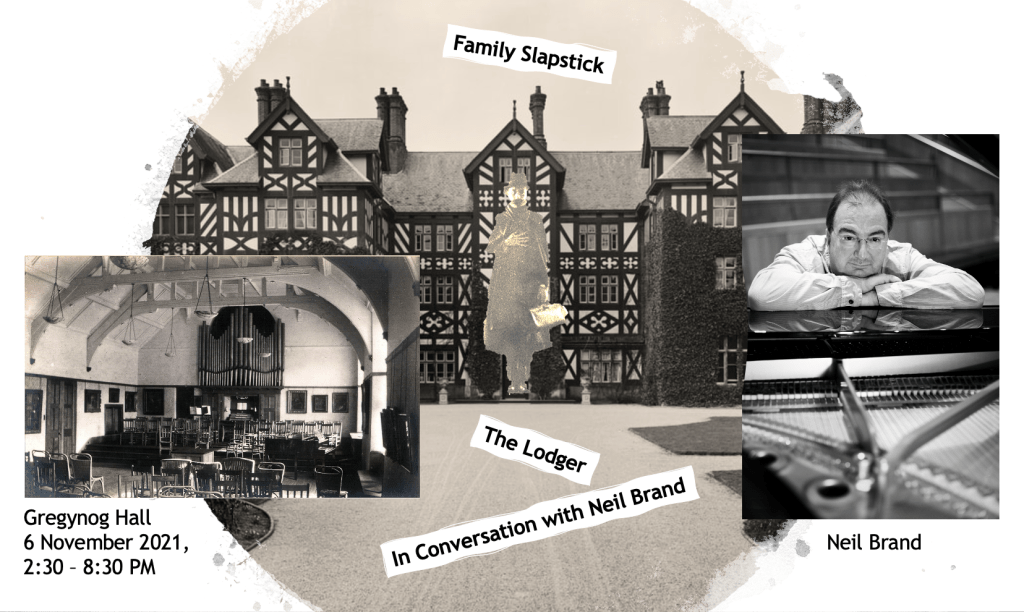
The next time I am (re)viewing The Lodger, the film will be accompanied by Neil Brand at Gregynog Hall, 6 Nov. 2021, when I shall be in conversation with the playwright-composer about silent film music and the language of pre-talkie cinema.

Marsh, Not Mellow: A Clutch of Constables (1968) and a Pang of Conscience

“We are not a starry-eyed lot.”

Mystery-and-detective fiction, in Britain at least, has been experiencing a decided revival since the mid 2010s, in part owing to – and evidenced by – the re-release of so-called golden-age whodunits by the British Library.  What the public’s readiness to soak up all that blood of yesteryear might tell us about the mores of the present day I shall leave to sociologists to unravel.  I, for one, welcomed that reopening of landmark trials and half-forgotten cases, not only as a chance at armchair detection – especially during pandemic times standing eerily still – but as an opportunity to reflect on my murderous past by returning to those crime scenes in middle age, knowing full well and being quite relieved that, by catching up, I could never go home again to what did not feel like home to begin with.  

That said, picking up the clues and piecing together the puzzle we are to ourselves, I feel a queer consistency – or consistent queerness – at the racing, bleeding or prematurely failing heart of it all.

My transition from children’s literature to ostensibly grown-up fiction did not happen via the young adult section of a lending library.  Fictions about growing up rarely spoke to me, as, back then, they were largely silent about desires that, while no longer criminalized, were deemed unfit for titles on general display.

Murder mysteries, in their indiscriminate pronouncements of death sentences, were reassuring in that respect.  Anyone could be a suspect or victim, and eventually the act of victimization would be disclosed.  Murder, at least, will out.  The most formulaic mysteries were the most agreeable to me.  I did not care for social realism that did not match my felt reality.  Agatha Christie whodunits, in particular, I appreciated for the perfunctory relentlessness of their nursery rhyme catechism in counting down and categorical settling of accounts.

Returning now to detective fiction via some of Christie’s notable but lesser-known contemporary competitors, I look for and find a renewed relevance.  Ngaio Marsh’s Clutch of Constables (1968), a copy of which I spotted in a local charity shop, makes considerable efforts to encourage such a reassessment. 

To begin with, those Constables referred to in the title are not officers of the law: they are patches of the outdoors featured in landscape paintings by the artist of the same name.  I would not have been alive to Marsh’s wordplay that all those years ago, when I was reading A Clutch of Constables in a German translation, removed from the culture in which they were produced and of which they speak.  To be sure, the German title of Marsh’s mystery – Mord auf dem Fluss – is so generic as to leave neither a hint of its origins nor a trace in my memory; I had to consult an old diary to discover that I had indeed read it some thirty-five years earlier.  

Significantly, the Constables in question are not the real thing – and, as I know now, being a reader and writer of art’s histories, even the real thing was not a true picture of parts of Britain but a commentary on changing times.  The same can be said about A Clutch of Constables.

The action of Marsh’s novel takes place aboard the “pleasure-craft Zodiac” as it leisurely cruises on a meandering river.  “For Five Days you Step out of Time,” the operators promise in their advertising – but there is no sidestepping the sign of the times.  And however picturesque the scenery, the river has not escaped pollution, with “detergent foam” muddying the waters and our image of an England steeped in history and yet somehow untouched by it.  Want your murders “cozy”? No soap, says Marsh.

By the time Clutch of Constables was published, Marsh had been in the guessing game for decades, and the whodunit was well past its prime.  Her aim, clearly, was to make her later work resonate with a new generation of mystery readers while remaining within the established boundaries of the genre.

What caught my attention was the self-consciousness with which Marsh’s mystery, for all its adroit plotting, reflected on its grappling with social relevance.  Marsh’s portrayal of two American, er, tourists, at once conservative and conniving, both reflects and reinforces changing attitudes towards the United States during the Vietnam War.  One of the characters, the surgeon Doctor Natouche – black and British – is the subject of harassment, stereotyping and suspicion.  And while readers are not encouraged altogether to rule out his guilt, those who judge him based on the color of his skin – the visiting Americans among them – are proven wrong both morally and intellectually.  

Marsh’s narrative also enables the spouse of her series detective, Inspector Alleyn, to assume center stage.  Agatha “Troy” Alleyn is an exhibiting artist and an astute observer reporting from the scene of the crime.  Even though, eventually, she is unceremoniously dismissed so her husband can take over and solve the crime, that position is justified by Marsh, and a reference to a popular franchise character serves as a reminder that latest developments in crime fiction are far from advanced: “In the Force our wives are not called upon to serve in female James-Bondage and I imagine most of you would agree that any notion of their involvement in our work would be outlandish, ludicrous and extremely unpalatable.”

In A Clutch of Constables, Marsh was making a plea for whodunits as a force for good, capable of making a difference by exposing prejudices rooted in the widely held but erroneous notion of a homogenous British society.  Take this passage, for instance, in which Inspector Alleyn – who is also an educator in and of the police force – reflects on the task of detection:

The moral is: that it takes all sorts to make a thoroughly bad lot and it sometimes takes a conscientious police officer quite a long time to realise this simple fact of unsavoury life.  You can’t type criminals. 

Detective fiction need not be removed from the lives and causes that matter, Marsh seems to say, anticipating the debates of the present day.  Taking the policing genre to task, A Clutch of Constables releases it from the grasp of those clinging to the false memory of a none-too-golden past.  “We are not a starry-eyed lot,” Alleyn insists:

But at the risk of getting right off the track – a most undesirable proceeding – I would like to say this.  You won’t be any the worse at your job if you can keep your humanity.  If you lose it altogether you’ll be, in my opinion, better out of the Force because with it you’ll have lost your sense of values and that’s a dire thing to befall any policeman.

That “dire thing” may also “befall” the writer of cleverly crafted whodunits.  To avoid such failings, Marsh not only communicates her values but, in those asides, advises her peers to not to let go of their fellow feeling at the profitable drop of another clutch of lifeless bodies.

“There [still] ain’t no sense to nothin’”: A Wayward Text Comes Home

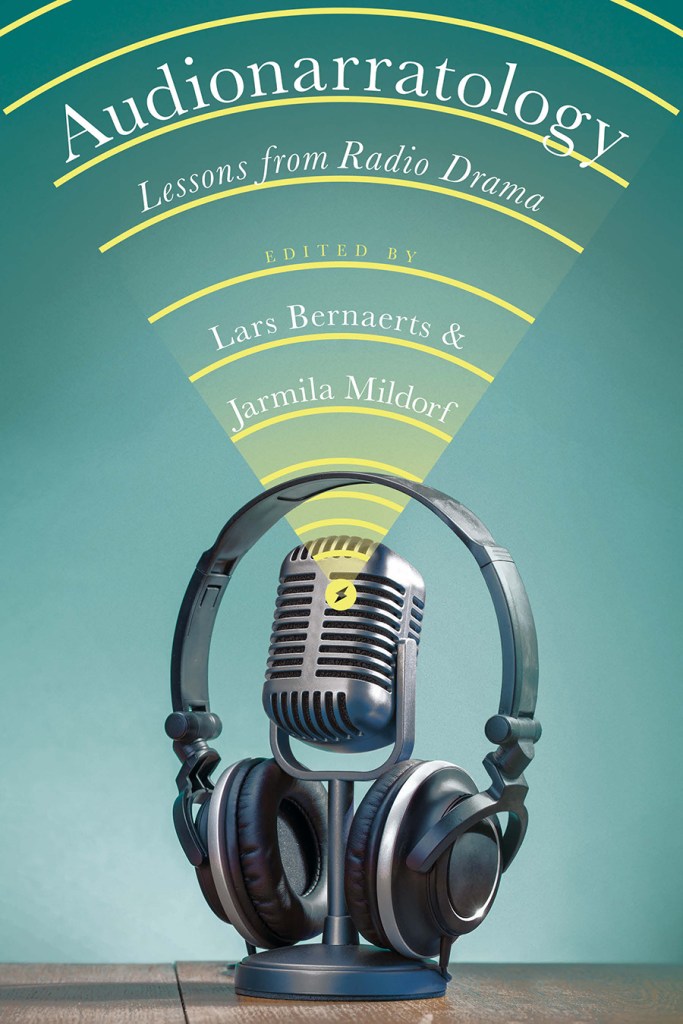
“Home at last,” I could almost hear myself sigh as, out of the narrow slit in our front door, I yanked the packet arriving today.  Bearing my name, as few pieces of mail of any consequence or sustenance do nowadays, it contained the volume Audionarratology: Lessons from Radio Drama, to which I had been invited a few years ago to contribute a chapter.  The book was published in July 2021 by Ohio State University, a press renowned for its contribution to the evolving discourse on narratology.  

The titular neologism suggests that an engagement with aural storytelling is proposed as one way of broadening a field that has enriched the interpretation not only of literature but also of visual culture.  Whether such aural storytelling should be subsumed under the rubric ‘radio drama’ is something I debated in my study Immaterial Culture, for which I settled on the term ‘radio play,’ as, I argued, the fictions written for radio production and transmission are hybrids whose potentialities remained underexplored and whose contribution to the arts underappreciated in part due to the alignment of such plays with works for stage and screen.  Nor am I sure that, by adding the prefix, “audionarratology” will be regarded as a subgroup of narratology – which would defeat the purpose of broadening said field.

To the question what “Lessons” may be learned from plays for radio, or from our playing with them, the quotation that serves as title of my essay provides a serviceable response: “There ain’t no sense to nothin.”  The line is uttered by one of the characters in I Love a Mystery, the thriller serial I discuss – and it is expressive of the bewilderment I felt when first I entered the world created in the 1930s and 1940s by the US American playwright-producer Carlton E. Morse.  My cumbersome subtitle is meant to suggest how I responded to the task of making sense not only of the play but also of the field in which I was asked to position it: “Serial Storytelling, Radio-Consciousness and the Gothic of Audition.”

By labelling ‘gothic’ not simply the play but my experience of it, I aim to bring to academic discourse my feeling of unease, a sense of misgivings about explaining away what drew me in to begin with, the lack of vocabulary with which adequately to describe my experience of listening, the anxiety of having to theorise within the uncertain boundaries of a discourse that I sought to broaden instead of delimiting.

Throughout my experience with radio plays of the so-called golden age, I felt that, playing recording or streaming play, I had to audition belatedly for a position of listener but that I could never hear the plays as they were intended to be taken in – serially, via radio – during those days before the supremacy of television, the medium that shaped my childhood.

In the essay, I try to communicate what it feels like not knowing – not knowing the solution to a mystery, not quite knowing my place vis-à-vis the culture in which the play was produced or the research culture in which thriller programs such as I Love a Mystery are subjected to some theory and much neglect.  Instead of analysing a play, I ended up examining myself as a queer, English-as-second-language listener estranged from radio and alien to the everyday of my grandparent’s generation – never mind that my German grandfather fought on the Axis side while the US home front stayed tuned to news from the frontlines as much as it tuned in to thrillers and comedies that were hardly considered worthy of being paraded as the so-called forefront of modernism.  So, a measure of guilt enters into the mix of emotions with which I struggle to approach or sell such cultural products academically.

The resulting chapter is proposed as a muddle, not as a model – although its self-consciousness may be an encouragement to some who are struggling to straddle the line between their searching, uncertain selves and the construct of a scholarly identity.  Its failings and idiosyncrasies are no strategic efforts to fit in by playing the misfit or refitting the scene – they are proposed as candid reflection of my mystification.  

They also bespeak the fact that the essay, unfinished or not fully realised though it may seem, was a quarter century in the making.  It started out by twisting the dial of my stereo receiver and happening on Max Schmid’s ear-opening program The Golden Age of Radio on WBAI, New York, agonising whether to turn my newly discovered hobby into the subject of academic study, enrolling in David H. Richter’s course “The Rise of the Gothic” at CUNY, and by responding to the essay brief by exploring gothic radio plays and radio adaptations of Gothic literature.

Once I had decided to abandon my Victorian studies in favor of old-time radio, the essay was revised to become a chapter of my PhD study Etherized Victorians.  It was revisited but removed from Immaterial Culture as an outlier – the only longer reading of a play not based on a published script – during the process of negotiating the space allotted by the publisher.  It had a lingering if non-too-visible presence on my online journal broadcastellan as an experiment in interactive blogging, and it now appears in a volume devoted to a subject of which I had no concept when I started out all those years ago.

The draft, too, has gone through a long process of negotiation — of editing, cutting and rewriting – at some point of which the frankness of declaring myself to be among the “outsiders” of the discourse did not make the editors’ cut.

So, home the essay has come; but the home has changed, as has its dweller, a student of literature who transmogrified into an art historian with a sideline of aurality, and who now has to contend with tinnitus and hearing loss when listening out for clues to non-visual mysteries and, ever self-conscious, waits for his cue to account for the latest of his botches, or, worse still, to be met with silence.  Estrangement, uncertainty, and the misery of having to account for the state of being mesmerised by mysteries unsolved – such is the gothic of audition.

“Nance” Encounter: Herman Wouk’s Don’t Stop the Carnival (1965) as a Bad Date

This curated window at the Oxfam Bookstore, Aberystwyth, drew me in.

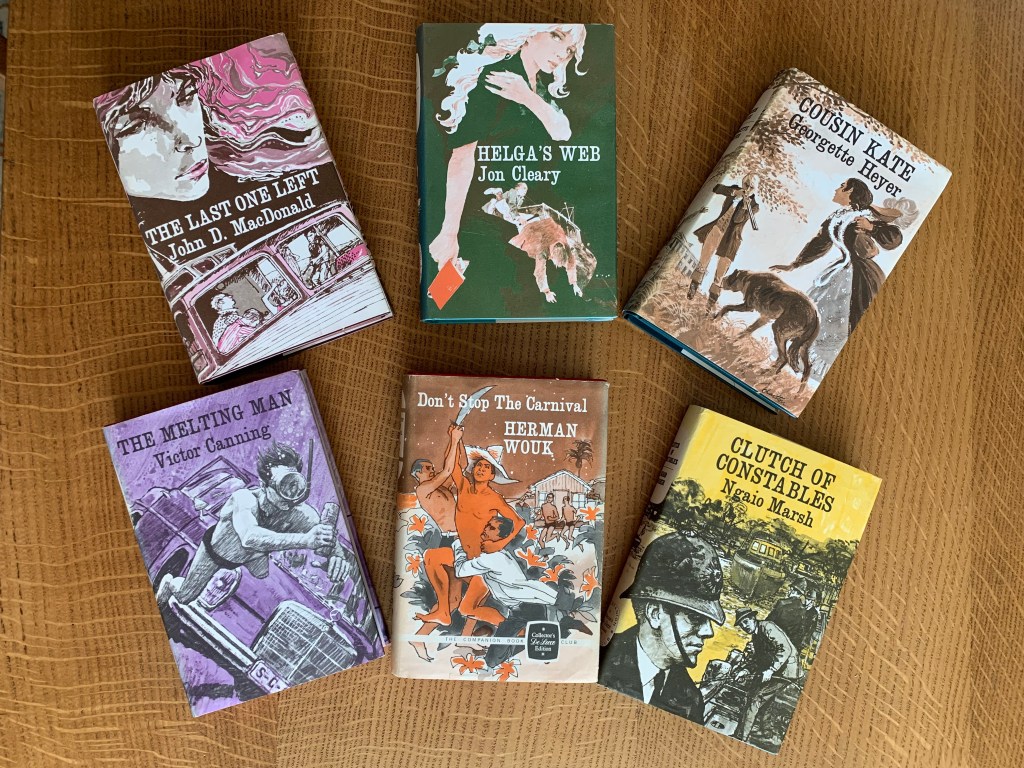
The themed window of our local Oxfam bookshop here in Aberystwyth was something to behold on that bright July afternoon.  A row of handsome, second-hand but well-preserved copies of once popular fiction beckoned, reminding me of the tag I had chosen for this blog devoted to unpopular culture upon its inception back in 2005: “Keeping up with the out-of-date.”

A novelist friend and avid reader, who had come from London for a visit, treated me to a volume of my choice.  Three of them, in fact, as the £5-for-three deal made it unnecessary to be quite so discriminating.  I passed up on erstwhile bestsellers by A. J. Cronin and Pearl S. Buck, both of whom had vanished from the display a day later, when I returned for another three titles (all six are pictured above).  My first choice, however, had been Herman Wouk’s Don’t Stop the Carnival (1965).

I remember picking up Wouk’s tome Youngblood Hawke (1962), in a German translation, from my parent’s sparse bookshelves.  My grandfather, likewise, was a Wouk reader, even though his chief interest lay in the writer’s Second World War subjects, to which Opa Heinrich, a former POW, could relate.  In my late teens, desultory though my readings were, I enjoyed Wouk’s earlier City Boy (1948) and Marjorie Morningstar (1955).

Volumes I recent additions to my bookshelf

My next encounter with Wouk’s writings dates from my years of graduate studies in New York.  I had decided to ditch Thomas Carlyle as a subject and instead write a PhD study on US radio plays.  Wouk, as I discussed here previously, had started as a radio writer or gagman.  He satirized the industry in Aurora Dawn (1947) and reflected on his experience it in his autobiographical novel Inside, Outside (1985).  From the latter I snatched the phrases “Hawkers of feces? Costermongers of shit?” – a reference to laxative commercials on the air – for the title of one of the chapters of Immaterial Culture to capture the dismissal of commercial radio as a legitimate literary forum by those who had written for broadcasting during the 1930s and 1940s but who gained prominence later as published writers and dramatists.

Long story short, I have a kind of casual relationship with Wouk as a writer, a relationship that at one point turned serious (or academic) due to my interest in radio.  So, when I spotted that copy of Don’t Stop the Carnival, an old book new to me, I felt inclined to get reacquainted.  It turned out to be a bad date.

Don’t Stop the Carnival is a story of middle age.  The action, of which there is plenty, is mainly set on an imaginary island in the Caribbean, anno 1959.  The novel relates the misadventures of a New Yorker – Norman Paperman – who falls in love with what strikes him as a tropical paradise and decides to take over a hotel, having had no prior experience either with the business or with life on a tropical island.  Complications abound, some less comical than others.

Paperman is a Mr. Blandings of sorts, a familiar figure in American fiction.  He’d rather lay an egg elsewhere than suffer his ‘disenchantment with Manhattan’ a day longer:

the climbing prices, the increasing crowds and dirt, the gloomy weather, the slow bad transportation, the growing hoodlumism, the political corruption, the mushrooming of office buildings that were rectilinear atrocities of glass, the hideous jams in the few good restaurants, the collapse of decent service even in the luxury hotels, the extortionist prices of tickets to hit shows and the staleness of those hits, and the unutterably narrow weary repetitiousness of the New York life in general, and above all the life of a minor parasite like a press agent.

Perhaps, as his name suggests, Norman is not to be looked at as man but as a page – scribbled on, rather than blank, over the course of nearly fifty years.  He may feel like turning over a new leaf – but his life is already scripted in ink that is indelible.  Don’t Stop the Carnival sets us up for its conservative moral: stick with what you know, stop kvetching, and don’t even think that the grass could be greener than in Central Park in May.

While it responds to the modernity of its day – to the threat of nuclear war and the growing doubt in the progress narrative of the 1950s – the novel nonetheless shelters in the makeshift of retrospection: it looks back at the end of the Eisenhower years from the vantage point of the violent end of the Kennedy presidency to reflect on the so-called modern liberalism of the early to mid-1960s.  

Was this choice of dating the action meant to suggest the datedness of the views expressed by the characters? What were the attitudes of the author toward race relations, civil rights and liberalism? In other words, what comments on the turmoil of the 1960s did Wouk make – or avoid making – by transporting back the readers of his day and dropping them off on an island that, for all its remoteness is nonetheless US territory, and that is about to be developed and exploited for its exoticism and natural resources?

The titular carnival is both figurative and metaphoric – an extended topsy-turvydom (or chaos) in which black mix and mate with white, queer live along straight folks, and Jews like Wouk’s protagonist Norman Paperman mingle with Catholics, Protestants, agnostics, pagans and atheists.  He encounters bad infrastructure, worse bureaucracy, and political corruption.  This island ain’t that different from Manhattan – which argues getting away from his former life to be futile and pointless.

The Carnival is not only shown to be a dead end but a deadly one.  In the final pages of the novel, two characters are killed in quick succession – one central to the narrative, the other – the decidedly other – being marginal.  The central one is Norman’s island fling, Iris Tramm, whom he knew as a celebrated actress two decades earlier and is surprised or reencounter, washed up but still alluring, as one of the guests in the hotel he decides to buy.  

The island carnival is exposed as a tropical fever that means either death or cure – a cure for an uncommon warmth of non-traditional bonds and realized desires.  Paperman recovers, and his understanding wife takes him “home.”  His lover, meanwhile, must first lose the companionship of her dog, and then, trashing Paperman’s car while trying to reunite with her wounded pet at a veterinarian’s, her life.  Was this the only out Wouk could conceive for a white woman who was the mistress of a black official who dared not to marry her?

It is the treatment of the marginal character of Hassim and his swift, unceremonious and unlamented disposal that lays bare Wouk’s fear of change: the antique dealer Hassim, introduced as a “rotund bald man” with a “bottom swaying like a woman’s,” who openly flirts with young men.  In fact, the island is awash with middle-class homosexuals of all ages.  Even Paperman’s hotel is pre-owned by a gay couple. And although he must have come across some of them in his former job as a Broadway press agent, Paperman is uneasy in their presence when he and Iris, his illicit love, visit an establishment frequented by gays:

Norman found the proprietor amusing, and he was enjoying the songs of his youth. But the Casa Encantada made him uneasy. Men were flirting with each other all around him; some were cuddling like teen-agers in a movie balcony. The boy in the pink shirt, biting his nails and constantly looking around in a scared way, sat at a small table with one of the rich pederasts from Signal Mountain, a pipe-smoking gray-haired man in tailored olive shirt and shorts, with young tan features carved by plastic surgery, and false teeth. Norman was glad when the proprietor finished a run of Noel Coward songs and left the piano, so that he and Iris could politely get out of the place.

Hassim is shot dead by a policeman, despite posing no risk and committing no crimes.  The killing, which occurs in Paperman’s hotel and bar, the Gull Reef, is described in few words and elicits less of a response than the stabbing of a dog a few pages before this incident near the close of the novel.

“As a matter of fact, […] I feel sorry for the poor bugger,” is the response to the death of  Hassim by one character, “munching on his thick-piled hamburger” not long after the killing.

“I’ve known thousands of those guys, and there’s no harm in ninety-nine out of a hundred of them. It’s just a sickness and it’s their own business.  Though gosh knows, when I was a kid working backstage, I sure got some surprises.  Yes ma’am, it was dam near worth my life to bend over and tie my shoelace, I tell you.” He laughed salaciously.  His once green face was burning to an odd bronze color like an American Indian’s, and he looked very relaxed and happy.  “Actually, Henny [who is Paperman’s wife], I almost hate to say this, but I think this thing’s going to prove a break for the Club.  I bet the nances stop coming to Gull Reef after this.”

Such views are unchallenged by the narrator and the main character, who decides to sell his business – to the man expressing those views, no less – and return to New York.  “People thought that this [his death] was a bit hard on Hassim,” the narrator sums, “but that the cop after all had only been doing his duty, and that one queer the less in the world was no grievous loss.”  Case closed. Business open as usual.

Clearly, queers like me were not considered by Wouk to be among his readers.  Targets, yes, but not target audiences.  Even the academic treatment of homosexuality – the suggestion that famous writers of the past, too, might have been homosexuals – is ridiculed in the novel, with one PhD student, the lover of Paperman’s teenage daughter, nearly drowning in the sea.  

Wouk, who died shortly before his 104th birthday in May 2019, lived beyond the middle age of Don’t Stop the Carnival for more than half a century.  I doubt that I shall make him a companion again on whatever is left of my journey.

Eyre Apparent: Adoption, Adaptation and the ‘orphan child of accepted literature’

The most recent item to enter my collection of ephemera is a somewhat tattered, unpublished radio script (pictured above).  It is held together by rusty staples that attest to the authenticity to which, as a cultural product, it cannot justly lay claim. I still do not know the first thing about it. When was it written? To whom was it sold? Was it ever produced?

Initial research online revealed at least that Hugh Lester, the writer claiming responsibility – or demanding credit – for the script, was by the late 1930s a known entity in the business of radio writing, with one of his adaptations (a fifteen-minute dramatisation of Guy de Maupassant’s story “The Necklace”) appearing in a volume titled Short Plays for Stage and Radio (1939).   Rather than wait to ascertain its parentage, I decided to adopt Lester’s brainchild after spotting it lingering in the virtual orphanage known as eBay, where the unwanted are put on display for those of us who might be enticed to give them a new home.

Getting it home – my present residence – proved a challenge.  After being dispatched from The Bronx, the script spent a few months in foster care – or a gap behind a sofa in my erstwhile abode in Manhattan – before my ex could finally be coaxed into shipping it to Wales.  I occasionally have eBay purchases from the US mailed to my former New York address to avoid added international postage; but the current pandemic is making it impractical to collect those items in person, given that I am obliged to forgo my visits to the old neighborhood this year.  I was itching to get my hands on those stapled sheets of paper, especially since I am once again teaching my undergraduate class (or module, in British parlance) in Adaptation, in which the particular story reworked by Lester features as a case study.

As its title declares, the item in question is a “Radio Serial in Three Half Hour Episodes” of Charlotte Brontë’s 1848 novel Jane Eyre.  It is easy for us to call Jane Eyre that now – a novel.  When it was first published, of course, it came before the public as an autobiography, the identity of its creator disguised (‘Edited by Currer Bell,’ the original title page read), leading to wild speculations as to its parentage.  An adaptation, on the other hand, proudly discloses its origins, and it builds a case for its right to exist by drawing attention to its illustrious ancestry, as Lester’s undated serialisation does:

Announcer: We take pride in presenting for your entertainment at the first chapter of a distinguished dramatisation of Charlotte Brontë’s world famous novel, Jane Eyre.

An interesting choice of phrasing, that: while the source is pronounced to be ‘world-famous,’ meaning popular, this further popularisation by radio is argued to be ‘distinguished,’ meaning, presumably, first-rate – unless ‘distinguished’ is meant to suggest that the child (the adaptation) can readily be told apart from the parent (source).  Is not Jane Eyre ‘distinguished,’ whereas the aim of radio serials, plays for a mass medium, is to be popular, if only temporarily? Clearly, Lester aimed in that announcement to elevate to an art the run-of-the-mill business of adaptation that was his line; and run-of-the-mill it certainly was, most or the time.

One expert on radio scripts, commenting in 1939, went so far as to protest that radio had ‘developed almost no writers,’ that it had ‘appropriated almost all of them, at least all of those who could tell a good story.’  The same commentator, Max Wylie – himself a former radio director of scripts and continuity at CBS – also called ‘radio writing’ the ‘orphan child of accepted literature.’ To him, most radio writing was no ‘radio’ writing at all, at least not ‘in the artistic and creative sense,’ but ‘an effort in translation’ – ‘a work of appropriation whose legitimacy depends upon the skill of its treatment but whose real existence depends upon the work of some able craftsman who quite likely never anticipated the electrical accident of the microphone.’

Instead of approaching adaptation in terms of fidelity – how close it is to its source – what should concern those of us who write about radio as a form is how far an adaptation (or translation, or dramatisation) needs to distance itself from its source so it can be adopted by the medium to which it is introduced.  However rare they may be, radio broadcasts such as “The War of the Worlds” have demonstrated that an adaptation can well be ‘radio writing’ – as long as it is suited to the medium in such a way that it becomes dependent on it for its effective delivery.  It needs to enter a new home where it can be felt to belong instead of being made to pay a visit, let alone be exploited for being of service.

Jane Eyre was adapted for US radio numerous times during the 1930s, ‘40s and early ‘50s.  The history of its publication echoing the story of its heroine and their fate in the twentieth century – Jane Eyre was apparently parentless.  Brontë concealed her identity so that Jane could have a life in print, or at least a better chance of having a happy and healthy one.  In the story, Jane must learn to be independent before the man who loves her can regain her trust – a man who, in turn, has to depend on her strength.  Similarly, Jane Eyre had to be separated from her mother, Charlotte Brontë, because she could not trust the male critics to accept her true parentage.

On the air, that parent, Charlotte Brontë, needs to be acknowledged so that an adaptation of Jane Eyre does not become an impostor; at the same time, the birth mother must be disowned so that Jane can become a child of the medium of which the parent had no notion – but which is nonetheless anticipated in the telepathic connection that, in the end, leads an adult and independent Jane back to Mr. Rochester, the lover who betrayed her and must earn her trust anew.

Lester’s three-part adaptation retains that psychic episode in Brontë’s story:

Rochester: (In agony.  Whispering through a long tube) Jane! Jane! I need you.  Come to me – come to me!

In radio broadcasting, ‘[w]hispering through a long tube’ can be made to suggest telephony and telepathy – and indeed the medium has the magic of equating both; the prosaic soundstage instruction revealing the trick makes clear, however, that the romance of radio is in the production, that, unlike a novel, a radio play cannot be equated with a script meant for performance.

Being three times as long as most radio adaptations, Lester’s script can give Jane some air to find herself and a home for herself.  And yet, like many other radio versions of the period, it depends so heavily on dramatisation as to deny Jane the chance of shaping her own story.  One scholar, Sylvère Monod has identified thirty passages in which the narrator of Jane Eyre Jane Eyre directly addresses the audience.  And yet, the most famous line of Brontë’s novel is missing from Lester’s script, just as it is absent in most adaptations: ‘Reader, I married him.’ How easily this could be translated into ‘listener’ – to resonate profoundly that most intimate of all mass media: the radio.

Lester, according to whose script plain Jane is ‘pretty,’ is not among the ‘distinguished’ plays of – or for – radio.  Exploiting its source, by then a copyright orphan, it fosters an attitude that persists to this day, despite my persistent efforts to suggest that it can be otherwise: that radio writing is the ‘orphan child of accepted literature.’