That’s No Lady. That’s an Executive: Robert Hardy Andrews’s Legend of a Lady (1949)

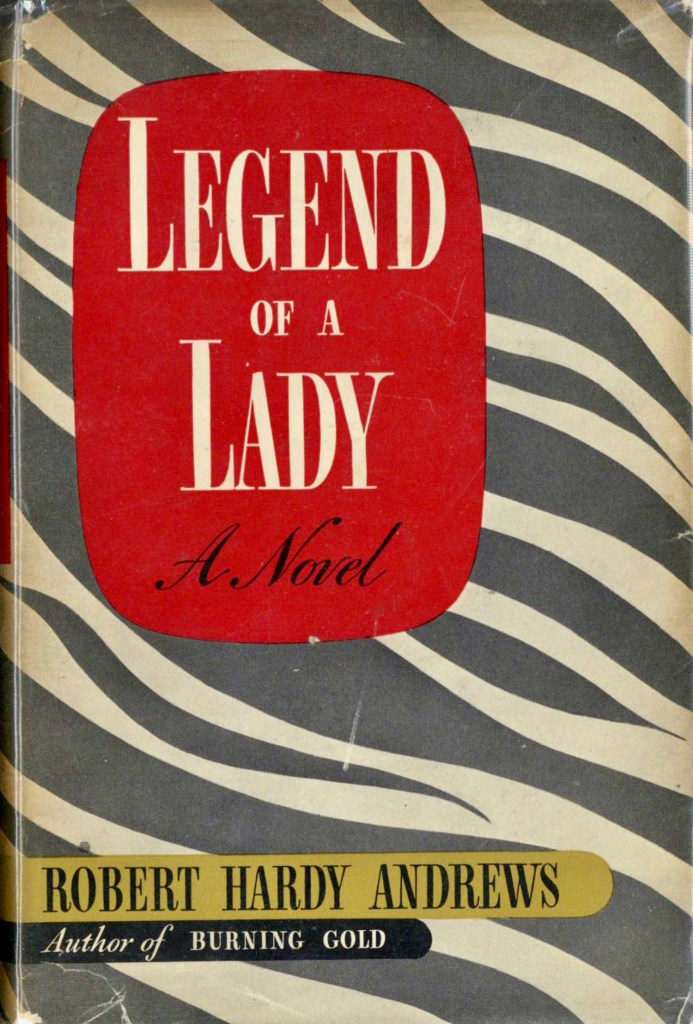
Dust jacket of my copy of Legend of a Lady, which I added to my library in June 2020

In โ€œโ€˜Hawkers of feces? Costermongers of shit?โ€™: Exits and Recantations,โ€ the final chapter of Immaterial Culture, I briefly discuss how creative talent working in the US broadcasting industry during the 1930s and 1940s tended to recall their experience upon closing the door to the world of radio in order to pursue careers they deemed more lofty and worthy.  Few had anything positive to say about that world, and their reminiscences range from ridicule to vitriol.

Within a year or two after the end of the Second World War, attacks on the radio industry became widespread and popular; most notable among them was The Hucksters, a novel by Frederic Wakeman, a former employee of the advertising agency Lord & Thomas.  Between 1937 and 1945, Wakeman had developed radio programs and sales campaigns for corporate sponsors, an experience that apparently convinced him to conclude there was โ€˜no need to caricature radio.  All you have to do,โ€™ the authorโ€™s fictional spokesperson sneers, โ€˜is listen to it.โ€™

Such โ€˜parting shots,โ€™ as I call them in Immaterial Culture, resonated with an audience that, after years of fighting and home front sacrifices, found it sobering that Democratic ideals, the Four Freedoms and the Pursuit of Happiness were being reduced to the right โ€“ and duty โ€“ to consume.  After a period of relative restraint, post-war radio went all out to spread such a message, until television took over and made that message stick with pictures showing the latest goods to get and guard against Communism.

Following โ€“ and no doubt encouraged by โ€“ the commercial success of The Hucksters, the soap opera writer Robert Hardy Andrews published Legend of a Lady, a novel set, like Wakemanโ€™s fictional exposรฉ, in the world of advertising.  Andrews probably calculated that like The Hucksters and owing to it Legend would be adapted for the screen, as his novel Windfall had been.

Unlike in The Hucksters, the industry setting is secondary in Legend of a Lady.  Andrews has less to say about radio than he has about women in the workforce.  And what he has to say on that subject the dust jacket duly proclaims: โ€˜Legend of a Lady is the story of pretty, fragile Rita Martin, who beneath her charming exterior is hell-bent for personal success and who tramples with small, well-shod feet on all who stand in her way.โ€™  The publisher insisted that โ€˜it would be hard to find a more interesting and appalling character.โ€™

I did not read the blurb beforehand, and, knowing little about the novel other than the milieu in which it is set, I was not quite prepared for the treatment the title character receives not only by the men around her but by the author. The Legend of the Lady, which I finished reading yesterday, thinking it might be just the stuff for a reboot of my blog, opens intriguingly, and with cinematic potential, as the Lady in question picks up โ€˜her famous white-enameled portable typewriter in small but strong handsโ€™ and throws it โ€˜through the glass in the office widow,โ€™ right down onto Madison Avenue, the artificial heart of the advertising industry.

This is Mad Women, I thought, and looked forward to learning, in flashback, how a โ€˜small but strongโ€™ female executive gets to weaponise a tool of the trade instead of dutifully sitting in front of it like so many stereotypical office gals.  Legend of a Lady is โ€˜appallingโ€™ indeed, reminding readers that dangerous women may be deceptively diminutive, that they are after the jobs held by their male counterparts, and that, rest assured, dear conservative reader, they will pay for it.  In the end, Rita Martin, a single mother trying to gain independence from her husband and making a living during the Great Depression, exists an office โ€˜she would never enter again.โ€™  Along the way, she loses everything โ€“spoiler alert โ€“ from her sanity to her son.

The blurb promises fireworks, but what Legend of a Lady delivers is arson.  It is intent on reducing to ashes the aspirational โ€˜legendโ€™ of women who aim to control their destiny in post-war America.  The world of soap opera writing and production serves as mere a backdrop to render such ambitions all the more misguided: soap operas are no more real than the claim that working for them is a meaningful goal.  As a writer of serials for mass consumption, Robert Hardy Andrews apparently felt threatened and emasculated working in a business in which women achieved some success in executive roles.  In a fiction in which men big and small suffer deaths and fates worth than that at the delicate hand of Rita Martin, Andrews created for himself a neo-romantic alter ego โ€“ the rude, nonchalant freelance writer Tay Crofton, who refuses to be dominated by a woman he would like to claim for himself but does not accept as a partner on her own terms, presumably because she cannot be entrusted with the power she succeeds in wresting from the men around her without as much as raising her voice.

Devoid of the trimmings and trappings of Hollywood storytelling, without glamor or camp, without gowns by Adrian or brows by Crawford, Legend of a Lady serves its misogyny straight up โ€“ but it couches its caution against โ€˜smallโ€™ women in spurious philosophy by claiming that, for men and women alike, there is life outside the proverbial squirrel cage that Andrews relentlessly rattles for his agonizing spin on the battle of the sexes.
A Nightโ€™s Wait: Hemingway, the Apocalypse and I

“Itโ€™s not the end of the world.”  How often do we utter those words, whether to calm ourselves or to dismiss the concerns of others.  Well, I never found anything calming about that expression.  It is the belittling by hyperbole that irks me.  We tend to judge the gravity of a situation by the magnitude of its physical manifestations rather than the depth of feelings it produces in the experiencer.  I, for one, have experienced the end of the world in early childhood; yet there is no evidence of an event having taken place, no trace of its existence save for the lachrymal salt on a crumpled pillow that, I suppose, was disposed of decades ago.  No surface trace, that is.

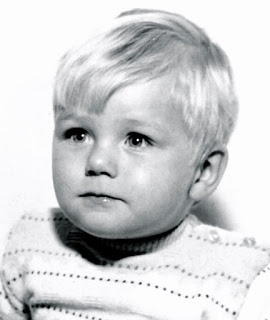
How am I looking? Is this an expression of trust, apprehension, or a questioning of portraiture as truth?

One evening, in a working-class flat in the grim sterility of the German industrial town I was expected to call home, I overheard my parents make mention of the apocalypse.  Someone had predicted that the world was going to end, and the date was set for the night to come. It was one of those doomsday prophecies that adults shrug off or subscribe to, depending on their intellect, faith and psychological make-up.  As a child, I had no recourse to experience.  I had no knowledge of having survived any number of doomsdays pronounced previously.  Nor did I yet doubt that adults knew all and spoke true.  I only had that night to go into, with a sense that it would be my last.

I was put to bed, and it felt as if I had been abandoned, cast out to face the unfathomable by myself.  I was going to be no more.  Everything I knew was to turn into unknowable nothingness.  No one seemed troubled to prepare me for this chaos, the void that I already felt lying alone in the dark.  I remember well the agony of that night, an angst that I now might term existential.

I have no recollection of the morning after.  What followed, though, were years of nightmares involving the atom bomb, cold-war sweat inducing anxieties about nuclear fallout and the nihilism of the No Future generation, mingled, in my case, with an awareness of my queer otherness that made it seem impossible for me to go into those nights in a fellowship of the doomed.

No doubt, this is why Ernest Hemingwayโ€™s short story โ€œA Dayโ€™s Waitโ€ appealed to me when I first read it as a teenager.  It is a story of a boy who, owing to a momentous misunderstanding, believes himself to be dying.  It is that story I chose to write about as an undergraduate student in English literature, even though it has often been dismissed as a minor work of magazine fiction beyond the canon of Hemingway’s supposed greatest.  I, on the other hand, was drawn to what I read as its theme of trivialized sublimity and the terror of that trivialisation.

Until recently, I did not consider that my first last night might have been the beginning of the end, not of childhood โ€“ a concept I have long come to question  โ€“ but of trust, faith, love and a sense of order and stability.  Now, as I am preparing for a lecture on gothic ruins, I am piecing together those haunting, Frankensteinean fragments of my past and present selves, and I wonder just how much fell apart that one nightfall โ€ฆ

[This entry is dedicated to the students of my Gothic Imagination class, whom, during the last few weeks, I exposed to visualisations of nightmares, sublime views and dystopian visions.]

โ€œ. . . a damโ€™ good shake-upโ€: Death at Broadcasting House

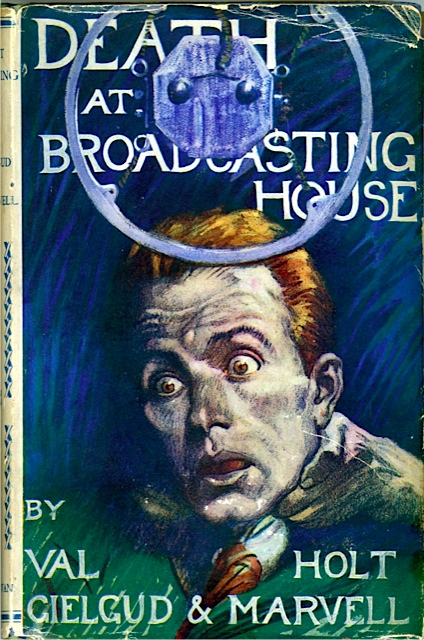
โ€œSnobbish nonsense!โ€ says one shabbily dressed young Londoner to another as they observe a man in a starched shirt and dinner jacket enter Broadcasting House.ย  The man, they reckon, is an announcer about to go on the air, unseen yet meticulously groomed and attired.ย  At the sight of which pointless and paradoxical propriety they sneer: โ€œThat whole place wants a damโ€™ good shake-up.โ€ย  A โ€œdamโ€™ good shake-up.โ€ย  That, in a coconut shell (to employ the most sound-effective nut in the business of radio dramatics), is what Val Gielgud and his collaborator Holt Marvell (the fanciful penname of fellow broadcaster Eric Maschwitz) set out to perform in Death at Broadcasting House (1934), a murder mystery set in and temporarily upsetting the reliable, predictable and frightfully proper BBC. ย Although I had know about it for quite some time, I just finished reading it; ย turns out, it’s a “dam’ good” page-turner, and a compelling commentary on the marginality, the relative obscurity of radio dramatics besides.
ย 
โ€œThereโ€™s not a drop of good red blood about the whole place.ย  Robots engaged in the retailing of tripe! Thatโ€™s broadcasting!โ€ one of the above sidewalk critics of the tried and generally trusted institution declares.ย  It is clear, though, that Gielgud and Maschwitz did not side with the two self-styled โ€œcommunists.โ€ย  The authors were BBC employees and not about to stage a revolution.ย  The โ€œshake-upโ€ was strictly a matter of maracas, a means of making some noise for their own undervalued accomplishments rather than spilling the beans without which those maracas would become utterly useless as instruments of ballyhoo.
ย 
Sure, broadcasting playsโ€”minutely timed, meticulously rehearsed and intensely scrutinizedโ€”were far more mechanic than any other form of dramatic performance.ย  Yet, as Gielgud insisted in one of his many articles on radio drama, โ€œ[i]n spite of [its] machine-like qualitiesโ€ and โ€œin spite of the lack of colour and applause, the work has a fascination of its own.โ€ That the multitude for whom these performances were intended showed so little gratitude was frustrating to an actor-director like Gielgud, who sarcastically remarked a few years earlier that dismissive reviews in the press suggested, at least, that the broadcast play had โ€œpassed the first and most depressing stage of developmentโ€”the stage of being entirely ignored.โ€ย  By 1934, it had clearly not advanced to a stage that could be deemed legitimate.
ย 
What better way to gainsay those naysayers than to spill some of that โ€œgood red bloodโ€ or to stir it properly and to make it run hot and cold by turns. ย โ€œA killing! In Broadcasting House, of all places! Good God!โ€ is the response of General Sir Herbert Farquharson, the corporationโ€™s fictional Controller.ย  He has just been informed that an actor was done away with during the production of a live broadcast.ย  โ€œMy god, sir,โ€ the director of that play exclaims, โ€œdo you realize that everyone who heard that play must have heard him die? That makes it pretty unique in the annals of crime.โ€
ย 
That most folks tuning in thought little of itโ€”that they believed it to be part of the dramaโ€”is owing to the fact that the murder was committed right at the moment when, according to the script, the character played by the victim was scheduled to breathe his last.ย  A crime at once prominent and inconspicuousโ€”like most radio dramas, performed as they were without a studio audience. ย After all, even the Controller, at the time of the murder, was attending a variety program staged in the specially designed Vaudeville Studio instead.
ย 
Death at Broadcasting House is the self-conscious performance of two radiomen, Gielgud and Maschwitz, fighting for the recognition that, for the most part, eludes those working behind the scenesโ€”especially the folks behind the scenes of a largely invisible business.ย  Their book, as they so slyly state, was โ€œdedicated impertinently โ€ฆ to those critics who persistently deny that the radio pay exists, has existed, or ever can exist.โ€ย  Radio plays existed, all right, but, for the most part, they died as soon as they were heard, if they were heard at all.
ย 
Unless, of course, they were blattnerphoned. โ€œBlattnerphone?โ€ the puzzled inspector exclaims.ย  โ€œYes,โ€ the BBCโ€™s dramatic director, Julian Caird, explains:
ย 
โ€œItโ€™s a way of recording a programme on a steel tape so that it can be re-transmitted.ย  We have to do a good deal of it for Empire work.โ€ [โ€ฆ]
ย 
โ€œYou mean we can hear that actual scene over again?โ€
ย 
โ€œWe can hear that scene,โ€ said Caird, โ€œnot only over again, but over and over again.ย  As often as you like.ย  I wonder if the murderer thought of that?โ€
ย 
Probably not.ย  Unless he numbers among the initiated few, folks like Cairdโ€”and Gielgudโ€”who have their fingers at the controls, conjurers who donโ€™t mind revealing some of their tricks to demonstrate just how powerful they are.
ย 
โ€œThe curious thing about the case what that it was both extremely simply and extremely complicated,โ€ the inspector wraps up the business of detection. ย โ€œIt was extremely complicated only because it took place under very remarkable conditionsโ€”conditions which you wouldnโ€™t find repeated anywhere else, and for which, of course, there was absolutely no precedent.โ€ย  The same applies to Gielgud and Maschwitzโ€™s fiction. However witty and engaging, the whodunit is entirely conventional. It is the setting, the broadcasting studio, that makes it unusual.ย  The setting, thus, becomes the star of the productionโ€”a star without whose presence the show simply could not go on.
ย 
Indeed, the crime depends on the complexity of British radio production to be in need of detection.ย  In American broadcasting, by comparison, all actors gathered in the same studio, a congregation that would render the unobserved strangling of one of them not only improbably but impossible.ย  At the BBC, however, plays were produced using a multiple studios, a complex approach Gielgudโ€™s stand-in explains thus:
ย 
[T]he chief reasons why we use several studios and not one, are two.ย  The first is that by the use of separate studios, the producer can get different acoustic effects for his scenes…. ย Secondly, the modern radio play depends for its “continuity” … upon the ability to โ€˜fadeโ€™ one scene at its conclusion into the next.ย  You can see at once that there must be at least two studios in use for these โ€œfadesโ€ to be possible.ย  In an elaborate play, therefore, the actors require as many studios as the varying acoustics of the different scenes require, while … sound effects have a studio of their own, gramophone effects one more, and the orchestra providing the incidental music yet another separate one.
ย 
Anyone who has ever listened to an American radio play of the 1930s, such as the ones produced by the Columbia Workshop, knows that no such complex arrangements are needed for the effective use of multiple fades and changes in acoustics. ย Death at Broadcasting House is a defense of the British system.ย  It turns the multi-studio approach into something to be marveled atโ€”an arcane system fit for a mystery, a puzzle whose solution requires the expertise of the initiated and thus vindicates the existence of the men masterminding the business with their hands firmly on that most complex of all pieces of broadcasting equipment: the dramatic control panel, which, Gielgud enthused elsewhere, enabled the director โ€œto move at will, both in time and space, as simply as if he were travelling on the fabled magic carpet, and to take his audience with him.โ€

Once Upon a Time in Radioland: A Kind of Ruritanian Romance

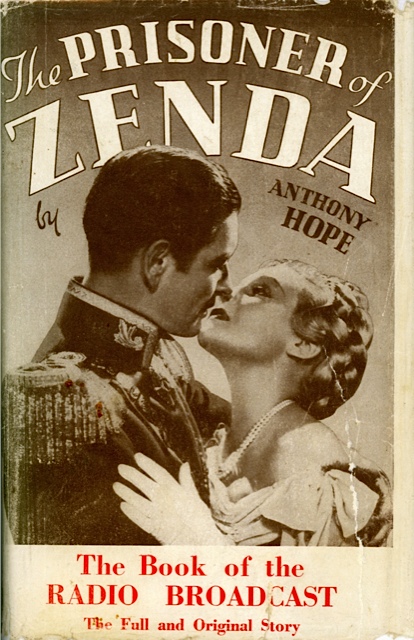
The other day, at my favorite bookstore here in Aberystwyth, I was caught in the eye by what struck me as a highly unusual cover for a 1938 edition of Anthony Hopeโ€™s fanciful pageturner The Prisoner of Zenda. Mind you, Iโ€™m not likely to turns those pages any time soon. Iโ€™m not one for Graustarkian excursions. That I found the old chestnut so arresting is due to the way in which it was sold anew to an audience of Britons to whom such a mode of escape from the crisis-ridden everyday must have beenย sufficiently attractive already. This was the 92nd impression of Zenda; and, with Europe at the brink of war, Ruritania must have sounded to those who prefer to face the future with their head in the hourglass contents of yesteryear like a travel deal too hard to resist.

My copy of the book

Now, the publishers, Arrowsmith, werenโ€™t taking any chances.ย  Judging by the cover telling as much, they were looking for novel ways of repackaging a familiar volume that few British public and private libraries could have been wanting at the time.

British moviegoers had just seen Ruritania appear before their very eyes in the 1937 screen version of the romance, which make dashing Ronald Colman an obvious salesperson and accounts for his presence on the dust jacket.ย  It is the line underneath, though, that made me look: โ€œThe Book of the Radio Broadcast,โ€ the advertising slogan reads.ย  Desperate, anachronistic, and now altogether unthinkable, these words reminded me just how far removed we are from those olden days when radio ruled the waves.

โ€œThe Prisoner of Zendaย was recently the subject of a highly successful film,โ€ the copy on the inside states somewhat pointlessly in the face of the faces on the cover.ย  Whatโ€™s more, it continues, a โ€œfurther mark of its popularityโ€ was the storyโ€™s โ€œselection by the BBC as a radio serial broadcast on the National Programme.โ€ ย To this day, the BBC produces and airs a great number of serial adaptations of classic, popular or just plain old literature; but, however reassuring this continuation of a once prominent storytelling tradition may be, a reminder of the fact that books are still turned into sound-only dramas would hardlyย sellย copies these days.ย  Radio still sells merchandiseโ€”but a line along the lines of โ€œas heard on radioโ€ is pretty much unheard of in advertising these days.

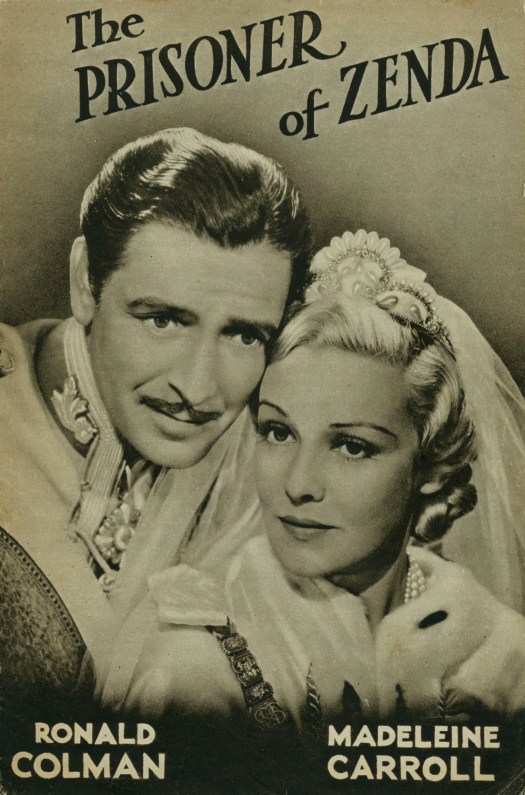
From my collection of Cinegrams.

โ€œThis book is the original story on which the broadcast was based,โ€ the dust jacket blurb concludes.  I, for one, would have been more thrilled to get my hands or ears on the adaptation, considering that all we have left of much of the BBCโ€™s output of aural drama is such ocular proof of radioโ€™s diminished status and pop-cultural clout.

Perhaps, my enthusiasm at this find was too much tempered with the frustration and regret such a nostalgic tease provokes.  At any rate, I very nearly left Ystwyth Books without the volume in my hands. That I walked off with it after all is owing to our friend, novelist Lynda Waterhouse, who saw me giving it the eye and made me a handsome present of it.  And there it sits now on my bookshelf, a tattered metaphor of my existence: I am stuck in a past that was never mine to outlive, grasping at second-hand-me-downs and gasping for recycled air . . . a prisoner of a Zenda of my own unmaking.

Gotham/Gothic; or, A Tale of Two Strawberries

Visiting Strawberry Hill

Much of what I know about English literature I learned in the Bronx.ย ย The peculiar indirection of my pathโ€”a German approaching British culture by taking the Lexington Avenue Expressโ€”did not escape me then; and even though I had no doubt as to the qualifications of those who taught me, I decided, upon finishing my Masterโ€™s thesis on the Scottish essayist-translator Thomas Carlyle, to go after something that, geographically speaking, lay closer to my temporary home.ย ย 

Never one for obvious choices, I wrote my doctoral study on US radio drama, a subject that, however arcane, struck me as being rather more compatible with life in a Mecca for the enthusiasts of American popular culture among which I numbered. ย It also made it possible for me to take advantage of some of the resources particular to Manhattan, the isle of Radio City.

Not that I considered studying British culture so far removed from the Globe Theatre, the Scottish Borders, or the wilds of Yorkshire to be much of a disadvantage, being that I had adopted a subjective mode of reading that favors response over intention, that explores the reception of a written work rather than tracing is origins.ย ย Call it rationalizing, call it kidding yourselfโ€”I thought that I should make a virtue of vicariousness.ย 

Living in Britain now, I am rediscovering its literature through the landscape rather than by way of the library; and I am finding my way back to those old books by stepping into even older buildings.  One such book and one such building is Horace Walpoleโ€™s Castle of Otranto (1764), otherwise known as Strawberry Hill.

A most un-Gothicโ€”but gloriousโ€”day at Strawberry Hill

Originally a small cottage in rural Twickenham, Strawberry Hill was transformed by Walpole into a gothic castellino; it also housed the authorโ€™s own printing press, although Otranto was published in nearby London.  The crenelated battlements were made of wood and needed to be replaced more than once in Walpoleโ€™s lifetime.  โ€œMy buildings are paper, like my writings,โ€ Walpole famously declared, โ€œand both will blown away in ten years after I am dead.โ€ This could well have happened; but, despite the relative weakness of his materialsโ€”a spurious medieval romance and the less than solid additions to Chopp’d Straw Cottageโ€”both survive today as a testimony to Walpoleโ€™s enduring influence on popular tastes in architecture and literature.

And yet, however exciting the experience, walking around Strawberry Hill after all those years of living and studying so close to Strawberry Fields, Central Park, brought home nothing more forcibly than that getting to the heart of the matter that is art is not a matter of inspection but of introspection. Stripped of most of its furnishings, Strawberry Hill is a tease. Beyond the stained glass windows and the restored faรงade, there is little left of Walpoleโ€™s story or his antiquarian spirit.  To be sure, even if Walpole’s library had not been emptied of the contents that makes and defines it, it would remain inaccessible to those looking around now without being permitted to touch and turn the pages.

Visitors to historic houses, like readers of fictions, must always be prepared to supply the fittings, to construct in their mind’s eye what the supposedly first-hand experience of seeing for ourselves can never make concrete and, therefore, never quite smash or supplant.  Where, if not in our reading, dreaming, thinking selves does the spirit of literature reside?

The audio guide at Strawberry Hill is a self-conscious acknowledgment of this sightseeing conundrum; it plays like a radio dramaโ€”my studies of which have not gone to waste altogetherโ€”that teases us with the voices of the dead and the echoes of their footsteps. Our own footfall, meanwhile, is muffled by the protective plastic coverings provided for our shoes at the entrance to the site.

Walpole’s paper house has been given a permanence in the midst of which I am reminded of the paper-thinness of my own existence.  What lingers is the anxiety of leaving hereโ€”or anywhereโ€”without having left a trace at all.

Sweetness and The Eternal Light

My bookshelf, like my corporeal shell, has gotten heavier over the years.  The display, like my waist, betrays a diet of nutritionally questionable comfort foodโ€”of sugar and spice and everything nice.   Now, I wonโ€™t take this as an opportunity to ponder just what it is that I am made of; but those books sure speak volumes about the quality of my food for thought.  There is All About Amos โ€˜nโ€™ Andy (1929), The Story of Cheerio (1937), and Tony Wonsโ€™s Scrap Book (1930).   There is Tune in Tomorrow (1968), the reminiscences of a daytime serial actress.  Thereโ€™s Laughter in the Air (1945) and Death at Broadcasting House (1934).  There are a dozen or so anthologies of scripts for radio programs ranging from The Lone Ranger to Ma Perkins, from Duffyโ€™s Tavern to The Shadow.

My excuse for my preoccupation with such post-popular culture, if justification were needed, has always been that there is nothing so light not to warrant reflection or reverie, that dismissing flavors and decrying a lack of taste is the routine operation of the insipid mind.ย  That said, I am glad to have addedโ€”thanks to my better half, who also looks after my dietary needsโ€”a book that makes my shelf figuratively weightier rather than merely literally so.

The book in question is The Eternal Light (1947), an anthology of twenty-six plays aired on that long-running program.  It is a significant addition, indeedโ€”historically, culturally, and radio dramatically speaking.

In the words of Louis Finkelstein, President of the Jewish Theological Seminary of America, under whose auspices the series was produced, The Eternal Light was a synthesis of scholarship and artistry, designed to โ€œtranslate ancient, abstract ideas into effective modern dramatics.โ€

In his introductory essay โ€œRadio as a Medium of Drama,โ€ Morton Wishengrad, the playwright of the series, defended broadcasting as a valuable if often misused โ€œtool.โ€ He did so at a time when, in the disconcerting newness of postwar opportunity and responsibility, radio was increasinglyโ€”and indiscriminatelyโ€”dismissed as the playground ofย Hucksters, to name a bestselling novel of 1946 whose subject, like Herman Woukโ€™sย Aurora Dawn (1947), was the prosperity and self-importance of the broadcasting industry in light of the perceived vacuity of its product.ย 

โ€œAn automobile does not manufacture bank-robbers,โ€ Wishengrad reasoned, “it transports them.  It also transports clergymen.  It is neither blameworthy because it does the first nor is it an instrument of piety because it does the latter.  It is merely an automobile, a tool.

 What the medium neededโ€”and what the times requiredโ€”were writers who had โ€œsomething to say about the culture.โ€

According to Wishengrad, there was โ€œnothing wrongโ€ with the techniques of radio writing.  He noted that serial drama, derided and reviled by โ€œdemonstrably incompetentโ€ reviewers, had great storytelling potential: “Here are quarter-hour segments in the lives of people which could transfigure a part of each day with dramatic truth and an intimation of humanity instead of presenting as they now do a lolly-pop on the instalment plan.”

A  โ€œlolly-pop on the instalment planโ€! To paraphrase Huckster author Frederic Wakemanโ€™s parody of radio commercials: love that phrase. Wishengrad is one of a small number of American radio dramatists whose scripts remain memorable and compelling even in the absence of the actors and sound effects artist who interpreted them.  Of the latterโ€™s mรฉtier Wishengrad wrote: โ€œSound is like salt.  A very little suffices.โ€  He cautioned writers, in their โ€œinfatuation with its possibilities,โ€ not to โ€œdrownโ€ their scripts in aural effects.

Wishengradโ€™s advice to radio dramatists is as sound as his prose.  โ€œGood radio dialogue,โ€ he held, should come across โ€œlike a pair of boxers trading blows, short, swift, muscular, monosyllabic.โ€  Speeches, he cautioned, ought not to โ€œbe long because the ear does not remember.  There is quick forgetfulness of everything except the last phrase or the last word spoken.โ€

While Wishengrad made no use of serialization inย The Eternal Lightโ€”as much as the title suggests the continuation and open-endedness of the formโ€”his scripts bear out what he imparts about style and live up to his insistence on substance.ย 

Take โ€œThe Day of the Shadow,โ€ for instance.ย  Produced and broadcast over NBC stations on 18 November 1945, the play opens: “Listen.ย  Listen to the silence.ย  I have come from the land of the day of the shadow.ย  I have seen the naked cities and the dead lips.ย  Someone must speak of this.ย  Someone must speak of the memory of things destroyed.”

The abstract gives way to the concrete, as the speaker introduces himself as the โ€œChaplain who stood before the crematorium of Belsen.โ€

I have buried 23,000 Jews.ย  I have a right to speak.ย ย  I stood the last month in Cracow when โ€œLiberatedโ€ Jews were murdered.ย  I have no pretty things to tell you.ย  But I must tell you.

The โ€œplain, and written down, and trueโ€ figuresโ€”appropriated from the โ€œadding machines of the statisticiansโ€โ€”tell of the silenced.ย  But, the Chaplain protests, โ€œ[l]et the adding machines be still,โ€ and let the survivorsโ€”the yet dyingโ€”speak; not of the past but of the continuum of their plight, of the aftermath that comes after math has accounted for the eighty percent of Europeโ€™s Jewish population who were denied outright the chance to make their lives count.

At the time The Eternal Light was published, radio drama, too, was dying; at least the drama with a purpose and a faith in the medium.ย  To this date, it is a body unresuscitated; and what is remembered of it most is what is comforting rather than demanding, common rather than extraordinary.ย  Shelving the candy, resisting the impulse to reach for the sweet and the obviousโ€”the lolly-popularโ€”I realize anew just what has been lost to us, what we have given up, what we have forgotten to demand or even to long for . . .

14 Gay Street: NYC, Myself and Eileen

I had walked past this place many an evening on the way to Tyโ€™s, my favorite Greenwich Village watering hole.ย  This time, though, it was mid-afternoon and I turned left, leaving Christopher for Gay Street.ย  I had come here specially to take a picture of number 14, the former residence of two sisters who, for about a quarter of a century or so, were household names across America. ย Ruth and Eileen McKenney had been on my mind ever since I saw that production of Wonderful Town on a visit to Manchester, Englandโ€”and the gals, whose misadventures are tunefully related in said musical, seemed determined to stay there.ย  On my mind, that is, not up in the Salford docklands; though, judging from their experience way down here on Gay Street, they might not have minded the docks.

A few days earlier, I had happened upon a copy of Ruth McKenneyโ€™s All About Eileen (1952) in the basement of the Argosy, one of my favorite antiquarian bookstores in town.  I hadnโ€™t even been looking for it at the time.  In fact, I had been unaware that such an anthology of McKenneyโ€™s New Yorkerstories existed.

Eileenย was lying there all the sameโ€”prominently if carelessly displayed, draped in a flashy, tantalizingly torn jacket that stood out among the drab, worn-out linen coats of a great number of unassuming second-hand Roses about to be put in their placeโ€”waiting to be picked up.ย  I don’t flatter myself.ย  My company was of no consequence toย Eileen.ย  If I was being lured, it was no doubt owing to an itchย Eileenย had to get out of yet another basement.

Thinking of the case I had to lug to the airport before longโ€”and the less than commodious accommodations that would awaitย Eileenย in my studyโ€”I had hesitated and walked out alone; but I soon changed my mind, returned to the Argosy, and, to my relief, foundย Eileenย still there, though shifted a little as if to say โ€œIโ€™m notย thatย easyโ€ and to make me suffer for waffling.

And here I was now, a week later. ย 14 Gay Street.ย  Itโ€™s an unassuming walk-up, next to a scaffolded shell of a building that, a friend told me, had been on fire a while ago.ย  Walk-up! More like a step-down for Ruth and Eileen. The two had been naรฏve enough to rent barely-fit-for-living quarters below street level, unaware that the construction of a new subway line was going to rattle their nerves and rob them of what one of their first visitors, a burglar, could not readily bag: their sleep.

โ€œ[W]e lived in mortal terror falling into the Christopher Street subway station,โ€ Ruth recalled, making light of her darksome days in their damp โ€œlittle cave.โ€โ€‚And “[e]very time a train roared by, some three feet under our wooden floor, all our dishes rattled, vases swayed gently, and startled guests dropped drinks.”

From the outside, at least, 14 Gay Street looked perfectly serene on that quiet, sunny afternoon. ย I was not the only one stopping by, though.ย  I walked up to what I assumed to be a fellow admirer ofย Eileenโ€™s; as it turned out, he was oblivious that the very spot had given rise to such lore as was retold on page, screen and stage.ย  He only had eyes for the wisteria that had taken its chancesโ€”and its timeโ€”to sidle up to and ravage a neighboring property.

Imposing as that looked, I had my heart set on those small dark windows peering from behind the pavement like a pair of Kilroy peepers.ย  Eileen was here, I thought, and was glad to have seen what seemed too little to look at.ย  Indifference, after all, is in the passerbyโ€™s eye.

I wonder now: How many sites of the cityโ€”fabled but forsakenโ€”are daily escaping the sightseerโ€™s gaze?

Time and the Airwaves: Notes on a Priestley Season

Both BBC Radio 4 and 7 are in the thick of a J. B. Priestley festival, a spate of programs ranging from serial dramatizations of early novels (The Good Companions and Bright Day) and adaptations of key plays (Time and the Conways and An Inspector Calls), to readings from his travelogue English Journey and a documentary about the writerโ€™s troubled radio days. Now, I donโ€™t know just what might be the occasion for such a retrospective, since nothing on the calendar coincides with the dates of Priestleyโ€™s birth or death. Perhaps, it is the connection with the 70th anniversary of the evacuation of Dunkirk, an event on which Priestley embroidered in June 1941 for one of his Postscript broadcasts, that recalled him to the minds of those in charge of BBC radio programming.
Never mind the wherefores and whys. Any chance of catching up with Priestley is welcome, especially when the invitation is extended by way of the wireless, the means and medium by which his voice and words reached vast audiences during the 1930s and early 1940s, both in the United Kingdom and the United States.

For all his experience as a broadcaster, though, Priestley, who was not so highbrow as to high-hat the mass market of motion pictures, never explored radio as a playwrightโ€™s medium, as a potential everymanโ€™s theater on whose boards to try his combined radiogenic skills of novelist, dramatist, and essayist for the purpose of constructing the kind of aural plays that are radioโ€™s most significant contribution to twentieth-century literatureโ€”the plays of ideas.

Priestley prominently installed a wireless set in Dangerous Corner, a stage thriller whose characters gather to listen to a thriller broadcast. Later, he read his controversial wartime commentaries (titled Postscripts) to a vast radio audience. He even went on one of Rudy Valleeโ€™s variety programs to discuss the fourth dimension. Yet the medium that relied entirely on that dimension, to the contemplation of which he devoted many of his stage playsโ€”Time and the Conways and I Have Been Here Before among themโ€”did not intrigue Priestley to make time and create plays especially for the air.

To be sure, his falling out with the BBC in 1941 (as outlined in Martin Wainwrightโ€™s radio documentary about the Postscript broadcasts) did little to foster Priestleyโ€™s appreciation of the radiodramatic arts. Yet the indifference is apparent long before his relationship with Auntie soured. When interviewed for the 1 September 1939 issue of the Radio Times about his novel Let the People Sing, which was to be read serially on the BBC before it appeared in print, Priestley dismissed the idea that he had written it with broadcasting in mind:

“I realised, of course, that the theme must appeal to the big majority. But apart from that, I thought it better to let myself go and leave the BBC to make it into twelve radio episodes. It would otherwise have cramped my style.”

To Priestley, the โ€œexperimentโ€ of broadcasting his novel lay in the marketing โ€œgambleโ€ of making it publicly available prior to publication, a challenge of turning publishing conventions upside down by effectively turning the printed book into a sort of postscript. Clearly, he looked upon radio a means of distribution rather than a medium of artistic expression.

Reading I Have Been Here Before and listening to the radio adaptation of Time and the Conways, I realized now little either is suited to the time art of aural play. Whereas the Hรถrspiel or audio play invites the utter disregard for the dramatic unities of time and space, Priestley relied on the latter to make time visible or apparent for us on the stage.

The Conways, like the characters of Dangerous Corner before them, are brought before us in two temporal versions, a contrast designed to explore how destinies depend on single moments in timeโ€”moments in which an utterance or an action brings about changeโ€”and how such moments might be recaptured or rewritten to prevent time from being, in Hamletโ€™s words, โ€œout of joint.โ€

โ€œTimeโ€™s only a dream,โ€ Alan Conway insists. โ€œTime doesnโ€™t destroy anything. It merely moves us onโ€”in this lifeโ€”from one peep-hole to the next.โ€ Our past selves are โ€œreal and existing. Weโ€™re seeing another bit of the viewโ€”a bad bit, if you likeโ€”but the whole landscapeโ€™s still there.โ€

In Priestleyโ€™s plays, it is the scenery, the landscape of stagecraft, that remains there, โ€œwholeโ€ and virtually unchanged. The unity of space is adhered to so as to show up changes in attitudes and relationships and to maintain cohesion in the absence or disruption of continuity.

In radioโ€™s lyrical time plays, by comparison, neither time nor place need be of any moment. It is the moment alone that matters on the air, an urgency that Priestley, the essayist and wartime commentator, must surely have sensed.  Priestley, the novelist and playwright did or could not.  Too few ever did.  To this day, a whole aural landscape is biding its time . . .

A โ€œkind of monsterโ€: Me[, Fascism] and Orson Welles

It doesnโ€™t happen often that, after watching a 21-century movie based on a 21-century novel, I walk straight into the nearest bookstore to get my hands on a shiny paperback copy of the original, the initial publication of which escaped me as a matter of course. Come to think of it, this never happened before; and that it did happen in the case of Me and Orson Welles has a lot to do with the fact that the film is concerned with the 1930s, with New York City, and with that wunderkind from Wisconsin, the most lionized exponent of American radio drama, into which by now dried up wellspring of entertainment, commerce and propaganda it permits us a rare peek. You might say that I was the target audience for Richard Linklaterโ€™s comedy, which goes a long way in explaining its lack of success at the box office.

And yet, despite the filmโ€™s considerable enticementsโ€”among them its scrupulous attention to verisimilitudinous detail and a nonchalant disregard for those moviegoers who, having been drawn in by Zac Efron, draw a blank whenever references to, say, Les Tremayne or The Columbia Workshop are being tossed into their popcorn littered lapsโ€”it wasnโ€™t my fondness for the subject matter, much less the richness of the material, that convinced me to pick up Robert Kaplowโ€™s novel, first published in 2003. Indeed, it was the glossiness of the treatment that left me with the impression that something had gotten lost or left behind in the process of adaptationโ€”and I was curious to discover what that might be.

On the face of it, the movie is as faithful to the novel as the book is to the history and culture on which it draws.  Much of the dialogue is lifted verbatim from the page, even though the decision not to let the protagonist remain the teller of his own tale constitutes a significant shift in perspective as we now get to experience the events alongside the young man rather than through his mind’s eye.  In one trailer for the film, the voice-over narration is retained, suggesting how much more intimate and intricate this story could have beenโ€”and indeed is in printโ€”and how emotionally uninvolving the adaptation has turned out to be.

Without Samuelsโ€™s narration and with a scene-stealing performance by Christian McKay as Welles, the screen version gives the unguarded protรฉgรฉ, portrayed by the comparatively bland Efron, rather less of a chance to have the final word and to claim center stage, as the sly title suggests, by putting himself first.

The question at the heart of the story, on page and screen alike, is whether successes and failures are born or made.  Prominence or obscurity, life or death, are not so much determined by individual talent, the story drives home, but by the circumstances and relationships in which that talent can or cannot manifest itself.  We know Welles is a phony when he goes around giving the same spiel to each member of the cast who is about to crack up and endanger the opening of the show, insisting that they are โ€œGod-created.โ€  They are, if anything, Welles-created or Welles-undone.

Finding this out the hard wayโ€”however easy it may have looked initiallyโ€”is high school student Richard Samuels who, stumbling onto the scene quite by accicent, becomes a minor player in a major theatrical production of a Shakespearean drama directed by a very young, and very determined, Orson Welles.  Samuelsโ€™s fortunes are made and lost within a single week, at the end of which his name is stricken from the playbill and his life reconsigned to inconspicuity, all on account of that towering ego of the Mercury.

The premise is an intriguing one: a forgotten man who lives to tell how and why he did matter, after allโ€”a handsome stand-in for all of us who blew it at some crucial stage in our lives and careers.  Shrewdly concealing that it was he who nearly ruined the Mercury during dress rehearsal by setting off the sprinklers, Samuels can luxuriate in the belief that he may have inadvertently saved the production by reassuring a superstitious Welles that opening night would run smoothly.

Speculating about the personalities and motives of historical figures, dramas based on true events often insert an imaginary proxy or guide into the scene of the action, a marginal figure through or with whom the audience experiences a past it is invited to assume otherwise real.  And given that Me and Orson Welles goes to considerable length capturing the goings-on at the Mercury Theater, anno 1937, I was quite willing to make that assumption.  Hey, even Joe Cotten looks remarkably like Joseph Cotten (without the charisma, mind).

It was not until I read the novel that I realized that Kaplow and the screenwriters, while ostensibly drawing their figures from life, attributed individual traits and behaviors to different real-life personages.  Whereas actor George Coulouris is having opening night jitters on screen, it was the lesser-known Joseph Holland who experienced same in the novel.

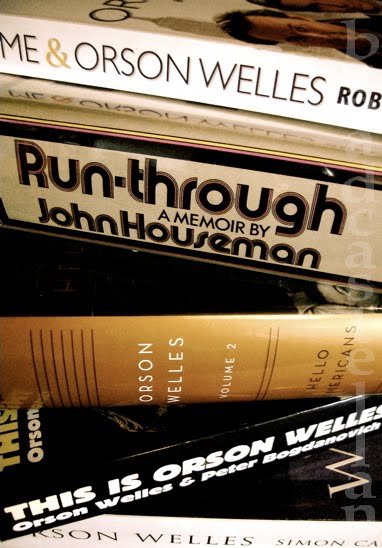
Although quite willing to let bygones be fiction, I consulted Mercury producer John Housemanโ€™s memoir Run-through, which suggests that the apprehensive one was indeed Coulouris.  Housemanโ€™s recollections also reveal that the fictional character of Samuels was based in part on young Arthur Anderson, a regular on radioโ€™s Letโ€™s Pretend program who, like Samuels, played the role of Lucius in the Mercury production.  According to Houseman, it was Anderson who flooded the theater by conducting experiments with the sprinkler valves.

Never mind irrigation; I was trying to arrive at the source of my irritation, which, plainly put, is this: Why research so thoroughly to so little avail? Why be content to present a slight drama peopled with folks whose names, though no longer on the tip of everyoneโ€™s tongue, can be found in the annals of film and theater? The missed opportunityโ€”an opportunity that Welles certainly seizedโ€”of becoming culturally and politically relevant makes itself felt in the character of Sam Leve, the Mercuryโ€™s set designerโ€”a forgotten character reconsidered in the novel but neglected anew in the screenplay.

Andersonโ€™s contributions aside, it is to Leveโ€™s account of the Mercuryโ€™s Julius Caesar that Kaplow was indebted, a debt he acknowledges in the โ€œSpecial thanksโ€ preceding the narrative he fashioned from it.

โ€œ[P]oor downtrodden Sam Leveโ€โ€”as Simon Callow calls him rather patronizingly in his biography of Orson Wellesโ€”was very nearly denied credit for his work on the set.  Featuring prominently in the novel, he is partially vindicated by being given one of the novelโ€™s most poignant speeches, a speech that turns Me and Orson Welles into something larger and grander than an intriguing if inconsequential speculation about a brilliant, egomaniacal boy wonder.

Confiding in Leve, with whom he has no such exchange in the movie, Samuels calls Welles a โ€œkind of monster,โ€ to which Leve replies: โ€œWe live in a world where monsters get their faces on the covers of the magazines.โ€  In this exchange is expressed what mightโ€”and, I believe, shouldโ€”have been the crux of the screen version: the story of a โ€œkind of monster,โ€ a man who professes to turn Julius Caesar into an indictment of fascism, however conceptually flawed (as Callow points out), but who, in his dictatorial stance, refuses to acknowledge Leveโ€™s contributions in the credits of the playbill and shows no qualms in replacing Samuels when the latter begins to assert himself.

โ€œAs in the synagogue we sing the praises of God,โ€ Leve philosophizes in the speech that did not make it into the screenplay, โ€œso in the theatre we sing the dignity of man.โ€  Without becoming overly didactic or metaphorical, Me and Orson Welles, the motion picture, could have put its authenticity to greater, more dignified purpose by not obscuring or trivializing history, by reminding us that Jews like Leve and Samuels were fighting for recognition as the Jewish people of Europe were facing annihilation.

To some degree, the glossy, rather more Gentile film version is complicit in the effacement of Jewish culture by homogenizing the story, by removing the Jewish references and Yiddish expressions that distinguish Kaplowโ€™s novel.  Instead of erasing the historical subtext, the film might have encouraged us to see the Mercuryโ€™s troubled production of Julius Caesar as an ambitious if somewhat ambiguous and perhaps disingenuous reading of the signs of the times, thereby making us consider the role and responsibility of the performing artsโ€”including films like Me and Orson Wellesโ€”in the shaping of history and of our understanding of it.


Related writings
โ€œOn This Day in 1938: The Mercury Players โ€˜dismember Caesarโ€™โ€
โ€œOn This Day in 1937: The Shadow Gets a Voice-overโ€

โ€œ. . . reduced, blended, modernisedโ€: The Wireless Reconstitution of Printed Matter

Nearly two centuries ago, young Rebecca Sharp marked her entrance into the world by hurling a book out of a coach window. That book, reluctantly gifted to her by the proprietress of Miss Pinkertonโ€™s academy for young ladies, was Johnsonโ€™s dictionary, a volume for which Ms. Sharp had little use, given that she was rarely at a loss for words. By the time her story became known, in 1847, words in print had become a rather less precious commodity, especially after the British stamp tax was abolished in 1835, which, in turn, made the emergence of the penny press possible. Publications were becoming more frequentโ€”and decidedly more frivolous.

Gone were the days when a teenager like Mary Jones, whose story I encountered on a trip to the Welsh town of Bala last weekend, walked twenty-five miles, barefooted, for the privilege of owning a Bible. Sure, I enjoy the occasional daytrip to Hay-on-Wye, the renowned โ€œTown of Booksโ€ near the English border where, earlier this month, I snatched up a copy of the BBCโ€™s 1952 Year Book (pictured). Still, ever since the time of the great Victorian novelists, the reading public has been walking no further than the local lending library or wherever periodicals were sold to catch up on the latest fictions and follow the exploits of heroines like Becky Sharp in monthly installments.

In Victorian times, the demand for stories was so great that poorly paid writers were expected to churn them out with ever greater rapidity, which left those associated with the literary trade to ponder new ways of meeting the supply. In Gissingโ€™s New Grub Street (1891), a young woman assisting her scholarly papa is startled by an

advertisement in the newspaper, headed โ€œLiterary Machineโ€; had it then been invented at last, some automaton to [. . .] turn out books and articles? Alas! The machine was only one for holding volumes conveniently, that the work of literary manufacture might be physically lightened. But surely before long some Edison would make the true automaton; the problem must be comparatively such a simple one. Only to throw in a given number of old books, and have them reduced, blended, modernised into a single one for todayโ€™s consumption.

Barbara Cartland notwithstanding, such a โ€œtrue automatonโ€ has not yet hit the market; but the recycling of old stories for a modern audience had already become a veritable industry by the beginning of the second quarter of the 20th century, during which โ€œgolden ageโ€ the wireless served as both home theater and ersatz library for the entertainment and distraction craving multitudes.

A medium ofโ€”and only potentially forโ€”modernity, radio has always culled much of its material from the past, โ€œReturn with us nowโ€ being one of the phrases most associated with aural storytelling. It is a phenomenon that led me to write my doctoral study Etherized Victorians, in which I relate the demise of American radio dramatics to the failure to establish or encourage its own, autochthonous, that is, strictly aural life form.

Sure, the works of Victorian authors are in the public domain; as such, they are cheap, plentiful, and, which is convenient as well, fairly innocuous. And yet, for reasons other than economics, they strike us as radiogenic. Like the train whistle of the horse-drawn carriage, they seem to be the very stuff of radioโ€”a medium that was quaint and antiquated from the onset, when television was announced as being โ€œjust around the corner.โ€

Perhaps, the followers of Becky Sharp should not toss out their books yet; as American radio playwright Robert Lewis Shayon pointed out, the business of adaptation is fraught with โ€œartistic problems and dangers.โ€ He argued that he โ€œwould rather be briefed on a novelโ€™s outline, told something about its untransferable qualities, and have one scene accurately and fully done than be given a fast, ragged, frustrating whirl down plot-skeleton alley.โ€

It was precisely for this circumscribed path, though, that American handbooks like James Whippleโ€™s How to Write for Radio (1938) or Josephina Niggliโ€™s Pointers on Radio Writing (1946) prepared prospective adapters, reminding them that, for the sake of action, they needed to โ€œretain just sufficient characters and situations to present the skeleton plotโ€ and that they could not โ€œafford to waste even thirty seconds on beautiful descriptive passages.โ€

As I pointed out in Etherized, broadcast writers were advised to โ€œfree [themselves] first from the enchantment of the authorโ€™s styleโ€ and to โ€œoutline the action from memory.โ€ Illustrating the technique, Niggli reduced Jane Eyreโ€”one of the most frequently radio-readied narrativesโ€”to a number of plot points, โ€œbald statementsโ€ designed to โ€œeliminate the non-essential.โ€ Only the dialogue of the original text was to be restored whenever possible, although here, too, paraphrases were generally required to clarify action or to shorten scenes. Indeed, as Waldo Abbotโ€™s Handbook of Broadcasting (1941) recommended, dialogue had to be โ€œinvented to take care of essential description.โ€

To this day, radio dramatics in Britain, where non-visual broadcasting has remained a viable means of telling stories, the BBC relies on 19th-century classics to fill much of its schedule. The detective stories of Conan Doyle aside, BBC Radio 7 has just presented adaptations of Thackerayโ€™s Vanity Fair (1847-48), featuring the aforementioned Ms. Sharp, and currently reruns Trollope’s Barchester Chronicles (1855-67). The skeletons are rather more complete, though, as both novels were radio-dramatized in twenty installments, and, in the case of Trollopeโ€™s six-novel series, in hour-long parts.

BBC Radio 4, meanwhile, has recently aired serializations of Trollope’s Orley Farm (1862), Wilkie Collinsโ€™s Armadale (1866) and Mary Elizabeth Braddonโ€™s Lady Audleyโ€™s Secret (1862). Next week, it is presenting both Charlotte Brontรซโ€™s Villette and Elizabeth Gaskellโ€™s Ruth (both 1853), the former in ten fifteen minute chapters, the latter in three hour-long parts.

Radio playwright True Boardman once complained that adaptations for the aural medium bear as close a relation to the original as โ€œpowdered milk does to the stuff that comes out of cows.โ€ They are culture reconstituted. โ€œ[R]educed, blended, [and] modernisedโ€œ, they donโ€™t get a chance to curdle . . .

Note: Etherised Victorians was itself ‘reduced and blended,’ and published as Immaterial Culture in 2013.


Related writings (on Victorian literature, culture and their recycling)
โ€œHattie Tatty Coram Girl: A Casting Note on the BBCโ€™s Little Dorritโ€
โ€œValentine Vox Pop; or, Revisiting the Un-Classicsโ€
“Curtains Up and ‘Down the Wires'”
Eyrebrushing: The BBC’s Dull New Copy of Charlotte Brontรซ’s Bold Portrait”