“โ€ฆ the same unseen beauty”: Music Returns to Gregynog Hall

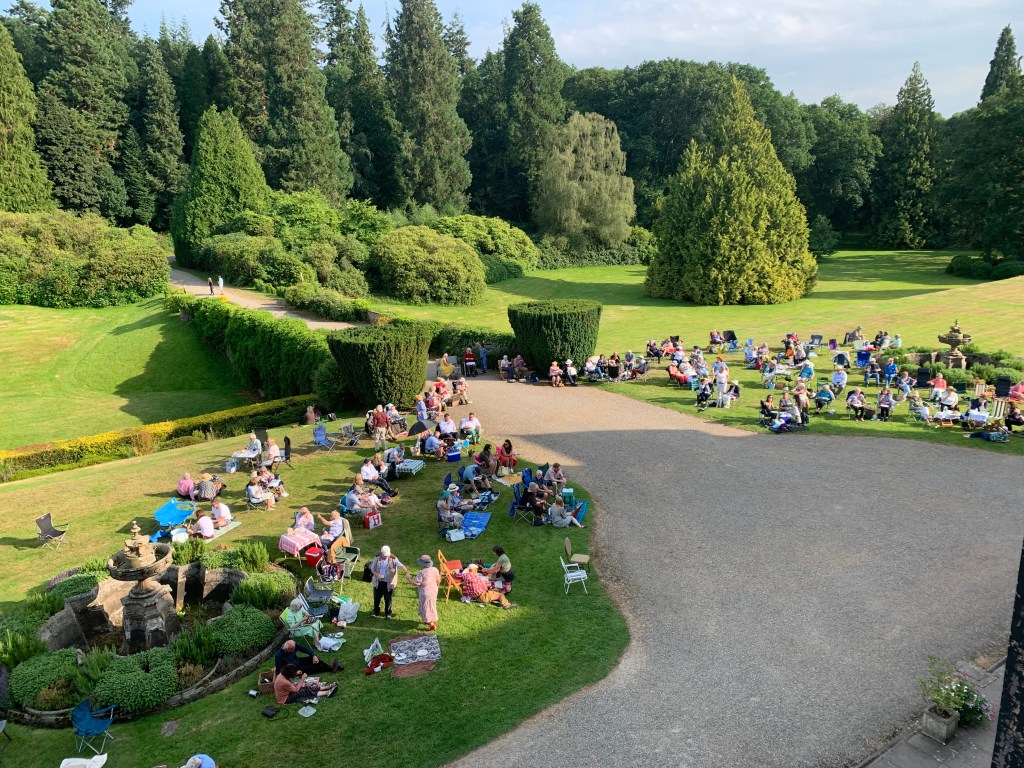
Members of the Mid Wales Opera performing at Gregynog, July 2021

Like much of the heritage of Wales, and indeed the world, the interior of Gregynog Hall was off limits during the pandemic (ongoing at the time of this writing), even though its extensive grounds continued to provide a welcome retreat for local visitors in the days of social distancing.ย ย Gregynog โ€“ pronounced as you would a portmanteau word for an alcoholic yuletide treat named after a Pope getting chummy, with an “un” wedged between the man and the intoxicant โ€“ was known for keeping the two apart for the purported benefit of the former.ย ย During its heyday โ€“ between the two World Wars โ€“ the Hall was owned by the teetotalling and public-spirited Davies sisters, Gwendoline and Margaret, and the recommended stimulant to be taken in there was produced on location during Gregynogโ€™s renowned Festivals of Music and Poetry.

I shanโ€™t rehearse what, in Wales at least, is well-known, as much has been written elsewhere about Gregynog and Davies sisters, who bought the mock-Tudor Hall in 1920 and, even though they did not initially intend doing so, lived there from 1924 until their respective deaths some three to four decades later.  Suffice it to say that, during their residence, the Hall was not only a home filled with art or for the arts.  It was a place devoted to cultural, spiritual and social uplift through the arts, as the sisters โ€“ encouraged by their friend and advisor Dr Thomas Jones (TJ) โ€“ understood it.  

The performing arts are returning, and so are the crowds.  On a warm and sunny afternoon in July 2021, the grounds of the estate once again resounded with classical music, as young members of the Mid Wales Opera โ€“ sopranos Meinir Wyn Roberts and Llio Evans and tenor Huw Ynyr, accompanied by pianist and Music Director Charlotte Forrest โ€“ came to give a crowd-pleasing concert of arias from works as diverse as Mozartโ€™s Die Zauberflรถte, Pucciniโ€™s La Bohรจme and Il tabarro, Leonard Bernsteinโ€™s Candide (โ€œGlitter and Be Gayโ€), with Jonathan Doveโ€™s The Enchanted Pig and Disneyโ€™s Snow White (Frank Churchillโ€™s โ€œSome Day My Prince Will Comeโ€) thrown into the mix, and appropriately so, considering that, these days, Gregynog is a popular venue for weddings. 

Equipped with a lawn chair, a bottle of champagne and a husband, I was glad to attend that charmed picnic concert, having spent some time behind the scenes in the months and weeks prior to the event to volunteer โ€“ despite a lack of practical skills but owing to the decidedly practical prince I wed anno 2014 โ€“ in getting the Hall ready to welcome back visitors.

When not lugging books or furnishings, I was ensconced in the library at Gregynog Hall, where I had a browse through the Festival programs and other documents still waiting to be drawn upon for a social history of the place.  

The program for the first Festival of Music and Poetry in 1933 reminded me of the mission of the sisters to put the family wealth to good use:

In these days of unprecedented difficulty and disillusionment, when the very fabric of our civilisation is rent and torn, we are compelled to return again to the unfailing sources of inspiration and delight.ย ย Music and poetry are no longer the luxury of the few but the necessity of the many.

Thousands upon thousands of our fellow beings are dragging out a dark and desolate existence; exhausted and in despair they stand at the corners of the streets, for no man hath need of them.ย ย A bewildered Government doles out to them the pittance which keeps them alive, but their minds and spirit are starved, for man doth not live by bread alone.ย ย They are bone of our bone and flesh of our flesh, their powers and potentialities are the same as ours, the same unseen beauty is theirs, could we but show it to them.

Held during the depression, that first festival was designed to raise money for Coleg Harlech, a Training Centre for Unemployed, contributions towards which, as the program stated, were “gratefully accepted during the Interval each evening.”ย  Thomas Jones would later become President of the Coleg.

Many who stayed as guests at Gregynog enjoyed the music and appreciated the spirit in which it was offered โ€“ but some found the sober atmosphere less than inspiriting.ย ย “We all went to Gregynog to stay with the Davies sisters,” actress Joyce Grenfell reminisced in her autobiography.ย ย Grenfell, who visited Gregynog as a friend of Thomas Jones, noted how important music was in the lives of the sisters.ย ย “[W]hen new staff were needed for the house, garden or farm,” Grenfell was told,

the sisters advertised for a contralto-housemaid, a bass-undergardener or a tenor-cowman to take part in the Gregynog choir.  All through the winter months the choir, under a professional master, worked on programmes for the summer festival, when musicians like Sir Adrian Boult and Sir Walford came, with their wives, to lead the music.

According to the visitor book, Grenfell attended the final two of the original Gregynog festivals in 1937 and โ€™38; she also returned at Easter 1939, when, as she recalled, “Elsie Suddaby, Mary Jarred and Keith Falkner sang Bach’s St Matthew Passion in the big white music-room hung with a series of Monet’s water-lily paintings.” When there was “religious music,” Grenfell noted, a “great EI Greco was put on a stand to conceal the choir and the conductor.” Grenfell was unconvinced; not only did it “do more than hide a few of the performers,” the artful cover-up struck her as “more of a disturbance than an inspiration.”

“Staying at Gregynog was a mixed blessing,” Grenfell summed up.ย ย “The music was unalloyed pleasure but the atmosphere in the house was cool, correct and daunting.”

The mood and tone on that July 2021 afternoon was decidedly more relaxed.ย ย After months of home front battle and its concomitant fatigue, the small crowd assembled on the lawn facing the entrance to the Hall felt reassured, no doubt, that “beauty” need no longer go “unseen,” or, for that matter, unheard.ย ย And while those in attendance, unlike Grenfell, were not subjected to the scrutiny of “two maiden ladies” โ€“ owing to whom it was “not possible to forget one’s ps and qs” โ€“ there also was nothing of the “missionary zeal” Grenfell observed in Thomas Jones and Gregynog as a project.

I am of two minds about such zeal.ย ย It is a worthy cause to make art something other than “the luxury of the few.”ย ย All the same, it is worth questioning just what constitutes โ€“ and who determines โ€“ “the necessity of the many.”ย That “necessity” needs to be felt like a yearning rather than being imposed, defined and determined by those presumably best equipped to judge what is proper art in the best possible taste.ย ย 

Instead of demanding the “same unseen beauty,” we need to recognise that much remains “unseen” because it is not yet deemed to be art.ย ย Clearly, that is why I am teaching โ€œGothic Imaginationโ€ again this autumn, why I encourage students to engage with “inconvenient objects” in our galleries (more about that in the next post), and why I write about canonically neglected radio plays (more aboutย thatย in the previous entry).ย ย I donโ€™t wait for the prince, thank you.ย ย Iโ€™ll do the crowning, or tiara-ing, using whatever materials are at hand …
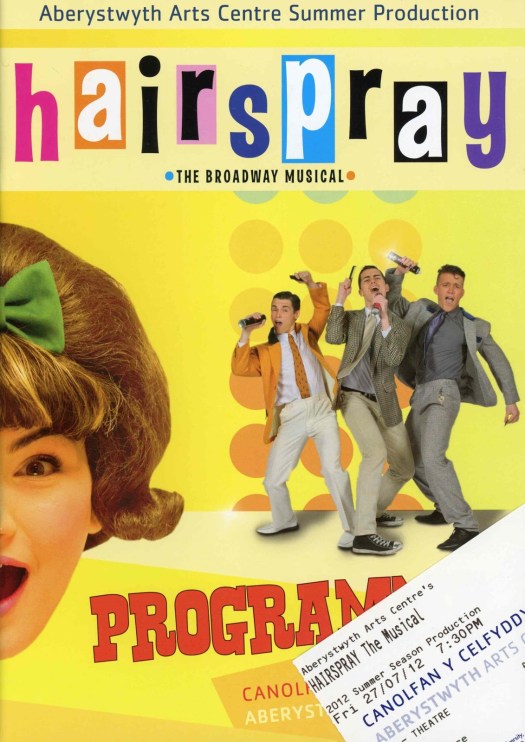
Stiff Competition: A Hairspray to Defy the West End Elements

Funny thing about prejudice: if you let it take hold, it can deprive you and those around you of a real good time.ย  That, in a shiny Aqua Net shell, is the message of Hairspray, the musical.ย  And, boy, did I deprive myself . . . until now.ย  Sure, others around me still had that good time, but when Hairspray hit Broadway back in 2002, I was as set as an untamed cowlick. ย I would have none of it. My Aqua Net days were long behind me by then, and I was not going to splash out on a rehash of a late-1980s cult comedy about early 1960s culture-clashing teenagers, told in songs that a Porter and Gershwin kind of guy like me is not inclined to hum while wearing a shower cap. Well, Kiss my Kate! Last Friday, I finally woke up and smelled the coiffing.ย  “Good morning, Baltimore!” Andโ€”oh, never mind โ€œbeautifulโ€โ€”what a colorful morning it is.

Funny thing, too, that I only had to travel about half a mile to learn that musical lesson; no subway ride down to 42nd Street, no walk through Londonโ€™s West End via Leicester Square (and TKTS).  Just up the hill, to Aberystwyth Arts Centre, where each summer a musical is staged that, as a tourist attraction, is far more reliable than our windswept seaside.  Over the years, I have seen eight of those summer seasons come and go, from Oliver! to Chess.  Boasting a cast whose list of combined Broadway and West End credits is way longer than I am in the tooth, this yearโ€™s production tops them all.

Its readily translatable story of teenage rebellion aside, Hairspray may not be the easiest piece of Americana to transplant to Wales.  Never mind references to Allen Funt, Jackie Gleason, and the Gabors, names not likely to ring for todayโ€™s young, British audiences the bells I and Tracy Turnblad can hear.  The Director’s Note in the program about Rosa Parks, whose image flashes on a big screen during one of the numbers, fills in some of the blanks.  This, after all, is American history, no matter how much John Waters it down.

Then again, it may not be the easiest thing, either, to translate the Civil Rights Movement into a musical riot without becoming as crude or politically incorrect as John Waters used to be.  But, whatever your own sense of otherness and experience of xenophobia might beโ€”and โ€œI Know Where Iโ€™ve Beenโ€โ€”Hairspray gives you enough of a whiff of those ill winds to make you investigate whence they blow.  โ€œRun and Tell Thatโ€: if any production can communicate a shakeup without making anger the primary colour of the emotional rainbow, Unholy Waters! this can can.

You might expectโ€”and forgive, tooโ€”any glitches or leftover curlers on opening night; but there were none here: upon pulling the lid, this Hairspraywas as solid as a freshly lacquered beehive.  Andrew Agnew is marvelous as Edna Turnblad, a part I identified so much with the fabulous Divine that I couldnโ€™t face watching John Travolta in a latex mask.  Agnew makes you forget bothโ€”and he plays Edna in such an understated way that her big number โ€œ(Youโ€™re) Timeless to Meโ€ makes you understand what, to someone of my certain age, is the warm heart of this show.  Itโ€™s a heart whose Beat youโ€™d canโ€™t stop without making Hairspray lose its maximum hold.

Edna might have missed every boat except the one she pours the gravy from; but she is not too old to kissโ€”and kickโ€”the past goodbye and say โ€œWelcome to the 60โ€™s.โ€  This transition requires more than a new do or a swift costume change; and Agnew achieves it by centering Edna in the 1950s, a woman who loves Lucy though she might not like Ikeโ€”and who not only loves Tracy from the remove of a generational gap but gets her, too.

Tracy, of course, is her daughterโ€”the embodiment of that new ageโ€”and Jenny Oโ€™Leary inhabits the role with the confidence and youthful energy for which it calls.  Tracy may not quite grasp just how seismic the event is in which she plays her part, an eventโ€”this much she knowsโ€”far bigger than “Negro Night” on the Corny Collins Show; but she approaches integration with the I-donโ€™t-get-it naivety that has many of todayโ€™s youngsters baffled at their parentโ€™s definition of marriage as a strictly segregated affair.

Hairspray leaves no doubt as to who โ€œThe Nicest Kids in Townโ€ are; โ€œniceโ€ simply ainโ€™t.  It is self-serving conventionality, a meanness of spirit that lingers under the neat surface like something you fight with lice shampoo.  How else to approach โ€œMiss Baltimore Crabs,โ€ Velma Von Tussle, a nasty piece of work done justice by Lori Haley Foxโ€”and done in by the sheer force of Motormouth Maybelle, a woman who, like Edna, has seen better days, but whose better days were lived in times much worse.  

Marion Campbell, who plays Maybelle, comes on stage late to belt out her showstopper of a numberโ€”and her presence hits you like, say, Mahalia Jacksonโ€™s in Imitation of Life: a voice to be reckoned with, especially in a fight for equality.

Though the actress playing Tracy Turnblad receives top billing, it would be wrong to call the rest of the cast โ€œsupporting.โ€  Hairspray demands a great many good voices as it gives most of its characters the chance and challenge to shine, and everyone in this cast is living up to that challenge: Arun Blair Mangat as Seaweed, Samantha Giffard a Penny Pingleton, Morgan Crowley as Wilbur Turnblad, Hugo Harold-Harrison as Corny Collins . . .

The list is longer than thatโ€”but I’d be bald by the time I were done honor roll calling.  Besides, if I’m counting anything it’s the days until my next trip to the salon for another hit of Hairspray. Yes, funny thing about prejudice: once confronted, it can yield such eye-opening, ear-popping surprises.

So, toodle-oo to stiff upper lip! Stiff up yer quiff instead.

Eur[e]vision

I donโ€™t often indulge in morning afterthoughts. I mightโ€”and frequently doโ€”revise what I said (or, rather, how I said it); but I generally just take time, and one time only, to say my piece instead of doling it out piecemeal. Unlike the producers of much of the (un)popular culture I go on about here, I donโ€™t make a virtue of saying โ€œAs I was sayingโ€ or make my fortune, say, by milking the cash cow of regurgitation. To my thinking, which is, I realize, incompatible with web journalism, each entry into this journal, however piffling, should be completeโ€”a composition, traditionally called essay, that has a beginning, middle and end, a framework that gives whatever I write a raison d’รชtre for ending up here to begin with.

Although I resist following up for the sake of building a following, it does not follow that my last word in any one post is the last word on any one subjectโ€”especially if the subject is as inexhaustible as the Eurovision Song Contest, which festival of song, spectacle and politics compelled me previously to go on as follows: โ€œIt [a Eurovision song] is, at best, ambassadorialโ€”and the outlandish accent of the German envoy makes for a curious diplomatic statement indeed.โ€

Diplomatic blunder, my foot. My native Germany did win, after all, coming in first for the first time since 1982, when Germany was still divided by a wall so eloquent that, growing up, I did not consider whatever lay to the east of it German at all. Apparently, this yearโ€™s German singer-delegate Lena Meyer-Landrut, born some time after that wall came down, did not step on anyoneโ€™s toes with her idiosyncratic rendition of โ€œSatellite,โ€ a catchy little number whose inane English lyrics she nearly reduced to gibberish.

Her aforementioned insistence on turning toenails into โ€œtoenatesโ€ intrigued a number of bemused or irritated viewers to go online in search of answers, only to be directed straight to broadcastellan. Perhaps, the United Kingdom should have fought tooth and nates instead of articulating each tiresome syllable of their entry into the competition, a song so cheesy that it did not come altogether undeservedly last, even if European politics surely factored into the voting.

Britain never embraced European unity wholeheartedlyโ€”and those in the thick of the economic crisis now challenging the ideal of Europe may well resent it. Is it a coincidence that the votes were cast in favor of the entrant representing the biggest economy in Europe, a country in the heart of the European continent?

While not content, perhaps, to orbit round that center of gravity, other nations may yet feel that it behoves them to acknowledge the star quality of Germany, which, according to contest rules, is called upon to stage the spectacle in 2011. After all, why shouldnโ€™t the wealthiest neighbor be host of a competition some countries, including Hungary and the Czech Republic, declared themselves too cash-strapped even to enter this year.

I may not have been back on native soil since those early days of German reunification, but there was yet some national pride aroused in me as โ€œSatelliteโ€ was declared the winner of the contest by the judges and juries of thirty-eight nations competing in Oslo this year along with Deutschland.

That said, seeing a German citizen draped in a German flag as she approaches the stage to take home a coveted prize, however deserved, still makes me somewhat uneasy. Given our place in world history, the expression of national pride strikes me as unbecoming of us, to say the least. I was keenly aware, too, that there were no points awarded to Germany by the people of Israel.

Will I ever stop being or seeing myself as a satellite and, instead of circling around Germany, get round to dealing with my troubled relationship with the country I cannot bring myself to call home? That, after the ball was over, formed itself as a sobering afterthought. And that, for the time being, is the beginning, middle, and end of it. Truth is, I take comfort putting a neat frame around pictures that are hazy, disturbing or none too pretty.

Letters of a [Class] Betrayed: Opera Without Soap

I am not inclined to manual labor. If I lift a finger, it is likely to come down on what isnโ€™t grammatically up to scratch or else to add a few scrapes to my scalp as I take some rambling bull by the inkhorn. There has been a little more of that going on latelyโ€”teaching and editingโ€”and, my furrowed pate notwithstanding, I am heartily glad of it. Yet as much as I relish being back in the game after suffering the indignity of being benched for the betterโ€”or, rather, worseโ€”part of the past five seasons, the academy has never felt like a home court to me. It is as if, carved into the trunk of my family tree however rotten, puny and lacking in shelter it might be, are memos more emphatic than the certificates of achievement now gathering dust in the drawer I am so little inclined to tidy. Instead of considering myself invited as I enter places of culture and learning, I still feel at times as if I were crashing a party.

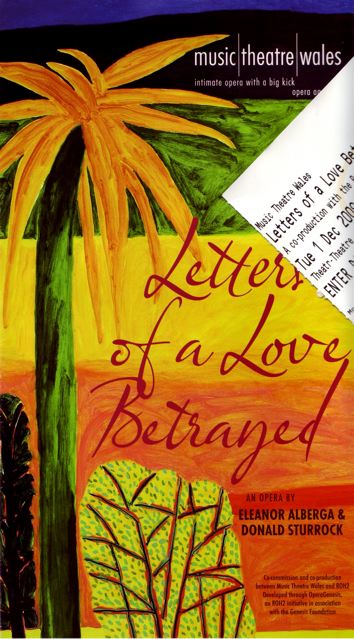
Program and ticket stub for Letters of a Love Betrayed

You see, I was born into that endangered social stratum known as the working class. It is an origin of which I am mindful, though neither proud nor ashamed. At least, I am not ashamed of it now. I used to be as thrilled about it as Ann Blythโ€™s character in Mildred Pierce, even though my parents bore a closer resemblance to Lana Turner in Imitation of Lifeโ€”that is, too busy to notice that living up to their aspirations left their offspring in the dust they raised as they tried to shake the dirt clinging to their roots. At any rate, stuck in that cloud of dust was I, an asthmatic kid who couldnโ€™t afford to hold his breath at the off chance of parental attention.

Not to suffocate under the rubble of post-Second World War Germany, my parents had to put their noses far closer to the proverbial grindstone than I ever did. Their generation, aided by American interests, pulled off the Wirtschaftswunder or โ€œeconomic miracle,โ€ a sleight-of-hands-on approach to the lasting trauma caused by total war and final solution, the coming to terms with which would have required equipment far more difficult to handle than shovel and broom.

I am not so disingenuous as to pass off my staying put as a form of sit-down strike, of giving the clean-and-cover-up efforts of my parentsโ€™ generation the spotless finger; but apart from the months I ill served my country working as a hospital orderly or the hours I spent cleaning apartments in New York City to help finance my college education, I remained sedentary for much of my life.

So far, itโ€™s been a life spent lost in thoughts, ensconced in writing, and plunked down for performances that artists work on studiously for our delight and instructionโ€”the kind of delight my father found it difficult to accept as serious work and the instruction he thought less of than the empirical knowledge that, along with calluses, is the badge and perquisite of the experience-hardened laborer.

I suppose it is easier for the workerโ€”not to be equated here with the impecuniousโ€”to aspire to material possessions instead of culture and learning, since exposing yourself to something that poses a challenge rather than promising instant gratification requires still more work on the part of those who have little time and less energy to spare.

Now, my comparatively indolent existence permits me to spare that time; yet, as if my conscience and buttocks alike had been shaped by Protestant work ethics, I often feel rather uncomfortable. Iโ€™m not one to pooh-pooh the benefits of resting on oneโ€™s Popo (as dainty Germans call the posterior); but, there is nothing like wriggling in my seat in hopes of improving my mind to convince me that the callusesโ€”and Iโ€”belong elsewhere.

I had that impression sitting through Letters of a Love Betrayed, a new opera by Eleanor Alberga (libretto by Donald Sturrock). Reading about it, I was intrigued by the promised fusion of Latin rhythms and a neo-Gothic romance based on a story by Isabel Allende, but felt let down by a score that to my untrained ear sounded forbidding, unmelodious, and, worse still, forgettable. Perhaps, the perceived cacophony was the result of a clanging together of too many stereotypes. Whatever melo- Letters possesses is all in the drama; derivative and contrived, it is creakier than a chair that has been squirmed out of too often.

I didnโ€™t get it. I didnโ€™t like it. I felt like a tired, vitamin deprived miner lured into a soup kitchen of the arts, the drama being a concession to what is assumed to be his tastes as he is being fed a presumably healthy diet with a none too musical spoon.

As I sat down again to express my thoughts on the matter of whatโ€™s the matter with me, I kept wondering whether what I was responding to so angrily was utter musical rubbish, dreck worse than the grime to which I chose not to expose myself, or whether my inability to open my mind was dictated to me by my past, a past unfolding in letters of a class betrayed.

โ€œI’ve Got a Little Listโ€ (and the Hot Mikado Isnโ€™t on It)

At the risk of sounding like a loser at a Vegas spelling bee, I am a serious eye roller. Like a roulette wheel on an off night, each circulation marks the extent of my displeasure. The other night, I was really taking my peepers for a spin. Judging from such ocular proof, you might have thought that more than eyeballs were about to roll. Indeed, it seemed as if I were going to face the Lord High Executioner himself. Instead, we were merely going to a production of The Hot Mikado. I just couldnโ€™t warm to the idea of going camp on a classic that seems least in need of burlesqueโ€”or Berlesques, for that matter. Not that this stopped middle-aged troupers like Jack Benny, Bob Hope, and Groucho Marx to play โ€œThree Little Maidsโ€ (as part of a war relief benefit broadcast); but, at least, those tuning in were spared the visuals.

If I was less than enthusiastic, it was mainly on account of Charleyโ€™s Aunt. That dubious Victor/Victorian dowager had way too many nephewsโ€”and โ€œthey’d none of them be missed, they’d none of them be missed.โ€ Cross-dressing has long been on the none too little list of circus and sideshow acts that are more of a source of irritation than of hilarity. One strategically placed banana peel does more for me than two oranges nestling in a bed of chest hair. Itโ€™s a fruitโ€™s prerogative.

The origins of my aversion date back to the time when I began to realize that what I needed to get off my chest one day was something other than the fur I was not destined to grow in profusion. I was about twelve. Still without a costume on the morning of the annual school carnival, I let my older sister, who was as resourceful as she was bossy, talk me into wearing one of the skirts she had long discarded in favor of rather too tight-fitting jeans. Being dressed in my sisterโ€™s clothes was awkward for me, considering that I was fairly confused about my gender to begin with, certain only about the one to which I was drawn. More than a skirt was about to come out of the closet, and I was not equipped to deal with it.

Responding to my calculatedly nonchalant remark that the costume was some kind of last-minute ersatz, our smug, self-loving English teacher, Herr Julius, told the assembled class that, during carnival, folks tended to reveal what they secretly longed to be, which, apparently, went well beyond the common desire not to be humiliated. No wonder Herr Julius did not bother to don a mask other than the one with which he confronted us all the scholastic year round.

Matters were complicated further by my wayward anatomy. Letโ€™s just say that it didnโ€™t require oranges to make a fairly convincing girl out of me; I was equipped with fleshy protuberances that earned me the sobriquet โ€œbattle of the sexes.โ€ I wondered whether I was destined to shroud myself in one pretense in order to drop another. That, in a pair of coconut shells, is why cross-dressers and any such La Cage faux dollies were never to become my bag. And Iโ€™ve got a lot of baggage.

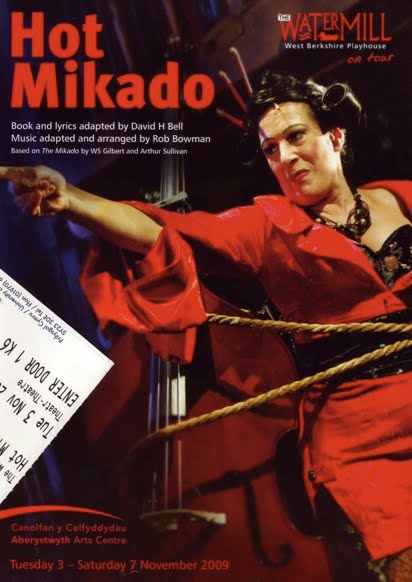
What has that to do with The Hot Mikado, the show I was so reluctant to clap my eyes on? As it turns out, not very much. I had been mistaken about the gender of the performer playing Katisha, the character on the poster (pictured above) that was advertising the Watermill production I caught at Aberystwyth Arts Centre.

Far from being some newfangled cabaret act, The Hot Mikado is seventy years old this year. Appropriating presumably WASPish entertainment for a younger and less exclusive audience, it was first performed in 1939 with an all-black, extravagantly decked out cast headed by the legendary Bill โ€œBojanglesโ€ Robinson in the title role. The currently touring Watermill productionโ€”which is soon to conclude in Girona, Spainโ€”updates the carnivalesque spectacle in retro-1980s colors, with Manga and movie inspired costumes, as well as assorted references to Susan Boyle and British politics. The music is still jazz-infused Gilbert and Sullivan.

Set โ€œsomewhere in Japanโ€ and produced at a time when Mr. Moto was forced to take an extended Vacation, the anachronistic Hot Mikado was all jitterbug without being bugged down by pre-war jitters. It is outlandish rather than freakish, amalgamated rather than discordant, qualities reassuring to anyone who has ever felt mixed up or unable to mix. A few bum notes aside, the production was hardly an occasion for any prolonged orbiting of orbs. The joyous spectacle of it kept even my mindโ€™s eye from rolling, from running over the bones, funny or otherwise, that tend to tumble out of this Fibber McGeean closet of mine . . .

Related recordings
Greek war relief special (8 February 1941), featuring Frank Morgan, Bob Hope, Jack Benny and Groucho Marx singing songs from The Mikado
โ€œHollywood Mikadoโ€, starring Fred Allen (11 May 1947)
Chicago Theater production of โ€œThe Mikadoโ€ (22 October 1949)
The Railroad Hour production of โ€œThe Mikadoโ€ (5 December 1949

Gone South . . . and Very Pacific: Broadway on an Off Day

I suppose I am back in my element (earth, mingled with dust), being that I can reminisce at last about my recent trip to New York City from the comfort of my own patch of terra firma across the pond. Okay, so I never managed to turn writing into a living; but I sure can turn life into writingโ€”provided I can go on about past experiences once I am good and ready, once that which has been going on and gone through my mind is bona fide bygone. Not one to multitask, I somehow cannot both be living and writing simultaneously, which is why Twitter is not for me. I am not cut out to be an on-the-spot correspondent. You wonโ€™t catch me with my finger on the pulse of anything yet living other than in my thoughts where, quickened by imagination, anything presumably dead and gone is readily revived.

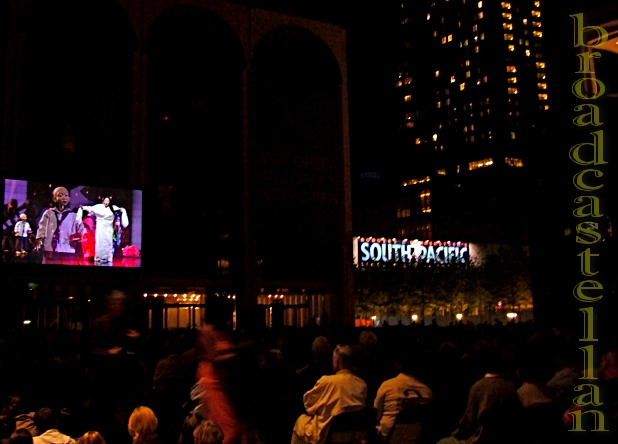
Perhaps, going live is not the same as being in the moment; at least, performances need not be, by virtue of being live, worth a moment of my time. For the record (and this is a new record to me, for I am about to change my tune): canned performances are not necessarily inferior to live ones. At least I thought so a few weeks ago while watching a recorded broadcast of a dazzling Metropolitan Opera production of Madama Butterfly, screened on the plaza in front of the building housing that venerable institution.

There I was (leaning against a trash can, no less), joined by hundreds of strangers, to take in, free of charge, the musical equivalent of cured meat, a pickled delicacy shared out to lure those partaking into the venue to shell out serious money for the supposedly real thing. Maybe Iโ€™ll think differently tomorrow at the local cinema, where I will be catching a high definition broadcast of the current National Theatre production of Shakespeareโ€™s Allโ€™s Well That Ends Well, live from London; but I sure realized that live is not to be confused with lively when I went to see South Pacific at New Yorkโ€™s Lincoln Center Theater, just a few feet from the screen where Madama Butterfly had flickered before my teary eyes.

South Pacific left my peepers dry, even though I was on the brink of welling up when I reminded myself that I had let go of more than $90 for a discount ticket to for the dubious privilege of beholding said spectacle. What I witnessed was Broadway on an off night, some less than โ€œEnchanted Eveningโ€ during which the cast went through the motions like Zombies on sabbatical. I knew as much when I opened my playbill to discover one of those white slips that, on the Great White Way, are equivalent to a pink one: Paulo Szot, the celebrated lead, had been replaced for the evening (and several weeks to come) by one William Michals.

Turns out, Mr. Michals had all the charm and thespian animation of a Bela Lugosi. Not that Laura Osnes (as Nellie Forbush) was out-Mitziying Ms. Gaynor. She did not as much try to wash that man right outa her hair as dispose of him with a purple rinse. As I remarked to my fellow onlooker, the pair had less going on between them as might be generated by a preschoolerโ€™s chemistry set.

Almost everything about this potentially engrossing play seemed to have been rehashed on a desperately reduced flame. I, for one, was boiling; it wasnโ€™t โ€œHappy Talkโ€ youโ€™d have overheard had you been eavesdropping on us as we left the theater. Sure, the production had been running for a year and a half and wasnโ€™t exactly โ€œYounger Than Springtimeโ€; but the Pacific, never more deserving of the name, has rarely felt quite this tepid. A rousing rendition of โ€œThere Is Nothinโ€™ Like a Dameโ€ and the still-spirited performance of Danny Burstein (as Billis) aside, the promise of Bali Haโ€™i never left anyone feeling quite this low . . .

โ€œ. . . from a civilized land called Walesโ€: A Puzzlement Involving The King and I

I rose before the sun, and ran on deck to catch an early glimpse of the strange land we were nearing; and as I peered eagerly, not through mist and haze, but straight into the clear, bright, many-tinted ether, there came the first faint, tremulous blush of dawn, behind her rosy veil [ . . .]. A vision of comfort and gladness, that tropical March morning, genial as a July dawn in my own less ardent clime; but the memory of two round, tender arms, and two little dimpled hands, that so lately had made themselves loving fetters round my neck, in the vain hope of holding mamma fast, blinded my outlook; and as, with a nervous tremor and a rude jerk, we came to anchor there, so with a shock and a tremor I came to my hard realities.
With those words, capturing her first impression and anticipation of a โ€œstrange landโ€ as, on 15 March 1862, it came into partial viewโ€”the โ€œoutlookโ€ being โ€œblindedโ€โ€”aboard the steamer Chow Phya, Anna Harriette Leonowens commenced The English Governess at the Siamese Court (1870), the โ€œRecollections of Six Years in the Royal Palace at Bangkok.โ€ The account of her experience was to be followed up by a sensational sequel, Romance of the Harem (1872), both of which volumes became the source for a bestselling novel, Margaret Landonโ€™s Anna and the King of Siam (1944), several film and television adaptations, as well as the enduringly crowd-pleasing musical The King and I.

Conceived for musical comedy star Gertrude Lawrence, the titular โ€œIโ€ is currently impersonated by Shona Lindsay, who, until the end of August 2009, stars in the handsomely designed Aberystwyth Arts Centre Summer Musical Production of the Rodgers and Hammersteinโ€™s classic.

The title of the musical personalizes the story, at once suggesting authenticity and acknowledging bias. Just as it was meant to signal the true star of the original productionโ€”until Yul Brynner stole the showโ€”it seems to fix the perspective, assuming that we, the audience, see Siam and read its ruler through Annaโ€™s eyes. And yet, what makes The King and I something truly wonderfulโ€”and rather more complex than a one-sided missionaryโ€™s taleโ€”is that we get to know and understand not only the Western governess, but the proud โ€œLord and Masterโ€ and his daring slave Tuptim.

Instead of accepting Anna as model or guide, we can all become the โ€œIโ€ in this story of identity, otherness and oppression. Tuptimโ€™s experience, in particular, resonates with anyone who, like myself, has ever been compelled, metaphorically speaking, to โ€œkiss in a shadow,โ€ to love without enjoying equality or protection under the law. Tuptimโ€™s readily translatable story, which has been rejected as fictive and insensitive, is emotionally rather than culturally true.

โ€œTruth is often stranger than fiction,โ€ Leonowens remarked in her preface to Romance of the Harem, insisting on the veracity of her account. Truth is, truth is no stranger to fiction. All history is narrative and, as such, fictionโ€”that is, it is made up, however authentic the fabric, and woven into logical and intelligible patterns. Whoever determines or imposes such patternsโ€”the historian, the novelist, the reporterโ€”is responsible for selecting, evaluating, and shaping a story that, in turn, is capable of shaping us.

Tuptimโ€™s adaptation of Uncle Tomโ€™s Cabin, which strikes us at first strange and laughableโ€”then uncanny and eerily interchangeableโ€”in its inauthentic, allegorical retelling of a fiction that not only made but changed history, is an explanation of and validation for Rodgers and Hammersteinโ€™s sentimental formula. Through the estrangement from the historically and culturally familiar, strange characters become familiar to us, just Leonowens may have been aided rather than mislead by an โ€œoutlookโ€ that was โ€œblindedโ€ by the intimate knowledge of a childโ€™s love.

Strange it was, then, to have historicity or nationality thrust upon me as Anna exclaims, in her undelivered speech to the King, that she hails โ€œfrom a civilized land called Wales.โ€ It was a claim made by Leonowens herself and propagated in accounts like Mrs. Leonowens by John MacNaughton (1915); yet, according to Susan Brownโ€™s โ€œAlternatives to the Missionary Position: Anna Leonowens as Victorian Travel Writerโ€ (1995), โ€œno evidence supportsโ€ the assertion that Leonowens was raised or educated in Wales.

Still, there was an audible if politely subdued cheer in the Aberystwyth Arts Centre auditorium as Anna revealed her fictive origins to us. Granted, I may be more suspicious of nationalism than I am of globalization; but to define Leonowensโ€™s experience with and derive a sense of identity from a singleโ€”and rather ironic reference to homeโ€”seems strangely out of place, considering that the play encourages us to examine ourselves in the reflection or refraction of another culture, however counterfeit or vague. Beside, unlike last yearโ€™s miscast Eliza (in the Arts Centreโ€™s production of My Fair Lady), Anna, as interpreted by Ms. Lindsay, has no trace of a Welsh accent.

As readers and theatergoers, we have been โ€œgetting to know you,โ€ Anna Leonowens, for nearly one and a half centuries now; but the various (auto)biographical accounts are so inconclusive and diverging that it seems futile to insist on โ€œgetting to know all about you,โ€ no matter now much the quest for verifiable truths might be our โ€œcup of tea.โ€ What is a โ€œpuzzlementโ€ to the historians is also the key to the musical, mythical kingdom, an understood realm in which understanding lies beyond the finite boundaries of the factual.


Related writings
“By [David], she’s got it”; or, To Be Fair About the Lady
Delayed Exposure: A Man, a Monument, and a Musical

Related recordings
โ€œMeet Gertrude Lawrence,โ€ Biography in Sound (23 January 1955)
Hear It Now (25 May 1951), which includes recorded auditions for the role of Prince Chulalongkorn in The King and I

The Ironed-Out Curtain; or, From Russia With Love Songs

“I’m in love with a fairy tale / Even though it hurts.” It was with these lyrics, a fiddle, and a disarming smile that Norwegian delegate Alexander Rybak came to be voted winner of the 54th Eurovision Song Contestโ€”an annual spectacle-cum-diplomatic mission reputed to be the worldโ€™s most-watched non-sporting event on television. However intended, the lines aptly capture the attitude of many Europeans toward the contest, just as the entries in the ever expanding competition are a reflection of all that is exasperating, perverse, and wonderful about European Unityโ€”a leveling of cultures for the sake of political stability, national security, and economic opportunity.
This year, forty-two countries qualified for the semi-finales, among them Albania, Andorra, and Azerbaijan, while former, traditional contestants Austria and Italy have opted out of participating in the competition. The friction between East and West has become more pronounced in recent years, leaving a frustrated West to contribute awkwardly self-conscious throwaway songs that further diminished the chance of a winning song from, say, Ireland (a seven-time winner), the United Kingdom, or Germany. It was as if the West chose to cloak itself in a mantle of irony to set itself garishly and haughtily apart from the closely-knit, sheer impenetrable post-Iron curtain it perceived to be obstructing Eurovision.

The collapse of the Soviet Union brought about a shift in the voting, with viewers of Eastern European nations favoring the songs representing neighboring countries, since voting for the representative of oneโ€™s own country is not permitted. For the West, the contest has become both an embarrassment and a liability (the United Kingdom, Germany, France, and Spain being the chief sponsors of the event and guaranteed a place in the finale). The chance of winning the contest based on merit or popularity became tantamount to wishing for a happily-ever-after. Until last night.

This yearโ€™s live event was hosted by Russia, the previous winning nation. Although Russiaโ€™s 2008 victory was not necessarily undeserved, the bloc voting had become so flagrant as to call any success of an Eastern European act into question. The thought that the triumph of the East was by now all but certain became so irksome to organizers and broadcasters in the United Kingdom that long-time commentator Terry Wogan withdrew from the contest and musical composer Andrew Lloyd Webber stepped in to prevent Britain from suffering another abject yet just defeat.

To increase the chances, voting procedures were changed once again, this time combining popular vote (via phone and instant messaging) with the vote of a presumably less partial jury of musical experts. In a reversal of the dreaded trend, the British entry finished fifth, and that despite Lloyd Webberโ€™s low-voltage power ballad and a somewhat flawed performance by the heretofore unknown Jade Ewen. Still, the United Kingdom may have regained the respect of the jurors by deciding to put an end to defeatist silliness and to reconsider the meaning of โ€œSongโ€ in โ€œEurovision Song Contest.โ€

Inspired perhaps by the participation of Baron Lloyd-Webber, the overall quality of the songs and the performers was superior to the dross and folly to which the pop-cultural event had been reduced in the 21st century. Sure, Alexander Rybak was born in the former Soviet Unionโ€”but there is no doubt that Norway won because of the exuberance, charm, and catchiness of its entry, just as neighboring Finland rightly came in last.

โ€œI donโ€™t care if I lose my mind / Iโ€™m already cursed,โ€ the lyrics continue. Thanks to last nightโ€™s event, those words no longer reflect the attitude of Western contestants.

Stepchildren Rejoice; or, Fetching a Grand Ball

Last night, I felt like an old queen. Granted, that is not an uncommon feeling for me; but the Queen in this case was none other than Victoria, who, in the last years of her reign, enjoyed partaking of live opera without actually having to leave for the theater at which it was presented. Her royal box was a contraption called the Electrophone, a special telephone service that connected subscribers with the theaters from which the sounds of music and drama could be appreciated while being seated in whichever armchair one designated as a listening post. Today, we may be accustomed to liveโ€”or, wardrobe malfunctions notwithstanding, very nearly liveโ€”broadcasts of sounds as well as images; but last nightโ€™s event felt as new and exciting to me as it must have been picking up the electrophone or dialing in to those experimental theater relays during the 1890s and 1920s, respectively.
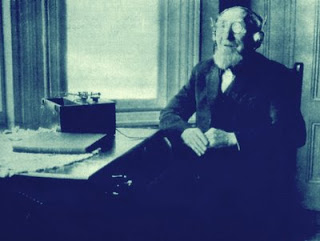
The caption for the above photograph, taken from the 3rd volume of Radio Broadcast (May to October 1923) reads: โ€œChristian Strohm traveled from Oldes Leben [wherever that might be] to Weimar, Germany, sixty-four years ago to hear the first presentation of an opera composed by Wagner. This year, he heard on a crystal set the same music, broadcasted from WIP, Philadelphia.โ€ What, I wonder, was more thrilling to Herr Strohm or to Queen Victoria: the memory of past pleasures or the reality of present technology?

There we were, gathered at a movie house well over three thousand miles away from the Metropolitan Opera in New York City, taking in a live presentation of Rossiniโ€™s La Cenerentola (based on the fairy tale Cinderella or Aschenputtel, its meaner, dirtier, German ancestor, which renowned child psychologist Bruno Bettelheim rightly preferred over the dainty French and glossy American versions). Our local arts center cinema is the first independent movie theater in Wales to subscribe to those high definition broadcasts from the Met (or elsewhere); and, with the exception of the fact that the cameras fail to capture scenes set in near darkness, the transmission was received without a glitch.

True, I wasnโ€™t seated in my favorite chair. I was in an auditorium, with a few dozen others who had come into town for the occasion, presumably undernourished stepchildren of the great cultural centers of the world. This far-fetched ball was a theatrical experience for which one dresses up (and I, for one, enjoys to do so), at which one meets and mingles at intermission.

The last time I saw a theatrical adaptation of Cinderella I was being squirted by a water gun. This time, I was sipping a glass of wine (included in the price of admission). I was very pleased to learn that, based upon the reception, the local cinema is going to book the entire season of opera broadcasts, beginning in October 2009 with Tosca, followed by Aida and Turandot. Tear your eyes out Clorinda and Tisbe. Every Cinderella has her dayโ€”and every dreaded midnight is over in a flash . . .


Related writings
My Evening with Queen Victoria
โ€œNow on the Air: โ€˜Down the Wiresโ€™โ€ (on the Electrophone)
โ€œโ€˜Oh no he isnโ€™tโ€™ (โ€˜Oh yes he isโ€™): Mickey Rooney in Bristolโ€ (in Cinderella)

Many Returns, Mostly Happy: Toscanini at NBC

“I want you to go to Milan and get him. The American radio listener deserves the very best in music. All we can lose is a few weeks of your time and the expenses of the trip. No more cables. Get on a boat.”

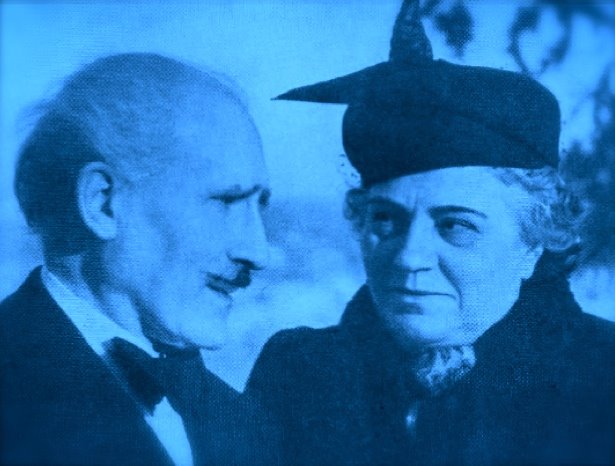
Toscanini and his wife, Carla De Martini

That is what, back in the fall of 1936, RCA president and NBC chairman David Sarnoff told New York Post music critic Samuel Chotzinoff, whom Sarnoff made musical director at NBC. The man that โ€œChotzyโ€ was to go “get” was none other than the legendary Arturo Toscanini, born on this day, 25 March, in 1867. Earlier that year, Toscanini had announced his retirement from the New York Philharmonic Symphony Orchestra and, on 1 March 1936, he had conducted what he meant to be his final radio concert as guest conductor of the General Motors Symphony. Nearly seventy, Toscanini could hardly be expected to jump at the opportunity of raising his baton in a series of weekly broadcasts; but that is just what General Sarnoff had in mind.

Chotzinoff, who was a friend of the temperamental Maestro and later recalled his career in the somewhat less than faithful Intimate Portrait, sailed for Europe to make Toscanini an offer he could not refuse. He was promised an orchestra โ€œhand-picked from the finest virtuosi available,โ€ along with the enticing sum of $40,000, and the added perk to have his income tax paid by the network.

According to radio historian Thomas DeLong, it took a shrewd businesswoman, Toscaniniโ€™s wife (pictured above with her husband), to convince Arturo that it was worth his while to return to the US. The best part of the deal, though, was getting away from Mussolini, whom Toscanini openly despised.

The first of the Saturday evening concerts, broadcast live from studio 8-H at Radio City, New York, was heard on Christmas in 1937. As Francis Chase wrote in the October 1938 issue of Radio Stars, a studio audience of

over 1,400 persons sat breathless as the white-haired, flashing-eyed, dynamic little figure of Toscanini mounted the podium before one of the greatest symphony orchestras ever assembled; certainly the greatest ever presented wholly for the radio audience. ย The finest instrumentalists from many great American orchestras sat beneath the master’s baton, while in the brilliant audience, listeners hardly breathed. ย There was not the faintest rustle of a program (so that no slightest sound should mar the transmission, programs had been printed on silk).

Less attention was paid to the studio acoustics, which, as B. H. Haggin argues, were โ€œunresonantly dry, flat, hard and made airlessly tight by the audience which filled the studio.โ€ That did not stop the perfectionist from demanding the best from his orchestra, and, judging from the rehearsal recordings shared on NBC’s Biography in Sound tribute that aired on the day after Toscanini died, the Maestro was fierce in his criticism. โ€œDo you believe that I am crazy?โ€ he asked the performers, not waiting for a reply. “No,” he insisted, “sensitive.”

Year after year, the aging and only very gradually mellowed Toscanini vowed to retireโ€”but for seventeen seasons he returned to the studio until, on 4 April 1954, he stepped from the podium for the last time; having faltered and dropped his baton during a performance temporarily taken off the air and replaced with recorded music, Toscanini walked off before the orchestra had played the final chord. He was eighty-seven years old.

The stick with which he conducted the NBC orchestra (if not always too well), must have been a kind of crutch to Toscanini. It enabled him to hold together a body of artists at an age when most men can barely keep their own from falling apart.

Related recordings
โ€œThe Man Behind the Legend: A Tribute to Arturo Toscanini,โ€ Biography in Sound (22 January 1957)
Beethoven, Symphony No. 5, NBC Symphony Orchestra, (probably 11 November) 1939