His Words, Her Voice: Errol Flynn, Olivia de Havilland, and the Resonance of โ€œEnoughโ€

“Oh, I have seen enough and done enough and been places enough and livened my senses enough and dulled my senses enough and probed enough and laughed enough and wept more than most people would suspect.” This line, as long and plodding as a life gone wearisome, was recently uttered by screen legend Olivia de Havilland, now in her 90s. You may well think that, at her age, she had reason enough for saying as much; but Ms. de Havilland was not reminiscing about her own experiences in and beyond Hollywood. She was reciting the words of one of her most virile, dashing, and troubled contemporaries: Errol Flynn, who was born one hundred years ago, on 20 June 1909, and apparently had โ€œenoughโ€ of it all before he turned fifty, a milestone he did not live to enjoy.

In her brief talk with BBC Radio 3โ€™s Night Waves host Matthew Sweet, de Havilland talks candidly, yet ever so decorously, about her swash-buckled, devil-may-careworn co-star, about his temperament, his aspirations, his fears. Hers is an aged voice that has a tone of knowing in it. A mellow, benevolent voice that bespeaks understanding. A voice that comforts in its conveyance not of weariness but of awareness, a life well lived and not yet spent.

I could listen for hours to such a voice. I might not care for, learn from or morally improve by hearing what is saidโ€”but the timbre gives a meaning to โ€œenoughโ€ that the forty-something Flynn never lived to express or have impressed upon him. It is the โ€œenoughโ€ of serenity, the โ€œenoughโ€ of gratitude, the โ€œenoughโ€ of not asking for more and yet not asking less . . . or stop asking at all.

My own life is marked and marred by a certain lack of inquisitiveness, it sometimes strikes me. Being blasรฉ is one of the first masks we don not to let on that we donโ€™t know enough, that we know as much, but donโ€™t know enough simply to ask. I wore such a mask of vainglory when I set out in life, the dullest of lives it seemed to me. My fellow employees had a nickname for me then.

It was my moustache that inspired it. Errol Flynn they called me. Little did they know that, even at age 20, I felt that I had โ€œenoughโ€ even though I so keenly felt that I had not had much of anything at all. I simply had enough of not even coming close to the glass of which I might one day have had my fill; but, for three long years, I did not have sense enough to leave that dulling life behind. No voice could talk me out of that barren existence but my own.

It was not easy for me to regain a sense of curiosity; it was as if the pores beneath the mask had been clogged after being concealed so long, my skin no longer alive to the breeze and its promises. I had brushed off more than I dared to absorb. One morning, I took a walk around Central Park with one of Errol Flynnโ€™s leading ladies, Viveca Lindfors, and was neither startled nor thrilled; nor did I not seize the opportunity to inquire about her past or permit her to draw me into her presence as she offered me advice and assistance.

Instead, I preserved the sound of her voice on the tape of my answering machineโ€”like a butterfly beyond the magic of flightโ€”her words saying that she had enough of me was dispensing of my humble services as her dog walker. I am left with canned breath, quite beyond the chance of living what might have been a great story.

Enough of my regrets. I can only hope that, when next I feel that I had โ€œenough,โ€ the word will sound as if it were uttered in what I shall henceforth refer to as a de Havilland sense, with dignity, insight and calmโ€”and an acceptance that is not resignation.
Dwelling on the Subject: The House in the Child

My future study, getting a make-over

How insignificant, at the moment, seem the influences of the sensible things which are tossed and fall and lie about us, so, or so, in the environment of early childhood. How indelibly, as we afterwards discover, they affect us; with what capricious attractions and associations they figure themselves on the white paper, the smooth wax, of our ingenuous souls, as โ€œwith lead in the rock for ever,โ€ giving form and feature, and as it were assigned house-room in our memory, to early experiences of feeling and thought, which abide with us ever afterwards, thus, and not otherwise.

It was Walter Paterโ€™s โ€œThe Child in the Houseโ€ (1878) that gave me the idea for a title; but it was my history of habitation that made me write The House in the Child, a fictionalized autobiography. I received some sort of graduate prize for submitting a fragment of it, a rather generous acknowledgement of the pain it took to attempt its constructionโ€”and fail. Now that I am quite preoccupied with the impending moveโ€”a subject that, to recycle a line from Charlotte Perkins Gilmanโ€™s โ€œYellow Wallpaperโ€ (1892),ย  โ€œdwells in my mind soโ€โ€”it occurred to me just how long the concept of dwelling has been on my mind, that maze of memories Pater calls the brain-building.

The House in the Child was never finished; and that is just as it should be, for the house was never finished with me. The foundation for the narrative was a sense of dislocation and the absence of private spaceโ€”living abroad, with a dinner table as a study, wondering what โ€œhomeโ€ meant. Thinking about the past, it came home to me that my family had been destroyed by the ambition of building that house. And yet, retreating into my own room (a luxury denied me during much of my adulthood) and the hidden realm of thought, I had done so little to keep the architecture of domesticity from falling apart.

Writing about myselfโ€”this most self-serving of literary endeavorsโ€”offered me a chance at revision, a chance to think of myself as someone who was not always thinking of himself first. I was not this child, but I might have been:

She points at the colorful map drawn neatly with crayonsโ€”red, blue, and green. Mostly red, though, because it makes everything look more significant and urgent somehow, like a warning label. On the map, the house looks like a castle, with chambers and vaults, corridors and hidden passageways. Everythingโ€™s angular and crooked, like in a real maze. A map can make any place important even if it really needs no map at all. The new house is much too small, reallyโ€”too plain, straight, and square. Nobody gets lost in a bungalow. But this drawing was not supposed to make it all clearer and plainer. It was meant to add the mystery and adventure the whole place lacked from the start.

There is still so much to unpack; but she needs to rest for a moment, anyway; and so she sits right here, glancing at this piece of paper.

โ€œEverythingโ€™s set up nicely, donโ€™t you think? You kids will love it. No more fighting about space and privacy, no more arguing about what goes where. Now, let me see.โ€

She plays the game well, slowly following the paths with her finger, studying the map as if it really were the floor plan to an enormous fortress.

Maybe she enjoys this moment because she is just as disenchanted with her new home as . . .

โ€œAh, here we are. This is your room. Your sisterโ€™s room is next to it . . . right here, see? And somewhere down here, in the basement, is the workroom. And you know whoโ€™s going to spend most of his free time in there. Then there is our bedroom, straight across this hallway, here. This is what we always wanted, isnโ€™t it? Weโ€™re all going to have our own rooms now.โ€

All except she. She does not have a place to herself, like we all do. What is her place? Where can she go to close the door? She has to sleep with him at night.

Maybe thatโ€™s why she keeps staring at the map, examining it as if she were looking for a vacant space to rest her eyes. Maybe she holds on to this plan because it promises a hiding place not to be found elsewhereโ€”not provided for in our house. Maybe thatโ€™s why her finger keeps running up and down the paths, back and forth, back and forth, like a mouse trapped in a labyrinth.

Finally, she lets go, gets up, and turns out the light.

โ€œYou can always come here, Mutti.โ€ But she has already closed the doorโ€”and she did not take the map . . .

โ€œI pulled and she shookโ€: A Dรฉcor to Try Oneโ€™s Decorum

My dog, Montague, demonstrating his wallpaper training in response to my stripping

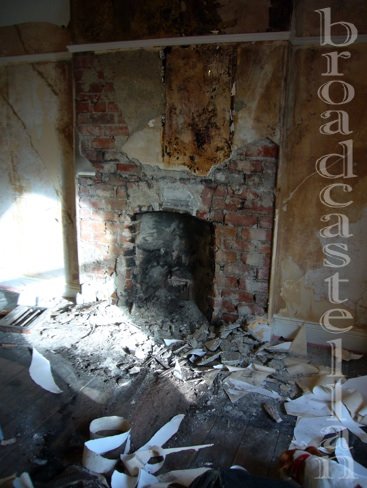
All right, so Iโ€™m sounding like an aging burlesque queen about to toss her tassels and turn in the G-string that is a turn-on no longerโ€”but, by Gypsy, I am tired of stripping. Wallpaper, I mean. This old Mazeppa has nothing but a scraper for a gimmick, and the only hand she ever got for all her grinding is a mighty sore one. I just could not live with it, though, that dreadful patternโ€”having it stare me down in defiance, berate me for letting myself be defeated by all the work that needs doing in the old house we plan on inhabiting before long. The idea (not mine, mind) was to paint over itโ€”but I scratched that faster than I could scrape. It might peep out from behind the paint, that ghastly design. It might start to creep up on me if I donโ€™t get at it firstโ€”just like in that most famous of all interior decorating nightmares, Charlotte Perkins Gilmanโ€™s โ€œYellow Wallpaperโ€ (1892). To date, Gilmanโ€™s feminist tale of terror is the most convincing argument for taking it all off.

To the tormented soul telling the story, the paper she finds in her roomโ€”the room in which she is meant to restโ€”becomes a โ€œconstant irritant.โ€ Within a few short weeks of studying it, for want of the intellectual activity denied to her, she is driven to the distraction once classified as hysteria:

The color is hideous enough, and unreliable enough, and infuriating enough, but the pattern is torturing.ย 

You think you have mastered it, but just as you get well underway in following, it turns a back-somersault and there you are. It slaps you in the face, knocks you down, and tramples upon you. It is like a bad dream.

Unlike the blank, โ€œdeadโ€ paper on which she writes in secret, the wallpaper is teeming with life, just below the surface. It is the surface of conventions that Gilman tears down with a vengeance:

This bed will not move!

I tried to lift and push it until I was lame, and then I got so angry I bit off a little piece at one cornerโ€”but it hurt my teeth.

Then I peeled off all the paper I could reach standing on the floor. It sticks horribly and the pattern just enjoys it! All those strangled heads and bulbous eyes and waddling fungus growths just shriek with derision!

When Gilman’s story was adapted for US radio, listeners to CBSโ€™s Suspense program may have felt rather differently about this schizophrenic battle when, in a broadcast that aired on 29 July 1948, it was enacted by Agnes Moorehead, who, in tackling the part, had to struggle as well with our memories of the neurotic and disagreeable Mrs. Elbert Stevenson, her most famous Suspense role. โ€œSorry, Wrong Paper,โ€ I kept thinking as I witnessed the disintegration. And yet, as the hard and cutting echoes of Mrs. Stevenson suggest, paper can beat both rock and scissorsโ€”a thought that filled me with renewed terror.

โ€œIt dwells in my mind so!โ€ Gilmanโ€™s character remarks, tellingly, about the dreaded wall covering. The dwelling has overmastered the dweller, like a wild animal resisting domestication, a beast beyond paper training. The prospect of being dominated or possessed in this way by a questionable dรฉcor is a scenario horrifying enough for me to put penknife to paper . . . and keep stripping.

"Milkman" in the Attic

โ€œLook, sonny, weโ€™re up here for work. Weโ€™ve put this attic off, and put this attic off. Now that weโ€™re here, letโ€™s make every minute count.โ€ That was the voice of reason Rush Gookโ€”and several million radio listeners besidesโ€”heard on the day (18 August 1942, to be precise) that mom Sade decided it was time to tackle that stuffy space under the roof of the โ€œsmall house half-way up in the next block.โ€

Our attic, revealing the age of our house

As anyone familiar with Paul Rhymerโ€™s Vic and Sade could guess right off, there was more room for doubt than reason that the task would be accomplished, and that, when the brief visit with the home folks was over, said space would be any more disorganized than it was before the job got underway. You could expect more order, method and sanity sticking your head into Fibber McGeeโ€™s closet.

Now, Iโ€™m not being etymologically sound here, but it is probably no coincidence that attics are just a single consonant removed from anticsโ€”and that is just what you should expect to find while up there, even if it is antiques youโ€™re after.

Our new old house has not one but two attic spacesโ€”and in the smaller of these we found ourselves confronted with some kind of time capsule. Only, it wasnโ€™t quite the right time.

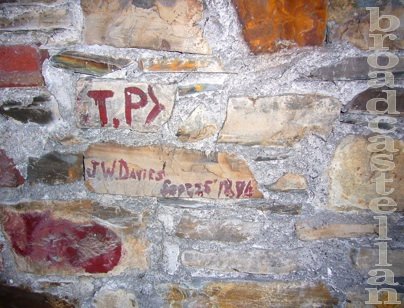
The graffiti on the wall suggests that construction was pretty much completed by September 1896, which was probably the last time the roof space was clutter free. Not that I want it to be barren of memories, mind.

Given the age of the house, I was kind of hoping for a family skeleton. Romantic novels of the Victorian age suggest that the darkest secrets are best kept just below the roof, rather than being crammed into the proverbial closet. Jane Eyre’s Bertha Mason comes to mind, and that seminal study on the subject (Gilbert and Gubarโ€™s Madwoman in the Attic).

The Benny Hill album

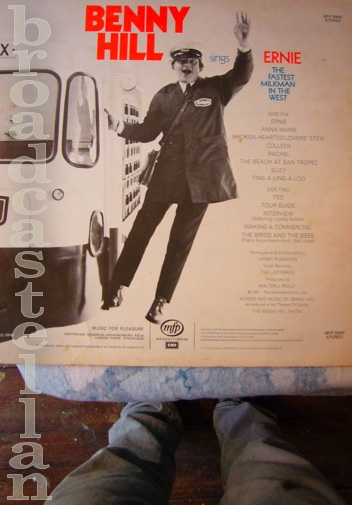
Instead, we were treated to โ€œBenny Hill Sings โ€˜Ernie, the Fastest Milkman in the West.โ€™” Not exactly a Victorian treasureโ€”but at least Ernieโ€™s story has the proper romantic ingredients: lust, rivalry, and premature death (a โ€œstale pork pie caught him in the eye and Ernie bit the dustโ€); there is even revenge from the beyond, as the milkmanโ€™s โ€œevil-lookingโ€ successor, Two-Ton Ted from Teddington, is denied the pleasures of his wedding night:

Was that the trees a-rustling? Or the hinges of the gate? / Or Ernie’s ghostly gold tops a-rattling in their crate?

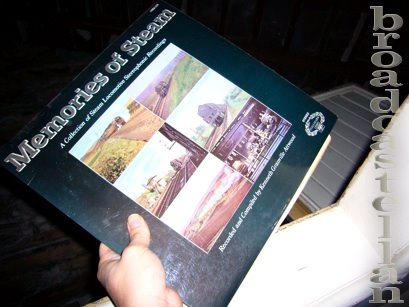
The cleanup sure slowed down once I came across that discarded collection of vinyl, the highlight of which, to me, is a curiosity labeled โ€œMemories of Steam.โ€ The locomotives on the cover could not deceive anyone into expecting the tell-all record of an inveterate Lothario; but I was thrilled nonetheless, transported back to the days when, as a boy, I was given an album of collected noises that led me to stage my own audio dramasโ€”signifying nothing to anyone else, but chock-full of sound and fury. Come to think of it, that one record may well have laid the tracks that, long and winding though they were, earned me a doctorate . . . just the kind of certificate to relegate to the space I had just visited.

Another find in the attic

Yep, even a climb up to an attic filled with the leavings of previous inhabitants leads me no further than some dim corners of my own memory. Unlike Sade and Rush, I do not have to wait for crazy Uncle Fletcher to disrupt the tasks at hand with one of his dubious recollections (โ€œSadie, do you remember Irma Flo Kessy there in Belvidere?โ€ She was a โ€œpeevish womanโ€ who “used to have a little habit of slappinโ€™ her husbandโ€™s face in publicโ€). I can count on my own past to traipse close behind and creep up on me.

This time, though, the detour into those mental crevices was a welcome and trouble-free one. Down below, rooms hung with ghastly wallpaper were waiting for a hand attached to my aching body . . .

Related recordings
โ€œCleaning the Attic,โ€ Vic and Sade (18 August 1942)

Related writings
“The Home Folks Are Moving In”
โ€œHome Folks Lose Ground to Plot Developers”


โ€œVon Ribbentropโ€™s Watchโ€: Thoughts on Kristallnacht

Perhaps I should call her. We have not talked in over a year. Could I have telephoned tonight, though? Not simply to exchange a few kind words, mind. From her, I would like to learn about the past that shaped our world; and who would not seize the opportunity to grasp that past firsthand? That said, I have never quizzed my German grandmother about life in the Third Reich, never attempted anything amounting to probing inquiry. I am more distressed by my failure to ask than by any responses I might get. Not that any number of answers could make me stop wondering.

Another watch, another (lost) wartime story

Tonight marks the 70th anniversary of Kristallnacht, and I am more keenly aware than usual that the past is not done with, that many of those who threw stones into shop windows or looked on as Jews were hauled off to the concentration camps are still among us. Their ideologies, their hypocrisies, and their indifference are alive as well.

My grandparents were not among those who resisted the Reich and its reign of terror. โ€œOf course, we knew they were being shipped to the camps,โ€ my paternal grandmother once told me. Frank about knowing, she was open rather than open-minded. Third Reich propaganda remained at work throughout her life, even some forty, fifty years after the defeat of the Nazi regime. Once she heard I was schwul (German for gay), she ceased to acknowledge me; not as much as a reply to my Christmas cards. My maternal grandmother, now in her nineties, continued to correspond, though, sending greetings and wishes to me and mine. Is she more open? Or is she, like so many of us, merely permitting her personal feelings for her own kind to gainsay thoughts that would otherwise dominate her mind?

My maternal grandmother worked for one of the leading Nazi families and remained loyal to them decades after the war, introducing me to the heirs when I was a child. My memories are vague. I remember being told about the guilt that made outcasts of the obviously well-to-do family for which grandmother worked as a seamstress. There was a boy, roughly my age, with whom I played while grandmother worked. As much as I would like to fill in the blanks, I cannot bring myself to ask about the past, about grandmotherโ€™s connection to the Von Ribbentrops.

On this Remembrance Sunday, as Britain commemorates the 90th anniversary of the 1918 armistice and those killed in war, I drift in and out of consciousness, sick with the commonest of colds. Swirling in the thick of my head are thoughts that just the right word cannot put into any conclusive or satisfying order. I continue to question myself rather than demanding answers from those who might help me to resolve matters.

Instead of proving that actions speak louder than words, Kristallnacht demonstrated that actions are louder than the silence of unvoiced dissent. A stone, in this respect, is like a resounding โ€œnoโ€ to the potentialities of change latent in the troubled mind. Words can set nothing aright if they merely create the illusion of control, if they obscure the chaos within us rather than dispel it. I let my words bespeak confusion rather than answer conclusively, thus falsely. I let them run riot rather than underwrite what amounts to the hollow triumph of paper solutions.

A quandary is at the heart of โ€œVon Ribbentropโ€™s Watch,โ€ a radio play by Laurence Marks and Maurice Gran, which premiered 8 November 2008 on BBC Radio 4. It is the story of a Jewish shop owner in contemporary Britain who learns that the less-than-reliable watch he inherited from his father once belonged to Nazi Germanyโ€™s Foreign Minister Joachim Von Ribbentrop. What to do? Keep the watch and ignore the Swastikas to which a watchmaker alerted him? Sell it to collectors of Nazi memorabilia in order to keep alive his own struggling business? Would that be retribution or profiteering?

The fascinating premise is undermined by the language in which the conflict is couched. It seems that the playwrights are rather too enamored of their at times desperate wordplay, too eager to elicit awkward chuckles from assorted squabbles at a Passover table when restraint might have served them better. Perhaps, the broadcast date for this dreadful piece of imitation Goldbergs was as unfortunate a choice as the playwrights’ mockeryโ€”a Jewish defense of Nazi crimes, the sounds of broken glass after a family quarrel, followed by an otherworldly visit from Von Ribbentropโ€”as it gave me reason to believe that โ€œVon Ribbentropโ€™s Watchโ€ was meant to coincide with and somehow commemorate the horrors of Kristallnacht. Armistice Day, by comparison, is given a solemn treatment on BBC Radio 3, with an adaptation of All Quiet on the Western Front.

At least, the titular chronometer of โ€œVon Ribbentropโ€™s Watchโ€ seems to suggest that even belated justice is preferable to terminal ignorance; time catches up with timepiece in question, however exasperating and offensive the ninety minutes that it takes us to hear about it. Not that the conclusion is rewarding: in its tacky irony, the play insists that the Jews end up confessing their guilt by association.

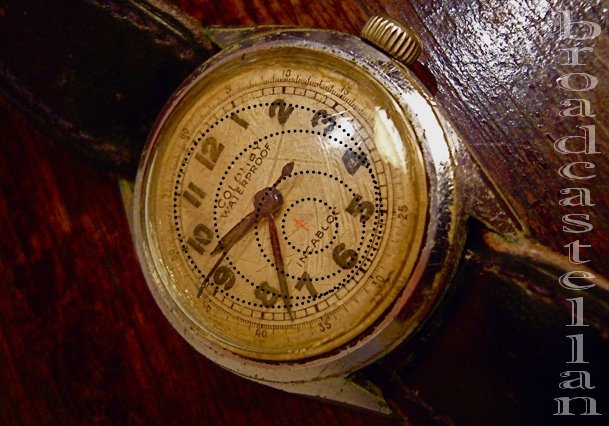
In response to this appalling piece of misjudged comedy, which is supposedly based on a true story, I retrieved the watch shown above. Like so many stories of so many objects around me, the story of this watch cannot be recovered, the one who could have helped to pieced it together having died many years ago. It was given to my partner, whose father brought it back from the Second World War. My camera failed to capture it, but the face bears the Cross of Lorraine, the symbol of the Resistance.

What we need to resist, always, is the convenient answer, the conclusive remark, the word to extinguish the doubt that is the life of thought, the hope for change; and the doubt we should all permit ourselves to voice on this day is whether the past is truly over or whether we are still victims of the same prejudices, susceptible to the same talk, capable of the same actions. Those are the questions we cannot expect anyone to answer on our behalf.

Day for Bonfire Night; or, On a Bum Note of Triumph

However disheartening California’s majority rule in favor of amending the state constitution so as to protect an institution for which millions of divorced Americans have shown little respect, 5 November 2008 is still a day to inspire confidence in a democracyโ€™s ability to refine and redefine itself, to let go of old prejudices so often upheld as time-honored traditions. To update and appropriate On a Note of Triumph, Norman Corwin’s cautiously optimistic radio play in commemoration of VE Day: “Seems like free men [and women] have done it again!” Perhaps, it seems even more of a victory to those living in Europe and elsewhere around the world.

Like many non-Americans anxious for change in Washington, I stayed up all night to keep track of the election results. Watching the BBC coverage, I was struck by the enthusiastic response to the outcome, even though it should come as no surprise that most people around the world are relieved to see the Republican rule of proud indifference come to an end.

I was tickled by David Dimblebyโ€™s hilariously awkward interview with the cantankerous Gore Vidal, who refused to explain his enthusiasm about the Obama victory to an audience he assumed to be ignorant of America’s civil rights movement and the Republican mindset that impeded it. Perhaps, the world does not understand what it means to be an American; but now, for the first time since 11 September 2001, the world is once again eager to learn and willing to empathize.

Here in Britain, 5 November marks the anniversary known as Guy Fawkes Day, or Bonfire Night, when the threats of extremism and self-righteousness go up in smoke. Generally, it is the figure of Gunpowder Plotter Guido Fawkes that is burned in effigy. Tonight, though it may well be the Republican legacy that the British are eager to consign to the flames. Change, after all, is only a dirty word to those incapable of coming clean about a past that is far from spotless. And, given the state of our global economy and, more importantly, our globe, mend our ways we must.

Today, 5 November, also marks a personal anniversary. It was on this day, four years ago, that, after nearly fifteen years of living, working and studying in the US, I left Manhattan to impose myself on the Welsh and the British at large. I intended the departure date to coincide with the previous election, thinking that the result might either be so decisively against my kind as to eclipse any misgivings about moving andโ€”allowing me to wash my hands of a country whose people were reckless enough to re-elect George W. Bushโ€”or so encouraging and propitious as to send me off into uncharted territory with a sense of hope and a feeling of elation.

It turned out to be the former, of course; but that did not keep me from visiting to Manhattan and from feeling very much at home there. You may not read the anxiety into the above picture, one of the first photographs taken of me after my move to Wales, a Principality theretofore unknown to me.

Before moving, I had shed nearly twenty percent of my body weight, as if resolved to let go of my past or determined to leave behind what could not be retrieved, as if I were trying to convince myself that I needed to regain weight on British soil in order to make it British. If you look at the image of me posted in the previous entry into this journal, you will notice that I did regain the weight, largely owing to Welsh meat and home cooking.

I owe it to my partner, with whom I am yet barred from forming a legally recognized union amounting to matrimony, that I am feeling at home in our remote cottage halfway up in the Welsh hills, a place that, the wilds of the rain forest or the Congo notwithstanding, could hardly be more different from life in Manhattan. How wonderful it is to be celebrating this historic moment of harmony as a very intimate part of my own journey . . .

After the Falls

Having just returned from a trip to Niagara Falls, I was eager to revisit Henry Hathawayโ€™s 1953 technicolor thriller starring Marilyn Monroe. Shrewd, sexy, and sensational, the expertly lensed Niagara is the most brilliantly devised star-making spectacle of Hollywoodโ€™s studio era. It has so much going for it that it can afford to be utterly predictable. The Falls are predictable, which does not make them any less exciting. And as much as I enjoy spotting old-time radio performers like the aforementioned Lurene Tuttle or Jack Bennyโ€™s jovial announcer Don Wilson, Niagara hardly requires any added attractions to make repeat viewings worth my while. More than the mere setting for a tale of adultery and revenge, the magnificent Falls are a dramatic extension of Monroeโ€™s form and the character she portrays, as well as an obvious metaphor for the rush of desire and the flimsiness of the social fabric with which we attempt to stay it.

No one seems safe from the inexorable and devastating force of Niagara. Not even Jean Peters, the far better half of a couple of second honeymooners so clean as to be emotionally washed up and well past passion. Spending a honeymoon by the falls is something of an endurance test. Either your love proves as strong and permanent as the scenery or the flame is doused and consumed by it. Passion, to be sure, is no requisite for marriage, which is why the falls can be seen as a substitute for it, an ersatz externalization for the unsettling influences those settling in dare not permit themselves to experience.

No matter how many showers she takes, how many times she gets sprayed by the mist, no matter how many times she slips into a new dress, Monroeโ€™s Rose is far from spotless. She is no Lorelei Lee, either, an infantilized siren whose predatory sexuality is rendered innocuous by her apparent simplicity and her chief interest in the monetary value of her prey. According to the Code under which Hollywood operated, a lapsarian anti-heroine like Rose must go down in her own scheme to rid herself of her brooding, volatile husband (Joseph Cotten, whose character is too unsure of himself or his position to control his wife, let alone the filmโ€™s point of view).

For the gender-confused and fatalistic teenager I once was, Niagara outlined adult life as an improbable proposition, a threatening, unconquerable front: the terror of “taking the plunge” in conformity and the peril of attempting to go against the stream while stuck in a barrel destined for the Horseshoe Falls. Wet behind the ears, I seemed unlikely to get altogether soaked. My downfall would be suffocation, not rapture. The only recourse that appeared open to me back then was to assume the likeness of a devastating and lamented corpse when the bells were rung on my behalf by the re-producers in charge of casting me aside. I never got entirely over this feeling, but have long since learned to keep afloat.

Does Every Cinderella Project Have Its Midnight?

Well (I am saying โ€œwellโ€ once more, for old timesโ€™ sake), broadcastellan is entering its fourth year today. It all began on 20 May 2005, when I decided to keep an online journal devoted to old times, good or bad, to the culture that, however popular, is no longer mainstreamed, but, as I explained it in my opening post, marginalized or forgotten. Looking at broadastellan through the lens of the Internet Archive’s “Wayback Machine,” you will notice a few changes; but, overall, things are just as they were when I set out. Except that I am much more at ease and far less concerned about my online persona, its definition and reception, more fully aware of my status and the consequences of casting myself in the role of marginalien as I have come to accept and embrace it. No, it wasnโ€™t this way right from the start.

Having earned my doctorate and relocated from New York City to Wales, I felt the want of continuity. I was reluctant to immerse myself in Welsh culture, let alone its language, for fear of not being able to recognize myself as the cosmopolitan I had impersonate with some success for most of my adult life. The dissertation was placed on the shelf; and my career alongside it. Still, I was not done with American popular culture as I had rediscovered it during years of research.

Not having been able to ride my hobbyhorse all the way to the bank, I thought Iโ€™d start parading it here on this busy commons. I sure wasnโ€™t ready to put it out to pasture and wash my hands of it with the soap derived from its carcass. Initially, I might have been confused about the purpose of such a vanity production. I wanted this mare to be petted, even though I was prepared to take it out for others to deride. Nowadays, I am mainly writing for myself, for the kick I get out of being kicked by it into the thicket of research and the paths of (re)discovery.

Whenever I see a show, watch a movie, read a book, or listen to a radio program, broadcastellan encourages me to make it relevant to myself, to investigate and connectโ€”and on the double at that. Right now, I have eight books before me, all designed to warrant my title. After all, it was the aforementioned Eve Peabody who declared that โ€œ[E]very Cinderella has her midnight.โ€

Eve Peabody, the self-proclaimed American blues singer who arrives penniless in Paris, posing as a Hungarian baroness, no less. Iโ€™ve always related to this Cinderellaโ€™s identity crisisโ€”and admired the sheer ingenuity with which she made it all happen all over again. In the words of Ed Sikov, she proves โ€œtremendously elastic,โ€ a quality that prompted New York Times DVD reviewer Dave Kerr to remark on the โ€œunpleasant degreeโ€ to which writer Billy Wilder was obsessed โ€œwith the theme of prostitution.โ€

โ€œI thought that Eve Peabody was a very interesting character,โ€ director Mitchell Leisen remarked. โ€œYou see, thereโ€™s a bit of good and a little bit of bad in all of us.โ€ Yes, Leisenโ€™s Midnight, like all proper Cinderella tales, has an edge; and, at last, it is being brought into digitally sharp focus. Earlier this month, the screwball comedy Elizabeth Kendall referred to as the โ€œultimate girl-on-her-own fairy taleโ€ was released on DVD, perhaps in anticipation of the by me dreaded remake starring one Reese Witherspoon.

Since Britain has not caught up with this gem, it shall be one of my first purchases next week when I shall once again (and probably again and again) take the train down to J&R Music World. What with our UK DVD/VCR recorder refusing to accept my US tapes, I have long waited for this moment to catch up with what Ted Sennett has called โ€œone of the best and brightest romantic comedies of the [1930s].โ€ Of course, there’s always the radio.

On this day, 20 May, in 1940, stars Claudette Colbert (pictured above, in an autographed magazine cover from my collection) and Don Ameche reprised their roles in this Lux Radio Theater adaptation (>which you may enjoy by tuning in the Old Time Radio Network). Perhaps, though, the wireless is not the proper medium in which to appreciate a Leisen picture, distinguished as his work is for what James Harvey calls โ€œthat look of discriminating opulence.โ€

Still, you get to hear some of the best lines in romantic comedy, albeit soften at times to appease the censors. For instance, when confronted with a cabbie eager to take her for a ride, even though she confessed to having nothing but a centime with a hole in it to her name, she offers to pay him for driving her around town while she goes hunting for a job. โ€œWhat kind of work do you want?โ€ he inquires. โ€œWell, look,โ€ Eve replies, โ€œat this time of night and in these clothes Iโ€™m not looking for needlework.โ€

Like Eve, I have gone round in circles (apart from the proverbial block). The ride may not amount to much to many, but this is not why I keep on mounting this hobbyhorse of mine. It is the sheer pleasure of taking my mind for a spin. And, to answer my own question, there is still time for a few jaunts. After all, it is not quite midnight . . .

Choice Words; or, When a Mac Crashes (Again!)

In written communications, I generally refrain from cursing. I am not sure why so many web journalists feel compelled to express their emotionsโ€”even their apparent lack thereofโ€”in terms referring to certain uses of the male sex organ or the issue of our daily excretions. I gather that both spell relief, as does the act of swearing. We all have to get it out of our system once in a while; and I am not one to recommend mealy-mouthing the unsavory by resorting to equivalents of a truculently tossed paper napkin; such disingenuous substitutions have been the curse of radio drama.

Back in 1938, for instance, a production of O’Neill’s Pulitzer Prize-winning Beyond the Horizon met with a storm of protest when it was broadcast over NBC’s Blue network. As Francis Chase Jr. recalls in his Sound and Fury (1942), the FCC forced an affiliate in Minneapolis to justify such language under the threat of refusing to renew its license after a single listener complaint about exclamations of “Hell,” “Damnation,” and “For God’s Sake.”

To be sure, I am under no obligation to act in the public interest; and somehow I cannot bring myself to avail myself of defused verbal missiles like โ€œdarn,โ€ โ€œdratโ€ or โ€œshucksโ€ (the last of which I, as a German, would have trouble pronouncing during moments of distress). That said, I donโ€™t hold with those who believe that mentioning acts of penetration renders the thought expressed more penetrating. If I censor myself here, it is because I am trying to come to grips with whatever has me by the throat as my hands flit across the keyboard, erasing as much as they produce.

I do not have to recreate verbatim what escaped my lips some time ago, as long as I manage to capture the feeling of that moment. Writing it down does not just mean getting it out; to me, it must also mean getting over it. It is a chance to let go of something rather than to let oneself go all over again and make a display of the discharge. Writing is the process of cleaning up, which is not to say that it is the concealment of disorder. Posture and composure become especially important when life seems to be in the very process of . . . decomposing.

What has been breaking down of late is the non-matter of my online existence. Another Mac has crashedโ€”and that a mere three months after the previous wipeout (as lamented here). Never mind that I have learned little since the last incident and that many a souvenir has gone down the virtual sewer. What I noticed is that the crashes occurred while using iRecord, the software with which I copy audio files on the web. As a lover of radio programs, I use it quite a lot. Make that past tense.

To have oneโ€™s computer hard disk erased in the attempt to store what is fleeting is beyond โ€œironicโ€ (another word I dislike). It is a rotten business, being shipwrecking for one’s love of the airwaves. The phrase โ€œblistering barnaclesโ€ comes to mind. Indeed, most of Captain Haddockโ€™s celebrated curses will do nicely just now.

Open a New Door . . .

Well, this is St. Nicholas Day. Traditionally, it is the day on which children in Germany (among whom I once numbered) put their hands in their boots to find out whether Saint Nick, passing by overnight, left anything within. Preferably candy, and, given the repository, preferably wrapped. Now, it has been several decades since last I observed the custom. These days, as an every so slightly overweight atheist with somewhat of a passion for boots, I would be more pleased to find my footwear polished.

There are still a few holiday customs I like to observe. I shall miss the annual display of tinsel, since we won’t be home long enough to enjoy the spectacle. So, Ms. Colbert, generally to be found up a tree around this time, is going to dangle elsewhere this season.

At least I won’t have to do without the miniature thrills of opening those little doors (or Tรผrchen). This year, my Advent calendar (which I used to make but never get for myself) arrived just in time for the first of those twenty-four minute inspections, a welcome series of opening acts at a time when you are supposed to be closing the door on a rapidly expiring year. How surprised and delighted I was to be receiving a calendar featuring old Krtek, the mole that dug up childhood memories a few months ago on my trip to Prague. How fortunate I am to have a best friend (and fellow web journalist) who remembers . . .

Since this is also the 107th birthday of the aforementioned Agnes Moorehead (1900-1974), radio’s First Lady of Suspense (heard on this day, 6 December, as the “Useful Information Lady” in Orson Welles’s Hello Americans), it is an opportune time to return to my journal and my favorite subject . . . so-called old-time radio drama. The last few days have been rather busy and none too inspired. I did not get to pick a Dickens novel, which I enjoy reading around this time. Nor did I manage to follow this season’s twenty-part radio adaptation of Dombey and Son. The serial is still being broadcast and you may catch up with this week’s chapters at the BBC broadcast archive.

Until my departure for New York City next Friday, I am going to listen to a few recordings of seasonal broadcasts from the 1930s, ’40s, or early 50s (as I have done before). Now, Ms. Moorehead would have made a wonderful Scrooge. Never mind that, as The Mayor of the Town‘s Dickensian housekeeper Marilly, she was still heard humming “O Tannenbaum” well past New Year’s (21 January 1948, to be exact); but, unlike so many actors before and after, foremost among them her costar, the actor pictured in the previous entry into this journal (and heard here doing his celebrated impersonation of Dickens’s old grouch, however incongruously, on the same program [24 December 1942]), the former Margot Lane to Welles’s Shadow was never cast in the role. And Susan Lucci was? As Krtek might say, “Bah, hummock!”