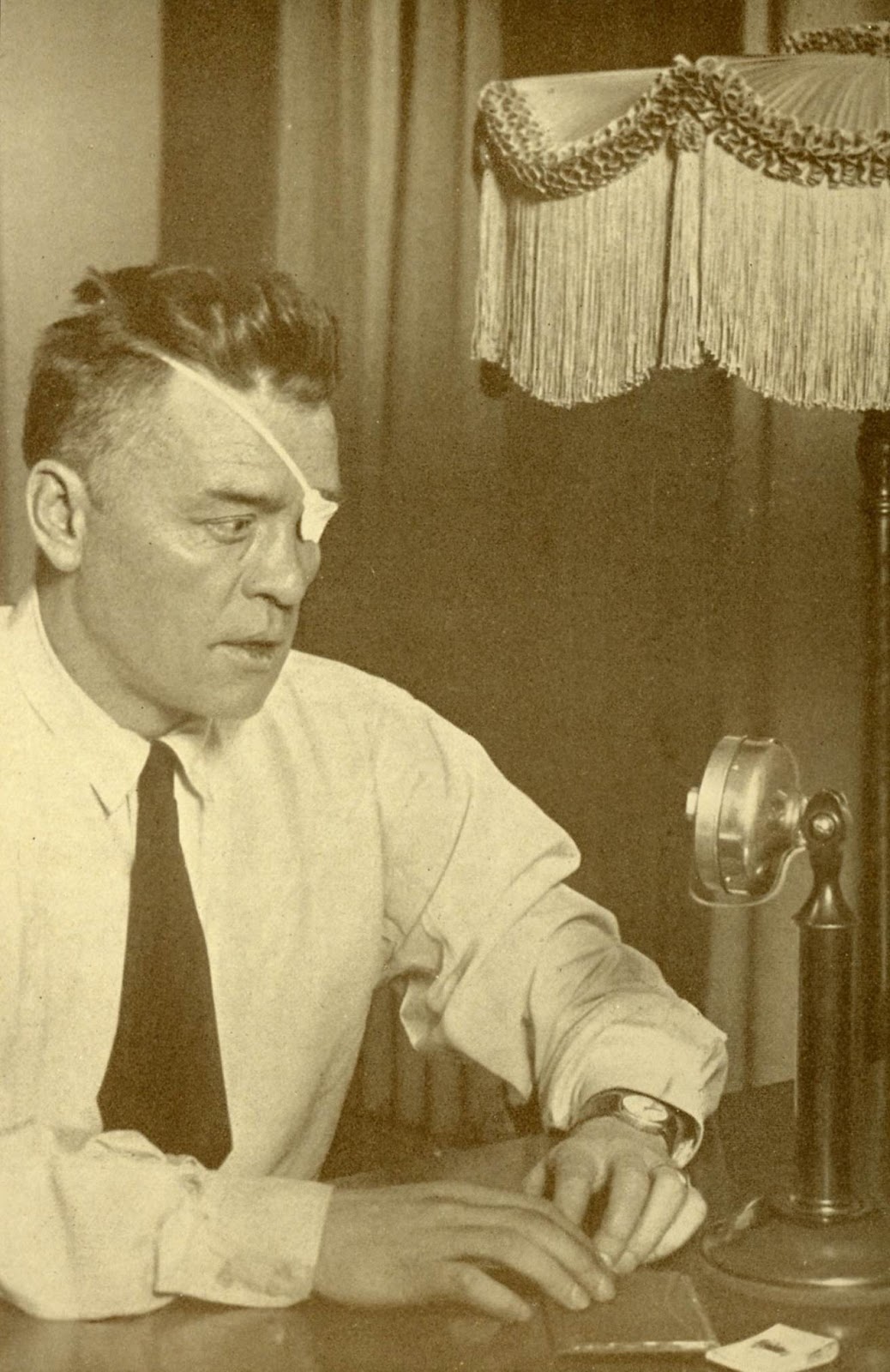
Wherever fighting men are in action—wherever disaster shakes the earth—wherever history is in the making—there you’ll find Headline Hunter Gibbons, the machine-gun stylist of words.
His record is 217 words a minute, steady flow for sustained speech. But what a price he has paid for the background that makes his record possible!—His body is crosspatched with bullet wounds and sword cuts. The spot where his left eye should be is covered by a white patch. He’s bivouacked on the feverish sands of Mexico, India and Egypt. His toe joints have been frozen on the arctic waste of Manchuria.
But he’s happy. It is his life and he loves it.
That is how a 1934 article in Radio Guide (for the week ending 17 November) introduced Floyd Gibbons (1887-1939), a news commentator whose life was as thrilling and fast-paced as the one he breathed into the scripts he read—or, rather, performed—on the air.
Delivering his lines, and with such rat-a-tat rapidity, was not easy for the battle-scarred Headline Hunter. According to Robert Eichberg’s Radio Stars of Today (1937), Gibbons was with the American army at Belleau Wood, France, when, on 6 June 1918, the major leading his troop was struck down by German machine gun fire:
Suddenly a bullet struck Floyd in the left shoulder, and another tore through his left arm. Still he crept toward the stricken officer, only to have a third shot pierce his steel helmet, fracturing his skull, and blind him in his left eye.
As one of his colleagues, John B. Kennedy, recalls (in Robert West’s 1941 broadcasting history The Rape of Radio), Floyd “used to have his scripts typed in jumbo type so that he could read easily. ‘With that big type he would come to the studio with forty or fifty pages of stuff, almost four times as many as the rest of us used!’”
Little now survives of Gibbons’s celebrated broadcasts, aside from a couple of reports aired on the Magic Key program. In March 1936, Gibbons returned to the airwaves after nearly seven months, “glad” to be getting away from the crisis in Ethiopia to focus instead on a natural catastrophe much closer to home: the Connecticut River Valley flood. A few years earlier, he had abandoned his coverage of the Sino-Japanese conflict to rush to Hopewell, New Jersey, to get in on the sensational story of the Lindbergh baby kidnapping.
In his Magic Key notes from 22 March 1936, which Jim Widner shares in his tribute to the man, Gibbons referred to the overflowing of the Connecticut River as “the worst flood in the history of the last half century.” Seen, as he had it, from above—a view not generally afforded his listeners—the valley looked like a “vast inland sea” on which Gibbons spotted “dismal, un-milked cows” and “bedraggled wet chickens” that were “perched bewildered” upon “isolated elevations like animated weather cocks.”
Gibbons talked of the “withered mushrooms” that were the gas and oil tanks of the refining companies, each containing “hundreds of thousands of explosive fuel which in turn represent fire and disaster should these enormous receptacles be torn loose from their foundations” and “lose their fiery contents.” Those at work to prevent further disaster looked like “Lilliputians” as they tried to “tie down these deadly metallic giants.”
Meanwhile, in the riverbed,
in which ambitious men had hoped to incarcerate old man river with dikes and dams of stone and steel, the prisoner [ was] lashing, foaming, writhing like a serpent striking back with frightful force and power, an unexpected fury.
Some nine months before his death, Gibbons gave a brief account of his exploits—riding with Pancho Villa in Mexico, sailing on the Laconia when it was torpedoed and sank—to listeners of the Lux Radio Theater (16 January 1939). In it, he remarked that
the best and most truthful report of any happening is that of the personal eye-witness who can honestly say “I saw it. I was there when it happened.” He has to keep in mind the importance of the main event, but must not overlook the apparently unimportant little facts that prove the truth of the story.
In the rush of his reportage, “little facts” at times made way for great effects. According to West, Gibbons’s report of the Ohio River Flood of 1937 referred to “sensational happenings” that had not actually taken place as described. Gibbons was sued for two hundred and fifty thousand dollars in damages by a scriptwriter who argued that “his reputation had been marred.”
What Gibbons’s rapid-fire imagery does convey, though, is the fury of the scenes we imagine he beheld. In a rhetorical style long fallen out of favor but so vital to depiction in the absence of visuals, Gibbons personified the threatening force of the raging Connecticut River to capture the truth of the moment in a torrent of pathetic fallacies:
Like a slave, freed from the chains of his presumptuous would-be masters, the river is striking back in wild retaliation. It seems to say: for years, for years I have turned your wheels and lighted your cities and watered your fields and cattle, and heated your homes and transported your commerce; and now, now comes my day of revolt, to show you my strength.
At the conclusion of his report from the Connecticut River Valley, Gibbons paid his respect to those who kept their ears to the flooded ground and saved “thousands of lives” simply through word of mouth: a “newly developed class of men and women,” the “short and long wave amateur operators” who, “[w]hen landlines and other means of high-power communications became disrupted” by the flood, “stuck to their dangerous posts” and “kept going a running fire of information.”
Few understood better than the Headline Hunter how to keep that fire from dying out; and to men like him we must turn to rekindle our imagination in a world awash with images.

 “April is the cruellest month,” T. S. Eliot wrote (in his opening lines for “The Waste Land”)—“mixing / Memory and desire.” I somehow felt the cruelty of this mixture more keenly this year, being that the seasonal rebirth coincides with activities amounting to more than spring cleaning, a project that triggered memories of a less than happy home and anxieties about moving. The first month of renovating our house in town has passed; and even though another month will go by before our relocation, I am desirous to move on and continue with this journal without mentioning or alluding to our future domicile (pictured) in every post. So, during the month of May, I shall try to refrain from making any references to the place.

 The currency market has been giving me a headache. The British pound is anything but sterling these days, which, along with our impending move and the renovation project it entails, is making a visit to the old neighborhood seem more like a pipe dream to me. The old neighborhood, after all, is some three thousand miles away, on the Upper East Side of Manhattan; and even though I have come to like life here in Wales, New York is often on my mind. You don’t have to be an inveterate penny-pincher to be feeling the pressure of the economic squeeze. I wonder just how many dreams are being deferred for lack of funding, dreams far greater than the wants and desires that preoccupy those who, like me, are hardly in dire straits.


 Harry Heuser