
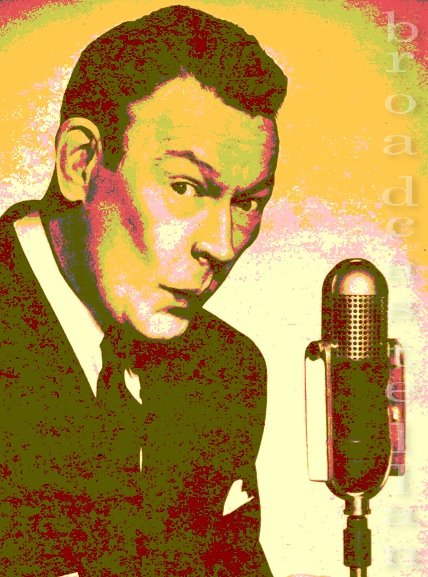
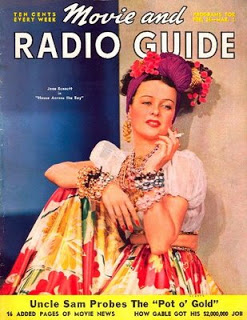
 For the reward of a single dollar, readers of Movie-Radio Guide used to send in “boners”—fluffed or unintentionally funny lines they had caught on the air. On 29 Feburary 1940, for instance, Olive Doeling of Petaluma, California, tuned in to station KGO and heard Benny Walker (Benny Walker?) say: “Wish you could see her, folks. She’s lugging a saxophone almost as big as she is behind her.” Another buck went to a listener from Jackson, Mississippi, who reported the following exchange between Major Bowes and a contestant on his Amateur Hour broadcast from 7 June 1936:
CONTESTANT. I was a dressmaker’s model and then I married.
MAJOR. Wholesale or retail?
Reading lines like these makes me want to tune in the original program, to find the recording and hear for myself.
The other day, when I read that Mary Livingstone was supposed to have giggled “Jack, I’ll never forget the look on that ski house when it saw your face,” I wondered whether that was indeed what she had said and how her husband, the cast, and the studio audience had responded. Listening to a recording of the 25 February 1940 broadcast of the Jell-O Program, I heard no such fluff. “I’ll never forget the impression on your face when you crashed in the ski house,” Livingstone said instead. Had J. N. Lawrence from San Diego earned that dollar? Was the “boner” bona fide or bogus?
Well, before accusing any of those tuners-in, I had to remind myself that many of the live programs of the past were staged twice—once for the East Coast, then for the West. What J. N. Lawrence had picked up on California was not what anyone living East could have heard—or anyone listening to a recording of the East Coast broadcast.
How different the two broadcast could be was demonstrated on 20 March 1940, when a certain Mr. Ramshaw caused a riot on the Fred Allen Show. Mr. Ramshaw was a celebrated Golden Eagle who toured the US with his British trainer, falconer Captain C. W. R. Knight. The Captain was encouraged by Allen to let the Mr. Ramshaw fly around in the studio; but, as it turned out, he had little success in convincing the bird to return to him as rehearsed—and not until he had left his mark on the members of the audience assembled in studio 8-H, Radio City, New York.
Actually, as Allen recalled in Treadmill to Oblivion, Mr. Ramshaw had narrowly “missed the shoulder of a student who had come down from Fordham University to advise [Allen] that [he] had won a popularity poll at the school.”
Responding to a complaint from the vice president of NBC, a less than apologetic Allen remarked: “i thought i had seen about everything in radio but the eagle had a trick up his feathered colon that was new to me,” to which he added: “i know you await with trepidation the announcement that i am going to interview sabu with his elephant some week.”
There was no getting back to the script that evening; and the commotion that ensued was another forceful reminder that, for all his talent as a writer, Allen was in even finer feather when he did not have to stick to the ink from his mechanized quill. Now, winging it, or flying by the seat of one’s pants, was not condoned by those who footed the bill of comedy-variety programs and kept an eagle eye on their production. Everything had to be performed as scripted—and strictly within the time allotted for each number, sketch, and broadcast.
So, when Allen had to repeat his program three hours later—at midnight—for the West Coast audience, the spokesperson of Young and Rubicam, the advertising agency working on behalf of the show’s sponsor, did not permit Mr. Ramshaw to make an encore. The segment was out, and, as Stuart Hample (author of “all the sincerity in hollywood” told Max Schmid in a 4 November 2001 interview over WBAI, New York, Allen was forced to revise the script and remove the offending segment.
Allen defended his feathered guest by claiming that Mr. Ramshaw had resented the censor’s “dictatorial order” and, “deprived by nature of the organs essential in the voicing of an audible complaint, called upon his bowels to wreck upon us his reaction to [Mr. Royal’s] martinet ban.”
The feather “l’affaire eagle” added to Allen’s cap never got to tickle his West Coast listeners. Network radio programs may have had a coast-to-coast audience; but, be it an eagle, a turkey, or a lark, some of what took off or managed to escape in the East could never fly or land in the West.
Related recordings
Fred Allen Show, 20 March 1940
 Historically speaking, it is difficult for me to get the larger picture. When I express anything amounting to a weltanschauung, I go all philosophical. Perhaps, I live too much in the confines of my own peculiar everyday to engage with the political events and developments that shape my existence. Life in the United States has taught—or, at any rate, encouraged—me to live in and for the now, a modus of going about one’s affairs that is more personally rewarding even though it might not always be quite so socially or globally responsible. Seizing the day for the sake of that day and its glories alone is not something to which Germans, in particular, are prone; they are more likely to seize opportunities for the future, or another country, for that matter.

 Staying out of touch has never been easier. We’ve all got our personal teleporters to spirit us away from the here and now. Technology is making it possible for us to remove ourselves from our communities, to stay at home not watching the world go by. Instead, we can revel in bygone worlds. Hundreds of satellite channels are serving up seconds. Before you know it, you quite forgot what time it is that you just passed. Isn’t it high time for Sally Jessy Raphaël to stop gabbing? Eight years ago she went off the air; but there she is, chatting away on British television, her owl glasses unscratched by the sand of time.
  This is a day for disguises, and a night of unmasking. A time to let yourself go, and a time to let go of something. A night to make an ass of yourself, and a morning to mark yourself with ash. Shrove Tuesday, Mardi Gras, Fastnacht. Back where I come from—Germany’s Rhineland—carnival is a major holiday, an interlude set aside for delusions, for letting powerless misrule themselves: laborers parading in the streets without demanding higher wages, farmers nominating mock kings and drag queens to preside over their revels; women storming the houses of local government to perform the ritual of emasculation by cutting off the ties that hang from the necks of the ruling sex. It is a riotous spectacle designed to preserve what is; a staged and sanctioned ersatz rebellion that exhausts itself in hangovers.

 Harry Heuser