
“Well, he won’t last long.” That is what I thought, back in April 1993, when I tuned in to witness Conan O’Brien’s debut as host of Late Night. Gawky and twitchy, the comedy writer turned performer was so ill at ease he made me jittery. It felt like watching the rehearsal for a cancellation notice, the curtain rising and falling on a production staged by Bialystock and Bloom.
I might have had a similar response if, on this day, 2 May, in 1932, I had I tuned in to witness the debut of Jack Benny as master of ceremonies for the Canada Dry Program: “Ladies and gentlemen, this is Jack Benny talking, and making my first appearance on the air professionally. By that I mean I am finally getting paid, which of course will be a great relief to my creditor.”
Listening to that stiltedly casual preface, the creditor must have been anything but relieved. It was a mere five weeks earlier that the seasoned vaudevillian had first stepped behind the microphone on a program hosted by Ed Sullivan, who, as Arthur Frank Wertheim points out in Radio Comedy (1979), thought that his guest comedian was as “nervous as a goat.” Apparently, the idea was to conceal the lack of confidence by scripting it as self-deprecating humor.
Benny’s famous persona, a vain skinflint rather too sure of himself (or too insecure to let on), was not yet in place; and without his inflated ego, Benny comes across like Harold Lloyd without his trademark glasses. To be sure, an MC does not get much to do besides introducing the acts, and Benny’s act was to confess as much:
I, er, I really don’t know why I’m here; I’m supposed to be a sort of a master of ceremonies to tell you all the things that will happen, which would happen anyway. I must introduce the different artists who could easily introduce themselves, and also talk about the Canada Dry made-to-order by the glass, which is a waste of time since you know all about it. You drink it, like it, and don’t want to hear about it. So, ladies and gentlemen, a master of ceremonies, is really a guy who is unemployed and gets paid for it.
Even the commercials, as delivered by Benny—rather than an announcer—were self-conscious, which, however awkward it may sound today, was a novel approach to advertising back then. A huckster with humility: “I suppose nobody will drink it now,” Benny quipped after one of his attempts to promote the product.
Two years and several sponsors later, Benny was still not quite tops among radio’s leading personalities, trailing Joe Penner, Bing Crosby, and Eddie Cantor (according to a Radio Guide reader poll published in March 1934). More appreciative than the public were the national radio editors, who voted him the best comedian on the air.
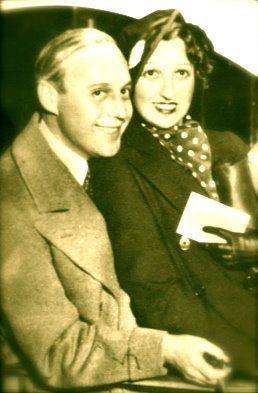
Considering Benny’s inauspicious debut, the comedian’s rise to fame and well-deserved popularity is quite remarkable. Partner Mary Livingstone (pictured with Benny above), who did not appear on the program until several months later, would have found in this broadcast ample material with which to cut Benny down to size. Back then, though, there was not much to cut.
“Er, that, ladies and gentlemen,” Benny concluded the 2 May 1932 broadcast, “that was the last number on our first program on the 2nd of May. Are you sleepin’, huh?”
Related writings
“’. . . that same young man in that same brown suit’: A ‘Jackass’ Takes a Bow” (Benny’s seventh anniversary)
“How Jack Benny’s Gagmen Lost Their Typewriter”


 The currency market has been giving me a headache. The British pound is anything but sterling these days, which, along with our impending move and the renovation project it entails, is making a visit to the old neighborhood seem more like a pipe dream to me. The old neighborhood, after all, is some three thousand miles away, on the Upper East Side of Manhattan; and even though I have come to like life here in Wales, New York is often on my mind. You don’t have to be an inveterate penny-pincher to be feeling the pressure of the economic squeeze. I wonder just how many dreams are being deferred for lack of funding, dreams far greater than the wants and desires that preoccupy those who, like me, are hardly in dire straits.

 Harry Heuser