

Tickled by Canary Feather’s account of being an accompanist for silent movies, I was in the mood for another non-talkie. The term may be unhappy in its connotation of lack, yet seems preferable to “silent movie,” considering that, prior to the late 1920, the sound for motion pictures was supplied by those playing the piano or the organ; even sound effects artists and entire orchestras were not unheard.
Having had my fill of non-talkie comedy of late, I chose a melodrama likely to wear out the most resourceful and nimble-fingered of pianists: The Master Mystery a 1919 thriller underscored by Stuart Oderman, whom I have often heard and seen playing the piano to movies screened at the Museum of Modern Art in New York. Intolerance, Grandma’s Boy, and Caligari—Lillian Gish biographer Oderman has articulated them all.
In the case of The Master Mystery, the pianist must have been relieved that his accompaniment was being recorded, rather than performed live. However fragmentary, the film still runs an epic 238 minutes. With an attention span shortened by broadband and a clock ticking down the last minutes of the day, I was resolved to take in this thriller as it was conceived; that is, as a weekly chapter play.
From the first instalment, I expected little more than an exposition, an introduction of the main characters, and the obligatory cliffhanger. After all, The Master Mystery stars the famed escape artist Harry Houdini (previously encountered on a boat about to go over Niagara Falls).
Now, I pride myself in not readily throwing in the remote control; but The Master Mystery, with its secret identities, its corridors and hidden caves stalked by an pre-RUR automaton, and its cases of Madagascar Madness—proved too complex to master at that late hour. The opening title card should have been ample warning. The “Foreword” reads:
International Patents, Inc., is a firm whose vast fortune has been made by inducing inventors to trust the marketing of inventions to their care and after obtaining sole rights—they suppress the manufacture of these inventions—much to the financial gain of the owners of already existing patents.
However intriguing, this is hardly the most effective way of opening a chapter play. We have not yet been introduced to any of the characters, but are confronted instead with a corporation and with legalities not quite the stuff of melodramatic action. Equally frustrating is the introduction of characters by indirection, that is, as a name on a title card not referring to the character shown. The secretary of businessman Peter Brent, for instance, is identified as being “secretly in the service of Balcom,” before we are shown the latter.
My own shortcomings aside, was it writerly ineptitude that caused me to get lost in the muddle? Was it owing to the fragmentary state of the surviving print, segments of which have been “rearranged” to create the “illusion of completeness”? Or was it, perhaps, all part of a shrewd design? I was determined to fill in the blanks with whatever notes I could find. Notes? How about an entire book!
In May 1919, Masters of Mystery was published as a novelization co-written by Arthur B. Reeve, one of the scenarists credited as the “authors” of the serial. Yes, viewers lost in the maze from which only Houdini could extricate himself were promised a key to it all in the form of a tie-in book, replete with stills from the film. I wonder just how many moviegoers resorted to a purchase in hopes of mastering this Mystery?
Here is how the opening title card is translated into some semblance of a narrative:
“I will see Mr. Brent,” insisted the new-comer, as he pushed past the butler. “Mr. Brent!” he cried, advancing with a wild light in his eyes. “I’m tired of excuses. I want justice regarding that water-motor of mine.” He paused, then added, shaking his finger threateningly, “Put it on the market—or I will call in the Department of Justice!”
Brent scowled again. For years he had been amassing a fortune by a process that was scarcely within the law. For, when inventions threaten to render useless already existing patents, necessitating the scrapping of millions of dollars’ worth of machinery, vested interests must be protected.
Thus, Brent and his partner, Herbert Balcom, had evolved a simple method of protecting corporations against troublesome inventors and inventions. They had formed their own corporation, International Patents, Incorporated.
Their method was effective—though desperate. It was to suppress the inventor and his labor. They bought the sole rights from the inventor, promising him glittering royalties. The joker was that the invention was suppressed. None were ever manufactured. Hence there were no royalties and the corporations went on undisturbed while Brent and Balcom collected huge retainers for the protection they afforded them.
Thus Brent Rock had come to be hated by scores of inventors defrauded in this unequal conflict with big business.
While the perfunctory prose suggests that the book is not always better than the movie, I was at least caught up with the story and prepared to follow Houdini as he gets in and out of scrapes to a score by Stuart Oderman . . . next week.

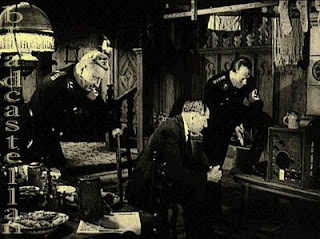 Placing Mitchell Leisen alongside Hollywood’s top flight directors is likely to raise eyebrows among those whose brows are already well elevated. Most others will simply shrug their cold shoulders in“Who he? indifference, a stance with which I, whose shoulders are wont to brush against the dusty shelves and musty vaults of popular culture, am thoroughly familiar by now. Respected for his knack of striking box-office gold but dismissed by his peers, the former art director was not among the auteurs whose works are read as art chiefly because it is easier to conceive of artistic expression as a non-collective achievement: something that bears the clearly distinguishable signature of a single individual. Their careful design aside, little seems to bespeak the Leisen touch, which is as light as it is assured. Stylish and slick in the best Paramount tradition, a Leisen picture stunningly sets the stage under the pretense of drama; otherwise, it has few pretensions.
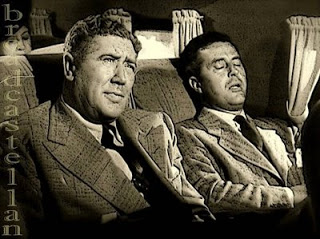 Leisen was not about to denounce the medium he had romanced in two of his earlier revues, The Big Broadcast of 1937 and its 1938 follow-up. Instead, Golden Earrings confronts nationalistic, state-run radio with a distinctly American voice of commercial broadcasting. In the narrative frame, the English officer is seen relating his story to Quentin Reynolds (pictured here with Milland), a news commentator known for his on-air missives to Doktor Goebbels and Herr Schickelgruber.
 No, I am not referring to the millions of dollars and pounds that have vanished into thin air during the current stock market upheaval. I am just concerning myself with thin air. You know, the kinds of programs and personalities that kept folks from falling into a great depression of their own in the months following the collapse of the stock market back in 1929. Movies and magazines aside, radio was the chief source of entertainment during those bleak days; yet whereas periodicals are generally well archived and films of the period are receiving attention from scholars and pre-code aficionados alike, few of the shows then on the air can still be appreciated today. As a lover of the old cat’s whiskers, I often resort to rivalling media to get an earful of network radio’s earliest offerings.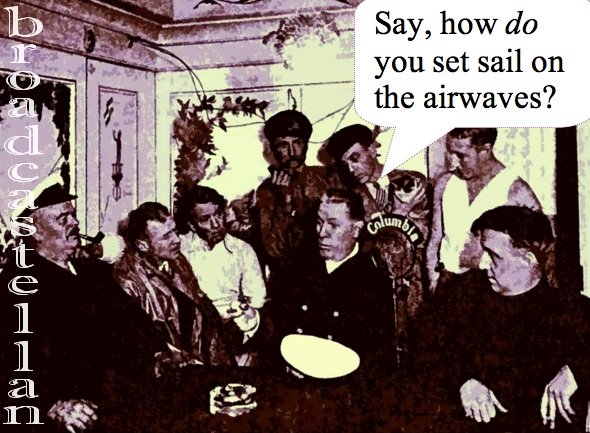

 My grandmother refused to listen. She would walk out of the room whenever Marlene Dietrich appeared on the small screen. “She betrayed our country,” Oma would say, referring to Dietrich’s departure for Hollywood about the time the fascists came into power. Actually, Dietrich left a few years earlier; but the Nazis sure failed to lure her back. What a loss it is to turn a deaf ear to what aforementioned radio actor Joe Julian called “an exotic accent” and a “strong voice-presence.” Working with her in Dietrich’s lost radio series Café Istanbul (1952), Julian got a “glimpse behind the public image” and discovered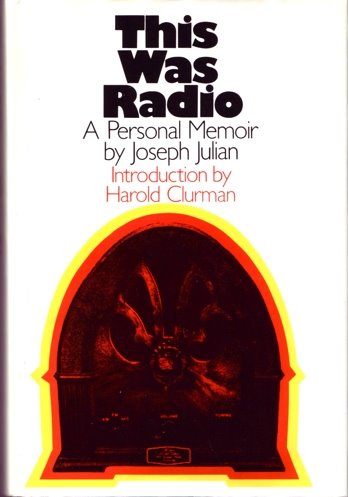
 Sometimes, when my heart is not in in, my mind’s eye begins to stray. That was what happened a while back when I tried To Please a Lady. Tried to follow it, that is. The Lady in question is one of Barbara Stanwyck’s decidedly lesser vehicles, and the horsepower on display in it is not likely to get my heart a-racing. Still,
  Harry Heuser