
Dancing with Franchot Tone: Tenth Avenue Girl Gets to Be “Lady for a Day”

Fancy that, Florence Farley! You were one lucky teenager, when, early in March 1939, a photographer from the ever enterprising Hearst paper New York Journal American came to see a fashion show planned by you and the kids in your neighborhood—the none too fashionable Tenth Avenue in Manhattan. Subsequently, you were chosen to go to Hollywood and become a “Lady for a Day.” What’s more, on this day, 1 May, you got to tell millions of Americans about your experience, dutifully marvelling at the “simply swell” Lux toilet soap in return. After all, you were talking to Cecil B. DeMille, nominal producer of the Lux Radio Theater, and there had to be something in it for those who made you over, young lady, and made your day.

Mr. DeMille was in New York City for the premiere of his Union Pacific, while Leslie Howard took over as narrator and host in Hollywood; so, C. B. didn’t really have to go out of his way (or send you back, all expenses paid, to Tinseltown) to meet up with you. You had returned by then from your West Coast adventure, the title of “Lady” being bestowed upon you “with the understanding” that you would return to your “own workaday world.”

“I was just another girl,” you told the famous director, just as the script had it. “Gee,” you exclaimed, as anyone should, having had a break like yours. When prompted to do so, you told listeners of going to your “first nightclub,” where you met Dorothy Lamour and “danced with Franchot Tone.” He probably felt like dancing, too, considering that he was single again, his marriage with Joan Crawford having recently ended in divorce, which might not be as bad as going back to the tenements. By the way, I’m watching Harriet Craig tonight and wonder what it must have been like, living with Crawford. But never mind that now.

While in Hollywood, you also got to make a screentest, go for a “bicycle ride with Bob Hope,” and appear in a Paramount picture. Not that I could find your name anywhere on the Internet Movie Database. Who knows just how much of your dream come true is true, Florence Farley. Tell me, were you really glad to return to the tenements to live with your grandma and go out with boys who only dream of being Errol Flynn? Did you get to keep those “Cinderella slippers,” never having “paid more than $2 for shoes” before?

Yours was another thin slice of Hollywood baloney, a West Coast diversion from the butchery about to commence in the east to the east of you. It’s no coincidence, either, that the Lux Radio Theater presented an adaptation of Damon Runyon’s ”Madame La Gimp” (later aired under original title on the Damon Runyon Theater program and remade as Pocketful of Miracles starring Glenn Ford, who would have celebrated his 91st birthday today, had he not died last August). Nor is it surprising that your fairy tale fits so well into the scheme of selling things, of carving the mess of life into neat bars of soap.

You know, Flo, listening to your voice (more real than the hooey you were asked to repeat) and wondering about the life behind those lines of yours—the life behind the “human interest” story and the publicity act you were that spring—sure beats following the sentimental play on offer that night. Now let’s wash our hands of the whole affair, without so much as thinking about lathering with the sponsor’s product . . .

"Round and Round Hitler’s Grave"

It took a while before the news got around the world; but on this day, 30 April, in 1945, Adolf Hitler got around facing trial and execution by committing suicide in his bunker. It would take another six decades until that hideout was opened for public inspection, when, in 2004, the Führer’s final days became the subject of a German film Der Untergang (2004). The Great Dictator had often been the subject of caricatures and crude character sketches, which are so much easier to accomplish than a life-size portrait. They are so much easier to take, as well, considering that a realistic image forces us to acknowledge that, far from being super- (or sub-) human, Hitler was one of us.

Throughout the Second World War, parodies and revenge fantasies boosted the morale of the Allies, comforted by way of comic deflation or enraged through violent melodrama. Radio popularized songs like Spike Jones’s previously mentioned “Der Führer’s Face” and Pete Seeger’s “Round and Round Hitler’s Grave.” If he could not be assassinated, potshots had to do:

I’m-a going to Berlin
To Mister Hitler’s town
I’m gonna take my forty-four
And blow his playhouse down.

This is how, a few days after the Führer’s death, the Almanac Singers modified those lines of Seeger’s original song when they performed it for a live broadcast of Norman Corwin’s celebrated VE-Day tribute “On a Note of Triumph,” the highest-rated American radio play of all time:

We’re gonna tell the postman,
Next time he comes ’round,
That Mr. Hitler’s new address
Is the Berlin buryin’ ground.

The Führer was dead, all right. Some eager radio writers had already killed him off, in fantasies like the aforementioned “Death Comes for Adolf Hitler.”  And yet, did that “playhouse” of his ever shut down only because its director, its producers, sponsors, and select members of staff were found dead, along with an audience of millions or, as discussed here, tried and executed in the spectacle of Nürnberg?

Corwin cautioned the American public, asking listeners to “fix [their] eyes on the horizons” and swing [their] ears about.” The old regime did not simply expire, no matter how many rounds had been shot to silence the enemy or how loudly one went “Round and Round” the problem of facing the aftermath.

Lately, I have been watching a number of German post-war films that dealt with the recent past of the fallen Reich and were less than sanguine about the Wunder of the nation’s reinvention as a republic. That is, they dealt with the inconvenient truth that the Nazis were not all below ground. Some had gone underground. They went on to make it big during the US-financed Wirtschaftswunder (or economic boom). Both Wir Wunderkinder (1958) and Rosen für den Staatsanwalt (1959) comment on the big fascist business and bureaucracy behind Germany’s capitalist society and its corruption by Nazi big shots who, rehabilitated without remorse, managed to get high up by keeping a low political profile.

It is this sense of a hidden presence, of an unresolved, let alone conquered past, that, many decades after Germany’s surrender, made it difficult for me to face life in that country, a country where fascists old and new still dance round and round Hitler’s grave as if in hopes of a resurrection; where those in denial of the past or in support of its policies still trample on the graves of millions; and where the radical left not only opened wounds, but fire, perpetrating acts of extremist terror.

I have not been back these seventeen years. We all have our baggage, you might say. Sometimes it weighs so heavily on our souls, it keeps us from dancing . . .

Shutting Private Eyes; or, the Day Spade Kicked the Bucket

When is it ever the right time, the moment to call it a day after all those years and retire that greasy old trenchcoat—or whatever fashion-defying trademark you might have worn out long before your welcome? Who’s to say, or decide? Peter Falk, apparently, is having a tough time convincing executives that he’s still kicking anything but the bucket. He simply can’t get them to greenlight another Columbo mystery, not even one that closes the book on the four-decades old franchise. I was reminded of the booted gumshoe when, walking around Pest (as in Budapest), we came across that dive in the doctored snapshot.

Columbo is a legend, all right; but to those with an eye for fresh blood, that’s just a fancy way of saying “past it.” Those bags under your eyes sure can get you sacked. These days, wrinkles don’t give a guy character; they take it away from him. And unless you can pass yourself off as Miss Marple, your days in the business are numbered if you can still manage facial expressions.

It wasn’t a matter of putting a stud out to pasture, though, when Sam Spade was kicked out of the radio branch of his office on this day, 27 April, in 1951, after solving what those who got paid to put words into his mouth called, “for obvious reasons,” the “Hail and Farewell Caper.”

Spade wasn’t too old, see. Just ask his secretary, Effie, who would have loved to straighten more than his tie. Besides, on radio you’re as old as your voice can make others imagine you are; and tough-talking Spade was a good enough egg to make you think hardboiled rather than rotten. It was his father who got him axed. Dashiell Hammett, I mean, who got blacklisted for being so un-American as to exercise his right to a political position. After Washington started to dig and got red dirt on Hammett, no broadcaster dared to touch his Spade. That’s when they got out the axe.

There was some retooling, initially. But dropping Hammett’s name just wasn’t enough to appease the network, just as giving Spade a new voice (Stephen Dunne taking over for Howard Duff) did little to please prospective sponsors, the old one (Wildroot Cream Oil) having defected. What was left of Spade after the blunt instruments in the business of commercial broadcasting had operated on his larynx just wasn’t enough to convince listeners, who had fought to get their favorite detective back on the air and lift Spade’s two-month suspension in the fall of 1950.

Radio was a queer racket in those days. You could be a a Communist for the FBI, but not a pink private eye. As I said, a new agenda called for a new kind of scouring agent. It mattered little that Hammett had nothing to do with the writing of the show (he just collected the royalties, which is pretty good business sense for a Commie), or that the Spade on the air was about as red as the greenbacks he was after but always short of.

At the close of the “Hail and Farewell Caper,” Spade makes a final sales pitch, a word to prospective advertisers; but, being that it wasn’t yet time for the obligatory summer hiatus, during which executives decided the fate of radio heroes, the plea sounds out of place. If you ask me, it was a ruse intended to quiet listener protest by leaving some hope for a commercially sponsored resurrection, a denial of the politics behind the show’s death warrant. It was the spirit of the age that dug Spade‘s grave.

Pride of the Luftwaffe: Guernica at 70

“Well, gentlemen, let’s get aboard,” says the pilot in Norman Corwin’s “They Fly Through the Air.” What a “peach” of a morning. “You couldn’t ask for a better day” . . . to blow up a few hundred civilians. The verse play (discussed here previously), was written in commemoration of the air raid on the village of Gernika-Lumo, perpetrated on this day, 26 April, in 1937. In what words, in which ways can one approach such a monstrosity, reproach such a murderous marvel as modern warfare? How to make sense of it? How to keep from becoming numb, insensitive to the atrocities of war that are being committed even today, when our gardens are peaceful and the pavements busy with people consumed with their own cares or the pleasures of consuming? These are the questions poet-journalist Corwin, who will turn 97 in a few days, tackles in his response to the raid. Picasso’s Guernica, which I got to see at last on a visit to Madrid, is a lament for the dead and wounded; Corwin’s “They Fly” is an attack on the machinery of war and the minds that get it running.
“Gee, that’s fascinating,” exclaims the pilot as he looks down upon the havoc and horror he has wrought by dutifully carrying out his mission, which is merely to test the what is hot from the runways of Germany, the latest line of the Luftwaffe: “What a spread! Looks just like a budding rose, unfolding.” That precious simile is an echo of a remark attributed to Mussolini, who is said to have found floral beauty in mass destruction.

“How can we justly celebrate the odysseys / Of demigods who finger destinies upon their trigger tips?” Corwin’s narrator considers. He has a few suggestions, all of which he rejects as unworthy of the deed:

With wreaths of laurel?
Laurel withers fast.
By sculpturing in bronze?
Too cold; too passive;
Also, in emergencies, it may be melted to make other things;
Rechristen with you names a public square?
That’s vulgar.
Furthermore, no single square is big enough.

A poem, perhaps?
Aha, that’s it! A poem!
A verse or two that will contract no rust,
A bombproof ode, whose strophes will stand stout
Against all flood and famine, epidemic war,
And pox and plague and general decay.
Yes, poetry’s the thing.

Is it? The narrator tries to escape the noise of the motors (“Our meter will be influenced”), but is dissatisfied with his lines:

What words can compass glories such as we have seen today?
Our language beats against its limitations.

How do we commemorate Guernica? Perhaps by listening for and to those engines running, the war machinery that is at work today. The past is often conveniently looked at as if from above, from which vantage point it appears distant, clearly patterned, even negligible or quaint. Perhaps it is best to resist the temptations of flight . . .

Earwitness for the Prosecution

Being that this is the anniversary of the birth of Guglielmo Marconi, a scientist widely, however mistakenly, regarded as the inventor of the wireless, I am once again lending an ear to the medium with whose plays and personalities this journal was meant to be chiefly concerned. Not that I ever abandoned the subject of audio drama or so-called old-time radio; but efforts to reflect more closely my life and experiences at home or abroad have induced me of late to turn a prominent role into what amounts at times to little more than mere cameos. Besides, “Writing for the Ear” is a course I am offering this fall at the local university; so I had better prick ’em up (my auditory organs, I mean) and come at last to that certain one of my senses.

The English lexicon amply documents the western bias against listening, generally “seen” as being secondary to sight. Compared to the commonly used “eyewitness,” for instance, the expression “earwitness” sounds rather unusual. What’s more, it is rejected by my electronic dictionary and, when typed in defiance, promptly marked as a spelling error. That is perhaps the victorious eye thumping its nose at the once superior ear, which, prior to the invention of the printing press, played a greater or at any rate more respected role in the sharing and absorption of information than it does in this our age of gossip and hearsay. If the always favored ocular proof cannot be discovered, it is the eyewitness report that carries more weight than the overheard.

I am going to refrain from channeling McLuhan, however, and concentrate instead on a notable fictional witness whose testimony was brought before an audience in the strictest sense of the word. I am referring to Agatha Christie’s Witness for the Prosecution, a courtroom melodrama initially conceived as a short story and subsequently adapted, albeit not by Dame Agatha herself, for US radio, whose early experiments in courtroom dramatics have been previously discussed here.

According to the Wikipedia, the “very first performance of Witness for the Prosecution was in the form of a live telecast which aired on CBS’s Lux Video Theatre on 17 September 1953. Now, this is accurate only if Witness is meant to denote Christie’s stage play, rather than her story. The latter had already been dramatized nearly four and a half years earlier. Produced by NBC’s Radio City Playhouse, it was broadcast on this day, 25 April, in 1949.

Such a hold has visual storytelling on our imagination today that it is difficult to approach this audio performance of Witness without seeing before one’s mind’s eyes the features and the legs of the legendary Marlene Dietrich (of whom I have seen quite a bit this year [see my movie lineup on the right] and to whose voice I intend to devote my next podcast). Then there is that prominent scar in the face of the titular character, more prominent still than Ms. Dietrich’s invaluable German accent. Can a sound-only adaptation without access to Dietrich’s features or voice succeed in rendering Christie’s cheeky deception?

Unlike the character of Leonard Vole, the accused, whose innocence is laid on rather too thickly by David Gothard in the Radio City Playhouse production to escape the listener’s suspicion, the mysterious woman who comes to his aid (ably portrayed by theater actress Lotte Stavisky) might just manage to pull the wool over your ears. The radio dramatization handles the challenges of duping the audience, both the listeners at home and in the fictional courtroom, remarkably well, the scar being made audible in the gasp of its beholder. Like the members of a jury, when called upon to examine accusations and protestations of innocence, the listener deals with interpretations of reality, on someone’s word taken for an otherwise unknowable “it.”

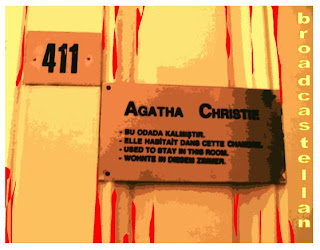
I confess, though, that, as much as I value my hearing, I frequently feel compelled to see for myself; which is why, on the anniversary of Dame Agatha’s birthday, I went up to her room at the Pera Palas Hotel in Istanbul last fall and had a look. There wasn’t much to see, really; not so much as an air of her presence. And, after paying the concierge who escorted us up to room 411, which the enterprising management has shrouded in a mystery of its own, I felt as if I were getting a box on the ear for not having had more sense.

Monumental (S)care: A Walk in Statue Park

No matter how hard I tried to make light of them, by pulling their fingers or sitting on their boots, the colossal statues gathered in the ideological leper colony that is Szoborpark made me feel (and, as you can see, seem) rather small. They were intended to awe, of course, to impress those looking up with a sense of being overmastered rather than represented, of being conquered and compelled to surrender their personal aspirations along with their cultural identity. Removed from the public squares in which they towered over the multitude, the statues of the communist regime imposed on the Hungarian people have been relegated by them to the outskirts of Budapest, to a forlorn place called Memento or Statue Park.

Never completed as conceived on paper in the early 1990s, the park has already fallen into disrepair. Weeds now triumph over concepts, mocking at once the old order of terror and this new method of detaining it, of quarantining a body of unsettling memories by setting it apart from the everyday. The past needs tending to; but, as the grounds of Statue Park suggest, we balk at beautifying what amounts to pathology, at manicuring a disease known to have corrupted intellects, choked incentives, and smothered lives.

As those monuments went up in 1940s Hungary, the US took monumental care in tearing down communist and socialist ideals, many of which had been shared and endorsed by thousands of upright, patriotic Americans during the 1930s. After years of economic hardship, of rationing and sacrifice, Americans seized the chance of raising picket fences, those monuments to sovereignty, which they were encouraged to set up as individual tributes to American virtues, to the pursuit of personal happiness and the proper boundaries of its expression.

Yet the straight and clean domains of the home frontier were argued to be under attack, compromised by wayward doubters and their doubtful ways; and it was on the air that the infiltrations and contaminations of the social fabric by the newly branded un-Americans—who were argued to have their designs on the dream they questioned as fabrication—were mass-circulated as cautionary tales of anti-communist propaganda.

Aside from the common weed of crime, once rooted out with precision and glee by superheroes like The Shadow (reportedly slated to be recast for the screen that could never contain him), the fungus of homegrown communism at home threat of mushroom clouds over America demanded a new breed of secret and sanitary agents, men like Matt Cvetic, who infiltrated the infiltrators and spread his cleansing mission statement by boldly declaring I Was Communist for the FBI in a series of espionage thrillers that premiered on US radio back in April 1952.

Throughout the 1930s, ‘40s and ‘50s, US radio assisted in setting up new statues and dismantling old, in forging idols and fostering ideals while pronouncing others fallen or rotten. It created images in the mind more persuasive, invasive and pervasive than prominently displayed sculptures in stone or steel. The United States did not require monuments to steer and stir, to guide, goad and guard its citizenry. It had microphones.

Square New Deal?

At one point it was prosaically called Uploading Square. Roosevelt tér in Budapest, that is. I decided to start our visit to the Hungarian capital by walking across the old Chain Bridge to pay my respects to the thirty-second US President who died in office on this day, 12 April, in 1945. As previously mentioned here, FDR owed much to the radio; his voice and views were known to millions of Americans who tuned in to hear his Fireside Chats. Three days after his death, his life was recalled by two special and very different broadcast, one headed by Ronald Colman and featuring an uncommonly yet appropriately somber Fibber McGee and Molly, the other featuring Canada Lee, reciting FDR’s D-Day prayer.

Roosevelt did not get a square deal, I thought, as I approached the spot named after him in 1947. These days, it is little more than a roundabout, a traffic island with a few statues in the middle—and none of them of FDR. Seen from the top of the hill in Buda, however, its prominence in the cityscape becomes apparent. Besides, as Fibber expressed it: “You know, a man is entitled to a lot of credit when people can say his family, and his community, and his country are better off for his having lived; but when a man dies and the whole world was a better place for his living, well, nobody needs much more of a monument than that.”

Meanwhile, the statues of Soviet heroes and leaders from whose rule Hungary struggled to free itself (after having lost the war siding with Nazi Germany) have been relegated to a park of their own . . .

Hungary to Hollywood; or, "seven maids with seven mops"

Well, this is it. My last entry into the broadcastellan journal before I’m off to Budapest, from which spot I hope to be reporting back on 12 April with a snapshot of Roosevelt Square, in commemoration of FDR’s death in 1945. Supposedly, our hotel room has wireless access; so I might not have to share my impressions retrospectively (as I have done on almost every previous occasion, after trips to London and Madrid, Istanbul and Scotland, Cornwall and New York City). This time, perhaps, I won’t have to catch up with myself as well as our pop cultural past.

Preparing for my trip, in an experiment you might call method blogging, I devoted the last few posts to connections between broadcasting and Budapest, between Hollywood and Hungary. Today’s association was not so much forged but found; and it is rather more remarkable for that. You’ve probably experienced it too from time to time: the feeling that, once you begin to engage with something you haven’t much thought of before, everything seems to point or relate to it. Suddenly, life is just a bowl of goulash.

Let me give you a for instance. Last night I watched a Hollywood non-classic I assumed to be entirely unrelated to our Hungarian adventure: the Ginger Rogers-starring fantasy romance It Had to Be You (1947), one of the fifty-odd movies I’ve been taking in so far this year (all listed on the right). It is a daft romance about a gal who can’t say “yes” (leaving three guys at the altar) because she cannot get her dream lover out of her head—until said dream enters her life to tell her how to lead it. Her dream lover, whose waking double eventually turns into her true love, is played by Cornel Wilde, who spends much of the picture walking around dressed like a Hollywood Indian. Anyway . . .

I generally follow up my viewings by checking out the filmographies compiled on the Internet Movie Database, which is how I came to speculate about Mr. Wilde (pictured above). Is he, or ain’t he? Hungarian, I mean. It would never have occurred to me, considering that, unlike Paul Lukas or Peter Lorre, Wilde does not have a readily distinguishable accent. Whereas most other online sources will tell you that the actor was born in New York City to Czech-Hungarian immigrants, the Database claims that he not only studied in Budapest and spoke Hungarian, but was indeed Hungarian by birth. Apparently, there are census reports confirming the former.

Wilde’s early screen name was Clark Wales. That alias does not make him Welsh, of course, but might have been chosen to suggest the foreign and rebellious. What would make him Hungarian, though? What is left of your national identity after Hollywood, like an Ellis Island checkpoint for Tinseltown hopefuls, changes your name or compels you do so? Hungarian, of course, was not a highly valued heritage in 1940s Hollywood, given the country’s suspicious proximity to the volatile Balkans, and, as the 1944 propaganda play “Headquarters Budapest” drove home, its alliance with Nazi Germany (“Admiral Horthy of Hungary, or people like him, will help to start World War III in the Balkans”).

I have long tried to get away from such a past (and, after seventeen years, am running still); but I could not hide my national origins, as much as I resent being defined by them. In stubborn grains of truth, the fatherland keeps sticking to my tongue (as you might have gathered from my podcasts). No matter how loudly I declare my past to be water under the proverbial bridge, it won’t wash. It is too prominent to be swept away or brushed aside:

“If seven maids with seven mops
Swept it for half a year.
Do you suppose,” the Walrus said,
“That they could get it clear?”
“I doubt it,” said the Carpenter,
And shed a bitter tear.”

Those lines, from Lewis Carroll’s “The Walrus and the Carpenter,” were recited by Mr. Wilde—in a broad Southern accent, no less—as he played an innocent American falling through the looking-glass in “Allen in Wonderland” (27 October 1952), a Suspense thriller involving an assassination plot, a crisis in the Balkans, and a case of mistaken identity. Earlier, in the same series, Wilde attempted an Eastern European accent playing the villain in “A Ring for Marya” (28 December 1950). It must be wonderful to have a tongue that can be twisted as readily as a broom handle.

Cleaning up the inconvenient pasts of their most valued players, Hollywood swung a lot of mops back then. It was left to the journalists to inspect the buckets. I envy those who get to sweep for themselves or learn to live with the sand.

Things Eve Peabody Taught Me

Well, it is the “Little Paris of Middle Europe.” At least that’s how our newly arrived Eyewitness Travel Guide introduced me to the city of Budapest. Since I am about to visit the Hungarian capital, I’ve been flicking the pages to get acquainted with the place, its people, and its language; but whenever I find myself in need of cultural initiation I go about it in a roundabout way, with a stopover in Hollywood. Or Paris. You know, the really big Paris to the West of Middle Europe.

You can really learn a lot from old Hollywood movies, as long as you don’t get taken in or turned off by fake sets and phony accents. Take Mitchell Leisen’s 1939 screwball romp Midnight, for instance, and profit from the experience of American adventuress Eve Peabody (as portrayed by Claudette Colbert, whose career was the recent topic of an Alternative Film Guide discussion). Eve’s story, the gist of which you can follow in this recording of a Lux Radio Theater adaptation broadcast on 20 May 1940, will teach you a thing or two about traveling on a budget of little more than a centime with a hole in it, about crashing a society party with a pawn ticket, and about the perils of unwittingly impersonating a Hungarian baroness—practical stuff not generally covered by Baedekers.

Now, as the previous entry into this journal will tell you, I have just been in the company of a true Hungarian baroness last night, one with an accent to prove at least the Hungarian part of her past. The misleading lady Eve, on the other hand, has to work somewhat harder to hoodwink her way out of the hood (in her case, the Bronx). After suffering a “nasty accident” in Monte Carlo (“The roulette system I was playing collapsed under me”), down-and-out Eve is forced to depend on little more than her wits, her sex appeal having gotten her into too much trouble already.

She takes the name of the first person she met in Paris, one Tibor Czerny (Don Ameche), a Hungarian cabbie who’s been rather too eager to chauffeur her around town in her futile attempt to land a gig as a nightclub singer. “I guess, mine is strictly a bathtub voice,” she concludes, and makes a swift exit before Tibor can make good on his offer of taking her home. “No woman ever found peace in a taxi. I’m looking for a limousine.” However much she really likes the guy, it’s dough, not romance, that this dame is after.

At the swanky soiree onto which she happens when dodging those driving forces (the Hungarian, the rain, and the subconscious), the Czerny handle proves somewhat of a liability. The assembled high society assumes Eve to be one of the Czernys—a baroness, no less. And while it proves a breeze for Eve to slide around the foreign angle by alleging to be a Czerny by marriage, not birth, she slips on a treacherous bit of trivia and soon blows her cover.

When asked about that “most enchanting” city of Budapest, where she claims to have left her ailing husband, the baron, she is dealt a trick question about the town’s famous subway. “Did they ever finish that?” a guest at the dull get-together she’s managed to infiltrate inquires. “The streets are still a little torn up,” she responds, rather flustered. Her inquisitor did not need to hear any more to know this Eve from Adam. The Budapest metro, after all, is one of the oldest subways in the world, and Miss Peabody is little more than an impersonatrix eager to get away from a past that involved being squeezed each day into the Bronx local.

According to Hollywood justice, Eve gets away with it all . . . and walks away on the arm of Czerny to boot. In fact, having gotten it wrong works out all right for her. History, geography, facts and figures—none of that matters, Midnight suggests, as long as you’ve got beauty, charm and moxie. Considering that I still know so little about my destination, and a gold lamé gown like Eve’s does so little to enhance whatever charm I might have, I’d better cram plenty of moxie into that duffle bag of mine.

Man of the World (Wide Web)?

Okay, so, I tend to overdramatize. I can’t help it. I was born with a hyperbole on my lips. Turns out, I am still a man of the world wide web, despite the scheduled (and currently ongoing) landline repairs I lamented previously. At least, the prospect of not having access to the internet motivated us to realize some last-minute holiday plans by booking a trip to . . . Budapest. However eager I might be to share my experience, the challenge, as always, is not to drift too far from the format and subject of this journal and yet to make it reflect my everyday life, whether I am spending An Evening with Queen Victoria (as I will be on 22 April) or going back to my old neighborhood in New York City (on 14 May). Still, it is going to be (almost) all about Budapest from now until my royal visit.

“There is no such place as Budapest. Perhaps you are thinking of Bucharest, . . . and there is no such place as Bucharest, either,” New England wit Robert Benchley once remarked. Fortunately, especially for someone with a non-refundable ticket, there is ample proof to the contrary on the birth certificates of a number of film and radio personalities; and, as much as I love goulash or views of the Danube, I shall devote subsequent entries in the broadcastellan journal to the exploration of a few Hollywood-Budapest connections, whether prominent or obscure. To director Michael Curtiz, perhaps (whose Mildred Pierce I revisited earlier this year), or matrimonially challenged Zsa Zsa Gabor, whom I spotted not too long ago in Touch of Evil.

Then there are playwright Ferenc Molnar, whose Liliom was spun into a musical Carousel, and director Géza von Bolváry, who made movies starring the glamorous Zarah Leander (recently back in the limelight, in commemorations of the 100th anniversary of her birth). Never mind character actor Paul Lukas, who became a US citizen in 1933, or (soon to be exhumed?) escape artist Harry Houdini, who denied his Budapest birthplace. How could I, as an old-time radio aficionado, resist a few half-hours with “gorgeous” Ilona Massey, whose Top Secret adventures were blurted out on US radio back in 1950.

Now, I don’t question that Ms. Massey was indeed gorgeous; the quotation marks are merely embracing the adjective to suggest that the actress was billed in this manner when she agreed to become incorporeal for the sake of starring in her own thriller series (before materializing on television in 1954, when, years after her meeting with an Invisible Agent (a 1942 comedy-thriller co-starring Austro-Hungarian Peter Lorre) she got to host a variety program named after her).

In Top Secret, the aforementioned Hollywood actress played a Baroness on perilous assignments of “international intrigue and espionage before and during the World War II.” It all began on a “Night Train to Berlin,” in a compartment of which the Baroness found herself locked up with a Gestapo officer who threatens to break more than her silence: “Your fingernails, your knuckles, your beautiful white teeth, that golden hair. I promise you, your hair will be gray as ashes before the treatment is over.”

Not exactly the Beverly Hills spa treatment. How did she get into such a pickle? And how come she carries six lumps of poisonous sugar in her handbag and a radioactive transmitter in her heels, like some “walking Geiger counter” in search of tea or uranium? “It is very simple,” the Baroness explains in an accent thicker than the plots she was dealt. “A long time ago, a man, a very wonderful, brave man,” offered her a job and she took it.

Who would refuse a position that guaranteed “no credit in success, no protection in danger, no recognition even in death,” a career in which “your first mistake will be your last”? The job takes her to Berlin, where the Baroness works . . . as a manicurist. “It is surprising how much one can pick up in a beauty parlor. And I do not mean, er, tips.” A real nail salon-biter.

Massey got out of Hungary for that? I’ll have to study the travel brochures more carefully next time. Anyway. I may not be a Man of the World like debonair William Powell (whom I watched last night, opposite Carole Lombard, presuming to be one); but it sure is swell to be traveling to foreign countries now and again. I get to enjoy all those Hollywood stopovers.