
 No matter how hard I tried to make light of them, by pulling their fingers or sitting on their boots, the colossal statues gathered in the ideological leper colony that is Szoborpark made me feel (and, as you can see, seem) rather small. They were intended to awe, of course, to impress those looking up with a sense of being overmastered rather than represented, of being conquered and compelled to surrender their personal aspirations along with their cultural identity. Removed from the public squares in which they towered over the multitude, the statues of the communist regime imposed on the Hungarian people have been relegated by them to the outskirts of Budapest, to a forlorn place called Memento or Statue Park.
Never completed as conceived on paper in the early 1990s, the park has already fallen into disrepair. Weeds now triumph over concepts, mocking at once the old order of terror and this new method of detaining it, of quarantining a body of unsettling memories by setting it apart from the everyday. The past needs tending to; but, as the grounds of Statue Park suggest, we balk at beautifying what amounts to pathology, at manicuring a disease known to have corrupted intellects, choked incentives, and smothered lives.
As those monuments went up in 1940s Hungary, the US took monumental care in tearing down communist and socialist ideals, many of which had been shared and endorsed by thousands of upright, patriotic Americans during the 1930s. After years of economic hardship, of rationing and sacrifice, Americans seized the chance of raising picket fences, those monuments to sovereignty, which they were encouraged to set up as individual tributes to American virtues, to the pursuit of personal happiness and the proper boundaries of its expression.
Yet the straight and clean domains of the home frontier were argued to be under attack, compromised by wayward doubters and their doubtful ways; and it was on the air that the infiltrations and contaminations of the social fabric by the newly branded un-Americans—who were argued to have their designs on the dream they questioned as fabrication—were mass-circulated as cautionary tales of anti-communist propaganda.
Aside from the common weed of crime, once rooted out with precision and glee by superheroes like The Shadow (reportedly slated to be recast for the screen that could never contain him), the fungus of homegrown communism at home threat of mushroom clouds over America demanded a new breed of secret and sanitary agents, men like Matt Cvetic, who infiltrated the infiltrators and spread his cleansing mission statement by boldly declaring I Was Communist for the FBI in a series of espionage thrillers that premiered on US radio back in April 1952.
Throughout the 1930s, ‘40s and ‘50s, US radio assisted in setting up new statues and dismantling old, in forging idols and fostering ideals while pronouncing others fallen or rotten. It created images in the mind more persuasive, invasive and pervasive than prominently displayed sculptures in stone or steel. The United States did not require monuments to steer and stir, to guide, goad and guard its citizenry. It had microphones.
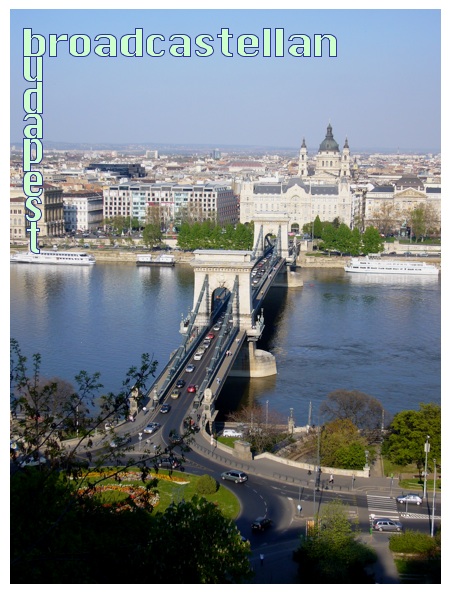
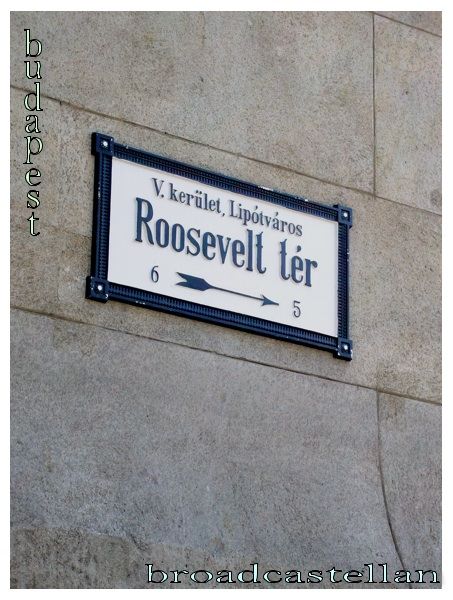
 Well, this is it. My last entry into the broadcastellan journal before I’m off to Budapest, from which spot I hope to be reporting back on 12 April with a snapshot of Roosevelt Square, in commemoration of FDR’s death in 1945. Supposedly, our hotel room has wireless access; so I might not have to share my impressions retrospectively (as I have done on almost every previous occasion, after trips to London and Madrid, Istanbul and Scotland, Cornwall and New York City). This time, perhaps, I won’t have to catch up with myself as well as our pop cultural past.
 Okay, so, I tend to overdramatize. I can’t help it. I was born with a hyperbole on my lips. Turns out, I am still a man of the world wide web, despite the scheduled (and currently ongoing) landline repairs I lamented previously. At least, the prospect of not having access to the internet motivated us to realize some last-minute holiday plans by booking a trip to . . . Budapest. However eager I might be to share my experience, the challenge, as always, is not to drift too far from the format and subject of this journal and yet to make it reflect my everyday life, whether I am spending An Evening with Queen Victoria (as I will be on 22 April) or going back to my old neighborhood in New York City (on 14 May). Still, it is going to be (almost) all about Budapest from now until my royal visit.

 It is the fuel that keeps the search engines humming. It is fodder for loudmouthed if often unintelligible webjournalists thriving on the divisive. It is the foundation of many a rashly erected platform by means of which the invisible make a display of themselves. The so-called war on terror, I mean, and the time, the shape, and the lives it is taking in Iraq. My position becomes sufficiently clear in those words, as tenuous as it sometimes seems to myself. Experiencing the uncertainty, the turmoil and sorrow that was New York City during the days following the destruction of the World Trade Center, I was anxious to see prevented what then felt like an out and out war against the democratic West; but as a descendant of Nazi sympathizers who is convinced that putting an end to thralldom is a noble cause and conflicted about the use of military force to achieve this end, I could only work myself up to a restrained fervor, which soon gave way to bewilderment, anger, and frustration.
 It was too pleasant an afternoon not to be warming to it. The outdoors, I mean. Though all thumbs (and not one of them green), I nonetheless tried my hands at gardening again, transplanting English-grown Californian Lilac into Welsh soil. Unless deterred by the vagaries of what goes for “vernal” here in Wales, I shall probably spend more time tending to the plants than to this journal next week, when the storm-frayed and patched-up telephone lines to our house are scheduled to be cut down and replaced, a spring renewal of telecommunications during which service is likely to be suspended.
 Well, I am off this instant on a short and none-too-well planned trip to the south of England, to which quick exit you owe the uncommon brevity and, what is more irregular still, the antemeridian dispatch of this entry in the broadcastellan journal. However inconvenient this last-minute post might be for my traveling companions, I simply could not wait another year to share this anniversary. True, I excite easily when it comes to the old wireless; but in this case the enthusiasm is not altogether unwarranted.
  Harry Heuser