
Carl Sandburg Makes a Confession

Well, I didn’t get a pumpkin to carve and, the weather excepting, there is no sign of Halloween around the house. As a German, I did not grow up with the custom; before they realized how to make a killing by marketing this un-holy day, something that did not happen until the 1990s, my country(wo)men skipped the dressing up, parading, and trick-or-treating and went straight to the cemetery to remember the dead, November 1 being a national holiday.

Halloween struck me as an odd mixture of carnival (when Germans do put on costumes to make a spectacle of themselves) and the feast of St. Martins (when, on November 11, their children light lanterns and go caroling from door to door begging for candy); except that, rather than symbolically splitting St. Martin’s mantle in the spirit of charity, some folks in Hollywood decided it was high time to slice open a few random souls in the spirit of Friday, the 13th.

At any rate, donning fanciful guises, stepping into the crowd to be gawked at or approaching the public in hopes of a swift, sweet and easy pay-off is not just a Halloween tradition. It pretty much sums up the advertising racket. On this day, 31 October, in 1939, American poet Carl Sandburg went so far as to assume the role of a quiz show panelist to spread the word about his latest work.

Mind you, that show was Information, Please!, the most longhair or highbrow of all the popular quiz programs on the air. As I argued in a previous entry in the broadcastellan journal, Information, Please! had an ingenious formula that attracted both to the erudite and the illiterate, since questions were sent in by the audience for the express purpose of stumping the so-called experts.

The regular (and rather generously remunerated) panelists—Franklin P. Adams, John Kieran, and Oscar Levant (all pictured above)—were joined by a special guest expert, a noted author, film director, explorer, politician or actor. Would the public succeed in cutting those luminaries down to size? Would these articulate, gifted celebrities falter behind the microphone? That, along with the ensuing banter, accounted for the appeal and success of the program.

The people? No, Mr. Sandburg did not seem to mind them. Indeed, he was so eager to present himself as one of the commoners that the first question posed to him by master of ceremonies Clifton Fadiman, the literary critic of the New Yorker, extracted somewhat of a confession: “What notorious living American author was thrown out on account of his ignorance of arithmetic when he tried to break into the West Point Military Academy?” “Should I answer ‘me’ or give my name?” the poet inquired and, when encouraged to recount the incident, affirmed that he was indeed the “notorious” one, his attempt to enter West Point having been foiled some forty years earlier, back in 1899.

A little while later in the program, Sandburg is again given a question relating to his own life when asked whether he knew of a poem (a word used loosely, since even advertising slogans were deemed acceptable as answers) featuring a description or mere mention of fog. “Little ridiculous,” Sandburg chuckled with a note of embarrassment in his voice. After all, he was being prompted to recall one of his own works describing just such a weather condition (“Fog”):

The fog comes
on little cat feet. 

It sits looking
over harbor and city
on silent haunches
and then moves on.

Again, the author let listeners in on a secret: it had taken him just “about five minutes” to compose those lines—yet, to his professed astonishment, they were not only the best known in all his works, but practically the only ones the general public could recall.

While managing to mention John Wilkes Booth in one of their answers, another nod to Sandburg’s Lincoln biography, panelists did rather poorly that night, failing to recall how the regretful Miss Otis met her death or from which ports Gulliver embarked on his travels, and struggling to come up with five flowers with “masculine names,” Mr. Sandburg advancing “frankincense.” I gather this bit of silliness might have been a relief to its author, considering that there weren’t as many occasions to plant a pun in a serious (and eventually Pulitzer Prize-winning) history than there are opportunities to plant a plug for such a tome in a quiz program.
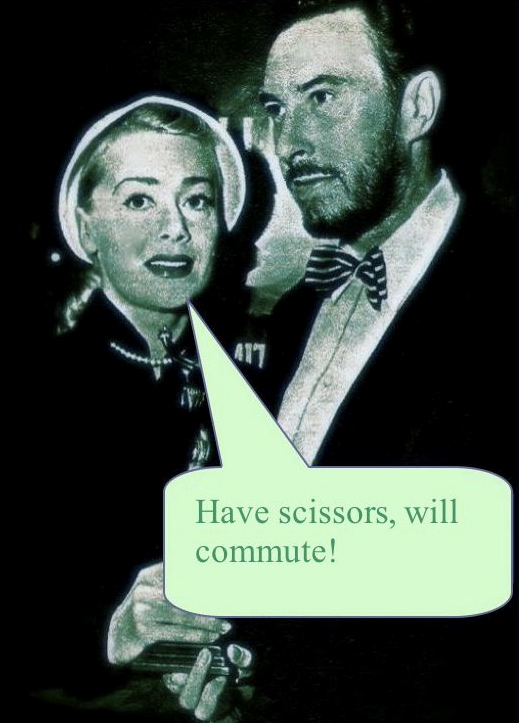
On This Day in 1947: Havoc in "Subway" Gives Commuters Ideas

Well, if you’re on the edge, you’d better not take the subway and stand next to someone who has the job you want, wants the partner you have, and won’t stop yapping about her career and the lucky breaks she’s had. You’d better hold on to the strap and, crowds permitting, take a deep breath—especially if you got a sharp pair of scissors in your bag. “Idea and scissors. Scissors . . . and idea!” That’s what the down-on-her-luck Paula has running through her mind in a Suspense play titled “Subway,” which aired on this day, 30 October, in 1947.

The leading role in this thriller is played by June Havoc, who happened to be the wife of Suspense producer William Spier (both pictured above). A few years after teaming up for this broadcast, Spier directed Havoc in the motion picture A Lady Possessed (1952), which pretty much sums up the driven yet frustrated Paula, the central character riding this New York City “Subway.”

While somewhat overpowering at first, the sound effects transported me back to the underbelly of the city. I thought of my commutes from Manhattan to the Bronx and back, or to wherever I was studying and working at the time. Having been squeezed in and shoved by the “five-o’clock mob,” as Paula calls her fellow straphangers, it is easy to sympathize with someone who suddenly “hated everybody” and “felt like committing murder.” She certainly has reason to resent Ruth, the woman next to her, who insists on unfolding her success story at a time when Paula’s career has pretty much folded. Scissors, please!

Perhaps someone ought to have handed a pair to veteran radio playwright Mel Dinelli, co-writer of “Subway.” The set-up, certainly, is well suited to a twenty-minute thrill ride on the airwaves, especially to the noirish psycho-dramas in which Suspense excelled after the departure of puzzle-crafter John Dickson Carr (previously mentioned here). A character sketch, narrated in the first person, that revolves around a possible turning point in that person’s life, a moment demanding quick decisions and swift action. “Idea and scissors.” Will the two meet so that Paula might get her break, taking over for Ruth, as suggested by this none-too-bright former rival? Or will Paula cut her losses and run off empty-handed? It’s all a matter of minutes. Why, Paula marvels, “I wouldn’t even be late for supper!”

Dinelli dealt with such a tense instant and the instincts it triggers very successfully in thrillers like “To Find Help,” a Suspense play he reworked into Beware, My Lovely, a motion picture starring Ida Lupino. Here, however, the survival drama is given a rather more ambitious treatment, as the protagonist’s drives—her desire to be Ruth-less—are being met by her conscience, the consideration that even strangers on a train, even those she thinks of as “an obstruction to be cleared away for something more important,” are part of a grandly designed human fabric her scissors are poised to slice and destroy. It is an awakening that, in order to ring true or convince, requires a finer tuning than the crude but effective formula devised for Suspense, the will she/won’t she scenario that, in order to sustain tension, pushes the moral issue of such an epiphany to the edge, where it is in danger of falling flat instead of rising to the occasion of being uplifting. Hearing about someone regaining self-control is decidedly less thrilling than listening to the unravelling of nerves.

“Subway” is a troubled ride of a domesticated Wild West show in which the law of the gun has become a split decision for scissors. The frustrated Paula stands in for the women in post-WWII America whose careers have been cut short by a return to the ostensibly normal; women who were pushed back into kitchen and nursery, away from the promises of assuming center stage among men, overshadowed by the ordinary and outdone by opportunists fighting with weapons fit for man-hunt or matrimony; women who were expected to keep their ambitions and their anger in check.

What are the rewards for patience and sacrifice in a post-war society reclaiming its entrepreneurial edge with a vengeance? While not as suggestive as that most famous of all radio plays to air on this day, “The War of the Worlds,” “Subway” might have given a few commuters ideas about running with scissors.

Dylan Thomas, the Man Who Sounded Dreams

To “begin at the beginning”: 27 October 1914. Birth of Dylan Thomas, the poet who put the town of Llareggub on the map—an imaginary, sound-wrought community whose Welsh enough sounding name takes on an everyday crudeness when reflected upon in the mirror, a curse of the visual that the ear does not appreciate. Nor could it have been uttered on national radio back in the late 1940s, when Thomas began to work on the play that would, after years of revisions, become “Under Milk Wood.” Yet it is far from muted, this “Play for Voices,” which eventually went on the air in January 1954, just weeks after Thomas’s binge drinking-induced death in New York City.

“To begin at the beginning.” It is with this sound plan of action that Thomas’s narrator ushers us into the world of “Under Milk Wood,” a fourth-dimensional non-space, the anti-matter of a dreamscape unfolding in time. Listen, and you “can hear the dew falling, and the hushed town breathing. Only your eyes are unclosed to see the black and folded town fast, and slow, asleep. And you alone can hear the invisible starfall, the darkest-before-dawn minutely dewgrazed stir of the black, dab-filled sea [. . .].”

“Time passes. Listen. Time passes,” we are reminded. “Come closer now,” the voice beckons. “Only you can hear and see, behind the eyes of the sleepers, the movements and countries and mazes and colors and dismays and rainbows and tunes and wishes and flight and fall and despair and big seas of their dreams.” It is an irresistible invitation, this: to close ones eyes and conceive of imaginings beyond images. “Under Milk Wood” is a play unfit to be seen.

It certainly wasn’t suited for the big screen, as I found out in my attempt to celebrate the anniversary of Thomas’s birth this evening. I rarely shut down the projector before a film has flickered out; but I was grateful to a friend of ours who interrupted Andrew Sinclair’s 1972 adaptation, a tawdry spectacle of ill-conceived literal-mindedness. Starring Burton and featuring Elizabeth Taylor, the film shows us horses and cats and false teeth in a glass whenever Thomas speaks of them (and “cocklewomen” at work when he tells us they are sleeping). It offers visuals for visions, a prosaic fidelity that is the very death of poetry.

I decided not to pick up where we had left off. Instead, I’ll turn down the lights and listen to the 1954 radio version (also narrated by Burton). I might drift off; but I will let it happen and even will this mingling of dreams, allowing Thomas’s word-made world to stream in and out of my consciousness, catching his redolent names and hyphenate-strung metaphors only to let them sink in the “black, dab-filled sea” amid the coasting boats of my unguarded thoughts.

For years, while researching my study on so-called old-time radio, I have been resentful of Thomas’s reputation among the radio dramatists. It irks me still that so much attention is being paid to this one piece, a zooming in on Llareggub that did not lead to a sustained effort in charting radio’s vast and varied soundscapes or to a widespread awareness of radio as a poetic medium. “Under Milk Wood” has been singled out and set apart as literature, glorified at the expense of a great number of unheralded and silenced performances.

Tonight, I am going to stifle this resentment—an anger rightly aimed at blinkered critics, not at the poet at play—and slide between the eyelids of Thomas’s dreamers to ease my way into that town made of time, a town made by those taking a moment, and by them only.

Curtains Up and "Down the Wires"

Well, aren’t we rather quaint in our high-tech ways? Getting our entertainment via cable? Subscribing to so-called premium channels? Pshaw, old hat! Even Queen Victoria had a home entertainment center. Called the Electrophone, it was a service that allowed those who signed up to tune in to theatrical performances live—not time delayed—from the London Stage. No need to sit through commercials or settle for anything not worth your while. You simply selected a program, dialed in and an operator standing by connected you to the opera, the theater, or—who’s going to tell—a bawdy music hall.

I became aware of this state-of-the-dramatic arts 19th-century invention while researching for my doctoral study, in which I mentioned it in passing as a precursor to radio’s earliest theatrical entertainments, which relied rather heavily on such stage hook-ups. The BBC Radio 4 Archive Hour presentation of “Down the Wires” provides a thorough—and thoroughly engrossing—introduction to the Electrophone’s dial-up service, which gave audiences access to operatic performances, political speeches, and religious services, piped into the sitting room (or wherever you chose to have it installed).

In this fashion, live theater was being made available to home listeners in the 1880s France and 1890s Britain and America. Matthew Parris’s “Down the Wires” (which is once again available online until Saturday), features rare recordings of early 20th-century performers, reformers, and politicians, including the voice of Teddy Roosevelt.

There are accounts as well of those who used this service, which, in the UK, was available for over twenty-five years, until the wireless cut those wires in the mid-1920s. Now, I’m not the nostalgic sort, really, but right now I’m thinking of all the thrilling plays that I might have caught over the phone (that fickle and fiendish device featured in my latest old-time radio podcast) had I been able to afford the considerable fee of £10 per annum for the service, in addition to the charge for the equipment.

Using my horn-honed imagination, which you’d need to flesh out what the stage business did not render intelligible to the home listener, I might have been able to take in sensational melodramas like The Worst Woman in London (1899) or The Ugliest Woman on Earth (1904)—the original Desperate Housewives. The title character of the former is a siren who blackmails her ex-lover, sets fire to his new home, disguises herself as a man and fights it out with his new bride whom she drags by the hair, onto the rooftops of London, until the virtuous rival manages to escape by tip-toeing to safety on a telegraph wire. Now, with my mind supplying the props, that’s an act fit to go “Down the Wires.”

Racket Science: Two Coconut Shells, a Blowlamp, and a Raspberry"

Well, what does it sound like? Home, I mean. The everyday we inhabit. Perhaps, home is a space in which we no longer pay much attention to what our ears can pick up because we are so accustomed to and at ease with our surrounding soundscape. Or perhaps it is that private environment within whose confines we can drown out what is strange with a soundcarpet of our own weaving. Today, my sonic rug received another sound beating, and I guess this is some of the dust that fell off.

There was an awful lot of howling and rattling, produced by the fierce winds that, while no longer unfamiliar to me after two years of living here in Wales, still suggest the foreign, the uncanny, the inhospitable. I guess I could have countered it by turning on the radio or by playing some of my favorite tunes; but I rarely listen to music these days, at least not as a means of muffling the world or creating an alternate one. I am trying to remember past places I called home and the sounds that might have made them such.

Do you recall sounds as easily as images? We tend to take pictures of our friends and surroundings; but, unless we take moving images with our digital cameras, we rarely record our lives in sound. Right now, I am not even sure about my father’s voice, for instance. He died some ten years ago; but I hadn’t talked to him for some time before that. My family was just about as functional as the clan in Little Miss Sunshine, with which I finally caught up this evening at a local cinema.

I was the teenager in that picture—moody, aloof, and not inclined to share my thoughts with the family to which I scarcely belonged. I might have a photograph of the man somewhere. I’m not sure; but I could get my hands on one should I require such supplemental image for the mental ones still vivid. Now, I could not produce a sound portrait of my father; at least not one featuring his own voice. He breathed his last . . . and the “rest is silence.”

Our voice excepting, what sounds might best represent us? That is a challenge few radio artists had to meet: to create a life in non-verbal, non-musical sound. Generally, aural effects were thought of as a crutch to the spoken word. They might create atmosphere, aid in setting scenes or in visualizing a body moving in space. Footsteps and doorslams, that sort of thing. Instead of supplementing or complementing, sounds may also counter the image the word creates. We are told one thing, but hear another, wonder and chuckle at the irreconcilable differences.

There was a little of that in the BBC 4 documentary “Two Coconut Shells, a Blowlamp and a Raspberry”, which is once again available online for a couple of days. However cursory, it tells the story of the BBC sound effects department and the uses of noisemaking in 1940s comedy programs like ITMA (It’s That Man Again). As in the US, the low humor of bodily sounds was frowned upon by the BBC; but there were a few amusing substitutes of the “raspberry” kind to suggest forcefully what escapes all of us from time to time. It rendered as over-the-top what was generally off limits.

Comedy is exempt from the realism often expected of radio drama, the realism for which the medium was famous—and infamous. Last night I watched the MGM musical Hullabaloo, which feebly sends up the panic created by the Mercury Players’s production of “The War of the Worlds.” Some of the humor, such as there was, derived from the sounds coming out of lip-synching Frank Morgan’s mouth, unexpected voices including those of stars like Spencer Tracy, Clark Gable, Hedy Lamarr and Claudette Colbert.

Closing your eyes, you’d see a scene from Boom Town, the box-office hit that Hullabaloo promoted by way of promising, conjuring, and withholding. Sounds can contradict both words and visuals in a way Magritte’s “Ceci n’est pas un pipe” does; but they can also confront each other so as to shatter the mental images we create while listening.

Perhaps I would resort to this sort of playful surrealism in a sonic portrait of my jovial if booze-wrecked father, who, when I created my first audio plays with my tape recorder, advised me not to use a narrative voice but let noises and dialogue speak for themselves. Now, we are well past dialogue, my father and I; but in rendering him, I might use sounds that speak against the revisionist and fragmented image I’ve made up, sham yet real—the mental picture that has become as much of a crutch as the old doorslam.

Now, I was all prepared to review “Two Coconut Shells”; but my mind was unruly tonight and wandered off into the cloud-shrouded sunset like . . . two coconut shells in a gravel box; carried away by the autumnal fury of sound, it decided not to return home in time for today’s post. Instead, it’s that man again, knocking on my windblown mind like the proverbial skeleton in the family closet. He insists on revisiting from time to time, as much as I’d like to send him off with an old-fashioned raspberry.

Wire(less): When Radio Answers the Phone

Well, it only took about five months, but, taking a break from the broadcastellan journal last night, I finally completed my fourth podcast. Titled “The Voice on the Wire,” it explores the relationship between radio and telephone. Its publication coincides with two BBC Radio 4 broadcasts, one documenting the history of radio sound effects (“Two Coconut Shells, a Blow Lamp and a Raspberry”), the other (“Down the Wires”) the development of the Electrophone, an early device for taking in theater over the telephone. I will discuss those two programs later this week; but today I’ll simply play the barker and do a bit of self-promoting:

Step inside, folks, step inside! This way to the big show. That’s your mind, ladies and gentleman, or at least it can be, with pulp-peddlers like me around to give you strange ideas. Be there when an invalid is strangled in her bed; listen to the disembodied voice of a man in the act of committing suicide, and witness assorted cases of murder, mayhem, and madness. Get your wires double-crossed here, folks! You’ll come across the most tremendous and terrifying tales of treacherous telephony. You’ve never heard such smooth operators, such neurotic callers. Busy signals, freak connections, hang-ups and heavy breathing—we’ve got it all. There’s nothing like a case of espionage and betrayal, of lines that go click in the night, of outcasts and shut-ins whose lives are being cut as short as an inconvenient call . . . as long as you are not at the receiving end.

I’ve gone on about thrillers like “Sorry, Wrong Number,” “Meridian 7-1212,” and “Long Distance” at some length in my doctoral study; unlike Roland Barthes, I find it easy to go on about what I love. It’s an even greater thrill to let radio speak for itself, to tune in and sample various melodramas from series including Inner Sanctum Mysteries, Suspense, The Whistler and Radio City Playhouse, and to put together this collage of telephone terror.

While it is the most famous of all plays written for American radio (“The War of the Worlds” being an adaptation, however innovative and radical), “Sorry, Wrong Number”—dubbed “radio’s perfect script”—was only one in a long line of audio dramas that took up the receiver and took it on by shouting across the wire, that means of point-to-point communication for the triumph over which the wireless was originally developed.

For decades, it was the wire that remained triumphant. In the 21st century, this failure has been rectified and “wireless,” an almost forgotten word in the early 1990s, now means both the intimate chat between two individuals and the broadcasting (or podcasting) of voices to the multitude. Still, whenever I see a sign saying “wireless”—and despite the fact that I am using such a network at home and, if lucky, on my travels—I still think of the old cat’s whiskers and the behemoth of a mass medium into which it had transmogrified by the 1930s—a culture of pre-internet voicecasting and sound-snatching turned into a one way operation and forced into commercial service.

As I argue, radio anathematized telephone as the anti-wireless, and for good reasons. Heard on an experimental program that glorified the sound medium and its potentialities, a play like “Meridian 7-1212” demonstrated how private talk, unlike public speech—once it was tele-communicated rather than delivered face to face—promoted selfishness and enabled sinister deeds. Pointing up the failures and dangers of telephonic exchanges, the radio, which has been accused of being a fascist medium, emphasized the public service it rendered by bringing and keeping a people together and glossing over or making a joke of differences, tasks of great importance during economic crises (as confronted in the 1930s) and war (from World War II and Korea to the installation of Russia as the new enemy to beat).

I rarely use the phone these days; and cellular ones are largely a nuisance or a mystery to me. I can manage to keep my appointments—and my distance—without them; but perhaps it was listening to all these tales of terror that convinced me to twist radio’s dial instead of running the risk of dialing wrong numbers.

The Thin Man Shows Some "Thigh"

There has always been an air of mystery about radio. It has been called the “blind medium,” which, while not quite accurate, suggests that its audiences are left in the dark, drawn in by sound and left out by silence. That is why the airwaves are so well suited to mysteries, the art of holding back and filling you in, deliciously piecemeal—the art of fascinating by frustration. The very word “mystery” is said to have its origins in the Greek verb meaning “to close the eyes,” as well as a noun denoting a faint sound made with one’s mouth shut. Mum, apparently, is the word in this sophisticated game of blind man’s bluff.

Now, this business of withholding information and frustrating those who are itching to know is somewhat less magical when it comes to collecting so-called old-time radio programs. So many transcriptions have disappeared over the years, leaving us clueless as to the nature and quality of a thriller series, aside from a few notes or a list of tantalizing titles. The Thin Man is one of those shows that have almost entirely vanished; only a small number of episodes have been preserved.

On this day, 20 October, in 1944, the Charleses, as impersonated on the air by David Gothard and Claudia Morgan, solved “The Case of the Tattooed Thigh.” That illustrated gam has gone missing; but, an unexpected aid in its recovery presents itself in form of an issue of Life magazine, which turned the script for the upcoming broadcast into a photo novel, shot at Manhattan’s Versailles Restaurant.

However disappointing it might have been for those eager to listen in back then to find not only the thigh but the entire case laid bare by this tell-all spoiler of a picture shoot, the magazine now comes in handy for those who would like to get a load of that elusive limb, or indeed any missing link in the rich history of American radio drama.

Having read the story, which involves an inked kooch dancer who is poisoned by a curare-coated dart while performing her routine with her partner and lover, I wonder how it might have played out on the air. The terse synopsis makes plain how simple radio whodunits were, and needed to be, considering that the twenty-odd minutes allotted to such plays does not allow for a great number of plot twists, suspects, and red herrings. Yet, as I said, there is an air of mystery about the sound-only medium, which can enhance the most prosaic picture and lend charm and intrigue to the dullest text. Sure, I saw the “Thigh,” but I’d much rather wrap my ears around it.

Moby-Dick, Squeezed into a Can of Sardines

Well, call me . . . whatever you like, but I am prickly when it comes to the protection of endangered species; those of the literary kind, I mean. Take Moby-Dick, for instance. Go ahead, so many have taken it before you, ripped out its guts and turned it into some cautionary tale warning against blind ambition and nature-defying obsession. Moral lessons are like sardines: readily tinned and easily stored until dispensed; but they become offensive when examined closely and exposed for much longer than it takes to swallow them.

Not far from where I live now, in the Welsh town of Fishguard (pictured), Gregory Peck was once seen impersonating the mad Captain Ahab, who, in the eyes and minds of many non-readers, became the scene-chomping villain in control of Herman Melville’s tough-to-steer vessel of a book. On this day, 19 October, in 1946, Moby-Dick was being chopped to pieces for the airwaves. It had come under the knife of Ernest Kinoy. who did this sort of hack job on a weekly basis; the remains were tossed onto the soundstage of the Columbia Workshop, ready to be delivered to American homes like a quick if none too nutritious meal.

Radio was a regular cannery row back then. Now, the Workshop was a classier establishment than most of radio’s story factories. As I last mentioned here, it was billed as “radio’s foremost laboratory of writing and production technique.” Its producers knew better than to present the entire volume in a twenty-five minute synopsis. A little better, that is. Instead, as if inspired by the hyphen that harpoons the original title, they allotted two installments for its audio-dramatic rend(er)ing of the old mammal. They had done as much in their treatments of Hamlet and Alice in Wonderland (as well as its sequel). They were still a thousand nautical miles away from approaching what E. M. Forster referred to as “the song” of the book.

As Forster remarked, Moby-Dick is “an easy book, as long as we read it as a yarn or an account of whaling interspersed with snatches of poetry. But as soon as we catch the song in it, it grows difficult and immensely important.” The “prophetic song” of Moby-Dick “flows athwart the action and the surface morality like an undercurrent. It lies outside words.” It certainly “lies outside” the domain of sound effects and choric shanties—the readily reproduced impressions of the sea.

I wonder whether Hemingway was listening in or taking notes that day (and on 26 October, when the Workshop presumed to have done justice to—or simply be done with—the book ). On radio, at least, Moby-Dick sounded like an extended version of The Old Man and the Sea, written a century later. Aside from the famous opening line and the hunt for the titular creature (which takes up the three concluding chapters of Melville’s 135-chapters-spanning tome), little blubber and less bone remains of Moby-Dick; or, The Whale, a book known to many and read by few.

To those picking it up for the first time, the humanity and gentle mankindliness of Moby-Dick—especially its tenth chapter—must come as a surprise. What has happened to popular culture in America that it balks at such pre-Wildean sentiment but gorges instead on the book’s supposed machismo appeal? Is it possible, perhaps, to take another look at this Brokeback Mountain of a whale?

“All my books are botches,” Melville declared to Nathaniel Hawthorne, to whom the book is inscribed. They most certainly are, once they fall into the hands of adaptors like Mr. Kinoy.

“. . . leaking out of Neverland”: Peter Pan in Scarlet

Well, I was all set to go on about Les Miserables.  No, not the musical record-trampler recently certified as the longest-milked cash cow in the history of West End and Broadway.  Nor the original yet-another-page turner, either.  I wanted to commemorate the anniversary of a 1942 radio sketch spoofing Hugo’s epic . . . until I realized that I had already done just that last October.  So, before I end up resorting to bottled thought, I’d better lower myself anew into the tortuous sewers of popular culture.  What I came up with, this time, is the idea for a new column.

Noticing that a recording of Fred Allen’s Les Mischief is being presented tonight by the WRVO Playhouse, it occurred to me that, rather than relying on my own library of plays, it might be refreshing to find out what is “Now on the Air,” to highlight programs currently online, broadcasts or podcasts that caught my ear and might be worth your time.

One such discovery is “Peter Pan in Scarlet,” an adaptation of the recently published sequel to the famous play and novel by J. M. Barrie. True, I’d prefer being treated to another helping of Barrie’s comedy As Every Woman Knows, a superb production of which I caught in Manchester, England, a few months ago. I am generally so little inclined to romanticize the alleged wonders of childhood that I was tickled to find “No Room for Peter Pan,” an odd radio play about growing up starring the most famous Every Woman of them all—Miss Helen Hayes.

Not that I’ve been trying to dodge those Peter Panhandlers altogether. Most recently I took in Paramount’s delightful 1924 version featuring the aforementioned Anna May Wong as Tiger Lily; but, having once suffered through Spielberg’s dismal 1991 update showcasing the belatedly juvenile antics of Man of the Year wannabe Robin Williams, I still approach subsequences like Peter Pan in Scarlet with some misgivings.

Mind you, this is an “official” sequel. In 2005, author Geraldine McCaughrean was commissioned to continue the adventures of Peter and Wendy as sanctioned by the trust to whom Barrie granted the rights to his story. On 14 October 2006, shortly after the publication of the legitimized follow-up, BBC Radio 4 presented its authorized dramatization of McCaughrean’s novel, adapted for the sound-only medium by Nick Warburton. Before being issued as an audio book, a recording of the broadcast has been made available in the BBC’s online archive.

The production is a throwback to old-fashioned radio dramatics, replete with a guiding, at times interacting, narrator and a for British radio unusual attention to sound effects. At ninety minutes, however, it might get on your nerves before it can plays itself out in your mind. As much of American radio drama of the so-called golden age, it tries to cram an entire novel through the comparatively narrow slot of a single broadcast; but unlike the former, this production seems to insist on telescoping it all in a nearly seamless Pan-orama rather than editing and segmenting through slow fades, pauses, and musical bridges, without which much gets lost in breathless confusion, a hyperactive storytelling as unruly as Peter himself.

In a nod to that beloved late-20th century fairytale A Nightmare on Elm Street, “Peter Pan in Scarlet” opens with John Darling shuddering to frightful visions of steel-clawed Captain Hook; and, the horrors being communicable, he is not the only one dreading sleep. “I imagine dreams are leaking out of Neverland. So we must find out why,” Wendy determines in her instant diagnosis of John’s case. The cure she prescribes is to “call the old boys together again” and, overcoming the considerable obstacle that is adulthood, to revisit their apparently endangered pal.

In order to take flight, the grown-ups have to become children again, a feat achieved by shrinking into the clothes of their offspring. This provides an occasion for cross-dressing and gender-bending in an update divested of the original’s androgyny and adolescent yearnings. The jolly downsizing is nicely realized by the uncredited sound-effects artists. From then on, bright ideas and dark twists chase one another in what amounts to a frantic and noisy quest for a good night’s rest.

Prominent in the cast is Shakespearean actor Roger Allam, who might have faired better than Fred Allen opposite the megalomaniacal Orson Welles in the radio sketch I had on my mind today. After all, Allam played Inspector Javert in the original West End production of Les Miserables and, not averse to hamming it up (as it struck me when I saw him in early 2005 in a crude pantomime at London’s Old Vic), would have refused to be drowned in the sewers without uttering as much as a line of dialogue. As Pan’s nemesis, he never stays down for long, a sequel-symptomatic resilience bespeaking a writer’s determination to keep a newly invigorated franchise afloat.

Morlock Guys and Eloi Dolls: The Domestic Battles of the Man Who Envisioned the War of the Worlds

I came across a peculiar piece of schlock science today. An evolutionary theorist has uttered the prediction that, within about 100,000 years from now, the human race may develop into two separate and unequal breeds, a scenario akin to the one H. G. Wells created in his sci-fi thriller The Time Machine over a century ago. Our descendants will either be nasty, brutish and short, or else graceful, fragile and overcultivated, enslaved by technology and a fear of Hobbsian life in the state of nature. In other words, a world of Morlock and Eloi.

Wells’s fictions strike me as rather more urgent and compelling than such a pseudo-scientific hypothesizing about the shape of things to come. As Orson Welles and his collaborators drove home when they brought The War of the Worlds to radio (as discussed here), they invite us to translate the grim visions of the future into a commentary on the none-too-bright world of today. If the time machine had not returned home, the ride would be pretty much wasted.

In some of his smartest if lesser-known novels, Wells dispensed with the creation of seemingly distant worlds as stand-ins for close and contemporary ones. Instead, he documented what was separate and unequal in his own society, examining the clash of classes and the battle of the sexes. One such Wellsian commentaries, which I am currently reading, is Ann Veronica (1909), an incisive comedy about women’s struggle for equality.

I owe this discovery, and quite a few others besides, to my daily excursions into the realm of —another trip not worth taking if you are not prepared to transport something back with you into your here and now. It was a remark made by Lost Horizon author James Hilton on the NBC University Theater that brought Ann Veronica to my attention.

On 3 April 1949, Hilton shared his thoughts on Jane Eyre with the listeners of the NBC University Theater, which presented a dramatization of the novel (as discussed here) with Deborah Kerr in the title role.

Considering how frothy the conclusion of the new four-part BBC television adaptation of Jane Eyre turned out to be last Sunday, Hilton’s lecture may serve as a reminder of the original’s “shocking” and groundbreaking qualities as the “first great novel that emancipated woman emotionally by portraying her not merely as the passive recipient of man’s favor, but as the possessor of rightful and independent passion of which she need not be ashamed.” This “battle” of Jane Eyre and her heirs, so Hilton, continued into the twentieth century, until Wells “fired the last shot” with Ann Veronica.

I just had to find out how that shot was going off, even though I could hardly agree that it was to be the last. I am grateful to Hilton for having brought Ann Veronica to my attention, happy to be following its rebellious heroine in her quest to grow up an equal to the men around her. “She wanted to live,” Wells’s narrator sums it up; but

all the world about her seemed to be—how can one put it?—in wrappers, like a house when people leave it in the summer. The blinds were all drawn, the sunlight kept out, one could not tell what colours these grey swathings hid.

Ann Veronica “wanted to know,” but was little helped by a father who held that women were creatures “either too bad for a modern vocabulary, and then frequently most undesirably desirable, or too pure and good for life.” Anxious to mingle with socialists and suffragettes, she very much resented being cast as an Eloi in a sheltered upper-middle class world apart from if beleaguered by the hoi polloi many of her class regarded as terrifyingly Morlockian.

To be sure, that feeling of being segregated, set aside or typecast, can hit you at any time in your life; nor are societal conventions oppressive to women only, as Wells demonstrated in another one of his remarkable comedies, The History of Mr. Polly. Like young Ann Veronica, the middle-aged Mr. Polly is eager to escape the strictures of a narrowly defined existence, a life of many divisions and few diversions.

On this day, 17 October, in 1948, the NBC University Theater presented Mr. Polly starring Boris Karloff, an actor whose career in film was similarly circumscribed by the (di)visions of men who profit from such classifications (as I remarked here exactly one year ago). It feels right to return to Wells now, whose gleefully staged domestic battles are often overlooked in favor of his more somber epic ones. I, for one, don’t require the thrills and frills of an elaborate Halloween party to appreciate an attempt to unmask human nature.