
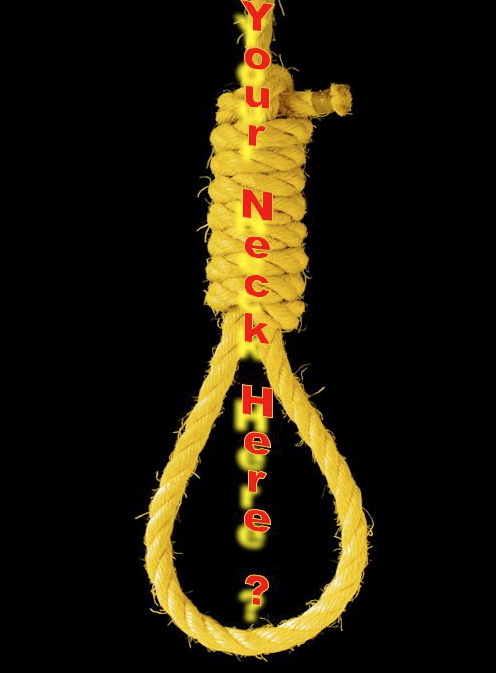
Imagine tuning in to one of your favorite mystery programs and being greeted instead by the following message:
“Columbia and its affiliated stations present a special broadcast for Wednesday, October 16, 1946, a day that will long be remembered at Nuremberg and throughout the world.”
It was a reminder that criminals greater than those generally found in detective fiction had been brought to justice; yet the broadcast that followed was far from celebratory.
The play was “The Empty Noose,” heard on the evening of that memorable day on which eleven masterminds of Nazi Germany’s crimes against humanity were being executed. The verdict had been announced two weeks prior to the date set for the hanging, giving writer Arnold Perl time to construct with care this provocative memorial, a document in sound that opens with the naming of the sentenced: “Goering, Ribbentrop, Keitel, Kaltenbrunner, Rosenberg, Frank, Frick, Sauckel, Jodl, Streicher and Seyss-Inquart.” Of course, only ten were actually hanged that day, leaving the eleventh noose empty.
“You should have seen them die,” the play’s “Eyewitness” addresses the listener,
seen all but one who arranged it by his own schedule [that is, Goering, who committed suicide] walk in the early morning of a gray cold day while most of Europe slept; seen them hanged one by one in the gymnasium under the electric lights. The ghastly ten who were left behind to where the hangman waited. Like those who watched, he knew, there was no payment large enough for what they had done.
Does the violent end of such violent men constitute the end of an era of violence? Or is this hanging little more than a gesture? Is it a time chiefly to rejoice and hope, or to reflect and doubt? These are the questions raised by Perl’s commemorative docudrama whose action unfolds in the eyewitness reports of those who had experienced life under fascist rule and were now attending the trial and executions.
“The Empty Noose,” like Norman Corwin’s “On a Note of Triumph,” refuses to cheer at the apparent victory for democracy, resists uttering or encouraging as much as a sigh of relief. After all, it was not Goering’s noose to which the title of Perl’s piece refers. His “Noose” was reserved for all those fascists who survived, living beyond remorse or reform, those denying the holocaust while harbouring thoughts of genocide, including those active in present-day Germany’s re-emerging Nationalist movement and those, elsewhere, tearing down liberties under cover of democracy.
“What didn’t we do at Nuremberg?” Perl’s play dares to ask, confronting listeners weary of conflict and eager to move on:
Well, that empty noose is still swinging, and it’s still empty. Until it’s used, until it’s choked the life out of Fascism—so far as I’m concerned this is no time, no place—there is no reason—to sit back relieved and calm. Tonight at Nuremberg—and tomorrow—there will still be one round coil of rope ready to be used. It’s going to take a lot of self-examining, a lot of faith in what we believe in, a lot of willingness to fight for it, a lot of speaking out, for all of us, here and everywhere, before that empty noose is filled, and we can stand up and say we have won, we have conquered.
In short—a message the play suggests rather than states plainly lest it promote fatalistic passivity—never.
Non-visual theater is the theater of ideas. While it has rarely been permitted to do so, it can dispense with traditional storytelling, with the Aristotelean dictum that there must be a beginning, middle, and end to any drama. It can raise questions, doubts, and awareness by raising voices and leaving interstices of ambiguous silence. It can resist dramatized exemplars and deal instead with ideological concepts simply by giving them utterance. And it can dangle an empty noose in the mind of its audience, a looming question mark in one’s own head more forceful and than the image of a rope around the neck of another. That image, after all, is a reminder of a time supposedly bygone, a reminder that, once again, someone else was made to stick his neck out to pay for our complacency and complicity.
The living breath of the voices on the air create no such conclusive image; instead, they caution us to be mindful, mindful of a present in which, around and within us, freedom and fascism run neck and neck for our future.

 Well, just how will North Korea react to the threat of “serious repercussions” uttered by the US? What is the nature and extent of the threat? And what is its validity? The current crisis may very well usher in the New Cold War, now that North Korea is said to have tested its first nuclear bomb, a privilege that the US apparently feels compelled and entitled to reserve for itself. Why should any nation intimidating the US with atomic competition feel obliged to heed such a warning? And why should any one second or third or fourth world power (thus labeled and locked in some position of dependency according to a Western system of classification) abandon its scientific efforts, hostile or otherwise, considering how well stocked American arsenals remain these days?
 Here I am, sorting and sifting through my English Literature anthologies, skipping from one century to another, slipping out of one channel of thought and slithering into the next as if sliding on dried ink liquefied in the muddy corridors of my mind. It is a mind receptive to—and indeed responsible for—all this skipping and slipping. It fancies the catch of whatever catches its fancy without letting such influences harden to the point that they might become a stranglehold. It resists arrest, flinches, and withdraws before any one imported thought can take root so as to seem an extension of some other self.

 Well, this will sound like a familiar story. A small house (halfway up in the next block, say) is being torn down after its long-established and well-liked owners cave in to some corporate big shots who want to get their hands on a valuable piece of property that seems just ripe for redevelopment. The transformation achieved proves agreeable enough to all; but to those who remember the neighborhood and used to stop by at the old house, there is something missing in the bright new complex that has taken its place.
 Well, this is a tough time for heroes. There might still be a need for them, but we stop short of worship. The nominal badge of honor has been applied too freely and deviously to inspire awe, let alone lasting respect. Even Superman is not looking quite so super these days, his box-office appeal being middling at best. And as much as I loathe the cheap brand of sarcasm that passes for wit these days, I am among those who are more likely to raise an eyebrow than an arm in salute.
 Harry Heuser