Being But Blogmad North-Northwest

Well, today is the birthday of Quentin Tarantino, the oddball director who started out inauspiciously if oddly enough playing bit parts such as the Elvis impersonator who mystified The Golden Girls at Sophia’s wedding. So, I am permitting myself to be a little more goofy than usual. As if the weekend’s diversions had not been daffy enough, considering that I witnessed Kevin “Chicken Little” Covais laying his last egg on American Idol; watched Julie Walters in Acorn Antiques, the straight-to-DVD release of the West End musical based on a series of TV sketches poking fun at shoddy soap operas; and followed the misadventures of Depression-weathered Marie Dressler and madcapitalist Polly Moran in Prosperity (1932).

My folly did not quite end there. Since it had been disquietingly quiet of late here at broadcastellan, I decided to give the much-talked-of referral service Blogmad a try. Sure enough, a few more quick-to-click onliners came galloping through; but I doubt there were any more readers, let alone interested ones. This general attention deficit can be gleaned from my recent survey, which remained largely unnoticed this weekend. In the relative sanity of my pre-Blogmad days, four bored passers-by lingered long enough, at least, to let me know they did not care, a response option omitted in the current poll. After all, I can surmise as much from silence.

Now, I have no commercial interest in blogging and write chiefly for my own amusement, partially derived from exposing myself publicly, and periodically at that. As I put it in the imitation Chanogram I composed shortly after inaugurating this journal, “Blog like hothouse flower: Must blossom for anyone.” It seems that the flora is being trampled rather than feasted on during the present stampede.

Services such as Blogmad or Blogadvance (which just awarded me credits for a “direct referral” in which I took no active part) are undoubtedly of greater use to those who wish to cash in on the thorough commercialization of the so-called blogosphere. Should I have stooped to adding my profile to a site that inquires about my “maritial status” (sic)—without giving me the opportunity to answer appropriately—and promises me certain “benifits” (sic) which I recieve (sic) for joining?

Such mis-spellbinding prospects notwithstanding, I am beginning to realize that I am reconciled to being cast as a marginalien—a stranger tossing in asides from the sidelines. In other words, I am not sure how long I will be indulging (in) the madness.

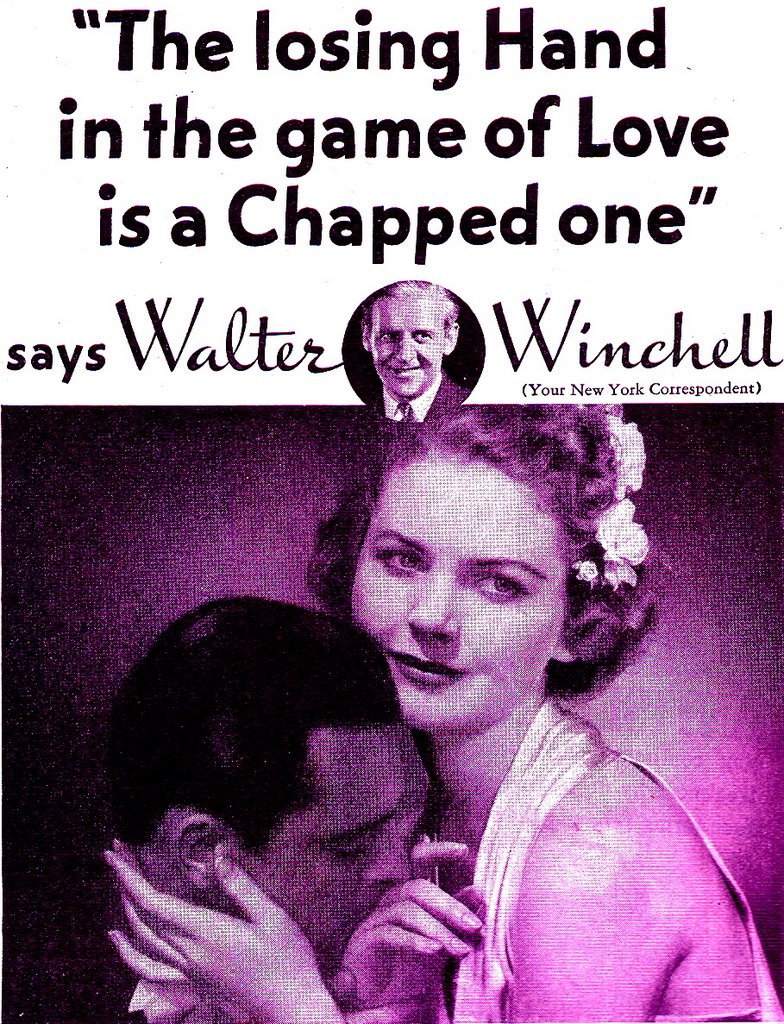
Clearly, bloggers are more forgiving of flawed spelling than of flowery speech, of which I spout enough to bar this metaphorical hothouse from becoming anything resembling a hotspot. How much easier was it for Walter Winchell, the high-school dropout who rags-to-enriched himself to become the most influential of all radio reporters during the 1930s and ’40s!

However dubious its reportorial integrity or merit, his program sure added some colorful blossoms to America’s garden-variety dictionary. In the 1930s, Winchell was ranked among the top contributors to American slang, whether or not he actually coined the saucy euphemism “making whoopie.”

“Good evening, Mr. and Mrs. North and South America and all the ships at sea—let’s go to press,” Winchell greeted listeners on this day, 27 March, in 1949, bombarding them with quick and random-fire newsflashes about a North Pole rescue and a deadly tornado, about Notre Dame University honors for actress Irene Dunne and trouble for Lois DeFee, “tallest of the striptease stars,” who had “just reported being robbed of all her gems.” Okay, considering that the Amazonian Ms. DeFee once tried to floor Americans by marrying a midget, such a flash was probably no more than another publicity shot.

Amid all that trivia, however, there were disturbing words. Not so much news, but signs of Winchell’s whole-hearted support for the McCarthy cause and his willingness to assist in turning the Soviet Union into an enemy fit to fill the spot left vacant after V-J Day.

Winchell talked of “changes in the soviet top command” and warned that Russia, having “put the big squeeze on Sweden,” was “getting ready for a military move of some kind.” He delighted in being denounced as a “radio liar” by Russian propagandists who labelled him the “pen gangster from the Hearst band.”

There sure was method in such red scare madness, which was as much a machination of the West as it was a menace from the East. Admiring the flowers of rhetoric, one must be prepared to step right into dung heap of history.

"This . . . is London": Casting John Donne’s Shadow

If Gothic Nightmares at the Tate Britain failed to send shivers down my receptive spine, the National Portrait Gallery’s Searching for Shakespeare sure did nothing less. I am generally not one to wax poetic at the sight of artefacts that may or may not have belonged to some literary so-and-so. For the most part, I don’t really care what a writer looked like, as long as his or her prose or poetry is to my liking. To be sure, having studied and taught Shakespeare during my college and university days, I am sufficiently impressed by the sight of an old Folio edition. Something else caught my mind’s eye at that exhibition; and it was not one of the supposed likenesses of Shakespeare—many of which have long been proven spurious—but the portrait of one of his contemporaries.

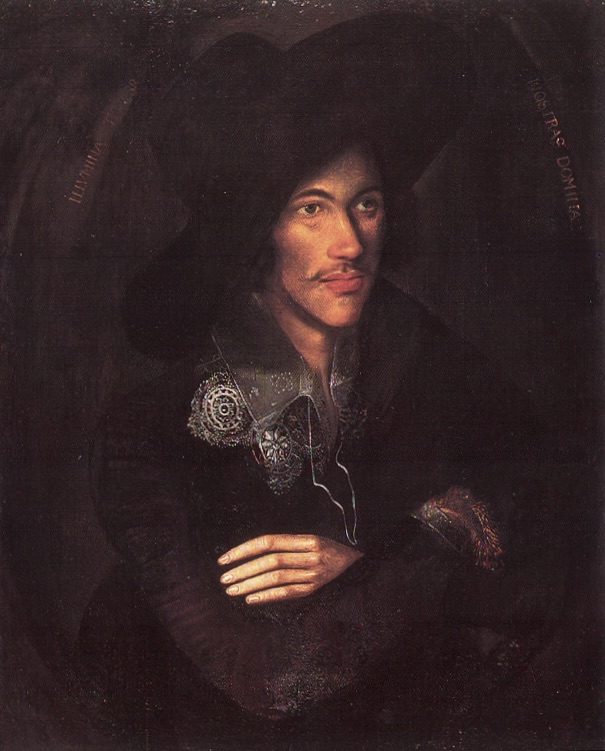
Portrait of John Donne by an unidentified artist (c. 1595) National Portrait Gallery, London

The portrait in question is that of John Donne, a painting currently being offered to the National Portrait Gallery, which is trying to raise funds in the amount of £1,652,000 to obtain it before the purchasing opportunity expires at the end of May. So, the picture now hangs in the Shakespeare exhibition, where visitors have to pay to get a glimpse of it. It is well worth a glimpse, I assure you. I confess the pleasures I derive from being moved by a work of art, whether considered trifling or momentous, and it is not rare that I stand before a painting with tears welling in my eyes or goose bumps sprouting on my skin. Composed by an unknown artist around 1595, the Donne portrait is decidedly of the gooseflesh variety.

It is in poems like “His Picture” and “Witchcraft by a Picture” that Donne speaks to us about attempts at portraiture, about the art or hubris of capturing life, the act of imitating nature or surpassing creation—troubling thoughts for a former Roman-Catholic growing up in the turmoil of the Reformation and its sanctioned smashing of images. In the former poem, Donne writes:

I fix mine eye on thine, and there
Pity my picture burning in thine eye;
My picture drown’d in a transparent tear,
When I look lower I espy;
Hadst thou the wicked skill
By pictures made and marr’d, to kill,
How many ways mightst thou perform thy will?

But now I’ve drunk thy sweet salt tears,
And though thou pour more, I’ll depart;
My picture vanished, vanish all fears
That I can be endamaged by that art;
Though thou retain of me
One picture more, yet that will be,
Being in thine own heart, from all malice free.

In the latter piece, Donne suggests the mental image and the imaged man to be at odds; a painting is a memento mori, which, fixed in time, turns into an unlikeness of fleeting life.

Here take my picture; though I bid farewell,
Thine, in my heart, where my soul dwells, shall dwell.
‘Tis like me now, but I dead, ’twill be more,
When we are shadows both, than ’twas before.

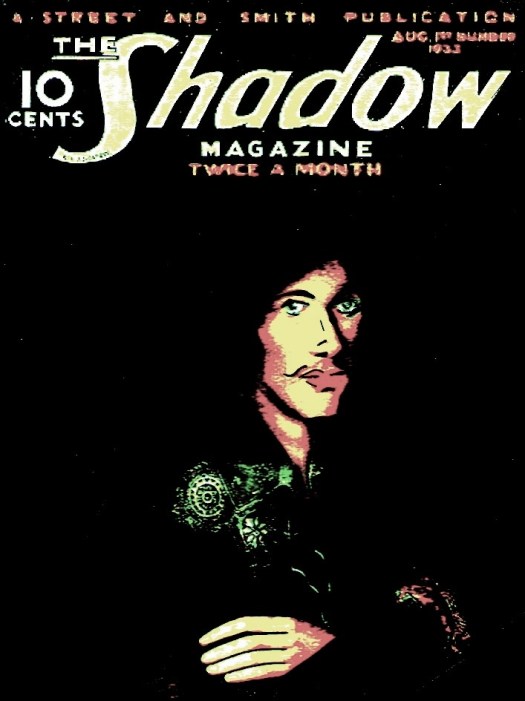
To his own portrait, lost and mislabeled for centuries, Donne referred as “that picture of mine which is taken in shadows.” In my irreverent mind, the striking features of Donne’s shadow-cast face began to resemble that of The Shadow, Lamont Cranston—the secret avenger who, striking hidden from view, laughed death in the face and had a sermon for all who dared to defy the law: “The weed of crime bears bitter fruit.”

Sermonizing Donne, who once wrote “A Lecture upon the Shadow,” approached the challenge of death in one of his most famous sonnets:

Thou art slave to fate, chance, kings and desperate men
And dost with poison, war and sickness dwell,
And poppy or charms can make us sleep as well
And better than thy stroke; why swell’st thou then?
One short sleep past, we wake eternally,
And death shall be no more; death, thou shalt die.

Donne’s portrait has captured my imagination; yet, having too often crossed—and all but crossed out—the uncertain boundaries between high art and low, it is The Shadow who now runs away with it. In my mind, I hear Lamont Cranston’s defiant laugh as I gaze at the poet’s likeness, “taken in shadows.”

"This . . . is London": "Searching for Shakespeare" at the Novello, the National Portrait Gallery, and on My iPod

Well, I hardly need to travel all the way down to London to go in search of him. After all, the man—or a stained-glass likeness of him—looks over my shoulder each time I fetch a volume from my bookshelves. His raised eyebrow and faint smile seem to say, “Come now, there must be something else beside radio drama to pique your interest.” For some time now, Shakespeare’s works, along with those of many other acknowledged topnotchers of western prose and poetry, have been relegated to the shelves upstairs to make room for my growing collection of books on American broadcasting and radio dramatics. Yet the bard need not consider himself debarred; even on American radio, he enjoyed a prominent position.

The Radio Guild, the first major American drama anthology for the airwaves, chose Romeo and Juliet for its premiere back in 1929. Subsequently, Orson Welles brought his acclaimed production of Julius Caesar to radio’s Mercury Theater (as discussed here), the irreverent Norman Corwin invited audiences to “[s]tand by to hear a Dane evaporate” as he faded out a production of Hamlet, and the CBS Radio Workshop went so far as to stage an interview with the playwright to investigate just “who wrote the works of William Shakespeare?”

As has often been argued, few dramatic works are as radiogenic as Shakespeare’s plays. They were written for the “wooden O” of an almost bare stage and, though hardly without action, rely much more on the spoken word than the elaborate masques, pantomimes, and melodramas of subsequent generations of playwrights.

When Shakespeare is translated for the contemporary boards, for big screen or small, text is often in competition and at times at odds with context, as costumes and stagecraft conspire to make the spoken word sound dated or the settings seem anachronistic. On the other hand, producers who opt for the blank canvas of a stripped stage in an effort to let Shakespeare’s words speak for themselves, give the eye so little to play with or feast on that they might as well lead us to the theater of the mind by handing out headphones and recordings.

The Royal Shakespeare Company production of As You Like It, now playing at the newly refurbished Novello Theatre in London’s West End, reduces the forest of Arden (or Ardenne) to a single tree. Yet it proves entirely sufficient to suggest a pastoral setting, to allow for some hide and seek among lovers, and to give poor Orlando, pining for his Rosalind, the requisite branches on which to pin his clumsy (and double entendre peppered) verse:

If a hart do lack a hind,
Let him seek out Rosalind.
If the cat will after kind,
So, be sure, will Rosalind.
Wintered garments must be lined,
So must slender Rosalind.
They that reap must sheaf and bind,
Then to cart with Rosalind.
“Sweetest nut hath sourest rind,”
Such a nut is Rosalind.
He that sweetest rose will find
Must find love’s prick, and Rosalind.

Orlando, of course, doesn’t altogether mind the prick of Rosalind (charmingly portrayed by a somewhat Ellen DeGeneresque Nia Williams); professing to cure his aching heart, she makes love to him while disguised as Ganymede, a simulated shepherd whose name spells boytoy of the gods. To be sure, the gender illusions of dramas designed for an all-male cast play out differently for today’s audiences (unless those of the all-male Propeller Company, whose production of The Winter’s Tale I saw last December). It is in these explorations of gender that radio can be more sophisticated and mature by being less provoking.

Non-visual theater can either obscure differences and tone down what may strike some as Charley’s Auntics and encourage us to look past gender markers like skirts and trousers to discover the humanity underneath. As cross-dressing all but fades into thin air, the sexual confusions take on a new subtlety, however drastic the cuts and unfortunate the synopsizing. Hear for yourself in Margaret Webster’s soundstaging of As You Like It, which was produced by the Columbia Workshop on 7 December 1939, and in which Webster gives her vocal chords a winningly understated if all too brief Victor/Victoria workout.

Regrettably, the single-trunk woods where Orlando woos Rosalind will be felled this weekend, when the Novello will stoop so low as to present an adaptation of the faux ’60s musical Footloose. If you care to go “Searching for Shakespeare” elsewhere, there is an exhibition of artifacts and portraits on display at the nearby National Portrait Gallery, my impressions of which I shall share tomorrow.

"This . . . is London": Fuseli’s Nightmare Revisited

Sometimes it takes questionable taste in art to make us realize how unpalatable or insipid our ready-meal answers to life’s challenges can be. In the bourgeois mediocrity of German suburbia, where I was obliged to wade through the quagmire of adolescence, an installation by performance artist Santiago Sierra is currently creating no inconsiderable controversy by daring to turn a synagogue into a gas chamber.

Media Nightmare

I suspect that quite a few of Sierra’s detractors who think such confrontations of violent history with artistic violence reprehensible will be less disturbed to learn that, some forty years after the end of World War II, the building had been a symbol of Germany’s inability to deal with its horrible past: obscured from public view and unknown to schoolboys like myself, who passed it daily, it had been permitted to deteriorate to such a state of dereliction that it was only deemed fit to serve as a barn or pigsty.

Fuseli’s Nightmare

Iconoclasm, barbarism, and unreason—these were also pre- occupations of 18th-century Gothic art, samples of which are now on display at the Tate Britain. Unfortunately, Gothic Nightmares: Fuseli, Blake and the Romantic Imagination suggests nothing more forcefully than that visual representations of horror are often less than horrifying; less horrifying, that is, than the terrors of which a fertile imagination can conceive and a methodic mind rent from humanity can implement without scruple. Instead, the shock-and-schlock artistry of Fuseli and his followers comes across as juvenile rather than rejuvenating, as cheap rather than free-spirited, as exhausted rather than inspired.

Gothic images are often too crude and obvious to stir the emotions, not unlike the gag-reflex testing effects achieved by today’s horror movies. Aiming at our throats, these lesser Romantics often extract mere giggles and at times guffaws.

Another version of Fuseli’s Nightmare

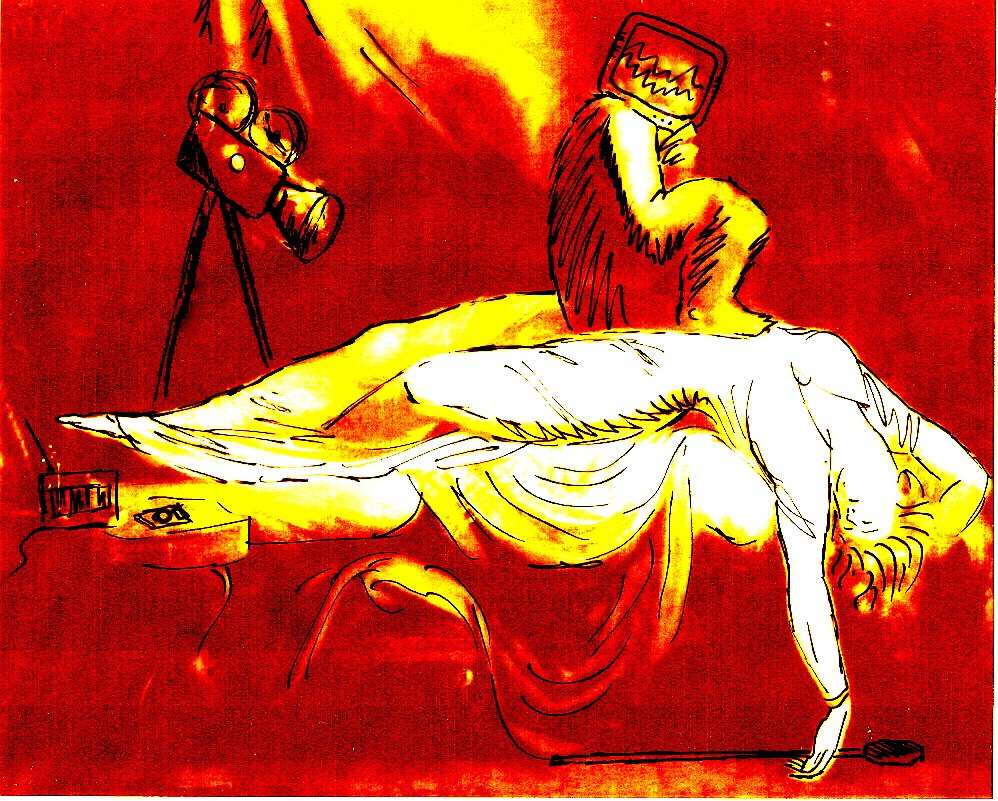
Not surprisingly, Fuseli’s (in)famous Nightmare painting was frequently mocked, especially in its day, when it served as a template for political caricatures such as the one attempted by me here, one in which liberty is being haunted by images of the Middle East (the camel in our bedrooms) and the ineptitude or rampant ambitions of a certain world leader.

How infinitely more stimulating, I thought, while wandering through the exhibition—which does some violence of its own by pairing sublime Blake with silly Fuseli, or by confronting the pre-cinematic Phantasmagoria with French-revolutionary Romanticism—is the suggestive terror of the airwaves, compared to the horror of the image, whether still or moving.

Of course, I am resorting to another caricature of my own to support—and thus undermine—my point: that the imagination, stifled or silenced by clamorous images, suffered its greatest defeat with the deposition of short-reigning radio by the matter-over-mind medium of television.

"This . . . is London": Approaching Edward R. Murrow

I have returned from my latest London trip; my stimulated mind is filled with assorted impressions that I now ready for recollection in relative tranquility. Rather than pouring out those impressions like the content of an overstuffed suitcase, I shall meet the challenge of assembling them into a sequence of composite portraits, portraits not so much of myself but of the experience of gathering ideas and collecting thoughts. You might call this manipulation of the everyday a form of “method living”: a mental aligning and creative channelling of life’s vast, fleeting, and potentially overwhelming influences into something resembling a design of my own making.

There is to me nothing more thrilling than the tracing of a pattern in the patched-up fabric of the everyday. Granted, I often impose such a design by snipping off too many of the loose ends and by choosing that to which I expose myself with rather too thorough discrimination, by excluding the ill-fitting piece or neglecting the odd thread. Yet the satisfaction of finding sameness where others might only detect difference is not necessarily the program of a narrow mind. I try to do as much stitching together as I do selecting or cutting away. Atropos, Clotho, and Lachesis—I intend to do the handiwork of all three fates.

One of the threads I chose to follow during my wanderings through the maze that—compared to the comforting simplicity of New York City’s map—is sprawling London was the career of American journalist Edward R. Murrow. In his late 1930s broadcasts from London, Murrow had encouraged Americans to connect with world affairs by bringing the hardship of those under Fascist attack home to radio listeners who, in the confines of their living rooms, might have imagined themselves immune to such devastating influences. Later, he exposed fascism of another kind in his commentaries on misguided patriotism and undemocratic perversions of unity.

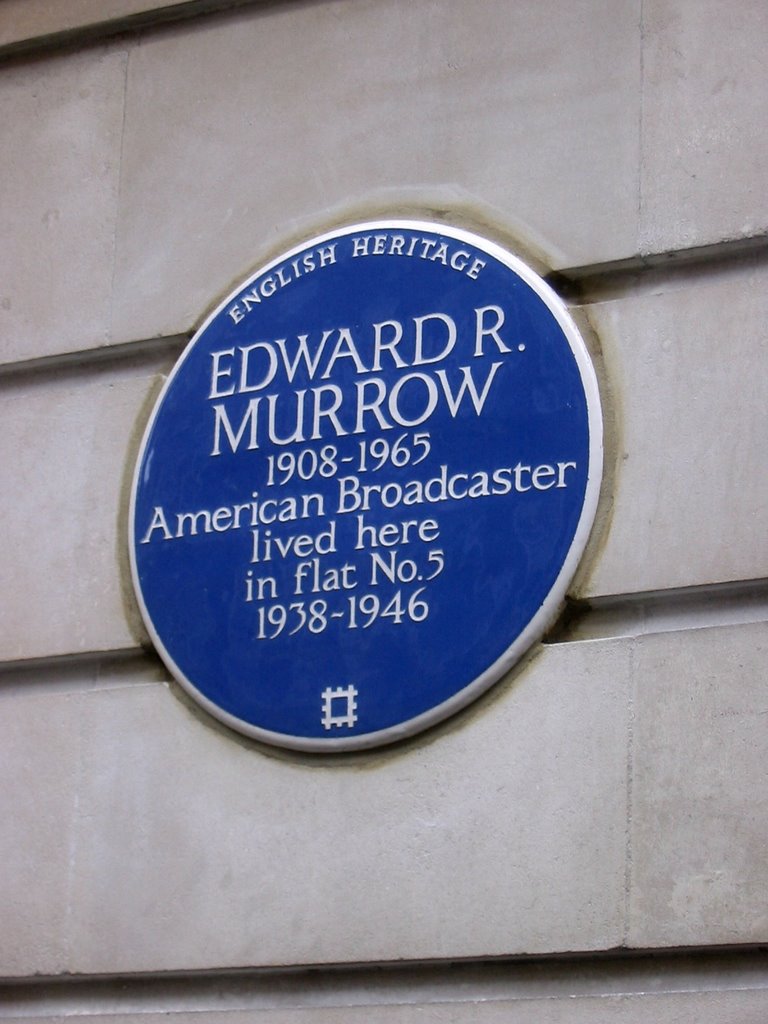
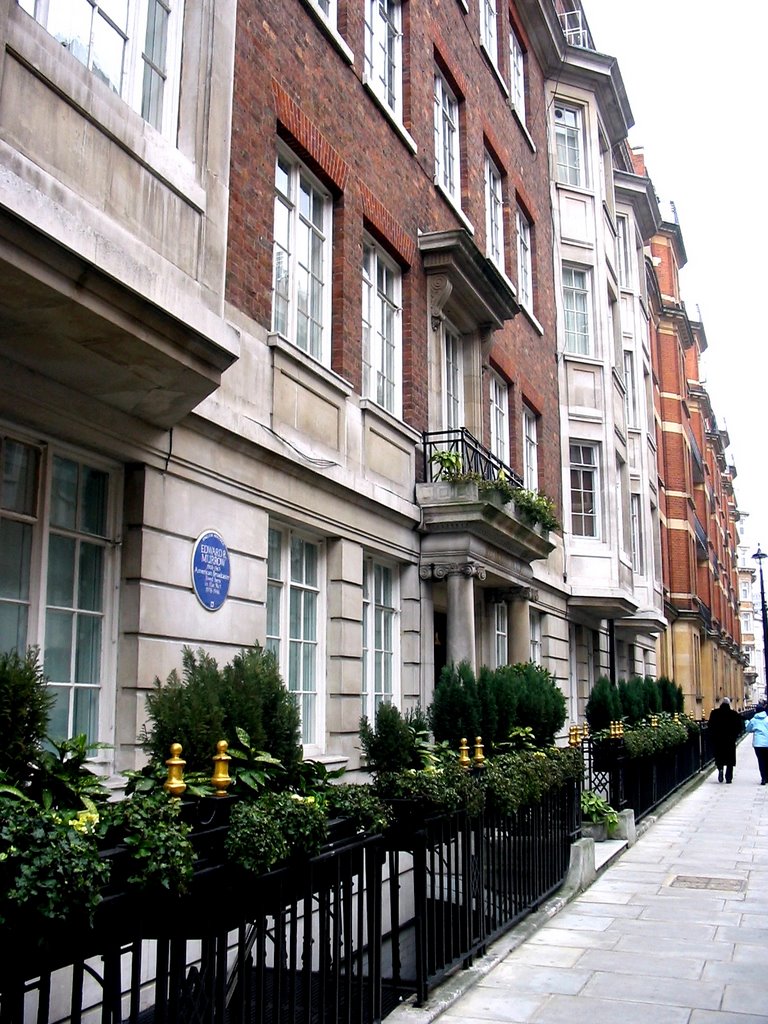
After a brisk two-hour walk from South Kensington, across Hyde Park, I arrived at Murrow’s former residence in Marylebone, not far from the British Telecom tower. I took a few photographs and walked on. I experienced no great stirring of emotions, let alone a spiritual connection. Yet the site itself, along with the act of finding, approaching and appropriating it pictorially became part of a design, enforced by the screening of Good Night, and Good Luck. my mate and I attended a day later. It had not been altogether planned that way; indeed, I was surprised to find the film to be still in such wide circulation.

The quietly impressive motion picture and my altogether unremarkable photographs do not so much amount to a biographical composite sketch of Murrow, a man who shaped history by recording it. Rather than capturing his past they suggest his presence—or our need for it.

Much of what Murray reflected upon in his broadcasts—even in reminiscences such as this one from 3 December 1944—is anything but dated, if only you permit yourself to look beyond the names of places and persons and weave his expressions of hope and fear into the fabric of our current wars and crises:

You remember those mean streets in London where so many died; the men stretching canvas over holes in roofs and walls, trying to patch things up before the winter comes, anything to keep out the rain and cold.  At the airfield you remember that it was just here you watched Mr. Chamberlain descend from his plane when he came back from Munich, waving his written agreement with Hitler and talking about peace in our time.  That was such a long time ago. And you wonder when there will be peace again and what it will be like. . . .

You recall all the talk of a better world, a new social order, a revolution by consent, that marked the desperate days, and you realize that talk of equality of opportunity, of equality of sacrifice, of a peace based on something other than force, comes more readily to the lips when disaster threatens.  There isn’t so much of it now [. . .]. 

Europe for a long time will be concerned with the urgent problems of day-to-day existence. The fundamental economic and social conflicts will not have been settled by this war. [. . .] 

For years after this war Europe will be in torment and [ . . . ] you wonder what part America will play in it all.  In battle and in production we have been magnificent.  We have delivered the planes, tanks, guns and ships and the men to fight with them.  The evidence of our strength can be found all around the world.  We’re not as tired as the others.  Our industrial plant is undamaged.  Our homes have not been blasted.  We enjoy security and relative comfort and our responsibility is frightening, for Europe will look to us—not for charity, advice or admonition, but for an example.  Democracy hasn’t been very fashionable over there in recent years and there are many who doubt that it can survive the strains and stresses of peace. . . .

Is democracy still “fashionable” anywhere? Is it the gear of choice or an imposed uniform that ceases to be fashion by resembling fascism? Has the current war on terror (or the terror of war) done much to preserve it? Are we still talking about a “peace based on something other than force”? The patterns we discover when engaging with the so-called past are often disturbing rather than reassuring. And yet, to ignore them, to refuse recalling them into our everyday, might be more disturbing still—a wilful refusal to connect that, far worse than passivity, is a violent act of tearing apart the fabric along with its flawed design.

White House Warnings, the Iran "Challenge," and the Art of Recycling Words for the Atomic Age

Only yesterday I was leafing through my dusty copy of Rogues’ Gallery: The Great Criminals of Modern Fiction. Granted, the story of pickpocket Thubway Tham (discussed in my previous journal entry) was anything but “great,” the dubious gentlemen among whom he appears in this anthology, figures like Raffles or Arsene Lupin, being far worthier of the appellation. Putting the book aside and glancing at today’s headlines, I got to thinking about those real-life acts of roguery and their perpetrators, thieves and tricksters fit for a place in that proverbial gallery.

Without being facetious, I think that most of us are eager to put certain politicians right up there with confidence men, embezzlers, and racketeers. Unlike fictional smugglers, highwayman, or cardsharpers, however, our misleading leaders rarely inspire cloak-and-dagger romances, at least not while they are still in office. Their potential to do harm to a far greater number of people than any pirate of old renders them too treacherous to be enchanting, and too powerful to be defused by mere ridicule. That we might have contributed to their ascent—either by having been taken in by their words or by having stood aside while others made what we’ve come to suspect as the “wrong” choice—only drives home that the joke, if ever it was one, is decidedly on us.

In the United States, the people’s trust in their political leaders may be reaching a new low these days, giving way to an indiscriminate, haphazard scepticism that could potentially be more hazardous than the actions that triggered it. So, hearing the latest White House warning about the Iranian nuclear program, I wonder who among us, the citizens or allies of the US, is willing to accept or heed it. Is it a danger real or imaginary, pre-existing or newly conceived in the act of pronouncing it true? What’s more, is not even a manufactured threat a concrete one nonetheless, whether as propagandist tool or diplomatic blunder?

Thinking this, I was reminded again of “Air Raid,” a verse play for radio by Archibald MacLeish, a big name in American poetry and pamphleteering. “Air Raid” is a didactic drama about an unheeded warning. Now, as I remarked when I commemorated the anniversary of the its premiere, the play was originally an appeal designed to caution US citizens against isolationism. Confronting the public with an enactment of a deadly attack on civilians, MacLeish went so far as to suggest that those who lose their lives to wartime terror are responsible for the consequences of their inaction.

However questionable his achievement, the anti-fascist cause that motivated its author was a noble one. “Air Raid” suggests that the greatest threat facing a people is not posed by foreign aggressors or domestic demagogues, but by an attitude of indifference to or ignorance of the political affairs makes the public vulnerable to acts of suppression and obliteration. Yet, like all propagandistic speech—and the melodramatic vehicles in which it hits its target audience—these words of caution were readily coopted.

On this day, 10 March, in 1956, nearly two decades after its first broadcast, “Air Raid” was restaged by the CBS Radio Workshop. The same words poured once more from the speakers—but their context had changed entirely. Now the play had the stamp of the Eisenhower years pressed upon it, the gullibility of the public being relied upon rather than challenged with the announcer’s insistence that “Mr. MacLeish’s prophesy” had become “grim reality” in an age of “guided missiles” capable of “nuclear destruction.”

“Learn what you can do to increase your chances of survival,” the program’s announcer implored listeners at the close of the broadcast: “Contact your Civil Defense Office.” As American families retreated into their picket-fenced homes—or into dreams of such—they were left with the impression that the world outside the United States was evil and that their leaders had solely their safety, rather than profits, in mind. It was thus that the lucrative armament of the cold-war years was being justified. MacLeish’s warning had become “grim reality,” all right—so much so that the public was not to appreciate his original message.

So, given that we have mostly familiar words of warning to go by once more, how can we determined the honesty or falsehood of those who utter them? Does the present truth lie in the perceived deceptions of the past? And how far should we remain willing to listen with the generosity of an open mind—instead of hiding behind the reflecting shield of satire—to keep an essentially sound and worthy political system such as democracy from falling apart?

Thneaking Up on "Thubway Tham"

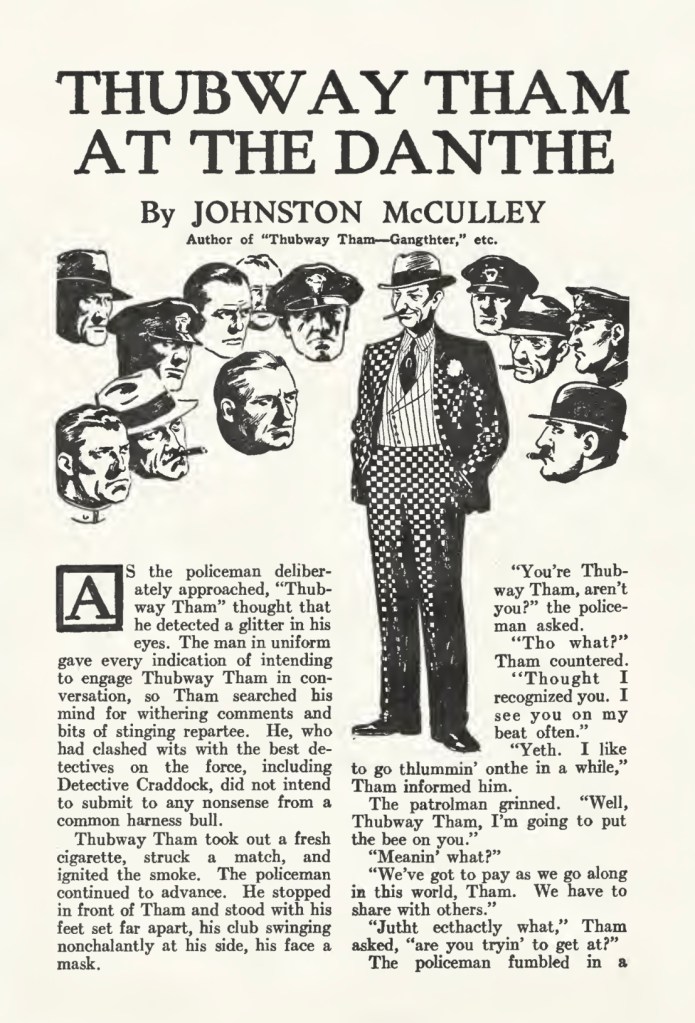
Thubway Tham, as he appeared in Detective Story magazine, 25 Jan. 1934

The other day I called detective Ellery Queen to the rescue when I found myself in need of some pop-cultural assistance while dealing with a certain case of bigotry in the blogosphere. Searching for a visual aid to prop up my improbable prose, I dug up my copy of Ellery Queen’s Rogues’ Gallery, a 1945 anthology of crime fiction containing radio scripts by Dannay/Lee and John Dickson Carr.

It occurred to me that, aside from those two scripts, I hadn’t read any of the other pieces in said volume. So, leafing through, I happened upon a story about a small-time crook with a big-time speech impediment, a lisp so thick that it earned him the nickname “Thubway Tham.”

Now, Tham never hit it big in radio or the talkies (with that voice, he had about as much of a chance to make it there as silent-screen siren Dolores Costello). That said, he was a rather popular pulp hero in his day, which is reason enough for me to make his acquaintance.

Thubway Tham was the brainchild of Johnston McCulley, creator of the recently if not altogether successfully resuscitated Zorro. According to McCulley (as retold by Mssrs. Ellery Queen), Tham first sprang into action during his author’s visit to New York City in 1919. Observing the crowds being “spewed out of the subway,” McCulley realized that those Big Apple commuters were a veritable herd of cash cows for a clever pickpocket.

In need of a saleable story, McCulley came up with “Subway Sam”; but, somewhat intoxicated at the time, the writer found that his mouth would not cooperate in pronouncing the name and settled for “Thubway Tham” instead.

An artful little dodger who forever thumbed his nose at the luckless Detective Craddock, his arch-enemy, Tham kept appearing and disappearing in story after story (some 182 by 1945, according to his prolific father); yet the times were changing, and what might have been amusing in the prosperous 1920s or reassuring in the lean 1930s was no longer appropriate during the war years, when paper was too precious for the spreading of questionable romances of self-serving criminals and the glorification of devious individualism.

Even less-than upright characters, such as the Saint, were being recruited for the war effort. And unless Tham was satisfied to go underground for the duration, disappearing from public view along with other misfits like honorable, but propagandistically irredeemable Mr. Moto, he was expected to take his hand out of other people’s pockets long enough to lend it to Uncle Sam.

Here is how McCulley’s aging lawbreaker, anno 1944, saw his dilemma:

Thubway Tham found his favorite bench unoccupied, and sat upon it.  He was thinking of the war.  Many of his younger friends had enlisted or been drafted.  Familiar faces were missing.  Even certain of the gentry habitually under the eyes of the police had accepted honest toil in shipyards and factories turning out munitions and war supplies.

Tham was sad.  A few days before he had tried to enlist and get into a uniform.  But there were several things wrong with him physically, the army surgeons found.  Tham had started the physical examination feeling rather fit, but by the time they got through with him he was wondering which hospital l would be the best when he unexpectedly collapsed on the street.

He was contemplating now seeking work in some defense plant.  But, frankly, that did not appeal to him.  Tham was a creature of habit, and a part of that habit was to ignore manual labor.  Moreover, work in a war plant would keep him away from his beloved subway.

So, McCulley confronted poor Tham with “the lowest of the low,” with con artists whose prey were “hicks from the sticks,” the “real men” about to fight for their country. Tham could continue stealing, but, punishing those more selfish than he and redistributing his loot, morphed into some simulated Saint, a decidedly less daring and debonair Robin Hood of Modern Crimes.

However valuable such sentimental propaganda might have been, the wartime heroics of turnabout Tham, as recorded in “Thubway Tham, Thivilian,” made for a rather dull and disingenuous Oliver! twist.

What might Thubway Tham be doing these days? Is he still trying his shaky hand at subway robbery? Or has he turned to that superhighway in the sky, where latter-day tricksters, unhampered by physical defects, find ample opportunity to keep their fingers busy and their pockets full?

Don’t let me catch you again, Tham.  Disguised as a conscientious “thivilian,” you pretty much wore out your welcome.

Up to My Eyes in Dog-eared Books

This is one of those rare, lugubrious days of landscape-swallowing fogginess on which you might as well retreat, brandy in hand, into the confines of your small but reassuringly familiar study. My thought being as opaque as the wintry sky, my mind as obnubilated as the mist-shrouded hills, I have put aside all semi-intellectual or quasi-artistic endeavors for the moment. Instead, I busy myself cataloguing the books in my radio drama library, another four dusty volumes of forgotten plays having arrived by mail yesterday. During my years of researching so-called old-time radio in New York City, I had access to several excellent public and academic libraries, however deficient my own.

While a vast number of recordings have been preserved, there are some plays you can only find on paper, among them rare pieces by noted American authors like Sherwood Anderson, who died on this day, 8 March, in 1941. Writing my dissertation, I was determined not to discuss at length any play I had never set my ears upon. The page seemed to be a poor substitute for a performance. Who, I ask you, would claim to know a movie having only read the screenplay? I thought. And yet, once your eye is becoming accustomed to the language of radio, you can almost hear the plays as they might have been produced.

Distrustful of my less than reliable memory, I used to photocopy much of what I read and carefully filed away each text for ready reference. After I had earned my doctorate and decided, propelled by romance, to move to the United Kingdom, I took those thousands of sheets out of their assigned ring binders, boxed them up, and posted them, along with most of my belongings, to be shipped overseas.

Upon my arrival in Blighty, I was not only confronted with stacks of paper (relieved to find them there), but with the problem of making a new and orderly home for them. Little did I know when I decided to be economic by dumping the old binders that the paper sizes in the UK differ from those in the US, that British sheet protectors are too narrow for American paper, and that such incompatibilities would spell many a tedious hour punching holes or cropping paper. Eventually, I resigned in frustration from such labors and resolved to ditch some of the copies in exchange for the originals, however obscure.

Tossing another photocopied script into the bin this morning, I noticed that the play thus preserved was broadcast on the first anniversary of Anderson’s death on this day in 1941. The piece in question is “The Test” by radio dramatist Joseph Ruscoll, and I have not yet come across a recording of it.

Produced by the Columbia Workshop, it concerns adolescent lovers Janet and Joseph who, thirty years after parting, are nothing but joyful memories and pangs of regret to one another. They separated as the result of a dare—the eponymous “test”—that was to prove Joseph’s love for Janet: would he give up his harmonica for their harmonious union? No, he would not stoop to accepting the challenge—and the two were twained no more. Through the miracle of the pre-cellular phone wireless, a radio commentator interviewing both brings about a reunion of sorts. After all, radio was, as Gerald Nachman put it, “yesterday’s internet”:

Narrator: And you never spoke to him again, Janet?

Janet.  Never.  (Sorrowfully)

Narrator: Or you to her, Mr. Pike? 

Joseph: I had my pride.  (Lowly)

Narrator (sighs): And that was thirty years ago?

Janet (flaring up): Pride! If he had really loved me, he wouldn’t have had any pride!

Joseph (flaring up in turn): And if she really loved me, she—what about her foolish pride?

Janet (indignantly): Foolish?

Joseph (crying out): Foolish! Foolish!

Janet: What do you think, Mr. Narrator?

Narrator (sadly): I think you were both very, very foolish.

Perhaps, we’d better put our keyboard to some special use tonight by searching for old friends or else put it aside altogether, seeking instead the company of neglected loved ones rather than dwelling in the sheltering obscurity of our inconsequentiality or sweltering in the ersatz heat of emboldening internet anonymity. I write for myself and strangers—but I live for a hug and a smile.

On This Day in 1943: Gracie Allen Decides to Replace Jack Benny with "Thirty Minutes of Refinement"

Last night, I finally got to see the so-called highlights of the Academy Awards, an assortment of leftovers that UK channel Sky One tosses to those subscribers who refuse to have juicy bits of trivia over-nighted for a premium. While mercifully abridged, the ceremony was chopped off at all the wrong spots, with more attention being paid to red carpet parading than to the presentation proper, let alone the politics behind the trophy distribution.

I had been looking forward to a few choice moments described by television critic Brent McKee in his online journal, but never got to judge for myself what exactly was the matter with Lauren Bacall, whom I had already presumed dead a few weeks ago. The commercials-riddled presentation made gossip-fest Entertainment Tonight look like an uncompromising piece of investigative journalism. Being accosted by the inane and utterly superfluous commentary provided by a couple of British MC stand-ins, I hardly even got as much as a glimpse of Jon Stewart, whose hosting of the high-profile, low-rated affair received rather mixed reviews.

Just how difficult it is to find a suitable master (or mistress) of ceremonies was played up in this year’s introductory Oscar sketches, in which former presentational misfires like Whoopi Goldberg and David Letterman refused to front once more what amounted to a chorus of disapproval.

What is required of an Academy Awards host is not simply a modicum of charm and wit, as well as a stature that bears a vague semblance to Hollywood star power, but also a persona firm enough not to crack when faced with the shocks and punctures it is likely to sustain during a never entirely predictable live broadcast. Censors and advertisers balk at volatile comics (an energetic personality Robin Williams once used to personify), as much as a large percentage of the statistical presence known as the general public might enjoy their ad-libbing antics.

True, the exposure of certain parts of the human anatomy aside, American broadcasters are no longer quite as squeamish as they once were in their furtive approach to the lexicon of the commoners (even though rap lyrics can still be awarded a prize without being deemed fit to air in their original form). Still, notwithstanding the fact that everyday language seems to have just about shrivelled to the utterance of monosyllabics, the broadcasters’ dictionary of permissible phrases sure used to be much smaller a few decades ago.

On this day, 7 March, in 1960, for instance, Jack Paar returned to host the Tonight Show after an absence of one month, during which he protested NBC’s rejection of a tame bit of toilet humor (some quip about a “water closet”). Today, of course, it is chiefly political correctness that concerns those who suck up the open air of which they are merely lessees while sucking up to the advertisers and corporate entities that condition it.

Sometimes I wonder whether the host is as overrated a figure as the actor who portrays the spectacle that is a James Bond movie. How irreplaceable are the ostensible headliners of any show, even if their names are as closely associated with it as, say, Jack Benny’s was with the Jack Benny Program? Benny learned the hard way on this day in 1943. The perennial 39-year old—who would later give a young Paar his break when discovering the newcomer while entertaining the troops)—was forced to sit out his own broadcast due to a cold, only a funeral having kept him away during the previous season.

Asked to substitute for him were fellow radio comedians George Burns and Gracie Allen. Yet while George was perfectly willing to pinch-hit for bedridden Benny, his batty wife simply refused to go on the air to take care of the impending vacuum.

Gracie had decided to become an intellectual, and filling in for the lead of an old comedy act just would no longer do. She was scheduled instead to give a piano concert, undaunted by her apparent lack of keyboards-tested talent. None of George’s coaxing would convince her to change her absent mind; besides, she already owned the expensive articles of clothing that George promised to bestow upon her in the event of her much-needed cooperation.

Eventually, Gracie condescended to do the show after all, having discovered a kindred soul in sensitive Dennis Day. Sure, he liked Little Women; but he liked books even better. And when he demonstrated his love for poetry by reciting Rudyard Kipling’s “If” in a pitch that screamed “cultured”—no ifs and buts about it—Gracie could not but seize Benny’s temporarily vacant timeslot, determined to present her “Thirty Minutes of Refinement.”

Now “refinement” was a concept to which violinist Benny himself aspired, but which those in charge of shaping popular radio entertainment mainly derided for profit as some harebrained, longhair attempts at bothering the blissfully ignorant with unnecessary uplift.

An Eye for an Ear: An Oscar "Triumph" for Radio Drama

Well, you’d expect me to go on about it, wouldn’t you? About the Academy Award for the documentary short “A Note of Triumph: The Golden Age of Norman Corwin,” I mean. Now, I haven’t actually seen the ceremony, shown live in the UK on one of those premium channels that test your willingness to pay yet a little extra for something that used to be free; on the night prior to the Oscars, I enjoyed instead “An Audience with Norman Corwin” (a recording of which is available on the BBC homepage until 10 March). The program features clips of several of the plays I wrote about in my study, including “We Hold These Truth,” “The Odyssey of Runyon Jones,” and experts from the World War II propaganda series An American in England.

To borrow the title of one of Corwin’s own commemorative pieces celebrating the triumph of the medium, “Seems Radio Is Here to Stay” after all. It is a rare occasion indeed when the visual arts are called upon to serve as a promotional vehicle for the theater of the mind, a theater that stood on shaky ground on the soil of American culture. Too often, old-time radio drama was reduced to the billboarding of motion pictures, to sly efforts of teasing home audiences out of their seats and into the theaters or the arms of the retailers.

So unless you choose to align yourself with the three unsympathetic passers-by who answered my poll question by stating that they simply “don’t care,” this Oscar win is an occasion for cheer and cautious optimism. I say “cautious” because I also don’t hold with those who argue my statement about the sorry state of and wanting respect for radio drama in the USA to be somewhat exaggerated, let alone patently false.

I assume those aficionados of the wireless are too much among their kind to notice how little the public knows about writers like Corwin, how little evidence there is of their works on the shelves of our stores and libraries. Even Corwin added a tentative “Seems” to his title. Not that he had doubts about its potential excellence, having so often provided evidence of it himself.

What’s so great about keeping one’s eyes closed? Is it an irresponsible drowning out of reality, or a hapless fishing in the shrinking pool of our imaginings? Or is radio just a plaything for those who missed the boat when it comes to modern technology? While I would not recommend it for viewers of American Idol, who’d realize that much of what we think we appreciate in sound is augmented by visuals, a time-out for our over-worked oculars may be a stimulating and downright exciting if perhaps disorienting workout for one of our often underestimated senses.

As Corwin put it in his salute to those already tuning in,

. . . it is good to take a nip of fancy every now and then,
A swig or two of wonderment
To jag the mind.
It’s good to send your thoughts excursioning
Beyond the paved and well-worn alleys of your life
If only as a form of exercise
Especially in wanton days like these.

The “days,” of course, are always “like these,” which makes this a time as good as any to go take that excursion on the airwaves. And should you decide to go sailing, surfing, or simply dipping your toes into that vast sea, come back again, if only long enough to tell me about your adventures. In the meantime, I am going to embark upon my own experiments in radio dramatics, the issue of which, if seaworthy, I might be sharing with you before long.