A Case for Ellery Who?: Detecting Prejudice and Paranoia in the Blogosphere

Well, only a few short hours ago I was writing about the constitutional freedoms that US citizens enjoy and the appeal American writers like Pulitzer Prize winner Marc Connelly made to 1940s radio listeners of the The Free Company (and “The Mole on Lincoln’s Cheek” in particular) to cherish and defend such liberties. I suppose that includes the freedom to sever one’s connections to anyone we realize to be incompatible or determine to be objectionable, regardless of any interests or passions we might otherwise share. Now, I don’t wish to make a Brokeback Mountain out of a molehill; but I have to confess that I am rather dismayed at the length one of my former readers went to in order to disassociate himself from my ramblings, sentiments he previously appreciated and endorsed. Allow me to expound.

I am always eager to read about and hear from others who, like me, are interested in early-to-mid 20th-century American popular culture; they need not be like me in other respects or feel themselves to be other, like me. Now that I am outside the academy and live somewhat remotely, I am thrilled to communicate with those who are drawn to the neglected yet fertile fields of silent movies, pre-code Hollywood, and old-time radio.

As may have become clear to the few who visit this site with some regularity, I am neither nostalgic nor flippant (or camp) in my approach to such marginalized topics. Nor am I an historian. The chief reason for keeping this journal is to share what I think matters to a few, regardless of how immaterial it may be to the many. Just who are these few, I sometimes wonder. And sometimes I get an answer that is disheartening if not, upon reflection, entirely uncommon.

Yesterday, I decided to add another online journal to my short list of links (see right). On said blog, I had left a comment about the sorry state of many old-time radio recordings, a remark that was kindly and publicly acknowledged, and received one in return regarding the career of actress Lurene Tuttle.

Pleased to have come across another old-time radiophile (I dislike lazy acronyms and refuse to stoop to letter combinations like OTR), I sent a message to the Tuttle expert, inviting him to be linked on my page. The response so startled me that I decided to drop today’s feature—much to my regret of disappointing an admirer of screen legend Kay Francis —and write instead about this sad case of blogophobia, the fear of being linked to and associated with someone as repulsive as myself.

I assure you, this is not a case of a bruised ego. I always assumed the most repellent aspect of broadcastellan to be its syntax and diction, its subject being merely inconsequential to most. It turns out, however, that the invitation was rejected as a direct response to . . . my blogroll.

According to the e-missive sent to me, one of the sites listed on the right is so offensive that said Tuttle-tale decided not only to refuse the link, but to erase the two comments I had left on his blog, even if doing so meant having to delete the posts to which they were attached—one of which journal entries having welcomed my “intelligent” remarks (about Vic and Sade) and greeting me as the first reader to leave a response. However obliging, I won’t go so far as to delete my essay about Ms. Tuttle in order to assist in this erasure, an obliterating not only of the former association but of the prejudice behind its severance.

What has this to do with Ellery Queen, apart from the double entendre intended? Well, even during the McCarthy era, in which small-mindedness reached its peak in the US, programs like The Adventures of Ellery Queen encouraged listeners to be open and embracing of those whose constitutionally protected beliefs, creeds, and pursuits of happiness differed from their own. Here, for instance, is the message attached to “One Diamond,” first heard on the Ellery Queen program on 6 May 1948:

This is Ellery Queen, saying goodnight ’till next week, and enlisting all Americans every night and every day in the fight against bad citizenship, bigotry, and discrimination—the crimes which are weakening America.

Should you find this message offensive and the people I chose to include in my blogroll abhorrent, I ask you—kindly but resolutely—to turn away and divest yourself of any associations with broadcastellan you might have sought or tolerated until now.

Presidential Approval Ratings, Patriotism, and "The Mole on Lincoln’s Cheek"

Perhaps I shouldn’t be whistling “Consider Yourself” quite so cheerfully today, considering that it was just announced that Jack Wild, Oscar-nominated for his portrayal of Dickens’s Artful Dodger in the 1968 musical Oliver! has passed away at the age of 53 (the generally reliable Internet Movie Database had yet to catch up when last I checked this afternoon). Now, I haven’t been able to get those Oliver! tunes out of my head ever since I saw a production of it last summer, when I was impressed by Peter Karrie’s stirring rendition of “Reviewing the Situation.” Someone else who ought to be reviewing the situation—someone quite possibly sighing “Where Is Love?” along with future James Bond, Daniel Craig, whose birthday is being celebrated today by remarkably few fans of the series—is the current US President, whose waning popularity might as well be measured in disapproval ratings.
Whatever one’s view of the man or his performance, one has to wonder how future generations will look upon his administration and its handling of the so-called war on terror, the US economy, disaster relief and matters environmental. On this day, 2 March, in 1940, a play was broadcast on CBS radio that encouraged Americans to ask question like these and to resist the kind of hero-worship that is the result of blind faith and blatant revisionism.

The play was Marc Connelly’s “The Mole on Lincoln’s Cheek” (previously mentioned in connection to Cindy Sheehan). Starring Claire Trevor, Melvyn Douglas, Charles Bickford, and Margaret Hamilton, it was part of a series of original radio dramas produced by the The Free Company, a “group of prominent writers, actors, and radio workers” who “organized to give expression to their faith in American democracy,” as it was put with some confidence in the introduction of each play (recordings of which you’ll find here). Connelly’s play deals with the freedom of speech in education, of which the depiction of Lincoln’s prominent mole is a metaphor. A heated dispute over the use of textbooks that portray America’s leaders in an at times less than flattering manner is dramatized to urge listeners to “resist any temptation to suppress truth or distort it.”

In the words of one of Connelly’s characters—a teacher accused of un-American activities for using a history book whose author points out that John Hancock was a smuggler and that “Andrew Jackson was rough and uncultured, couldn’t even spell—those who try to clean up history are “as reactionary as Mrs. O’Leary’s cow. Put an unexpected truth in front of them and they’ll always kick over the lamp.”

One of the offending line in the textbooks under attack is the assertion that “[i]n many instances the devotion of the leaders in the fight for independence in 1776 was caused less by patriotism than by the opportunity for what today we would call graft.” The teacher who ordered and approves of the textbook, dismisses accusations of anti-Americanism by expressing his belief that “a patriot is someone who exerts himself to promote the well-being of his country.”

“No one can deny that we are living in a changing world. Its social and economic orders are vanishing in front of our eyes. The chief purpose of teaching history is not to glorify the past but to insure the future.” Reviewing the situation, it seems to me that this lesson has been suppressed a few years ago and that much of what is troubling Americans today is the direct result of a momentary overcrowding of the passive, no-matter-what school of patriotism Connelly warned against, a dismissal or downright vilifying of critical thinking that led first to silence and now that the school is being torn down provokes equally immature fits of told-you-so hilarity.

Oscar Nods, Corwin Winks, and Red Carpet Wrinkles

Unless they missed the 28 February 2006 deadline, the members of the Academy of Motion Picture Arts and Sciences have cast their votes for this year’s nominees in the various categories. The long list of winners and losers will be read aloud in one of those excruciatingly drawn-out and rather tiresome displays of self-aggrandizing common among the tinseltownies.

Apparently, most of those celebrating celebrities are still unaware of the increasing likelihood that their nip/tucked tuchuses and streamlined features, boxoted-out-of-all expressiveness, will soon be replaced by the real thing in perennial flawlessness: tantrum-free CGI stand-ins who have that airbrushed and anorexic look to which so many of these cartoonish red-carpet crawlers aspire. Once again, it is left to the British to put a few creases back into Logan’s runway; but Dame Judy Dench stands as much of a chance to take home a trophy as quasi-live audiences have staying awake long enough to find out.

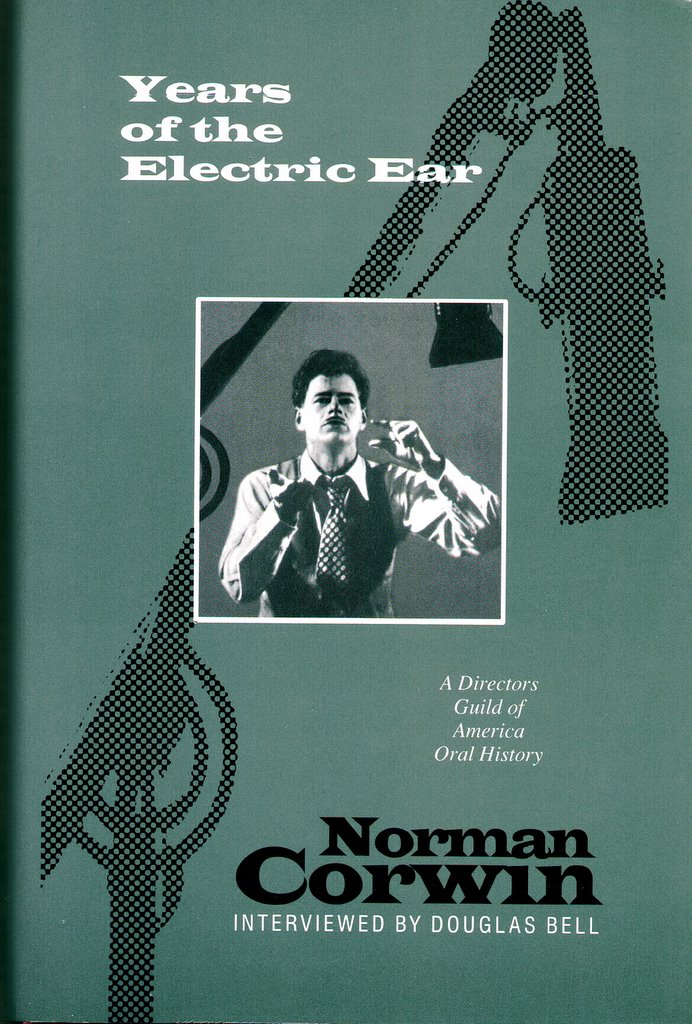
At least, one of the documentaries nominated this year pays tribute to the world of radio—that refuge of the bald and wrinkled, that last frontier and Lost Horizon for those among us who leap at the opportunity of supplying in our minds all that is wanting on the screen, warts ‘n all. The subject of that documentary, of course, is poet, playwright, and journalist Norman Corwin, age 95.

This Friday, BBC 4 radio will feature an hourlong “Audience with Norman Corwin,” which listeners worldwide can pick up here. An Oscar nominee himself (in the category of best adapted screenplay for Lust for Life in 1957), Corwin enjoyed lambasting the pomp and frippery of Hollywood’s long-gone studio era. Some of what he had to say, however, still rings true.

“Let nothing interfere with your enjoyment, / We’ll waltz away through war and unemployment.” This is how Corwin’s 1944 “Movie Primer” sends up the “Ostrich studio” approach to filmmaking, as expressed in the studio theme song, the “Graustark national anthem”:

Have you got those ‘need-a-vacation-from-a-world situation’ blues?
Oh, those blues.
Then cheer up, neighbor, fear no capital or labor.
Keep smiling, sweety, why fret about a treaty?
Chin up, fella, we give you Cinderella,
And you’ll never have, you’ll never have those headline blues . . . 

Let nothing interfere with entertainment,
The screen was not for sadness or for painment.
We’ll cuddle you and kiss you, and guard your free issue.
We manufacture syrup to cheer up your blues. 

Have you got those ‘need-a-vacation-from-a-serious-consideration’ blues?
Oh, those blues.
Keep grinning, oh you kiddoes, buck up, you widows.
You must never sink as low as to have to think.
So, chin up, fella, we give you Cinderella,
And you’ll never have, you’ll never have those headline blues.

Granted, many of the old production codes have long been cracked, and, from what I’ve read, this year’s nominated pictures are a little less frivolous than of old. Epics, fantasies, and new-fangled musical are taking a backseat and the tired boy-meets-girl formula has received some gender adjustments. That said, playing it safe in order to generate potential blockbusters is still common practice, and Hollywood producers either continue to drag storylines out of the same moldy vault or abandon intelligible storytelling altogether in favor of special effects and noisy action.

All right, the stories have some new wrinkles; it’s the faces that seem to be getting more insipid each year.

The Passing Parade: A Fat Tuesday Hangover

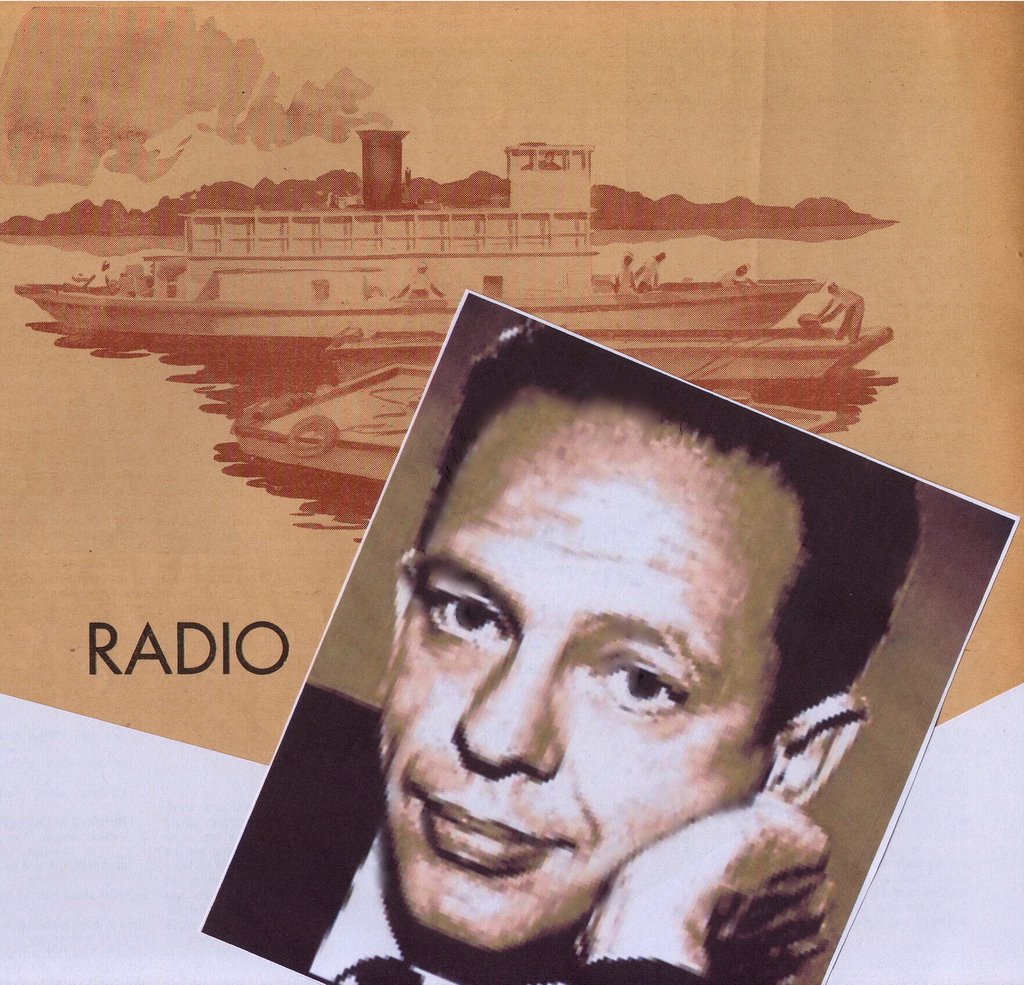
Perhaps I should not have been quite so surprised; nor pleased, for that matter. For twenty-four hours or so, broadcastellan ceased to be practically invisible—and it was all due to my tribute to video star Don Knotts. In an effort to be timely, for once, I dispatched the previous post before sunrise on Monday morning while those across the big pond still clung to what was left of their weekend. When next I checked for signs of life on this blog, I noticed a dramatic increase in the number of visitors, nearly three times as many as on an average day. Most of them found their way here through a topics exchange rather than the common traffic generators on which many e-diarists rely. Now, I won’t stoop to pinning my hopes of boosting my low voltage scribblings on the passing of aged celebrities with more or less marginal careers in old-time radio. Still, waking up to a Fat Tuesday hangover after this intoxicating surge in circulation, I decided that I’d rather give up cocktails than topicality for Lent.

Though it should not take an actor’s death to make others alive to a neglected dramatic medium, a revival of interest cannot take place if the world is dead to the subject you go on about. So, in effort to adhere to my own dictum, I must keep on trying to relate the presumably out-of-date to our present everyday. Not enough of this is being done elsewhere. As a result, radio drama is mostly appreciated as a font of nostalgia or camp.

In my current poll I ask, not for the first time, just why old-time radio drama does not enjoy the status granted to old movies. Even as video stores are slowly being replaced by online libraries, the shelves of the major DVD retailers are still stacked with copies of classic Hollywood films and, increasingly, not-so classy television fare. Saunter over to the CD section and try to find the radio plays of Norman Corwin. You might as well be browsing for recorded mating calls of the dodo, despite the fact that Corwin’s seminal works are the subject of one of the documentary shorts nominated for an Academy Award this year.

Sure, there is less demand for non-musical, non-visual dramatics; apparently, people would rather gawk at a giant squid on display than pay a few quid to take in a well-directed audio play; but, as we all know, demand is being created and kept alive through advertising, and old-time radio, with its uncertain copyrights and complicated commercial ties, has little chance at being thus promoted. Or is it just that much of radio ain’t any good?

As I am trying to push my own study on radio—and to push it forward—I am at times as disillusioned as the anti-hero of Frederic Wakeman’s best-selling novel The Hucksters (1946). “There’s no need to caricature radio,” he opined. “All you have to do is listen to it. Or if you were writing about it, you’d simply report with fidelity what goes on behind the scenes. It’d make a perfect farce.” I am going to refrain from scoffing, however; encouraged by the ongoing podcasting revolution, I defiantly if cautiously concur instead with Mr. Corwin, who, some sixty years ago, observed: “Seems Radio Is Here to Stay.”

What Those Who Remembered Forgot: Don Knotts (1924-2006) on the Air

Last night, I was pleased to make the acquaintance of Dr. Jack (1922), the chief passenger in an early but well-oiled Harold Lloyd vehicle, a sentimental comedy speeding up to some nimble last-reel slapstick. Within a few years of this outing, Lloyd reached the height of his silent screen career with classics like Safety Last (1923) and Girl Shy (1924), my favorite among his many fine films. Watching the genial and ingenious Dr. Jack as he rescued a girl’s doll from a well or cured a schoolboy of his feigned illness, I had a vision of this good physician attending to the aches and growing pains of Don Knotts, the late comedian who was born just about the time Girl Shy first flickered on American movie screens.

I cannot claim to have followed Knotts’s career on television and in motion pictures closely over the years. I never as much as sat through a single episode of The Andy Griffith Show, even though I enjoy whistling its catchy theme. Nor have I ever laid eyes on I Love a Mystery, the television adaptation of Carlton E. Morse’s previously discussed serial thriller “The Thing That Cries in the Night.” And I sure didn’t rush to hear him in Chicken Little, either. Such well-nigh disqualifying deficiencies notwithstanding, I can contribute here an “on the air” footnote to his otherwise well-documented career. In fact, researching Knotts’s early years on radio, I came across a rather remarkable echo.

As a radio performer, Knotts is undoubtedly best known as sidekick Windy Wales—teller of tall tales—in the revival of the Bobby Benson adventures, which had begun in the early 1930s as the kind of juvenile radio serial Irwin Shaw mocks in his short story “Main Currents of American Thought.” Such quasi-folk antics aside, Knotts was given an opportunity to play the brother of a true American storyteller: Samuel Clemens, the writer still better known by his pseudonym, Mark Twain.

Heard on the Cavalcade of America program, the play was an adaptation of Twain’s Life on the Mississippi and starred Raymond Massey as the grown-up author recalling his life story. As Twain’s brother Henry, Knotts was heard in a brief but pivotal scene dramatizing an incident that changed the life of the reluctant author.

Sam and Henry (the Clemens brothers, not Gosden and Correll’s Amos ‘n’ Andy precursors) worked together on the Pennsylvania, a Mississippi riverboat on which Sam was being trained as a cub pilot. The captain instructed Henry to tell the pilot to stop at a certain landing; but the hateful, irascible man denied having been informed. Sam defends his brother, engages in a fight with the pilot and knocks him down; but even though he is being congratulated rather than punished for his assault on the man, Sam thinks himself unfit to be his replacement. Leaving the boat, he bids farewell to Henry, who stays aboard. Before they part, Henry once more urges Sam not to squander his talent as storyteller.

Shortly thereafter, Henry, along with some 150 others, loses his life after an explosion aboard the Pennsylvania. Yet his voice remains alive in Twain’s mind, and Henry’s hopes for his brother are being realized at last. “Life on the Mississippi” was broadcast on 24 February 1953—exactly fifty-three years prior to Knotts’s own death last Friday.

Another “Wrong Number,” a False Start for Marilyn, and the Right Answer at Last

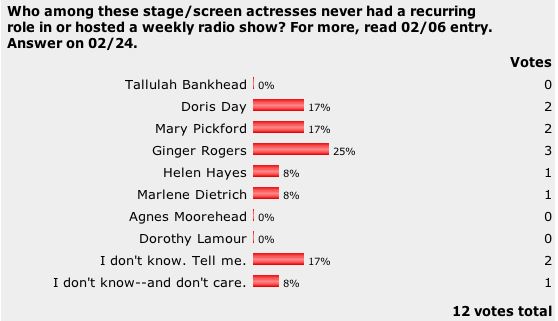
For the past three weeks I have been commemorating the dames, gals, and ladies of the airwaves; but now, the correct answer to the question posed in first broadcastellan quiz can finally be revealed. Thanks to all those who guessed or knew or couldn’t care less—and told me so. Tallulah Bankhead, Doris Day, Mary Pickford, Helen Hayes, Marlene Dietrich, Agnes Moorehead, and Dorothy Lamour—they were all radio regulars at some point in their careers, whereas others, including Ginger Rogers, the lady in question (as guessed by three readers), limited their air time to occasional guest appearances on dramatic programs like the Lux Radio Theatre. And others still, Marilyn Monroe among them, started out in commercials.

On this day, 24 February, in 1947, more than five years before she became a major star, a noticeably nervous Monroe, having waited months for her first movie role while already under contract at Fox, was pushed before the microphone to appear in a commercial break for the Lux production of “Kitty.” Within the few seconds allotted for her radio debut, Monroe was faced with the task of initiating her career (by mentioning her first Technicolor screen test), plugging Betty Grable’s The Shocking Miss Pilgrim (whose costume she got to wear during the test shoot), and peddling Lux “flakes” (which ostensibly kept those costumes fresh and colourful). However alluring her timbre, Monroe fumbled. She could not even get the name of the announcer straight; her voice was rarely broadcast thereafter, even as her film roles remained scarce and undistinguished.

A pleasant voice, while an asset, was not a radio requisite. As I mentioned previously, Louella Parsons did quite well without one, notwithstanding her consternation when being told she had to do without the larynx of Ms. Rogers, who allegedly insisted on getting paid to be interviewed. The giggles and high-pitched screechings of comedy actresses aside, the most celebrated woman’s voice on American radio was the less than pleasing one emanating from Agnes Moorehead. Her virago vocals, by which Joseph Cotton’s character in Since You Went Away claims to have been haunted across the Atlantic, was ideally suited to the role of irate Mrs. Stevenson in that most famous of original old-time radio plays, Lucille Fletcher’s “Sorry, Wrong Number.”

On this day in 1944, Moorehead, shown left during a performance of “Sorry,” once again starred in the role she had originated on the radio thriller anthology Suspense in May 1943. The part was subsequently translated for motion picture audiences and television viewers (by Barbara Stanwyck, Mildred Natwick, Ida Lupino, and Shelley Winters); but, however bitter Moorehead might have been losing the role to Stanwyck on the big screen, no actress would snatch the original from the “First Lady of Suspense.”

It was not until long after Moorehead’s death that Claire Bloom (recently seen on UK television in the last of the second season of Marple), made an attempt at superseding the “First Lady,” not only by recreating the role for radio in 1999, but by starring in a sequel of sorts.

While she had nothing to do with that sequel, radio dramatist Lucille Fletcher was responsible for the 1948 film adaptation. Her involvement did not, however, assure the aesthetic success of the latter, which, for all its high melodrama, has little of the tension generated by the original play. With its numerous flashbacks, the film destroys the intensity of a drama unfolding in real time. Like Allan Ullman’s novelization of Fletcher’s screenplay, it fails to approximate, let alone recreate, the excitement of eavesdropping on someone in mortal danger, someone whose life, like the live broadcast during which it plays out—runs on a decidedly tight schedule beyond our control and influence.

“I wanted to write a show that was ‘pure medium,'” Fletcher remarked about “Sorry, Wrong Number.” She succeeded so well that any adaptation would amount to nothing short of mediocre impurity.

Wireless Women, Clueless Men: Ann Sothern, Multimediated Minx

Well, this is one of those days when it is best to give the old peepers a rest. The wintry sky is of that dull hue your bleached undies acquire if you’ve been too careless again to sort your laundry. There is little comfort in the fact that the pale face staring at you in the mirror is of a similarly drab shade and that, even though the days are short, it’s too early yet for that warming glass of brandy. You realize that the word of the day over at Waking Ambrose, with whose creator you exchanged a few e-messages earlier, is “tedium,” and that your current mood fits that description so well that you refrain from adding your definition: “The abundance of life wasted on a barren imagination.”

Okay, snap out of it and perk up already. How about a generous helping of lip from someone perennially pert? Someone who’s got verve and nerve enough to be unfazed by whatever it is that daunts you. Whether you’d like to be with her or—what the heck—be her, you know just the dame. You’ve been reminded of her only last night, watching Desperate Housewives and thinking how much that series borrows from A Letter to Three Wives, a voice-over narrated film comedy starring . . . Ann Sothern (pictured here, in another artistic misfire by yours truly). Yes, it’s a little Sothern comfort you crave. So, quit whining, close your bloodshot eyes and let some sass waft your way by listening to The Adventures of Maisie.

As Maisie, Sothern was a siren whose tongue launched a thousand quips—and lashed the hopes of many an ill-suited suitor. Each episode of her syndicated radio show—an aural continuation of MGM B-movies like Maisie, Congo Maisie, Swing Shift Maisie and Undercover Maisie—begins with a wolf call, a “Hi ya, babe, say how about a . . .” from an oversexed admirer, a slap, the “Ouch” of a bruised ego, and the triumphant reply “Does that answer your question, buddy?”

Maisie knows all the answers, right and wrong. She doesn’t even let the announcer have the last word when introducing her adventures: “Yup, I’m Maisie, like the man said. Maisie Revere. I was born in Brooklyn in nineteen hundred and . . . well, I was born in Brooklyn.” That’s enough by way of introduction.

At this point, Maisie goes straight into the retelling of her latest exploits, a dramatized story from the annals of her incident-riddled and peripatetic existence. “I’m in show business. A very fascinating business to be in,” she scoffed, “because you meet so many interesting people who are also out of work.” She always found herself “out of work in the darndest places”; and whether mingling with the hoi polloi or the hoity-toity, whether finding jobs out west or in London salon modelling gowns for “one of them stuffy titled dames,” she was never quite at home but far from lost anywhere.

Long before she became American television viewers’ Private Secretary, the voice of My Mother the Car, or that desperate female who left the Lady in a Cage, wisecracking Sothern was the last word in high-polished brass. With a sultry broadcast voice that only Natalie Masters as Candy Matson could rival, she had you in her dark corner from the start, no matter how many slaps you’d receive from a former title-holder like Ringside Maisie. Give her a listen, won’t you? She just might respond to your introduction with an inviting “Likewise, I’m sure.”

Wireless Women, Clueless Men: Louella Parsons, Dirt Dispenser

Today, I am closing my series of tributes to women in American radio by devoting this final edition to one of the biggest names in Tinseltown hearsay: Hearstian columnist Louella Parsons. I leave it to Ms. Parsons to dish a little dirt about her on-air scandalmongering, even though that dirt is no more messy than a dusting of confectionary sugar on a well turned cuff. “Well,” Parsons told readers of Radio and Television Mirror Magazine (from an issue of which this picture has been taken), “I can safely say that no one else in the business can boast that her program was almost a radio casualty because of a toothache, a can of soup, and Audie Murphy’s cold! Likewise, I’m the only woman in these parts who’d had the dubious distinction of being almost ‘stood-up’ by Clark Gable. . . .”

Now, she does say “almost.” As it turns out, Gable was scheduled to appear on Parsons’s Hollywood Hotel when he got “snarled up” in a traffic accident. Shortly before the broadcast, he showed up with assorted bruises, welts, and a torn coat; but, according to Parsons, he insisted on going ahead with the live broadcast as scheduled, since, as the enterprising secret sharer put it, “he knew the program was very important to me, and didn’t want to disappoint me.”

He also knew better than to stand up this formidable career ender. So, Parsons’s wounded pride was mended—and Gable’s stardom secure. “Since that day,” Parsons added, “he has had a very special place in my book of friends.” Merely pencilled in, no doubt. This lady dealt in muck, after all, which in her profession is more precious than friendship.

I’ve mentioned Joan Crawford’s mike fright before in this journal. It was a well-known fact the first lady of gossip enjoyed repeating, claiming that the star “ran like a startled faun” every time a microphone was as much as “mentioned” to her. Eventually, the actress’s fear of bad press must have been more pronounced than her microphonophobia, as Parsons got her to go on the air talking about “what an advantage it was to be born on the wrong side of the tracks.”

Carole Lombard, on the other hand, was “completely unruffled when she lost two whole pages of her script. She merely ad libbed her way through, without a pause, and you’d never have known the difference.” Abbott and Costello, in turn, “turned the tables” on Parsons by reading her lines instead of their own. So, the chat hostess obliged by reading theirs, and, “as mad as it may sound,” she discovered that “the program had some semblance of sense to it.” These recollections are not exactly an endorsement of Parsons’s writing; but, by her own admission, “lack of talent has never dimmed [her] enthusiasm.”

Her first program, Hollywood Hotel, was off to a shaky start back in 1934: “My show was probably the worst in existence—I wrote, produced, and directed it all by myself.” Perhaps, it was not so much the writing and directing that were most amiss. Unlike rival columnist Hedda Hopper, Parsons did not have a trained voice, let alone a pleasing one; but she “knew too that is wasn’t how [she] said anything that mattered, because people were interested in what [she] was talking about.”

Sure, she couldn’t “close [her] eyes to television indefinitely,” she concluded. “But until better make-up and lighting are developed,” she vowed to “stick with [her] Hooper” (Hollywood jargon for radio audience).  And stick she did, for better and worse.

Wireless Women, Clueless Men: Bernadine Flynn, "Small House" Keeper

ANNOUNCER: Well, sir, it is the middle of the afternoon as we enter the small house half-way up in the Welsh hills. In the conservatory we find our friend Dr. Harry Heuser in less than scholarly pursuits as he stares out of the windows to witness the birth of the first lamb of the season. He has taken a few pictures and now picks up the phone to relate the news to his pal in the old country. Listen!

Okay, you won’t get to listen. As you may have gathered from the above imitation, I was determined to keep the old-time radio comedy Vic and Sade—but especially Sade—in my ear and on my mind this afternoon when I got distracted by the opening of an outdoors birthing center just beyond the hedge.

Being an old urbanite, the opportunity of witnessing the spectacle of a lamb being born in full view is something too fascinating to pass up. I seem to be averting my eyes too often as it is, you might think, as I rarely mention the headlines of the day, be it the rise of cartoon riots or the spread of avian flu, Holocaust denier trials or Winter Olympics scandals. Indeed, I generally have such strong opinions that it is not always easy to refrain from speaking up. Ish!

The privilege of this online journal, as I see it, is not so much to go on indiscriminately about anything, but to show the restraint that is the requisite of all artistic expression. Rather than the illusion of being altogether ungoverned, art is the reality of adhering chiefly to our own rules. So, let’s go visit Mrs. Victor Gook, shall we?

As imagined by radio writer Paul Rhymer and brought to life by former stage actress Bernadine Flynn (pictured), Sade Gook was neither a desperate housewife nor a dainty one. She was her husband’s equal, and sometimes his superior. She got along well with her adopted son, Rush, but did not always find it easy to keep her cool when confronted with the antics and outrageous anecdotes of her visiting Uncle Fletcher.

Rhymer’s imaginary small house was only occupied by those four characters; and sometimes Sade was left all to herself (something she relished, rather than dreaded). Through their exchanges and their one-sided telephone chats with others, however, listeners got to hear about a lot of different folks. Indeed, these talked-about or talked-to personages are so frequently mentioned and vividly described by Sade, Vic, Rush, and Uncle Fletcher that you might sense having heard them after all.

When the men of the menage are gone, Sade Gook enjoys settling down at last to one of her telephonic exchanges with confidante Ruthie Stembottom; never heard, always there. Unlike Uncle Fletcher’s outlandish acquaintances, recalled from the past or made up for the sole purpose of yarnspinning, Mrs. Stembottom is decidedly real.

Rhymer’s writing and Flynn’s well-timed monologue make it so. Yet, by not being imaged forth through voice, she becomes, by extension, our imaginary friend. We know her because we are her genetrix, giving birth to her in our minds.

The noisy men in Sade’s life are about to leave now. Once again we are being teased with a bit of intimacy; but, as in this conclusion to one of Rhymer’s scripts, little more than Sade’s satisfaction is conveyed. Let’s listen in as she cherishes the momentary stillness—by talking, of course:

VIC and RUSH. Telephone is ringing, telephone is ringing. 

SADE. I’ll get it. 

FLETCHER. (off a ways) Good-bye. 

SADE. Good-bye, Uncle Fletcher. So long, fellas. 

VIC. (moving off) So long, kiddo. 

RUSH. (moving off) So long, Mom. 

SADE. [into the imaginary telephone receiver] Hello? (warmly) Oh, yes, lady. Why, bless your old sweet heart, you did call back. (giggles affectionately) Gee, lady, I still haven’t got anything to say. It was just such a still quiet lonesome afternoon I felt like I had to talk to somebody. Isn’t it quiet though. Person runs into quiet afternoons like this every so often. Yes. (giggles) Well . . . quietness is nice sometimes. Gollies . . . I don’t think I’ve spoken to a soul all day. No. (and then briskly) Who had an operation, Ruthie? Mis’ McFreemer? Which Mis’ McFreemer? The one on South Morris Avenue or the one on West Monroe Street?

ANNOUNCER. Which concludes another interlude . . . at the small house half-way up in the Welsh hills.

Wireless Women, Clueless Men: Joan Davis, Vallee Girl

I was inclined to put the “wireless women” on hold for today. I have been feeling rather poorly as a result of an exposure to noxious fumes emanating from a fresh coat of paint in our conservatory. My evening with Claudette Colbert, starred in the rarely screened melodrama The Man from Yesterday (1932) was utterly spoiled. I also missed the BAFTAs, the new Marple (controversially, not a mystery in which the old sleuth was placed by her creator), and found little enjoyment in Crack Up (1946), a noirish thriller directed by radio dramatist Irving Reis, which aired on BBC Two early last Saturday. Dizziness, mood swings, fatigue and nausea are my mental and bodily responses to a thankfully small number of chemical solutions including household cleaners, varnishes, and insecticides.

Having spent some time in the crisp winter air this afternoon, I am ready to carry on about those fabulous radio ladies. I was thrilled to hear from a relative of Ms. Minerva Pious, one of the “wireless women” I have been commemorating here over the past few weeks. Her rags-to-riches-to-rags story sure seems worth exploring, particularly by someone who has ready access to personal correspondences and can draw on childhood memories.

The series will come to an end this Friday, when the (to the best of my knowledge) correct answer to the quiz will be disclosed in a tribute to radio playwright Lucille Fletcher. The “microphonic men” will be honored in the fullness of time (meaning, the emptiness of my schedule).

Earlier today, after a few exchanges via email, I was pleased to send off excerpts from my doctoral study to one of those old-time radio greats: none other than poet-journalist Norman Corwin, who will be very much a man of the hour come Oscar night, considering that a documentary about his work is up for an award. Now, on to the current column.

Judging from above picture, I seem to have quite a bit in common with ditzy dame Joan Davis. I am lousy at housework (particularly after taking a whiff of those detergents), tend to break things around the house (even when not intoxicated), and am inclined to sweep many of my mishaps under the proverbial carpet. Of course, Davis merely “enacts a housecleaning drama for Tune In,” a 1940s broadcasting magazine. According to that periodical (an issue of which I picked up years ago at a Chicago memorabilia store), Davis’s career was a “New Example of Rudy [Vallee]’s ability to Pick and Make Stars.”

No “clueless men” here, so far (except for me, of course). Certainly not Vallée, whose oleaginous radio persona I never found particularly prepossessing (give me John D. Hackensacker III anytime). He was a poor reader of lines, and his singing, too, had an air of carelessness about it. I gather he relied rather too much on the superstardom to which he became accustomed and used it to propel others instead of making any further efforts to push himself. Among those who came out of Vallée’s star factory were Carmen Miranda, Milton Berle, Edgar Bergen and Beatrice Lillie, the article claims.

Joan Davis, anno 1943, was hailed as Vallée’s “newest discovery,” notwithstanding the fact that she had already appeared on the screen in comedies like Sally, Irene, and Mary (1938) and Sun Valley Serenade (1941). “To many who have seen her in films,” the article continues, “Miss Davis may not seem a new discovery. But it was Vallee who lifted her out of a medium in which she was but little known, a minor success, and built her into the radio’s outstanding find of the season.”

When Vallee left his show to join the Coast Guard in the summer of 1943, he chose Joan to mind the Store. Here you can tune in to Joan’s remodelled Sealtest Village Store. It becomes clear just who took care of business, even though clueless executives thought for a while they needed to throw in Jack Haley for support. Davis, in fact, slightly improved on Vallee’s Hooper ratings, outscreeching competitors like Abbott and Costello, Burns and Allen, Eddie Cantor, Fannie Brice, Fred Allen, and Jimmy Durante. Obviously, his time was her time—and America made time for it.