The Couple in Grandmother’s Bed

I have said nothing yet about my trip to Germany.  It was not any old sightseeing tour, mind; nor was it a carefully mapped out homecoming, which makes it all the more difficult to capture in a few indifferent words.  The thing is, I had not been to my native country in over two decades; and, during that time, not going back to what folks presume to be my home evolved into a programmatic, defining rejection of the notion that home equals country of origin.  I vowed never to return, except in a pine box. 

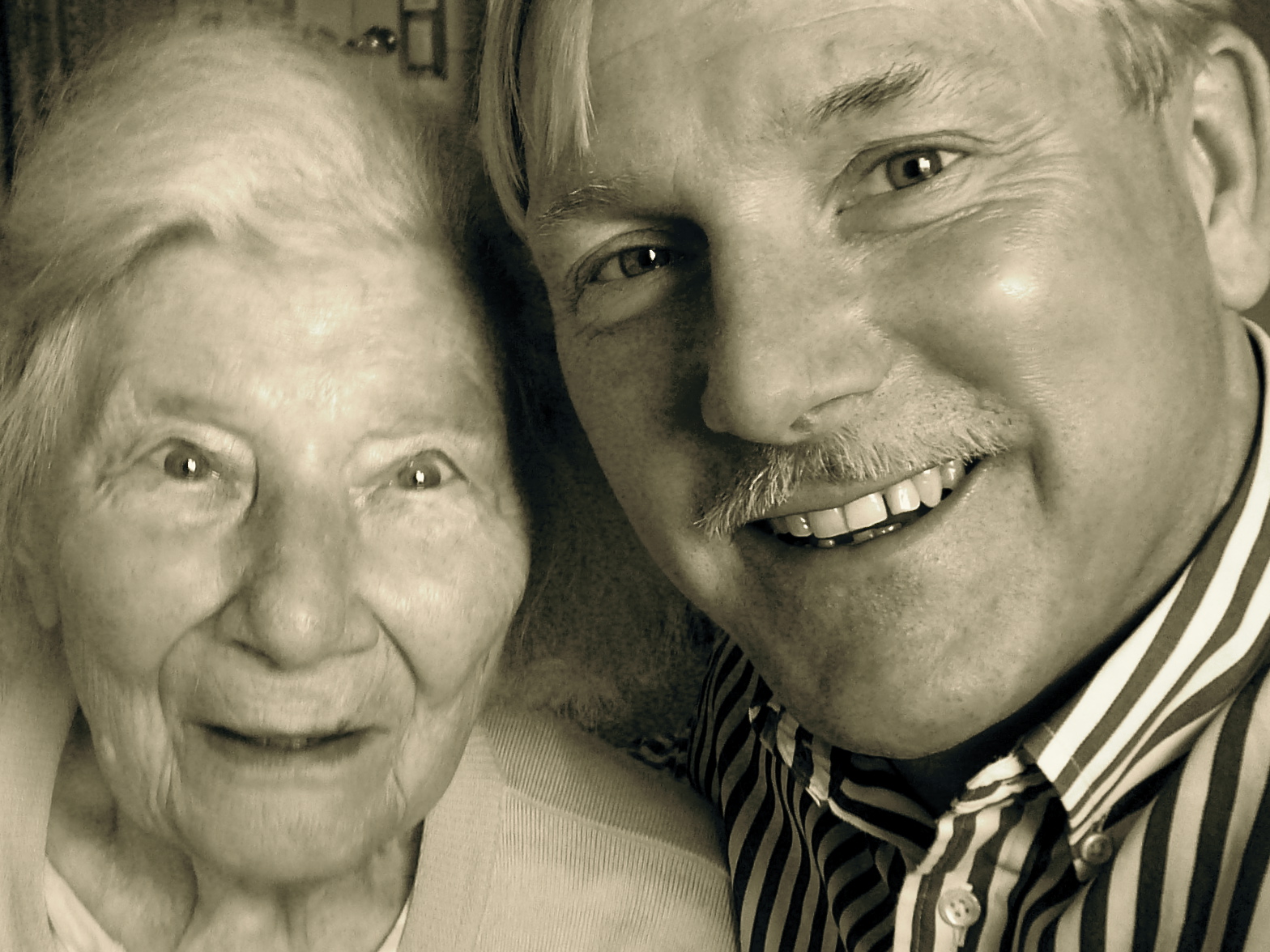
Ella and I

That I did go back at last, in the similarly confining encasement that is the cabin of a budget airline craft, required a great deal of preliminary introspection—and a leap over the shadow to which I had tried to relegate my past.

The department at the university where I teach was taking students to Berlin for its annual outing.  Previously, I had been on the departmental trip to Budapest; and while that adventure was an adulterated delight, owing to transportation problems in the form of a broken bus and a missed flight, I thought that it would be petty to stick to my principles and stay put while my partner, as head of the School, was joining our students and colleagues for a week in the town known for Cabaret, communism, and Currywurst.  Besides, Berlin is too far from my native Rhineland to be thought of as “home” or trigger unwanted back-where-I-come-from reminiscences.  So, to Berlin I agreed to go . . .

Now, a few days before we were scheduled to depart for the German capital—which hadn’t been capital at the time I left former West Germany for the East Coast of the United States—I received one of those infrequent e-missives from the fatherland that are reserved mainly for anniversaries, holidays, and assorted disasters.  My sister’s message read that my grandmother had contracted a virus while hospitalized for a fracture—her first hospitalization in well over half a century—and that, unless I acted posthaste, I might never see her alive again.

Unlike the mater of my father (both deceased), my maternal grandmother had kept in touch with me during my years abroad.  She had learned, decided—or perhaps never thought twice—to accept me, which, given her youth in fascist Germany, is a triumph of spirit over doctrine.  For years, she had been sending her regards to my same-sex partners, companions my other grandmother thought best accommodated behind barbed wire, if they were to be granted living space at all.

So, a few days before I was scheduled to depart for Berlin, I booked a flight to Düsseldorf to see Oma.  I suffered a great deal of anxiety going by myself, going to see relatives I had abandoned years ago and walking down streets I had known during what, not in retrospect only, was an unhappy youth.

Luckily, I had friends on whom I could count: a cousin came to collect me from the rather remote airport and old friends offered quarters and shoulders should my visit prove overwhelming . . . or my arrival too late.  Such comforts notwithstanding, it was disconcerting to visit Ella at the hospital, especially since it involved having to wear a protective mask that obscured my face so that she did not recognize me.  I had not announced my visit lest she might think that, if even the prodigal grandson was coming to see her, her condition must truly be touch-and-go.  It was sobering to be greeted like a stranger, but also deserved, I thought—until at last there was a look of recognition in her eyes and a warm smile radiating from her lips.

Not having booked a hotel room, I stayed in grandmother’s apartment that night.  There I was, sleeping in the bed of a woman who might not see another morning and who, as it turned out, would never sleep in it again, though live she did.

We all have our security blankets, I suppose.  Mine is made out of immaterial stuff, a fabric as gossamer and yet as tangible as the air on a sultry summer’s evening as I had known it well to the west of Wales.  Lying there, alone in Ella’s bed, I surrounded myself with voices at once strange and familiar; voices of a safe, distant past—a past that was none of mine.

On a night rendered restless by thoughts of loss and futility—a life in danger and a life wasted in the refusal to be faced—I belatedly tuned in The Couple Next Door, a late-1950s serialized radio sitcom.  Written by and starring Peg Lynch, whom I had once seen performing one of her husband-and-wife sketches during an old-time radio convention, The Couple controlled the crowds with which my thoughts were teeming.  It comforted like no cotton coverlet could, warmed like no drop of Scotch.  Though not soundly, I did sleep that night, wrapped up as I was in a cocoon of sound . . . a quilt to muffle the guilt I felt for not returning sooner and for being defined instead by a quarter century of negation . . .

“Who Are [These] People?”: The Mediations of A. L. Alexander

“What do you think of a husband who has given a woman eight children and lived with [her] for twenty-four years and in front of his children denies that he is married to her?” No one hearing the question—an estimated twelve million US Americans—could have been particularly interested in a considered response by anyone else, given that radio listeners were invited to articulate it for themselves. It was the scenario that thrilled, the common, raw and purportedly true story that was 1438C, one of three cases put before A. L. Alexander and his Mediation Board on this day, 28 June, in 1943.

As told in the words—and the accents—of ordinary if not ordinarily quite so communicative contemporaries in situations of personal crises, it turned anyone listening into a father confessor, a judge of manners, morals and mental states.

Placing the unexceptional and non-exemplary on a national rostrum, the Mediation Board, like the tabloid talk shows that dominated the daytime schedules of American television networks during the 1990s, was a readily available and gratefully ingested nostrum, a dose of quack medicine designed to comfort the listener rather than cure the speaker . . .

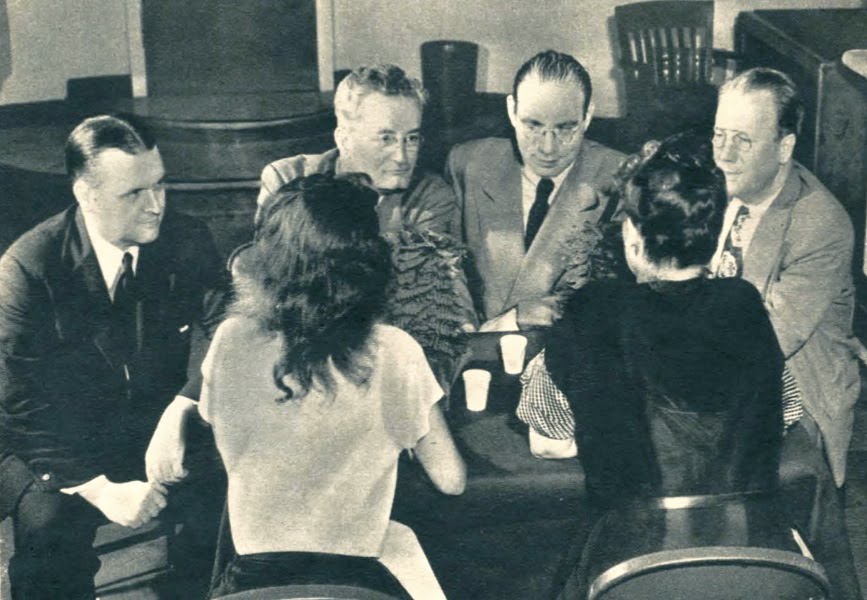
According to an article in the October 1945 issue of Tune In, “most” of the folks who wrote in to appear on the program—without receiving any compensation other than a few kind or cautionary words—were “working-class Americans who have never heard of psychoanalysts, or [would] find the cost of a divorce prohibitive,” and—the occasional “prankster” who would “invent some complex and chaotic problem” aside—turned to Alexander (pictured above, second from the right) and his rival John J. Anthony “with an intensity and devotion” that turned the host into an “almost god-like” figure.

Case 1438C was the story of forty-year-old woman who, at the age fifteen, left her parental home, where, according to her, she had been shown “no affection whatsoever,” to live with the man, then also a teenager, who eventually fathered her eight children.

Having been presented with a wedding band, she assumed herself to be legally married; but, by the time their first child was born, she came to realize that this was not the case, an illegitimacy that did not stop her from bearing him seven more. “I want my husband to marry me,” the woman now demanded, and that despite her suspicion that her partner was also a bigamist.

Unable to confront this accusation, her agitated “husband,” who had agreed to join her on the program, nearly stormed out of the WOR, New York studio from which A. L. Alexander’s Mediation Board emanated and broadcast nationally over the Mutual network. “There’s no such a thing as love,” he exclaimed, suggesting that the couple’s care for their offspring—among them “three lovely sons in the service”—was not reason enough to keep them together and legalize their relationship after nearly a quarter of a century.

To this, the Mediation Board members—priest William C. Kernan, executive director of the Institute of American Democracy, rabbi James G. Heller, and Paul Dawson Eddy, member of the Council for Religious Education and president of Adelphi College—had very little to say. Their words of warning or compassion merely sanctioned the dramatic she says/he says showdown, giving it an air of respectability and creating a sense that the program was living up to FCC standards.

Apart from its culturally diverse and reputable panel, Alexander’s Mediation Board responded to detractors by suggesting that its relevance and service in the public interest lay in the presentation of domestic problems “arising out of restless wartime conditions” in the alleviation it strove to assist, presumably as part of the war effort, however questionable it might have been to penetrate the home front in order to air its sundry grievances, thereby demonstrating it to be less than sound and far from self-disciplined.

Alexander had not always been able to defend his cashing in on the mental anguish and the at times morbid curiosity of his fellow Americans. Some six and a half years earlier, in December 1936, he was forced to shut down his popular Good Will Court, which, according to the 3-9 January 1937 issue of Radio Guide, had commanded network radio’s “fifth largest listening audience” until the New York Supreme Court ruled in favor of those who argued, as Alexander put it, that “the consideration of legal problems on the radio was ‘unethical.’”

By turning legal matters into spiritual and psychological concerns, Alexander managed to return to the airwaves and riding them, on the strength of the flotsam and jetsam with which his program was awash, for another decade.

After all, as Tune In pointed out, staying on the Board “proved to be one of radio’s most lucrative businesses,” especially considering Alexander’s credentials, or lack thereof, as a former “prize debater in public school” who had no “training in psychiatric social work.”

Having studied for the ministry and served three years at a Cincinnati theological seminary, he “became infatuated with the vast potentiality of listeners that radio could provide, took several routine announcing jobs before the idea for his program crystalized in his mind.”

During his involuntary and prolonged hiatus, Alexander explored the similarly vast financial “potentiality” of publishing by compiling Poems That Touch the Heart (1941), a volume of human interest poems that became a tie-in for his latest radio venture when selections were read at the conclusion the weekly Mediation Board meetings.

Heard on the 28 June 1943 broadcast, for instance, was “Who Are My People?” by Rosa Zagnoni Marinoni (not identified by name), a poem that emphasized comforting commonality while mitigating against what, in the unscripted words of the quarrelling couples, might come across as dead common.

In search of “my people,” the speaker senses “no kinship” toward fellow worshippers and feels estranged from the native old world, only to find the question “Who are my people?” answered by an encounter with one of the plebs:

Last night in the rain I met an old man
Who spoke a language I do not speak,
Which marked him as one who does not know my God.
With apologetic smile he offered me
The shelter of his patched umbrella.
I met his eyes. . . . And then I knew. . . .

Few folks now know A. L. Alexander; but the man who made a nation’s tattered nerve and moral fiber his umbrella—and who so shrewdly stitched the profane to the sacred cover he provided for it—still has his name on that volume of the poetry that served to promote his program. In print to this day, Poems That Touch the Heart still credits Alexander, however meaningless the reference may now be, with being the “Creator and Conductor” of the Good Will Court, the “original” Mediation Board, and The Court of Human Relations.

Patching, joining, and thriftily recycling for the ostensible public good—it was all part of the A. L. Alexander technique.

Murder on the Cathedral Radio: Rudy Vallee and the WPA

”Whatever your own political views in the matter may be. . . .”

Diplomatic, cautious and propitiatory, those are hardly words you would expect to hear coming from the close-miked mouth of crooner Rudy Vallee, one of the 1930s most popular—and insipid—radio personalities. After all, Vallee was not emceeing America’s Town Meeting of the Air; his chief ambassadorial function was to promote middlebrow culture and represent the makers of a certain leavening agent. Yet that is just the preamble with which the old Vagabond Lover segued into the dramatic portion of the Fleischmann’s Yeast Hour, which, on this day, 25 June, in 1936 presented what sounded very much like an endorsement of one of the Roosevelt administration’s latest projects, notwithstanding Vallee’s assurance that the views of the program’s producers and sponsors—in contrast to the debates from the Democratic Convention broadcast elsewhere that evening—were “strictly neutral.”

The calculatedly catholic Fleischmann’s Yeast Hour took variety to the extreme that evening, featuring vaudeville song-and-dance duo Alan Cross and Henry Dunn, “Gags and Gals” cartoonist Jefferson Machamer (who would have liked to talk “sex” but was told that the subject was “never mentioned” on the air), comedian Bert Lahr (whom Vallee’s writers sent to the dentist), swing vocalist Midge Williams (referred to as a “small bundle of dark dynamite”) . . . and T. S. Eliot’s Murder in the Cathedral. Natch . . .

Murder had come to Broadway some three months earlier, in March 1936. As stated by contemporary critics Ernest Sutherland Bates and Alan Williams in their book American Hurly-Burly (1937), Eliot’s play “as offered by the WPA was finer than anything produced during the season at any price.”

Yet rather than merely extracting scenes from the celebrated drama, Vallee’s program offered a dramatization of a “true story” that had “happened only a little while ago,” namely the behind-the-scenes story of how the Broadway production was cast.

As Vallee’s writers have it, an aging stage actor enters the offices of the WPA, declaring: “I’m looking for a job.” He claims to have been in the acting profession for thirty-three years; but lately he has only been pounding the pavement in hopes of treading the boards again. He is referred to the Federal Theatre Project, where, by the kind of miracle that smacks of Victorian melodrama, he is greeted by producer-manager George Vivian, an old friend of his from his days in London’s West End.

Soon, the actor is given the chance, however slight, of auditioning for Broadway director Edward T. Goodman, who is still trying to cast the role of the Archbishop. As many listeners tuning in to the Fleischmann’s Yeast Hour would have known, the old actor got the part—and, as Bates and Williams summed it up,

gave a magnificent performance in the role of Becket.  When Murder closed he re-appeared with another splendid characterization in Class of ’29, but at the end of the season he was promptly reclaimed by the commercial theater.

That actor—playing himself in the broadcast version of his story—was Harry Irvine, who, aside from Murder and Class of ‘29, went on to appear on Broadway in several dramas by Maxwell Anderson, including Joan of Lorraine starring Ingrid Bergman and Anne of the Thousand Days starring Rex Harrison.

Vallee commented that “the sequel” to this story was “yet to be written,” by which he was not referring to any attempts to follow up Murder with Resurrection. “The name of Harry Irvine appears again,” Vallee predicted. “He is very much in demand now. You’ll see him in pictures before long. Hollywood is taking care of that.”

Irvine responded to these not entirely fulfilled prophesies and commented on his good fortunes by reciting one of his speeches from Eliot’s play:

We do not know very much of the future
Except that from generation to generation
The same things happen again and again.
Men learn little from others’ experience.
But in the life of one man, never
The same time returns. Sever
The cord, shed the scale. Only
The fool, fixed in his folly, may think
He can turn the wheel on which he turns.

As much as he was in the center of the Fleischmann’s Yeast Hour playlet telling his story, Irvine was little more than a cog in the wheel, an example of the “true story” extolling the wonders of the “relief project” that gave “the actor out of work” a “helping hand.”

“In the larger cities all over the country these past few months,” Vallee reminded his audience,

dark theaters have been opening, idle actors have been finding work.  Reason: The Federal Theatre Project, a branch of the Works Progress Administration in Washington.

So why, radio having benefitted most from the Depression and the closing of popular playhouses, did an ersatz revue like Vallee’s program now celebrate the policies through which actors returned to newly reopened stages? Well, considering that the Fleischmann’s Yeast Hour was an East Coast production—whereas Lux Radio Theater had just left New York for Hollywood and abandoned its Broadway format—it stood only to gain from the renewed activity along the Great White Way.

Given that the performers who appeared on variety programs of that period were deemed somebodies largely owing to the name they had made for themselves in other media, Fleischmann’s, far from being neutral, depended on its theatrical ties—and stage actors like Harry Irvine—to fill its weekly roster of acts.

Listening to slickly commercial variety programs such as the Fleischmann’s Yeast Hour, I realize that escapism is not so much a matter of production as it is a manner of consumption, a way of tuning out rather than tuning in. No form of entertainment, however trifling or shallow, can entirely escape the role an alert listener may assign to it—the role of telling us about the time in which it was created.

A Voice in the Wave: Carl Brisson at the Golden Oriole

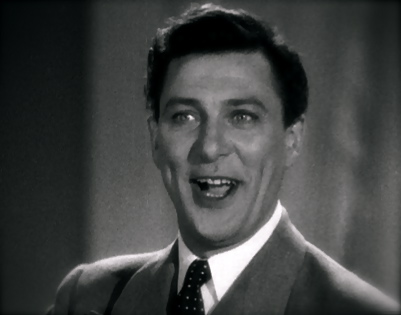
Carl Brisson

“42 Men Killed Every Week,” the headline read. Those who had already heard as much on the radio would likely have felt the impact of this crime wave; but, unless they were pining for the likes of Rudy Vallee, they would have relished it as well. Religious leaders, child psychologists, and a few popular entertainers aside, hardly anyone would have been the least bit alarmed. After all, the headline appeared in the 27 July 1946 issue of Billboard and the tally of fatalities was not meant to reflect the hebdomadal wrongdoings in one of America’s urban jungles. Instead, it referred to the “[l]opsided preponderance” of crime dramas that, after the killings at the front had come to an end, hit the airwaves so hard as to wipe out much of the competition.

Perhaps, “swallow up” might be a better way of putting it, as the zingers and songs previously heard elsewhere were subsumed by thriller programs that, in a desperate attempt not to sound cookie-cutter, were becoming increasingly kooky. Take Voice in the Night, for instance. Mentioned in the Billboard report as a contributor to the body count—yet rarely ever mentioned elsewhere or thereafter—it was one of the most baffling mysteries ever devised for the sightless medium, all the more so for having been green-lighted to begin with.

Folks tuning in to Mutual on Friday nights back in the summer of 1946 were told that Voice in the Night was something new under the moon—“a musical mystery story starring the internationally famous stage, screen and supper-club star Carl Brisson.” Never mind the hyperboles, the fact that Brisson had not appeared on the screen in well over a decade. At the time, he was indeed a successful act on the hotel circuit, although even favorable reviews would point out that “his pipes [were] no longer the same” and that he suffered from “a lapse of memory” (Billboard 30 March 1946). Indeed, such setbacks may have made crooning behind a mike with sheet music in his hand sound like an attractive alternative to the middle-aged baritone.

Not that Brisson would have appreciated being called an “Engaging Grandfather”—as a less than subtle Newsweek review had done two years earlier; but, if his voice or appearance did not suggest as much already, there was that prominent son of his (Rosalind Russell’s husband), then in his early thirties. Such telltale signs could be airbrushed away with the aid of a microphone. On the radio, by which even seasoned voices in the night penetrated many a chambre séparée, Brisson could yet be Carl Brisson, a detective who sang for his private suppers.

True, Brisson had experience playing romantic leads, having starred in two melodramas helmed by Alfred Hitchcock; but that was in the silent era, when his Danish accent posed no obstacle to a career in British or American film. In 1934, he had even mixed music and mayhem and “Cocktails for Two” in Murder at the Vanities (pictured above); but a duet with Kitty Carlisle could not have prepared him for the challenge of carrying anything other than a tune, least of all a dramatic radio series of his own. For, no matter how many times he would perform his signature song “Little White Gardenia” (“You may wear it if you care / Or toss it away”), a crime had to be related and solved within each half-hour allotted to Voice in the Night. And on this night, 14 June, in 1946, it was a case involving the theft of a necklace that “once cost two men their lives.”

We meet Carl Brisson at the Golden Oriole, a nightclub where he takes requests and performs standards like “All of a Sudden My Heart Sings” to an appreciative proxy audience, sit-ins for the listeners at home, some of whom would have seen Brisson in person and may well have resented being drawn in by the performer only to be short-changed as he, having invited the diegetic (or built-in) crowd to stand up and dance, walks over to one of the tables for a tête-à-tête with a female and no doubt attractive newspaper columnist whom he feeds his stories of crime and romance.

Old-time radio encyclopedists John Dunning and Jim Cox, who merely quotes and paraphrases the former without giving him proper credit, would have you believe that Brisson dashes off to solve a crime before resuming his nightclub act. Don’t take their word for it, though. In the only two extant episodes, at least, he merely takes a break to relate one of his adventures.

“You’re never more beautiful than when you’re angry to me,” Brisson tells his private listener. Now, I am not sure whether the script or the interpreter is responsible for the way this comes out, whether, as the linguists put it, the problem is structural (“beautiful . . . to me”), or lexical (“angry at me”); but the performance is riddled with such incidents, which become rather distracting. Indeed, forget the largely frisson-free mystery of the stolen “neggless.” It is Brisson’s delivery that will puzzle you. Perhaps, Mutual had hoped for a second Jean Hersholt; but Brisson, though closer in age to his fellow countryman than he would admit, was not called upon to play another Dr. Christian here. Nor would he have been content to be a kindly old Mr. Keen with a trace of a hard-to-lose accent. The romance-filled mysteries were meant to be fast-paced—but the “Great Dane” kept tripping over his tongue.

Having performed “Bells of St. Mary” for a lovely young “corple” at the club, Brisson admits that he “may have lost Mary Morgan”—but the one he was supposed to pursue was a guy named Larry. Perhaps, it was that “lump on [his] head like the size of an egg” that caused Brisson to fluff his lines or else to render them all but unintelligible.

A few weeks later, an episode titled the “Case of the Worried Detective” self-consciously worked what was problematic about the program into a rather more light-hearted script. “I placed you by your accent immediately,” Brisson is told by a hotel clerk. “You are that new long distance runner from Sweden, aren’t you?” A “long distance singer from Denmark,” Brisson corrects. Neither fame nor ready money could get him a room, though, what with the post-war housing crisis going on. “Not even if I promise not to sing?” the performer inquires. If only he had promised not to speak.

While the tongue-in-cheek approach somewhat improved on the tedious double-cross romance contrived for the earlier episode, Brisson was less convincing as a wit than he was as a womanizer. He simply could not get his tongue around certain English words, at least not quickly enough to deliver snappy one-liners.

Besides, anyone alerting the “Voice in the Night” to his glossal obstacle may have received a response similar to the one Murder at the Vanities director Mitchell Leisen got when he tried to correct Brisson’s diction. The singer-actor “was supposed to say ‘She’ll’ and kept pronouncing it ‘Seel,’” Leisen told David Chierichetti.

I thought he was having language problems, so I enunciated it very carefully for him. He said, “Oh, I know how to say it, but don’t you think it’s cuter the other way?”

Rather than being called upon to talk sense or crack wise, Brisson should have been permitted to give his target audience—“the fair, fat and 40 trade,” as Billboard (5 April 1947) called them—what they really wanted, which is just what he did when he returned to his successful club routines. His Voice in the Night was an early casualty of radio’s post-war crime wave, the riding of which tempted and drowned many a hapless performer.

For the Record: Lindbergh and the Electrola

Announcer Graham McNamee called it the “most terrific broadcast [he] ever took part in.” He was referring to NBC’s on-the-spot coverage of Colonel Charles L. Lindbergh’s return from France to the United States on this day, 11 June, in 1927. It certainly was a technical achievement worthy of “this new world hero, this new ambassador of America to all other countries,” as McNamee heralded the “unassuming, quiet boy” who was anxiously awaited “not only the crowd of us ordinary folks but the cabinet of the President of the United States, high officials of the army and of the navy [. . .].”

According to the September 1927 issue of Radio Broadcast, NBC’s coverage of the event set a “new record,” requiring fourteen thousand miles of “wire line” and involved three-hundred and fifty engineers.

Now, the figures differ depending on who does the counting and recounting. In Empire of the Air, for instance, Tom Lewis claims it took twelve thousand miles of wire and four hundred engineers. But never mind those figures now—or the fact that the figure of Lindbergh itself differs now that the man must be held accountable for his fascist views and Third Reich sympathies. It was an historical event on and in the air, in aviation and broadcasting alike.

Awarding him with the Flying Cross, President Coolidge called Lindbergh a “[c]onqueror of the air and strengthener of the ties which bind us to our sister nations across the sea.” When it came to strengthening ties, the public-conquering airwaves were second to none. Not only was NBC’s coverage of Lindbergh’s return home the biggest network hookup to date, it was also, as McNamee reminded listeners, “the first time band music or music has been transmitted from the Atlantic coast to the Pacific coast, which is another epoch.”

As columnist John Wallace argued in the September 1927 issue of Radio Broadcast, the

making known of great national events, while they are actually taking place is, after all, radio’s unique contribution, and the one field in which it reigns supreme without competition from phonographs, theaters, churches, or newspapers.  And it is greatly to radio’s credit that it does this job so thoroughly and well.

Seizing the day, NBC may have rather overdone its coverage of the “hullabaloo incidental to Lindbergh’s arrival.” Commenting on the banquet given in the aviator’s honor, Wallace remarked that he

would have been quite content had all the speeches of eulogy been omitted and only that of the flyer broadcast.  Never have we heard worse blah sprung at a banquet, and sprung by such eminent leaders, divines and statesmen!

Aware that his was no doubt a minority report, the journalist added that “the nation as a whole was interested in every and any detail of the flyer’s reception and credit must be given to the National Broadcasting Company for slipping up on no smallest part.”

What, though, of all those who were unable to be part of that moment because they were away both from Washington, D. C., where the celebrations took place, and from the wireless? Able to annihilate space, radio was nonetheless time-bound. Given the “ephemeral” nature of broadcasting, the effort and money set aside to capture and yet not hold this historic moment seemed almost perverse:

Thousands of dollars are spent to engage talent, wires covering half a continent are hired, advertising is scheduled in newspapers, several studio rehearsals are held, and finally the elaborate program is put on the air. For an hour it lasts but it can never be repeated. If you did not hear it, all the king’s horses and all the king’s men couldn’t put it into your loud speaker again.

For some time, radio listeners had been able to appreciate the voices of their radio favorites on their phonographs. Not only could they take home Sam ‘n’ Henry, Vaughn De Leath, or the Happiness Boys—radio had made that happen—but they could hold and keep them there. “A very great number of well-known radio artists are regularly recording for each of the important phonograph companies,” Radio Broadcast pointed out—and supplied a list of

fine recordings made by the favorites of the Atwater Kent hour, and the famous artists of the Victor, Brunswick and Columbia hours. As for the jazz bands, the comedy duos, and other entertainers with a more local fame, they, too, are forever at your beck and call on the black discs.

What makes the festivities in honor of Lindbergh’s return to America another milestone in the history of radio is that, for the first time, phonograph records of the live broadcast were made available for sale. As Radio Broadcast reported,

Victor has the distinction of pioneering and they offer three double-face records of the national welcome to Colonel Charles A. Lindbergh at Washington. On these three records you have the voice of President Coolidge, the interspersed announcements of Graham McNamee, a short address by Colonel Lindbergh, and his longer speech at the National Press Club. It’s all there and if you close your eyes, it isn’t hard to imagine that the events are just taking place.

True, what has been preserved for us is an edited copy of the live event; the “ceremonies were recorded on forty-six record surfaces” and “edited down” to six. True, editing is judging what matters; it is, to a degree, falsification, intentional or otherwise. Still, without the technology available back then, without the efforts of those broadcasting pioneers, I would not be writing about radio today.

As much as I at times deplore my second-hand experiences, my removal in time and space from thrilling events and fascinating personages, I, as a belated auditor, am indebted to those records. And I am grateful, too, for the “new record” in aviation that marked the beginning of an age in which sound was no barrier.

Related recording
Graham McNamee on Lindbergh’s return to America (11 June 1927)
Recollections at 30, featuring the 11 June 1927 broadcast (26 December 1956)

Hush, Hush, Charlotte Greenwood

You’re sorry?” That was the rather pitiful catchphrase devised for a certain “lovable lady of stage, screen, and radio”—Miss Charlotte Greenwood, who, having done well for herself on stage and screen, added “radio” to her resume in June 1944, when the Charlotte Greenwood Program was first broadcast over NBC’s Blue network as a summer replacement for Bob Hope. Actually, Greenwood had been Mrs. to Mr. Martin Broones for nearly two decades; but whenever another character in her serialized situation comedy addressed her as Mrs.—an assumption based, no doubt, on her far from youthful appearance—and apologized after being duly corrected, Greenwood replied in the fashion of a frustrated spinster by letting off the above retort.

Sorry, indeed. In the fall of 1944, when Hope returned to the airwaves, Greenwood was presented with a vehicle that—after the disappointment of not starring in Oklahoma!, in a part written expressly for her, no less—must have been as thrilling to her as walking off with the unclaimed favors from a cancelled party. It sure wasn’t a surrey with a fringe on top. There’s no way you could confuse that fabulous Broadway hit with the miss that was The Charlotte Greenwood Show (1944-1946), even though the compiler of one Encyclopedia of American Radio did just that, claiming the lovable one was starred “as eccentric Aunty Ellen [sic] from Oklahoma.”

Instead, Charlotte Greenwood was playing Charlotte Greenwood—an actress preparing for her next movie role as a reporter by womanning the desk in the local room of a small-town newspaper. So, for about two and a half months, Greenwood talked long-distance to her manager in Hollywood or had some confrontation or other with the city editor.

Greenwood should have spent more time talking to the show’s head writers—Jack Hasty, who, as stated in the April 22-28 issue of Radio Life (from which the above picture was taken) had previously fed lines to Al Pearce and Dr. Christian, and Don Johnson, who had been one of Fred Allen’s gagmen. Else, she might have had a heart-to-heart with her real-life manager, who also doubled as her real-life spouse. And they all should have had a word with the sponsor, or, rather, the advertising agency handling the Halls Brothers account, since their executives insisted on having a card like Greenwood dispense sentiments as hackneyed as anything printed on cardboard bearing the Hallmark label:

“Friends,” she addressed the listening public in November 1944, a couple of weeks before Thanksgiving,

for most of us, these busy days are filled with big jobs to be done, big problems to be solved.  There’s so little time for the tiny, little everyday things.  The neighborly chat, the letter to an old friend.  And yet, in this swiftly moving world, friendship need not be forgotten.  A few words that say “I hadn’t forgotten” may mean more than you know to someone, somewhere.  There’s an old saying I think all of us should remember: The way to have friends is to be one.

More offensive than such platitudes is the opportunism apparent in advertising copy urging home front folks to drop a line to those on the frontlines, like this reminder from October 1944:

Friends, there has never been a time when so many families were disunited, separated by thousands of miles from those they love.  Our top-ranking officers have told us again and again, there’s nothing so important to our boys and girls as mail from home.  So, look around you today.  Think of some boy or girl out there who would like to hear from you—and do something.  Send something [. . .]

It was left to announcer Wendell Niles to suggest that the “something” in question ought not to be just anything, at least not if listeners truly “cared to send the very best.”

Quite early on in the program’s run, there must have been some debate about its appeal and prospects. As the year 1944 drew to a close, Charlotte Greenwood’s fictional film career came to an abrupt end—as did her musical interludes that had enlivened proceedings—when her character claimed an inheritance that convinced her to retire. The enticement? The Barton estate, replete with a trio of orphans now in her charge.

“You mean, to have three children, all I have to do is just read and write?” Greenwood exclaimed on 31 December 1944. “Oh, judge, isn’t education wonderful!” Perhaps, producers counted rather too much on the lack of education among the viewers. The advent of the minors sure wasn’t a belated Christmas miracle—and the retooled Greenwood vehicle was no immaculate contraption.

Softening the quirky Greenwood persona by placing three orphans in Aunt Charlotte’s lap, the sponsors may well have hoped to win the ratings war by riding the wave of popular sentiment as the all but certain victory in Europe had public attention shift from defeating the enemy and supporting the troops to dealing with the underage casualties of war.

For the remainder of the program’s run—another year, to be exact—Greenwood had do deal with the problems of two teenagers (played by Edward Ryan and Betty Moran) and their prepubescent sibling (Bobby Larson), who, on this day, 3 June, in 1945, gave his Aunt Charlotte some slight grief by being late from school.

Actually, the kid’s temporary waywardness was little more than an occasion for the writers to string together a few cracks about spanked bottoms (“[H]ow can you get anything into a child’s head by pounding the other end?”) and double entendres involving the meaning of “play.”

Not sure whether to punish young Robert for having stayed out “with some boy,” as his sister suggests, Aunt Charlotte remarks: “I know a girl who’s spend her whole life trying to find some boy to play with. Mr. Anthony [the Dr. Phil of his day] called her ‘The Case of Miss C. G.’ It was very touching.” To which she adds for our but not her niece’s amusement: “And what’s more, thirty thousand privates picked her as the girl they’d most like to see marooned on a desert island with their top sergeant.”

Without a consistent tone, let alone situations consistent with the talents of the beloved comedienne, the program’s legs were far shorter than Greenwood’s interminable gams. Apparently, the figures added up as the laughs per episode, which is to say, not. “Well, I’m no expert on arithmetic either,” Charlotte’s on-air alter ego told the nephew she could not bring herself to spank. “If I knew anything about figures, would I keep the one I’ve got?”

Those who did the accounts decided not to keep what they got—and that despite the fact that the series earned Greenwood a star on the Hollywood Walk of Fame. Instead, as Billboard correctly predicted on 22 December 1945, the Charlotte Greenwood Show would “fold as soon as cancellation [could] take effect”—well before the end of the second season—after the sponsor had decided to take over the Reader’s Digest program from Campbell’s.

Charlotte Greenwood left radio, returned to the screen—and, in 1955, she did get to play Aunt Eller after all. You’re sorry?

The “Invisible Rudolf”: Behind the Mike of a Radio Criminal

“As you know, in many countries in Europe the people are only permitted to hear what their government wishes them to hear through government controlled radio stations.” With that reason to be grateful for being an American, uttered on 8 June 1941, veteran announcer Graham McNamee introduced listeners who might have tuned in to Behind the Mike to hear the “sound effect of the week” or learn how radio series were readied for commercial sponsorship to a kind of broadcasting unlike anything heard over NBC, CBS, or Mutual stations. Despite imposed strictures, McNamee continued, there operated “within these countries or near their borders courageous men and women who, opposing the government, broadcast at the risk of their lives the truth as they see it to their fellow men.” Recusant, daring, and hazardous—such were the cloak-and-dagger operations known as “freedom stations.”

For anyone broadcasting—indeed, for anyone lending an ear to those broadcasts—the German government had a word: “Runkfunkverbrecher” (radio criminal). It also insisted on having the last word: a decree to silence those opposing the regime that would turn the cornerstones of democracy into gravestones.

Just how dangerous was it to turn off the Volksempfänger and tune in those secret stations instead? In Voices in the Darkness (1943), British historian Edward Tangye Lean (brother of film director David Lean), offered this piece of evidence from the Strassburger Neueste Nachrichten, dated 15 March 1941:

The Nuremberg Special Court has sentenced the traitor Johann Wild of Nuremberg to death for two serious radio crimes. Both before and after the coming into effect of the radio decree he behaved as an enemy of state and people by continually listening to hostile broadcasts from abroad. Not content with that, he composed insulting tirades whose source was the enemy station.

As Lean points out, propaganda minister Goebbels issued a “list of stations to which listening was allowed.” Along with their ration cards, German citizens received a “little red card with a hole punched in the middle of it so that it might be hung on the station-dial of a radio set.” The card read: “Racial Comrades! You are Germans! It is your duty not to listen to foreign stations. Those who do so will be mercilessly punished.”

Warnings were not always heeded and what was “verboten” on the air became increasingly sought-after. So, the radio-savvy Nazis devised a method to catch “Rundfunkverbrecher” in the act. Explaining how that was done was one of the “criminals” who, along with McNamee stood Behind the Mike that afternoon.

Introduced as “Rudolf,” a “young man who [had been] in charge of one of these freedom stations,” the guest speaker, having first explained how such cloak-and-dagger operations were originated by stray Nazi Otto Strasser, went on to explain:

Well, the Germans would set up mobile stations in automobiles. These stations were on the same wavelength as the freedom stations. They would play loud records as they drove through the streets. If you were listening to a freedom station and the mobile transmitter playing loud records would pass your door, your radio would pick up their broadcast and blare. Following this mobile transmitter was another car, full of Gestapo, the secret police. They traced the blare and you’d be under arrest and in a concentration camp.

“Rudolf,” who now lived in the US, proudly announced that he was “becoming an American citizen”—a “citizen of a country that needs no freedom stations,” because “here,” he reasoned, “you can hear the truth.”

The United States would not enter the war for another six months; and even though commercial broadcasters were reluctant to embrace the kind of “important messages” that were not designed to hawk a sponsor’s wares, propagandists were gradually emerging from Behind the Mike—though it would be considered rather unorthodox to have the “truth” delivered in a Germanic voice.

Still, American broadcasters could learn a lot from “Rudolf”—if, indeed, McNamee’s guest was the man whom a British newspaper had dubbed “Invisible Rudolf—the Voice of Austria.” As a contemporary historian, Charles Rolo, describes him in Radio Goes to War (1942), Rudolf was an “ex-Viennese lawyer” whose gravest “Verbrechen” it had been to impersonate Hitler on the air, making the kind of Versprechen (promises) for which the Führer was best known around the world—those he had no intention to keep . . .

Brown Study

I am often too lost in whatever thoughts go through that absent mind of mine to take note of what goes on in the world or who among the world’s notables have departed it of late. Else I am too slow to gather those thoughts in time for anything approaching timely. Enter fellow web journalists Ivan Shreve, on whom you can depend for the latest in great names to have joined the parade of late lamented.

Himan Brown, Raymond Edward Johnson and Claude Rains

As I learned catching up with The Thrilling Days of Yesteryear this morning, one of the most prolific producers of radio drama in the United States passed away last Friday at the age of ninety-nine: Himan Brown (pictured here, to the left of Raymond Edward Johnson and Claude Rains, during a no doubt brief script conference for Inner Sanctum Mysteries).

Why “no doubt brief”? Well, Brown was not only one of the busiest men in radio, he was also one of the thriftiest—which, his skills and personality aside, is how he got so far so fast in a business that valued performers over producers. According to an article published in the July 1943 issue of Tune In magazine, Brown, then thirty-three, already had some fifteen thousand radio programs to his credit, and, at one time, “had thirty-five of them going each week.”

If he “almost ha[d] a corner on radio horror programs,” it was due largely to his reputation as the medium’s “champion corner cutter,” which is how radio actor Joseph Julian describes the “fabulous Himan Brown” in his memoirs.

For starters, Brown was a “one-man operation.” As Julian points out, the “fabulous” one

produced, cast, and directed of all his shows himself.  He never even had an office. He’d make his phone calls from home, or use a phone at one of the studios.  He had shrewd understanding of script values and an outsize charm that seduced performers to work for him for less than they would for anyone else.

Brown was involved in all aspects of radio production, and understood them in both dramatic and economic terms. “We must write our scripts with the constant vision of a dollar sign before our eyes,” he told the editors of The Microphone. Interviewed for the magazine’s 14 July 1934 issue, he deplored the industry’s insistence on

employing only the most microphone-experienced actors, who, as Julian points out, “could deliver quickly, thus saving on rehearsal pay and studio costs,” Brown was able to “sell a program at a lower price than his competitors.”  Those who assisted him to beat the competition by reading their lines without much instruction appreciated that Brown provided them with steady work, made fewer “demands on their time,” which, in turn, created a “pleasant working atmosphere.”

Julian claims that Brown had made “a million dollars by the time he was twenty-four.” In later life, Brown made a donation in excess of that amount to Brooklyn College, where he taught radio drama. Even on his way up, the enterprising producer opened doors, creaking or otherwise, for young New York writers like Irwin Shaw, who, as Michael Shnayerson recounts in his biography of the noted playwright-novelist, owed his career in radio to Brown, however much Shaw came to resent the experience.

“Still another newspaper cartoon strip comes to the air,” Radio Guide for the week ending 16 February 1935 announced. The program in question was Dick Tracy. “The scripts are to be written by Erwin Shaw [sic] and produced by Himan Brown, who produces The Gumps and Marie, the Little French Princess.”

Clearly, the 1943 article in Tune In, which portrays Brown as a “lone wolf” who was “something of a mystery even within the industry,” is rather overstating it when asserting that the producer had remained “practically unknown to the listening public.” To avid dial twisters—those choosy enough to pick up periodicals like Tune In and its predecessors—the noted producer was already a household name in the mid-1930. How else could readers of the February 1935 issue of Radio Stars be presumed to care that, in November 1934, the “stork left a brand new young man at the home of Mr. and Mrs. Himan Brown”?

It was a rarity, though, for producers to be hailed as “Radio Stars,” among whom those reading the commercial were far more prominent than those preparing the scripts. Perhaps, it was Brown’s past that aided him here, as surely it did in his handling of his numerous programs. As the 1934 article in Microphone reminded me, the producer of series like Little Italy and Jack Dempsey’s Gymnasium was then still referred to as writer, director and “actor [. . .] of his plays.”

Brown himself played Papa Marino in Little Italy, and, if an article in the January 14-20 issue of Radio Guide is to be believed, studied the Italian accent of his Brooklyn neighbors so carefully that he was being mistaken for a paisan.

Given his full schedule and reliable troupe of performers, that ambition (his “greatest,” according to Tune In) remained largely unfulfilled. After all, even a “one-man operation” cannot be expected to be quite this self-sufficient . . .

Related recording

Himan Brown recalling the origins of Inner Sanctum Mysteries in a 1998 interview

That “mental brain from the radio”; or, He Does Duffy’s, Doth He?

Ed Gardner as Duffy

It wasn’t just the “usual gang of crumbs” gathering at Duffy’s Tavern that evening. Otherwise, Archie would not have replaced the “Watch Your Hats and Coats” sign with one saying “Maintain Scrutiny of Thy Chapeaux and Hats.” Nor would Mrs. Duffy, who wasn’t exactly an authority on high classical authors, have been dusting off the Dostoyevsky, which Archie struggled to classify as animal, mineral, or vegetable. Such categorical impediments aside, there were tell-tale signs that Duffy’s was closer than ever to living up to what Archie always pronounced it to be: a place “where the elite meet to eat.”

To be sure, back in its heyday as the most valued source of news and entertainment, American radio was far from elitist; it was too popular—and too important as a commercial and propagandist medium—to risk being either offensively vulgar or alienatingly esoteric. Still, if it meant reputable or established, you couldn’t be more “elite” than Clifton Fadiman, the “mental brain from the radio.” Known to millions of listeners as host of the intellectual quiz program Information, Please!, Fadiman was scheduled to pay a visit to the beloved neighborhood Tavern on this day, 1 June, in 1943. What’s more, he was to give a literary talk there.

If that impressed Archie any, he didn’t let on. How smart did you need to be to ask questions, especially questions submitted by the audience? In fact, Archie had written the Fadiman lecture himself. And why not, pray? Archie could talk poetry with the best of them. He knew all about the Bard from Stratford Avenue and, as he told Duffy’s regular Finnegan (Clifton Finnegan, that is), he was well versed in “cubic centimeter” and other such poetic matters.

Archie may not have been the proprietor of Duffy’s Tavern but he sure was its resident malaproprietor. And what could be greater lexical fun than getting it wrong just right? Not only do you get to enjoy a play on words, but you also get to indulge in the Schadenfreude of hearing someone lose it.

Nowadays, though, catching up with 1940s radio comedies like Duffy’s can be as scholarly a pursuit as the study of the literary greats, considering that some of the lines in Duffy’s Tavern are so topical, they require footnotes.

For instance, there is Duffy’s confusion as to the identity of guest Kip Fadiman. The unheard tavern owner, whose talks with manager Archie open each half-hour visits at Duffy’s Tavern, assumes that the famous quiz show host is the man who asks questions like “Madam, what is your problem?” on his program. “No, Duffy,” corrects Archie, “you’re thinking of Mark Antony.”

Archie, who has Shakespeare on his mind, is getting all confused. The guy he had in mind was John J. Anthony, a spurious, self-styled marriage counselor who enjoyed popular success on radio’s Goodwill Hour.

Then there is uppity Mrs. Piddleton’s confession that she was forced to take the subway because her limousine was hors de combat, or “out of action.” Archie, unfamiliar with the expression, suggests OPA as an American equivalent meaning “out of gas.” In light of all the propaganda that comedy writers were expected to build into their routines, this was a welcome moment of letting off steam. The OPA was the Office of Price Administration, whose wartime rationing forced dames like Mrs. Piddleton to leave their private conveyances behind and join the real folks underground.

Then and now, listening to programs like Duffy’s Tavern is a thoroughly respectable divertissement. Back then, you could revel in the fact that you had to be Archie’s intellectual superior to get the jokes made at his expense; today, it is the occasional effort you have to make to catch Archie’s drift that makes hanging out at Duffy’s a pleasure far from guilty.

“That radical thing”: The Rise and Risibility of Broadcast Reception

“What is the future of the radio business in the United States? Is it to be like the telephone, the automobile, or the phonograph business, a thing that will rise suddenly to almost universal acceptance by the public and support great manufacturing plants?” These aspects of the “Commercial Side of Radio” were mooted back in May 1922, when they were raised in the first issue of Radio Broadcast. Clearly, broadcast reception was not simply a matter of technology. It required the establishment of a new industry devoted to giving receptive audiences something to receive and to making their reception a favorable one. There was room yet for doubt that radio was here to stay and take pride of place in the parlor.

Enter the satirist, ready to poke fun at enthusiasts and skeptics alike. Among those who could not pass up this opportunity was one Harry M. Doty, who, in 1922, wrote and published “Tiddville and the Radio,” a “Rural Comedy in One Act” involving a group of yokels who gather to take in their first radio broadcast, a demonstration—or wireless reception—prepared for them by a young “radio fan.”

As much as Mrs. Simpson, his mother, regrets that “[t]here’s no such thing as getting any work out of him around the house or farm nowadays,” there is some comfort to be gleaned from the possibility that “some day or other he may be a great electrician like Mr. Edison or Mr. Marconi who invented the wireless telephone.”

Those assembled in Mrs. Simpson’s sitting room are representatives of the older generation, folks somewhat behind the times and, whether resisting change or willing to catch up, do not quite know what to make of or do with the newfangled apparatus.

There is uncertainty as to the nature of broadcasting, whether or not the receiver is a telephone capable of transmitting the voices of the audience. “Why,” exclaims one concerned listener, “if this sort o’ thing keeps up, a body won’t dare to do a thing because if they talk, them air waves or whatever scatter it all over creation for folks to listen to.”

Another is having a peabrainwave. “That radical thing” (“It isn’t a radical, it’s a radio,” the boy corrects) was capable of carrying messages from places thousands of miles away, it should also be possible to carry them “straight up” and communicate with those dearly departed we hope to have gotten there.

“I never heard of one of these machines getting messages from above excepting from an airship,” the young radio fan remarks. Besides, the “government allows only a few of the larger stations to send messages. All I can do is to receive ’em.”

Anxiety and puzzlement give way to grumbling: “Do you mean to tell me that when you’re usin’ that thing, all you can do is to listen to what somebody else is sayin’ and never have a chance say a word back?” Who would put up with such “one-sided conversations”?

Not those present, all of whom voice their objections. An academic is concerned that staying at home to be entertained—rather than entertaining—would mean an end to social gatherings such as Tiddville’s choral club, whereas the local pastor is troubled by the thought that, if sermons were broadcast, local churches would have to close, leaving one member of the party to wonder about the future of community “strawberry festivals and oyster suppers.” And what of wedding ceremonies, if couples could not make their vows be heard?

By the time the receiver picks up the transmission of a prizefight, everyone’s had enough of “that machine,” even though they condescend to tuning in a concert so that a latecomer to their gathering may partake of this demonstration.

However crude, this sketch perfectly mirrors the radical changes brought about by the radio: the decline of local theatricals, the shift from a culture of making home entertainment to one of consuming what was centrally produced, and the demise or marginalization of the amateur broadcasters to whom radio telephony had been something other than a one-sided conversation.

Doty, who wrote a number of plays for amateur performers, might well have been among those who had reason to be wary of broadcast entertainment. He may not have aligned himself with the rustics, but he understood and accommodated them. In the Note that prefaces his comedy, he states:

A radio outfit is not absolutely necessary for the presentation of this play although one may be used if it can be obtained. With one or two small boxes, wires, receivers, or horn, etc., a representation of the radio apparatus can be easily made.

A comedy about radio reception without a radio receiver? It wasn’t that, anno 1922, radios were mere oddities; if they were not fast becoming commodities, Doty’s topical comedy would be pointless. Still, radios were hard to come by. As stated in the aforementioned issue of Radio Broadcast, ever since broadcasting stations like KDKA, Pittsburgh, were providing entertainment “for public consumption,” thereby giving consumers a “reason to buy radio telephone receiving sets,” manufacturers had

never been able to catch up with the demand. The manufacturers of radio receivers and accessories are much in the situation that munition makers were when the war broke. They are suddenly confronted with a tremendous and imperative demand for apparatus. It is a matter of several months at best to arrange for the quantity production of radio receiving apparatus if the type to be manufactured were settled, but the types are no more settled than were the types of airplanes in the war.

Whether it meant war for amateur players and hobbyists, whether it was ammunition for lampoonists or opportunists, radio broadcasting had arrived. Eventually, even Tiddville rubes would buy Cunningham tubes, and from small hayseed homes antennae would sprout. The era of streamlined, national broadcasting was yet several years off, but “[t]hat radical thing” had surely arrived.