Hush, Hush, Charlotte Greenwood

You’re sorry?” That was the rather pitiful catchphrase devised for a certain “lovable lady of stage, screen, and radio”—Miss Charlotte Greenwood, who, having done well for herself on stage and screen, added “radio” to her resume in June 1944, when the Charlotte Greenwood Program was first broadcast over NBC’s Blue network as a summer replacement for Bob Hope. Actually, Greenwood had been Mrs. to Mr. Martin Broones for nearly two decades; but whenever another character in her serialized situation comedy addressed her as Mrs.—an assumption based, no doubt, on her far from youthful appearance—and apologized after being duly corrected, Greenwood replied in the fashion of a frustrated spinster by letting off the above retort.

Sorry, indeed. In the fall of 1944, when Hope returned to the airwaves, Greenwood was presented with a vehicle that—after the disappointment of not starring in Oklahoma!, in a part written expressly for her, no less—must have been as thrilling to her as walking off with the unclaimed favors from a cancelled party. It sure wasn’t a surrey with a fringe on top. There’s no way you could confuse that fabulous Broadway hit with the miss that was The Charlotte Greenwood Show (1944-1946), even though the compiler of one Encyclopedia of American Radio did just that, claiming the lovable one was starred “as eccentric Aunty Ellen [sic] from Oklahoma.”

Instead, Charlotte Greenwood was playing Charlotte Greenwood—an actress preparing for her next movie role as a reporter by womanning the desk in the local room of a small-town newspaper. So, for about two and a half months, Greenwood talked long-distance to her manager in Hollywood or had some confrontation or other with the city editor.

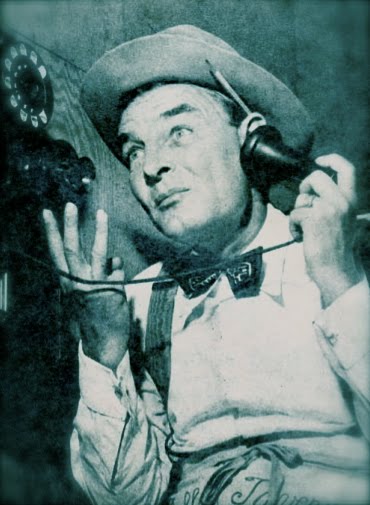
Greenwood should have spent more time talking to the show’s head writers—Jack Hasty, who, as stated in the April 22-28 issue of Radio Life (from which the above picture was taken) had previously fed lines to Al Pearce and Dr. Christian, and Don Johnson, who had been one of Fred Allen’s gagmen. Else, she might have had a heart-to-heart with her real-life manager, who also doubled as her real-life spouse. And they all should have had a word with the sponsor, or, rather, the advertising agency handling the Halls Brothers account, since their executives insisted on having a card like Greenwood dispense sentiments as hackneyed as anything printed on cardboard bearing the Hallmark label:

“Friends,” she addressed the listening public in November 1944, a couple of weeks before Thanksgiving,

for most of us, these busy days are filled with big jobs to be done, big problems to be solved.  There’s so little time for the tiny, little everyday things.  The neighborly chat, the letter to an old friend.  And yet, in this swiftly moving world, friendship need not be forgotten.  A few words that say “I hadn’t forgotten” may mean more than you know to someone, somewhere.  There’s an old saying I think all of us should remember: The way to have friends is to be one.

More offensive than such platitudes is the opportunism apparent in advertising copy urging home front folks to drop a line to those on the frontlines, like this reminder from October 1944:

Friends, there has never been a time when so many families were disunited, separated by thousands of miles from those they love.  Our top-ranking officers have told us again and again, there’s nothing so important to our boys and girls as mail from home.  So, look around you today.  Think of some boy or girl out there who would like to hear from you—and do something.  Send something [. . .]

It was left to announcer Wendell Niles to suggest that the “something” in question ought not to be just anything, at least not if listeners truly “cared to send the very best.”

Quite early on in the program’s run, there must have been some debate about its appeal and prospects. As the year 1944 drew to a close, Charlotte Greenwood’s fictional film career came to an abrupt end—as did her musical interludes that had enlivened proceedings—when her character claimed an inheritance that convinced her to retire. The enticement? The Barton estate, replete with a trio of orphans now in her charge.

“You mean, to have three children, all I have to do is just read and write?” Greenwood exclaimed on 31 December 1944. “Oh, judge, isn’t education wonderful!” Perhaps, producers counted rather too much on the lack of education among the viewers. The advent of the minors sure wasn’t a belated Christmas miracle—and the retooled Greenwood vehicle was no immaculate contraption.

Softening the quirky Greenwood persona by placing three orphans in Aunt Charlotte’s lap, the sponsors may well have hoped to win the ratings war by riding the wave of popular sentiment as the all but certain victory in Europe had public attention shift from defeating the enemy and supporting the troops to dealing with the underage casualties of war.

For the remainder of the program’s run—another year, to be exact—Greenwood had do deal with the problems of two teenagers (played by Edward Ryan and Betty Moran) and their prepubescent sibling (Bobby Larson), who, on this day, 3 June, in 1945, gave his Aunt Charlotte some slight grief by being late from school.

Actually, the kid’s temporary waywardness was little more than an occasion for the writers to string together a few cracks about spanked bottoms (“[H]ow can you get anything into a child’s head by pounding the other end?”) and double entendres involving the meaning of “play.”

Not sure whether to punish young Robert for having stayed out “with some boy,” as his sister suggests, Aunt Charlotte remarks: “I know a girl who’s spend her whole life trying to find some boy to play with. Mr. Anthony [the Dr. Phil of his day] called her ‘The Case of Miss C. G.’ It was very touching.” To which she adds for our but not her niece’s amusement: “And what’s more, thirty thousand privates picked her as the girl they’d most like to see marooned on a desert island with their top sergeant.”

Without a consistent tone, let alone situations consistent with the talents of the beloved comedienne, the program’s legs were far shorter than Greenwood’s interminable gams. Apparently, the figures added up as the laughs per episode, which is to say, not. “Well, I’m no expert on arithmetic either,” Charlotte’s on-air alter ego told the nephew she could not bring herself to spank. “If I knew anything about figures, would I keep the one I’ve got?”

Those who did the accounts decided not to keep what they got—and that despite the fact that the series earned Greenwood a star on the Hollywood Walk of Fame. Instead, as Billboard correctly predicted on 22 December 1945, the Charlotte Greenwood Show would “fold as soon as cancellation [could] take effect”—well before the end of the second season—after the sponsor had decided to take over the Reader’s Digest program from Campbell’s.

Charlotte Greenwood left radio, returned to the screen—and, in 1955, she did get to play Aunt Eller after all. You’re sorry?

The “Invisible Rudolf”: Behind the Mike of a Radio Criminal

“As you know, in many countries in Europe the people are only permitted to hear what their government wishes them to hear through government controlled radio stations.” With that reason to be grateful for being an American, uttered on 8 June 1941, veteran announcer Graham McNamee introduced listeners who might have tuned in to Behind the Mike to hear the “sound effect of the week” or learn how radio series were readied for commercial sponsorship to a kind of broadcasting unlike anything heard over NBC, CBS, or Mutual stations. Despite imposed strictures, McNamee continued, there operated “within these countries or near their borders courageous men and women who, opposing the government, broadcast at the risk of their lives the truth as they see it to their fellow men.” Recusant, daring, and hazardous—such were the cloak-and-dagger operations known as “freedom stations.”
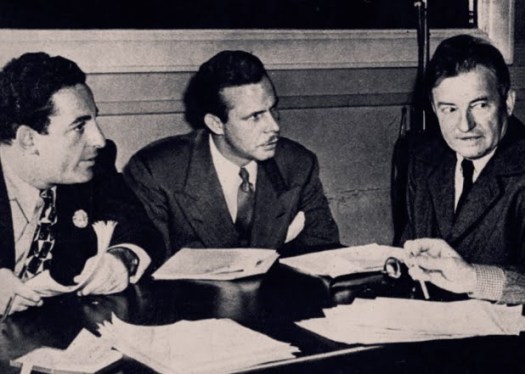
For anyone broadcasting—indeed, for anyone lending an ear to those broadcasts—the German government had a word: “Runkfunkverbrecher” (radio criminal). It also insisted on having the last word: a decree to silence those opposing the regime that would turn the cornerstones of democracy into gravestones.

Just how dangerous was it to turn off the Volksempfänger and tune in those secret stations instead? In Voices in the Darkness (1943), British historian Edward Tangye Lean (brother of film director David Lean), offered this piece of evidence from the Strassburger Neueste Nachrichten, dated 15 March 1941:

The Nuremberg Special Court has sentenced the traitor Johann Wild of Nuremberg to death for two serious radio crimes. Both before and after the coming into effect of the radio decree he behaved as an enemy of state and people by continually listening to hostile broadcasts from abroad. Not content with that, he composed insulting tirades whose source was the enemy station.

As Lean points out, propaganda minister Goebbels issued a “list of stations to which listening was allowed.” Along with their ration cards, German citizens received a “little red card with a hole punched in the middle of it so that it might be hung on the station-dial of a radio set.” The card read: “Racial Comrades! You are Germans! It is your duty not to listen to foreign stations. Those who do so will be mercilessly punished.”

Warnings were not always heeded and what was “verboten” on the air became increasingly sought-after. So, the radio-savvy Nazis devised a method to catch “Rundfunkverbrecher” in the act. Explaining how that was done was one of the “criminals” who, along with McNamee stood Behind the Mike that afternoon.

Introduced as “Rudolf,” a “young man who [had been] in charge of one of these freedom stations,” the guest speaker, having first explained how such cloak-and-dagger operations were originated by stray Nazi Otto Strasser, went on to explain:

Well, the Germans would set up mobile stations in automobiles. These stations were on the same wavelength as the freedom stations. They would play loud records as they drove through the streets. If you were listening to a freedom station and the mobile transmitter playing loud records would pass your door, your radio would pick up their broadcast and blare. Following this mobile transmitter was another car, full of Gestapo, the secret police. They traced the blare and you’d be under arrest and in a concentration camp.

“Rudolf,” who now lived in the US, proudly announced that he was “becoming an American citizen”—a “citizen of a country that needs no freedom stations,” because “here,” he reasoned, “you can hear the truth.”

The United States would not enter the war for another six months; and even though commercial broadcasters were reluctant to embrace the kind of “important messages” that were not designed to hawk a sponsor’s wares, propagandists were gradually emerging from Behind the Mike—though it would be considered rather unorthodox to have the “truth” delivered in a Germanic voice.

Still, American broadcasters could learn a lot from “Rudolf”—if, indeed, McNamee’s guest was the man whom a British newspaper had dubbed “Invisible Rudolf—the Voice of Austria.” As a contemporary historian, Charles Rolo, describes him in Radio Goes to War (1942), Rudolf was an “ex-Viennese lawyer” whose gravest “Verbrechen” it had been to impersonate Hitler on the air, making the kind of Versprechen (promises) for which the Führer was best known around the world—those he had no intention to keep . . .

Brown Study

I am often too lost in whatever thoughts go through that absent mind of mine to take note of what goes on in the world or who among the world’s notables have departed it of late. Else I am too slow to gather those thoughts in time for anything approaching timely. Enter fellow web journalists Ivan Shreve, on whom you can depend for the latest in great names to have joined the parade of late lamented.

Himan Brown, Raymond Edward Johnson and Claude Rains

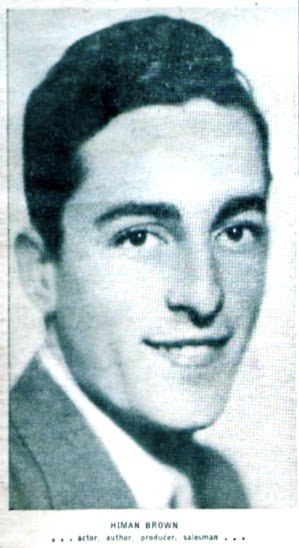
As I learned catching up with The Thrilling Days of Yesteryear this morning, one of the most prolific producers of radio drama in the United States passed away last Friday at the age of ninety-nine: Himan Brown (pictured here, to the left of Raymond Edward Johnson and Claude Rains, during a no doubt brief script conference for Inner Sanctum Mysteries).

Why “no doubt brief”? Well, Brown was not only one of the busiest men in radio, he was also one of the thriftiest—which, his skills and personality aside, is how he got so far so fast in a business that valued performers over producers. According to an article published in the July 1943 issue of Tune In magazine, Brown, then thirty-three, already had some fifteen thousand radio programs to his credit, and, at one time, “had thirty-five of them going each week.”

If he “almost ha[d] a corner on radio horror programs,” it was due largely to his reputation as the medium’s “champion corner cutter,” which is how radio actor Joseph Julian describes the “fabulous Himan Brown” in his memoirs.

For starters, Brown was a “one-man operation.” As Julian points out, the “fabulous” one

produced, cast, and directed of all his shows himself.  He never even had an office. He’d make his phone calls from home, or use a phone at one of the studios.  He had shrewd understanding of script values and an outsize charm that seduced performers to work for him for less than they would for anyone else.

Brown was involved in all aspects of radio production, and understood them in both dramatic and economic terms. “We must write our scripts with the constant vision of a dollar sign before our eyes,” he told the editors of The Microphone. Interviewed for the magazine’s 14 July 1934 issue, he deplored the industry’s insistence on

employing only the most microphone-experienced actors, who, as Julian points out, “could deliver quickly, thus saving on rehearsal pay and studio costs,” Brown was able to “sell a program at a lower price than his competitors.”  Those who assisted him to beat the competition by reading their lines without much instruction appreciated that Brown provided them with steady work, made fewer “demands on their time,” which, in turn, created a “pleasant working atmosphere.”

Julian claims that Brown had made “a million dollars by the time he was twenty-four.” In later life, Brown made a donation in excess of that amount to Brooklyn College, where he taught radio drama. Even on his way up, the enterprising producer opened doors, creaking or otherwise, for young New York writers like Irwin Shaw, who, as Michael Shnayerson recounts in his biography of the noted playwright-novelist, owed his career in radio to Brown, however much Shaw came to resent the experience.

“Still another newspaper cartoon strip comes to the air,” Radio Guide for the week ending 16 February 1935 announced. The program in question was Dick Tracy. “The scripts are to be written by Erwin Shaw [sic] and produced by Himan Brown, who produces The Gumps and Marie, the Little French Princess.”

Clearly, the 1943 article in Tune In, which portrays Brown as a “lone wolf” who was “something of a mystery even within the industry,” is rather overstating it when asserting that the producer had remained “practically unknown to the listening public.” To avid dial twisters—those choosy enough to pick up periodicals like Tune In and its predecessors—the noted producer was already a household name in the mid-1930. How else could readers of the February 1935 issue of Radio Stars be presumed to care that, in November 1934, the “stork left a brand new young man at the home of Mr. and Mrs. Himan Brown”?

It was a rarity, though, for producers to be hailed as “Radio Stars,” among whom those reading the commercial were far more prominent than those preparing the scripts. Perhaps, it was Brown’s past that aided him here, as surely it did in his handling of his numerous programs. As the 1934 article in Microphone reminded me, the producer of series like Little Italy and Jack Dempsey’s Gymnasium was then still referred to as writer, director and “actor [. . .] of his plays.”

Brown himself played Papa Marino in Little Italy, and, if an article in the January 14-20 issue of Radio Guide is to be believed, studied the Italian accent of his Brooklyn neighbors so carefully that he was being mistaken for a paisan.

Given his full schedule and reliable troupe of performers, that ambition (his “greatest,” according to Tune In) remained largely unfulfilled. After all, even a “one-man operation” cannot be expected to be quite this self-sufficient . . .

Related recording

Himan Brown recalling the origins of Inner Sanctum Mysteries in a 1998 interview

That “mental brain from the radio”; or, He Does Duffy’s, Doth He?

Ed Gardner as Duffy

It wasn’t just the “usual gang of crumbs” gathering at Duffy’s Tavern that evening. Otherwise, Archie would not have replaced the “Watch Your Hats and Coats” sign with one saying “Maintain Scrutiny of Thy Chapeaux and Hats.” Nor would Mrs. Duffy, who wasn’t exactly an authority on high classical authors, have been dusting off the Dostoyevsky, which Archie struggled to classify as animal, mineral, or vegetable. Such categorical impediments aside, there were tell-tale signs that Duffy’s was closer than ever to living up to what Archie always pronounced it to be: a place “where the elite meet to eat.”

To be sure, back in its heyday as the most valued source of news and entertainment, American radio was far from elitist; it was too popular—and too important as a commercial and propagandist medium—to risk being either offensively vulgar or alienatingly esoteric. Still, if it meant reputable or established, you couldn’t be more “elite” than Clifton Fadiman, the “mental brain from the radio.” Known to millions of listeners as host of the intellectual quiz program Information, Please!, Fadiman was scheduled to pay a visit to the beloved neighborhood Tavern on this day, 1 June, in 1943. What’s more, he was to give a literary talk there.

If that impressed Archie any, he didn’t let on. How smart did you need to be to ask questions, especially questions submitted by the audience? In fact, Archie had written the Fadiman lecture himself. And why not, pray? Archie could talk poetry with the best of them. He knew all about the Bard from Stratford Avenue and, as he told Duffy’s regular Finnegan (Clifton Finnegan, that is), he was well versed in “cubic centimeter” and other such poetic matters.

Archie may not have been the proprietor of Duffy’s Tavern but he sure was its resident malaproprietor. And what could be greater lexical fun than getting it wrong just right? Not only do you get to enjoy a play on words, but you also get to indulge in the Schadenfreude of hearing someone lose it.

Nowadays, though, catching up with 1940s radio comedies like Duffy’s can be as scholarly a pursuit as the study of the literary greats, considering that some of the lines in Duffy’s Tavern are so topical, they require footnotes.

For instance, there is Duffy’s confusion as to the identity of guest Kip Fadiman. The unheard tavern owner, whose talks with manager Archie open each half-hour visits at Duffy’s Tavern, assumes that the famous quiz show host is the man who asks questions like “Madam, what is your problem?” on his program. “No, Duffy,” corrects Archie, “you’re thinking of Mark Antony.”

Archie, who has Shakespeare on his mind, is getting all confused. The guy he had in mind was John J. Anthony, a spurious, self-styled marriage counselor who enjoyed popular success on radio’s Goodwill Hour.

Then there is uppity Mrs. Piddleton’s confession that she was forced to take the subway because her limousine was hors de combat, or “out of action.” Archie, unfamiliar with the expression, suggests OPA as an American equivalent meaning “out of gas.” In light of all the propaganda that comedy writers were expected to build into their routines, this was a welcome moment of letting off steam. The OPA was the Office of Price Administration, whose wartime rationing forced dames like Mrs. Piddleton to leave their private conveyances behind and join the real folks underground.

Then and now, listening to programs like Duffy’s Tavern is a thoroughly respectable divertissement. Back then, you could revel in the fact that you had to be Archie’s intellectual superior to get the jokes made at his expense; today, it is the occasional effort you have to make to catch Archie’s drift that makes hanging out at Duffy’s a pleasure far from guilty.

“That radical thing”: The Rise and Risibility of Broadcast Reception

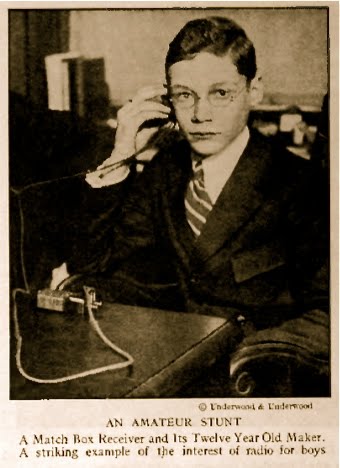
“What is the future of the radio business in the United States? Is it to be like the telephone, the automobile, or the phonograph business, a thing that will rise suddenly to almost universal acceptance by the public and support great manufacturing plants?” These aspects of the “Commercial Side of Radio” were mooted back in May 1922, when they were raised in the first issue of Radio Broadcast. Clearly, broadcast reception was not simply a matter of technology. It required the establishment of a new industry devoted to giving receptive audiences something to receive and to making their reception a favorable one. There was room yet for doubt that radio was here to stay and take pride of place in the parlor.

Enter the satirist, ready to poke fun at enthusiasts and skeptics alike. Among those who could not pass up this opportunity was one Harry M. Doty, who, in 1922, wrote and published “Tiddville and the Radio,” a “Rural Comedy in One Act” involving a group of yokels who gather to take in their first radio broadcast, a demonstration—or wireless reception—prepared for them by a young “radio fan.”

As much as Mrs. Simpson, his mother, regrets that “[t]here’s no such thing as getting any work out of him around the house or farm nowadays,” there is some comfort to be gleaned from the possibility that “some day or other he may be a great electrician like Mr. Edison or Mr. Marconi who invented the wireless telephone.”

Those assembled in Mrs. Simpson’s sitting room are representatives of the older generation, folks somewhat behind the times and, whether resisting change or willing to catch up, do not quite know what to make of or do with the newfangled apparatus.

There is uncertainty as to the nature of broadcasting, whether or not the receiver is a telephone capable of transmitting the voices of the audience. “Why,” exclaims one concerned listener, “if this sort o’ thing keeps up, a body won’t dare to do a thing because if they talk, them air waves or whatever scatter it all over creation for folks to listen to.”

Another is having a peabrainwave. “That radical thing” (“It isn’t a radical, it’s a radio,” the boy corrects) was capable of carrying messages from places thousands of miles away, it should also be possible to carry them “straight up” and communicate with those dearly departed we hope to have gotten there.

“I never heard of one of these machines getting messages from above excepting from an airship,” the young radio fan remarks. Besides, the “government allows only a few of the larger stations to send messages. All I can do is to receive ’em.”

Anxiety and puzzlement give way to grumbling: “Do you mean to tell me that when you’re usin’ that thing, all you can do is to listen to what somebody else is sayin’ and never have a chance say a word back?” Who would put up with such “one-sided conversations”?

Not those present, all of whom voice their objections. An academic is concerned that staying at home to be entertained—rather than entertaining—would mean an end to social gatherings such as Tiddville’s choral club, whereas the local pastor is troubled by the thought that, if sermons were broadcast, local churches would have to close, leaving one member of the party to wonder about the future of community “strawberry festivals and oyster suppers.” And what of wedding ceremonies, if couples could not make their vows be heard?

By the time the receiver picks up the transmission of a prizefight, everyone’s had enough of “that machine,” even though they condescend to tuning in a concert so that a latecomer to their gathering may partake of this demonstration.

However crude, this sketch perfectly mirrors the radical changes brought about by the radio: the decline of local theatricals, the shift from a culture of making home entertainment to one of consuming what was centrally produced, and the demise or marginalization of the amateur broadcasters to whom radio telephony had been something other than a one-sided conversation.

Doty, who wrote a number of plays for amateur performers, might well have been among those who had reason to be wary of broadcast entertainment. He may not have aligned himself with the rustics, but he understood and accommodated them. In the Note that prefaces his comedy, he states:

A radio outfit is not absolutely necessary for the presentation of this play although one may be used if it can be obtained. With one or two small boxes, wires, receivers, or horn, etc., a representation of the radio apparatus can be easily made.

A comedy about radio reception without a radio receiver? It wasn’t that, anno 1922, radios were mere oddities; if they were not fast becoming commodities, Doty’s topical comedy would be pointless. Still, radios were hard to come by. As stated in the aforementioned issue of Radio Broadcast, ever since broadcasting stations like KDKA, Pittsburgh, were providing entertainment “for public consumption,” thereby giving consumers a “reason to buy radio telephone receiving sets,” manufacturers had

never been able to catch up with the demand. The manufacturers of radio receivers and accessories are much in the situation that munition makers were when the war broke. They are suddenly confronted with a tremendous and imperative demand for apparatus. It is a matter of several months at best to arrange for the quantity production of radio receiving apparatus if the type to be manufactured were settled, but the types are no more settled than were the types of airplanes in the war.

Whether it meant war for amateur players and hobbyists, whether it was ammunition for lampoonists or opportunists, radio broadcasting had arrived. Eventually, even Tiddville rubes would buy Cunningham tubes, and from small hayseed homes antennae would sprout. The era of streamlined, national broadcasting was yet several years off, but “[t]hat radical thing” had surely arrived.

Time and the Airwaves: Notes on a Priestley Season

Both BBC Radio 4 and 7 are in the thick of a J. B. Priestley festival, a spate of programs ranging from serial dramatizations of early novels (The Good Companions and Bright Day) and adaptations of key plays (Time and the Conways and An Inspector Calls), to readings from his travelogue English Journey and a documentary about the writer’s troubled radio days. Now, I don’t know just what might be the occasion for such a retrospective, since nothing on the calendar coincides with the dates of Priestley’s birth or death. Perhaps, it is the connection with the 70th anniversary of the evacuation of Dunkirk, an event on which Priestley embroidered in June 1941 for one of his Postscript broadcasts, that recalled him to the minds of those in charge of BBC radio programming.
Never mind the wherefores and whys. Any chance of catching up with Priestley is welcome, especially when the invitation is extended by way of the wireless, the means and medium by which his voice and words reached vast audiences during the 1930s and early 1940s, both in the United Kingdom and the United States.

For all his experience as a broadcaster, though, Priestley, who was not so highbrow as to high-hat the mass market of motion pictures, never explored radio as a playwright’s medium, as a potential everyman’s theater on whose boards to try his combined radiogenic skills of novelist, dramatist, and essayist for the purpose of constructing the kind of aural plays that are radio’s most significant contribution to twentieth-century literature—the plays of ideas.

Priestley prominently installed a wireless set in Dangerous Corner, a stage thriller whose characters gather to listen to a thriller broadcast. Later, he read his controversial wartime commentaries (titled Postscripts) to a vast radio audience. He even went on one of Rudy Vallee’s variety programs to discuss the fourth dimension. Yet the medium that relied entirely on that dimension, to the contemplation of which he devoted many of his stage plays—Time and the Conways and I Have Been Here Before among them—did not intrigue Priestley to make time and create plays especially for the air.

To be sure, his falling out with the BBC in 1941 (as outlined in Martin Wainwright’s radio documentary about the Postscript broadcasts) did little to foster Priestley’s appreciation of the radiodramatic arts. Yet the indifference is apparent long before his relationship with Auntie soured. When interviewed for the 1 September 1939 issue of the Radio Times about his novel Let the People Sing, which was to be read serially on the BBC before it appeared in print, Priestley dismissed the idea that he had written it with broadcasting in mind:

“I realised, of course, that the theme must appeal to the big majority. But apart from that, I thought it better to let myself go and leave the BBC to make it into twelve radio episodes. It would otherwise have cramped my style.”

To Priestley, the “experiment” of broadcasting his novel lay in the marketing “gamble” of making it publicly available prior to publication, a challenge of turning publishing conventions upside down by effectively turning the printed book into a sort of postscript. Clearly, he looked upon radio a means of distribution rather than a medium of artistic expression.

Reading I Have Been Here Before and listening to the radio adaptation of Time and the Conways, I realized now little either is suited to the time art of aural play. Whereas the Hörspiel or audio play invites the utter disregard for the dramatic unities of time and space, Priestley relied on the latter to make time visible or apparent for us on the stage.

The Conways, like the characters of Dangerous Corner before them, are brought before us in two temporal versions, a contrast designed to explore how destinies depend on single moments in time—moments in which an utterance or an action brings about change—and how such moments might be recaptured or rewritten to prevent time from being, in Hamlet’s words, “out of joint.”

“Time’s only a dream,” Alan Conway insists. “Time doesn’t destroy anything. It merely moves us on—in this life—from one peep-hole to the next.” Our past selves are “real and existing. We’re seeing another bit of the view—a bad bit, if you like—but the whole landscape’s still there.”

In Priestley’s plays, it is the scenery, the landscape of stagecraft, that remains there, “whole” and virtually unchanged. The unity of space is adhered to so as to show up changes in attitudes and relationships and to maintain cohesion in the absence or disruption of continuity.

In radio’s lyrical time plays, by comparison, neither time nor place need be of any moment. It is the moment alone that matters on the air, an urgency that Priestley, the essayist and wartime commentator, must surely have sensed.  Priestley, the novelist and playwright did or could not.  Too few ever did.  To this day, a whole aural landscape is biding its time . . .

Dunkirk 70 / Roosevelt 69

This week marks the 70th anniversary of “Operation Dynamo,” an ad hoc rescue mission involving small civilian ships coming to the aid of French and British soldiers who had been forced into retreat at Dunkerque during the for Allied troops disastrous Battle of Dunkirk. The operation, which became known as “The Miracle of the Little Ships,” was recreated today as more than sixty British vessels, sailing from Kent, arrived on the shores of northern France.

During the course of a single week, nearly 340,000 soldiers were brought to safety, however temporary. Many civilians who had what became known as “Dunkirk spirit” were recruited after listening to BBC appeals on behalf of the British admiralty for aid from “uncertified second hands”—fishermen, owners of small pleasure crafts, any and all, as the BBC announcer put it, “who have had charge of motor boats and [had] good knowledge of coastal navigation.”

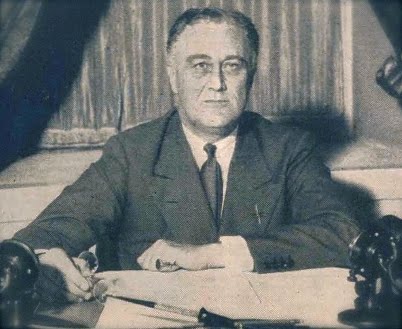
Eager to maintain its neutrality prior to the attack on Pearl Harbor, America was understandably lacking in such public “spirit,” frequent outcries against Nazi atrocities notwithstanding; but even long after entering the war, the US government kept on struggling to explain or justify the need for sacrifices and (wo)manpower to a people living thousands of miles from the theaters of war. On this day, 27 May, in 1941, one year after the operation at Dunkirk began, US President Franklin Delano Roosevelt came before the American public in another one of his Fireside Chats.

Although the nation was “[e]xpect[ing] all individuals [. . .] to play their full parts without stint and without selfishness,” the Roosevelt administration took considerable pains to explain the significance of the war, the need for “toil and taxes,” to civilians who, not long recovered from the Great Depression, were struggling to make a living.

If Hitler’s “plan to strangle the United States of America and the Dominion of Canada” remained unchecked, FDR warned the public,

American laborer would have to compete with slave labor in the rest of the world. Minimum wages, maximum hours? Nonsense! Wages and hours would be fixed by Hitler. The dignity and power and standard of living of the American worker and farmer would be gone. Trade unions would become historical relics and collective bargaining a joke.

Crucial to America’s freedom was the security of the oceans and ports. If, as FDR put it, the “Axis powers fail[ed] to gain control of the seas,’ their “dreams of world-domination” would “go by the board,” and the “criminal leaders who started this war [would] suffer inevitable disaster.”

The President’s address—broadcast at 9:30 EST over CBS stations including WABC, WJAS, WJAS, WIBX, WMMN, WNBF, WGBI and WJR—departs only slightly from the script, published in the 31 May 1941 issue of the Department of State Bulletin. Whatever changes were made were either designed to strengthen the appeal or else to prevent the urgency of the situation from coming across as so devastating as to imply that any efforts by the civilian population were utterly futile.

The address, as scripted, was designed to remind the American public that the US navy needed to be strengthened, alerting listeners that, of late, there had been “[g]reat numbers” of “sinkings” that had “been actually within the waters of the Western Hemisphere.”

The blunt truth is this—and I reveal this with the full knowledge of the British Government: the present rate of Nazi sinkings of merchant ships is more than three times as high as the capacity of British shipyards to replace them; it is more than twice the combined British and American output of merchant ships today.

In address as delivered, this passage was rendered slightly more tentative as “The blunt truth of this seems to be,” a subtle change that not so much suggests there was room for doubt as it creates the impression that the great man behind the microphone was weighing the facts he laid bare, that the devastating and devastatingly “blunt truth” was being carefully considered rather than dictated as absolute.

No mention was made of the “Miracle of Dunkirk,” that remarkable demonstration of spirit and resilience. More than a flotilla of “little ships” was required to defend the US from the potential aggression of the Axis powers. The challenge of American propaganda geared toward US civilians was to make the situation relevant to individuals remote from the battlefields, to motivate and, indeed, create a home front.
In Britain, where “ignorant armies clashed” just beyond the narrow English Channel and where the battlefields were the backyards, there was less of a need to drive home why the fight against the Axis was worth fighting.

In the US, the driving home had to be achieved by breaking down the perfectly sound barriers of that great American fortress called home, by making use of the one medium firmly entrenched in virtually every American household, an osmotic means of communication capable of permeating walls and penetrating minds. Radio served as an extension to the world; but it was more than an ear trumpet. It was also a stethoscope auscultating the hearts of the listener.

As FDR, who so persuasively employed it in his Fireside Chats, was well aware, the most effective medium with which to imbue the American public with something akin to “Dunkirk spirit” was the miracle not of “little ships” but of the all-engulfing airwaves—and the big broadcasts—that helped to keep America afloat.

“You Were Wonderful,” Lena Horne

When I heard of the passing of Lena Horne, the words “You Were Wonderful” came immediately to mind. Expressive of enthusiasm and regret, they sound fit for a tribute. However, by placing the emphasis on the first word, we may temper our applause—or the patronising cheers of others—with a note of reproach, implying that while Horne’s performances were marvellous, indeed, the system in which she was stuck and by which her career was stunted during the 1940s was decidedly less so. No simple cheer of mine, “You Were Wonderful” is also the title of a radio thriller that not only gave Horne an opportunity to bring her enchanting voice to the far from color-blind medium of radio but to voice what many disenchanted black listeners were wondering about: Why fight for a victory that, of all Americans, will benefit us least? As title, play, and cheer, “You Were Wonderful”—captures all that is discouraging in those seemingly uncomplicated words of encouragement.

Written by Robert L. Richards, “You Were Wonderful” aired over CBS on 9 November 1944 as part of the Suspense series, many of whose wartime offerings were meant to serve as something other than escapist fare. As I argued in Etherized Victorians, stories about irresponsible Americans redeeming themselves for the cause were broadcast nearly as frequently as plays designed to illustrate the insidiousness of the enemy. Despite victories on all fronts, listeners needed to be convinced that the war was far from over and that the public’s indifference and hubris could endanger the war effort, that both vigilance and dedication were required of even the most war-weary citizen. “You Were Wonderful” played such a role.

When a performer in a third-rate nightclub in Buenos Aires suddenly collapses on stage and dies, a famous American entertainer (Horne) is rather too eager replace her. “I’m a singer, not a sob sister,” she declares icily, thawing for a tantalizing rendition of “Embraceable You.”

The very name of the mysterious substitute, Lorna Dean, encourages listeners to conceive of “You Were Wonderful” in relation to the perennially popular heroine Lorna Doone, or the Victorian melodramatic heritage in general, and to consider the potential affinities between the fictional singer and her impersonatrix, Lena Horne, suggesting the story to be that of an outcast struggling to redeem herself against all odds.

One of the regulars at the nightclub is Johnny (Wally Maher), an seemingly disillusioned American who declares that his country did not do much for him that was worth getting “knocked off for.” Still, he seems patriotic enough to become suspicious of the singer’s motivations, especially after the club falls into the hands of a new manager, an Austrian who requests that his star performer deliver specific tunes at specified times. The absence of a narrator signalling perspective promotes audience detachment, a skeptical listening-in on the two central characters as they question each other while all along compromising themselves.

When questioned about her unquestioning compliance, Lorna Dean replies:

I’m an entertainer because I like it.  And because it’s the only way I can make enough money to live halfway like a human being.  With money I can do what I want to—more or less. I can live where I want to, go where I want to, be like other people—more or less.  Do you know what even that much freedom means to somebody like me, Johnny?

However restrained, such a critique of the civil rights accorded to and realized by African-Americans, uttered by a Negro star of Horne’s magnitude, was uncommonly bold for 1940s radio entertainment, especially considering that Suspense was at that time a commercially sponsored program.

“[W]e are not normally a part of radio drama, except as comedy relief,” Langston Hughes once remarked, reflecting on his own experience in 1940s broadcasting. A comment on this situation, Richards’s writing—as interpreted by Horne—raises the question whether Horne’s outspoken character could truly be the heroine of “You Were Wonderful.”

Talking in the see-if-I-care twang of a 1930s gang moll, Lorna is becoming increasingly suspect, so that the questionable defense of her apparently selfish behavior serves to render her positively un-American. When told that her command performances are shortwaved to a German submarine and contain a hidden code to ready Nazis for an attack on American ships, she claims to have known this all along.

The conclusion of the play discloses the singer’s selfishness to have been an act. Risking her life, Lorna Dean defies instructions and, deliberately switching tunes, proudly performs “America (My Country ‘Tis of Thee)” instead.

About to be shot for her insubordination, Lorna is rescued by the patron who questioned her integrity, a man who now reveals himself to be a US undercover agent. When asked why she embarked upon this perilous one-woman mission, the singer declares: “Just to get in my licks at the master race.”

“You Were Wonderful,” which, like many wartime programs was shortwaved to the troops overseas, could thus be read as a vindication of the entertainment industry, an assurance to the GIs that their efforts had the unwavering support of all Americans, and a reminder to minorities, soldiers and civilians alike, that even a democracy marred by inequality and intolerance was preferable to Aryan rule.

Ever since the Detroit race riots of June 1943, during which police shot and killed seventeen African-Americans, it had become apparent that unconditional servitude from citizens too long disenfranchised could not be taken for granted. With “You Were Wonderful,” Horne was assigned the task of assuring her fellow Negro Americans of a freedom she herself had to wait—and struggle—decades rightfully to enjoy.

Had it not been for this assignment, Lena Horne may never have been given the chance to act in a leading role in one of radio’s most prominent cycles of plays. Yes, “You Were Wonderful,” Lena Horne—and any tribute worthy of you must also be an indictment.

“. . . there must come a special understanding”: To Corwin at 100

Today, American journalist and radio playwright Norman Corwin turns 100. Whether that makes him the oldest living writer to have had a career in radio I leave it to fact-checkers and record book keepers to determine. I do know that, seventy years ago, he was already the best. Oldest. Best. Why not dispense with superlatives? Corwin has been set apart for too long. Instead, an appreciation of his work calls for the positive and the comparative, as his plays deserve to be regarded at last alongside the prose and poetry of his better-known literary contemporaries.

No survey of 20th-century American literature can be deemed representative, let alone definitive, without the inclusion of some of Corwin’s Whitmanesque performances. What has kept him from being ranked among the relevant and influential writers of the 1940s, and of the war years in particular, is the fact that, during those years, Corwin wrote chiefly for a medium that, however relevant and influential, was—and continues to be—treated like a ghetto of the arts in America.

You might argue that the metaphor is not altogether apt, especially if you bear in mind the distinguished authors and playwrights who did turn to—or agreed to be pulled into—broadcasting during the Second World War; among them poets Archibald MacLeish, Edna St. Vincent Millay, and Stephen Vincent Benét, as well as dramatists like Maxwell Anderson, Marc Connelly, and Sherwood Anderson. And yet, even their scripts are rarely acknowledged to be contributions to literature, the American airwaves being thought of as a cultural site quite beyond that field.

At best, dramatic writings for radio are handled as historical documents that, by virtue of being propagandist or populist, could hardly be regarded as having artistic merit or integrity. As something other—and less—than literature, they were as quickly obliterated as they were produced, stricken from the records so as not to tarnish the reputation of erstwhile writer-recruits most of whom exited the radio camp well before V-J Day.

Norman Corwin never deserted that camp. Rather, the camp was shut down, raided by McCarthy, all but razed to make way for television. Sporadic returns to the old playing field notwithstanding, he was forced to move on. Yes, the air was—and is—Corwin’s playground. For all their wartimeliness, his 1940s plays were never mere means to an end, even if end is understood to mean an end to the war that gave them a reason for being.

To gain an understanding of that past is not the only good reason for being in the presence of Corwin today. Rather than promoting uniformity, which is a chief aim of propaganda, Corwin’s plays challenge the commonplace, encourage independent thinking and the voicing of ideas thus arrived at. Take “To Tim at Twenty,” for instance. It is hardly one of Corwin’s most complex, ambitious or experimental works for radio; in a note to a fellow writer, published in Norman Corwin’s Letters (1994), the playwright himself described it as “the lowest common denominator of simplicity.” Simplicity, in this case, is an achievement. Quietly startling, “To Tim at Twenty” bespeaks the humanity, intellect, and dignity of its author.

Written for the CBS Forecast series, a string of pilot broadcasts designed to test audience responses to potential new programs, the play first aired on 19 August 1940, when it starred Charles Laughton, for whom “To Tim” was expressly written, and Elsa Lanchester. Newly arrived in California, Corwin was staying at the couple’s Brentwood home at the time.

As he shared in a letter to his sister-in-law, he felt “kind of lonely” in Hollywood, and was “getting tired of singlehood.” In times of war—and to Laughton and Lanchester August 1940 was wartime—the thought of growing up and raising a family is compounded by the realization that the future is darkly uncertain instead of rich in potentialities. So, Mr. Corwin wrote a letter.

To Tim at Twenty is an epistolary play, a radiodramatic genre of partially dramatized speeches addressed to an implied audience. The proxy listener, in this case the unheard Tim, suited Corwin since indirection made whatever was conveyed come across as something other than an act of overt indoctrination. The addressee also provided him with a veil behind which to enact his personal conflicts as he contemplated his maturity, mortality, and legacy.

The letter writer is Tim’s father, a British gunner spending a sleepless night in the “barracks of an RAF squadron on the northeast coast of England”; as the narrator-announcer informs us, he is “leaving at dawn on a mission from which there can be no return.”

Once the United States entered the war, lesser writers, melodramatist Arch Oboler among them, would use this kind of set-up to remind American civilians of the sacrifices made for them overseas, of the bravery that must be honored and matched at the home front. Tim, we expect, is asked to honor his father’s memory. Instead, the letter he is to receive tells him that the men of his father’s generation “haven’t made out any too well” in the business of “the running of the earth.”

At the time the letter is composed, Tim is just five years old. His father made a “special point” of asking his wife “not to deliver” it until 1955, at which time he might have had the “man to man” talk with his son that war denied him.

Sentimental, seemingly pacifist messages were not unheard of at the time. They were welcomed by isolationists who counted on big business as usual—and commercial radio, which shunned the controversial, was very big business indeed; but “To Tim at Twenty” suggests something alien to those determined to preserve the status quo. Instead, the belated address of the Englishmen, who knows better than to have faith in things as they are, is meant to instill his son—and Corwin’s listeners—with a “fuller appreciation of women.” To Marshall, they are authorities of humanity superior to men because “there must come a special understanding of the dignity of life to those who grow it in their vitals.”

As the dramatic flashbacks reveal, the lessons he shares with his son were taught Marshall by his wife, who suggested that the voices of the many might have drowned the shrill cries of the few, the “wanton wills” that were not countered by “man’s vast raw materials of love and tenderness and courage” in time to avoid deadly conflict. “There are several kinds of valor,” Tim is to learn from his dead father, “and the least is the kind that comes out of the hysteria of battle.”

I suspect that it was easier to write this message in 1940 than it was to understand it in 1955, when America’s leader was a five-star general, when superpowered dominance was the manly objective of the day and the “appreciation of women” was more a matter of the male gaze than of political influence or workforce equality. By then, there was no place for Corwin in network radio.

Since his climactic “Note of Triumph” in 1945, to which nearly half of the US population was estimated to have tuned in, his voice has been heard by a comparatively few—the fortunate few who, by lending him an ear, are gaining a “special understanding.”

“Because there is always someone left out”: Bennett, Biography, and the Habit [of Framing] Art

I might as well come right out with it, dissentient, fractious and uncharitable as it may sound. I don’t like Alan Bennett—popular British playwright, memoirist, and frequent reciter of his own words—whose latest work for the stage, The Habit of Art, was beamed from London’s National Theatre into movie houses around the world this month. He irritates me. Why, then, did I number among the sizeable crowd this satellite event drew at our local cinema? Truth is, I kind of like that he irritates—unless he does it with the sound of his voice, a querulous whine the exposure to which theater audiences, unlike radio listeners, are generally spared. In The Habit of Art, Bennett does it—that is, doesn’t do it for me—in the way he packages or frames what I think he is trying to capture.

At this stage in his career, Bennett is about as stuffy as an old whoopee cushion. Once in a while, he stands up to lecture, letting his characters—all stand-ins for himself—disseminate lines that stand out not merely by virtue of their brilliance but by the less-than-virtue of being borrowed for the occasion as if they were quotations taken from what could have been the draft of an unpublished essay. Then, sitting down again, he, in his frightfully British way of rendering himself human and opening up to us—and of confusing secrets with secretions—carries on about bodily functions as if he were out to revive the Carry On series. The habit? O, fart!

“That’s Auden farting, not me,” one of Bennett’s characters, Fitz, insists after doing so audibly. Whether caught breaking wind or urinating in the kitchen sink, that’s still W. H. Auden, the distinguished poet, with whose short yet (since?) intimate friendship to composer Benjamin Britten the play is ostensibly concerned. Ostensibly, because Bennett is not about to humor those curious about the private lives of two fellow gay artists, reunited in 1972 to discuss a collaboration that does not come off, by delivering some kind of Sunshine Boys routine. In its roundabout way, The Habit of Art refuses to be about any one thing. It isn’t Auden letting go. It’s an actor portraying him in a rehearsal of a play whose Author, also on the scene, seems unsure about just what it is all about—or at least unable to convince his players.

To say what he needs to say, Bennett’s Author feels compelled to move a biographer into the frame of what he is anxious to preserve as his composition; Bennett does the same in order to explore that frame and explode it. In other words, Bennett is rehearsing his failure—or inability or unwillingness—to restrain himself for the sake of art by acting out passages from his decidedly golden notebook.

A kind of Greek Chorus, the biographer is the Author’s device, just as the sensitive, defensive Author is Bennett’s. That is, the device is similar, but the purpose is different. In Bennett’s play, the unassuming actor assuming the part of the interviewing, interjecting biographer is aware of being a device and resents it. Since his character is based on a real person (radio broadcaster Humphrey Carpenter), the actor wants his role to come across as real even as he is made to walk in and out of Auden’s quarters like the Stage Manager in Our Town. Nothing seems real here aside from Bennett’s artistic struggle.

Although the actor does not have to emit gas to prove his character’s humanity, he—that is, the biographer in spite of his extra-autobiographical self—is confronted with Auden’s request for a sex act the performance of which was the job of the callboy for whom the biographer is briefly mistaken. Enter the callboy proper. He, not Auden or Britten, is the character referred to, albeit obliquely, in the Author’s play Caliban’s Day, the troubled rehearsal into the midst of which we are plonked.

Meanwhile, Fitz, the less than letter-perfect actor set to play Auden, is not amused by this Caliban, nor by Caliban’s Day, a dramatic monstrosity that also features talking furniture (“I am a chair and in New York / I seated his guests and took in their talk”) and an exchange between Auden’s Words and Britten’s Music, performed, in the absence of the two unfortunate thespians assigned those parts, by the jovial Stage Manager and her hapless assistant.

It is through Fitz that Bennett responds to the frustrations of theatergoers eager—if increasingly less so—to get closer to a poet whom, after witnessing this closed-door run-through of what is about to go on public display, it would be nigh on impossible to romanticize as bohemian: “There’s no nobility to him,” Fitz protests, “Where—this is what the audience will be thinking—where is the poetry?”

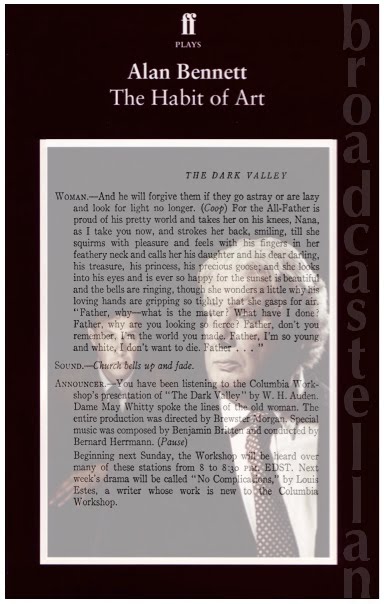
Not that I was expecting, even from an audiophile like Bennett, any reference to “The Dark Valley,” Auden’s 1940 contribution to The Columbia Workshop. Dramatically underscored by Britten’s music, Auden’s monologue for radio is a collaborative effort that speaks, more directly and poignantly than Bennett, of love, death, and the secrecy that is the death of love:

Under the midnight stone
Love was buried by thieves.
The robbed hearts weep alone.
The damned rustle like leaves.

Taking center stage instead is a professional sex worker. Bennett’s Author does his utmost to justify the callboy’s presence, insisting that his request performance is neither uncalled for nor gratuitous. As the only surviving witness of that fictionalized meeting between Auden and Britten, the young man is recalled from obscurity to tell us what he would want to get out of the exchange if he, a Caliban among Prosperos, were to have his day:

I want to figure. He goes on about stuff being cosy, England and that. But it’s not England that’s cosy. It’s art, literature, him, you, the lot of you. Because there’s always someone left out. You all have a map. I don’t have a map. I don’t even know what I don’t know. I want to get in. I want to join. I want to know.

Neither the Author, whom we are not encouraged to take seriously, nor Bennett, in all his tongue-in-cheekiness, convinces me that the boy truly wants to be in the know; above all, he wants to be known. And, for some reason—a touch of Death in Venice, Habit with its built-in commentary suggests—Bennett lets the youth voice his demands on behalf of all the faceless boys that Britten and Auden may have privately enjoyed while enjoying critical success.

But the boy—played by a self-conscious twenty-nine-year old—does not figure. If anything, he disfigures. He, like anyone who ever catered to Auden’s bodily needs, cleaned his kitchen sink or inspected his carcass, is generally “left out” for a reason. After all, is it really such a revelation that an artist may be rankly human, that, stripped of the artistry for which he is known, he stands before us as homo mephiticus?

Bennett, to borrow a line from myself, is “like a boar chasing Adonis for the sweat on his thighs.” That we are unknowable to each other is old hat. To add that, if we do get to know what others did not mean to share, we might end up with more—or less—than we need to know is hat decomposing.

Bennett means to share, though. He means to share what it means to create, to critique, and collaborate, what it means to be old, what it means to be gay, what it means to be public, to be private, to be popular, to be British, to be human. Now artsy, now fartsy, he means to let it all out, and say, too, how difficult it is to say anything, let alone everything and the kitchen sink. Yet, as Scream 3 drove home back in 2000, postmodern self-reflexivity is as dead as a nail in a mortuary’s door, a door that, if left open, releases nothing but the ptomaine wafting our way when storytelling is permitted to keep turning and feasting on itself.

However breezy this exercise in framing and dismantling may be, nothing quite this undisciplined and self-indulgent can be any longer mistaken for fresh air. It’s just a hard-to-kick habit of art, and a rather bad one at that.