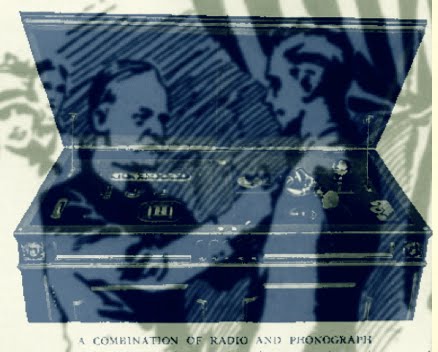
Of Myrt and Marge-inal “interest”; or, Getting It in the “hinterland”

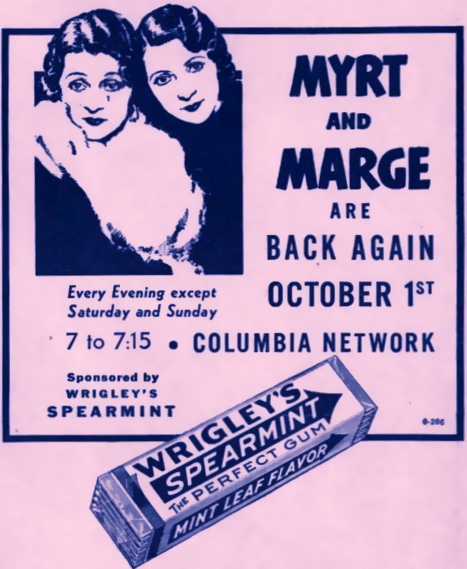
Amos ‘n’ Andy is old-fashioned,” radio critic Darwin L. Teilhet complained as early as 1932. “Its dramatic machinery creaks.”  He much preferred Myrt and Marge, a 42nd Street-smart if way-off-Broadway Melody then in its inaugural season.  To Teilhet, Myrt and Marge was not only “very good serialized melodrama,” it was the “most advanced program of its type now on the air.” 
For all its popularity—and its groundbreaking granddaddy-of-them-all status—Amos ‘n’ Andy sure was “old-fashioned.”  Indeed, its success depended on that comforting, reassuring recognizability—comforting and reassuring, that is, to folks who thought a black face routine less troubling than the effectuation of racial equality.  The early 1930s were highly competitive times of economic hardship, and to hear potential competitors bumbling and make fools of themselves must have been comic relief to the paler faces in the crowd, the faces that mattered most to sponsors.

So, how fresh-faced were Myrt and Marge by comparison? And why was it that, by January 1933, their serialized adventures came pretty close to rivaling Amos ‘n’ Andy in the ratings? Never having been enthusiastic about the latter, I was eager to find out.

As next to nothing is left of the program’s initial run, I had to take the critics’ ear and word for the “it” of listening.  Teilhet, for one, was wowed by the “swift lines,” which he found to be “very different from Amos’ and Andy’s ponderous exchanges.”

Indeed, those “swift lines” translated into swell curves in the critic’s mind.  “Miss [Donna] Damerel [as Marge] provides a sweet and pure sex interest,” Teilhet opined, “which can be safely gulped down by the hinterland without making the children go to bed before their proper hour.”  It took an adult’s imagination of adulterated purity to figure that not all that occurred in the lives of chorines Myrt and Marge was altogether “sweet and pure,” least of all by the puritan standards commercial radio was obliged to uphold.

According to Teilhet, the “tempo” set by the two leads was “hard and glittering.”  Myrt and Marge was quick to respond to the public’s fascination with Al Capone and Little Caesar by turning the backstage drama into an “exciting gangster story.”  It brought a touch of Dillinger to the dilly-dalliance of romantic serials, then still a genre in search of a formula.  By doing so, and by implicating its leads, Myrt and Marge came as close to pre-code Hollywood as network radio could get.

What’s more, Teilhet remarked, that “tempo” was “directly traceable to the vaudeville antecedents” of Myrtle Vail, who created the serial, wrote and starred in it.  “The things she has seen—and experienced,” winked Radio Guide’s Arthur Kent in 1934.  Kent attributed the program’s success to the fact that the title characters were played by actresses who were mother and daughter in real life and that Myrtle Vail had “lived in three great epochs of show business: epochs dominated, respectively, by stage, movies and radio.”  Having “been though it all,” Vail now wrote “the life of the theater as well as her own life into her script.”   Like a true trouper, she carried on even after the death of her co-starring daughter in 1941.

At least on one occasion, the realism was inspired by actual events.  “That tearful episode of Myrt and Marge last week was not the result of an emotionally successful script, m’dears,” readers of Radio Guide’s issue for the week ending 1 February 1936 were told.  “No, it was because the cast almost was overcome by tear gas fumes released when the bank adjoining the CBS studios tested out its automatic vault system.” 

I am surprised that listeners, if not overcome by the vapors, weren’t positively fuming at some of the backstage goings-on.  Perhaps they were overcome, which may account for the lack of documented complaints, radio’s chief tool of self-censoring.  Could they have been oblivious of the program’s other or third “sex interest”—that flaming figure in the dressing room?

What Myrt and Marge brought into American homes, if they didn’t already have one in the closet—and what contributed to renewed interest in the serial, albeit as a mere pop-cultural footnote—was Clarence Tiffingtuffer, the queer sidekick responsible for the gowns worn by the show-busy leads, and for considerable gossip besides.

If listeners were clueless, the hoofers sure weren’t.  When teenager Marge, the newest member of Hayfield Pleasures celebrated precision chorus, feels uncomfortable about being fitted by a man, one of her fellow chorines hisses “Don’t worry, he’ll never harm a hair o’ your head, dearie.”  Rather than being the brunt of it, Clarence dishes out some “swift lines” of his own. “Those gams of yours are practically parenthetical,” he remarks upon the alleged assets in his sartorial care.

Now, belated followers of Myrt and Marge have to make do with a mid-to-late 1940s revival of the serial (although a 1933 film version featuring the radio cast is extant).  Gone are the true-to-life leads; gone, too, is much of what had seemed “different” or “advanced” about the serial back in 1932.  Yet even though we now have to settle for Myrt and Marge-arine, the substitute still retains a flavor of the first outing, as the actor originating the part of Clarence, Ray Hedge, reprises the role he made his own.

I can imagine that, had I been growing up in the early 1930s, Myrt and Marge would have made me feel a little less marginal by moving someone recognizably like me—yet way out there, enjoying a career and a life of make-believe—into the center of the action.  How thrilling it would have been to hear Myrt and Marge take to the soundstage set by their better-known seniors, Gosden and Correll, and listen to them tear down that old minstrel show-on-taxi cab wheels.  With Clarence in their midst, and on my mind, it sure would have sounded like the “most advanced program of its type.”

To be continued, as they say in soap opera land.

Blind Man’s Stuff: Alec Templeton in Time and Space

Last night, I had the good fortune to hear the music of Alec Templeton. Live and by proxy—and right here in town. Templeton’s compositions, among them barrier-obliterating and class-unconscious numbers like “Bach Goes to Town” and “Debussy in Dubuque,” were performed at the National Library of Wales, Aberystwyth. Pianist Simon Crawford-Phillips was ably assisted by Templeton himself, whose voice and ways on the keyboard were heard in a variety of radio recordings from the 1930s, ‘40s, and ‘50s.

Why here? Why now? Well, Templeton was a Welshman by birth, a fact that seems to have eluded most of the Welsh who pride themselves to be a nation of song. So, last night was as good and as high a time as any for his countrymen and women to acknowledge Templeton’s remarkable against-almost-all-odds career, even if the will to embark upon it took the composer-pianist as far West from the West of Britain as Hollywood. The countrywoman who did the acknowledging was Rhian Davies, teller of Templeton’s life in words and images. Davies, who generously acknowledged as well all the support and assistance her project received from broadcasting buffs and music lovers around the inter-networked world, has known about Templeton practically all her life. Eager to share her readily transmitted enthusiasm, she brought home to us, the assembled audience, that it is always Alec Templeton Time.

Templeton’s life is the stuff of legend. Born blind, he developed an ear so keen and a wit so sharp that he was destined to play tunes made for the cutting of rugs. That he was an expert at middlebrow musical culture has a lot to do with the fact that the eyes beneath his brows saw nothing and that his ears saw nothing but potential. Others, left in the dark yet accustomed to light, might have seen an insurmountable impediment.

The mind’s eye of Alec Templeton saw no such manifestations of doubt. He saw, say, Lower Basin Street … and took it. It may be that sightless people, who sense space by feeling their way around and listening intently, are not so much impressed by the walls facing them as their seeing contemporaries, not so much concerned with apparent boundaries, be they cultural or national.

“I understand,” a writer for Radio Guide remarked in 1936, “why his friends, when you start glooming about his sightless eyes, smile superciliously and say: ‘Save your sympathy for someone who needs it.’”

The stuff sighted folks concern themselves with is so much nonsense to a man like Templeton. Sensing a universe where others might imagine chaos, he crossed the waves and made a home for himself on the airwaves, authoring an etherized existence.

“Radio,” Templeton reportedly said, “is to me the greatest miracle of man’s ingenuity. My ears are my eyes, and I tune in at every opportunity, listening to everything from Vic and Sade to Toscanini.”

Hearing Templeton’s music performed live and seeing his career celebrated was a thrill. Yet as pleased as I was that all this happened in the little Welsh town where I now live, I wonder what claim Wales has to her native son. After all, the place of his birth, like his blindness, was not of his choosing. Indeed, he chose to unfurl his pinions, take to the air, and come to live for all willing to be all ears, in a medium whose art is not limited by space but that is instead the stuff—the no-matter—of time.   Make that Alec Templeton Time.

Of “historical value”: Hitler’s “Best” Straight Talk and Other Continuity Types

As soon as I decided to make radio plays written in the United States in the 1930s, ‘40s and early ‘50s the subject of my doctoral study, I set out to scour New York City University libraries for scripts published during that period. My degree is in English, and I was keen not to approach broadcasting as a purely historical subject. The play texts and my readings of them were to be central to my engagement with the narrative-drama hybridity that is peculiar to radio storytelling. Whenever possible, I tried to match script with recording—but, to justify my study as a literary subject, I was determined to examine as many print sources as possible. One text that promised to provide a valuable sample of 1930s broadcast writing was Radio Continuity Types, a 1938 anthology compiled and edited by Sherman Paxton Lawton.

Back in the late 1990s, when I started my research, I was too focused, too narrow-minded to consider anything that seemed to lie outside the scope of my study as I had defined it for myself, somewhat prematurely. Instead, I copied what I deemed useful and dutifully returned the books I had borrowed, many of which were on interlibrary loan and therefore not in my hands for long. It was only recently that I added Radio Continuity Types to my personal library of radio related volumes—and I was curious to find out what I had overlooked during my initial review of this book . . .

Radio Continuity Types is divided into five main sections: Dramatic Continuities, Talk Continuities, Hybrid Continuities, Novelties and Specialties, and Variety Shows. Clearly, the first section was then most interesting to me. It mainly contains scripts for daytime serials, many of which I had never heard of, let alone listened to: Roses and Drums, Dangerous Paradise, Today’s Children. There are chapters from Ultra-Violet, a thriller serial by Fran Striker, samples of children’s adventures like Jack Armstrong and Bobby Benson, as well as an early script from Gosden and Correll’s Amos ‘n’ Andy taken from the period when the program’s format was what Lawton labels “revolving plot drama.”

Aside from a melodrama written for The Wonder Show and starring Orson Welles, I got little use out of Lawton’s book, mainly because I concentrated on complete 30-minute or hour-long plays rather than on serials I could only consider as fragments. Besides, I was not eager to perpetuate the notion of radio entertainment as being juvenile or strictly commercial.

Anyway. Looking at the book now, I am struck by Lawton’s choices. Never mind the weather report on page 346 or Madam Sylvia’s salad recipe. How about the editor’s selection of “Occasional speeches”? Historically significant among them are Franklin D. Roosevelt’s first inaugural, a “Welcoming” of Roosevelt by Getulio Vargas, President of Brazil, as well as Prince Edward VIII’s announcement of his abdication.

No less significant but rather more curious are Lawton’s “Straight Talk” selections of fascist propaganda by Benito Mussolini, Joseph Goebbels and Adolf Hitler: “Long live the National Socialist German Reich!” and “Now and forever—Germany! Sieg Heil!” Surely, such lines draw attention to themselves in a volume promising readers “some of the most successful work that has been done in broadcasting.” What, besides calling Goebbels’s “Proclamation on Entry into Austria” and Hitler’s “I Return” speech (both dated 12 March 1938) “straight” and “occasional,” had the editor to say about his selections? And what might these selections tell us about the editor who made them?

In a book on broadcasting published in the US in 1938, neutrality may not be altogether unexpected, as US network radio itself was “neutral”; but Lawton—who headed the department of “Radio and Visual Education” at Stephens College in Columbia, Missouri—seems to have gone beyond mere representations of “types.” Introducing a translation of Hitler’s speech, which comments on the reluctance of “international truth-seekers” to regard the new “Pan-Germany” as a choice of its people, Lawton argued it to represent “some of the best work of a man who has proved the power of radio in the formation of public opinion.” There are no further comments either on technique or intention. No explanation of what is “best” and how it was “proved” to be so. No examination of “power,” “public,” and “opinion.” It is this refusal to contextualize that renders the editor’s stamp of approval suspect.

The “continuity” Lawton was concerned with was of the “type” written for broadcasting—not the “continuity” of democracy or the free world. When he spoke of “historical value,” the editor did so as a “justification for a classification” of the kind of “continuity types” he compiled (among them “straight argumentative talks” by Senator Huey Long and Father Coughlin). And when, in his introduction, he speculated about radio in 1951 (“when broadcasting [would] be twice as old” as it was then), he did not consider what consequences the “best” and “most efficient” of “straight talk” might have on the “types” that were still “in common use” back in 1938.

Given its definition of “historical value,” it hardly surprises that Lawton’s anthology was not in “common use” for long. There was no second edition.

Ascent to the Gods: The Odyssey of Norman Corwin (1910-2011)

Obituaries often begin like this: The world (the art world, the theater world, the world of miniature golf, or what have you) has lost one of its leading, brightest, most prominent so-and-so’s. But that won’t do. Not if the so-and-so is Norman Corwin. The formula would not be worthy of him, for one. Stylistically alone, it would be un-Corwinian; it would be Hummertsian. Nor would it fit the occasion of commemorating his life’s work since the formula cannot contain it. The application would lead instead to inaccurate, misleading statements such as this one: The world of radio drama lost one of its greatest writers.

True, Norman Corwin, who died on 18 October 2011 at the age of 101, was a leading light in that dark theater of the mind. But he was also a journalist, a teacher, a screenwriter, a director, a producer, and, what has yet to get into the heads of those who assemble the anthologies of American Literature, a poet. He inhabited and enriched many worlds—and yet, for the past sixty years or so, Corwin has not been known the world over. You might say that we, most or millions of us, lost Norman Corwin decades ago because we, or some somebodies we permitted to act in our stead—though not on our behalf—decided that the world Corwin helped create and never forgot should be written off, abandoned, and depopulated of its talent like the ghost of a mine whose ore is no longer deemed worth our digging . . .

In the United States, the world of radio drama is such a lost world—and those, like cretaceous me, who keep on living in this world even if we can no longer live by it, might as well be dwelling on some dark star in a parallel universe. Unlike today’s listeners, radio writers did not have that choice back in the late 1940s, unless they were content, as Corwin put it in retrospect, to be “apolitical except for strong support of home and motherhood,” “inoffensive to the world in all its parts (although in radio practice, exceptions are often made in the case of minority-opinion groups which cannot possibly reply)” and prepared to “keep within the pale of clichés of character and situation so traditional there is a mellow patina on them.”

“I believe that artistic radio, whether commercial or otherwise, will not develop without a willing and interested leadership on the part of those who control programming, budget and time,” Corwin exclaimed in 1947. “That is all.”

That was all. One year later, Corwin felt compelled to remind those in control that he was still there, waiting and willing to take on another creative assignment—another Twenty-Six by Corwin, perhaps, another One World Flight. “I Can Be Had,” he announced; but those in “control” would not have him back.

“The artists are around, and there is nothing occult about the process of dialing their telephone numbers and talking it over.” Apparently, no one bothered to touch that dial. After years of restraint, commercial radio was eager to get richer even it that meant becoming culturally less enriching. It was a short-lived strategy of cashing in before television would take over and pretty much close the theater of the mind for good. Never again would a single play written for the ear reach and move an audience of sixty million in no more than two performances—as Corwin’s “On a Note of Triumph” did in 1945.

Forced to exit network radio because executives no longer commissioned verse plays, dramatic documentaries or travelogues in sound—three genres that are quintessentially Corwinian—Norman Corwin began travelling between worlds, the worlds of film, journalism, and the academia. Television, at least initially, was too small, too restrictive a realm to attract, let alone accommodate an imagination as vast as his. To Corwin, the audiovisual upstart was but a “poor bastard among the arts, having the benefit of neither the full scope and mobility of cinema, the immediacy of the legitimate theatre, nor the powerful suggestibility of radio’s unillustrated spoken word.”

The American theater of the mind may have been shut up, but Corwin’s mind stayed open. For over sixty years, he kept on journeying, searching and yearning. That’s the spirit that sustains you until you’re 101. Lucky are those who encountered him along the way. I prize the words of encouragement he wrote to me when, a few years ago, I dusted off my obscure dissertation on the American play to share my chapter on Corwin with the very man. I think of those words whenever I feel that, not being quite as eager as he to venture elsewhere, I lost my way; that I am lost to most of the image-minded world, untravelled, unraveling, yet all the while revelling in the “unillustrated spoken word.” I got the words, all right; Corwin had the wisdom as well.

I shall leave this entry in my otherwise image-filled journal “unillustrated.” I imagine Mr. Corwin appreciates the gesture . . .

(For those ready to catch up or on, the entire run of Twenty-Six by Corwin is currently being rebroadcast by John and Larry Gassman of Same Time, Same Station.)

Better the DeMille You Know

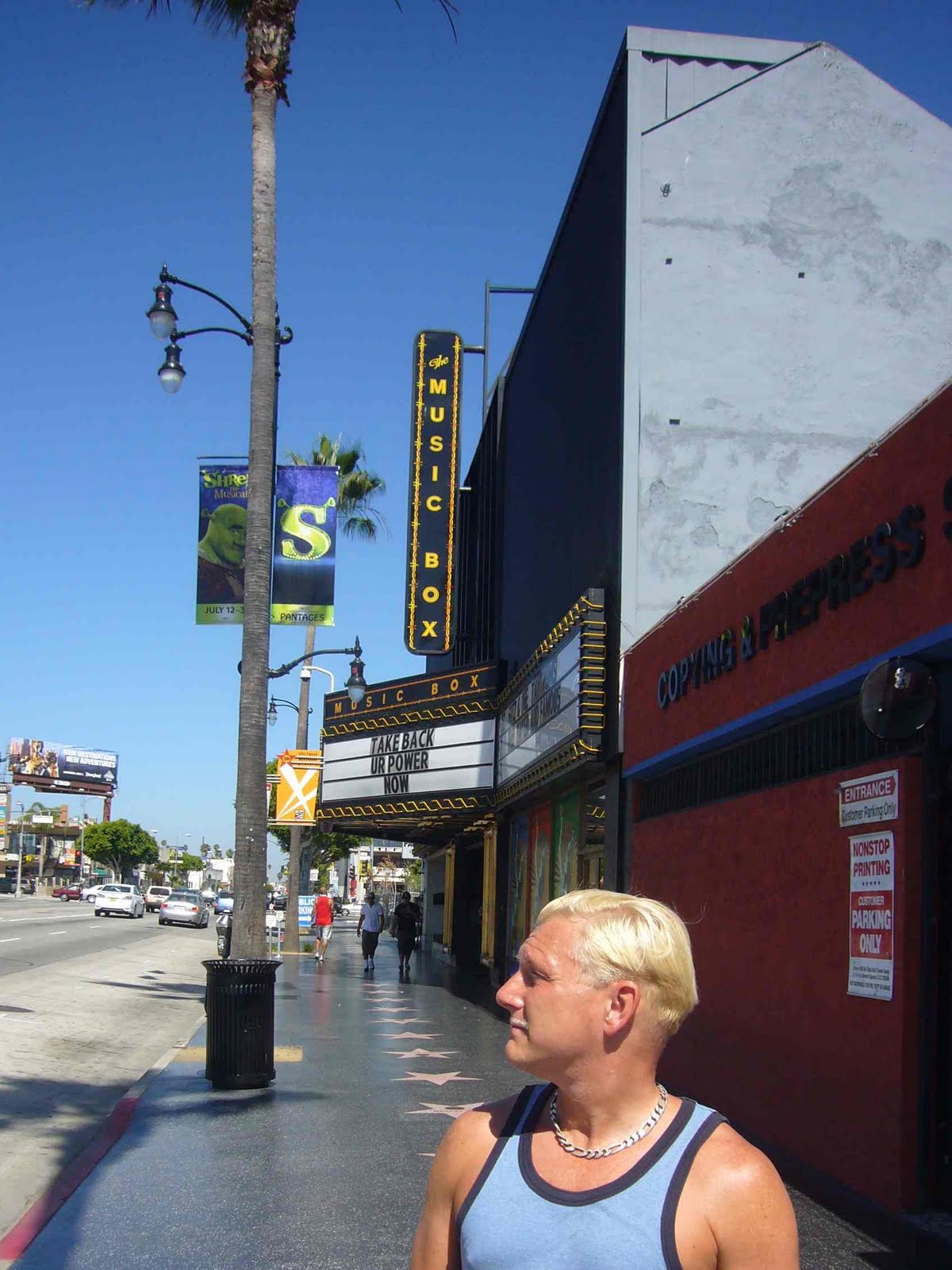
“Take Back UR Power Now,” the letters on the marquee read. I am standing in front of the Music Box Theater on Hollywood Boulevard. Whose power? I wonder. Who took it? Who lost it? And just who is telling me—or anyone else reading—to seize it? Take it from me, perhaps? Do I have it? Did I ever have it? Am I supposed to have it? If so, to do what with? Storm the box office? Take to the stage? Tear down the building and plant a tree? A windmill? Hold it. Is this one of those tiresomely postmodern Barbara Krugerisms? As my friend Clifton once put it, “I could look [it] up . . . but it’s more fun to speculate.”

The imperative “Now” intrigues me. It strikes me as incongruous, anachronistic. And, yes, antagonistic. It does not seem to denote the “Now” of 2011, my “Now” on this bright, sunny afternoon spent in one of the most frivolous locales in the western hemisphere. The look of the venue, the somewhat run-down surroundings, the slogan and its lettering transport me back to the early, bleak, violent, recession-shaken 1990s. Why am I thinking race relations? Could this not just as well be some hackneyed Tea Party catchphrase? Or else, a sign of things to come . . .

The time is ripe for warping. I’ve just been to Grauman’s Chinese, placing my palms into the imprints left by stars long gone out. I’ve been taking in all those names on the Walk of Fame, and it felt like treading on gravestones. And I arrived here, at the Music Box, transported by a longing, by the kind of nostalgia I am so wary of.

I did not expect to be reminded of the 1990s, to be taken aback instead of simply being taken back, if that were ever achieved ‘simply.’ Sure, I was prepared to be late. Seventy-five years late, to be exact. If it were in my power, I would be standing here, back in line with hundreds of other enthusiasts, to take a gander at Marlene Dietrich, Myrna Loy, Ruby Keeler, or Claudette Colbert. Not on the screen, mind, but live and in person. The Music Box, after all, was once the venue for the Lux Radio Theater, a Monday afternoon extravaganza hosted by showman-director Cecil B. DeMille. Merle Oberon, Marion Davies, Joan Crawford. Back in the summer of 1936, they were all here. I am in awe.

That is why I have come to this spot—on a Monday afternoon, no less, as I would later realize. I was dreaming. Now I feel tired out, and a little bit stupid, having caught myself chasing after ghosts. It is as if I had been hoping to get hold of the breeze stirred up by some wispy number long since mothballed. The spirit of the place does not “send me,” as swooning teenagers used to call it (the state of swooning, I mean). If anything, it sends me back to where I started this reverie. It takes me back into the ether, the mythical non-space I can fill, at will, with the voices of Marlene Dietrich, Myrna Loy, Ruby Keeler . . . as they were performing for millions of listeners, broadcasting live from the Music Box stage. It takes me back.

Wait. When was it again that I discovered these recordings for myself? The early 1990s. Well, what do you know! I guess, looking at that marquee, I have been forced to catch up with myself, and I find that self wanting, historically lost to the world. Years spent circling in representations of a past not alive to my being. Is it time to take back whatever I squandered? Is there still time? Do I have the energy to matter, the power to mean? I wonder . . .

The Couple in Grandmother’s Bed

I have said nothing yet about my trip to Germany.  It was not any old sightseeing tour, mind; nor was it a carefully mapped out homecoming, which makes it all the more difficult to capture in a few indifferent words.  The thing is, I had not been to my native country in over two decades; and, during that time, not going back to what folks presume to be my home evolved into a programmatic, defining rejection of the notion that home equals country of origin.  I vowed never to return, except in a pine box. 

Ella and I

That I did go back at last, in the similarly confining encasement that is the cabin of a budget airline craft, required a great deal of preliminary introspection—and a leap over the shadow to which I had tried to relegate my past.

The department at the university where I teach was taking students to Berlin for its annual outing.  Previously, I had been on the departmental trip to Budapest; and while that adventure was an adulterated delight, owing to transportation problems in the form of a broken bus and a missed flight, I thought that it would be petty to stick to my principles and stay put while my partner, as head of the School, was joining our students and colleagues for a week in the town known for Cabaret, communism, and Currywurst.  Besides, Berlin is too far from my native Rhineland to be thought of as “home” or trigger unwanted back-where-I-come-from reminiscences.  So, to Berlin I agreed to go . . .

Now, a few days before we were scheduled to depart for the German capital—which hadn’t been capital at the time I left former West Germany for the East Coast of the United States—I received one of those infrequent e-missives from the fatherland that are reserved mainly for anniversaries, holidays, and assorted disasters.  My sister’s message read that my grandmother had contracted a virus while hospitalized for a fracture—her first hospitalization in well over half a century—and that, unless I acted posthaste, I might never see her alive again.

Unlike the mater of my father (both deceased), my maternal grandmother had kept in touch with me during my years abroad.  She had learned, decided—or perhaps never thought twice—to accept me, which, given her youth in fascist Germany, is a triumph of spirit over doctrine.  For years, she had been sending her regards to my same-sex partners, companions my other grandmother thought best accommodated behind barbed wire, if they were to be granted living space at all.

So, a few days before I was scheduled to depart for Berlin, I booked a flight to Düsseldorf to see Oma.  I suffered a great deal of anxiety going by myself, going to see relatives I had abandoned years ago and walking down streets I had known during what, not in retrospect only, was an unhappy youth.

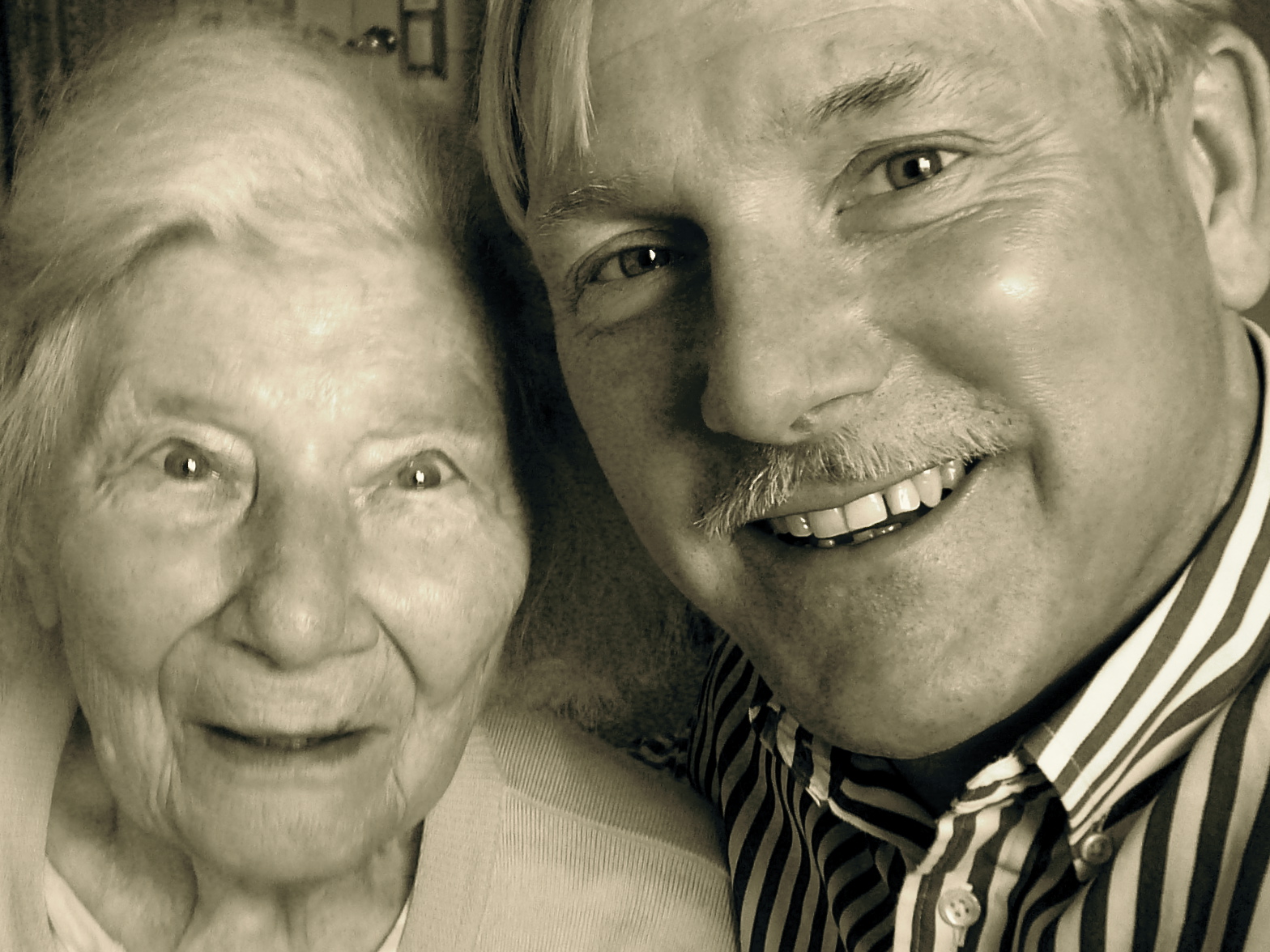
Luckily, I had friends on whom I could count: a cousin came to collect me from the rather remote airport and old friends offered quarters and shoulders should my visit prove overwhelming . . . or my arrival too late.  Such comforts notwithstanding, it was disconcerting to visit Ella at the hospital, especially since it involved having to wear a protective mask that obscured my face so that she did not recognize me.  I had not announced my visit lest she might think that, if even the prodigal grandson was coming to see her, her condition must truly be touch-and-go.  It was sobering to be greeted like a stranger, but also deserved, I thought—until at last there was a look of recognition in her eyes and a warm smile radiating from her lips.

Not having booked a hotel room, I stayed in grandmother’s apartment that night.  There I was, sleeping in the bed of a woman who might not see another morning and who, as it turned out, would never sleep in it again, though live she did.

We all have our security blankets, I suppose.  Mine is made out of immaterial stuff, a fabric as gossamer and yet as tangible as the air on a sultry summer’s evening as I had known it well to the west of Wales.  Lying there, alone in Ella’s bed, I surrounded myself with voices at once strange and familiar; voices of a safe, distant past—a past that was none of mine.

On a night rendered restless by thoughts of loss and futility—a life in danger and a life wasted in the refusal to be faced—I belatedly tuned in The Couple Next Door, a late-1950s serialized radio sitcom.  Written by and starring Peg Lynch, whom I had once seen performing one of her husband-and-wife sketches during an old-time radio convention, The Couple controlled the crowds with which my thoughts were teeming.  It comforted like no cotton coverlet could, warmed like no drop of Scotch.  Though not soundly, I did sleep that night, wrapped up as I was in a cocoon of sound . . . a quilt to muffle the guilt I felt for not returning sooner and for being defined instead by a quarter century of negation . . .

“Who Are [These] People?”: The Mediations of A. L. Alexander

“What do you think of a husband who has given a woman eight children and lived with [her] for twenty-four years and in front of his children denies that he is married to her?” No one hearing the question—an estimated twelve million US Americans—could have been particularly interested in a considered response by anyone else, given that radio listeners were invited to articulate it for themselves. It was the scenario that thrilled, the common, raw and purportedly true story that was 1438C, one of three cases put before A. L. Alexander and his Mediation Board on this day, 28 June, in 1943.

As told in the words—and the accents—of ordinary if not ordinarily quite so communicative contemporaries in situations of personal crises, it turned anyone listening into a father confessor, a judge of manners, morals and mental states.

Placing the unexceptional and non-exemplary on a national rostrum, the Mediation Board, like the tabloid talk shows that dominated the daytime schedules of American television networks during the 1990s, was a readily available and gratefully ingested nostrum, a dose of quack medicine designed to comfort the listener rather than cure the speaker . . .

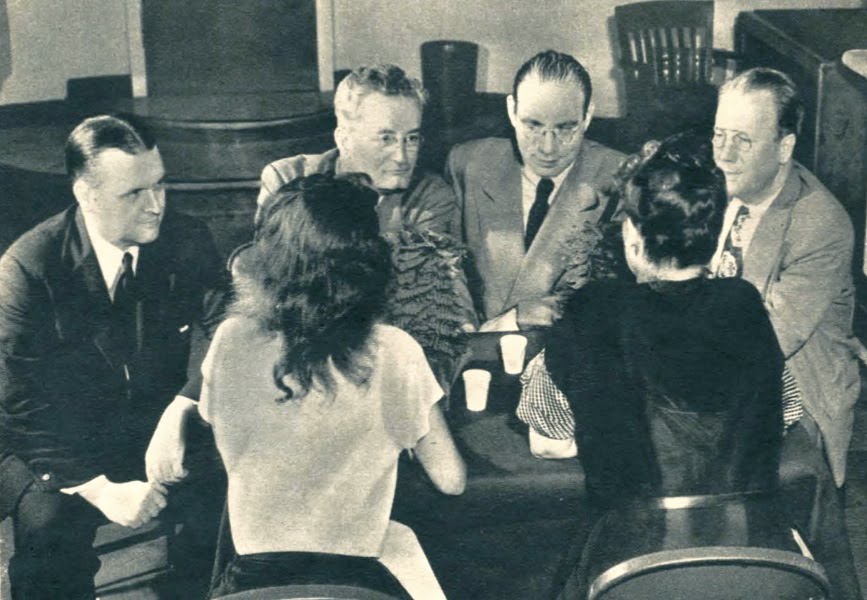
According to an article in the October 1945 issue of Tune In, “most” of the folks who wrote in to appear on the program—without receiving any compensation other than a few kind or cautionary words—were “working-class Americans who have never heard of psychoanalysts, or [would] find the cost of a divorce prohibitive,” and—the occasional “prankster” who would “invent some complex and chaotic problem” aside—turned to Alexander (pictured above, second from the right) and his rival John J. Anthony “with an intensity and devotion” that turned the host into an “almost god-like” figure.

Case 1438C was the story of forty-year-old woman who, at the age fifteen, left her parental home, where, according to her, she had been shown “no affection whatsoever,” to live with the man, then also a teenager, who eventually fathered her eight children.

Having been presented with a wedding band, she assumed herself to be legally married; but, by the time their first child was born, she came to realize that this was not the case, an illegitimacy that did not stop her from bearing him seven more. “I want my husband to marry me,” the woman now demanded, and that despite her suspicion that her partner was also a bigamist.

Unable to confront this accusation, her agitated “husband,” who had agreed to join her on the program, nearly stormed out of the WOR, New York studio from which A. L. Alexander’s Mediation Board emanated and broadcast nationally over the Mutual network. “There’s no such a thing as love,” he exclaimed, suggesting that the couple’s care for their offspring—among them “three lovely sons in the service”—was not reason enough to keep them together and legalize their relationship after nearly a quarter of a century.

To this, the Mediation Board members—priest William C. Kernan, executive director of the Institute of American Democracy, rabbi James G. Heller, and Paul Dawson Eddy, member of the Council for Religious Education and president of Adelphi College—had very little to say. Their words of warning or compassion merely sanctioned the dramatic she says/he says showdown, giving it an air of respectability and creating a sense that the program was living up to FCC standards.

Apart from its culturally diverse and reputable panel, Alexander’s Mediation Board responded to detractors by suggesting that its relevance and service in the public interest lay in the presentation of domestic problems “arising out of restless wartime conditions” in the alleviation it strove to assist, presumably as part of the war effort, however questionable it might have been to penetrate the home front in order to air its sundry grievances, thereby demonstrating it to be less than sound and far from self-disciplined.

Alexander had not always been able to defend his cashing in on the mental anguish and the at times morbid curiosity of his fellow Americans. Some six and a half years earlier, in December 1936, he was forced to shut down his popular Good Will Court, which, according to the 3-9 January 1937 issue of Radio Guide, had commanded network radio’s “fifth largest listening audience” until the New York Supreme Court ruled in favor of those who argued, as Alexander put it, that “the consideration of legal problems on the radio was ‘unethical.’”

By turning legal matters into spiritual and psychological concerns, Alexander managed to return to the airwaves and riding them, on the strength of the flotsam and jetsam with which his program was awash, for another decade.

After all, as Tune In pointed out, staying on the Board “proved to be one of radio’s most lucrative businesses,” especially considering Alexander’s credentials, or lack thereof, as a former “prize debater in public school” who had no “training in psychiatric social work.”

Having studied for the ministry and served three years at a Cincinnati theological seminary, he “became infatuated with the vast potentiality of listeners that radio could provide, took several routine announcing jobs before the idea for his program crystalized in his mind.”

During his involuntary and prolonged hiatus, Alexander explored the similarly vast financial “potentiality” of publishing by compiling Poems That Touch the Heart (1941), a volume of human interest poems that became a tie-in for his latest radio venture when selections were read at the conclusion the weekly Mediation Board meetings.

Heard on the 28 June 1943 broadcast, for instance, was “Who Are My People?” by Rosa Zagnoni Marinoni (not identified by name), a poem that emphasized comforting commonality while mitigating against what, in the unscripted words of the quarrelling couples, might come across as dead common.

In search of “my people,” the speaker senses “no kinship” toward fellow worshippers and feels estranged from the native old world, only to find the question “Who are my people?” answered by an encounter with one of the plebs:

Last night in the rain I met an old man
Who spoke a language I do not speak,
Which marked him as one who does not know my God.
With apologetic smile he offered me
The shelter of his patched umbrella.
I met his eyes. . . . And then I knew. . . .

Few folks now know A. L. Alexander; but the man who made a nation’s tattered nerve and moral fiber his umbrella—and who so shrewdly stitched the profane to the sacred cover he provided for it—still has his name on that volume of the poetry that served to promote his program. In print to this day, Poems That Touch the Heart still credits Alexander, however meaningless the reference may now be, with being the “Creator and Conductor” of the Good Will Court, the “original” Mediation Board, and The Court of Human Relations.

Patching, joining, and thriftily recycling for the ostensible public good—it was all part of the A. L. Alexander technique.

Murder on the Cathedral Radio: Rudy Vallee and the WPA

”Whatever your own political views in the matter may be. . . .”

Diplomatic, cautious and propitiatory, those are hardly words you would expect to hear coming from the close-miked mouth of crooner Rudy Vallee, one of the 1930s most popular—and insipid—radio personalities. After all, Vallee was not emceeing America’s Town Meeting of the Air; his chief ambassadorial function was to promote middlebrow culture and represent the makers of a certain leavening agent. Yet that is just the preamble with which the old Vagabond Lover segued into the dramatic portion of the Fleischmann’s Yeast Hour, which, on this day, 25 June, in 1936 presented what sounded very much like an endorsement of one of the Roosevelt administration’s latest projects, notwithstanding Vallee’s assurance that the views of the program’s producers and sponsors—in contrast to the debates from the Democratic Convention broadcast elsewhere that evening—were “strictly neutral.”

The calculatedly catholic Fleischmann’s Yeast Hour took variety to the extreme that evening, featuring vaudeville song-and-dance duo Alan Cross and Henry Dunn, “Gags and Gals” cartoonist Jefferson Machamer (who would have liked to talk “sex” but was told that the subject was “never mentioned” on the air), comedian Bert Lahr (whom Vallee’s writers sent to the dentist), swing vocalist Midge Williams (referred to as a “small bundle of dark dynamite”) . . . and T. S. Eliot’s Murder in the Cathedral. Natch . . .

Murder had come to Broadway some three months earlier, in March 1936. As stated by contemporary critics Ernest Sutherland Bates and Alan Williams in their book American Hurly-Burly (1937), Eliot’s play “as offered by the WPA was finer than anything produced during the season at any price.”

Yet rather than merely extracting scenes from the celebrated drama, Vallee’s program offered a dramatization of a “true story” that had “happened only a little while ago,” namely the behind-the-scenes story of how the Broadway production was cast.

As Vallee’s writers have it, an aging stage actor enters the offices of the WPA, declaring: “I’m looking for a job.” He claims to have been in the acting profession for thirty-three years; but lately he has only been pounding the pavement in hopes of treading the boards again. He is referred to the Federal Theatre Project, where, by the kind of miracle that smacks of Victorian melodrama, he is greeted by producer-manager George Vivian, an old friend of his from his days in London’s West End.

Soon, the actor is given the chance, however slight, of auditioning for Broadway director Edward T. Goodman, who is still trying to cast the role of the Archbishop. As many listeners tuning in to the Fleischmann’s Yeast Hour would have known, the old actor got the part—and, as Bates and Williams summed it up,

gave a magnificent performance in the role of Becket.  When Murder closed he re-appeared with another splendid characterization in Class of ’29, but at the end of the season he was promptly reclaimed by the commercial theater.

That actor—playing himself in the broadcast version of his story—was Harry Irvine, who, aside from Murder and Class of ‘29, went on to appear on Broadway in several dramas by Maxwell Anderson, including Joan of Lorraine starring Ingrid Bergman and Anne of the Thousand Days starring Rex Harrison.

Vallee commented that “the sequel” to this story was “yet to be written,” by which he was not referring to any attempts to follow up Murder with Resurrection. “The name of Harry Irvine appears again,” Vallee predicted. “He is very much in demand now. You’ll see him in pictures before long. Hollywood is taking care of that.”

Irvine responded to these not entirely fulfilled prophesies and commented on his good fortunes by reciting one of his speeches from Eliot’s play:

We do not know very much of the future
Except that from generation to generation
The same things happen again and again.
Men learn little from others’ experience.
But in the life of one man, never
The same time returns. Sever
The cord, shed the scale. Only
The fool, fixed in his folly, may think
He can turn the wheel on which he turns.

As much as he was in the center of the Fleischmann’s Yeast Hour playlet telling his story, Irvine was little more than a cog in the wheel, an example of the “true story” extolling the wonders of the “relief project” that gave “the actor out of work” a “helping hand.”

“In the larger cities all over the country these past few months,” Vallee reminded his audience,

dark theaters have been opening, idle actors have been finding work.  Reason: The Federal Theatre Project, a branch of the Works Progress Administration in Washington.

So why, radio having benefitted most from the Depression and the closing of popular playhouses, did an ersatz revue like Vallee’s program now celebrate the policies through which actors returned to newly reopened stages? Well, considering that the Fleischmann’s Yeast Hour was an East Coast production—whereas Lux Radio Theater had just left New York for Hollywood and abandoned its Broadway format—it stood only to gain from the renewed activity along the Great White Way.

Given that the performers who appeared on variety programs of that period were deemed somebodies largely owing to the name they had made for themselves in other media, Fleischmann’s, far from being neutral, depended on its theatrical ties—and stage actors like Harry Irvine—to fill its weekly roster of acts.

Listening to slickly commercial variety programs such as the Fleischmann’s Yeast Hour, I realize that escapism is not so much a matter of production as it is a manner of consumption, a way of tuning out rather than tuning in. No form of entertainment, however trifling or shallow, can entirely escape the role an alert listener may assign to it—the role of telling us about the time in which it was created.

A Voice in the Wave: Carl Brisson at the Golden Oriole

Carl Brisson

“42 Men Killed Every Week,” the headline read. Those who had already heard as much on the radio would likely have felt the impact of this crime wave; but, unless they were pining for the likes of Rudy Vallee, they would have relished it as well. Religious leaders, child psychologists, and a few popular entertainers aside, hardly anyone would have been the least bit alarmed. After all, the headline appeared in the 27 July 1946 issue of Billboard and the tally of fatalities was not meant to reflect the hebdomadal wrongdoings in one of America’s urban jungles. Instead, it referred to the “[l]opsided preponderance” of crime dramas that, after the killings at the front had come to an end, hit the airwaves so hard as to wipe out much of the competition.

Perhaps, “swallow up” might be a better way of putting it, as the zingers and songs previously heard elsewhere were subsumed by thriller programs that, in a desperate attempt not to sound cookie-cutter, were becoming increasingly kooky. Take Voice in the Night, for instance. Mentioned in the Billboard report as a contributor to the body count—yet rarely ever mentioned elsewhere or thereafter—it was one of the most baffling mysteries ever devised for the sightless medium, all the more so for having been green-lighted to begin with.

Folks tuning in to Mutual on Friday nights back in the summer of 1946 were told that Voice in the Night was something new under the moon—“a musical mystery story starring the internationally famous stage, screen and supper-club star Carl Brisson.” Never mind the hyperboles, the fact that Brisson had not appeared on the screen in well over a decade. At the time, he was indeed a successful act on the hotel circuit, although even favorable reviews would point out that “his pipes [were] no longer the same” and that he suffered from “a lapse of memory” (Billboard 30 March 1946). Indeed, such setbacks may have made crooning behind a mike with sheet music in his hand sound like an attractive alternative to the middle-aged baritone.

Not that Brisson would have appreciated being called an “Engaging Grandfather”—as a less than subtle Newsweek review had done two years earlier; but, if his voice or appearance did not suggest as much already, there was that prominent son of his (Rosalind Russell’s husband), then in his early thirties. Such telltale signs could be airbrushed away with the aid of a microphone. On the radio, by which even seasoned voices in the night penetrated many a chambre séparée, Brisson could yet be Carl Brisson, a detective who sang for his private suppers.

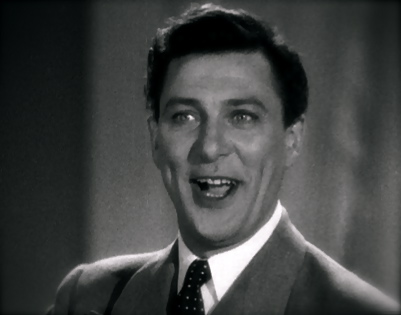
True, Brisson had experience playing romantic leads, having starred in two melodramas helmed by Alfred Hitchcock; but that was in the silent era, when his Danish accent posed no obstacle to a career in British or American film. In 1934, he had even mixed music and mayhem and “Cocktails for Two” in Murder at the Vanities (pictured above); but a duet with Kitty Carlisle could not have prepared him for the challenge of carrying anything other than a tune, least of all a dramatic radio series of his own. For, no matter how many times he would perform his signature song “Little White Gardenia” (“You may wear it if you care / Or toss it away”), a crime had to be related and solved within each half-hour allotted to Voice in the Night. And on this night, 14 June, in 1946, it was a case involving the theft of a necklace that “once cost two men their lives.”

We meet Carl Brisson at the Golden Oriole, a nightclub where he takes requests and performs standards like “All of a Sudden My Heart Sings” to an appreciative proxy audience, sit-ins for the listeners at home, some of whom would have seen Brisson in person and may well have resented being drawn in by the performer only to be short-changed as he, having invited the diegetic (or built-in) crowd to stand up and dance, walks over to one of the tables for a tête-à-tête with a female and no doubt attractive newspaper columnist whom he feeds his stories of crime and romance.

Old-time radio encyclopedists John Dunning and Jim Cox, who merely quotes and paraphrases the former without giving him proper credit, would have you believe that Brisson dashes off to solve a crime before resuming his nightclub act. Don’t take their word for it, though. In the only two extant episodes, at least, he merely takes a break to relate one of his adventures.

“You’re never more beautiful than when you’re angry to me,” Brisson tells his private listener. Now, I am not sure whether the script or the interpreter is responsible for the way this comes out, whether, as the linguists put it, the problem is structural (“beautiful . . . to me”), or lexical (“angry at me”); but the performance is riddled with such incidents, which become rather distracting. Indeed, forget the largely frisson-free mystery of the stolen “neggless.” It is Brisson’s delivery that will puzzle you. Perhaps, Mutual had hoped for a second Jean Hersholt; but Brisson, though closer in age to his fellow countryman than he would admit, was not called upon to play another Dr. Christian here. Nor would he have been content to be a kindly old Mr. Keen with a trace of a hard-to-lose accent. The romance-filled mysteries were meant to be fast-paced—but the “Great Dane” kept tripping over his tongue.

Having performed “Bells of St. Mary” for a lovely young “corple” at the club, Brisson admits that he “may have lost Mary Morgan”—but the one he was supposed to pursue was a guy named Larry. Perhaps, it was that “lump on [his] head like the size of an egg” that caused Brisson to fluff his lines or else to render them all but unintelligible.

A few weeks later, an episode titled the “Case of the Worried Detective” self-consciously worked what was problematic about the program into a rather more light-hearted script. “I placed you by your accent immediately,” Brisson is told by a hotel clerk. “You are that new long distance runner from Sweden, aren’t you?” A “long distance singer from Denmark,” Brisson corrects. Neither fame nor ready money could get him a room, though, what with the post-war housing crisis going on. “Not even if I promise not to sing?” the performer inquires. If only he had promised not to speak.

While the tongue-in-cheek approach somewhat improved on the tedious double-cross romance contrived for the earlier episode, Brisson was less convincing as a wit than he was as a womanizer. He simply could not get his tongue around certain English words, at least not quickly enough to deliver snappy one-liners.

Besides, anyone alerting the “Voice in the Night” to his glossal obstacle may have received a response similar to the one Murder at the Vanities director Mitchell Leisen got when he tried to correct Brisson’s diction. The singer-actor “was supposed to say ‘She’ll’ and kept pronouncing it ‘Seel,’” Leisen told David Chierichetti.

I thought he was having language problems, so I enunciated it very carefully for him. He said, “Oh, I know how to say it, but don’t you think it’s cuter the other way?”

Rather than being called upon to talk sense or crack wise, Brisson should have been permitted to give his target audience—“the fair, fat and 40 trade,” as Billboard (5 April 1947) called them—what they really wanted, which is just what he did when he returned to his successful club routines. His Voice in the Night was an early casualty of radio’s post-war crime wave, the riding of which tempted and drowned many a hapless performer.

For the Record: Lindbergh and the Electrola

Announcer Graham McNamee called it the “most terrific broadcast [he] ever took part in.” He was referring to NBC’s on-the-spot coverage of Colonel Charles L. Lindbergh’s return from France to the United States on this day, 11 June, in 1927. It certainly was a technical achievement worthy of “this new world hero, this new ambassador of America to all other countries,” as McNamee heralded the “unassuming, quiet boy” who was anxiously awaited “not only the crowd of us ordinary folks but the cabinet of the President of the United States, high officials of the army and of the navy [. . .].”

According to the September 1927 issue of Radio Broadcast, NBC’s coverage of the event set a “new record,” requiring fourteen thousand miles of “wire line” and involved three-hundred and fifty engineers.

Now, the figures differ depending on who does the counting and recounting. In Empire of the Air, for instance, Tom Lewis claims it took twelve thousand miles of wire and four hundred engineers. But never mind those figures now—or the fact that the figure of Lindbergh itself differs now that the man must be held accountable for his fascist views and Third Reich sympathies. It was an historical event on and in the air, in aviation and broadcasting alike.

Awarding him with the Flying Cross, President Coolidge called Lindbergh a “[c]onqueror of the air and strengthener of the ties which bind us to our sister nations across the sea.” When it came to strengthening ties, the public-conquering airwaves were second to none. Not only was NBC’s coverage of Lindbergh’s return home the biggest network hookup to date, it was also, as McNamee reminded listeners, “the first time band music or music has been transmitted from the Atlantic coast to the Pacific coast, which is another epoch.”

As columnist John Wallace argued in the September 1927 issue of Radio Broadcast, the

making known of great national events, while they are actually taking place is, after all, radio’s unique contribution, and the one field in which it reigns supreme without competition from phonographs, theaters, churches, or newspapers.  And it is greatly to radio’s credit that it does this job so thoroughly and well.

Seizing the day, NBC may have rather overdone its coverage of the “hullabaloo incidental to Lindbergh’s arrival.” Commenting on the banquet given in the aviator’s honor, Wallace remarked that he

would have been quite content had all the speeches of eulogy been omitted and only that of the flyer broadcast.  Never have we heard worse blah sprung at a banquet, and sprung by such eminent leaders, divines and statesmen!

Aware that his was no doubt a minority report, the journalist added that “the nation as a whole was interested in every and any detail of the flyer’s reception and credit must be given to the National Broadcasting Company for slipping up on no smallest part.”

What, though, of all those who were unable to be part of that moment because they were away both from Washington, D. C., where the celebrations took place, and from the wireless? Able to annihilate space, radio was nonetheless time-bound. Given the “ephemeral” nature of broadcasting, the effort and money set aside to capture and yet not hold this historic moment seemed almost perverse:

Thousands of dollars are spent to engage talent, wires covering half a continent are hired, advertising is scheduled in newspapers, several studio rehearsals are held, and finally the elaborate program is put on the air. For an hour it lasts but it can never be repeated. If you did not hear it, all the king’s horses and all the king’s men couldn’t put it into your loud speaker again.

For some time, radio listeners had been able to appreciate the voices of their radio favorites on their phonographs. Not only could they take home Sam ‘n’ Henry, Vaughn De Leath, or the Happiness Boys—radio had made that happen—but they could hold and keep them there. “A very great number of well-known radio artists are regularly recording for each of the important phonograph companies,” Radio Broadcast pointed out—and supplied a list of

fine recordings made by the favorites of the Atwater Kent hour, and the famous artists of the Victor, Brunswick and Columbia hours. As for the jazz bands, the comedy duos, and other entertainers with a more local fame, they, too, are forever at your beck and call on the black discs.

What makes the festivities in honor of Lindbergh’s return to America another milestone in the history of radio is that, for the first time, phonograph records of the live broadcast were made available for sale. As Radio Broadcast reported,

Victor has the distinction of pioneering and they offer three double-face records of the national welcome to Colonel Charles A. Lindbergh at Washington. On these three records you have the voice of President Coolidge, the interspersed announcements of Graham McNamee, a short address by Colonel Lindbergh, and his longer speech at the National Press Club. It’s all there and if you close your eyes, it isn’t hard to imagine that the events are just taking place.

True, what has been preserved for us is an edited copy of the live event; the “ceremonies were recorded on forty-six record surfaces” and “edited down” to six. True, editing is judging what matters; it is, to a degree, falsification, intentional or otherwise. Still, without the technology available back then, without the efforts of those broadcasting pioneers, I would not be writing about radio today.

As much as I at times deplore my second-hand experiences, my removal in time and space from thrilling events and fascinating personages, I, as a belated auditor, am indebted to those records. And I am grateful, too, for the “new record” in aviation that marked the beginning of an age in which sound was no barrier.

Related recording
Graham McNamee on Lindbergh’s return to America (11 June 1927)
Recollections at 30, featuring the 11 June 1927 broadcast (26 December 1956)