
Well, this is one of those days when it is best to give the old peepers a rest. The wintry sky is of that dull hue your bleached undies acquire if you’ve been too careless again to sort your laundry. There is little comfort in the fact that the pale face staring at you in the mirror is of a similarly drab shade and that, even though the days are short, it’s too early yet for that warming glass of brandy. You realize that the word of the day over at Waking Ambrose, with whose creator you exchanged a few e-messages earlier, is “tedium,” and that your current mood fits that description so well that you refrain from adding your definition: “The abundance of life wasted on a barren imagination.”
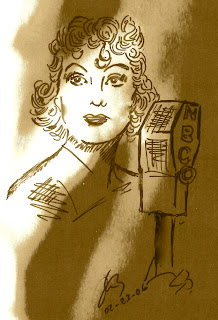
Okay, snap out of it and perk up already. How about a generous helping of lip from someone perennially pert? Someone who’s got verve and nerve enough to be unfazed by whatever it is that daunts you. Whether you’d like to be with her or—what the heck—be her, you know just the dame. You’ve been reminded of her only last night, watching Desperate Housewives and thinking how much that series borrows from A Letter to Three Wives, a voice-over narrated film comedy starring . . . Ann Sothern (pictured here, in another artistic misfire by yours truly). Yes, it’s a little Sothern comfort you crave. So, quit whining, close your bloodshot eyes and let some sass waft your way by listening to The Adventures of Maisie.
As Maisie, Sothern was a siren whose tongue launched a thousand quips—and lashed the hopes of many an ill-suited suitor. Each episode of her syndicated radio show—an aural continuation of MGM B-movies like Maisie, Congo Maisie, Swing Shift Maisie and Undercover Maisie—begins with a wolf call, a “Hi ya, babe, say how about a . . .” from an oversexed admirer, a slap, the “Ouch” of a bruised ego, and the triumphant reply “Does that answer your question, buddy?”
Maisie knows all the answers, right and wrong. She doesn’t even let the announcer have the last word when introducing her adventures: “Yup, I’m Maisie, like the man said. Maisie Revere. I was born in Brooklyn in nineteen hundred and . . . well, I was born in Brooklyn.” That’s enough by way of introduction.
At this point, Maisie goes straight into the retelling of her latest exploits, a dramatized story from the annals of her incident-riddled and peripatetic existence. “I’m in show business. A very fascinating business to be in,” she scoffed, “because you meet so many interesting people who are also out of work.” She always found herself “out of work in the darndest places”; and whether mingling with the hoi polloi or the hoity-toity, whether finding jobs out west or in London salon modelling gowns for “one of them stuffy titled dames,” she was never quite at home but far from lost anywhere.
Long before she became American television viewers’ Private Secretary, the voice of My Mother the Car, or that desperate female who left the Lady in a Cage, wisecracking Sothern was the last word in high-polished brass. With a sultry broadcast voice that only Natalie Masters as Candy Matson could rival, she had you in her dark corner from the start, no matter how many slaps you’d receive from a former title-holder like Ringside Maisie. Give her a listen, won’t you? She just might respond to your introduction with an inviting “Likewise, I’m sure.”
 I was inclined to put the “wireless women” on hold for today. I have been feeling rather poorly as a result of an exposure to noxious fumes emanating from a fresh coat of paint in our conservatory. My evening with Claudette Colbert, starred in the rarely screened melodrama The Man from Yesterday (1932) was utterly spoiled. I also missed the BAFTAs, the new Marple (controversially, not a mystery in which the old sleuth was placed by her creator), and found little enjoyment in Crack Up (1946), a noirish thriller directed by radio dramatist Irving Reis, which aired on BBC Two early last Saturday. Dizziness, mood swings, fatigue and nausea are my mental and bodily responses to a thankfully small number of chemical solutions including household cleaners, varnishes, and insecticides.
 Fair weather convinced me to spend the afternoon in the garden, where I busied myself with saw and secateurs. All that vigorous communing with nature felt like a tonic, especially after last night’s screening of Humoresque, an acrid Joan Crawford melodrama co-starring John Garfield and Oscar Levant, all of whom (but particularly Levant) rather overdid the acerbic one-liners with which the screenplay is riddled. Just about everything is wrong with this overwrought picture, from the drearily predictable and uninvolving plot to Crawford’s atrocious eyewear, the exceptions being J. Carroll Naish as Garfield’s father and the to me intriguing Peg La Centra as an underappreciated nightclub singer.

 Well, it is time to light the candles, open that bottle of champagne, and count the ways in which we love . . . Mrs. Living- stone’s husband? Comedian Jack Benny, I mean, who would have turned thirty-nine all over again on this Valentine’s Day. Americans may declare their love for the man by
  Well, I am back from my three-day getaway to Manchester, my makeshift Manhattan. And what a poor substitute it has proven once again. The only bright spot of an otherwise less than scintillating weekend was the production of James M. Barrie’s comedy What Every Woman Knows at the
 Harry Heuser