
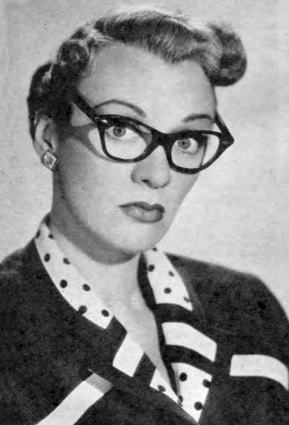
I am up north for a weekend in Manchester, England, which, for the past twelve months or so, has been some kind of ersatz New York City, a Manhattan in miniature. Not that the three-and-a-half hour journey from here in Mid-Wales is exactly a subway ride downtown. Before spending an evening among strangers, I am going to listen now to another familiar voice as I continue my tribute to female performers in radio drama. It’s a feature coinciding with the first broadcastellan quiz, which you are herewith encouraged to take. Now, the wireless woman I am commemorating today knew all about quizzes—and smart answers. For about a decade she was America’s schoolteacher: Eve Arden, the mistress of the well-timed one-liners.
Before hitting it big in radio and finding the role with which she became so closely identified thereafter, Arden had been a supporting player in a great many Hollywood films. Nominated for an Academy Award (a small but memorable part in Mildred Pierce), she invested even the sparsest and weakest of lines with caustic wit. On Our Miss Brooks (previously discussed here), Arden got ample opportunities to demonstrate her infallible comedy timing.
With Our Miss Brooks, the situation comedy reached maturity, a sophistication only excelled by the smart, sentimental, and at times socially profound Halls of Ivy. Replacing the rather tired and generic he said/she said routines of vaudeville, the sitcom placed a small group of regular and roughly outlined characters (or caricatures) in more or less outrageous scenes designed to test their clearly defined strengths and weaknesses. Now, Connie Brooks had one prominent weakness: Mr. Boynton, the clueless biology teacher.
Much of the humor in Our Miss Brooks derived from the central character’s attempt to balance her responsibilities as an educator with her not so secret passion and her desire to escape the academic hierarchy, to be as giddy and goofy as a teenager. Mingling with her charge rather than ruling over it, Miss Brooks formed a close bond with one of the students at Madison High, the similarly lovelorn Walter Denton.
However ardent a teacher, Miss Brooks was also Eve; and the apple of her eye was always tantalisingly close. According to sitcom logic, however, she never got very far in her pursuit of Boynton, which, much to our amusement, was destined to go pear-shaped.
Perhaps, Arden identified so closely with her role that she was drawn to a man whose first name matched her on-air persona: fellow actor Brooks West. No need to put Eve on the psychiatrists couch, though. I’m just happy to sit in the back of her class, and listen.
 Have you taken the broadcastellan quiz yet? I’ve got a few more laudable larynxes lined up to commemorate women in American radio dramatics. There is certainly a renaissance of old-time radio underway, an iPod regeneration infinitely more satisfying than my phrasing here; after all, just how long can a birthing or rebirthing process take? It’s the nurturing that matters now. And while some of those names on my list of leading ladies no longer ring the proverbial bell, they sure spelled “stardom” when radio took center stage in American living rooms. Perhaps, “star” isn’t the word for being it on the radio. Stardom requires visibility, screen close-ups and paparazzi snapshots that define an individual’s status as being removed enough from the crowd to demand admiration and near enough to encourage our approach. A broadcast voice can make an actor; but it is the circulated image that makes a star.
 Last night, I watched The Damned Don’t Cry (1950), a seedy but glamorous rags-to-riches-to-rags melodrama starring Joan Crawford. Crawford was a perfectionist on screen, even though producers like Jerry Wald determined that, by the mid-1940s, her physiognomy was less than ideal and called for that extra layer of gauze in front of the lens to soften her mature looks (because most leading roles in Hollywood are, to this date, a little too young for anyone over forty). No doubt, Crawford’s need for control contributed to what those in the radio business called mike fright. When Crawford went on the air, starring in dramatic programs like Suspense, she insisted on being recorded for later broadcast rather than going on the air live. Apparently, to someone as protective of her persona as Crawford, any screw-up in radio insinuated something tantamount to crow’s feet on screen. Not to Crawford’s Johnny Guitar (1954) co-star and rival, though, the radio-trained and true Mercedes McCambridge.
 Well, are you ready to tap your toes to the “The Cabinet Shuffle,” sing “The Tory Blues” or stand up for the “Thatcher Anthem”? That’s right, the Iron Lady is back in business. Show business, that is. Thatcher: The Musical is
  In my fifth poll I had invited readers to close their eyes and wander off—an invitation perhaps too readily accepted. “What image,” I had asked, “appears foremost in your mind when you read the term ‘old-time radio’?” The replies were pretty much divided between two responses, just as had I expected.
.jpg)

 I was among those tuning in live today to catch the announcement of the Academy Award nominations. It was a surprising moment of up-to-date enthusiasm, considering that I have only seen one of the films competing in the major categories (and that being the less-than-timely Mrs. Henderson Presents). Not exactly riveted to the spot after Mira Sorvino had stepped to the podium, I promptly consulted the Internet Movie Database (
 Harry Heuser