
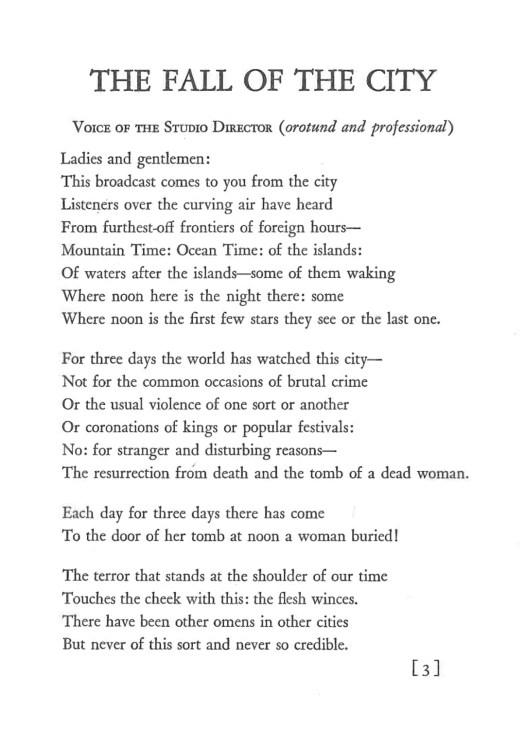
Not being revisited by the nuisances of power failures and coughing fits I suffered recently, I find myself willing to rise to something amounting to a challenge. Tackling the ambiguities of Archibald MacLeish’s verse drama “The Fall of the City,” for instance. Originally broadcast on 11 April 1937, “The Fall” was again presented by the Columbia Workshop on this day, 28 September, in 1939. The world changed considerably during the time elapsed between those two productions, adding urgency to a play about . . . well, about what, really?
I’ve grappled at length with “The Fall” in my dissertation, describing the confusion and frustration of critics who sensed the play to be significant but could neither make sense of it nor find much consensus among each other. Some argued that it wasn’t even a play at all. Apparently anticipating this reception, MacLeish prefaced the published script with the following disclaimer:
“Any introduction is a confession of weakness. This one is no exception. It is written because I am anxious to persuade American poets to experiment with verse plays for radio and because I am quite certain the radio verse play I have written will not persuade them of itself.”
US poets were not too keen on having their precious wares compete with soap commercials. Others believed that their words were best spread among the few rather than being freely disseminated through channels of less-than-pure air. The horrors of WWII shook up a number of ivory towers, drawing out poets like Stephen Vincent Benét and Edna St. Vincent Millay in fighting form. In propagandist poetry, the ultimate test of language was not whether it could move listeners, but whether it could get them moving, whether it could motivate them to fight battles, buy bonds, or save kitchen fat.
While American broadcasters were training announcers (like the proud vocal-talent pictured above) to hawk the products of their corporate sponsors, Fascist Germany had been exploiting the power of the spoken word to turn open-minded individuals into a league of like-minded or mindless lemmings. “The Fall of the City” opened a debate about mass persuasion, about the media’s role in molding opinions and fabricating war. Its ambiguity is rooted in a distrust of the very medium it employed.
“Ladies and gentlemen,” the play begins, “This broadcast comes to you from the city,” a town whose downfall is first announced, then actualized. It is talked into being as the figure of a radio announcer stands by to document the unfolding event. MacLeish’s announcer takes listeners to the “central plaza” of this unspecified city to become ear-witnesses to the resurrection of a recently buried woman who, for three consecutive days, appeared before a crowd of spectators, and who now utters a baffling prophesy:
The city of masterless men
Will take a master
There will be shouting then:
Blood after!
Amid the bewildered throng (some 500 people participated in creating the sound of the crowd), reporters and politicians are heard trying to interpret the oracle and to fix upon a plan of action. Is the message to be ignored? Is the prophesied attack to be countered or endured? One orator, holds that “[r]eason and truth” are the weapon of choice:
Let this conqueror come!
Show him no hindrance!
Suffer his flag and his drum!
Words . . . win!
His words are powerful enough to have people dancing in the streets—until another speaker convinces them to go into battle. While this exchange of words and changing of minds is going on, the talked-of invader—a hollow suit of armor—takes over and the masses surrender. Unlike William the Conqueror—who, on this day in 1066, made Anglo-Saxon words bow to French langue—he does not have to utter a single syllable to make a message-mangled city fall, its “masterless men” happy to have “found a master.”
Summing up this war of words, the announcer remarks that the “people invent their oppressors: they wish to believe in them.” Are these words to be taken for the author’s? If oppressors are inventions—a notion not going over well with some of MacLeish’s contemporaries—then who is to be entrusted with the power to use or control the media capable of creating such alleged fictions?
It seems that MacLeish was apprehensive about the uniformity of thought produced by broadcast speech. It made his own attempt to invade the medium a troubling undertaking: how to convince your listeners not to take your word for it?

 I remember the first time I heard the menacing voice of The Shadow—and it was not over the radio. I was a college student in New York City and was cleaning the Upper East Side apartment of a fading southern belle. Well, I needed the cash and she was too much of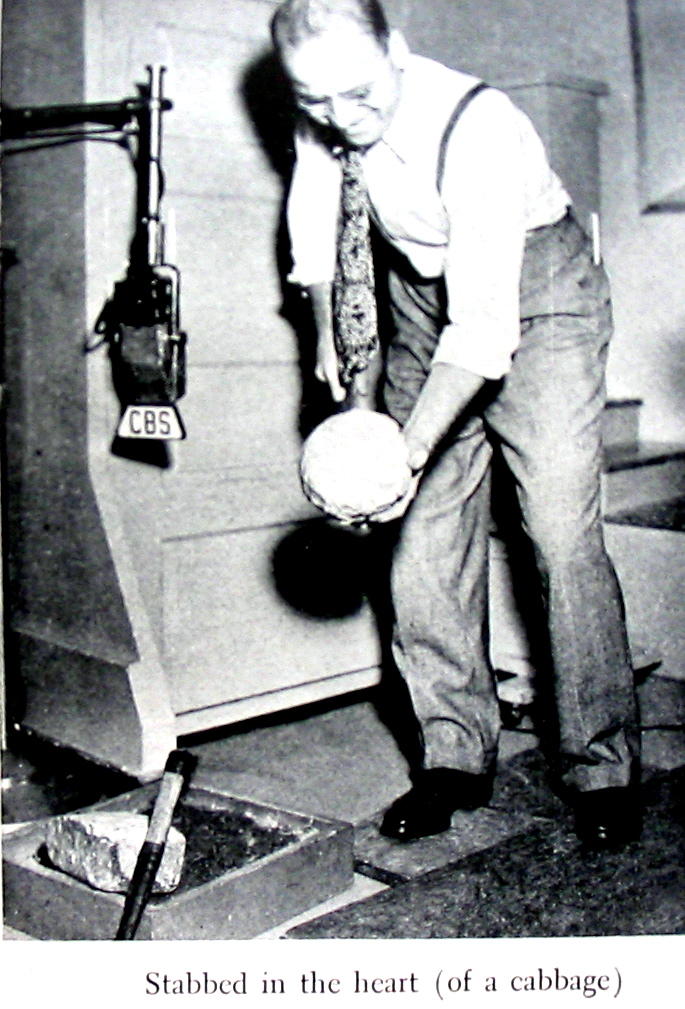
 Well, today I am taking the opportunity my “On This Day” column offers to revisit one of my favorite radio sleuths—the most debonair adventurer to go on the air, the mystery man about town known as . . . the Saint. When I discovered the thrills of old-time radio back in the early 1990s—while listening to
  Feeling as miserable as I do right now (the aforementioned cold), I was tempted to abandon the “On This Day” feature and escape the self-imposed strictures of such a format. Then I came across a recording of Words at War that made me decide not to disenthrall myself just yet. I might not have gotten to know Jean Helion, had it not been for the frustrating and inept adaptation of his wartime memoir They Shall Not Have Me, first broadcast on 23 September 1943.
 Well, the castellan is back in his element, which is air, preferably arid. Surely it is not water. I am still drying out—coughing, sneezing, and slowly recovering—from the why-not folly of riding a rollercoaster on a rain-soaked night in Blackpool, England. Listening to the soundwaves of old broadcasts seems a comparatively safer contact with the air—and a more edifying one at that—than having one’s aged bones twirled and one’s addled brains twisted in a series of gravity-defying thrill rides.
 Well, my gray cells had little to do with it, mes amis. Once again, coming up with the facts merely required some amateur sleuthing inside the ever-widening web. Both Agatha Christie (the Dame who gave birth to Hercule Poirot and Miss Marple) and the Mutual Broadcasting System (the network that delivered The Lone Ranger and The Shadow) came into being on 15 September, albeit decades apart. It was in the stars that the two would team up some day, but the meeting itself proved a not altogether fortuitous one.
 Harry Heuser