Back to Back-to-Back; or, Serialization of Schemes

A long time (well, okay, make that โ€˜about four and a half yearsโ€™) ago I came to the realization that the key to keeping an online journalโ€”and oneโ€™s fingers regularly on the keyboard in its serviceโ€”is serialization: some kind of evolving plot that, like life and Stella Dallas on a diet, keeps thickening and thinning from Monday till Doomsday until the inevitable sundown that not even Guiding Light could outshine.

Despite this realization, though, I have never managed to make a success of stringing together the latest on my follies and failures, mainly because I did not set out to make my person the axis around which this less than celestial body of essays spins. That, in recent months, the revolutions have ground to a near halt and affairs have become all but devolutionary is largely owing to the series of friction that is my one life to live beyond these virtual pages. These days, writing in installments begins and ends in โ€˜stall,โ€™ which is the least I tend to do best.

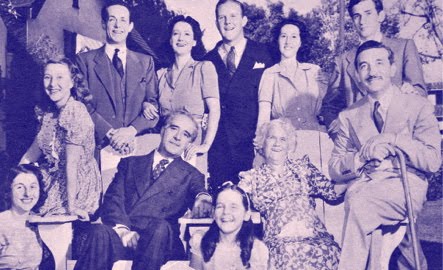
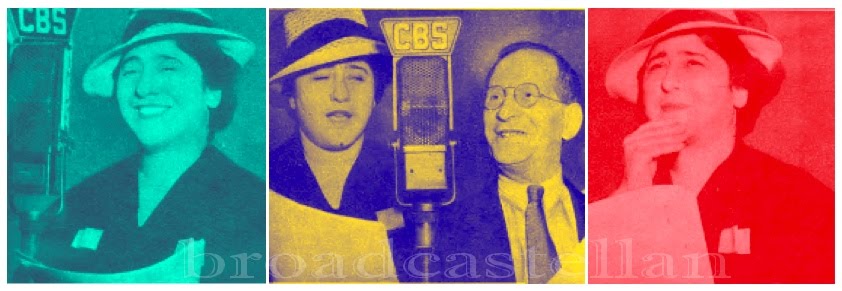
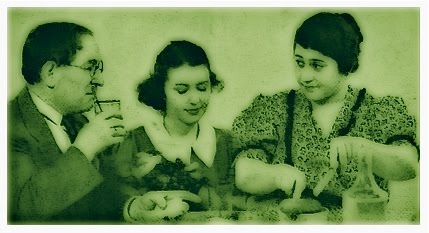
The cast of One Man’s Family

Not that the contemplation of the presumably out-of-date lends itself to frequent updates. I mean, whatโ€™s the point of being current when your harvest is raisins? For the love of ribbon mikes, how many times can you run away with the A & P Gypsies and still expect anyone to follow the run-down caravan in which you survey the bygone scene? Good for how many yarns are the bewildering progeny of the Happiness Boys, that old โ€œInterwoven Pair,โ€ until any attempt at catching up with the catโ€™s whiskers and its litter unravels like knitting gone kittyโ€™s corner? Why go on circulating gossip from the Make Believe Ballroom as the world turns the radio off?

Clearly, there is room for a chorus line of doubt when I now announce the beginning of a new chapter in the cancellation dodging saga of broadcastellan. Anyone hoping for a weekly quintuplet of All My Mindโ€™s Children should be advised that this is going to be more a case of One Manโ€™s Family Planning . . .

"2X2L calling CQ. . .": The Night They Made Up Our Minds About Realism

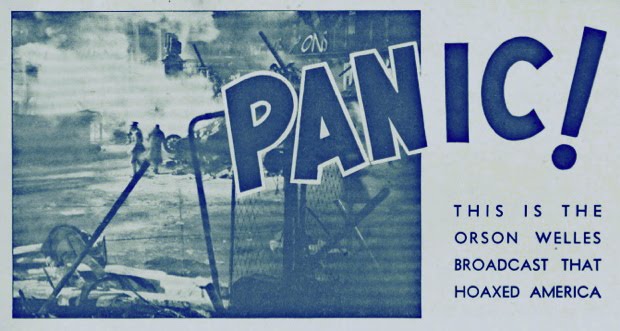
Radio Guide (19 November 1938)

This is just the night for a returnโ€”a return to that old, beloved yet woefully neglected hobbyhorse of mine. You know, the Pegasus of hobbyhorses: the radio. After all, it is the anniversary of the Mercury Theatreโ€™s 1938 โ€œWar of the Worldsโ€ broadcast, a date that lives in infamy for giving those who say that โ€œseeing is believingโ€ an ear-opening poke in the eye. These days, the old Pegasus doesnโ€™t get much of an airing. It may have sprung from the blood of Medusaโ€”but that old Gorgon, television, still has a petrifying grip on our imagination.

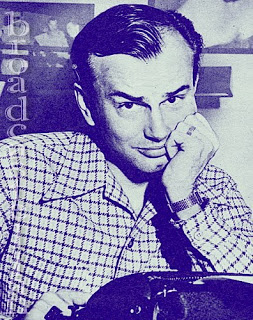
What made โ€œThe War of the Worldsโ€ so convincing was that it treated fantasy to the trickery of realism, by turning an old sci-fi yarn into what, too many, sounded like a documentary. As the programโ€™s general editor, John Housemanโ€”who gave up the ghost on Halloween in 1988โ€”recalled about the Mercuryโ€™s holiday offering, not even the script girl had much faith in the material: โ€œItโ€™s all too silly! Weโ€™re going to make fools of ourselves. Absolute idiots.โ€ Instead, the broadcast made fools of thousands by exploiting their pre-war invasion anxieties.

As I put it in Etherized Victorians, broadcast fictions could

tap into what McLuhan argued to be โ€œinherent in the very natureโ€ of radioโ€”the power to turn โ€œpsyche and society into a single echo chamber.โ€

The more urgent concern for broadcasters had always been whether it was proper for radio dramatists to exploit this power at all, especially after the codes of radioโ€™s surface realism had been so forcefully violated by Howard Kochโ€™s dramatization [. . .]. In one of the most disturbing scenes of the play, a speaker identified as a CBS announcer addresses the public to document the end of civilizationโ€”โ€œThis may be the last broadcastโ€โ€”until succumbing to the noxious fumes that spread across Manhattan and extinguish all human life below. ย His body having collapsed at the microphone, a lone voiceโ€”rendered distant and faint by a filterโ€”attempts to establish communication.ย 

It is the voice of a radio operator: โ€œ2X2L calling CQ. . . . 2X2L calling CQ . . . . 2X2L calling CQ . . . New York. Isnโ€™t there anyone on the air? [Isnโ€™t there anyone on the air?] Isnโ€™t there anyone. . . .โ€ ย The Mercury Playersโ€™ โ€œholiday offeringโ€ had not only โ€œdestroyed the Columbia Broadcasting System,โ€ as Welles jested at the conclusion of his infamous Halloween prank, but had pronounced the death of its receiversโ€”the listening public. ย Considering the near panic that ensued, was it advisable to open the realm Esslin called a โ€œregion akin to the world of the dreamโ€ without clearly demarcating it as fantasy by resorting to the spells of Trilby, Chandu, or The Shadow?

After that night, the aural medium as governed by those in charge of the realties of commerce and convenience seemed destined to perpetuate what Trilling referred to as the โ€œchronic American beliefโ€ in the โ€œincompatibility of mind and reality.โ€

Related writings
โ€œโ€˜War of the Worldsโ€™: A Report from the Sensorial Battlefieldโ€
โ€œโ€˜War of the Worldsโ€™: The Election Editionโ€
โ€œThousands Panic When Nelson Eddy Begins to Singโ€

They Also Sell Books: W-WOW! at Partners & Crime

Legend has it that, when asked what Cecil B. DeMille was doing for a living, his five-year-old grand-daughter replied: โ€œHe sells soap.โ€ Back then, in 1944, the famous Hollywood director-producer was known to million of Americans as host and nominal producer of the Lux Radio Theater, from the squeaky clean boards of which venue he was heard slipping (or forcefully squeezing) many a none-too-subtle reference to the sponsorโ€™s products into the behind-the-scenes addresses and rehearsed chats with Tinseltownโ€™s luminaries, lines scripted for him by unsung writers selling out in the business of making radio sell.

No doubt, the program generated sizeable business for Lever Brothers; otherwise, the theatrical spin cycle conceived to bang the drum for those Lads of the Lather would not have stayed afloat for two decades, much to the delight of the great (and only proverbially) unwashed. For all its entertainment value, commercial radio was designed to hawk, peddle and tout; and although the spiel heard between the acts of wireless theatricals like Lux has long been superseded by the show and sell of television and the Internet, old radio programs still pay off, no matter how freely they are now shared on the web. In a manner of speaking, they still sell, albeit on a far smaller and downright intimate scale.

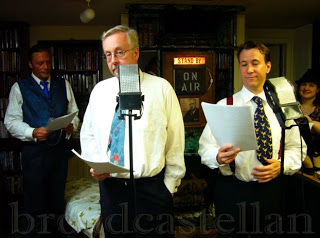
Take W-WOW! Radio. Now in its fourteenth season, the opening of which I attended last month, the W-WOW! Mystery Hour can be spentโ€”heard and seenโ€”on the first Saturday of every month (July and August excepting) from a glorified store room at the back of one of the few remaining independent and specialty booksellers in Manhattan: Partners & Crime down on Greenwich Avenue in the West Village. The commercials recited by the cast are by now the stuff of nostalgia, hilarity, and contention (“In a coast-to-coast test of hundreds of people who smoked only Camels for thirty days, noted throat specialists noted not one single case of throat irritation due to smoking Camels“); but the readings continue to draw prospective customers like myself.

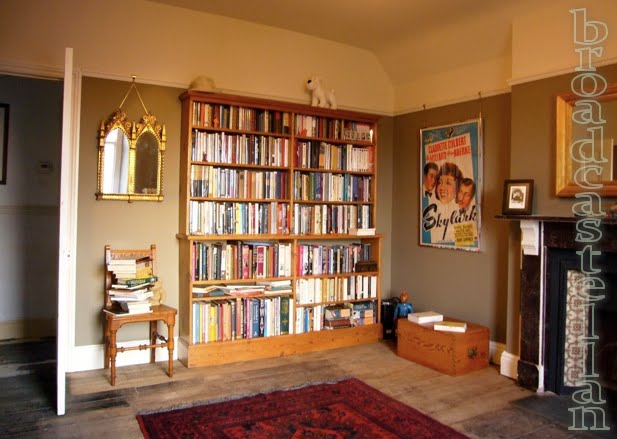
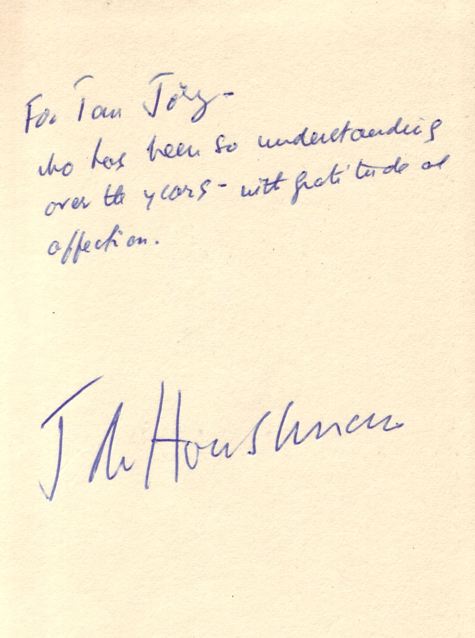
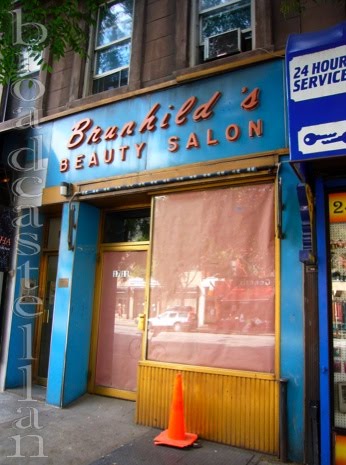
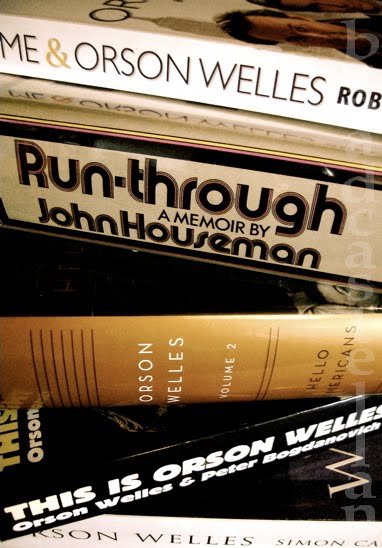
Whenever I am in town, I make a point of making a tour of those stores, even though said tour is getting shorter and more sentimental every year. There are rewards, nonetheless. Two of my latest acquisitions, Susan Wareโ€™s 2005 โ€œradio biographyโ€ of the shrewdly if winningly commercial Mary Margaret McBride and John Housemanโ€™s 1972 autobiography Run-through (signed by the author, no less) were sitting on the shelves of Mercer Street Books (pictured) and brought home for about $8 apiece. The latter volume is likely to be of interest to anyone attending the W-WOW! production scheduled for this Saturday, 3 October, when the W-WOW! players are presenting the Mercury Theatre on the Air version of Dracula as adapted by none other than John Houseman.

As Houseman puts it, the Mercuryโ€™s โ€œDraculaโ€โ€”the seriesโ€™s inaugural broadcastโ€”is โ€œnot the corrupt movie version but the original Bram Stoker novel in its full Gothic horror.โ€ Indeed, Housemanโ€™s outstanding adaptation is a challenge worthy of W-WOW!โ€™s voice talent and just the kind of material special effects artist DeLisa White (pictured above, on the right and to the back of those she so ably backs) will sink her teeth into, or whatever sharp and blunt instruments she has at her disposal to make your hair stand on end.

Rather more run-of-the-mill were the scripts chosen for W-WOW!โ€™s September production, which, regrettably, was devoid of vamps. You know, those double-crossing, tough-talking dames that enliven tongue-in-cheek thrillers like The Saint (โ€œLadies Never Lie . . . Muchโ€ or โ€œThe Alive Dead Husband,โ€ 7 January 1951) and Richard Diamond (โ€œThe Butcher Shop Case,โ€ 7 March 1951 and 9 March 1952), a story penned by Blake “Pink Panther” Edwards and involving a protection racket. The former opened encouragingly, with a wife pretending to have killed a husband who turned out to be yet living, if not for long; but, as it turned out, the dame had less lines than any of the ladies currently in prime time, or any other time for that matter. Sure, crime paid on the air; but sex, or any vague promise of same, sells even better.

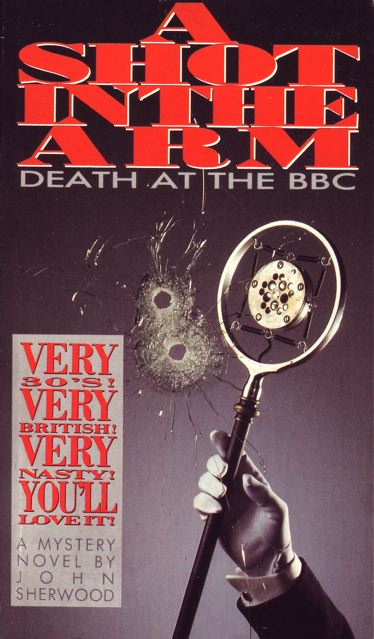
That said, I still walked out of Partners & Crime with a book in my hand. As I passed through the store on my way out, an out-of-print copy of A Shot in the Arm caught my eye and refused to let go. Subtitled โ€œDeath at the BBC,โ€ John Sherwoodโ€™s 1982 mystery novel, set in Broadcasting House anno 1937 and featuring Lord Reith, the dictatorial Baron who ran the place, is just the kind of stuff I am so readily sold on, as I am on browsing in whatever bookstores are still standing offlineโ€”if only to give those who are still in the business of vending rare volumes a much-deserved shot in the open and outstretched arm.

Related recordings
“Ladies Never Lie . . . Much,” The Saint (7 January 1951)
“The Butcher Case,” Richard Diamond (7 January 1950)
“The Butcher Case,” Richard Diamond (9 March 1951)

Yoo-hoo! Isn’t anybody anymore?

Remembering Gertrude Berg, that is. Having been to Fleischmanns last year (without spotting her tombstone there), I was thrilled to be catching Aviva Kempnerโ€™s much reviewed if ultimately unsatisfying documentary Yoo-Hoo, Mrs. Goldberg at the Quad Cinema in Manhattan last week. After all, it is not a film you are likely to see in Europe (or, for that matter, in any US multiplex); and I doubt whether it will ever be released in Wales, my present home. Who, after all, remembers (or ever had the opportunity of) tuning in to The Goldbergs, or The Rise of the Goldbergs, as Bergโ€™s program was initially called in the days before television?

Kempnerโ€™s filmic memorial to Berg and her creationโ€”heard on radio and seen on stage, television and the moviesโ€”aims at countering the oblivion to which the writer-producer-actress and her signature character have long been consigned; but, judging from the elderly, Jewish audience among which I found myself, aside from my good friend, Brian, Mrs. Goldberg is not likely to find new admirers through Kempnerโ€™s polite and downright reverent re-introduction, however deserving she may be of praise.

โ€œWhy, for all her popularity and apparent influence, is Gertrude Berg so little remembered today?โ€ Paul Farhi of the Washington Post asked back in July 2009. It is a question Kempner does not trouble herself to answer, other than with a resounding โ€œWhy indeed?โ€ Predating but overshadowed by I Love Lucy, The Goldbergs come across as little more than a noteworthy, ethnic curiosity, a historical footnote, the stuff of nostalgia. At least, Kempnerโ€™s documentary, which New York Post critic V. A. Musetto called โ€œfawning and formulaic,โ€ did little to convince me otherwiseโ€”and I donโ€™t need convincing.

โ€œUlleright, ulleright!โ€ For all its shortcomings, Yoo-Hoo, Mrs. Goldberg is still a welcome and overdue tribute to of a long overlooked icon of American popular cultureโ€”and an enterprising, emancipated woman at that; but it is also a rather perfunctory and historically questionable piece of bio-cinematography, replete with a poorly reenacted scene from Bergโ€™s earliest radio script.

Except for a few tantalizing clips of Edward R. Murrow’s interview with Berg on Person to Person and those seemingly random excerpts from The Goldbergs kinescopes, the documentary, like most pieces of ocular proof, is at a loss to fill the screen, resorting to images only remotely related to the subject; or, else, to talking heads like Ed Asnerโ€™s and Ruth Bader Ginsburg (who recalls being addressed as Mrs. Goldberg). Meanwhile, the snippets from Bergโ€™s radio and television broadcasts are often unintelligible, if it werenโ€™t for the subtitles. The result is about as funny as a translated jokeโ€”and certainly not remotely as amusing or charming as Bergโ€™s glossy autobiography Molly and Me (1961).

Here, for instance, is how autobiographer Berg made the connection between her parentage and her wireless offspring. Those watching Kempnerโ€™s documentary never get to hear about it. To them, Molly is a kindly woman leaning out of a window, chatting to her neighborsโ€”and an audience long since dispersedโ€”or praising the miracle of Sanka Coffee, instead of yelling โ€œYoo-hoo, is anybody?โ€ into a telephonic darkness just beyond her Bronx apartment:

My father was a special fan of the dumbwaiter and when radio was invented, he gave up the shaftway only because of the better coverage. But until that time it was through the dumbwaiter that he got to know everybody, not by their names, but by their locations. He predicted divorce for Mr. and Mrs. 5-D because of their nightly arguments; he knew that Mrs. 3-Aโ€™s son was going to leave home before even Mrs. 3-A. It didnโ€™t take second sight; all it took was a good ear and a comfortable chair near the dumbwaiter door.

Kempnerโ€™s film is so reverent and nostalgic, it sentimentalizes the already saccharine confection of Mother Goldberg, whose Jewish Amos โ€˜nโ€™ Andyisms enliven the early scripts for her radio serial, extant only in print, before the series-turned-daytime serial settled for at times โ€œsoap-operaishโ€ melodrama.

โ€œ[E]verything about The Goldbergs changed but the theme song, โ€˜Toselliโ€™s Serenade,โ€™โ€ Berg explains in Molly and Me. Those encountering Molly in Kempnerโ€™s documentary are unlikely to see Molly as an early Lucy, or, come to think of it, as a prototype for linguistically challenged immigrant Ricky Ricardo.

โ€œSo come down a liddle after,โ€ Mrs. Goldberg once yoo-hooed to her neighbor, Mrs. Bloom, โ€œmaybe veโ€™ll go to a mofieโ€”is playing de Four Horsemen in de Apoplexies.โ€ Well, you almost got it, Molly. Apoplexies are the kind of movie theaters that leave you angry at your lack of choices. Too bad that even the exceedingly rare art house simplexes are not likely to rescue you from the fate of being trampled to death by the pale horse of apathy.


Related writings
The House of [Broken] Glass
Wireless Women, Clueless Men: Gertrude Berg, Everybody’s Mama
On This Day in 1941: Molly Goldberg Nearly Chickens Out

“Chew that bacon good and slow”: Our Town Like You’ve Never Seen It

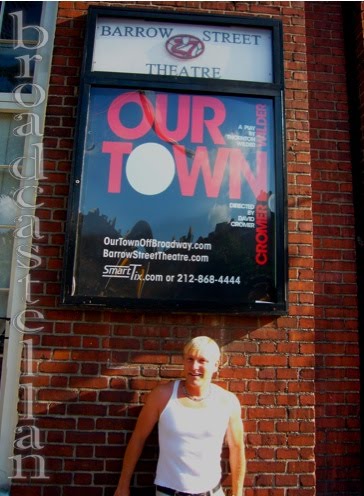
Okay, so Iโ€™ve been cutting a few corners during my present, month-long stay in New York City; but I wasnโ€™t about to cut Groverโ€™s Corners. Our Town, that is, a new production of which is playing at the Barrow Street Theatre in Greenwich Village. These days, there isnโ€™t much on Broadway to tempt me into letting go of whatever is left in my wallet. I mean, Shrek the Musical? Whatโ€™s next, Pac-Man of the Opera? A concert version of Saved by the Bell? Secret Squirrel on Ice? I am all for revisiting the familiarโ€”a tendency to which this journal attestsโ€”as long as I feel that such recyclings are worth my impecunious (hence increasingly persnickety) whileโ€”and theatrical retreads of The Addams Family, 9 to 5 or Spider-Man are not. Come to think of it, I had never seen a performance of Thornton Wilderโ€™s Pulitzer Prize-winning Our Town, which I always thought of as the ideal radio play. Well, let me tell you, David Cromer sure made me see it differently.

Our Town was produced on the air at least three times, even though the Lux Radio Theatre version (6 May 1940) is a reworking of the screenplay, replete with a tacky, tagged-on Hollywood ending and ample space for commercial copy between the acts. Wilderโ€™s 1938 play is decidedly radiogenic in its installation of a narrator (or Stage Manager) and its insistence of doing away with props or scenery. The Barrow Street Theater production seemed to be in keeping with the playwrightโ€™s instructions; and I was all prepared to watch it with my eyes closed.

There are two tables on the small stage; and the props do not amount to more than a hill of string beans. The Stage Manager points into the audience, inviting us to envision a small town in New Hampshire, anno 1901:

Along here’s a row of stores. ย Hitching posts and horse blocks in front of them. First automobile’s going to come along in about five years belonged to Banker Cartwright, our richest citizen . . . lives in the big white house up on the hill.

Here’s the grocery store and here’s Mr. Morgan’s drugstore. ย Most everybody in town manages to look into those two stores once a day.

Public School’s over yonder. ย High School’s still farther over. ย Quarter of nine mornings, noontimes, and three o’clock afternoons, the hull town can hear the yelling and screaming from those schoolyards.

Some eyes followed the pointed finger in my direction, faces in the crowd briefly looking past me in hopes of making out the Methodist and Unitarian churches just behind my back. Now, Iโ€™m not saying that the actors were not worth looking at, Jennifer Grace as Emily Webb being particularly charming. Still, at the end of the first act, I could not figure out what Frank Scheck of the New York Post referred to as โ€œrevolutionary staging.โ€ Two tables, eight chairs, string beans?

By act three, I understood. David Cromer defies Wilderโ€™s instructions (โ€œNo curtain. No sceneryโ€)โ€”and to startling effect. I never thought that the smell of bacon could be so overwhelming, so urgent and direct. Sure, it has often made my mouth waterโ€”but my eyes? Whether or not you are a staunch vegetarian, there is reality in the scent, just as there is a revelation behind that curtain. Our Town may be a wonderful piece of pantomime; but Cromer deserves some props.

โ€œOh, Mama, just look me one minute though you really saw me,โ€ the dead Emily implores the unseeing childhood vision of her mother. โ€œMama, just for a moment we’re happy. Let’s look at one another.โ€ Seeing this fragrant scene acted out made me realize anew the importance of coming to all of oneโ€™s senses, of partaking by taking in, of grabbing hold of the moment (which we Germans call an Augenblick, a glance) by beholding what could be gone at the blink of an eye.


Related recordings
“Our Town,” Campbell Playhouse (12 May 1939)
“Our Town,” Lux Radio Theatre (6 May 1940)

Crosstown Stitch: Embroidering on a Favorite Subject

โ€œSalut au monde!โ€ That is a greeting the narrator of Norman Corwinโ€™s โ€œNew York: A Tapestry for Radioโ€ extended to the never quite statistically average American listenerโ€”anybody tuning in to the nationally broadcast play cycle Columbia Presents Corwin back during World War II. And that is how I, returned again to my old yet ever changing neighborhood in uptown Manhattan, am reaching out to the potentially even more multifarious roamers of the World Wide Web.

Why Salut, though? Why go for the highfalutin when something lowbrow like hiya would do? After all, French is not among the languages most closely associated with the Big Pomme. Sure, there is that French lady who greeted the multitudes who came across the big pond to get a bite out of it; but only because sheโ€™s made of copper doesnโ€™t make her a coined phrase.

Corwin was not going for the definitiveโ€”the single, representative tongue with which to tie up an argument only to contradict it. Symbolic of the promises and failures of the Versailles treaty, the imported salutation is part of a pattern designed for a sonic romancing of immigration central, where nations become nabes and the worldโ€™s people are โ€œliving side by side so effortlessly, no one calls it peaceโ€โ€”a cosmopolitan locale to which nothing could be more foreign than the homogenous or the homo-logos.

As LeRoy Bannerman describes it, Corwinโ€™s voice collage
advocated world unity, exemplified in the polyglot harmony of New Yorkโ€™s people. It possessed threads taut with the strain of war and the urgency of an all-out effort, symptoms of concern that greatly colored Corwinโ€™s work with tints of patriotism.

The colors in Corwinโ€™s fabricโ€”that crowd-pleasing fabrication of Gotham (what do you call it? Gothamer)โ€”are red, white and blue all right; but when Corwin waves the flag, he does not make difference stand out like a blot on Old Glory. Corwinโ€™s aural tapestry is rich in the variations that the theme demands, distinguished by the โ€œspeakers of the foreign and the ancient tongues,โ€ the โ€œconjoined creedsโ€”the Jew, the Christian, the Mohammedan.โ€

The speech is American, which is to say that it is not exclusively, let alone officially, English or any variation thereof. โ€œDo not mistrust [folks] because of their accent,โ€ the narrator cautions those who stand their ground by calling it common, โ€œfor we ourselves might be incomprehensible in Oxford.โ€ The Queenโ€™s English ainโ€™t the English of Queens, New York.

โ€œThe people of the city are the main design,โ€ the narrator insists. Seemingly random utterances by speakers nameless to the audience constitute the โ€œindividual threadsโ€ of an intricately woven fabric whose pattern, unlike the grid formed by the cityโ€™s streets, cannot be visually apprehended. โ€œHow can you tell, from Seat No. 5 on the plane from Pittsburgh, what goes on here?โ€ Nor can it be comprehended by the unaided earโ€”at least not by anyone well out of earshot. As I put it in Etherized Victorians, the way to arrive at the design is microphonic, not macroscopic.

The narrator invites โ€œAmericans on this wave lengthโ€ to follow the threads of โ€œinterwoven hopesโ€ by โ€œlistening acutelyโ€ to the peoples of New York City, be they from โ€œGerman Yorkvilleโ€ or the โ€œoutlying Latin quarters.โ€ Their voices are brought into a meaningful relation through the aid of the radio, of which the main speaker as receiver, amplifier and transmitter is an abstraction.

At the momentโ€”and being in itโ€”it is easy to lose sight of the wireless, even as I walk past Radio City. I feel no need for a hearing aid or a translator. I am a part of a grand, Whitmanesque design, which is both spoken and understood.

The House That Jack Sat

โ€œFrankly, Iโ€™m a little worried,โ€ comedian Jack Paar confided in announcer Hy Averback on this day, 17 August, in 1947. He was, after all, merely a โ€œsummer replacement,โ€ a โ€œfellow who broadcasts during the hot weather to give the other actors time to count the money theyโ€™ve made all winter.โ€ For the past twelve weeks, Paar had been sitting in for his first-namesake, skinflint Jack Benny, and had held warm that cozy place on the summer sun dial quite nicely at that. Still, while the reception had been far from icy, his โ€œbrief summer careerโ€ was fast coming to an end as radio was โ€œgetting ready for the winter again.โ€

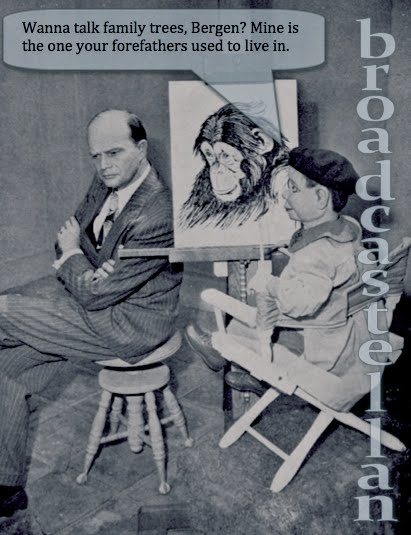
Unintelligible as they might seem to most of todayโ€™s readers, there were tell-tale signs: Edgar Bergen โ€œrepainting Charlie McCarthy,โ€ Fibber McGee โ€œwaxing Harlow Wilcox,โ€ and Phil Harris switching to โ€œantifreeze, with an olive.โ€

Resigned as he was to his autumnal fate, the soon-to-be displaced replacement did not go gentle into the night; instead, he took it upon himself to find his โ€œwinter replacementโ€ by staging a talent contest.

The first applicants auditioning for Paar are a midget sister act. The sisters do not impress Paar much, even though his assessment suggests that he was not quite at home in the non-visual medium. I mean, having bags under his eyes didnโ€™t send Fred Allen packing; nor did being a trifle wooden hurt Charlie McCarthyโ€™s career.

PAAR. ย Maybe I was listening wrong. ย Did you say you do card tricks with mice?

ACT 2. ย Yes. ย Here. ย Pick a mouse.

PAAR. ย [ . . .] Donโ€™t you do any of the conventional magicianโ€™s tricks, like, maybe, sawing a woman in half?

ACT 2. ย Oh, but monsieur, I shall never saw a woman in half again. ย I was never so humiliated. ย I was on the stage of the Orpheum Theater, you see . . .

PAAR. ย You mean, something went wrong with the trick?

ACT 2. ย Oh, yes. I donโ€™t know how it happened, but I was sawing this woman in half when, all of a sudden, I heard . . . blup, blup, blup, blip . . .

PAAR. ย Poor Simone Simon.

The third act is somewhat more promising or, at any rate, more familiar. It is, donโ€™t you know, Jack. Benny, that is, โ€œcomedian and violin virtuoso.โ€

โ€œI was the original Jack Armstrong, the All-American Boy,โ€ Benny insists as he lists his spurious radio credentials. โ€œWhen you were a boy, we didnโ€™t have all of America,โ€ Paar retorts. To prove that, until his season ended some twelve weeks ago, he was โ€œone of the funniest men in radio,โ€ the self-important Benny reads some lines from one of his scripts. So convinced was he of his own genius, that he did not bother to fill in the blanks left by his absentee sidekicks:

Thank you, Don. ย Well, hello Mary. ย Phil, you gotta do something about that band. ย Sing, Dennis. ย Rochester, answer the door. ย Yikes. ย Well, what do you know, itโ€™s Ronnie and Benita. ย But I think. ย But I. ย But. ย But. ย But. ย Bu . . . weโ€™re a little late. ย So, good night, folks.

Whether boasting Benny looked in on his replacement to give the latter a boost or to let listeners know that the spot was still his, I donโ€™t know; but rarely has a reminder of being replaceable made a comedian on hiatus sound so incomparable.

Meanwhile, just to remind myself that summer ainโ€™t over yet, even though it sure feels like autumn here on the Welsh coast, I booked a trip to visit the old place. Yes, hold your wax, Harlow, beginning next week, I am back in New York. Itโ€™s a neat trick, considering that the new place weโ€™ve been doing up still demandss so much of our attention and time. Displacement activity, you say? I should be scratching paint rather than scrape pennies and scram? Aw, go pick (on) a mouse!

Related recording
Jack Paar (17 August 1947)

โ€œ. . . reduced, blended, modernisedโ€: The Wireless Reconstitution of Printed Matter

Nearly two centuries ago, young Rebecca Sharp marked her entrance into the world by hurling a book out of a coach window. That book, reluctantly gifted to her by the proprietress of Miss Pinkertonโ€™s academy for young ladies, was Johnsonโ€™s dictionary, a volume for which Ms. Sharp had little use, given that she was rarely at a loss for words. By the time her story became known, in 1847, words in print had become a rather less precious commodity, especially after the British stamp tax was abolished in 1835, which, in turn, made the emergence of the penny press possible. Publications were becoming more frequentโ€”and decidedly more frivolous.

Gone were the days when a teenager like Mary Jones, whose story I encountered on a trip to the Welsh town of Bala last weekend, walked twenty-five miles, barefooted, for the privilege of owning a Bible. Sure, I enjoy the occasional daytrip to Hay-on-Wye, the renowned โ€œTown of Booksโ€ near the English border where, earlier this month, I snatched up a copy of the BBCโ€™s 1952 Year Book (pictured). Still, ever since the time of the great Victorian novelists, the reading public has been walking no further than the local lending library or wherever periodicals were sold to catch up on the latest fictions and follow the exploits of heroines like Becky Sharp in monthly installments.

In Victorian times, the demand for stories was so great that poorly paid writers were expected to churn them out with ever greater rapidity, which left those associated with the literary trade to ponder new ways of meeting the supply. In Gissingโ€™s New Grub Street (1891), a young woman assisting her scholarly papa is startled by an

advertisement in the newspaper, headed โ€œLiterary Machineโ€; had it then been invented at last, some automaton to [. . .] turn out books and articles? Alas! The machine was only one for holding volumes conveniently, that the work of literary manufacture might be physically lightened. But surely before long some Edison would make the true automaton; the problem must be comparatively such a simple one. Only to throw in a given number of old books, and have them reduced, blended, modernised into a single one for todayโ€™s consumption.

Barbara Cartland notwithstanding, such a โ€œtrue automatonโ€ has not yet hit the market; but the recycling of old stories for a modern audience had already become a veritable industry by the beginning of the second quarter of the 20th century, during which โ€œgolden ageโ€ the wireless served as both home theater and ersatz library for the entertainment and distraction craving multitudes.

A medium ofโ€”and only potentially forโ€”modernity, radio has always culled much of its material from the past, โ€œReturn with us nowโ€ being one of the phrases most associated with aural storytelling. It is a phenomenon that led me to write my doctoral study Etherized Victorians, in which I relate the demise of American radio dramatics to the failure to establish or encourage its own, autochthonous, that is, strictly aural life form.

Sure, the works of Victorian authors are in the public domain; as such, they are cheap, plentiful, and, which is convenient as well, fairly innocuous. And yet, for reasons other than economics, they strike us as radiogenic. Like the train whistle of the horse-drawn carriage, they seem to be the very stuff of radioโ€”a medium that was quaint and antiquated from the onset, when television was announced as being โ€œjust around the corner.โ€

Perhaps, the followers of Becky Sharp should not toss out their books yet; as American radio playwright Robert Lewis Shayon pointed out, the business of adaptation is fraught with โ€œartistic problems and dangers.โ€ He argued that he โ€œwould rather be briefed on a novelโ€™s outline, told something about its untransferable qualities, and have one scene accurately and fully done than be given a fast, ragged, frustrating whirl down plot-skeleton alley.โ€

It was precisely for this circumscribed path, though, that American handbooks like James Whippleโ€™s How to Write for Radio (1938) or Josephina Niggliโ€™s Pointers on Radio Writing (1946) prepared prospective adapters, reminding them that, for the sake of action, they needed to โ€œretain just sufficient characters and situations to present the skeleton plotโ€ and that they could not โ€œafford to waste even thirty seconds on beautiful descriptive passages.โ€

As I pointed out in Etherized, broadcast writers were advised to โ€œfree [themselves] first from the enchantment of the authorโ€™s styleโ€ and to โ€œoutline the action from memory.โ€ Illustrating the technique, Niggli reduced Jane Eyreโ€”one of the most frequently radio-readied narrativesโ€”to a number of plot points, โ€œbald statementsโ€ designed to โ€œeliminate the non-essential.โ€ Only the dialogue of the original text was to be restored whenever possible, although here, too, paraphrases were generally required to clarify action or to shorten scenes. Indeed, as Waldo Abbotโ€™s Handbook of Broadcasting (1941) recommended, dialogue had to be โ€œinvented to take care of essential description.โ€

To this day, radio dramatics in Britain, where non-visual broadcasting has remained a viable means of telling stories, the BBC relies on 19th-century classics to fill much of its schedule. The detective stories of Conan Doyle aside, BBC Radio 7 has just presented adaptations of Thackerayโ€™s Vanity Fair (1847-48), featuring the aforementioned Ms. Sharp, and currently reruns Trollope’s Barchester Chronicles (1855-67). The skeletons are rather more complete, though, as both novels were radio-dramatized in twenty installments, and, in the case of Trollopeโ€™s six-novel series, in hour-long parts.

BBC Radio 4, meanwhile, has recently aired serializations of Trollope’s Orley Farm (1862), Wilkie Collinsโ€™s Armadale (1866) and Mary Elizabeth Braddonโ€™s Lady Audleyโ€™s Secret (1862). Next week, it is presenting both Charlotte Brontรซโ€™s Villette and Elizabeth Gaskellโ€™s Ruth (both 1853), the former in ten fifteen minute chapters, the latter in three hour-long parts.

Radio playwright True Boardman once complained that adaptations for the aural medium bear as close a relation to the original as โ€œpowdered milk does to the stuff that comes out of cows.โ€ They are culture reconstituted. โ€œ[R]educed, blended, [and] modernisedโ€œ, they donโ€™t get a chance to curdle . . .

Note: Etherised Victorians was itself ‘reduced and blended,’ and published as Immaterial Culture in 2013.


Related writings (on Victorian literature, culture and their recycling)
โ€œHattie Tatty Coram Girl: A Casting Note on the BBCโ€™s Little Dorritโ€
โ€œValentine Vox Pop; or, Revisiting the Un-Classicsโ€
“Curtains Up and ‘Down the Wires'”
Eyrebrushing: The BBC’s Dull New Copy of Charlotte Brontรซ’s Bold Portrait”

The โ€œcrazy coonโ€ and the โ€œhighvoiced fagโ€: Jello and the Language of Revolution

Language is to me one of the main pulls of the no longer popular, be it American radio comedy of the 1940s or the serial novels of the Victorian era. That is to say, the absence of the kind of language we refer to as โ€œlanguageโ€ whenever we caution or implore others to mind theirs. Mind you, all manner of โ€œlanguageโ€ escapes me in moments of physical or mental anguish; but, once I hit the keyboard, whatever hit me or made me hit the roof is being subjected to a process of Wordsworthian revision. You know, โ€œemotion recollected in tranquility.โ€

If the revisions come off, what remains of the anger or hurt that prompted me to write has yet the kind of medium rare severity that renders expressed thought neither raw nor bloodless. No matter how many words have been crossed out, the recollection still gets across whatever made me cross in the first place, and that without my being double-crossed by lexical recklessness.

Writing with restraint is not a matter of adopting certain mannerisms to avoid being plain ill-mannered. Obscurity is hardly preferable to obscenity. The trick is to create worthwhile friction without resorting to diction unworthy of the causeโ€”without using the kind of words that just rub others the wrong way. I was certainly rubbed so when, researching old-time radio, I brushed up on Amiri Barakaโ€™s Jello (1970), no doubt the angriest piece of prose ever to be written about the American comedian Jack Benny (seen here, dressing up as Charleyโ€™s Aunt).

Jello was penned at a time when many Americans who grew up listening to Benny retreated into nostalgia rather than face, accept, let alone support the radical cultural changes proposed or, some felt, threatened by the civil rights movement. Baraka confronted this longing for the so-called good old days with a farce in which Bennyโ€™s much put upon valet Rochester refuses the services the public had longโ€”and largely unquestioninglyโ€”come to expect of the well-loved character.

What ensues is a riotโ€”albeit not one of laughsโ€”as Barakaโ€™s โ€œpostuncletomโ€ Rochester lashes out at his former master-employer and insists on forcefully taking the money out of which he believes to have been cheated during the past thirty-five years (according to Baraka’s rewriting of broadcasting history). Having found that โ€œlootโ€ in a bag of Jello, Rochester leaves Benny, Mary Livingstone, and Benny regular Dennis Day to their โ€œhorrible lives!โ€โ€”piled up on the floor like the corpses in a Jacobean revenge tragedy.

The plot of Jello is older than its messageโ€”the call to rise against the forces that made, made tame or threaten to unmake us; and the only startling aspect of Barakaโ€™s play is the aggressive tone in which that message is delivered, delivered, to be sure, to none but those already alive and receptive to his rallying call.

โ€œNo, Mary,โ€ Barakaโ€™s version of Benny insists, โ€œthis is not the script. This is reality. Rochester is some kind of crazy nigger now. Heโ€™s changed. He wants everything.โ€ The language alone signals that we are well beyond the grasp of the titular sponsor, beyond the code adopted in the summer of 1939 by the National Association of Broadcasters, according to which โ€œno language of doubtful proprietyโ€ was to pass the lips of anyone on the air.

As is the case in all attempts at policing language, the underlying thoughtโ€”the unsaid yet upheldโ€”might be more dubious still; and when Baraka picks up the word โ€œnigger,โ€ he gives expression to a hostility that could not be voiced but was played out in and reinforced by many of the networksโ€™ offerings. Indefensible, however, is his use of equally virulent language like โ€œstupid little queenโ€ and โ€œhighvoiced fagโ€ when referring to tenor Dennis Day or โ€œradio-dikey,โ€ as applied to Mary Livingstone. Staging revolution, Baraka is upstaged by revulsion. He has mistaken the virulent for the virile.

In those days and to such a mind, โ€œfagโ€ was just about the most savage term in which to couch oneโ€™s rejection of the unproductive and the non-reproductive alike. It was a monstrous word demonstrative of the fear of emasculation. It is that fearโ€”and that wordโ€”with which power and dignity was being stripped from those whose struggle for equality was just beginning during the days following the Stonewall Riots of 28 June 1969, from those whose fight was impeded by a fear greater and deeper even than racism.

Now, I’m no slandered tenor; but I have been affronted long enough by such verbiage to be tossing vitriol into the blogosphere, to be venting my anger or frustration in linguistically puerile acts of retaliation. If I pick up those words from the dust under which they are not quite buried, I do so to fling them back at anyone using them, whether mindlessly or with designโ€”but especially at those who inflict suffering in the fight to end their own. Our protests and protestations would be more persuasive by far if only we paid heed to the words we should strike first.

Related writings
โ€œA Case for Ellery Who?: Detecting Prejudice and Paranoia in the Blogosphereโ€
โ€œMartin Luther Kingfish?: Langston Hughes, Booker T. Washington, and the Problem of Representationโ€
โ€œJack Benny, Urging Americans to Keep Their Wartime Jobs, Catches Rochester Moonlighting in Allenโ€™s Alleyโ€


His Words, Her Voice: Errol Flynn, Olivia de Havilland, and the Resonance of โ€œEnoughโ€

“Oh, I have seen enough and done enough and been places enough and livened my senses enough and dulled my senses enough and probed enough and laughed enough and wept more than most people would suspect.” This line, as long and plodding as a life gone wearisome, was recently uttered by screen legend Olivia de Havilland, now in her 90s. You may well think that, at her age, she had reason enough for saying as much; but Ms. de Havilland was not reminiscing about her own experiences in and beyond Hollywood. She was reciting the words of one of her most virile, dashing, and troubled contemporaries: Errol Flynn, who was born one hundred years ago, on 20 June 1909, and apparently had โ€œenoughโ€ of it all before he turned fifty, a milestone he did not live to enjoy.

In her brief talk with BBC Radio 3โ€™s Night Waves host Matthew Sweet, de Havilland talks candidly, yet ever so decorously, about her swash-buckled, devil-may-careworn co-star, about his temperament, his aspirations, his fears. Hers is an aged voice that has a tone of knowing in it. A mellow, benevolent voice that bespeaks understanding. A voice that comforts in its conveyance not of weariness but of awareness, a life well lived and not yet spent.

I could listen for hours to such a voice. I might not care for, learn from or morally improve by hearing what is saidโ€”but the timbre gives a meaning to โ€œenoughโ€ that the forty-something Flynn never lived to express or have impressed upon him. It is the โ€œenoughโ€ of serenity, the โ€œenoughโ€ of gratitude, the โ€œenoughโ€ of not asking for more and yet not asking less . . . or stop asking at all.

My own life is marked and marred by a certain lack of inquisitiveness, it sometimes strikes me. Being blasรฉ is one of the first masks we don not to let on that we donโ€™t know enough, that we know as much, but donโ€™t know enough simply to ask. I wore such a mask of vainglory when I set out in life, the dullest of lives it seemed to me. My fellow employees had a nickname for me then.

It was my moustache that inspired it. Errol Flynn they called me. Little did they know that, even at age 20, I felt that I had โ€œenoughโ€ even though I so keenly felt that I had not had much of anything at all. I simply had enough of not even coming close to the glass of which I might one day have had my fill; but, for three long years, I did not have sense enough to leave that dulling life behind. No voice could talk me out of that barren existence but my own.

It was not easy for me to regain a sense of curiosity; it was as if the pores beneath the mask had been clogged after being concealed so long, my skin no longer alive to the breeze and its promises. I had brushed off more than I dared to absorb. One morning, I took a walk around Central Park with one of Errol Flynnโ€™s leading ladies, Viveca Lindfors, and was neither startled nor thrilled; nor did I not seize the opportunity to inquire about her past or permit her to draw me into her presence as she offered me advice and assistance.

Instead, I preserved the sound of her voice on the tape of my answering machineโ€”like a butterfly beyond the magic of flightโ€”her words saying that she had enough of me was dispensing of my humble services as her dog walker. I am left with canned breath, quite beyond the chance of living what might have been a great story.

Enough of my regrets. I can only hope that, when next I feel that I had โ€œenough,โ€ the word will sound as if it were uttered in what I shall henceforth refer to as a de Havilland sense, with dignity, insight and calmโ€”and an acceptance that is not resignation.