“It gets something off my chest, doesn’t it?”: Keeping Norman Corwin’s “Appointment” (1941) Because Liberty Won’t Keep in the Heat of Hatred

Cover of Thirteen by Corwin,
containing “Appointment,”
from my collection of radio-related literature

Speaking out against fascism—publicly and nationally, via the airwaves—used to be regarded in the United States of America as a moral imperative, or at least, in the terms of the Federal Communications Commission (FCC), as an act “in the public interest.”

These days, in the era of MAGA on steroids—and, to be clear, the first “A” in the acronym can be readily substituted to designate any number of imperiled democracies—fascism is no longer the anathema to democratic rule that it used to be understood as constituting.  

This is mainly because democracy itself—as a construct, an ideal and a reality—has become anathema to the members of a growing movement that is celebratory of autocracy and that, perversely and perfidiously, argues anti-fascism to be a threat to autocracy as a preferred system of streamlined government in which checks and balances are discarded and in which oppositional forces and alternative voices are denounced as deleterious and traitorous.

I had been meaning to write about the weaponization of the FCC in the wake of the cancellation and temporary or partial silencing of late night talk shows critical of the Trump administration; but for some reason, and via a route too tedious to trace, I happened, quite fortuitously, as it turns out, on a script for a radio play by poet-journalist Norman Corwin, the unofficial “poet laureate” of US radio during the early to mid-1940s.

I have already devoted a dozen or so posts to Corwin and his work, including plays as diverse as “A Man with a Platform,” “My Client Curley,” and “Seems Radio Is Here to Stay.”   

To this day, one of the most rewarding acknowledgments of my scholarly pursuits, such as they are, remains receiving word from Corwin expressive of his approval of my academic writings on him.

Although I have discussed many of Corwin’s writings for radio in Immaterial Culture, I had somehow failed to show up for his “Appointment”—a play first produced on 1 June 1941 as part of the cycle Twenty-six by Corwin.

Continue reading ““It gets something off my chest, doesn’t it?”: Keeping Norman Corwin’s “Appointment” (1941) Because Liberty Won’t Keep in the Heat of Hatred”

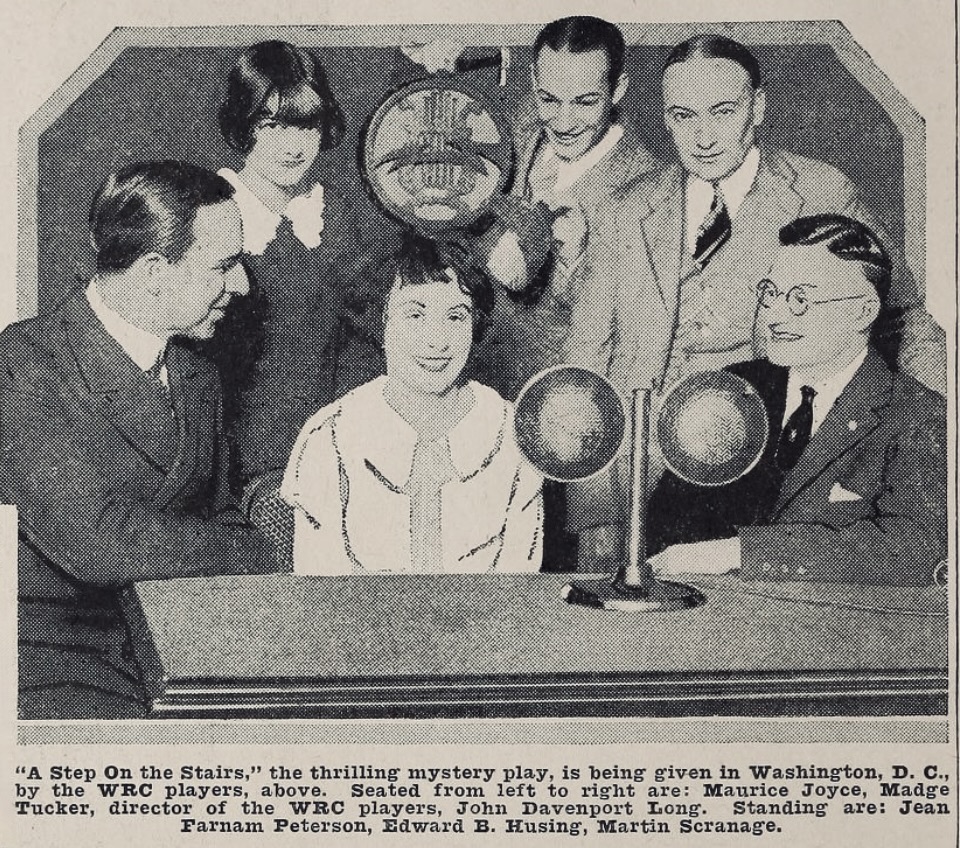
“The First Radio Play Printed in America”: “Sue ‘Em” (1925) and the Ensuing Question of Legitimacy

A photograph published in the April 1926 issue of Radio Broadcast
showing a young John Huston (left) and fellow members of the Provincetown Players

Here I go again.  Another broadcasting centenary, another radio “first.”  This “First,” mind, is wrapped in quotation marks, as the claim is not mine.  I am not going to dispute it, either, or challenge someone else to have the last word in the old “Who’s on First?” routine.  I have been there before.

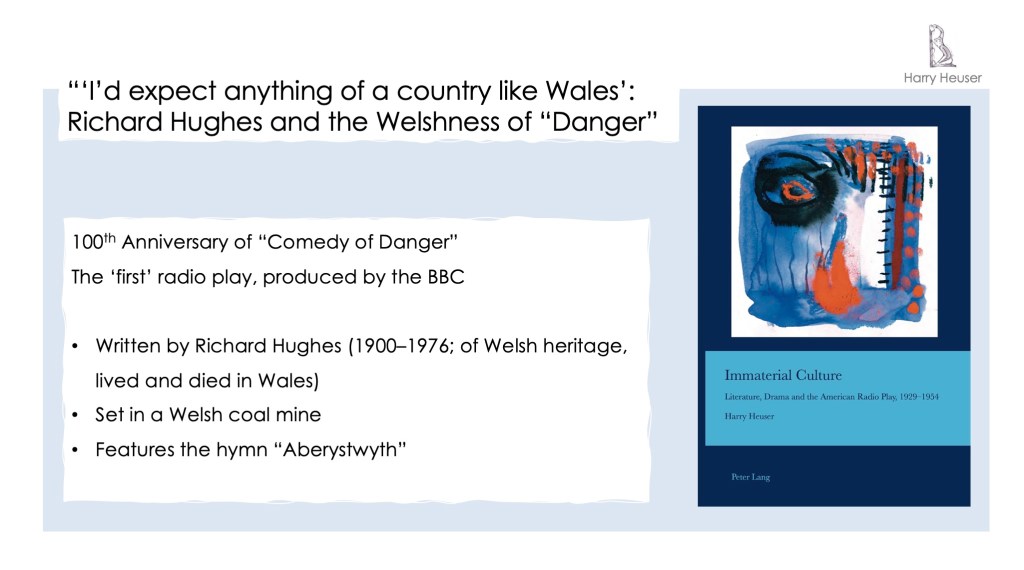
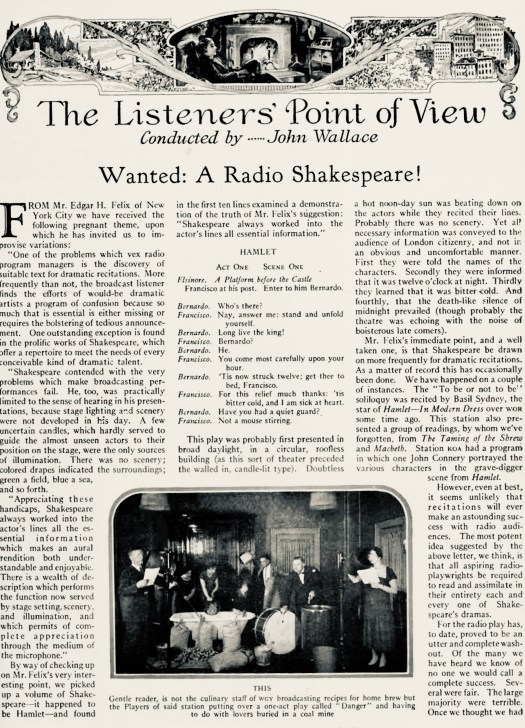
Picture it: Early 2024.  I am commemorating the one-hundredth anniversary of radio “drama” at an event I staged with British playwright Lucy Gough at the National Library of Wales.  I set out by acknowledging the widely held assumption that Comedy of Danger by playwright-novelist Richard Hughes was the “first” original radio play to be broadcast … anywhere.

The claim served as a hook.  It was designed to underscore the international significance of the event.  At the same time, I tried to justify its happening in Wales by drawing attention to the play’s Welsh setting and the playwright’s affinity with the country.  More important to me than arriving at a definitive answer to the vexed question of whether Comedy of Danger should be regarded as the “first” of its kind are the shifting definitions of the term “radio play” on which, to my mind, hinges the answer to that question—or rather, its unanswerability and ultimate pointlessness.

After all, it is difficult to say what is “first” in any field if the field itself is not clearly delimited first, or if the field is so limitless that it defies delineation in the first place.  In the case of “radio play,” Hörspiel (play for listening) or radio drama—relatively arcane though this field of study may be—definitions not only vary greatly but are often not even attempted.

When is a play a radio play? That is a question I have been asking for a long time in my musings on the wireless, and it is a question I keep asking myself.  “When is a play a radio play” strikes me as a more useful way of framing the debate than the more obvious question “What is a radio play?” because the former encourages us to avoid the most perfunctory of answers: A radio play is a play written for and/or heard on the radio.  

Sure, on the surface it barely scratches, that statement sounds reasonable enough.  But are all plays written and produced for radio broadcasting radio plays by default? Is it the medium, then, that makes a play—any play—a radio play?

Not that “radio” as we understand or know it these days bears a close resemblance to “radio”—as a receiver set, a system, and a phenomenon—anno 1925, the year when Sue ‘Em, proclaimed by its publisher to be the “first radio play printed” in the USA, successfully made a play for first place in a radio playwrighting contest.

Continue reading ““The First Radio Play Printed in America”: “Sue ‘Em” (1925) and the Ensuing Question of Legitimacy”

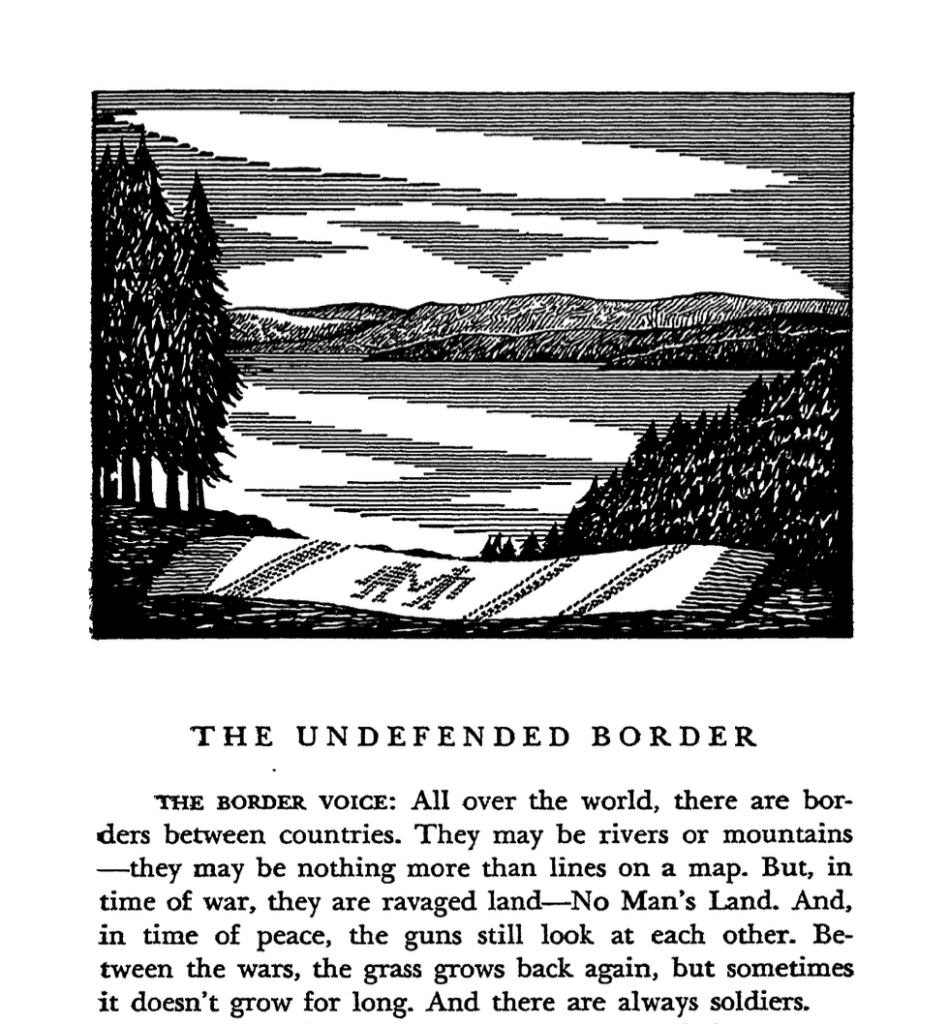
“There is a [loose] cannon”: Stephen Vincent Benét’s “Undefended Border” Revisited

The published script as it appeared in We Stand United, an anthology of radio plays by Stephen Vincent Benét and “decorated” by Ernest Stock.

I commenced this journal back in 2005.   It was intended as a continuation of, and promotional vehicle for, my doctoral study “Etherized Victorians: Drama, Narrative, and the American Radio Play, 1929–1954.”  Its title, broadcastellan, was meant to declare me to be keeper of a vast Luftschloss—a neglected alcazar of the air, immaterially composed of numberless radio recordings I determined to play back.

As of this post, broadcastellan is nearing its twentieth anniversary.  While I do not take this as an opportunity, let alone an excuse, to reissue older posts, I nonetheless wonder: When history seems to be repeating itself, perhaps I may be justified to do the same, if only to demonstrate that not every “been there” necessarily translates into a feeling of “done that,” and that not all twice-told tales are a rehash—not, at least, when you approach them from a perspective that has profoundly, even fundamentally, changed along with the context, your life experience and your attitude toward the world.

I devoted one early entry to “The Undefended Border” (1940), a play by Pulitzer Prize-winning poet Stephen Vincent Benét (1898–1943).  Revisiting it now, in the age of the MAGA tariff wars and annexation threats, I cannot but think of the loose cannon that is recklessly flouting, or at any rate tarnishing, the legacy of the rusty “lone cannon” commemorated in Benét’s play.

Continue reading ““There is a [loose] cannon”: Stephen Vincent Benét’s “Undefended Border” Revisited”

“… an America that must never happen—that will never happen!”: Revisiting US American Anti-Third Reich Propaganda in the Second Age of MAGA

The script for “Chicago, Germany” as it appeared in the June 7-13 issue of Radio Life

Delving into the “Draft and Ideas” folder set aside for this blog, I came across a fragment titled “‘Chicago, Germany’: A 1940s Radio Play for Our Parallel Universe.”  It was intended for posting on 10 November 2016 as a response to a “Trump administration having become a reality.”  The draft was abandoned, but no other piece of writing was published in its place.  

In fact, the next entry in this journal did not appear until 15 May 2017, and it coincided with the opening of Alternative Facts, an exhibition I staged with students at the School of Art, Aberystwyth University, in Wales.

As the abandoned fragment and the ensuing hiatus suggest, the “reality” of the Trump presidency had so rattled me that I could not bring myself to continue a blog devoted to the popular culture of yesteryear, as much as I had always tried to de-trivialize bygone trifles not only by examining them in the context of their time but also by relating them to the realities of the present day.

The exhibition project that kept me busy in the interim, had similar aims.  Alternative Facts provided me, as a curator and educator, with an opportunity creatively to engage with the outrage of MAGA by appropriating a phrase that encapsulated the duplicity and travesty of those early days of spurious swamp-draining.

Fast forward to 20 January 2025, the day that Trump returned to office, by the popular demand that is a product of his populist brand, with the singular and single-minded vengeance of a MAGA-loomaniac.  Pardon the execrable pun, but I find no words other than that crass neologism adequately to describe a US President who pardons rioters storming the Capitol and defecating on democratic principles, much to the Nazi-salute inspiring enthusiasm of enabling, super-empowered and quite literally high-handed oligarchs who, I suspect, will, rather than Elon-gate this reign, eventually assume the gilded let’s-lay-democracy-to-rest-room that, in the interim, is the seat of Trump’s throne,

It struck me that the time was ripe for—and indeed rotten enough—to pick up pieces of that draft in light or dimness of the current and perhaps irrevocably changed political climate, which, far from incidentally, is the only human-made climate change we are likely to hear about from the US government for the duration, as dramatically shortened for our species and for most lifeforms on our planet as that time may have become in the process.

As a melodramatist who staged the end of the earth both on radio and for the movies (in the 1951 nuclear holocaust thriller Five), Arch Oboler would have much to say about all this—except that what Albert Wertheim has called his “penchant for altered reality” was being “married to his anti-fascist zeal” in propaganda plays sponsored by or at least aligned with the objectives of the US government during the FDR years.

Continue reading ““… an America that must never happen—that will never happen!”: Revisiting US American Anti-Third Reich Propaganda in the Second Age of MAGA”

The Wireless, Herr Doktor Flesch, and the Devil: Hearing, Reading and Translating “Zauberei auf dem Sender” (1924), the First Radio Play Broadcast in Germany

Publication of “Zauberei auf dem Sender” in issue 35 of Funk (December 1924)

What is this sound and fury? Just who is behind it all? And why? Rather than making assumptions about the receptiveness—or perceptiveness—of radio listeners back in October 1924, I asked myself those questions as I tuned in belatedly and indirectly, via the internet, to a 1962 recreation of the orchestrated chaos that is Hans Flesch’s Zauberei auf dem Sender.  

Subtitled “Versuch einer Rundfunkgroteske” (“an attempt at a radio grotesque”), Zauberei is widely considered to be the earliest exponent of the Hörspiel (literally, “ear-play”) to be broadcast in Germany, or, to be precise, that nation’s Weimar variant, Germany’s first, flawed and spectacularly failing experiment in democracy.

In December 1924, a few weeks after the play was performed live in a studio in Frankfurt am Main, the script appeared in an issue of Funk, a German periodical devoted to radio technology and broadcasting.  

Now, “Funk” in German refers to wireless transmission—but, when it comes to Zauberei auf dem Sender, the “funk” you may be left with could well be blue.

Continue reading “The Wireless, Herr Doktor Flesch, and the Devil: Hearing, Reading and Translating “Zauberei auf dem Sender” (1924), the First Radio Play Broadcast in Germany”

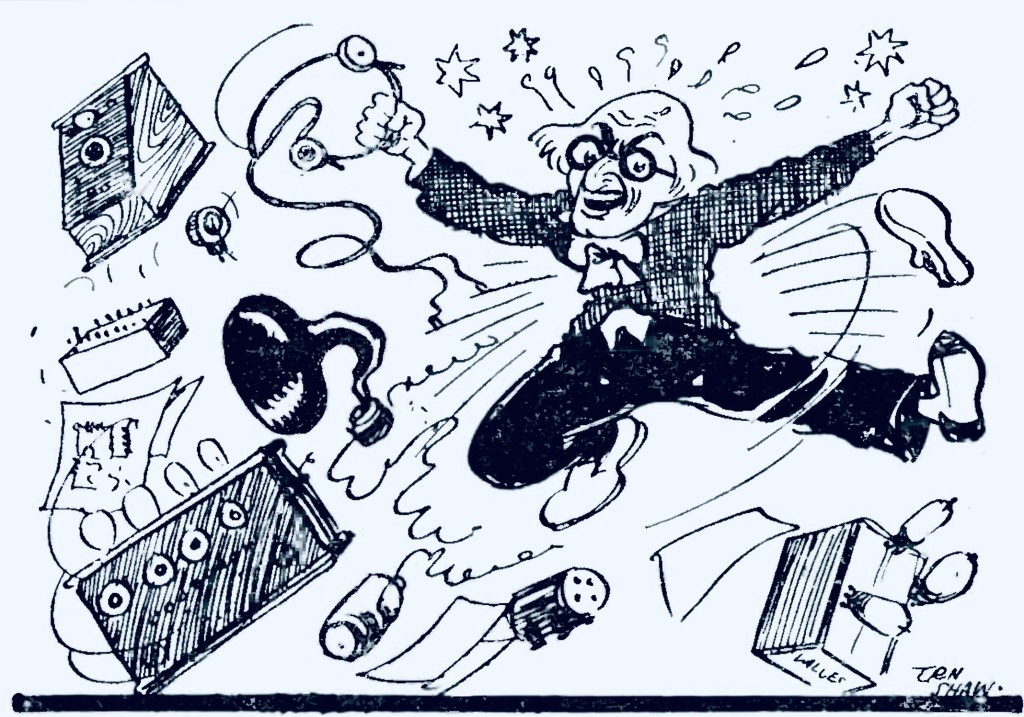
“… unequal emission”: “Interference,” “Modern Wireless,” and the “Wilds of Electronia”

Illustration by Ern Shaw (Modern Wireless, Nov. 1924)

“Many plays have been broadcast, but none of them seems to me to have the pep that is needed to get not merely across the footlights but across the ether.”  Complaints such as this one are all too familiar to me; in fact, they were launched so frequently against radio culture that, years ago, they prompted me to contest them. 

To misappropriate the famous question posed by the feminist critic Linda Nochlin, I asked “Why Are There No Great Radio Writers?” The objective was not to find examples to the contrary—those queer, quirky and quicksilver exceptions that can serve to prove the rule—but to query the question itself as (mis)leading and to expose the biases underlying it.

Continue reading ““… unequal emission”: “Interference,” “Modern Wireless,” and the “Wilds of Electronia””

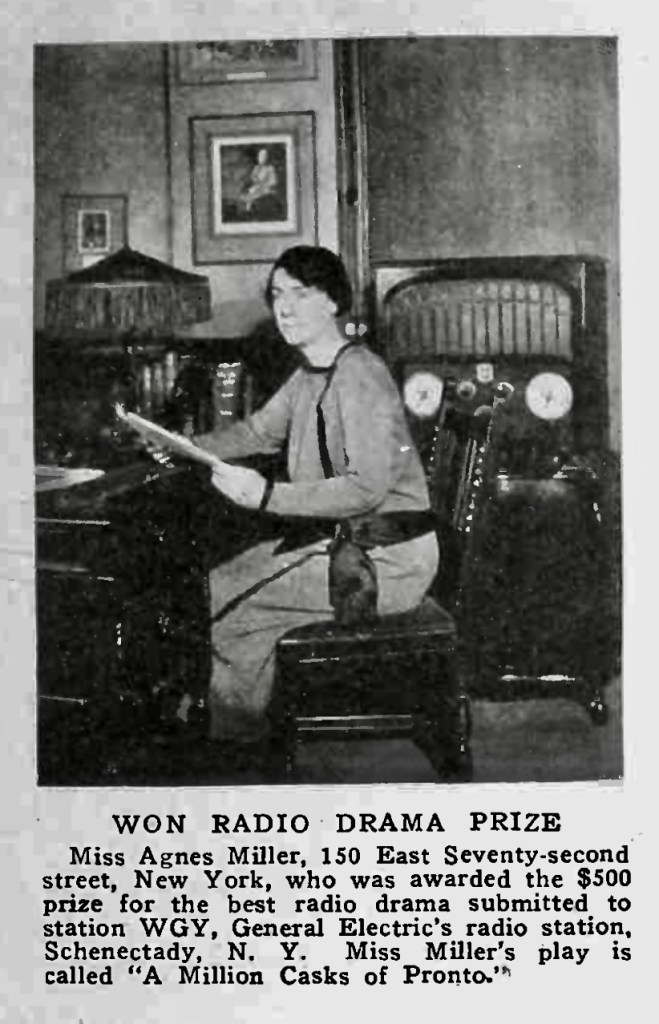
The Defined, the Definitive, and the Infinite: Thoughts Provoked by the Absence of “A Million Casks of Pronto”

Scoop up a tidbit, seemingly at random, however half-baked or nutritiously dubious.  Ask what made you stick your fork—or spork or chopstick—in it.  Reflect on why that morsel suits your palate, if indeed it does, at that particular moment in time.  Present your thoughts on a platter meant for sharing.  Hope for company, but don’t count on it.  That, in a coconut shell has been my approach to writing for the web since I commenced this journal back in the blogging heyday of 2005.  Eight hundred and forty-seven entries on, I am still at it, even though my diet, constitution and taste for potluck have changed considerably.

Not that I know exactly what those “Million Casks of Pronto” alluded to in the title of this blog entry contain; but more about that in as “pronto” as I can manage, especially since, as Wordsworth might have put it, these are lines composed a few minutes from Bronglais Hospital, where I went—and went under—for an endoscopy today.  Gallstones be damned, I am in a reflective mood, and those “Casks,” which were tossed onto the airwaves back in 1924, have been on my mind for quite some time now.

Continue reading “The Defined, the Definitive, and the Infinite: Thoughts Provoked by the Absence of “A Million Casks of Pronto””

“The lights have gone out!”: Commemorating One Hundred Years of Plays for Radio

First slide of my presentation

Taking the radio play to the library has long been an ambition of mine, given that dramatic and literary works written for the medium of sound broadcasting occupy comparatively little space on the bookshelves.  Taking the first of its kind to a national librarythe National Library of Wales, no less—is a chance of a lifetime amounting to poetic justice.  Allow me to shed a modicum of light on that, and on my benightedness besides.

So that meaningful conclusions may be drawn from my peculiar challenge of commemorating one hundred years of radio dramatics in just a few minutes, it strikes me as essential that the centenary first be quartered, a fate I hope to escape on 22 February 2024, the date set for the event.

Continue reading ““The lights have gone out!”: Commemorating One Hundred Years of Plays for Radio”

Hoarder Line: Some Notes on the Difference between Hoarding and Collecting

Early in 2023, I participated in a workshop at Aberystwyth University exploring collectibles and the collection of ephemera.  I was the only participant, among academics and museum staff, to talk about my private collection of ephemera.  So as to give that fruit fly of a presentation an afterlife, I have gathered my notes for this entry in my journal, which, after all, was created for the purpose of ‘keeping up with the out-of-date.’  

The presentation was titled “Making It Matter: Ephemerabilia, Queer Identity, and the Imperative of Being Out of Touch.”

I know, titles are like jokes.  If you have to explain them, they don’t work.  But, here goes:

“Ephemerabilia,” meaning, the love of the fugitive, the fragile, and perhaps even the futile.  All of the above – which may apply to any of our lives and bodies.  All of the above – but not ‘trivial.’  Nothing is trivial in itself.  Just like nothing is memorable in itself.  Someone has to make it matter.

For that reason, the word “minor” in Maurice Rickards’ definition of ephemera is problematic, as it devalues what it defines.  To quote myself: “Trivia is knowledge we refuse the potential to matter,” whereas “Memorabilia is matter we grant the capacity to mean differently.”

The need to make something matter and mean something, something else, no matter what, is, to me, intimately bound up with queer identity, with my sense of being, thinking, feeling, and loving differently.

And that is where, to me, the compulsion of being out of touch comes in: being drawn to what has been relegated to the margins, to matter that has been disregarded and discarded as presumably nonessential or unrepresentative.

I could have put the last two words in parenthesis; because sharing my passion for the untouchable – or the “not touched much lately” – means coming out with what drives me.  Making something neglected and presumably immaterial matter and mean something anew is an act of reification.

It means saying I matter.  But the question I keep asking myself, in relation to my collection habits, is “What’s the matter with me?”

Let’s say I say “I am a collector.”  Which question should I expect to follow? Is it “What are you collecting?” How about: “Why are you collecting?” “Why do you collect what you collect?”

What I collect is stated – and illustrated – on my website.  I collect ephemera related to products of what once was popular entertainment – early-to-mid twentieth-century, mainly US American, film, theatre and radio – that are lesser-known now.  I call it “unpopular culture.”

My collection is all fairly methodically put into actual and virtual drawers. Unlike in this scenario.  

The image on the left shows my ex’s apartment on the Upper East Side of Manhattan.  I once lived there, for about fifteen years, and, for over 33 years now I have stayed at that place whenever I am in the city.

Due to the pandemic, I hadn’t been back in three years.  In the fall of 2022, my ex had a heart attack just days before I was set to arrive there.  I looked after the apartment while visiting him at the hospital.  Anyway, I was shocked when I saw the place in such disarray.  My ex has always been a hoarder.  But the place had become almost unnavigable in the intervening years.

Obviously, hoarding is not collecting.  But is it so obvious? Is the distinction perhaps too obvious?  Sure, hoarding is chaotic.  It is indiscriminate, whereas collecting is orderly and discerning.  Collections are curated. whereas the compulsion of the hoarder may strike us as an infliction, an illness that may or may not be curable.

Curating is derived from the Latin word “curare,” meaning to care.  Does it follow that the hoarder is careless? While staying in my ex’s apartment, I took it upon myself to discard of some items I deemed trash.

Given that chaos, I thought my ex would never notice.  When my ex returned to the apartment after three months of intensive care, hospital care and aftercare, he emailed me and inquired about some of the objects I had discarded.

And he was so incensed about my attempt at tidying that he pretty much ended our 33-year-old friendship.

Seriously, to give up a friendship over a pile of cheap Chinese take-away containers, most of them without matching lids? That struck me as unreasonable, disproportionate.

But the fact that my ex remembered where what is in that chaos made me rethink the relationship between hoarding and collecting.

And it made me question whether collecting is not like hoarding in its illogical, perhaps even pathological clinging to matter that may not matter to most.  Something that takes up so much time and space, it can threaten to diminish rather than enrich our experience of life.

Possessions can take possession of us.  This is not vanity.  It is not conspicuous consumption.  For gay men born into decades of intolerance and legal discrimination, it may be a stab at making our existence more concrete and at leaving a trace or trail of it behind.  I should have known better than to mess with the mess that I found.

I have had occasion – or made it one – to examine the collection of the queer Anglo-Welsh Victorian dilettante George Powell in an exhibition I staged with my curating students a few years ago.  Powell bequeathed his collection to our museum.  But you might say he was a poor curator of his collection.  He did not collect methodically.  And some of the objects in his collections are fakes or copies of dubious provenance.

Powell had no offspring, even though he married toward the end of his short life.  Stating his intention to leave his collection to our museum, he referred to it as all he possessed of bigotry and virtue, meaning, bijouterie and vertu – trinket and treasure.

Powell left the lot to what is now Aberystwyth University.  In his book collection, for instance, was a popular volume called Book of Wonderful Characters, which contains a short account of the life of Chevalier D’Eon, who lived as a crossdresser for half a century and to whom we owe the term “eonism.”

I sensed that Powell created through that bequest a diary of sorts – an invitation, by way of visual and material clues among the objects he once possessed, to go in search of him.

The “it” in “making it matter” refers less to the collection than it does to the collector. Powell did not curate his collection to take care that what might reflect poorly on his character or cause suspicion as to his tastes.  To filter anything out would mean to erase what was at the core of his being, which is why Powell initially insisted that a museum be built to house it and that the collection be kept in one place, Aberystwyth, in its entirety.

He did not want to disappear behind his collection but reappear through it.  He wanted to be become readable, to be understood.  The Powell case made me more aware of the relationship between the private act of collecting and the public act of sharing a collection, of remaining visible through one’s collection.

Powell’s desire to remain visible, become readable and be understood becomes clearer to me in the contemporary periodicals he bequeathed to our University.  Here, he did not give us the lot – the magazines, cover to cover – but he cut out which articles he wanted to preserve and bound them in leather.  There is no telling whether he read the articles.  But it is clear that he thought they mattered and should matter to others.  And they are quite eclectic, ranging from articles on animal cruelty to drunkenness and insanity.

Articles on ‘Consanguinity in Marriage’ and ‘Marriages between First Cousins in England and Their Effects,’ which were no doubt of particular interest to him because his grandmothers were sisters and his parents first cousins.

Powell appeared to have been drawing attention to his struggle to figure out who he was and why he was the way he was.

Trying to understand what motivated Powell as a collector, I made a public display in the galleries of the School of Art Museum at Aberystywyth Univeristy of my own collection of cinema, theatre and radio-related ephemera.  In my gallery texts, I asked:

‘Do we collect things simply to indulge our passion for them? If so, why make a display of that passion? Showcasing seems calculated to raise certain objects to the status of ‘collectibles’ so as to advance the collector as connoisseur.  And yet, might not the urge to exhibit our personal belongings be rather more elemental?’

What are ‘collectibles’? What is collectible? Take, for instance, two different but related types of objects in my collection. Cigarette cards of once well-known but now mostly forgotten performers, in this case radio stars.  As well as movie posters and lobby cards of films of roughly that same period.

Both feature performers from the world of popular – or now less popular – entertainment.  Both are finite.  Lobby cards were generally produced in sets of eight.  Cigarette cards in sets of up to fifty.

The main difference is that cigarette cards were designed to be collected.  They were meant to be habit-forming, to encourage addiction.

Lobby cards on the other hand were not designed as collectibles.  In fact, as the fine print states, collecting them was prohibited by the studios whose property they remained.

By now, the industry that cigarette cards once served has become detached from them.  They no longer advertise and encourage addictive products, which makes them candidates for my belated affection, and which makes it possible for me to make them matter differently.

There are other intimate reasons why I mostly collect the likenesses of one particular actress: Claudette Colbert.

I became intrigued by the French-born US American actress watching a movie on television with my grandmother when I was 8 or 9.  I didn’t start collecting until decades later.  Nor did I know then that Colbert was rumoured to be queer.

My collection is also a catalogue of the love: more than 90% of my collection has been gifted to me by gay men, and almost all of which by my husband.  Original film posters are now almost out of my league as a collector.

I do not collect objects because of their monetary value, of which, due to the fact that the items were given to me, I often have no knowledge.  I have always been attracted to what is of little value to others.

A queer friend told me once that, as a child, he used to pick the crayon no other kid would pick up – the least popular colour.  Embracing neglected objects to me is related to the feeling of having been unwanted and misunderstood as a child.

Exhibiting my collection, I realized just how intimate collecting is.  I was very self-conscious about opening my drawers to display those objects – paper dolls, mass-produced pictures of performers few people today still relate to.  When I tried to exhibit the cigarette cards, I also realized they were too small to be impactful or readable for display.

So I created a slideshow of them.  There are objects in my collection that matter more once they are dematerialized.  I scan many books and scripts so that I need no longer handle the physical artifact.  It preserves the object.  But it also makes the object less meaningful if what matters is the visual or written information it conveys.  Not that I dispose of ephemera in my collection once I have scanned them.

The most ephemeral items in my collection are literally untouchable.  They are digitized sound recordings.  The cigarette cards of radio performers are, like scripts and contemporary books on radio, not the real thing.  They are a means to materialise the immaterial culture they commemorate: the world of sound broadcasting.

My (Im)memorabilia exhibition contained a listening station and featured a soundtrack of clips on a loop.  They are from my collection of audio recordings, now widely available online.  The files contain recordings of radio broadcasts from the 1930s to 1950s, most of them plays, almost all of which were part of episodes of series or chapters of serials.

The vast majority of plays were also broadcast only a single time.  Despite the recordings that gradually materialized from the vaults, they were as ephemeral as soundwaves.  That they survive at all is owing to their commercial value.

The recordings are evidence for the sponsor that the programme they funded actually existed and could be inspected – or audited.  As cultural products they were not valued.  They still are not valued much.  They certainly never received the scrutiny or status accorded to motion pictures or television programmes.

I organize the folders alphabetically by each series title.

And each subfolder contains recordings of broadcasts from those series.  Some subfolders contain close to one thousand recordings per series.  Cataloguing these immaterial objects, which I have written about at some length in my study Immaterial Culture and on my blog broadcastellan, involves adding and correcting information about talents involved in a broadcast play; verifying air dates by referencing old newspapers and magazines; checking for sound quality and recording speed; and replacing files with newer, cleaner, more authentic recordings.

It is not possible to listen to all of those recordings in full.  There are now over 30,000 of them.  It is almost impossible to keep track of them.

Unlike my ex, I have forgotten about many of the items in my collection. But like my ex, I would be very upset if only a single item went missing. Most of these recordings are readily available on the internet, copyright being a murky issue.  In my writing, I have argued for their cultural significance, their artistic merit.  But I have not been successful in making a career out of my caring.  I am wary of intellectualising my desire, and I am suspicious of such attempt by academics.

The difference between hoarding and collecting lies in the adding of value.  Hoarding is an act of accumulation.  Collecting is an act of accretion, of value added.

The ‘imperative’ in my title is the imperative of the matter – what drives us, what makes us who we are.  The ‘it’ in “Making it Matter” refers both to the ephemeron and the life of its collector who deems it worth preserving.  That my efforts have been futile only seems to fuel a desire that has been termed “The Queer Art of Failure.”

ASMR Jungle: Rambling Notes on NYC Composed Out of Earshot

Chalk drawing on the pavement at Union Square. Not that I need an invitation.

Inhale.  Exhale.  Inhale.  Exhale.  I must try that some time without using a brown paper bag.  Just kidding – but only just.  It’s been a breathless few weeks.  Now that I am coming up for air, I’d like to say, if it were not such a hackneyed phrase, that I have returned from my long and long-delayed New York trip with a suitcase full of memories.  Not that I care to be reminded about my luggage, given that, owing to an absent-mindedness brought on by physical exhaustion and an acute state of all-over-the-placeness, my carry-on case continued its journey by rail without me.

Argh.  Among other things, the valise gone astray contained a rare copy of Mr. Fortune Finds a Pig (1943), a curiosity of a mystery about which, had I not, through my negligence, forfeited the opportunity of its perusal, I would have liked to say considerably more here, especially given that its story is set in Wales, whereto its English author, H. C. Bailey (1878–1961) retired at the end of his career.

My copy of the novel, before it got lost in transit.

While in New York, I did a bit of research at the New York Public Library’s Billy Rose Theatre Division on lost recordings of Bailey’s “Mr. Fortune” stories, nineteen of which were adapted for US radio in the mid-1930s and are extant as scripts.  More about that, and the pig, some other time, the lost-and-found department of Transport for Wales permitting.  Never mind flying.  Pigs might travel by rail.

Pardon the rustling of mental notes; but as recounted here previously, fortune did not exactly smile on me during my stay in New York, entirely overshadowed as it was, at least initially, by my former partner’s heart attack and my bout of Covid, which barred me from the ICU and turned my legs to lead as I dragged myself from one testing site to another.

Rasp.  Not that my sojourns in the metropolis are ever an unalloyed joy, tinged as they invariably are with a sense of loss and estrangement.  Each year, the city I knew most closely when I lived there from 1990 to 2004, is becoming less familiar, less recognizable, and generally less worth revisiting, especially since what was particular and once characteristic is gradually being replaced by the generic and corporate.

The pandemic has speeded up this process, with many of the remaining one-of-a-kind sites going under in a sump of sameness.  A few years ago, when I researched the career of the English printmaker Stanley Anderson for a catalogue raisonné and a series of exhibitions, I was struck by the sense of dislocation some of his etchings communicate.  A kindred spirit, I am alive to Anderson’s visual commentaries on a world that was vanishing – or was made to disappear – before his very eyes.

Edward Hopper, The Lonely House (1920)

I was reminded of Anderson’s alternative views of 1920s London – of construction sites and demolitions – when I came across the etching The Lonely House (1920) in the exhibition Edward Hopper’s New York at the Whitney.  New York City, as the show’s curators put it with platitudinous generality, “underwent tremendous development” during Hopper’s lifetime; and instead of focussing his attention on landmarks that are more likely to stay in place than the architecturally commonplace – an assumption proven false decades later by the pulverization of the World Trade Center, an act of religious fanaticism bringing home that iconoclasm on any scale demands the iconic – Hopper “turned his attention” to “unsung utilitarian structures” and was “drawn to the collisions of the new and old” that “captured the paradoxes of the changing city.”

I am likewise eschewing the presumably picture-worthy sites in Asphalt Expressionism, my upcoming exhibition of large format, printed iPhone photographs of New York City sidewalks that, in a tourist’s pursuit of views or selfie backdrops, tend literally to fall by the wayside despite being in plain sight.

However, it is not visuals alone that vanish or material culture only that is subject to erasure.  Sounds, too, face neglect and extinction.  Unless they are voices or musical compositions, aural environments are largely unheard of in most records of our experiences, public or private.  Sounds may survive as a backing track to our home videos, but rarely do they become the main event, the real thing of our conscious engagement with sensed reality.

Continue reading “ASMR Jungle: Rambling Notes on NYC Composed Out of Earshot”