Blogging Troubles and British Treats

I was all prepared to talk about today’s television and radio offerings in Britain, something I don’t often do. A new cable TV channel is being launched tomorrow: More4. Of chief interest to me, I have to admit, is that it will air Jon Stewart’s Daily Show, albeit yesterdaily. I’ve also been following this, the second season of the X Factor, which is the only British must-see for me this fall. I have commented on this improvement on American Idol (or Pop Idol) before in this journal. The at times tedious auditions are finally over and the contestants are going head to head each Saturday evening in live telecasts. I don’t have a favorite yet, other than judge and promoter Sharon Osborne. Last season, which I only caught midway (after moving here from the US), it was the wonderfully overwrought Rowetta who, it appears, has become somewhat of a queer icon.

What else was on yesterday? Well, there was Margaret Rutherford, again, on BBC 4, in the delightfully wacky high school farce The Happiest Days of Your Life. And then there was that atrocious documentary about Mae West last Friday on BBC 4 radio, part of a new series of talks celebrating Great Lives.

I have never heard a more off-the-mark impression of that glamorous dame, whose comic allure was so effectively evoked by the stage comedy Dirty Blonde.  The discussion about her conducted by the two supposed experts was tiresomely trite. I had hope for some clips from her films, or for a mention at least of Oboler’s “Adam and Eve” sketch, which got West banned from US radio. I mean, if you’re on radio, talk radio already!

I was prepared to expound on any of these viewing and listening experiences until I realized that many of my prior journal entries were littered with symbols and marks that rendered them, if not illegible, so at least highly unprofessional. It seems that my m-dashes—to which I am partial—are metastasizing into something ghastly once they are being left here for a few weeks.

How irksome this is to someone who knows little about html but makes an effort to adhering to the code of the standard English I cannot begin to express (I guess language fails me there, after all). I have made a few corrections, but some of the previous posts are still in shambles, I fear.

How the Blind Medium Immaterialized Coward’s Blithe Spirit

I guess I am still too wrapped up in US culture to have given British cinema its due. So, last weekend, while on a DVD shopping spree in Manchester, I made an attempt to rectify this cultural lopsidedness. Among my purchases was a copy of David Lean’s Blithe Spirit. Or is it more appropriate to call it Noel Coward’s Blithe Spirit, even after a noted director has . . . transubstantiated it? Generally, stage plays are treated like the brainchildren of their authors, while motion pictures are attributed to their directors. How many classic films could you trace back to their screenwriter parentage without resorting to the Internet Movie Database?

Anyway, it is an irksome inconsistency I grappled with when I needed to decide how to present and define radio plays for my dissertation (the aforementioned “Etherized Victorians”). Far from being a dead issue, the question arose anew when I followed up my screening of Blithe Spirit (1945) by taking in two radio disincarnations of Coward’s 1941 play.

The first one, soundstaged for Everything for the Boys on 16 May 1944, preceded the world premier of Lean’s feature by a year. Its adaptor was none other than Arch Oboler, probably the biggest name—and not the smallest ego—in US radio drama. Whether daring Americans to turn their Lights Out! or to put on a pair of 3D glasses, Oboler was hardly a subtle craftsman; he certainly was ill-suited to deliver the wit of Noel Coward.

Not surprisingly, Oboler’s rewrite of Blithe Spirit is a humorless affair, a tepid romance rather than a wicked romp. Presented to a live studio audience, the reconstituted comedy elicited only one laugh and a few mild chuckles; nor did it deserve more. The soundman was permitted to break a few dishes—flung by the two ghostly wives of the “hag-ridden” protagonist—but the damage was done largely by eraser, as hardly any of the play’s celebrated witticisms survived the adaptor’s indiscriminate airbrushing.

The challenge seems a formidable one when the play to be radio-readied involves ghosts visible and invisible, audible and inaudible, as well as the flesh and fancy of a decidedly material psychic. A filter microphone and a few hints from The Shadow will not suffice when wit is what is wanting.

Aside from a clipped and colorless script, the casting of Madame Arcati—the robust medium with a penchant for sandwiches, physical exercise, and dry Martinis—made matters worse: fluttery and frazzled, she lost much of her comic weight when portrayed by Edna Best. The Theatre Guild on the Air, at least, had access to the original New York cast. It also had the benefit of thirty-five extra minutes, and a script that retained much of the sparkle of Coward’s virtual sex comedy.

On 23 February 1947, nearly two years after Oboler’s inept dabbling in Coward’s froth, the Theater Guild revived Blithe Spirit with considerably greater success. It also broke a few dishes too many (to the audible delight of the studio audience to whom following the job of the soundmen had all the relish of an inside joke); but it kept both the spirit-flesh dynamics and civility-vulgarity dialectics relatively intact.

Sure, Mildred Natwick as Madame Arcati fudges a few good lines, and the attempt to explain the fact that Elvira, the irreverent revenant, is visible only to the tormented male and not to his second wife is almost as clumsy as my prose here. Still, having missed the recent London revival of the play , this was a more than tolerable substitute.

However much it tickled me to watch the redoubtable Margaret Rutherford (captured above in an ethereal fade) as she throws herself into the role of Madame Arcati, the Theater Guild adaptation brought the wit of Coward’s lines home to me like no coating of Technicolor ever could.

How Cecil B. DeMille Delivered Air Mail for Hawks’s Angels

Without being aware of it at first, I continued my engagement with the movies of 1939—Hollywood’s greatest year—last night, as I followed up a previously mentioned screening of Drums Along the Mohawk by projecting Howard Hawks’s Only Angels Have Wings onto my small big screen. Well, I must agree with cinema critic Ted Sennett, who held that the two leads were unfortunate miscasts. The suave Cary Grant (as flying ace Geoff Carter) does indeed cut a “faintly ludicrous figure, and Jean Arthur [as Bonnie Lee] is nobody’s idea of a showgirl.”

Such sensory obstacles and prejudices are immaterial, of course, when listening to a radio adaptation. So, today I improved upon my viewing experience by listening to the mercifully shorter Lux Radio Theatre production of Angels, which aired 29 May 1939. Clipped and satisfyingly swift, the air treatment added a touch of self-reflexivity to Bonnie’s exclamation “Say, things happen awful fast around here.”

Timing itself, by which I mean the date of the broadcast, is significant for two reasons. Unlike most Lux presentations, the airwaved “Angels” took flight shortly after the 15 May 1939 release of the motion picture upon which it was based. Coinciding with—and thus capable of promoting—Hawks’s aviation melodrama, it boasted no fewer than eight members of the original cast, including Grant, Arthur, Thomas Mitchell, silent screen star Richard Barthelmess, and newcomer Rita Hayworth. Even for the lavishly produced Lux program, such screen presence was unusually extravagant. Yet Lux‘s promotional services for Columbia Studios went even further.

As Cecil B. DeMille, host and ostensible producer of the program pointed out during the show’s second intermission, there was a “real-life parallel” between Hawks’s drama of airmail daredevilry in South America and a recent “history-making flight.” Two days prior to the broadcast, Pan Am inaugurated a regular airmail service to Europe. Its pilot, Captain Arthur E. LaPorte was called before the CBS microphone to tell of the “tremendous strides” in aviation: “We have at last conquered the Atlantic.” After all, the clipper crossed the ocean in a mere twenty-five hours.

Picked up by about twenty-five million listeners each week, Lux was capable of delivering its fan letters to the movies with considerably greater speed and efficiency. Its timeliness dramatically underscored and confirmed, Hawks’s film could hardly have received a more prominent stamp of approval. It’s high time I got my hands on one.

On This Day in 1940: Arthur Miller Unleashes a Pussycat

As it turned out, I had been listening to Jeremy Vine’s “Climate Change Special” on BBC Radio 2, in which discussions about global warming and environmental crises were interspersed with a series of fictive news bulletin from the future—the year 2035. After such spurious time-traveling, I retreated into the world of fantasy, a bit of old-time radio whimsy from the pen of none other than the late American playwright Arthur Miller.

Pardon my credulity, but yesterday, listening to the radio, I experienced my own “War of the Worlds” encounter—you know, an act of airwave fakery during which hearing becomes believing. Going about my daily affairs, I picked up a few words of what I assumed to be a news broadcast, it being preceded by the customary jingle of the oft relied upon BBC. “Much of East Anglia remains under water today after the latest North Sea storm surge,” newsreader Adrian Finnegan informed me, and “nearly a million people” had been evacuated from an area large portions of which might never be reclaimed from the sea. Why hadn’t I heard about this before, I wondered, still under the influence of telecasts from hurricane-battered New Orleans.

Yes, Miller does have a radio past, even though it is a less than illustrious one. So it is frequently, politely, and foolishly ignored, as if a half-decade of dabbling in the theater of the mind could not possibly have had an influence on the career of a writer whose 1964 drama After the Fall “takes place in the mind, thought, and memory” of its protagonist.

“I despise radio,” Miller told an interviewer in 1947; with a successful play on Broadway and a well-received first novel to his credit, Miller was ready to get out of what he referred to as “a dark closet.” He meant the melodramatic excesses of radio drama, but also complained about the limitations imposed by network executives and the sponsors that fed them. Well, let’s open that closet now to commemorate the broadcast anniversary of Miller’s “The Pussycat and the Expert Plumber Who Was a Man,” a radio fantasy produced by the Columbia Workshop on 29 September 1940.

While not quite the man who had all the luck, Miller was rather fortunate to begin his career in radio, having his plays soundstaged by the sustaining (that is, commercial free) Workshop, a venue far more open to experimentation than the program he chose to recall in Timebends. His playful “Pussycat” is the story of an invisible trickster—a commentary on radio, therefore, and one that forced me to keep in mind the mind-game to which I had just been subjected.

The eponymous tomcat is a megalomaniac intent on going into politics and swaying the masses with his “lovely tenor voice.” Hidden from view behind a microphone, he convinces his audience of potential voters that he “must be a wonderful man,” until he is exposed as a fraud by an average Joe who threatens to drag him out into the open. “[I]f you want to know,” he sums up his tale, “a cat will do anything, the worst things, to fill his stomach, but a man . . . a man will actually prefer to stay poor because of an ideal.”

Clearly, Miller resented radio because he felt that it was making a pussycat of the manly expert he aspired to be. Yet he often overstated the strictures of network radio and eventually got too tired to resist them. Radio plays may not be the cat’s meow to narrow-minded intellectuals, but experts like Norman Corwin proved that they were hardly the litterbox of American culture.

On This Day in 1066 and 1939: Two Conquerors Take Language to War

Not being revisited by the nuisances of power failures and coughing fits I suffered recently, I find myself willing to rise to something amounting to a challenge. Tackling the ambiguities of Archibald MacLeish’s verse drama “The Fall of the City,” for instance. Originally broadcast on 11 April 1937, “The Fall” was again presented by the Columbia Workshop on this day, 28 September, in 1939. The world changed considerably during the time elapsed between those two productions, adding urgency to a play about . . . well, about what, really?

I’ve grappled at length with “The Fall” in my dissertation, describing the confusion and frustration of critics who sensed the play to be significant but could neither make sense of it nor find much consensus among each other. Some argued that it wasn’t even a play at all. Apparently anticipating this reception, MacLeish prefaced the published script with the following disclaimer:

“Any introduction is a confession of weakness. This one is no exception. It is written because I am anxious to persuade American poets to experiment with verse plays for radio and because I am quite certain the radio verse play I have written will not persuade them of itself.”

US poets were not too keen on having their precious wares compete with soap commercials. Others believed that their words were best spread among the few rather than being freely disseminated through channels of less-than-pure air. The horrors of WWII shook up a number of ivory towers, drawing out poets like Stephen Vincent Benét and Edna St. Vincent Millay in fighting form. In propagandist poetry, the ultimate test of language was not whether it could move listeners, but whether it could get them moving, whether it could motivate them to fight battles, buy bonds, or save kitchen fat.

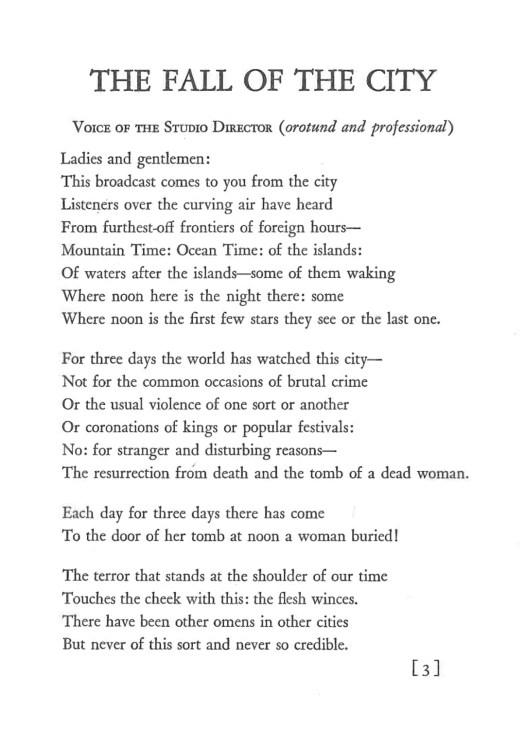
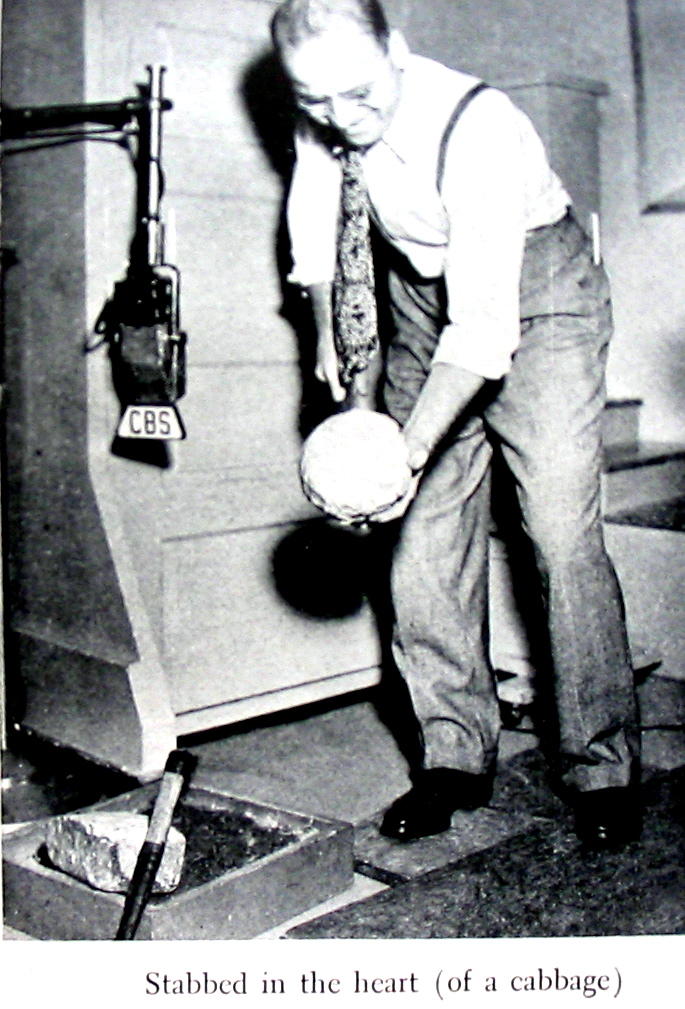
While American broadcasters were training announcers (like the proud vocal-talent pictured above) to hawk the products of their corporate sponsors, Fascist Germany had been exploiting the power of the spoken word to turn open-minded individuals into a league of like-minded or mindless lemmings. “The Fall of the City” opened a debate about mass persuasion, about the media’s role in molding opinions and fabricating war. Its ambiguity is rooted in a distrust of the very medium it employed.

“Ladies and gentlemen,” the play begins, “This broadcast comes to you from the city,” a town whose downfall is first announced, then actualized. It is talked into being as the figure of a radio announcer stands by to document the unfolding event. MacLeish’s announcer takes listeners to the “central plaza” of this unspecified city to become ear-witnesses to the resurrection of a recently buried woman who, for three consecutive days, appeared before a crowd of spectators, and who now utters a baffling prophesy:

The city of masterless men
Will take a master
There will be shouting then:
Blood after!

Amid the bewildered throng (some 500 people participated in creating the sound of the crowd), reporters and politicians are heard trying to interpret the oracle and to fix upon a plan of action. Is the message to be ignored? Is the prophesied attack to be countered or endured? One orator, holds that “[r]eason and truth” are the weapon of choice:

Let this conqueror come!
Show him no hindrance!
Suffer his flag and his drum!
Words . . . win!

His words are powerful enough to have people dancing in the streets—until another speaker convinces them to go into battle. While this exchange of words and changing of minds is going on, the talked-of invader—a hollow suit of armor—takes over and the masses surrender. Unlike William the Conqueror—who, on this day in 1066, made Anglo-Saxon words bow to French langue—he does not have to utter a single syllable to make a message-mangled city fall, its “masterless men” happy to have “found a master.”

Summing up this war of words, the announcer remarks that the “people invent their oppressors: they wish to believe in them.” Are these words to be taken for the author’s? If oppressors are inventions—a notion not going over well with some of MacLeish’s contemporaries—then who is to be entrusted with the power to use or control the media capable of creating such alleged fictions?

It seems that MacLeish was apprehensive about the uniformity of thought produced by broadcast speech. It made his own attempt to invade the medium a troubling undertaking: how to convince your listeners not to take your word for it?

On This Day in 1950: Ronald Colman Lectures on Bigotry and Schlitz Vows to Ship 600,000 Cans of Beer to Korea

I started writing this during a power outage; so, in commemoration of this event, I’ll try [and promptly failed] not to be quite so long-winded this time. I didn’t relish the experience of sitting alone in the dark without the comfort and convenience of electricity, especially since darkness is the very stuff of radio drama, the sound pictures that are stored on my computer or waiting to be snatched out of the world wide web.

For a while I tried to fill the void with my own voice, reading out loud by candlelight, enacting the parts in Jane Austen’s Persuasion, the book at hand. The flicker illuminating the pages began to irritate me; and when I caught a glimpse of the shiny surface of my laptop, I couldn’t resist to drain its precious battery power by popping in a CD and listening to one of my favorite situation comedies of old-time radio, Don Quinn’s witty and endearing Halls of Ivy. Besides, I had already decided to write about the 27 September 1950 broadcast of that show—an episode OTR enthusiast Jerry Haendiges argues to be “probably the best of the series.”

Among the smartest comedies of its day, the series had long escaped my notice, since “its day” was the early 1950s, a time when radio was already experiencing a decline in talent, audiences, and sponsorship. When setting up the research boundaries for my dissertation, I initially dismissed such late-comers, sound unheard, assuming them to be lacking in literary merit and production values, deficiencies owing to conservative—that is, money-starved—programming as a result of dwindling advertising accounts. The Peabody Award winning Halls of Ivy (1950-52) sure proved me wrong.

The program was greeted as a sign of radio’s maturity, not its senility and obsolescence. In the May 1952 issue of Theatre Arts critic Harriet Van Horne, who had previously lamented radio’s adolescent fare, recommended Halls of Ivy as a “literate” treat, arguing its writing to be “often much better than the dialogue you encounter in some Broadway shows.” Set in a liberal college, the series delicately addressed and eloquently expressed a number of social concerns, the fictional campus being a playground on which to act out matters of race, class, and gender. Sentimental without being saccharine, it was edifying without getting snooty about it. I mean, come on, the show was sponsored by the makers of Schlitz—the “beer that made Milwaukee famous.”

On this day in 1950, Halls of Ivy presented a study in prejudice. Penned by Don Quinn and Cameron Blake, the story for the evening involved a high-toned mother of a dead soldier who vows to make a $500,000 donation to Ivy College after finding a picture of her son in a newspaper announcing the award given to the student who painted his portrait. When college president Dr. Hall (Ronald Colman) hears about this proposed endowment, a “girdle” to bring the institution back into shape, he fears that “this girdle is the old-fashioned kind. You know, the kind with strings.” Sure enough, the benefactress stipulates that the money “must absolutely not be used to provide scholarships for . . . well, for certain races and creeds.”

The donation is refused. Adding to the irritation of the narrow-minded society lady who offered it, the Halls receive a visit from the student artist who captured the likeness of the son from whom she had been estranged. As it turns out, the painter is of a “certain race” himself. After this exposure—a confrontation with and a laying bare of her bigotry—the strings are removed and the money can change hands, a moral lesson delivered with such skill and grace that even the contrived ending does not come across as awkward or trite. Summing up the dramatized lecture, Dr. Hall remarks that “life itself is a little like a college. You don’t learn much by attending only one class.”

Not to be outdone my the fictional donation, Schlitz announced at the close of the program that, having been given the okay from the Eisenhower administration, it would ship 600,000 cans of beer to the American soldiers then fighting in Korea. It’s a rather tacky coda—but sponsors aren’t exactly classy when it comes to touting their wares.

Once the power was restored in my abode, I set out for another trip to Ivy College—because “you don’t learn much by attending only one class”—and watched a 1955 episode of the TV adaptation of Halls of Ivy, also starring Colman and his wife, Benita Hume (along with the wonderful Mary Wickes as their maid). Well, sometimes it is nice to let someone else do the picturing for you, particularly after having been forced to spend two hours in near darkness.

On This Day in 1937: The Shadow Gets a Voice-over

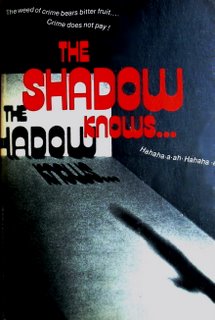
I remember the first time I heard the menacing voice of The Shadow—and it was not over the radio. I was a college student in New York City and was cleaning the Upper East Side apartment of a fading southern belle. Well, I needed the cash and she was too much of a spoiled socialite to do more around her place than pet her Shih Tzu and point out the offending dust particles. She told me about some prank phone calls she had been receiving from a rather peculiar and not-so-secret admirer in her neighborhood. I think she had filed a restraining order, but that did not stop this cookie character from entering her sphere telephonically. The eerie message he left on her answering machine, which she did not hesitate to play back for me, was as ominous as a line from David Lynch’s Twin Peaks. It was not ‘Fire walk with me,’ though, but “Who knows what evil lurks in the hearts of men?” followed by a declarative but less than clarifying ‘The Shadow knows!’ Sinister laughter concluded this bizarre tele-communication. Let’s just say I was glad to put down the feather duster that afternoon and make off with my meagre earnings.
Several months later I came across those very words once more—and I could not get out to escape them, as I was already home.  I had just discovered the thrills of old-time radio and now realized that the unnerving telephone message etched in my mind was nothing but an imitation—albeit a brilliant one—of the most memorable signature in American radio drama. Yes, those lines sure tolled a bell, even though the knell was delivered in a different voice and accompanied by the somber and to me as yet unfamiliar strain of Saint-Saens’s Le Rouet d’Omphale.

The alter ego of Lamont Cranston—’wealthy young man about town’ who used his mysterious ‘power to cloud men’s minds’ to aid the forces of law and order—The Shadow was a man of many voices. Since he always had to have the last laugh, his strained vocal chords seemed to require a number of replacements.  On this day, 26 September, in 1937, when The Shadow returned to the airwaves after a thirty-month-long hiatus, Cranston received another one of those vocal makeovers, this time courtesy of Orson Welles.

Welles has gotten rather too much credit for his portrayal of The Shadow; after all, he was neither the first actor to play the role nor the one who stuck with it the longest. He spoke condescendingly of the popular program—an attitude common among actors and writers who used radio as a career springboard or a temporary cash cow—and asserted that he read his part without rehearsals (an unlikely story, given the fastidiousness of the sponsors and Welles’s youthful inexperience). To be sure, Welles’s first disappearing act as The Shadow—in an episode titled “Death House Rescue”—was neither a dramatic nor a thespian marvel.

In a story about Cranston’s efforts to save the life of an alleged cop killer on death row, Welles comes across as pompous and disdainful; since he always sounded like none other than Orson Welles, overgrown ‘boy wonder,’ it is difficult to determine whether he was sneering in character or at his character—a ham hampered by an attitude of I’m-way-above-such-baloney.  Agnes Moorehead, who played opposite Welles, managed a less self-conscious performance as Cranston’s companion, the “lovely Margot Lane,” whatever trifle of a line she was being tossed. Unlike Welles, Moorehead inhabited her role rather than interrogating it, which made her a most valuable and much admired player in commercial radio drama.

Still, his pretensions notwithstanding, Welles’s subsequent fame served The Shadow quite well. It encouraged scholars to dig up transcriptions of the long-running series and contributed to their preservation, although surveys of Welles’s distinguished theatrical and cinematic repertoire generally devote little more than a few footnotes to these broadcast performances. Some scripts from the final months of the series (not preserved on tape) even resurfaced in print—as a 1970s high school textbook (pictured above).

As may have become apparent, I could never quite warm to Welles or wring chills from his impersonation of The Shadow. Then again, I always thought of The Shadow as the voice of a creep on the answering machine of a dislocated Scarlett O’Hara gone twilight. What an introduction!

On This Day in 1954: Escape Goes Up in Gunsmoke

“You are at the end of a journey you’ve committed murder to make,” radio announcer George Walsh told those tuning in to the long-running CBS series Escape on 25 September 1954. While addressing the escapism-craving public, he was referring to the protagonist of “The Heart of Kali,” the play scheduled for that day. The prologue in the second person was a signature device of Escape, an invitation to identify with the main character of the story, hero or villain, who was faced with a life-threatening crisis and in desperate need of . . . escape. On that particular evening, however, the announcer might very well have referred to the program itself, which, too, had reached “the end of a journey,” a journey strewn with corpses and the butchered remains of many a literary classic.

Yes, it was the end of a twisted on-the-air-off-the-air passage for Escape (1947-54), and “The Heart of Kali” opened like a weary reminiscence of the experience: “It’s been a long time. Exactly how long I don’t know. The years pile up and it’s hard to remember.” No, that wasn’t the producer talking, but play’s protagonist, a disillusioned veteran whose callous hankerings for wealth left him trapped and abandoned. Unfolding as a dramatized flashback, the narrator’s tale of greed, deception, and murder takes the listener on a hunt for the eponymous treasure, at the conclusion of which the self-serving raider is being cornered into serving as the guardian of the sacred object he sought to possess. “How long ago was that?” the ensnared man reflects, “How many lifetimes?”

Escape had ransacked the Western library of adventure stories; but, being tossed from one timeslot to another, it never managed to catch on with the listening public, a lack of a following that, in turn, caused sponsors to turn a deaf ear. At the conclusion of this last episode, the despairing narrator made a final pitch in hope of an audience, a redeemer—or anyone foolish enough to take his wretched place: “Why not you?” The ruby, he insisted, was there for the taking: “Take it, come and take it! Please! Please, somebody come and get me. Please!” It was too late to salvage or hawk this gem of a show.

“You know,” William Conrad told listeners at the close of the broadcast, “today marks the last of the current series of Escape programs and I know you will miss it as much as I shall. However, I would like to think that all of you who have listened to Escape these many months will now be able to take your pleasure in listening to Gunsmoke.”

The narrator’s plea had been answered after all. There was a suitable placeholder and successor for Escape: a Western to release a westerner caught in an Indian temple, a westerner suspicious of an Eastern “attitude of non-violence,” an ex-soldier who shot his way to a sacred object he describes as being “as big as a hand grenade.”

It wasn’t Escape alone that went up in Gunsmoke during the mid-1950s. The theater of the mind was being taken out, a carcass abandoned by audiences and sponsors alike in favor of television. Western-centric, ocular-oriented, matter-over-mind—it was a far more American medium than radio had ever been.

To date, aural treasures like “The Heart of Kali” (written by sound effects artist Ross Murray) are largely forgotten, left behind in the dim and quiet alleyways of our cultural past. “Take it, come and take it! Please!”

On This Day in 1950: Stand-in Saint Saves Pooch, Solves Puzzle, Then Stumbles to Pulpit

Well, today I am taking the opportunity my “On This Day” column offers to revisit one of my favorite radio sleuths—the most debonair adventurer to go on the air, the mystery man about town known as . . . the Saint. When I discovered the thrills of old-time radio back in the early 1990s—while listening to Max Schmid’s Golden Age of Radio on WBAI in New York City—the Saint was the first behind-the-mike crimefighter that caught my ear. Voiced for several years by the inimitable Vincent Price, The Saint did not only crack cases—he also solved the conundrum of radio whodunits. He did so again on 24 September 1950 in a routine romp titled “Dossier on a Doggone Dog.”

As I remarked previously, radio mysteries are rarely as engaging as murder puzzles in print. There simple aren’t enough culprits to be dragged into a small studio reading a sufficiently twisted yet clue-strewn script worthy of the term “whodunit.” The way out never found by stodgy detectives like Mr. Keen (Tracer of Lost Persons) was a solid dose of tongue-in-cheek humor. On screen, Nick and Nora Charles did wonders with that approach to the rather predictable Thin Man mystery. Ill-suited to no-nonsense flatfoots like Philip Marlowe, wit and whimsy worked well when delivered by the urbane and nonchalant Simon Templar (alias the Saint).

Though initially involved in the adaptation of his thrillers for radio, Saint creator Leslie Charteris (above, on the back cover of a rare radio thriller anthology) had little more to do than to collect the royalties as his “Robin Hood of Modern Crime” went through a series of reincarnations. Listeners tuning in to the 24 September 1950 broadcast were in for another metamorphosis. They were told that Mr. Price had been “delayed in Paris,” and that film actor Barry Sullivan would be heard instead in the title role.

Well, the delay had already been announced in the previous broadcast (17 September 1950). Not that the Parisian detour was quite so prolonged; the shows were transcribed, as was common for post-WWII radio, and apparently taped in pairs for economy and convenience.

“The Dossier” is a zany caper involving the shaving of a Pekinese, a jewel robbery, a screwy industrialist with a fortune in nuts (nuts and bolts, that is), his self-absorbed wife, ne’er-do-well offspring, and haughty butler-turned-stiff; as well as a smart-aleck ten-year-old skilled in judo.

While not much of a mystery, the episode, penned by Jerome Epstein, is thoroughly diverting, an irreverent deflation of bourgeois values and assumptions about the anchor of family life, the innocence of childhood, and the nobility of capitalism. As if to curtail such light-hearted tomfoolery, however, an incongruously sober appeal was appended in the form of a curtain call.

Having donned the undoubtedly smart suit of Simon Templar, Barry Sullivan was asked back before the microphone to read the following message:

Ladies and Gentlemen.  A long time ago it was written that man shall not live by bread alone. In this often-quoted line from the Bible, bread is merely a symbol of all material values.  And although we in America have the greatest material advantages in the world, they are not enough to bring us complete happiness.  We must find that happiness in our spiritual as well as our material lives, in faith as well as bread.  In America one of our most precious heritages is the right to worship as we please, to know the spiritual pleasures of our churches and synagogues.  The doors of your places of worship stand open to you and your religious leaders will welcome you to their services.  They also offer you personal and family guidance and the opportunity to become a firm part of your community.  Through our churches and synagogues that community and the families within it can find stability.  And as an individual you can find the peace that only religion can bring.  Thus the religious organizations in America invite you to find yourself through faith.  And come to church this week.  This is Barry Sullivan inviting you to join us again next week at the same time for another exciting adventure of The Saint.  Good night.

In this and similar public service announcements we find compacted the troubled story of the McCarthy era, an era of consumerism, bigotry, and xenophobia; an age of picket-fence dreams, witch hunts, and manufactured menaces—double standard times no more innocent or enlightened than our own terrifying present.

The “Dossier” closed, the Saint stepped down from the pulpit, leaving listeners to grapple with the implications, to examine the state of their spirituality, or to reach for a cool drink and twist the dial in search of further immaterial pleasures.

On This Day in 1943: Artist Jean Helion Escapes Into Thin Air

Feeling as miserable as I do right now (the aforementioned cold), I was tempted to abandon the “On This Day” feature and escape the self-imposed strictures of such a format. Then I came across a recording of Words at War that made me decide not to disenthrall myself just yet. I might not have gotten to know Jean Helion, had it not been for the frustrating and inept adaptation of his wartime memoir They Shall Not Have Me, first broadcast on 23 September 1943.

An ambitious literary anthology, Words At War (1943-45) was a class act in American radio propaganda. Produced by the National Broadcasting Company in cooperation with the Council on Books in Wartime, Words at War attempted to dramatize “important war books,” ranging from a clipped version of the home front melodrama Since You Went Away to a dystopian fantasy based on Louis Nizer’s fiercely anti-Teutonic “bible for peace” What to Do With Germany. The series was better suited than situation comedies, variety shows, and horror programs to provide a “living record” of the war and the “things” for which US citizens were called upon to fight. The program promised to be such a “living record,” but individual broadcasts were at times less than viable shorthand memos to the bewildered American public.

In the roughly twenty-five minutes allotted to the dramatization, “They Shall Not Have Me” attempts to recount the story of a French soldier, his imprisonment by the Nazis, and his escape. Neither its melodramatic potential nor its cultural significance was realized by the NBC staff writer at work on Jean Helion’s book. Having faced degradation by the Nazis, Helion now suffered a treatment akin to defacement. Sure, his name was mentioned often enough: “Yes, that is I, Jean Helion, weeping and unashamed like a baby,” the hero addressed the listener at the close of the play. Yet who was this man? Who was Jean Helion? The audience was left in the dark.

Radio actor Les Damon’s impression of the Frenchman, while commendable for its restraint, as it does not attempt to imitate a Gaul accent, already stripped the storyteller of his identity, an identity that motivated Helion to return to his native land to join the fight against German occupation. The script did worse. Emphasizing the supposedly uplifting event of an Allied soldier’s peril and perseverance, it omitted much that makes this individual account of bravery so remarkable and compelling.

Born in 1904, Helion was a French artist who enjoyed transatlantic success as a nonfigurative painter. In 1936, he moved to New York City, where his works had already been shown in a 1933 solo exhibition; among his acquaintances and friends numbered quintessential modernists like Marcel Duchamp, Max Ernst, Piet Mondrian, Joan Miró, and Yves Tanguy. Putting his career on halt in 1940, Helion joined the French army, but soon became a prisoner of war in Nazi Germany. He managed to escape in 1942 and made it back to the United States.

Apparently profoundly influenced by his wartime experiences, he not only wrote an account of it (published in 1943) but abandoned abstract for figurative art (such as the untitled 1943 painting shown above), thereby rupturing his integrity and risking his reputation. None of this is being captured by Kenneth White’s radio rendering of Helion’s story, which was essentially reduced to an undistinguished yarn of capture and getaway—a single man going free while thousands remained under Nazi occupation, a man who felt disenchanted and betrayed by the country he sought to serve. The situation in France left unimproved after his courageous effort to liberate what he believed to have been his home, is the story of escape artist Helion one of failure or triumph? Unfortunately, the adaptation lacks the intelligence to make use of such ambiguities.

I am grateful to old-time radio for the many literary and artistic encounters it has made possible by all these impossible foreshortenings. Such broadcasts instruct in their very failure to inform; that is, as long as the frustrated listener remains willing to supplement what was being tossed piecemeal across the airwaves. As it turns out, Helion’s paintings are now being exhibited (until 9 October 2005) at the National Academy in Manhattan, just around the corner from my former abode. Even when dwelling in the remotest corners of “unpopular culture,” there is always a personal connection waiting to be established.