Osage: No County for Old Men

“Life is very long.” That’s the opening line of August: Osage County, which isn’t exactly short, either. Nor is it short on family crisis, on anxiety, guilt, anger . . . and laughs. Pulitzer Prize or not, it’s honest-to-goodness melodrama, homemade (which is best). No wonder it is roping in the crowds. The British, too. Even those who’d expect a play set in Oklahoma to feature dancing cowboys and a rousing rendition of “Oh What a Beautiful Mornin’” I’m one of those folks; and I still went. Couldn’t have had a better ride if I’d been in the surrey with the fringe on top, neither. On account of that nasty eye infection, I missed out on catching the ride on Broadway; but I sure was glad to catch up with it here, with most of the original cast in the house. And what a house!

Not the Lyttleton Theatre, which is just fine; the Weston’s house, I mean, which is somewhere out there in Pawhuska, Oklahoma. Inside, it’s hotter than a blazing summer afternoon on a tin roof, with or without the cat. But crazy old Violet Weston ain’t one for pussyfooting around. Her husband, Bev, is the one who sets us up with that opening line; he’s saying it to the new help he’s hired to take care of Vi (“She’s the Indian who lives in my attic,” Vi later tells the assembled family). To care for her, and that old dark house, is “getting in the of [his] drinking.” Or so he says.

Bev’s a former literature teacher and an even more former poet. That’s why he’s quoting T. S. Eliot, “who bothered to write [that line] down.” I was a little worried about that line. I thought, if he is going on quoting people, I might want to look things up. And who’d stop the play for me! Or try to remember that one name or line or word and then get lose the plot. It’s not a modernist drama, fortunately; and we soon come to realize why Bev’s saying it, and what it means. For Bev, “very long” means too long. He’s had enough of life, of life with Vi, whose mouth is so foul she’s got mouth cancer, and whose mood can be even fouler, no matter how many of those over-prescribed pills she swallows (“Try to get ‘em away from me and I’ll eat you alive”).

Well, Bev is not exactly dry, either; but he’s sober enough to plan and make his exit. Soon after making arrangements with the new help he’s taking himself out of the family picture . . . which is when the fun begins. There’s Vi’s tacky sister Mattie Fae (“Feel it. Sweat is just dripping down my back”); her husband, Charlie (“I don’t want to feel your back”); their bumbling, “complicated” son (“Honey, you have to be smart to be complicated,” Mattie Fae disagrees); Vi and Bev’s three middle-aged daughters, a pot-smoking fourteen-year-old granddaughter (“Look at her boobs,” Mattie Fae exclaims—and she is not the only one taking notice, as one of Vi’s daughters finds out when her fiancé starts “goofin’” with her; and then there’s Vi’s louse of a son-in-law, who likes them younger as well (“You’re a good, decent, funny, wonderful woman, and I love you,” the louse tells his soon-to-be ex-wife, “but you’re a pain in the ass”). Just wait until they all sit down for dinner.

If this sounds like last Thanksgiving to you, you might be squirming in your seat; but, for the rest of us, it comes as a relief to witness a family even more dysfunctional than our own. You couldn’t possibly cram more melodrama into a single play without making it, say, Polyester. But that would be Baltimore.

" . . . from numberless and nameless agonies": The Bill of Rights Remembered

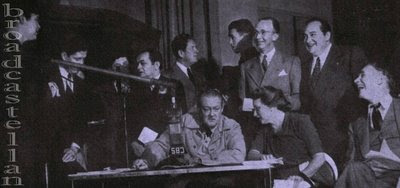
I might as well end this year’s regular programming here at broadcastellan with a bang. This one was sure made an impact, heard by as many as sixty million Americans—at once. Subtitled “A Dramatic Celebration of the American Bill of Rights, Including an Address by Franklin D. Roosevelt,” We Hold These Truths made radio history on this day, 15 December, in 1942. It also made the most of history in the making.

“No other single dramatic performance [. . . ] ever enjoyed so large an audience,” author Norman Corwin remarked in his notes on the published script. The program was “[w]ritten at the invitation of the US Office of Facts and Figures” to commemorate the 150th anniversary of the United States Bill of Rights, which came into effect on 15 December 1791,; but it was already in the works when the attack on Pearl Harbor took place.

“In fact,” Corwin later recalled (in Years of the Electric Ear), “I was on a train travelling from New York to Hollywood, still working on the script when the attack on Pearl Harbor took place.” Now that the United States had entered the war, the broadcast became a rallying cry, a reminder of the rights it is the duty of all those who possess them to protect.

“To many listening Americans,” Movie-Radio Guide summed up in its 3-9 January 1942 issue,

the big “Bill of Rights” program broadcast over the Nation’s networks Monday, Dec. 15, was an utterly unforgettable event. To the many personalities who joined their talents to produce the program it was likewise a memorable privilege. Coming as it did at a time when it could not have meant mere to the nation, the broadcast brought America figuratively to its feet. A transcription of the superb dramatic production [. . .] will be preserved in the archives at Washington.

The cast, as shown above, included Orson Welles, Rudy Vallee, Edward G. Robinson, Bob Burns, James Stewart, Walter Brennan, Edward Arnold, as well as (seated) Lionel Barrymore, Marjorie Main, and Walter Huston.

According to the Movie-Radio Guide, “[o]ne of the highlights of the presentation was the performance of James “Jimmy” Stewart.” So moved was he by the reading that, at the close of the broadcast, he “pulled off his earphones” and “let down his emotions, excusing himself from the studio and reportedly breaking into tears in private.” No wonder, Stewart was called upon to introduce President Roosevelt, who addressed the public from Washington, DC. Upon this experience, the humble actor remarked: “Imagine a corporal introducing a Commander in Chief of the armed forces!”

Not Quite the "Voiceless Sinatra": Van Johnson (1916-2008) on the Air

I am not sure who came up with the moniker “the voiceless Sinatra,” which is attached to virtually every obituary of and tribute for Van Johnson, the Hollywood actor who died on 12 December 2008 at the age of 92. Apparently, the coining of the phrase dates back to the mid-1940s and was meant to capture the boy-next-door’s appeal to teen-aged moviegoers (audible in the 11 December 1945 Theater of Romance introduction to Love Affair). It is a misleading label nonetheless, considering that Johnson was heard in musicals and had many a voice-only part in the so-called theater of the mind. Back in 1985, I saw him on the New York stage, when he starred in La Cage Aux Folles, the first Broadway musical I ever saw. Johnson’s show business career was long and diverse, if slow in becoming distinguished.

Many of his early roles were little more than featured bit parts designed to draw attention to the young hopeful on the MGM lot. As was the case with many a rising star, radio assisted in his promotion. Along with first-billed Edward Arnold and his co-star Fay Bainter, Johnson was given the opportunity to reprise his role in The War Against Mrs. Hadley for the in a Lux Radio Theater, in a broadcast commemorating the first anniversary of the attack on Pearl Harbor (7 December 1942). Introducing the players, host Cecil B. DeMille referred to Johnson as one of Hollywood’s “promising newcomers.”

Due to a severe accident, Johnson very nearly did not get a chance to make good on that promise. Barred from military action, he served his country on the home front, appearing in a string of wartime pictures, including The Human Comedy, A Guy Named Joe, and Thirty Seconds over Tokyo. Last night, I saw him in The White Cliffs of Dover. In it, Johnson plays the hapless admirer of a young woman (Irene Dunne) who visits England shortly before the Great War, falls in love and stays. Johnson is seen in the opening scene, but has only one memorable moment thereafter when he gets to kiss his married sweetheart during a chance encounter. I suppose MGM had so many stars back then that it could afford such frivolous casting.

Throughout the Second World War, Johnson remained “one of the screen’s most rapidly rising young personalities,” as he was billed on the 2 November 1944 broadcast of Suspense. Since his fine performance in “The Singing Walls” is not available on the Internet Archive, where you will hear Preston Foster and Dane Clark instead (in a 2 September 1943 production of the play), I have temporarily made the recording available here..

Johnson returned to Suspense four times, namely for ”The Defense Rests” (6 October 1949), ”Salvage” (6 April 1950), ”Strange for a Killer” (15 March 1951), and “Around the World” (6 April 1953).

Aside from his numerous dramatic performances on the air, including the Theatre Guild’s non-musical presentation of State Fair (4 January 1953), Van Johnson was also heard singing “Pennies from Heaven” as a tribute to an ailing Bing Crosby on The Big Show (1 April 1951). “I haven’t been singing much since I’ve been in pictures,” the former “song-and-dance man” warned his hostess after performing in a scene from his upcoming picture Go for Broke (1951), “My voice might crack.” Well, whatever Bob Hope’s cracks, “Go for Croak” he did not. Van Johnson’s was not such bad record for someone allegedly “voiceless.”

The Black Sheep and the Baby: A Kind of Christmas Story

I was not the last person to see Ilse Hiss alive; but I would like to think that I was the last one she had wanted to see. Shortly before Thanksgiving, Tante Ilse had been hospitalized with pneumonia. I knew then that she would not come out of that room upright and walking. She knew it, too. During the last few years of her life, I had gotten very close to my great-aunt. I have no other relatives in America, and none elsewhere that would speak to me. Call me a black sheep, if you like. I’m sure my family calls me many other things besides. Anyway, this isn’t about me. This isn’t even about Tante Ilse; but I had no idea what is was all about when the nurse handed me that small parcel. My inheritance, I thought.

Tante Ilse had already left me plenty. Memories, mostly. Hours of impressions and recollections I had preserved on tape. Her ‘recording angel’ she once called me in what I assumed to be a rare moment of sentimentality. Then she winked at me, chuckled, and, in that year-round Octoberfest of an accent she had kept after nearly six decades of life in America, she added: “Aindshell? I brobaply don’t know der haff of it.”

Tante Ilse, as I said before, had been a baby crier; she had a talent for bawling that was very much in demand during the days before television, when radio was the nation’s home theater. “Vrom me, dey wanted only babies,” Tante Ilse summed up her unlikely—and largely undocumented—history in show business. “Alleright, babies I gave dem. Och, how dey endjoyed to hear me gurkle and coo. Only during Christmas I vas still. Den, de holy invent dook over; and he was not allowed to make much noiss.” So, when the nurse handed me that audiotape, I expected it to contain a sampling of her cries.

To my disappointment, there wasn’t as much as a whimper on it. Just talk and music, and a rather dismal poetry recital: an old radio program from one of New York’s small, independent stations. As tuned-in as I was to old-time radio back then, having made it the subject of my Master’s thesis, I did not recognize any of the voices. Why had my aunt given me this recording? And why had she not shared it with me before? I could not help thinking that Tante Ilse, prim and Protestant in spite of herself, was sending me a message she could only deliver from the grave.

Aside from Walt Whitman, whose poetry was haltingly recited, the only name mentioned on the program was that of the announcer, one frightfully British sounding Cecil Bridgewater, whom I had never heard of. I was none the wiser after my aunt’s funeral. The friends she made during her radio days had long passed on, and no one present could recall much of her early life, her leaving Germany after the Nazis had come into power, her struggle to earn a living in New York City, and her unlikely foray into broadcasting after she was overheard imitating a toddler at her neighborhood market. “You call this grying?” she had scoffed; and when she screamed back, a radio executive in line took note.

I had her account of all that on tape. I never got to ask, though, and never dared to ask, just what had prompted her to leave her home town, accompanied by her brother, Heini, a miserable failure of a man about whom I knew nothing other than that he had deserted his wife and unborn child for a new life in New York. My father never spoke of Opa Heini, who died in apparent shame and obscurity before reaching the age of sixty, other than referring to him as the “Deserteur.”

Anyway, I followed Tante Ilse’s example more than half a century later, for very personal reasons of my own; and as thorough as I was in my research of her odd career as a baby crier, I never insisted on getting her life story, assuming that, like an infant, she would speak when she was ready. What a lousy excuse for a historian I had been; and how I regretted not to have asked while I still had the chance.

But, back to the tape. This was a few years before we all got on the Internet, mind; and, having checked every book on the subject of broadcasting available to me, all I could think of was to consult the Manhattan telephone directory. Would you believe, there was a listing for C. Bridgewater.

So, shortly before Christmas Eve, I found myself in the Upper East Side apartment of one Cecil V. Bridgewater, aged 94. A dapper chap he was, with a keen memory, for the gift of which I very much envied him. I played the recording. Not only did he recognize his voice, he recalled the program, Poetry for Everyone, which he announced during the early 1940s. He had never heard of my aunt, though; and, as we listened, he kept eyeing me, as if wondering what I had really come to find out.

I was about to leave when he turned to me and said: “You know, about that fellow who read Whitman.” “Yes?” I asked, encouragingly.

“He was not much of an orator, was he?”

“No,” I agreed.

“He wasn’t a professional, either, just a college kid from Columbia who had volunteered to recite. The station had little money for voice talent. He was never asked back.”

“I’m not surprised,” I retorted, flippantly.

“The thing was, he wasn’t really reading for Everyone,” at which point the old man performed a little dance with his finger to put the last word in quotation marks.

“No?” I urged on.

“I think I can tell you,” he responded, confidentially. “He was reading it to someone in particular. Like a code, you know.”

Tante Ilse, I thought.

“And he got hold of the transcription, as well. You know, a recording of the broadcast. I can think of only one person, besides him, who could have kept it all those years.”

I sensed he was not referring to my aunt.

“When I walked out of the studio that night, I saw him again,” Mr. Bridgewater continued. “He was in the company of another young fellow and, well, they looked very much . . . absorbed in each other’s company.”

He looked at me, and gave me a knowing smile. “I remember it well because I was very suspicious.”

“Because they were both men?” I asked.

“No,” he said, rather irritated by the question, “because the other one was German.”

At that moment, for the first time, I felt a kinship with that other black sheep beyond the fold, for mine was a story that my grandfather had lived. And I was grateful to his sister for giving me a chance to find him out at last by sharing what she could be sure would stir me to research. How brave of Tante Ilse to leave behind all she knew for the sake and safety of the likes of me, sheltering him in a cloak of silence, even as she cried like a newborn child:

Do you see O my brothers and sisters?
It is not chaos or death. . . It is form and union and plan. . . . it is eternal life. . . . it is happiness.

"Everybody talks too much": Dylan Thomas and the Long-Lost "Art of Conversation"

“To begin at the beginning.” Thus opens what is undoubtedly the most famous of all plays written for radio: Under Milk Wood, by Welsh poet Dylan Thomas. BBC radio first produced the play in January 1954, with fellow Welshman Richard Burton in the role of the narrator. It had been previously performed in New York, shortly before Thomas’s death in November 1953 (which is the subject of a new book, Fatal Neglect by David N. Thomas, whose previous biography was the source for the motion picture The Edge of Love. Thomas’s poetry is still widely read today; but little is known generally about his other works for the wireless, about which there is generally little talk these days.

Thomas’s most popular story, “A Child’s Christmas in Wales” (published posthumously in 1955) was originally written for radio, as may be deduced from the attention Thomas’s pays to descriptions of sounds and voices, from the “most unducklike sound, a mewing moo that an ambitious cat might make who wished to be a cow” to that “small, dry voice, like the voice of someone who has not spoken for a long time,” a “small, dry, eggshell voice from the other side of the door: a small dry voice through the keyhole.”

Indeed, as I learned from Douglas Cleverdon’s introduction to the Folio edition of Under Milk Wood, Thomas had been on the air, whether as poet, critic, or actor, since 1939. Among his broadcast features is “Return Journey” (1947), a precursor to “Mad Town” (as Under Milk Wood was initially titled); it has been published in the anthology Wales on the Wireless (1988). Earlier this year, another play for voices by Dylan Thomas has been discovered and is now being given its first production on the air. Titled “The Art of Conversation,” it is available online until 9 December.

The title is somewhat misleading, since the play is really about shutting up. It is a Second World War propaganda piece, commissioned as part of a “Loose Lips Sink Ships” campaign, the sort of cautionary talk on the virtue of silence exemplified in the US by mystery writer Mignon Eberhart’s “The Enemy Is Listening” (Cavalcade of America, 7 June 1943). In it, a sinister voice (Everett Sloane’s) replies to remark that no “real American intends to give information to the enemy,” that

sometimes, sometimes someone forgets.  A word overheard and repeated. A small fact passed on to someone else may mean little to you.  It may mean nothing to the person to whom you repeat it.  But the third or the fourth person or the tenth or the twentieth may be your enemy. Your enemy.

Thomas’s “The Art of Conversation” is a rather more subtle performance. It permits us to indulge in the excesses of talk by Britain’s most celebrated conversationalists, only to remind us that there are times when—and subjects about which—the word should be “mum.” “I don’t think you’ll find Mr. Hitler with a little notebook under our table, do you?” one careless talker quips; but, just to be on the safe side, the idle talk that ensures is being censored.

Like Eberhart, Thomas weaves a web of compromising voices; yet he dispenses with melodrama and, indeed, as is typical of his compositions, with plot altogether. Instead, he opts for an informal lecture (replete with audience) punctuated by “the lantern slides of sound”: a multitude of voices, some distinct, others choric. All are preliminaries and subject to shushing:

Hundreds of odds and ends of hundreds of hearsays and rumours may, and can, be brought together into such a pattern that a whole Allied enterprise is thwarted or destroyed. A wagging tongue may sink a ship; a stray word over a mild-and-bitter may help to murder children.

However chatty and playful, “The Art of Conversation” eventually gets down to business and brings its message across; at least, it might have done, had it not disappeared for decades—apparently before it was ever broadcast. According to the current issue of the Radio Times, there is no evidence that the play was intended for radio; but you need only to listen to know that it could have hardly been written with any other medium in mind.

Alison Hindell’s belated production slightly condenses the original script (available here in its entirety), but otherwise takes few liberties with Thomas’s prose and directions; a 1920s “nigger” is turned into “negro,” a concession to our politically corrected sensibilities. Few US radio dramatists were treated with such respect.

The single exception is the rather pointless addition of an opening line that is not part of Thomas’s “Art,” but the famous introduction to Under Milk Wood, quoted above. No doubt, the presenters intended to draw the famous poet into his forgotten “Conversation,” so as to validate this lesser performance; but, instead of indulging in such self-conscious reverberations, they should have left themselves out of it, especially since there is enough of Thomas in it to make the lecture worth our while.

If only a discovery like this could get us talking again about radio . . .

Even Reindeer Get the Flu

Four weeks and a day! As the exclamation mark suggests, being that I use it so sparingly, I am not counting down the days to New Year’s Eve here or marvel at the seemingly accelerated passing of time. It is the time my cold has been taking thus far to run its collision course and me crazy into the not so welcome bargain. It could be, though, that today’s headache has been exacerbated by Mickey Rooney.

My attempt to book tickets to his latest show, that is. I tried to get in touch with a sales representative to make sure that the tickets I ordered online won’t be sent to our home, as requested, given that, as it dawned on me only after I had finalized the booking, we are elsewhere during the latter part of December.

The apparently unstoppable octogenarian, Judy Garland’s co-star in a series of musical-comedies, is going to be in one of those pantomimes so popular in Britain during the holiday season; this time, some eighty-two years after his acting debut in motion pictures, he appears at the Hippodrome in Bristol, England, where we had planned to spend the final forty-eight hours of 2008.

The busy Mr. Rooney, slated to appear in four films in the upcoming months, stars opposite British stage and television actress Michelle Collins, whom last we saw backstage at the Shaftesbury Theatre in London (and whose autograph I displayed here). Anyway, I eventually sorted out the mailing situation and can only hope that the constitution of the man formerly known as Andy Hardy will prove sturdier than mine.

I am in the mood for a seasonal tale, tall or otherwise, but would much rather close my eyes than read Christmas Stories with its selection of fiction by Conan Doyle, Damon Runyon, Evelyn Waugh, and, a personal favorite, Anthony Trollope. So, once again, I rely on the radio, or recordings of plays once produced for the medium. On this day, 2 December, in 1945, The Philco Radio Hall of Fame presented a new story, which it predicted to “become a Christmas classic.”

Never mind that this prediction did not quite come true. After all, the woman who made it was not chiefly known as a clairvoyant, even though she had a voice that could induce millions to spend millions on war bonds and forge stars in the smithy of her own radio shows. Announcer Glenn Riggs somewhat needlessly reminded the public that, “as commentator, singer, forceful personality and discoverer of stars,” she had “no equal on the air.” Yes, it was Kate Smith who ventured that guess, no doubt boosting the sales of the volume. When Smith sings, you can count on sales as well as volume.

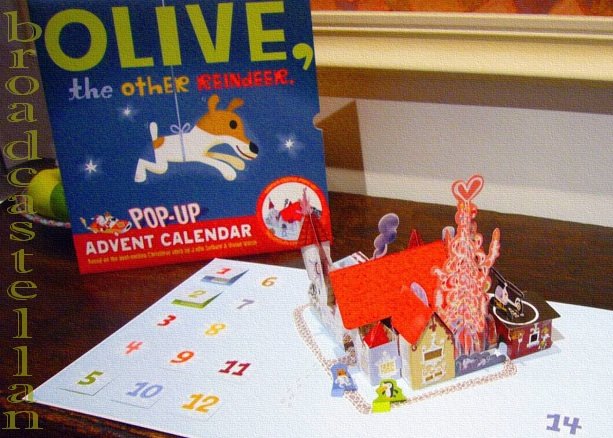
On the Hall of Fame, Smith not only belts out a number of tunes, including “If I Loved You” from the latest Rodgers and Hammerstein musical Carousel and her celebrated rendition of “God Bless America”; as story lady, Smith narrates a dramatized version of Roger Duvoisin’s “The Christmas Whale,” a whimsical paean to ingenuity involving the breakout of a flu epidemic at Santa’s toyshop and the reindeer that flew not because they all came down with it. Perhaps, such susceptibility explains why this year’s advent calendar featuring Olive, the Other Reindeer, arrived a day late in the mail.

The title of Duvoisin’s story leaves no doubt as to the creature lending a helping fin. Perhaps, the sudden substitution was a metaphor for the death of FDR just at the time when things were beginning to look up and the theaters of war were closing, not merely for the duration of the holidays. There is no mention of Harry Truman; but, when asked what Christmas gift she would make General Eisenhower, Smith remarks: “Well, I’d give him a future as great as his past.” Perhaps, she was prophetic after all . . .

Picking up The Magic Key

When I was growing up, looking forward to Christmas meant opening the Türchen (little doors) of an advent calendar (last shown here). Every morning, for twenty-four days, colorful pictures marked the countdown to Heiligabend, as Christmas Eve is known and celebrated in my native Germany. In an update of this seeming oxymoron—the surprise-filled ritual—I am trying to turn this journal into such a calendar, discovering something new to think, wonder, and write about. There won’t be twenty-four doors, mind you, since I am going to make an exit to London on the 17th, from which day forward there will be many a silent night here at broadcastellan; but, during the next few weeks, I shall open as many Türchen as time and internet access permit.

Perhaps, this isn’t so very different from what I do with this journal throughout the year; but I shall endeavor to make what’s behind the door a revelation, or a surprise, at least, to myself—stories, voices, and personalities I have not yet mentioned on these virtual pages. Rather than being a reflex, the surprise is a reaction for which I shall have to strive. What I find behind those closed doors, I should add, may not always befit the spirit of the season.

I shall open the first door by picking up The Magic Key, a popular US radio variety program of the mid to late 1930s; sponsored by RCA, it was designed to promote the wonders of radio, no expenses spared. On this day, 1 December, in 1935, the hourlong program offered “varied entertainment, from Buenos Aires, Ottawa, Canada, Chicago and New York City, presented for the families of the nation by the members of the family of RCA.”

The afternoon’s entertainers included silent screen idol Richard Barthelmess who, opposite Warner Brothers’ star Jean Muir, made “one of his rare microphone appearances” in a scene from Maxwell Anderson’s Pulitzer Prize-winning Saturday’s Children, along with Eddy Duchin and his orchestra, Eduardo Donato and his tango ensemble, members of the cast of George Gershwin’s Porgy and Bess and, if that weren’t varied entertainment enough, John B. Kennedy touring the Chicago stockyards and a report from Canada’s Minister of Agriculture. All live, of course, both from the studio and via hook-ups.

The Magic Key was a marvel in this respect, and it wasn’t bashful about being marvelous: “Within the memory of men now living, the speediest communication between New York and Buenos Aires consumed twenty-seven days. Today, we’ll make the journey in so many seconds [. . .].”

The highlight, for me, are the scenes from Saturday’s Children; but it is difficult to enjoy the performance, knowing what actress Jean Muir had to endure throughout the 1950s, when the doors to sound stages and broadcast studios were closed to her as a direct result of anti-Communist hysteria. In 1950, Muir’s name appeared in Red Channels, effectively barring her from starring in the television version of The Aldrich Family. As Rita Morley Harvey tells it in Those Wonderful, Terrible Years, Muir sought “solace” in alcohol, suffering “poor health” and “personal sorrow.”

Muir’s is a notorious case of witch-hunting; and, considering that few recordings of her radio performances are extant today, it is a thrill to hear her on this Magic Key program, well before radio, anxious to avoid scandal and diminished returns, decided to lock her out. “The proverb says,” Richard Barthelmess remarked in an overly complicated setting of the scene, “that Saturday’s children must work for a living”; but a regular job as only radio and motion pictures could offer an actor back then was a luxury denied the talented Ms. Muir.

As if to comment on things to come, the scenes from Anderson’s play involve a peculiar gift: a bolt, a hammer, and a screwdriver, given to Muir’s character, “a free agent” lately separated from her husband, by her boss, an admirer who wanted to guard against an inquisitive landlady. “Anytime you want a bolt on your door,” her still-loving husband implores her, “I wish you’d ask me.” Unlike Muir, her character got to choose whether to bolt the door or bolt.

The broadcast closes with the obligatory holiday shopping reminder, announcer Milton Cross insisting that the “members of the family of RCA [were] eager to help make your Christmas holidays happy ones. Will there be an RCA Victor in your home this Christmas?” I wish there were occasion for such a purchase these days; but, about half a century ago, the makers and sponsors of radio entertainment decided to throw away those magic keys to the kingdom of make-believe . . .

Let’s Pretend . . . We’ve All Grown Up

Just how up have we grown since, say, the 1950s? You know, those innocent days of atomic terror, Cold War fears and anti-Communist witch-hunting. We who presume to have grown up tend to make small of what lies behind us, whether we ridicule or romanticize it. We not only know, we know better. We believe ourselves so much more educated, sophisticated or complicated than folks back in the day, whatever that day might be. It rarely occurs to us that we may have lost something other than simplicity, that we have forgotten much that was worth remembering. All those fables and fairy tales, for instance, those legends and myths that once were known to children and adults alike, the archetypal yarns that bound us, tied us to distant yet related cultures, to past generations, and to antiquity by reminding us that we are one with the earth and the universe. We have not so much grown up, it seems to me, as we are growing apart.

Imagine a children’s program these days dramatizing the by now little known story of “Ceres and Prosperina,” which was heard on this day, 28 November, in 1953 by anyone tuning in to the popular and long-running radio series Let’s Pretend. Obviously, this was well before those Teenage Mutant Ninja Turtles graced the plastic lunch boxes of a myth-starved generation.

Let’s Pretend rarely resorted to such faux myths and ersatz folk tales; instead, it kept many of the traditional ones alive, from “Bluebeard” to “Hiawatha,” from “Jason and the Golden Fleece” to “The Emperor’s New Clothes.” Under what Norman Corwin in his Foreword to cast member Arthur Anderson’s chronicle of the program called the “benign dictatorship” of Nila Mack, Let’s Pretend “enjoyed a run of 24 years, during which it scooped up almost half a hundred national awards, and also during which the adapter-director-producer smoked two and a half packs of cigarettes daily.”

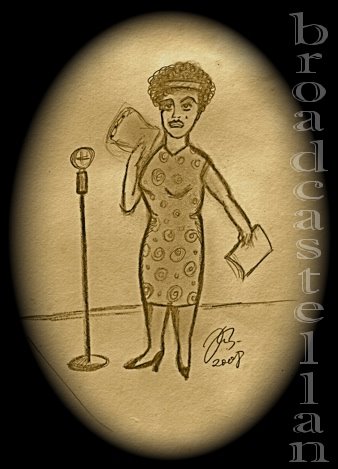
For the “Ceres and Proserpina” episode, the producers of the series (Ms. Mack, pictured above, had died earlier that year of a heart attack) did not feel obliged to explain just who these characters were, other than pointing out that this Roman myth was a perfect story for Thanksgiving, which had been celebrated two days prior to the Saturday broadcast. As the host of the series, Uncle Bill Adams, put it:

Thanksgiving is America’s own holiday; but ever since the beginning of time people have been celebrating the harvest season one way or another. The Greeks and Romans, two thousand years ago, had a wonderful harvest story. And today we’re doing it for the first time on Let’s Pretend.

All that needed to be clarified to make “Ceres and Proserpina” (as streamlined and sanitized for radio by Johanna Johnston) come alive to the target audience of tots was the meaning of the word “pomegranate.” As Sybil Trent defined it, “it’s round and red, and a little bigger than an apple, Pretenders, but the inside is full of red seeds like big currants, full of juice and very delicious.”

I suspect that, these days, the producers of a kids’ program would have to spend more time explaining or justifying their choice of presenting a myth like “Ceres and Proserpina” than they would the shape or taste of the fruit that plays such a pivotal role in it. Thanksgiving aside, the story was readily made relevant to its listeners, who were reminded of the people who, even eight years after the end of the Second World War, were living in abject poverty overseas. As announcer Jim Campbell explained:

Yes, Pretenders, now that the Thanksgiving season is almost over and everybody is beginning to think about Christmas, here’s a reminder for you to pass on to your families. Many children, and grown-ups, too, in lands that were devastated by the war, face a very miserable Christmas indeed, unless some good Americans play Santa Claus for them.

This year, a “miserable” or, at any rate, less splendid holiday season is being forecast for many families, including “some good Americans”; but no one seems to advocate Ovid’s Metamorphoses as an alternative to the computerized fantasy games that are less likely this season to fly off the shelves of the electronic stores not yet closed down for good. Along with cost-effective radio dramatics, mythology is the kind of nutritious snack that has long disappeared from the menu of children’s entertainment. The change of seasons, fancifully explained by “Ceres and Proserpine,” is now defined by commerce, by what is and what is not on display in the shop windows. It is the modern myth of perpetual growth and prosperity that may well prove the less relevant and enduring one. By all means, have that pomegranate, but brace yourself for a prolonged visit with Pluto.

Blind Justice; or, ‘1000 for Verdicts’

“It does not matter whether your verdict is ‘guilty’ or ‘not guilty.’ If your reasons for it are good enough you will share in the prizes.” With this peculiar invitation, millions of US Americans were lured to their radios, tuned in to WJZ, for a trial in which they, the listening public, were called upon to act as jurors. As previously mentioned here, it all began on this day, 25 November, in 1930.

The judge in the case was none other than New York Senator Robert F. Wagner, lending gravitas to a spectacle that was, in more sense than one, a trial broadcast. Would listeners find fictional society beauty Vivienne Ware guilty of the murder of millionaire architect Damon Fenwicke, a crime for which she could be sentenced to the electric chair? And would they leap out of their armchairs to boost not only their own circulation but that of their local paper by rereading what they just heard on the air?

“It is no part of your duty to decide whether or not she shall die,” Senator Wagner insisted. That, he told the listeners,

is the function of the Court and the Law.  But you must remember that in endeavoring to secure a conviction of this young and beautiful defendant the District Attorney is but pursuing the business to which you, the people of this State, have set him.  You will consider carefully all the evidence as it is presented for you from the witness stand.

Whether or not their voices could kill, those tuning in nevertheless derived their thrills from the importance of the interactive role granted to them. Tune in, have your say, all for a chance to win a substantial amount of dough—what’s not to love!

Leave it to a Hearst paper to conceive of a reality show like The Trial of Vivienne Ware—a trial that sold papers and bought the jury. Those who caught up with the daily broadcasts from the courtroom and read transcripts and analyses in their daily Hearst paper were rewarded for being informed enough to arrive at the verdict they were invited to mail in. No attendance, no deliberations with fellow jurors required. All that was needed, aside from a radio set and a few cents for daily tabloids, was curiosity, rhetoric, and greed.

You might say it was just fiction, this fictitious call for justice; but the Hearst press, known to have started a war with mere words, was doing its utmost to make the trial seem as real as the joined media of radio and the press could make it, all with the aim of a very real boost in sales through a cleverly manipulative marketing campaign.

More than a radio serial, The Trial of Vivienne Ware is one of the most elaborate and dubious media events ever staged. All that remains of it now are a number of newspaper articles and a book touted as “an innovation in both the radio and publishing worlds”—the “first radio novel.”

To be sure, Kenneth M. Ellis’s “novel”—a combination of faux news reportage and courtroom dialogue—has none of the thrills of the original experience. Its failure to excite and convince convincingly argues the power of the media to create a sense of reality through the realities we glean from sensation.

Once More Round the Horne

I just got back from Brighton, England, the popular seaside resort that is pretty much the gayest town in all of Britain. So, to speak in the cheek-lodged tongue of Polari, I was bound to have a “fantabulosa” time. And how “fantabulosa” was it for an old “omi-palone” like me to have Round the Horne playing just round the corner at Brighton’s Theatre Royal. Considering that Round the Horne is a British radio series whose last original episode aired back in 1968, I could hardly believe my “ogles” when I read that it was on while I was visiting. I was thrilled to get my “lills” on a pair of tickets to “aunt nell” some of the wittiest comedy act never seen by millions.

Round the Horne: Unseen and Uncut is an ingeniously—if deceptively—simple production. It merely presents two of the sixty-six 45-minute broadcasts from this much-loved and well-remembered BBC program (1965-68), separated by an intermission that only the most humorless of stick-in-the-muds would take as an opportunity to make a hasty retreat. The scripts are taken directly from the original series. You would not want to tinker with lines composed by Barry Took (Laugh In) and his writing partner Marty Feldman. You certainly would not have to.

The second act (or half, rather) builds on the first, allowing viewers to pick up the rhythm of the show, pick up on the slight but clever variations, and pick their favorite among the recurring characters in a line-up including Fiona and Charles, an aging pair of actors who reprise their preposterously Cowardesque silver screen dialogues (“I know you know I know”) in that posh and most unnatural anti-vernacular of BBC English; folk singer Rambling Syd Rumpo with yet another rendition of his Jabberwockian tunes; and, of course, Julian and his friend Sandy in all their Polari-riddled glory that was enjoyed by millions but understood and shared by only a few whose nature made them appreciate the subversiveness and desperation of such artifice. After all, homosexuality was still illegal at the time.

Of course, the production is not at all simple. The performers are called upon to impersonate well-known radio (and television) personalities, including Kenneth Horne (played by Jonathan Rigby), Kenneth Williams (Robin Sebastian), and Betty Marsden (Sally Grace). Standing behind a row of microphones, without any other props of scenery to speak of, the six cast members (not including the singers and orchestra members) have to sound the part and deliver their borrowed lines with an enthusiasm that is thoroughly rehearsed without sounding disingenuous. Along with the harmonizing quartet known as Not the Fraser Hayes Four, the seen voices of this stage show are fully deserving of a hearty cheer of “fantabulosa!”

However convincingly the experience of attending a live radio broadcast (or a recording session thereof) in a studio is being recreated, though, one aspect of such productions has been overlooked or obscured. Hidden from view were the indispensable sound effects artists whose presence would have completed the picture. I would have settled for an extra pressing a number of buttons while seated among the musicians who were in full view at all times. Instead, the recorded yet well-timed effects (from footsteps to horses hoofs) came from a loudspeaker, its makers or purveyors unseen and, a mention in the playbill aside, unacknowledged.

The production might also have benefited from a few glances behind the scene, with actors walking on, preparing for their roles or having a chat before each broadcast. No dirt, just an element of realism. Since Took’s widow serves as “script consultant” for this touring show, some insightful biographical notes might have been worked into this simulation. Kenneth Williams’s life, in particular, is worth exploring in a stage drama. According to the playbill, the “action takes place” at the “BBC Paris Recording Studios in Lower Regent Street, London”; but what there is of action hardly speaks as loudly as the words. This is “theater of the mind”; and once it is taken out of the wooden O of your cranium, you begin to wonder whether what you see is really what you get as you make an effort to wipe your “oglefakes.”

That said, I was glad for this chance to catch up with Round the Horne—and at such an opportune moment to boot. It so happens that, this Friday, 28 November, BBC Radio 7 is rebroadcasting the 7 March 1965 debut of the program, with subsequent episodes to follow sequentially in the weeks and months to come. My “aunt nells” are ready for it . . .