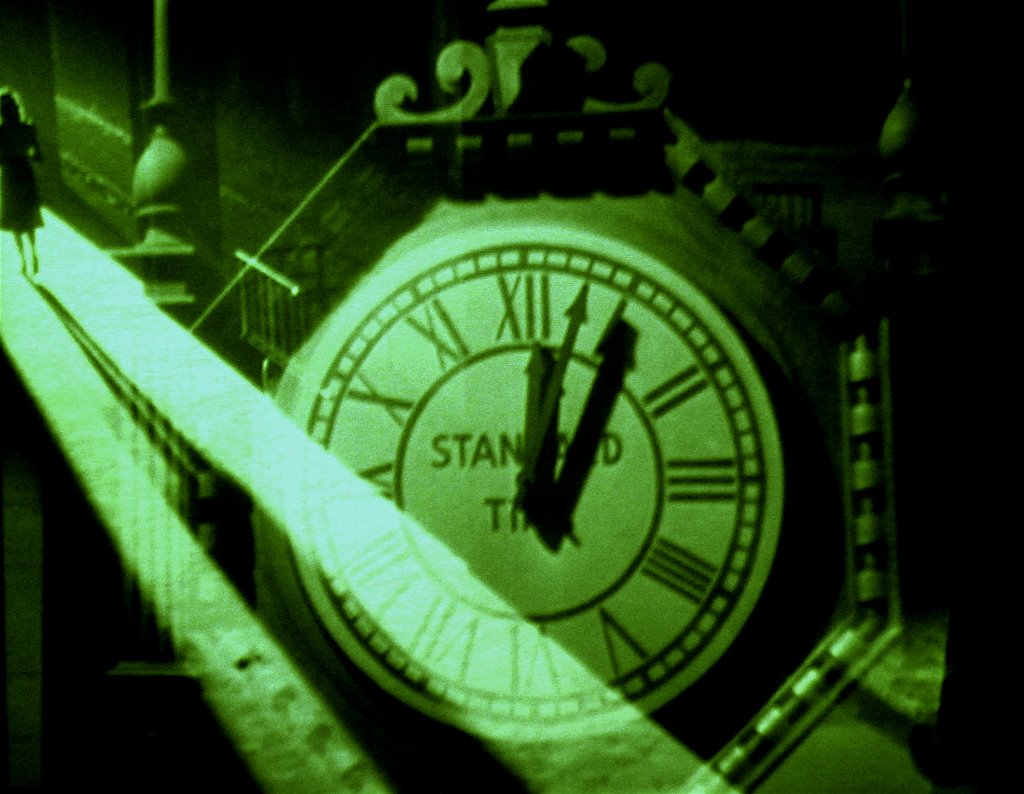
“Being Served”: Mr. Humphries, Mr. Dickens, and Me

Well, we’re “free”—all of us. John Inman, the outrageously queer men’s wear salesclerk Wilberforce Clayborne Humphries of Britcom fame, is free of all bodily cares after taking the inside leg of the grim reaper today at age 71. Mr. Dickens, whose words have long been spread somewhat too freely in the public domain, is currently being made free with in a new stage adaptation of Great Expectations, the world premiere of which I attended last night. And I? After having been Internet-free for yet another ten days (four weeks and counting so far this year), I am at liberty at last to go on about Mr. Humphries, Mr. Dickens, and myself . . . sharing the miseries of not Being Served well.

“I’m free!” That, of course was Mr. Humphries’s catchphrase, a phrase to catch his drift with. And while he wasn’t, really trapped as he found himself in that ultra-conservative world of the Grace Brothers emporium—oh, brother, the disgrace of Empire!—watching him sure felt liberating to those who shared his lot. Particular, prickly, and peculiar, Mr. Humphries came across as a none-too-distant cousin of Franklin Pangborn, the Queen of Paramount. You know, the kind of character you are free to laugh at, if only to remain in the chokehold of the stereotypes that brought him into being.

For anyone who, like me, grew up with an anxiety of being deemed abnormal, an anxiety that, to be endured, was best (that is, most safely) wrapped in the cloak of flamboyancy, Mr. Humphries was at once a model and a monster—a grotesque mask you felt inclined to pick up mainly because you lacked the fiber and fortitude to tear down the structure responsible for its manufacture and marketing. No, the likes of Mr. Humphries are never free. Mr. Inman, at least, got to celebrate his coming out, however late in life, by publicizing his “gay wedding,” thereby to dismantle what is the most insidious of all secrets . . . the open one.

Mr. Humphries is a thoroughly Dickensian character: a mores-reflecting surface that is buffed up to speak and account for the unspeakable and unaccountable: a caricature that sanitizes as it unsexes. In the Dickensian universe—which is no larger than a Victorian middle-class closet, a repository of so many readily retrievable garments—it is the figure of Pip that best demonstrates the pitfalls of trading one’s identity for a dangled, ready-made mask—a substitution of which its creator had made a trade. Pip is as much a mask of melodrama as it is an unmasking of its workings and limitations.

Pip’s struggle and ultimate inability of coming into his own become apparent in Neil Bartlett’s adaptation of Dickens’s story, in which the episodes of Pip’s life are staged with a minimalism that divests the melodrama of its thrills and offers nothing in their stead, a creative “zilch” for which “existential void” is a mere euphemism. A set of loudspeakers is filling in as a Greek chorus, robbing Pip of the only authority he enjoyed—the privilege to relate the tale in which he found yet failed to find himself.

The silhouettes of characters traversing the stage in front of a white screen suggest what is clear from the start of this production: that none of the figures in the play are treated as living individuals, an impression enhanced by the doublings of most of the eight cast members. The avoidance of overt reflexive gestures—a director in search of his characters, perhaps—render altogether lifeless what might have generated some energy as a Brechtian comment on the world Dickens inhabited and peopled, a world whose masks and conventions we have not quite managed to drop, as much as we delight in making a spectacle of it.

The Big Brother Incident

Well, I did not tune in for it; but you would have to be dwelling under a boulder without broadband not to have become aware of the diplomatic incident and international protests caused by the treatment of Bollywood star Shilpa Shetty on the Channel 4’s Celebrity Big Brother program here in the UK. I generally shut off and down at the mere mention of the word “celebrity,” which to me signals the exhibition of some latter-day Zsa Zsa Gaborisms—the state of being prominently stupid for the sake of being stupendously prominent—that I can well do without.

Where is the humility that convinced notoriously competitive Rose Nylund (portrayed by birthday Girl Betty White, born on this day in 1922) to turn down the St. Olaf Woman of the Year award after discovering that the judges had been swayed by a spurious account of her achievements?

That said, confronting undereducated, overexposed, and self-absorbed have-beens or wannabes with someone who is someone somewhere else strikes me as an inspired premise for a potentially edifying spectacle. It might offer a cultural corrective to the culturing of fame, forcing those who fancy themselves somebodies—along with those who buy into or by way of mockery perpetuate the process of celebrification (the fabrication of celebrity)—to reevaluate the limits and merits of popularity. At any rate, it lends a culture clash edge to a program that is otherwise nothing but trash edging itself in on culture.

Now, Celebrity Big Brother has received some twenty-thousand viewer complaints citing the abuse of Ms. Shetty by other housemates, deploring the ethnic slurs and biasides (you know, those tossed in remarks revealing a speaker’s prejudices) that have translated into a ratings bonanza for the program. In a development worthy of satirist Johnathan Swift, these televised housecoolings have led to protests in India and protestations by the British Prime Minister (who, like the folks in the East, has never seen the show).

The public shaming of this guilty pleasure is a remarkable development indeed, considering that much of British entertainment is based on the principle of offending. Apparently, it is acceptable to caricature and be-Little Britain, but not to portray as reality the actual small-mindedness of some of its people who have been elevated to the status of representatives by virtue of their omnipresence.

It’s been good for business, this brouhaha; but might a muzzle put an end to the foul-mouthing? Could Big Brother live up to its Orwellian name by resulting in overzealous watchdoggedness, by causing a backlash more profound than the aftermath of Janet Jackson’s wardrobe malfunction, by pushing any kind of social controversy off the screen and by keeping prejudice private so that it may flourish, undetected and unchecked. Perhaps it is better to permit those in need of publicity to make fools of themselves (and each other) than to fool ourselves into believing such ignorance extinct.

The ongoing debate whether to aspire to cultural universals or favor the ethnically distinct predates the social climate change brought on by political correctness. Jewish writer-actress Gertrude Berg (previously mentioned here), whose sitcom The Goldbergs had its television premiere on this day in 1949, once remarked about the success of her series in the age of anti-Semitic Gentleman’s Agreements that “we all respond to human situations and human emotions—and that dividing people into rigid racial, economic, social, or religious groups is a lot of nonsense.” Worse than nonsense would be to deny that those divisions exist and that an assumed, unquestioned sameness is a healthy substitute for hard-fought equality.

Digitally Overmastered: Death of a President

Well, what is your weapon of choice when it comes to making a point? Last night’s television premiere of Death of a President went so far as to fake the assassination of George W. Bush to comment on the civil liberties debate in the current climate of so-called anti-terrorism. Gabriel Range’s controversial film is a shock-u-drama worthy of an Orson Welles or an Arch Oboler, who, with “The War of the Worlds” and “Chicago, Germany” (mentioned here) did on the radio in the late 1930s and early 1940s what Death of a President renders concrete with digital precision: a dark vision of the corruption and collapse of what we have come to think of as civilization.

It took more than a bullet and some digital trickery to get this point across; indeed, the minutes leading to the killing of the president and the deadly assault itself struck me as a pointless exercise in elaborate and laboriously executed fakery.

While the assassination plot unfolded in flashbacks, accompanied by commentaries from various sources involved or caught up in its investigation, I kept asking myself why the death of President Bush (rather than any generic substitute) was desirable to the makers of this film; and, unable to arrive at an immediate answer, whether there was any point to this literal approach of shooting down an iconic figure that is being shot down so often—and not without wit or reason—by pundits and pollsters alike.

Was Range’s effort the cinematic equivalent of a carnival shooting range where Bush could be brought down by simulated armament rather than salient arguments, all with the spectator’s understanding that it amounts to mere show, not an actual showdown? Wouldn’t it be more meaningful to protest or debate instead of indulging in such imaginary exploits?

It would hardly be justifiable to mow down a standing president for the sake of sheer sensationalism. Yet unlike “Abrogate,” Larry Gelbart’s futuristic radio satire on the Bush years broadcast on BBC radio earlier this year (and discussed here), Death of a President is not a crass attempt at revenge fantasy; nor does it stir the emotions with lurid melodrama.

Indeed, I was disconcertingly detached from the spectacle itself. Less than captivated by the scenes leading up to the crime, my scrutinizing eyes registered that the trees looked quite bare to suggest Chicago in mid-October, 19 October 2007 having been chosen as the reappointed one’s appointed hour of departure. Was it proper for me to be counting gaffes as the film counted down the final moments in the life of a world leader?

The assassination itself, as it turns out, is merely a premise, the hook for a compelling debate about the state of post-9/11 political reasoning and makeshift moral righteousness, as well as the consequent risking of individual freedoms in the dealing with global terrorism. If some unidentified assassin were to shoot the president of the United States, the film invited me to think, what assumptions would I have about the perpetrator?

Do the media—or does the government—create or at least favor politically advantageous suspects? Are we not complicit in this hunt for the politically correct culprit? We know that both the press and the president are capable not only of inciting wars but of inventing them. Now, if the killer could be made out to be Syrian, would this provide the US with an opportunity to stage further wars in the Middle East while curtailing the liberties of its diverse citizenry that it claims to be so determined to defend?

Death of a President is a twisted whodunit; but as it fakes such momentous news, it raises questions about the act of fakery, its uses and consequences as we find ourselves rushing to injustice and leaping to deadly conclusions. The character it assassinates is decidedly our own.

Loaded Trifles: Killing Time, Wasting Life, and Assassinating George W. Bush

Well, “It doesn’t matter, does it?” That is a pivotal and oft-repeated line in Pulitzer Prize winning novelist J. P. Marquand’s Thank You, Mr. Moto (1936), the aforementioned thriller I finally put down tonight. Does it matter? The novel, I mean. Was it just a way of passing some dull hours before, in a few minutes from now, the Death of a President—the assassination of George W. Bush, no less—is being televised here in Britain, a media event you may look at as just another opportunity to “kill time”? I have always been revolted by the phrase “killing time.” Sure, I take in plenty of popular culture; but I do not consider my engagement with such alleged trifles to be quite so destructive. Instead of getting away with murder, I try to come away with something rather more meaningful and life affirming.

Last night, after watching another instalment of the four-part adaptation of Jane Eyre, one more glossy take on the classic novel (previously reviewed here) to which I am warming against my better judgment of the original, I had a glance at Reader, I Married Him. It is a documentary that borrows its title from the most famous line of Jane Eyre—the very line denied me by this latest adaptation, since those at work on visualizing the novel decided to drop the first-person narration that served actresses like Ingrid Bergman, Madeleine Carroll, or Deborah Kerr so well in radio versions of this bold if bogus autobiography.

Now, the common argument for (or against) pageturners like Jane Eyre—and the lesser works inspired by or ransacking it—is that they provide vicarious relief. They allow those reading (or viewing or listening) to leave their restricting bodies and circumstances and become fictional characters who are daring and courageous despite the recognizable shortcomings that enable us to identify with them in the first place.

Escapism is often thought of as beneficial or at any rate innocuous. It gives hope to those who deem themselves beyond escaping, those swallowed up by the mundane and too feeble or frightened to realize that the everyday is all we’ve got. Others contend that this losing oneself in make-believe mainly serves the interests of those who would rather preserve the status quo and encourage alternate realities where everyday life ought to be.

What use is any novel, any film or play, if it only leads away from the present like a cul-de-sac littered with dreams deferred? What can we take away from novels before we put them away to grab another? Is a novel or film or radio play worth our while if it does nothing but help us to while away the hours?

Luckily, I am not the kind of person who is ever bored, even though I might spend an entire day doing what many would think of as nothing at all. Early in adulthood I decided that killing time is a deadly pursuit. I left behind my former self, my miserable nine-to-five job, and turned my back on my native country because such a lethal rejection of life began to disturb and depress me. It roused me to move to the United States, where I learned in time to live for the day rather than wait for a presumably better tomorrow, a period consumed by watching diverting films and reading distracting books.

No, I did not gain this courage from reading any piece of fiction; but since escaping home I have stopped perceiving any work of fiction as being escapist. Unless I put it aside as something not worth my while, I generally manage to find something in cultural pop, however devoid of fizz, that reflects or refreshes me. Making time for such works is no longer a fast getaway but a gradual getting at something. Weaving myself in and out of fictions, I no longer find myself sneaking out of what I think of as my own life.

Now, before I witness the assassination of George W. Bush—which I will not accept as wishful thinking—I am going to share a few lines that I took away from Thank You, Mr. Moto, words be thought of long after the plot and characters have become a blur in the vapor of experience pulverized by time. The first lines are uttered by the American narrator, the second by the one who makes him change his “it doesn’t really matter” attitude toward life:

I could see myself as others may have seen me [. . .] a stranger in a strange country, living in a fool’s Paradise; and I could see myself as something uglier than that.  I could see myself as one of those misfits who cumber the earth, like spoiled children, incapable of adjustment to the life where they were placed and indulging instead in illusory futilities of existence which certainly were no part of life.  I could see myself as one of those unfortunates, unable to face incontrovertible fact, constantly escaping from reality, and at the same time endeavouring to gain applause.  That vision of myself made me lonely, empty.  More than that, it filled me with distaste. 

You can be as much of a fatalist as you like, but don’t forget there are times when you can do something.  There are times when anyone can make fate change a little [. . .].  People may be altered by circumstances but they can alter circumstances too. At any rate I’ve taught you that.

The novel hasn’t exactly taught me anything; but the relevance of these lines, so obviously designed to validate the novel as something other than a time-waster, has not escaped me. They have returned me to my own story, my inescapable past, my retreat abroad, and my current remoteness from much that I once believed to be giving life meaning. You’ve got to be prepared to sustain a few injuries when handling such loaded trifles.

Terror of Judgment: "The Path to 9/11"

Firefighter memorial, Upper East Side, NYC

I decided to see for myself. So, I watched the first part of The Path to 9/11, which aired last night on BBC2. I am not sure whether or in how far this version differs from the one that aired, a few hours later, on ABC in the US; and aside from the word “Pathetic” hissed by John O’Neill (Harvel Keitel) in response to anti-terror efforts of the Clinton administration, I found little that smacked of partisan fingerpointing. This fictional documentary strikes me as far more significant, thought-provoking and accomplished than Oliver Stone’s World Trade Center, the subdued disaster movie I saw on its opening night in New York City and wrote about in the first of a series of Gotham impressions that is herewith coming to an end.

As I remarked previously, Oliver Stone’s film was exasperatingly a-political, reducing a world-historical event to an intimate portrait of personal suffering. It had more pathos than Path, which, in its first instalment, went astray only once, namely with the emotional outburst of the pseudonymous (and hence factually suspicious) CIA analyst “Patricia.” Otherwise, I commend the forgers of Path, whether they forged history or not, for driving home that the collapse of the Twin Towers was not a senseless tragedy but a hostile response to the west that had been long in the planning.

AOL Tower, NYC

To be sure, what a visual dramatizations like The Path to 9/11 cannot but fall short of showing is the ideological/theological conflict underlying the series of attacks in which we now find ourselves. A clash of ideologies is portrayed as a clashing of minds, and masterminds are made flesh so that they can be tracked, trapped, and presumably rendered innocuous. Fanaticism is far more hazardous than “The Most Dangerous Game.” However comforting the thought, however rewarding the execution, the terror it begets won’t end in the capture of a few ruthless misleaders, just as fascism—to which we still surrender many of our democratic ideals today—did not perish with Hitler in his bunker.

I am not about to reduce this anniversary of the attacks known as 9/11 to another opportunity to advocate sound (or radio) plays as the drama of ideas, even though we might do well to pay more attention to words the articulation of powerful ideas than absorb images of their physical manifestations. New York City is in need of visual reminders of its past. Too often, gleaming surfaces (like the façade of the post-9/11 AOL Tower, shown right) smooth over the scars that document the city’s path and its pathology.

Old-time Radio Primer: C Stands for Crooner

Well, I am mad about music this weekend, or something remotely resembling it. After fifteen years of going without while living in the Eurotrash-resisting US, I finally got another hit of it last spring. The Eurovision Song Contest, I mean, the spectacle (or cultural war) in whose battles have fought the likes of Celine Dion, Olivia Newton-John, Abba, Lulu, Cliff Richards, Katrina and the Waves, and whoever it was first to belt out “Volare.” Thursday night’s semi-finals in Athens were predictably vulgar—short on fabric and long on fanfare, feuds and fanaticism.

Gone are the days in which a song could be sold without a dance, in which lyrics could catch the ear while the eye got a rest, on in which a chart-topper could have legs without the exposure of gams (assets that rarely hurt but failed Kate Ryan in her attempt to step up for Belgium).

So, my Norman Corwin-inspired Old-time Radio Primer, a lexical expedition of yesterday’s airwaves that got underway with definitions of “audience” and broadcastellan will pay tribute today to a craze that is as closely associated with radio as the set itself; to the vocal chords that, if Marion Davies’s experience in Going Hollywood is to be believed, ensnared a generation, made youngsters rebel and schoolmarm’s swoon; in short, the crooners and their tunes.

The crooners seized the advantage of the sonic close-up, the proximity to the microphone that can lend force to a whisper, a subtlety and intimacy hard to achieve in a crowded auditorium. They performed for an unprecedented multitude, but, coming home into parlor or boudoir, could always create the illusion of reaching everyone separately, singly, and, if imagined so by the listener, secretly as well.

Having no voice to match the tones of Rudy Vallée or Bing Crosby—whose “Temptation” still sends me—I will salute the much-mocked crooner with some slight but only slightly irreverent verse I penned for the occasion:

Well-oiled enough to wrestle
And steady enough to grind
It finds a niche to nestle
In the ever so obstinate mind.

Well-groomed enough for cocktails
And flashy enough to blind
It sticks when other crock fails
In the ever so obstinate mind. 

Well-heeled enough to dally
Obliging enough to bind:
The crooner and his sally
On the ever so obstinate mind. 

The crooner and his bally-
hoo,
of the
ever so obstinate
no-chance-you-will-forget
cure’s-not-discovered-yet
match-that-your-mind-has met
(more? how about a bet?) kind.

With the notable exception of Mr. Vallée, crooners quickly came to resent the term, insisting, like Crosby, to be billed or labeled otherwise (a simple “baritone” would do). After all, as much as they were adored by the radio listeners of the 1930s, who fantasized about American idols like Vallée, their “Vagabond Lover,” the crooners were widely dismissed or ridiculed by the press, whose writers might have felt threatened by these newly emerging voices, vocal Valentinos whose low, lavender tones seemed to have so much more erotic sway than can be generated by the most aggressive and boisterous Winchellean journalese.

To the chauvinists of the tabloids, radio had opened a Pandora’s voice box, and what poured out into the air to impregnate the imagination of millions was a provokingly and intimidatingly potent seed, strongly suggesting that such sounds could be mightier than the pen.

“Boom Bang a Bang”: Mae West, Eurovision, and the Re-education of Charlie McCarthy

Well, it’s one of those drab and dispiriting whatever-happened-to-summer kind of days on which even morale-boosting Carmen Miranda might have thrown in the technicolored towel. Yesterday, the house was shrouded in mist; and now, as if to mock the recently announced drought warning and water restrictions, the slow-moving clouds across the Welsh hills have assumed a washed-out shade of gray that looks about as cheerful as the fur of a middle-aged rat trying to waddle off with your last piece of cheese. Not that there was any more merriment to be had last night when I lowered the blind to screen the less-than-classic Mae West vehicle The Heat’s On (1943).

Watching West’s caricature of back-alley “come hither” cut the rug with dithering Victor Moore, whose hairpiece had just fallen off while hers remained as conspicuous as a comb-over, had all the gayety of a fancy dress party at a retirement home in a northern suburb of Minsk.

To be sure, West was already past her prime in the mid-1930s, an obsolescence determined not so much by biology than by the enforcement of the Hollywood Production Code, the same code that made similarly cartoonish Betty Boop lower her skirts. Such strictures notwithstanding, West continued to keep censors busy by causing the greatest sex scandal on US radio, when, in 1937, she impersonated the original lady Eve in a Garden of Eden sketch presented on the Chase and Sanborn Hour (as previously mentioned here). West’s delivery was so suggestive that she was subsequently deemed too hot for radio.

Now, the star of the Chase and Sanborn Hour, ventriloquist dummy Charlie McCarthy, got away with considerably more verbal tease and naughtiness than anyone else on the air. Saved by his image—the picture of a wooden chap on Bergen’s knee, that is—Charlie didn’t have to worry much about his reputation. Without such widely circulated likenesses, Charlie would undoubtedly have come across as a rather more adult toy—a stunted youth Peter-Pandering to the randy fantasies of the frustrated heterosexual middle-aged male.

While The Heat’s On made a farce out of censorship in the theaters, Charlie was amusing himself with many a leading lady of the silver screen—and a few misleading ones. On this day, 16 May, in 1943, for instance, Charlie’s heart went a-racing at the sight of Claudette Colbert, who invited the lucky log to spend his summer on her island farm. (At this point, I usually refer readers to my collection of Colbert memorabilia; but one of the finest sets of Claudette images are now on display at the glamour sanctuary known as Trouble in Paradise, a treat not to be missed.)

Charlie was soon disillusioned, however, when it became clear that Ms. Colbert had something other than romance in mind. He was to get busy on the farm, rather than enjoying the fruits without labor. There was a war on, and the Pinocchio among Romeos had to learn to be a little less selfish and irresponsible. As a piece of carved wood, he was certainly expendable—unless his antics could both delight and teach. After all, even old Victor Moore was seen promoting Victory Gardens in The Heat’s On, while Hazel Scott—the only performer to get The Heat up to temperature—tickled the ivories in an attempt to appease disenfranchised African-Americans, racial harmony being essential to the war effort.

On the same evening Charlie learned that flirting with Colbert was futile, Jack Benny’s valet Rochester took center stage singing a number from Cabin in the Sky on his boss’s program; meanwhile, Benny’s rival Fred Allen tried to sell a pan-American ditty to singing sensation Frank Sinatra. Like pleasure-seeking Charlie McCarthy, America’s musical entertainers had all become recruits in the fight against the Axis.

A decidedly more frivolous war will be waged all over Europe this weekend, when the Eurovision Song Contest, responsible for tunes like “Volare,” “Waterloo” and the abovementioned “Boom Bang a Bang” (also the title of a Eurovision documentary to air on UK television tonight) gets underway for the fifty-first time. Assault weapons include rap from the UK, Country from Germany, and Death Metal from Finland. It’s the showdown of the year on European television; and the US, slow to catch on for once, is planning to copy the concept.

And why not? As Shakespeare might have put it (had he not said otherwise): “If music be the [fuel of war], play on; / Give [us] excess of it, that, surfeiting, / The appetite may sicken, and so die.”

Back in the X Factory; or, the Legacy of Major Bowes

Today marked the beginning of the second season of The X Factor on ITV1. It had pathos, it had romance, and it had its fair share of wackiness—just like Major Bowes’s Original Amateur Hour. The Major, pictured left in his lavish New Jersey home, was the first talent scout to enter broadcasting, to captivate and to make millions. According to radio historian John Dunning, the “rise of Major Edward Bowes in the summer and fall of 1934 led to a national rage of frantic and sometimes tragic proportions.” It offered hope to many a poor laborer and fueled the delusions of many a talentless wretch.

Major Bowes in a contemporary publicity photo

To get on Bowes’s programs, contestants were known to have sold their homes and hitchhiked to the studios of the Columbia Broadcasting System in New York City. Back in 1935, Bowes’s program attracted up to 10,000 amateurs a month, of which about 25% could audition each week.   Of these 500 to 700 hopefuls, twenty were chosen to perform on the Major’s weekly broadcasts, a ratio of rejection that, during the Great Depression, caused hundreds of homeless rejects to apply for shelter in the Big Apple.

The X Factor does not come close to such real life drama, of course—drama, that, back then, was not part of the program, but the harsh reality behind the scenes.  Still there were poignant moments of blind ambition on tonight’s X Factor premiere, snapshots that told of shattered dreams, thwarted ambitions, and years of therapy.  How dairy farmer Justin, who returned as drag queen Justine to win over the flabbergasted judges, got through the audition process must be attributed to the producers’ desire to stir up controversy and keep reality-show fatigued audiences watching and voting.

Simon Cowell may have claimed to be in search of someone “normal” this time around, but the producers certainly seem to be after amateurs with the F factor—freaks to be gawked at, fools to be ridiculed, and frumps to be pitied.  The Major, who cut off performers with his gong, was accused of setting up contestants for ridicule as well, even though he denied such charges.  Then as now, the audience went for the joy ride and flocked to the public beheading of swellheaded nobodies and self-awareness lacking airheads.

The major auditioned all sorts of wannabes, such as jugglers, tap dancers, and mimes—which, to be sure, did not make for the best in aural entertainment. On The X Factor, the moves, the make-up, and the general stage presence is all part of the act, to be appreciated or, if wanting in quality, deplored by those tuning in.  As in the case of 16-year-old Trevor, appearances and voice might be at odds, leaving viewers to decide whether vocal cords really matter more than personas in today’s celebrity business. 

Once the audition clip shows are over, contestants will be given a chance to call in their votes.  The Amateur Hour was interactive as well. Each week the program aired, an American town was chosen as a so-called “honor city,” which made its citizens eligible to cast their votes along with the NYC audience. Votes were phoned in or submitted in writing.

As is the case for programs like American Idol today, talent was later sent on tour across the country.   Yet whereas today’s instant celebrities are given the opportunity to make a fortune, the Amateur Hour, which made Major Bowes a millionaire, at best secured found talent a salary of $100 per week.

Today, even the William Hongs among the contestants get lavished with record contracts. Don’t remember William Hong? Well, I guess his 15 minutes of infamy were up last fall.  The main question for me as I tune in to The X Factor is whether there will be another Rowetta.  Don’t remember her either? Major Bowes’s gong sure is beaten faster these days.

Hope on the Bottom Shelf; or, What to Do When the Cable Box Seems Barren

Moving to the UK from the movie junkie heaven that is New York City meant having to find new ways of getting my cinematic fix. Gone are the nights of pre-code delights at the Film Forum; no more silent film matinees at the MoMA (which is just concluding a Gregory La Cava retrospective); and no more browsing at J&R Music World—and all just a cab ride away. And yet, judging by who is posting reviews at IMDb, it becomes obvious that cineastes are not exclusively city dwellers (a review of the rarely screened talkie The Hole in the Wall may serve as a case in point). Just don’t count on UK television.

The commercial-free BBC 2 has proven the most reliable source of classic Hollywood fare, even though the screenings of old movies are generally relegated to the after-hours or late-morning time slots. There have been a number of pleasant surprises, such as a Val Lewton series (including the literate horror of The Dead Ship), the film adaptation of the Suspense radio drama “To Find Help” (reworked, not altogether successfully, as Beware, My Lovely) and several Claudette Colbert films (including Texas Lady, which I had never seen in the US).

Silent movies are unheard of, however; nor do pre-1940s films get much airtime (the team efforts of Astaire/Rogers and Laurel/Hardy being a notable exception). Still, this beats the advertisement-riddled offerings at TCM Britain, whose one-shelf library even infrequent viewers are likely to exhaust within a few months.

Since I am not an online shopper and still enjoy hunting trips per pedes, I have been checking out the DVD sections of the major music/video retailers here in the UK. Virgin is least attractive, stocking mainly recent titles at largely unacceptable prices. It is little more than a snazzy second-run theater where all the so-called blockbusters are dumped and repackaged as soon as they are pulled from the movie houses.

Rather better are HMV and MVC. With some luck, DVDs of classics like All About Eve, Sunset Blvd., or The Third Man can be had for under £10, while lesser-known titles may be spotted (and left behind) sporting higher price tags bespeaking their exclusivity. At HMV, for instance, Tod Browning’s Freaks bears the label “An HMV Exclusive.”

And then there is FOPP. A smarter store with a larger number of classic or literary films, it boasts £5 and £7 DVD shelves. It’s a good place to set out from for anyone interested in setting up a library of essential Hollywood films. Many Hitchcock features can be had here for £5, and most DVDs are authorized studio releases, rather than the cheap transfers that end up in supermarket bargain bins. These copies are so washed out that it often difficult to distinguish the features of the players; even the rugged male leads seem to be getting the Doris Day treatment, as if shot through layers of gauze. The problem is exacerbated if the DVD image is projected onto a screen, as I am wont to enjoy my movies whenever possible.

Well, to FOPP I went last weekend; and, once again, hope lay on the bottom shelf: a copy of G. W. Pabst’s Pandora’s Box. So, tonight is going to be spent looking at Lulu, our decidedly other Miss Brooks.

Lost Issue: US Television, Elsewhere

A really old issue of Radio Times

Yesterday, at the local supermarket, a line on the cover of Radio Times caught my eye: “The new Desperate Housewives is here!” Since Housewives was the last—come to think of it, the only—dramatic series I had been following since moving here to Britain from the US, I was sufficiently intrigued to do a double-take. Yes, that’s what it said. Then I scratched my head in momentary puzzlement: A new season already, I thought, how could that be? As it turns out (and I tend to read carelessly at times) the line referred to the series Lost, which is being touted, somewhat misleadingly, as the newest US ratings champ in search of a British audience.

Lost, indeed! That show had its US premiere in September 2004. What took Channel 4 so long to land it? This might have meant smooth sailing in the days of Gilligan’s Island; but in an age of online piracy and file sharing, when motion pictures are tossed into the market in near-global simultaneity to counter ticket sales erosion, eleven months at sea seems a dangerously prolonged journey. It’s already been regurgitated on the web and neatly logged for me over at TV.com. So, why hop aboard now?

I grew up with second-hand culture. A TV-crazed kid in my native Germany, I very rarely watched any locally produced programs. Cartoons aside, my earliest memories include watching Hoppla Lucy (Here’s Lucy), Familie Feuerstein (The Flintstones), Lieber Onkel Bill (Family Affair) Die Bezaubernde Jeannie (I Dream of Jeannie), Raumschiff Enterprise (Star Trek), and, somewhat later, Drei Jungen und drei Mädchen (The Brady Bunch). All shows were dubbed, of course, but the production values—the home of the Bradys alone—told me that these shows had not been thrown together in my backyard. Although the Bradys were notoriously unfashionable, I took these hand-me-downs gladly.

That didn’t change much during the shoulder-pads decade, when Alexis Carrington Colby Dexter vamped herself to the top of the ratings in Denver Clan (as Dynasty was known in Germany). What did change was that I began to realize I was looking at preserved goods not quite as fresh as they were advertised to me (no, I’m not talking Joan Collins here). The tabloids were already giving away plot developments and cast changes for the months to come and what was left for me to do was to speculate just how the convoluted storylines would end up where I knew they would eventually go.

Melodrama thrives on foreshadowing and you-know-it’s-coming signposting; but these inside scoops were no markers woven into the fabric of the plot. It was almost like watching Psycho after reading Truffaut’s seminal Hitchcock interview—it was impossible for me really to see it for the first time. The experience was second-hand and I was almost forced to be distant and analytic in my reading, rather than engrossed. The feeling that I was untouched by something millions elsewhere had reveled in began to irk me.

Watching US television in the US, I experienced a sense of sharing, of participating in broadcasting events as they were unfolded to the public, even though the fictions I followed were no longer televised live. Now, I once again get the impression that I’m being dealt seconds. Pouting, I decided that, next week, when Lost comes along I’m not going to stand on the pier to watch this inaugural-seasoned vessel dock or sink.

So, when I got home from the market, I put aside the Radio Times, picked up a DVD, and settled down to watch The Shanghai Cobra from my Charlie Chan collection. Old hat and third rate, to be sure, but at least it wasn’t peddled to me as dernier cri.