Double Hedda: Friel, Ibsen, and the Business of Giving It Oneโ€™s Best Shot

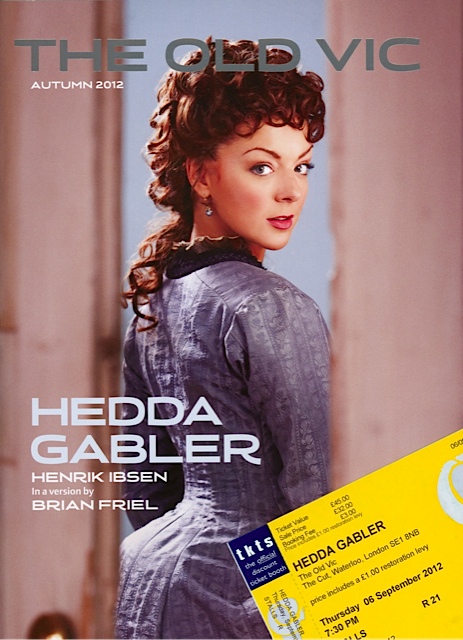
โ€œI donโ€™t think heโ€™s written a line thatโ€™s unnecessary,โ€ Adrian Scarborough remarked about Henrik Ibsen during rehearsals for the latest production of Hedda Gabler at Londonโ€™s Old Vic, in which Scarborough plays the part of Heddaโ€™s husband.  The endorsement is peculiarly out of place, considering that the Old Vicโ€™s Hedda hardly distinguishes itself byโ€”or even strives forโ€”a line-by-line fidelity to Ibsenโ€™s original.  Rather than a rewording of previous translations, Brian Frielโ€™s โ€œnew versionโ€ puts a few new words into the mouths of the old, familiar characters created by his fellow playwright, adding a line here and there that left me questioning their necessity.

Now, few theatergoers around the world are in a position to compare Ibsenโ€™s Norwegian to the translation in which they hear those lines performed; and whether a character (in this case Hedda) says โ€œBut of course one has to grow accustomed to anything newโ€ or โ€œNew surroundings take a little getting used toโ€ seems to make little difference.  Are such substitutions worth the bother? What’s more, are they worthy of a playwright like Friel?

โ€œBut of course one has to grow accustomed to anything new.โ€  That line can be found in the American-English translation by Rolf Fjelde, who, in an effort of doing โ€œthe very best [a translator] can do,โ€ kept โ€œa conscience-file of revisionโ€ in hopes of getting the opportunity โ€œFinally [to] Get It Right.โ€  Fjelde got that chanceโ€”and the result seems not particularly in need of further emendation.  Playwright Friel, though, is not about to offer his services as a mute transcriber whose job is to interpret without drawing attention to the interpreter and the challenges or impossibilities of arriving at any one definitive text in a given or taken language.  Friel does not claim his English version to be the last wordโ€”and, rather than having us take his word for it being faithful, wants to have a word with us about it.

To do so, Friel inserts hints of himself into the action, which, aside from Heddaโ€™s quest to destroy, quite literally, the text of patriarchy, involves the contest between two published writers, both western and male.  Most overtly, he does this by taking liberties with the lines spoken by the middle-aged Judge Brack who, in Frielโ€™s version, confounds his listeners with Americanisms like โ€œmaking whoopeeโ€ and provides a running commentary on the currency and lifespan of written and spoken language.  โ€œPhiladelphia, there you go!โ€ Friel seems to say to Fjelde, suggesting that Broadway and the West End may well require or at least warrant alternate versions of Ibsen and arguing that neither variant of English can or should be considered transcontinental, let alone universal.

Unlike Fjelde, Friel reminds us that we are in Norway, having characters drop names of places or remarking on the quality of โ€œNorwegian air.โ€  Yet, also unlike Fjelde, Friel reminds us, by foregrounding the novelty or datedness of words and debating their suitability, that we are not in any particular, definitive place at all but that we are instead in the contested, dangerous territory of language.  It is a territory that Hedda seems to control for a while with her probing questions and scathing remarks but that nonetheless delimits and ultimately overmasters her.

As scholar Anthony Roche puts it, Friel demonstrates himself to be โ€œconcerned with updating the constantly changing English language that will always require new adaptations of Ibsen, while making subtle additions that perhaps deepen our understanding of the rich emotional lives of the characters.โ€  Frielโ€™s Hedda is almost as much about Ibsenโ€™s characters as it is about the act of reading them โ€ฆ and of interpreting Ibsen.  It is a self-conscious take on the act of taking on a classic that, in its reflexivity borders on the by now rather tiresomely postmodern.  Give it your best shot, translator, I felt like responding, and let Hedda get her gun and do the rest.

That Hedda couldnโ€™t quite do her jobโ€”and that Friel hadn’t quite done hisโ€”became apparent from the laughter in the audience even as Hedda was about to do away with herself in the ingenious glass coffin the Old Vic production had prepared for that purpose.  โ€œThis is my first Ibsen,โ€ commented actress Fenella Woolgar (who took on the part of Thea Elvsted), โ€œand Iโ€™m discovering that he is a lot funnier than I anticipated.โ€  Perhaps, thatโ€™s because this ainโ€™t quite Ibsen and because Friel isnโ€™t quite the Ibsen-minded processor anyone expecting a traditional Hedda interpretation is likely to expect.

โ€œTranslation,โ€ as I said elsewhere (in an essay on the subject) is too mild a word to capture the violent process whereby a text written in one language and time is taken apart and rebuilt in another.  Hedda is a violent play; but given that I find myself preoccupied with the making of this Hedda rather than with the unmaking of its nominally central character, I wonder whether Friel has not inflicted some harm, necessary or otherwise, on Hedda and Hedda alike โ€ฆ

Stiff Competition: A Hairspray to Defy the West End Elements

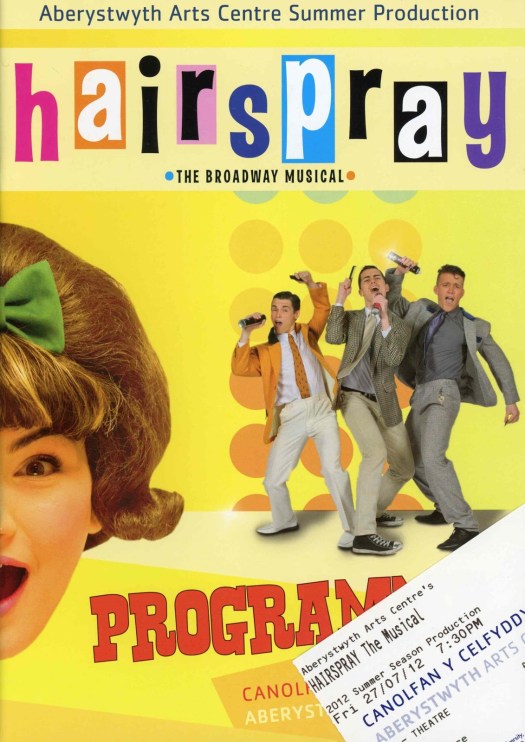
Funny thing about prejudice: if you let it take hold, it can deprive you and those around you of a real good time.ย  That, in a shiny Aqua Net shell, is the message of Hairspray, the musical.ย  And, boy, did I deprive myself . . . until now.ย  Sure, others around me still had that good time, but when Hairspray hit Broadway back in 2002, I was as set as an untamed cowlick. ย I would have none of it. My Aqua Net days were long behind me by then, and I was not going to splash out on a rehash of a late-1980s cult comedy about early 1960s culture-clashing teenagers, told in songs that a Porter and Gershwin kind of guy like me is not inclined to hum while wearing a shower cap. Well, Kiss my Kate! Last Friday, I finally woke up and smelled the coiffing.ย  “Good morning, Baltimore!” Andโ€”oh, never mind โ€œbeautifulโ€โ€”what a colorful morning it is.

Funny thing, too, that I only had to travel about half a mile to learn that musical lesson; no subway ride down to 42nd Street, no walk through Londonโ€™s West End via Leicester Square (and TKTS).  Just up the hill, to Aberystwyth Arts Centre, where each summer a musical is staged that, as a tourist attraction, is far more reliable than our windswept seaside.  Over the years, I have seen eight of those summer seasons come and go, from Oliver! to Chess.  Boasting a cast whose list of combined Broadway and West End credits is way longer than I am in the tooth, this yearโ€™s production tops them all.

Its readily translatable story of teenage rebellion aside, Hairspray may not be the easiest piece of Americana to transplant to Wales.  Never mind references to Allen Funt, Jackie Gleason, and the Gabors, names not likely to ring for todayโ€™s young, British audiences the bells I and Tracy Turnblad can hear.  The Director’s Note in the program about Rosa Parks, whose image flashes on a big screen during one of the numbers, fills in some of the blanks.  This, after all, is American history, no matter how much John Waters it down.

Then again, it may not be the easiest thing, either, to translate the Civil Rights Movement into a musical riot without becoming as crude or politically incorrect as John Waters used to be.  But, whatever your own sense of otherness and experience of xenophobia might beโ€”and โ€œI Know Where Iโ€™ve Beenโ€โ€”Hairspray gives you enough of a whiff of those ill winds to make you investigate whence they blow.  โ€œRun and Tell Thatโ€: if any production can communicate a shakeup without making anger the primary colour of the emotional rainbow, Unholy Waters! this can can.

You might expectโ€”and forgive, tooโ€”any glitches or leftover curlers on opening night; but there were none here: upon pulling the lid, this Hairspraywas as solid as a freshly lacquered beehive.  Andrew Agnew is marvelous as Edna Turnblad, a part I identified so much with the fabulous Divine that I couldnโ€™t face watching John Travolta in a latex mask.  Agnew makes you forget bothโ€”and he plays Edna in such an understated way that her big number โ€œ(Youโ€™re) Timeless to Meโ€ makes you understand what, to someone of my certain age, is the warm heart of this show.  Itโ€™s a heart whose Beat youโ€™d canโ€™t stop without making Hairspray lose its maximum hold.

Edna might have missed every boat except the one she pours the gravy from; but she is not too old to kissโ€”and kickโ€”the past goodbye and say โ€œWelcome to the 60โ€™s.โ€  This transition requires more than a new do or a swift costume change; and Agnew achieves it by centering Edna in the 1950s, a woman who loves Lucy though she might not like Ikeโ€”and who not only loves Tracy from the remove of a generational gap but gets her, too.

Tracy, of course, is her daughterโ€”the embodiment of that new ageโ€”and Jenny Oโ€™Leary inhabits the role with the confidence and youthful energy for which it calls.  Tracy may not quite grasp just how seismic the event is in which she plays her part, an eventโ€”this much she knowsโ€”far bigger than “Negro Night” on the Corny Collins Show; but she approaches integration with the I-donโ€™t-get-it naivety that has many of todayโ€™s youngsters baffled at their parentโ€™s definition of marriage as a strictly segregated affair.

Hairspray leaves no doubt as to who โ€œThe Nicest Kids in Townโ€ are; โ€œniceโ€ simply ainโ€™t.  It is self-serving conventionality, a meanness of spirit that lingers under the neat surface like something you fight with lice shampoo.  How else to approach โ€œMiss Baltimore Crabs,โ€ Velma Von Tussle, a nasty piece of work done justice by Lori Haley Foxโ€”and done in by the sheer force of Motormouth Maybelle, a woman who, like Edna, has seen better days, but whose better days were lived in times much worse.  

Marion Campbell, who plays Maybelle, comes on stage late to belt out her showstopper of a numberโ€”and her presence hits you like, say, Mahalia Jacksonโ€™s in Imitation of Life: a voice to be reckoned with, especially in a fight for equality.

Though the actress playing Tracy Turnblad receives top billing, it would be wrong to call the rest of the cast โ€œsupporting.โ€  Hairspray demands a great many good voices as it gives most of its characters the chance and challenge to shine, and everyone in this cast is living up to that challenge: Arun Blair Mangat as Seaweed, Samantha Giffard a Penny Pingleton, Morgan Crowley as Wilbur Turnblad, Hugo Harold-Harrison as Corny Collins . . .

The list is longer than thatโ€”but I’d be bald by the time I were done honor roll calling.  Besides, if I’m counting anything it’s the days until my next trip to the salon for another hit of Hairspray. Yes, funny thing about prejudice: once confronted, it can yield such eye-opening, ear-popping surprises.

So, toodle-oo to stiff upper lip! Stiff up yer quiff instead.

Donโ€™t Dress for Dinner: Six Characters in Search of a Round Table

The prosaically named American Airlines Theatre on Broadway has about as much intimacy and sex appeal as a departure lounge.  The long entrance hallway, which barely opens up to a space resembling the lobby of a two-star hotel, makes you feel that, once your ticket has been scanned, you are a mere hourโ€™s worth of taxiing away from takeoff.  That said, it wasnโ€™t the venue that made the Roundabout Theatre Companyโ€™s production of Donโ€™t Dress for Dinner such a terminal bore.

Farces are all about frustrated desires, about wanting to take it off and waiting to get it on, about fooling around the longest way round and never quite getting around to it.  In this case, though, the exasperation I sensed was all mine.  As the characters got together for their scheduled assignations, the actors seemed to be heading off in different directions.  Watching them move around on the stage was about as scintillating as staring at other folkโ€™s suitcases circling the baggage carousel, which aroused in me nothing but the suspicion that this was going to be a wearisome cat-and-spouse game indeed.

Not since Tony Randallโ€™s 1991 production of The Crucible had I witnessed such a spilled ragbag of irreconcilable acting styles.  Their task being merrily to prolong the unwanted dinner party at the expense of hoped-for dessert spooningโ€”and to make all this falling apart come together for usโ€”the assembled cast members were in desperate need of a round table, not a dinner table, and a director, not a waiter, giving orders rather than taking them.

To be sure, Marc Camoletti play is no Noises Off; and the fact that I had seen Michael Fraynโ€™s farce-to-end-all-farce only a few weeks earlier made Donโ€™t Dress seem like a morning after.  Camoletti, best known for Boeing-Boeing was ill served by a translator whose lines are so threadbare (yes, cooker does rhyme with hooker) as to deserve nothing more than booing, booing.

The male leads, Ben Daniels as Robert and Adam James as Bernard came dressed for office, not play. A third maleโ€”make that machoโ€”role was so indifferently cast that the ending, in which alone the character featured, fell as flat as postage stamp on a card reading โ€œWish I were anywhere but here.โ€

The ladies were livelier by far; but whereas classy Patricia Kalember as Jacqueline seemed to have expected a Noel Coward soiree, brassy Jennifer Tilly as Suzanne was fitted out for a Vegas dinner theater . . . or a romp with Chucky.  Meanwhile, the energetic Spencer Kayden as Suzetteโ€”who reminded me of Elizabeth Berridge and her role as the maid in the glorious if short-lived โ€˜90s sitcom satire The Powers That Beโ€”brought to the proceedings a verve and a timing well suited to the inspired slapstick that Donโ€™t Dress so desperately lacked.  Alas, you canโ€™t have good comic timing all by yourself.

What you can have by yourself is the last laugh, scoffing at what elicited nary a chuckle in the first place.

I Remember, Mama: Complicity, Mendacity, and Other Desert Cities

Once, as I recalled here before, I had the audacity to tell a well-known biographer, whose student I was, that I had no respect for writers of other peopleโ€™s life stories.  Unless content to be mere chroniclers, recording activities and recounting events, they are fabricators of interiorities that, I wasโ€”and amโ€” convinced, are unknowable to anyone other than the single occupant of that interior.  For all our confidences and intimations, we are ultimately unreadable to one another.

In order to turn life into story, biographers must impose a logic beyond chronology, a pattern to make unreason rhyme.  They connect the dots on a timeline to create causal relationships designed to account for peopleโ€™s behaviors and actions: because she couldnโ€™t face her past, she couldnโ€™t live with herself; because she lost her brother, she lost her trust in family; because he was in truth insecure, he became a make-believe gunslinger.  Without being supplied with at least a hint of what we call โ€œmotivation,โ€ we reject stories as lacking in psychological depth and moral complexity.

Back when I gave my professor a piece of my mindโ€”proffered, mind you, with a smileโ€”I thought of the biographerโ€™s determination to make sense of other peopleโ€™s existences as sheer hubris.  Now, I am more inclined to look at biography as an act of desperation.  Nothing is more disconcerting, more silencing and disabling, than the blank we have to call potentiality in order to face or overwrite and deface it.  We cannotโ€”will notโ€”settle for zilch.

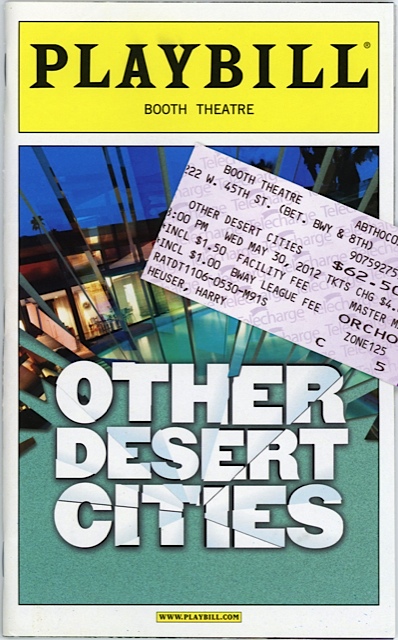
Secrets and duplicities, intimacy and detachment.  Like all family dramas worth relating to, Jon Robin Baitzโ€™s stage play Other Desert Cities measures the distance between folks who are biologicallyโ€”and often physicallyโ€”closest to each other: the flesh, the blood and the closeted skeletons of kinfolk.

Approaching Palm Springs (and Other Desert Cities)

Baitzโ€™s American stage family, the Wyeths, could hardly be more traditional: a mother and father, married to one another, a daughter and son, offspring of that union.  Then there is the dramatically expedient extension of that nucleus; in this case an alcoholic, donโ€™t-give-a-damn aunt whom the audience looks at as a go-between, not only between characters but between those characters and ourselves.  It is a well calculated constellation, this, as Other Desert Cities does not just explore relationships but the act of relating, of putting that relationship and all those relations into words, and of questioning the words and the unspoken.

Though most of us couldnโ€™t live with Aunt Silda (Judith Light, in the Booth Theatre production), we love her for what we are encouraged to read as her forthrightness and free spirit.ย  She, we assume, would be the person most likely to tell the true story of that family, as compromised as her memory and judgment might be after years of swilling the kind of spirits from which she is unable to free herself.

Hello Sildaโ€”
The way I remember Palm Springs

After all, we cannot expect to get the inside dirt from her sister Polly (Stockard Channing), a staunch yet tarnished Republican who is terrified that her daughter Brooke (Elizabeth Marvel) has written a tell-all autobiography threatening to tear the faรงade right off the familyโ€™s sunny Californian home.

Yes, Silda tells it like it is.  Criticized by her class-conscious sister of wearing knock-offs, she barks back:

Honey.  News-flash: youโ€™re not a Texan, youโ€™re a Jew! Weโ€™re Jewish girls who lost their accents along the way, but for you that wasnโ€™t enough, you had to become a goy, too.  Talk about the real thing? Talk about โ€˜faking it.โ€™ Honey, this Pucci is a lot more real than your Pat Buckley schtick.

As it turns out, neither Silda nor Polly are what we are led to believe them to be; and this is Brookeโ€™s lesson, too, as she tries to piece together the life story of her lost brother, a left-wing radical whose act of terrorism forced Nancy Reagan pal Polly and her ex-Hollywood star husband Lyman (Stacey Keach) into retirement in the desert.

Desperate to figure out who or what made her brother Henry what the facts donโ€™t quite tell her he was, Brooke turns from writing fiction to biography.  Yet, in her attempt to expose the truth, she ends up with yet another version of the story rather than a definitive one.  โ€œShe presents us as ghouls who drove [Henry] to become sort of a murderer,โ€ her anguished, disconsolate father protests to his son (Thomas Sadoski), the โ€œADD riddled, junk-food-addicted porn surfing Trip Wyeth,โ€ as Brooke calls him to his face.

โ€œChrist, thereโ€™s something so vicious about what youโ€™re doing here, Brooke, donโ€™t you know that?โ€ Lyman exclaims.  Vicious and necessary, Other Desert Cities argues.  And futile? As suggested by the closing scene, which may strike some as perfunctory or incongruously sentimental, Brookeโ€™s ordealโ€”and the ordeal to which she put her familyโ€”has served a purpose.

What may seem like a coda or anticlimax I took as the point of the Baitzโ€™s drama.  As a biographer, Brooke has failed.  She has been taken in, taken story for life and secrecy for guilt only to become complicit in her familyโ€™s cover-up.  As an autobiographer, though, Brooke is to be envied.  She has learned something about herself that she didnโ€™t know before she came to investigate the lives of those around her.  We may be unknowable to each otherโ€”but we can learn to know ourselves.

Of Two Minds: Can The Best Man Win?

Anyone who has as much respect and appreciation for the niceties of the English language as Gore Vidal has will realize, if perhaps only after the final curtain has fallen on The Best Man, that the title is not simply ironic but prognostic: the best man, whoever he may be, cannot be declared if the fight and choice is between just two candidates.  The ostensibly โ€œbetterโ€ one of them might win, but not, grammatically speaking, the โ€œbest.โ€  Now, the man whom Vidal favorsโ€”and expects the audience of his political comedy The Best Man to root for in the playโ€™s fictional contest for Presidential nominationโ€”is not just a man of his word, he is a man who uses each word properly.  The political banter is no mere wordplay: in The Best Man, grammar and morals are one.

Like any wit, Vidalโ€™s central character, William Russell, takes language seriously.  He is not beyond lecturing and flinging the grammar at anyone who doesnโ€™t play by the rules of that book, a volume that the upright man carries in his head.

 
Russell, proper right down to that noun, is proud to have the last name of a noted philosopher; and, as a thinker, it strikes him as morally wrong to allow others to put words in his mouth.  He would rather write his own speechesโ€”โ€œItโ€™s a shameful business, speech by committee,โ€ he declaresโ€”but has come to terms with the fact that his busy schedule dictates otherwise.  What he will not brook, though, is ungrammatical speech. โ€œPlease tell the writers again that the word โ€˜alternativeโ€™ is always singular.  There is only one alternative per situation.โ€
 
In the dramatic situation of The Best Man, โ€œalternativeโ€ is clearly the wrong word, just as choosing the supposedly lesser evil is the wrong approach to casting votes.  Like the dilemma of the two-party system, the either-or decision to which the unquestioning responder is restricted calls for something better: the rejection of the supposed choice as spurious and misleadingly restrictive.
 
โ€œMay the best man win!โ€ is the choice platitude of Russellโ€™s opponent, Joseph Cantwell, whose last name, more than the name of Russell, suggests that the playwright cares less about his characters than about the philosophies for which he makes them stand and fall: they are metaphors for what politics can reduce us to when all we care about is making a name for ourselves.  Both Russell and Cantwell are stand-ins for the figures we imagineโ€”hope and fearโ€”politicians to be; beyond that, they arenโ€™t at all.  “A candidate should not mean but be,โ€ the literary playwright has Russell quip; as a character, Russell is not meant to be anything other than the mouthpiece Vidal means him to be in this verbal play of true versus nominal values.
 
Asked whether he thought that โ€œa president ought to ignore what people want,โ€ Russell replies โ€œIf the people want the wrong thing, [. . .] then I think a president should ignore their opinion and try to convince them that his way is the right way.โ€  How to do right and what is โ€œrightโ€ are the questions The Best Man aims at encouraging us to ponder.  Russell answers by taking his opponent by his clichรฉd expression and extricating himself from the either-or bind that threatens to turn him into a man no better than Cantwell.
 
Vidal, too, attempts a way out here, a synthesis of satire and sentimentality, cynicism and hopefulness, as he demonstrates Russell to be the โ€œbestโ€ man, after all, by proving him to be the better one.  The solution is as noble as it is grammaticalโ€”but it is rather too neat and ponderous, especially since the alternative โ€œmessageโ€ Vidal communicates is more tired than the dirty politics from which he derives a modicum of dramatic tension.
 
โ€œAnd if I may bore you with one of my little sermons,โ€ Russell and Vidal tell reporters and audiences early on:

Life is not a popularity contest; neither is politics.  The important thing for any government is educating the people about issues, not following the ups and downs of popular opinion.

Who, today, would buy that little nugget of shopworn sentiment?

Few, no doubt, even bother, as they are more likely to have come to sample the wares on display in the latest Broadway production at the Gerald Schoenfeld Theatre.  The cast is headed by two sentimental favoritesโ€”Angela Lansbury and James Earl Jonesโ€”whose presence, however lively, takes some of the bite out of the 1960 play, which now provokes nothing more effectively than nostalgia: a longing for politics that never were.  Like politics, the business of staging a show is too much of a โ€œpopularity contestโ€ to rely on a playwright’s words to win us over.  Reading the script now without seeing the assembled personalitiesโ€”Candice Bergen, John Larroquette, Eric McCormackโ€”before me on that evening in May, I can better appreciate Vidal’s best linesโ€”but, as a play, The Best Man remains ultimately unconvincing.

 
Sizing up his competition, Victorian novelist Anthony Trollope once interrupted one of his narratives by attempting witty remarks about Thomas Carlyle and Charles Dickens, labeling  the latter โ€œMr. Popular Sentimentโ€ and the former โ€œDr. Pessimist Anticant.โ€  With his showdown between โ€œPopularโ€ Cantwell and โ€œAnticantโ€ Russell, Vidal demonstrates that wanting to be both satirical and sentimental means doing justice to neither; the sentiment feels calculated, the wit pointless. In the noble experiment of making dirty politics cleaner, everything comes out rather muddy in the wash.

The Lion in Winter Wonderland; or, Whatโ€™s That Fir?

Once a year, in the run-up to Christmas, my better half and I make the seemingly interminable journey from Wales to London for some seasonal splurging on art and theater. Now, I donโ€™t travel all the way east to the West End to waste my time on pap like Dirty Dancing. This isnโ€™t snobbery, mind; I simply canโ€™t thrill to a feast of re-processed cheese and the prospect of paying for it through a nose bigger than Jennifer Greyโ€™s old one. Besides, why raid the bottom shelves of our pop cultural cupboard when Iโ€™ve got a heaping plateful of squandered opportunities to chew over? During the days of my graduate studies in English and American literature, I had little money to spare for Broadway theatricals, which is why I now tend to seek out revivals of plays I missed the first, second, or umpteenth time aroundโ€”drama with some history to it, be that pedigree or baggage. James Goldmanโ€™s The Lion in Winter has a bit of both.

As an added attraction, the current Theatre Royal Haymarket production also has the ever Ab-fabulous Joanna Lumley, whom I first saw on stage in the 2010 Broadway revival of La Bรชte. Lumley plays caged lioness Queen Eleanor opposite Robert Lindsayโ€™s Henry II, the husband who keeps her under lock and key.  Witty and fierce, The Lion is a domestic drama fit for the tryingly festive season. All the same, the darn cat is in a confounded state of seasonal disorder.

What those stepping into the auditorium from the audio-visual onslaught that is Christmas time in the city cannot but gasp at is that even Henryโ€™s halls are decked: his French chateau, anno 1183, features a regal Tannenbaum, no less. It certainly had my eyebrows raised to the alert level of WTF: you might expect a Green Knight, surely, but a bebaubled evergreen?

The proud Lion is prepared to pounce, though, ready to defend itself against โ€œturbulentโ€ critics crying bloody murder in the cathedral of culture. Goldman acknowledged that his โ€œplay contains anachronismsโ€ such as the โ€œway . . . Christmas is celebrated.โ€ As he states in the notes duly reprinted in the playbill, the ahistorical trimmings are โ€œdeliberateโ€; โ€œthough it deals carefully with history,โ€ The Lion โ€œremains a piece of fiction.โ€

Towering over the assembled branches of Henryโ€™s living family tree, the familiar, dead one serves as a reminder of the storytellerโ€™s presence.  The needling transplant from our present day tells not only of the authorโ€™s intervening re-inventiveness but also of his obligation to make that past relevant: the dramatist does not simply stage history; he fashions it. To withhold evidence of this intervention would mean to falsify, to deny the hand and mind involved in the process of transcribing.

Goldman was nonetheless concerned that this never-evergreen might overshadow his research and cast doubt on his responsible interpretation of verifiable historical events. โ€œThis play,โ€ he pointed out to his audience, โ€œis accurately based on the available data.โ€

The elephant of a dislocated trunk aside, The Lion is refreshingly unself-conscious; it is a deluxe soap free from the by now irritating additives of postmodernist reflexivity. For all its modern day translationsโ€”of which only its pre-gay lib treatment of the 19th century construct of homosexuality struck me as datedโ€”it affords a close look at historical figures that rarely seem human to us in the accounts of battles and political maneuverings.

If Goldman reduces the sweep of history to an intimate first-family portrait, he chose a subject that warrants such an approach; as historian John Gillingham argued, what โ€œreally matteredโ€ to Henry II โ€œwas family politics,โ€ in the belief of the failure of which he died. Far from being a Peyton Placeholder, Goldmanโ€™s โ€œChristmas Court that never wasโ€ has been assembled to bring historical intrigue home.

Ladykillers Instinct; or, Marcia Warrenโ€™s Profession

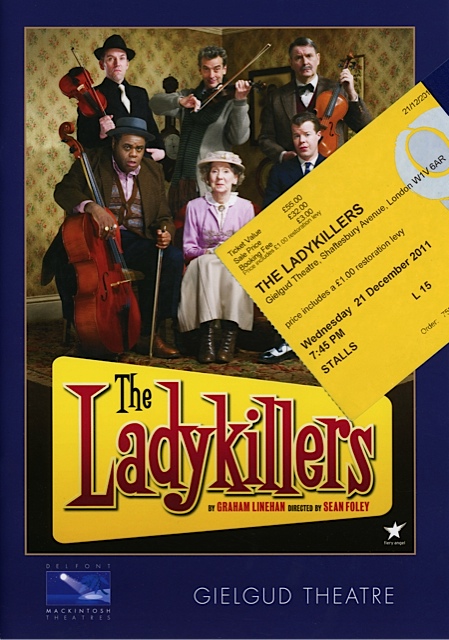
“Whatโ€™s your great online discovery,โ€ an interviewer asked Marcia Warren, star of the current West End production of Ladykillers.ย  To this, the veteran of stage, screen and radio replied, โ€œWhat does online mean?โ€ It is just the kind of answer most of us expectโ€”and want to hearโ€”from someone past middle age, which makes hers such a sly response.ย  Warren remains in character, as Mrs. Wilberforce, kindly old landlady to the killers, giving us what we find so reassuring and endearing about the senescence we otherwise dread.ย  She may or may not be jokingโ€”but she sure has earned the right neither to know nor to care.ย  Looked at it that way, being past it becomes a shelter, a retreat beyond trends, updates and upgrades whose seeming simplicity appeals to those who cannot afford to be quite so nonchalant about technology, who feel the pressure of performing in and conforming to the construct of the present as a digital age.ย 

Not to know or willfully to ignoreโ€”what luxury! Young and not-so-young alike find comfort in this deflecting mirror image of our future selves.ย  Itโ€™s a Betty White lie we use to kid ourselves .

We enjoy making light of old age; and those of us who have half a conscience enjoy it even more to be presented with elderly people or characters who are not simply the brunt of yet another ageist joke but are in on itโ€”and cashing in on it as well.  We laugh all the way as they take our laughter to the bank.

We want older folks to be feisty because it comforts us to know that, even in our declining years, there are weapons left with which to fight, however futile the fighting.  The middle aged, by comparison, are past the prime against which the standard their looks and performances are measured; it is their struggle to conceal or deny this obsolescence that makes them the stuff of deflationary humor.  We don’t laugh at Mrs. Wilberforce; we laugh at the bumbling crooks whose willfulness is no match for her force shield of insuperable antiquity.

It is this nod to nostalgia as a weapon against the onslaught of modernity that makes Ladykillers such a charmer of a story.ย  And what makes it work on the stage just as it works on the screen is that the 1955 original requires no update: the Ladykillers was born nostalgic.ย  It hit the screensโ€”in fabulous Technicolor, no lessโ€”at a time when, after years of postwar austerity, the British were ready to look back in amusement at their wants and desires and all those surreptitious attempts to meet them.ย  Sneers turned to smiles again as greed was finally being catered to once more.

Eluding those who try to will it by force, fortune winks at those who wait like Mrs. Wilberforce, a senior citizen yet hale, clearheaded and driven enough to enjoy a sudden windfall.  It is a conservative fantasy that appealed then as it appeals now, especially to middleclass, middle-aged theatergoers eager to distract themselves from banking woes and pension fears, from cybercrime and urban riots.

Familiar to me from radio dramatics, Warrenโ€™s name was the only one on the marquee I recognized as I decided whether or not take in what I assumed to be another one of those makeshift theatricals that too often take the place of real theater these daysโ€”stage adaptations of popular movies, books and cartoons like Shrek, Spider-Man, or Addams Family with which the theater world is trying rather desperately to augment its aging audience base.

Written by Graham Linehan and directed by Sean Foley, this new production of The Ladykillers fully justified its staging.ย  There is much for the eye to take in; indeed, it owing to an able castโ€”and the lovely, lively Ms. Warren above allโ€” to prevent the ingenious set and special effects from stealing this caper.

In the real, honest-to-goodness make-believe beyond the online trappings of which she claims to be ignorant, Warren gives us just what we want.  After all, acting for our pleasure and acting out our desires is her business.  Itโ€™s the oldest profession in the world.

โ€œThe lady of the house speakingโ€: A Bucket for Myra Hess

Eve Arden is Our Miss Brooks. Joan Collins is Alexis. Estelle Getty, Sophia. Whatever else these ladies did in their long stage, screen and television careers, they have become identified with a single, signature role they had the good fortune to create in midlife. Grabbing their second chances at a second skin, they experienced a regenerative ecdysis. The character or caricature that emerges in the process obscures the body of work thus transformed. Another such anew-comer coming readily to mind is Patricia Routledge, who, for better or worse, makes us forget that she has ever done anything else before or since she took on the role of Hyacinth Bucket in Keeping Up Appearances back in 1990. Would she forever keep up the charade, or might she yet have the power to make this our image of her disappear? Could she spring to new lives by kicking that Bucket? Those questions were on my mind when we drove up to the ancient market town of Machynlleth, here in mid-Wales, where Ms. Routledge was scheduled to make an appearance in a one-woman show.

Well, it was bucketing down that afternoon, which, had I been metaphorically minded at that spirit-dampening moment, I might have taken as an omen. Not that the rain had the force to keep the crowd, chiefly composed of folks scrambling to make the final check marks on their bucket list, from gathering in the old Tabernacle. Here, the stage was set for Admission: One Shilling. Not much of a stage, mind; there was barely โ€œroom for a pony.โ€ Piano, I mean. But little more than that piano was required to transport those assembled to 1940s London, where, for the price of the titular coin, wartime audiences were briefly relieved from the terror of the Blitz by the strains of classical music . . .

The music, back then, was played by British concert pianist Myra Hess who, though much in demand in the United States, put her career on hold to boost the morale of her assailed country(wo)men. Hess did so at the National Gallery, a repository of culture that, at the outbreak of war, had taken on a funereal aspect when its paintings were removed from the walls and carted to Wales to be hidden in caves for the benefit of generations unborn and uncertain.

Meanwhile, those living or on leave in London at the time were confronted with a shrine that held none of the riches worth fighting for but that instead bespoke loss and devastation. From October 1939 to April 1946, Hess filled this ominous placeholder with music; much of it, like her own name, was Germanโ€”a reminder that the Nazi regime and the likes of Rudolf Hess had no claim to the culture they did not hesitate to extinguish if it could not be made to serve fascist aims.

Taking her seat on the stage, the formidable, elegantly accoutred Ms. Routledge seemed well suited to impersonate Dame Myra as a woman looking back at her career in later life. It mattered little that Routledge did not herself play the piano while she reminisced about the concerts she had given. Selections from these performances were played by accompanist Piers Lane, who filled in the musical blanks whenever Routledge paused in her speech.

Writing that speech posed somewhat of a challenge, considering that Hess never published a diary. According to her great nephew, who created this tribute, the script is based on press releases and radio interviews. Indeed, the entire affair comes across as a piece made for radio, if it werenโ€™t for those occasional darts shot at no one in particular from Ms. Routledgeโ€™s eyes, frowns that remind you of irritable Ms. Bucketโ€™s priceless double-takes.

Perhaps, it does take a little moreโ€”and a little lessโ€”to pull off this impression. On the air, we could hear Dame Myra Hess at the piano. If the performance were more carefully rehearsed, or edited, we would not have before our mindโ€™s eye the script from which Routledge reads throughout. We would not require the distractions of a screen onto which photographs of the wartime concerts are projected. We would not be as distanced from the life that yet unfolds in Hessโ€™s own sparse words.

Never mind that Admission: One Shilling has about as much edge as a Laura Ashley throw pillow. What got me is that I felt as if I were attending one of Ms. Bucketโ€™s ill-conceived candlelight suppers, whose decorous make-believe remains ultimately unconvincing. I found myself hoping for something undignifiedโ€”a pratfall, evenโ€”as if I had come to see this woman but not come to see her succeed. Such, I guess, is the lasting legacy, the curse of Hyacinth Bucket that, as I exited, I was wondering what Sheridan might have done with the money . . .

Murder on the Cathedral Radio: Rudy Vallee and the WPA

โ€Whatever your own political views in the matter may be. . . .โ€

Diplomatic, cautious and propitiatory, those are hardly words you would expect to hear coming from the close-miked mouth of crooner Rudy Vallee, one of the 1930s most popularโ€”and insipidโ€”radio personalities. After all, Vallee was not emceeing Americaโ€™s Town Meeting of the Air; his chief ambassadorial function was to promote middlebrow culture and represent the makers of a certain leavening agent. Yet that is just the preamble with which the old Vagabond Lover segued into the dramatic portion of the Fleischmannโ€™s Yeast Hour, which, on this day, 25 June, in 1936 presented what sounded very much like an endorsement of one of the Roosevelt administrationโ€™s latest projects, notwithstanding Valleeโ€™s assurance that the views of the programโ€™s producers and sponsorsโ€”in contrast to the debates from the Democratic Convention broadcast elsewhere that eveningโ€”were โ€œstrictly neutral.โ€

The calculatedly catholic Fleischmannโ€™s Yeast Hour took variety to the extreme that evening, featuring vaudeville song-and-dance duo Alan Cross and Henry Dunn, โ€œGags and Galsโ€ cartoonist Jefferson Machamer (who would have liked to talk โ€œsexโ€ but was told that the subject was โ€œnever mentionedโ€ on the air), comedian Bert Lahr (whom Valleeโ€™s writers sent to the dentist), swing vocalist Midge Williams (referred to as a โ€œsmall bundle of dark dynamiteโ€) . . . and T. S. Eliotโ€™s Murder in the Cathedral. Natch . . .

Murder had come to Broadway some three months earlier, in March 1936. As stated by contemporary critics Ernest Sutherland Bates and Alan Williams in their book American Hurly-Burly (1937), Eliot’s play โ€œas offered by the WPA was finer than anything produced during the season at any price.โ€

Yet rather than merely extracting scenes from the celebrated drama, Valleeโ€™s program offered a dramatization of a โ€œtrue storyโ€ that had โ€œhappened only a little while ago,โ€ namely the behind-the-scenes story of how the Broadway production was cast.

As Valleeโ€™s writers have it, an aging stage actor enters the offices of the WPA, declaring: โ€œIโ€™m looking for a job.โ€ He claims to have been in the acting profession for thirty-three years; but lately he has only been pounding the pavement in hopes of treading the boards again. He is referred to the Federal Theatre Project, where, by the kind of miracle that smacks of Victorian melodrama, he is greeted by producer-manager George Vivian, an old friend of his from his days in Londonโ€™s West End.

Soon, the actor is given the chance, however slight, of auditioning for Broadway director Edward T. Goodman, who is still trying to cast the role of the Archbishop. As many listeners tuning in to the Fleischmannโ€™s Yeast Hour would have known, the old actor got the partโ€”and, as Bates and Williams summed it up,

gave a magnificent performance in the role of Becket. ย When Murder closed he re-appeared with another splendid characterization in Class of ’29, but at the end of the season he was promptly reclaimed by the commercial theater.

That actorโ€”playing himself in the broadcast version of his storyโ€”was Harry Irvine, who, aside from Murder and Class of โ€˜29, went on to appear on Broadway in several dramas by Maxwell Anderson, including Joan of Lorraine starring Ingrid Bergman and Anne of the Thousand Days starring Rex Harrison.

Vallee commented that โ€œthe sequelโ€ to this story was โ€œyet to be written,โ€ by which he was not referring to any attempts to follow up Murder with Resurrection. โ€œThe name of Harry Irvine appears again,โ€ Vallee predicted. โ€œHe is very much in demand now. Youโ€™ll see him in pictures before long. Hollywood is taking care of that.โ€

Irvine responded to these not entirely fulfilled prophesies and commented on his good fortunes by reciting one of his speeches from Eliotโ€™s play:

We do not know very much of the future
Except that from generation to generation
The same things happen again and again.
Men learn little from others’ experience.
But in the life of one man, never
The same time returns. Sever
The cord, shed the scale. Only
The fool, fixed in his folly, may think
He can turn the wheel on which he turns.

As much as he was in the center of the Fleischmannโ€™s Yeast Hour playlet telling his story, Irvine was little more than a cog in the wheel, an example of the โ€œtrue storyโ€ extolling the wonders of the โ€œrelief projectโ€ that gave โ€œthe actor out of workโ€ a โ€œhelping hand.โ€

โ€œIn the larger cities all over the country these past few months,โ€ Vallee reminded his audience,

dark theaters have been opening, idle actors have been finding work.  Reason: The Federal Theatre Project, a branch of the Works Progress Administration in Washington.

So why, radio having benefitted most from the Depression and the closing of popular playhouses, did an ersatz revue like Valleeโ€™s program now celebrate the policies through which actors returned to newly reopened stages? Well, considering that the Fleischmannโ€™s Yeast Hour was an East Coast productionโ€”whereas Lux Radio Theater had just left New York for Hollywood and abandoned its Broadway formatโ€”it stood only to gain from the renewed activity along the Great White Way.

Given that the performers who appeared on variety programs of that period were deemed somebodies largely owing to the name they had made for themselves in other media, Fleischmannโ€™s, far from being neutral, depended on its theatrical tiesโ€”and stage actors like Harry Irvineโ€”to fill its weekly roster of acts.

Listening to slickly commercial variety programs such as the Fleischmannโ€™s Yeast Hour, I realize that escapism is not so much a matter of production as it is a manner of consumption, a way of tuning out rather than tuning in. No form of entertainment, however trifling or shallow, can entirely escape the role an alert listener may assign to itโ€”the role of telling us about the time in which it was created.

Mother, She Wrote

โ€œThere’s no family uniting instinct, anyhow; it’s habit and sentiment and material convenience hold families together after adolescence. There’s always friction, conflict, unwilling concessions. Always!โ€ Growing up in a familial household whose microclimate was marked by the extremes of hot-temperedness and bone-chilling calculation, I amassed enough empirical evidence to convince me that this observationโ€”made by one of the characters in Ann Veronica (1909), H. G. Wellsโ€™s assault on Victorian conventionsโ€”is worth reconsidering. It is not enough to say that there is no โ€œfamily uniting instinct.โ€ What is likely the case during adolescence, rather than afterwards, is that the drive designed to keep us from destroying ourselves becomes the one that drives us away from each other. Depending on the test to which habit, sentiment and convenience are put, this might well constitute a family disuniting instinct.

Not even a motherโ€™s inherent disposition toward her childโ€”to which no analogous response exists in the offspring, particularly once the expediencies that appear to increase its chances of survival are being called into questionโ€”is equal to the impulse of self-preservation. I was twenty when I made that discovery; the discovery that there was no love lost between my mother and myself, or, rather, that whatever love or nurturing instinct, on her part, there had been was lost irretrievably.

Years ago, I tried to capture and let go of that moment in a work of fiction:

An early evening in late October. She stands in the dimly lit hallway, a dinner fork in her right hand, blocking the door, the path back inside. The memory of what caused the fight is erased forever by its emotional impact, its lasting consequences. The implement, picked up from the dining table during an argument (some trifle, no doubt, of a nettlesomeย disagreement), has not yet touched any food today.

In one variant of this recollection, she simply stands there, defending herself. She wants to end the discussion on her terms. In another version (which is the more comforting, thus probably the more distorted one) she keeps attacking with fierce stabs, brandishing the fork as if it were a sword. Was it self-control that kept her from taking the knife instead? She is right-handed, after all.ย 

Though never hitting its target, the fork, brandished or not, becomes indeed an effective weapon in this fight. Itโ€™s an immediate symbol, a sudden and unmistakable reminder that it is in her hands to refuse nourishment, to withhold the care she has been expected to provide for so many years, and to drive the overgrown child from the parental tableโ€”and out of the house.ย 

โ€œGet out. Now!โ€

She is in control and knows it. She will win this, too, even though the length of the skirmish and the vehemence of the resistance are taxing her mettle. It has been taxed plenty. In this house, coexistence has always been subject to contest, as if decisions about a game of cards, a piece of furniture moved from its usual spot, or even the distribution of a single piece of pie were fundamental matters of survival. In this house, anything could be weaponized. In this house, which since the day of its conception has been a challenge to the ideals of domesticity and concord, has slowly worn down the respect and dignity of its inhabitants, and forced its dwellers into corners of seclusion, scheming and shame, it is only plaster and mortar that keeps those walled within from hurling bricks at each other.ย 

โ€œI want you out of here. Now. Get out. Out.โ€ Her terse wordsโ€”intelligent missiles launched in quick succession at the climactic stage of a traumatizing blitzโ€”penetrate instantly, successfully obliterating any doubt as to the severity of her anguish, and, second thoughts thus laid waste to, even the remotest possibility of reconciliation.

This time she really means it. She screams, screeches, and hisses, her words barely escaping her clenched teeth. It is frightening and pathetic at once, this sudden theatrical turn, an over-the-top rendition of the old generation gap standard. Yet somewhere underneath the brilliant colors of this textbook illustration of parent-child conflict and adolescent rebellion is a murky layer of something far more disquieting and unseemlyโ€”something downright oedipal.

Words, exquisitely vile, surface and come within reach but remain untransmitted, untransmissible. Addressing her in that way is a taboo too strong to be broken even in a moment of desperate savagery. Instead, the longing for revenge, for a reciprocal demonstration of the pain she, too, is capable of inflicting, will feed a thousand dreams.

Ultimately, it is fear that becomes overpowering. There is more than rage in her expression. It is manifest loathing. Two decades of motherhood have taken their toll.

At last, she slams the door. A frantic attempt to climb back inside, through the open bathroom window, fails when she, with a quick turn at the handle, erects a barrier of glass and metal.

The slippery steps leading to the front doorโ€”now away from itโ€”feel like blocks of ice, a bitterness stinging through thin polyester dress socks. There was no time to put on shoes. This is a time to evacuate. Humiliated, cold, and terrified. Thrown out of the house.

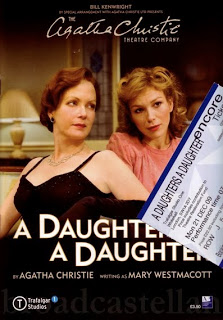
Now, contrary to what these fictionalized recollections suggest, Iโ€™m not one to cry over spilt motherโ€™s milk; besides, I did return homeโ€”through that doorโ€”and stayed at my parentsโ€™ house for another excruciating two years. It would have been far smarter and far more dignified to let go and move on. I had clearly outstayed my welcome. The realization came to me again the other night when I went to see the A Daughterโ€™s a Daughter, a cool examination of what may happen to close family ties once both mother and child reach maturity. The playwright, who resorted to the pseudonymous disguise of Mary Westmacott, was none other than mystery novelist Agatha Christie.

So, I oughtnโ€™t to have been surprised by the lack of sentiment in the portrayal of a parent-child relationship that goes sour once the expiration date has passed. Think Grey Gardens without the cats. After all, in guessing games like And Then There Were None and The ABC Murders, Christie reduced human suffering to a countdown. And when she went back to the nursery, it was mainly to borrow rhymes that provided titles for some of her most memorable imaginary murders, the ruthless precision of which was a kind of voodoo doll to me during my troubled adolescence.

Still, I was surprised by the chill of the unassuming yet memorable drama acted out by Jenny Seagrove and Honeysuckle Weeks in Londonโ€™s Trafalgar Studios that December evening. I was surprised by a playโ€”staged for the first time since its weeklong run in 1956โ€”that was not merely unsentimental but unfolded without the apparently requisite hysterics that characterize Hollywoodโ€™s traditional approaches to the subject.

To be sure, A Daughterโ€™s a Daughter is hardly unconventional. It is not A Daughterโ€™s a Daughterโ€™s a Daughter. Modest rather than modernist, controlled more than contrived, it is assured and unselfconscious, a confidence to which the apparent tautology of the title attests. Yes, a daughterโ€™s a daughterโ€”and just what acts of filial devotion or maternal sacrifice does that entail? How far can the umbilical bond be stretched into adulthood until someoneโ€™s going to snap?

The central characters in Christieโ€™s play reassure anyone who got away from mother or let go of a child that, whatever anyone tells youโ€”least of all arch conservatives who urge you to trust in family because itโ€™s cheaper than social reformโ€”survival must mean an embrace of change and a change of embraces.


Related writings
โ€œIstanbul (Not Constantinople); or, There’s No Boat โ€˜Sailing to Byzantiumโ€™โ€
โ€œCaught At Last: Some Personal Notes on The Mousetrapโ€
โ€œEarwitness for the Prosecutionโ€
โ€œOn This Day in 1890 and 1934: Agatha Christie and Mutual Are Born, Ill-conceived Partnership and Issue to Followโ€