Chalk Circuits: Brecht, the Stage, and the Radio

Well, it rolled into town last night . . . and carted me right back to high school (in Germany, anno never-mind), where I was exposed to it first. The National Theatre’s “education mobile,” I mean, whose production of Brecht’s Caucasian Chalk Circle I went to see at the local Arts Centre. Despite the publicly staged custody battle at the Circle‘s center, I did not once think of the circus that has become the life and legacy of Anna Nicole Smith. Brecht’s parables of the filthy rich and dirt poor are hardly without tabloid appeal; but instead of drawing parallels between this story and history, I felt encouraged by the production’s interpretation of Brecht’s theory of Epic Theater to contrast the techniques of the theatrical stage with the potentialities of the sound stage, radio being a medium of which Brecht was suspicious at first (given its exploitation in Fascist Germany), but for which he was to write a number of plays.

Communism has always been big business in capitalist societies, both as fuel for wars, cold or otherwise, and as an artistic construct. A carnivalesque appreciation of his anti-capitalist allegories from the comfort of a loge might run counter to anything Brecht envisioned in his organon, but I suspect that such is the spirit in which most audiences take in his works for the stage. They are didactic, all right, but that does not mean theatergoers are ready, willing, or able to be instructed.

Instead, audiences might take in, take on or leave Brecht’s Epic theatricals, only to return to their shopping, to the latest installment of an American television serial featuring the works of Hollywood’s highest-paid plastic surgeons, or to their various modes of right-winging it in style. Episches Theater struggles against the complacency induced by the convenience and relative comforts of a reserved seat in a handsome theater. Theatergoing, after all, is little more than a costly interlude these days, a getting-away-from the everyday rather than a forum in which to face it.

Besides, Brecht’s apparatus seems by now more creaky than a well-oiled Victorian spectacle. Its stage was not the proscenium arch of melodrama, plays of sentiment and sensation that draw you in and, once the curtain is drawn, absolve you from any responsibility to engage further with whatever you had the privilege of witnessing. Never mind that The Caucasian Chalk Circle draws to a close with the potentially high-tension climax of two women called upon to tear at a child rightfully belonging to one of them (the verdict depending on the judge’s—and our—definition of “rightful”). Much lies outside this circle that invites onlookers to stray from the center.

The main principle of Epic Theater is not to let anyone watching get emotionally absorbed in the action. Brechtian drama challenges audiences to observe behavior, action and circumstance, however stylized, in order to assess and draw conclusions from it. Conceived as a theater of estrangement (or Verfremdung), it is meant to provoke thought rather than pity. The play (and the play within) remain an artifice rather than becoming—or assuming the guise of—reality.

In order to create this sense of estrangement, the National Theatre production lets the audience in on the stagecraft involved in the manufacture of realist theater, especially the motion picture variety whose special effects trickery has long surpassed traditional stagecraft. The stage was both scene and soundstage, a set peopled with foley (or sound effects) artists at work in the background and, to highten the effect of alienation, interacting with the performers or taking part in the drama they help to mount. Not since I last attended a production of a radio drama have I seen so many tricks of the trade displayed, from the production of a crackling fire to the imitation of a bawling infant.

I’m not sure whether Brecht would have approved of this interpretation of his theory, which results in a spectacle that was amusing rather than authoritative, a Marx Brother’s production during Karl’s night off, a staging that turned Verfremdungseffekt into an elaborate running joke. This Chalk Circle, replete with a narrator addressing the audience with a microphone in his hand, was a radio melodrama turned “epic” by virtue of being both played and displayed.

On the air, with its techniques obscured from view, it would have come across like the very stuff against which Brecht rebelled with his theory. The eye and the ear were pitted against each other, an “epic” battle of the senses whose enemy is realism but whose victim is engagement. For once, my ears were the channels of realism, while my eyes were instructed to see and disbelieve. Sure, I learned how to set a palace on fire; but Revolution had nothing to do with it.

Please, Mr. Memory: Concussion on The Thirty-Nine Steps

I felt torn last night. Torn between The Falcon’s Brother (in which George Sanders passes the thriller franchise to sibling Tom Conway) and John Buchan: Master of Suspense, a television documentary about the author of The Thirty-Nine Steps. Quandaries like these are peculiar to life in a single-TV household. Considering that I am going on a New Year’s trip to Glasgow (where Buchan grew up) and just saw a dramatization of his classic spy novel in London, I decided in favor of the latter. Not that the documentary (part of BBC Four’s Adventures for Boys season) did much to clear the muddle my mind, at work under the influence of Patrick Barlow’s stage adaptation, has made of the Steps, one of those books everyone claims to know but few ever read, let alone without preconceptions.

Now, I have read Buchan’s 1915 novel (available online here); and, like most readers who come to it by way of Alfred Hitchcock’s 1935 adaptation, I was astonished at the film’s brazenfaced infidelity. I was disappointed, as well. Missing was the wit that Hitchcock and writer Charles Bennett brought to the original by reworking it in the screwball comedy tradition. It Happened One Flight, they might as well have called what amounts to conclusive proof that tying a male hero to a dame (absent in Buchan’s story) does not have to slow down a fast-paced chase. Infusing sex appeal rather than sentimentality, Hitchcock’s cinematic update created a new adversary for the already much-beleaguered hero, Richard Hannay, who finds that a lot can go wrong in the effort to do right.

Barlow’s dramatization, by comparison, aims at demonstrating that a lot can go right in the effort to do wrong. When I read that John Buchan’s “The 39 Steps” was playing at London’s Criterion Theatre (where it can bee seen until April 2007), I had reason to expect an update of the novel, rather than a recreation of the film, however farcical the treatment (as reviews and poster art suggested).

As it turns out, Buchan’s novel has little to do with the nightly frivolities at the Criterion. The attribution to Buchan in the title of Barlow’s play (based on an “original concept” by Simon Corble and Nobby Dimon) seems to be part of an elaborate practical joke—a set-up in which spectators gladly take the fall since they are being coddled by travesty into assuming themselves superior to the material, whatever its source. Being tongue-in-cheek is a convenient escape, a laughing away of what could—and perhaps ought to—have been an engagement or confrontation with Buchan’s story, a tale of espionage and persecution anxities so relevant in this age of terror and so-called anti-terrorism.

Aside from the material of which John Buchan’s “The 39 Steps” makes light, the main attraction of the play lies in its being performed by a cast of only four actors, who dare to take on well over a hundred characters. With a small supply of basic props, those nimble four are shown in the ludicrous struggle to recreate the screenplay as realized by Hitchcock (who, in one of the many inspired moments of silliness, makes a cameo appearance in silhouette). This minimalist-absurdist approach to adaptation was not entirely a novelty act to me, having previously attended a production of The Importance of Being Earnest acted out by a cast of two.

Overly familiar as well felt the play’s reflexivity, its awareness of and delight in the improbability of being equal either to Buchan’s spy story or Hitchcock’s screwball caper. Many self-conscious remakes operate in this manner, escaping the challenge of finding the new in the old by making a mockery of the attempt at renewal and a mess of what is presumably so outmoded that it deserves nothing more than a send-up.

There is enjoyment in seeing things go awry, no doubt; and John Buchan’s “The 39 Steps” rewards theatergoers for their knowledge of the Hitchcock version (one of three film adaptations of the story). Cineastes will appreciate the effort that went into finding ways of making it almost work, whereas those who read and respect Buchan may regret how much is being squandered by ignoring his paradigm. After all, his thrills, too, depend on the pleasure derived from seeing things go awfully wrong, albeit with far higher stakes for the protagonist and his world.

Calling the play John Buchan’s The 39 Steps obscures the fact that the first motion picture adaptation was already a comic revision of Buchan’s rip-roaring yarn. Going after Buchan, Hitchcock managed to be fresh (both new and irreverent) without losing sight of the hunter-on the-run formula that would serve him so well, without neglecting the task of dusting off this decades-old story for action-seeking motion picture audiences. Forgoing thrills, sentiment, and politics alike, Barlow is strictly after laughs.

That said, the bungled dramatization is a chuckles-filled joyride for those who take pleasure in playing fast and loose with supposed literary classics. I gladly go along, provided I can still pride myself in being able to tell a sly impostor from the real thing. Instead, the theatrical experience has given me somewhat of a concussion, leaving me in a state of confusion that neither the aforementioned documentary nor the numerous American radio dramatizations (by the Lux Radio Theater and the Mercury Players, for instance) are likely to clear up. Was Richard Hannay a South African, a Canadian, or a Scotsman? Was he driven by the impulse to save a crumbling empire, to counter boredom, or to clear his name? Come to think of it: just who built The Thirty-Nine Steps, an unstable architectural composite of which now arises before my mind’s eye?

Even Mr. Memory won’t be of much assistance to me, I suspect. Besides, he is . . . but you know the story.

A Moody Christmas: There’s Life Yet in the Old Scrooge

Eighty-what? Bah, humbug! Age does not deter film, stage, and television actor Ron Moody from going on tour in yet another dramatization of Dickens’s A Christmas Carol, the Wales Theatre Company production of which I caught at the Aberystwyth Arts Center. In fact, Moody adapted the story as well, in collaboration with director Michael Bogdanov (whose productions of Fiddler on the Roof and Amazing Grace I have reviewed on previous occasions).

What’s more, Moody not only took on the play’s largest role but enlarged it still by taking over as Dickens’s narrator as well.  He resurrected the old miser with wit, humor, and feeling, even though his voice came across rather faintly and his lines were at times mumbled or muddled to an extent that the character’s age and grumpiness could not entire disguise or explain. When Scrooge reminds one of his ghostly guides of being “mortal” and “liable to fall,” Moody’s frame made the line utterly convincing; yet he stepped surprisingly lively after his reformation, cheerfully urging the audience to rise for a standing ovation.

The production was a busy one, meticulously recreating the story’s memorable scenes and characters with numerous set changes performed by stagehands shifting the makeshift props, activities that distracted from the endearing fairytale simplicity of the narrative and very nearly defeated the object of creating a sense of proscenium arch realism. It was all too much for poor Mrs. Fezziwig, who slipped upon entering the scene in which she was introduced to Scrooge by the Ghost of Christmas Past.

All this stagecraft brought to mind the superiority of non-visual storytelling on radio and in public readings. It is in the spoken word, aided at most by music and sound effects, that a ghost story like A Christmas Carol is most likely to thrill and enchant, as it certainly did in many of the productions heard during the 1930s and ‘40s on US radio, including this Campbell Playhouse adaptation broadcast on Christmas Eve, 1939.

There is no use trying to keep the eyes dry; their services are not required for the enjoyment of plays by radio. If tears happen to blur your vision, let them run freely.  They are testimony to the vision and insight of your mind’s eye.

To the Moon

It has been hailed as “magnificent” and “mesmerizing.” Kevin Spacey’s performance in the Old Vic production of Eugene O’Neill’s A Moon for the Misbegotten, I mean. After seeing the Old Vic’s take on The Philadelphia Story last year, in which Spacey, the theater’s artistic director, acted less-than-Cary Grantly opposite Jennifer Ehle, I was skeptical, to say the least. The Spacey age at the Old Vic has proven a troubled one.

I have yet to experience anything “mesmerizing” at the Old Vic, where, aside from Spacey’s turn in A Moon and Philadelphia Story, I also watched Sir Ian McKellen camping it up as Widow Twankey in Aladdin, which struck me, unaccustomed to the Christmas panto tradition, as disenchanting and tawdry. A Moon is well beyond both of those trifles, without quite rising above unevenness. I am not sure, though, whether to attribute my dissatisfaction with it to the script, the production, the performances, or to a perverse streak all my own—which accounts for the mess I made of these oft-revised notes.

To begin with Spacey, whose career I’ve been following since the early 1990s, when I was introduced to him by a mutual friend, backstage at the Richard Rodgers Theatre on Broadway, where the man who would be Lex Luthor appeared with whatever-happened-to-Academy-Award-winner Mercedes Ruehl in Neil Simon’s Lost in Yonkers. No doubt, I have been trying to discover the man in his parts ever since, which does not help matters. Spacey’s off-stage persona has irked me at times, an uneasy, calculated ease that threatens to render his acting as disingenuous as an act. Then again, selecting his roles for stage or screen, he seems most comfortable and convincing in the skin of the con, the trickster, or the sham.

In A Moon, Spacey is Jim Tyrone, a middle-aged, self-confessed “third-rate ham” who lays bare his conscience-tormenting past while under the influence, in a state where men are most likely to drop their masks. Spacey’s Jim is a queer duck, more likely to drop a glass than a hint of hidden truths: there are elements of camp in his gestures and postures, suggesting a self-indulgent act rather than honesty.

In his “reflections” on A Moon (published in the playbill), Spacey claims that the challenge of impersonating a drunk is to play him “so he doesn’t become monotonous.” Was it just that, or could playing the lush be an opportunity to go “gay all of a sudden” (to quote Grant’s character in Bringing Up Baby) and explain such release as temporary spasms?

A Moon is a play of lost schemes and the schemers who get lost in them, who struggle to redeem themselves by scrapping their act or getting it together. The central character is Josie Hogan, a farmer’s daughter whom O’Neill envisioned as “so oversize for a woman that she is almost a freak,” a dated, gender-stereotyping description Eve Best could not be expected to fit. Just as Spacey’s Jim may not know as much about loving women as he claims, being that he is more likely to adore or assault than to embrace them, Josie only puts on the act of a wanton to conceal that she is virtuous, a quality she derides as being “worse than decent.”

Despite his flaws, Josie has fallen in love with Jim; or, rather, she loves him for his vulnerability when exposing them. She might have more satisfaction forgoing the company of men altogether, considering that she is being manipulated into becoming a mantrap for Jim in order keep a roof over the pighead of her father (Colm Meaney). While not lacking in willfulness, she is the only one of Hogan’s children to remain on the farm, having assisted in the escape of her younger brother, a “New England Irish Catholic Puritan, Grade B” (played by an altogether miscast Eugene O’Hare, who seemed to have gotten into the first act on a Guy Madison scholarship).

Disregarding O’Neill’s instructions, Bob Crowley, the designer in charge at the Old Vic, places what there is of action in a surrealist set reminiscent of the Dust Bowl conceived by Dali instead of a September day in the Connecticut of the early 1920s. As a symbol of farmer Hogan’s crookedness and his lost dream of a plot, this hovel of a crazy house created in me a sense of dislocation that even the earthy performance of Irish actor Meaney could not counter. And yet, it is a set fit for a play that seems set on estrangement, that sets you up by setting out as comedy but never quite settles there.

There are shades of Ah, Wilderness!, the lightest, least controversial of O’Neil’s works, considered inoffensive enough to be frequently adapted for American radio during his lifetime; but then this Moon, considered unfit for Broadway until long after the playwright’s death in 1953, turns on you and the light-heartedness gives way to some heavy-handed, drawn-out confessionals.

The audience, like the titular satellite, is being compelled to keep circling what amounts to a rehearsal for a funeral during which fears and failings are exposed and confessed, talked about rather than dealt with, let alone resolved. Redemption has rarely felt quite this unredeeming. If the lack of resolution may be considered a triumph of modernism, the orbiting in the sphere of words strikes me as a failure in dramaturgy.

The circular and roundabout are not without their returns; but, I’d rather be spinning quietly in a chairoplane (like the one at the fun fair on London’s Leicester Square, pictured above) than sit through what amounts to a cycle of remorse and unfulfilled desires.

Shaking the Spear: How an All-Male Cast Can Tame a “Shrew”

It’s been a while since last I saw The Taming of the Shrew performed onstage—and I didn’t even get to see the feat accomplished. Halfway through, a curtain of rain descended on the players (Tracey Ullman and Morgan Freeman among them), putting a premature end to one of those open-air affairs at New York’s Delacorte Theater. Maybe Kate was lucky that night, for Petruchio sure rains on what might have been her parade. The ending is a challenge for today’s producers and can be an ordeal for the audience, especially those who regard the theater as a political correctional facility of post-modern society. It’s an ending that can make or break both Kate and the play she’s stuck in; for, depending on how The Taming is framed, the bride may well be. So, when I finally got to see Kate reach the end of the matrimonial tether last Friday, in a production by the touring Propeller company, I felt that something had gone terribly wrong.

Propeller stages Shakespearean dramas with an all-male cast, an approach at once traditional and revisionist, considering that female roles used to be performed by male actors and that we, more than four hundred years on, are not at all conditioned to see such casting as conventional, no matter how open-minded we might think ourselves.

Last year’s Propeller production of The Winter’s Tale was so sensitive and engrossing as to de-politicize gender, despite the fact that the guys in gowns sport prominent chest hair and bald spots. It was a revelation to see those tokens of testosterone atomized in tender humanity. The man-handled Shrew, by comparison, is as subtle as the Birdcage—and that nut-strewn coop is no place for a chick-lit contender like Katherine. Strangely enough, cross-dressing had little to do with her mistreatment.

As adapted by Edward Hall and Roger Warren, The Taming refuses to put Petruchio in his place by taking advantage of the apparatus provided, a frame that, as in the 1937 radio version starring John Barrymore, is often removed, leaving the make-believe sparring of Kate and Petruchio unmediated. Petruchio is, after all, a character in a play staged for the purpose of making fun of Christopher Sly, an irresponsible, common drunkard. The frame, to be sure, can be set up as a ready excuse for the misogynist picture within. It is the shaming of Sly that can make the taming of Kate tolerable—and the Propeller players won’t have it that way.

Their version adds a prologue in which Sly is seen standing up his bride at the altar; but instead of getting his come-uppance by becoming the plaything for a nobleman disgusted by the looks of a vagrant lout he encounters, Sly himself is being cast in a raucous shrew-taming comedy and, instead of being a confused if fascinated onlooker, gets to don the mask of Petruchio, a stage costume that becomes an extension of Sly’s macho persona. He is not so much humiliated than humored. And while he has to be reminded in the end that what he performed was merely the illusion of a taming, he is still free to exit the stage as he entered it, free to take women or leave them hanging.

It is the revision of the opening scene that makes the ending so troubling. If Sly gets to play out a fantasy, one he so clearly relishes, without having to deal with the responsibilities of matrimony, the framed Taming is like an episode of the Jerry Springer show featuring the antics of a self-centered, insensitive, and hormonally overcharged jerk. Impersonated with swagger and brawn by Dugald Bruce Lockhart, Sly (in the role of Petruchio) gets considerably more sinister and less likable as the taming proceeds; but, without any chastising or moralizing, he still comes out on top, whereas Kate is reduced to a stoic Victorian heroine, suffering yet submissive.

Taming is a domestic comedy that turns on you in its bitterness; yet Simon Scardifield’s Kate is hardly in on what fun there is to begin with. Instead, she comes across like a desperately mousy housewife so little in need of taming—as all the flamboyant and badly behaved men around her are fiercer far than she—that we pity her before we had much of a chance to cheer her on. I appreciate a fresh take, if fresh it be; but, this time around, Propeller seems to have spun its gay blades out of control.

"The Party’s Over": Anita O’Day and Betty Comden

Well, by pronouncing the “Party” over I am not referring to Thanksgiving (which I only observed from afar this year), but to a popular song and two remarkable women closely associated with it: “The Party’s Over” from Bells Are Ringing, a musical revived on Broadway, if unsuccessfully, back in 2001, when I saw it with Faith Prince in the part made famous by Judy Holliday. Yesterday, lyricist Betty Comden, who wrote it, and singer Anita O’Day, who performed it, both passed away at the ages of 89 and 87, respectively. I spent some time this weekend researching their careers in search of a radio angle.
Being that Ms. O’Day was a popular singer in the 1940s, that angle was not hard to find. Here you may hear her sing the “Drum Boogie,” accompanied by Gene Krupa’s orchestra on the Command Performance program, broadcast 4 September 1942. “Brother, that is solid sending,” mistress of ceremony Tallulah Bankhead put it in the slang of the day.

The “fine little red-headed vocalist,” as Bob Hope introduced her, would return to the Command Performance microphone on 16 December 1944, this time singing “And Her Tears Flowed Like Wine.” Together with bandleader Stan Canton, O’Day is heard reading the names (and the fanciful monikers) of the servicemen who requested the number and to whom it was dedicated.

Just a few days after this broadcast, the musical On the Town opened on Broadway, capturing the mood of a war-weary nation by following three marines on shore leave, out for fun in the “wonderful town” of New York, New York (which is where I caught the show in 1997, at the Delacorte Theater in Central Park). On the Town was the first of many shows written by Betty Comden and her lifelong collaborator, Adolph Green, who started out with a comedy act in Greenwich Village, called “The Revuers.” As early as 1939, the team took their act to the airwaves. Fun With the Revuers, which featured Judy Holliday (then still performing under the name of Judy Tuvim), became a weekly series on NBC radio and ran until November 1940 (as I learned here).

Comden and Green understood how to maximize their exposure; not only did they perform in the plays they wrote, they also recycled their material for various media. One such piece was the operetta “The Baroness Bazooka,” which was shoehorned into the “Cliche Expert,” a radio comedy produced on 2 May 1944 by Columbia Presents Corwin (for a recording of which I am indebted to the keeper of BlogAdvance’s “Blog of the Month” for October 2006). Based on a character created by Frank Sullivan, “Cliche Expert” is a courtroom farce of sorts, with Comden and Green playing themselves, as “star witnesses” called in to testify to the titular character’s expertise on the subject of trite phrases. Being a burlesque, rather than cliche, “The Baroness” is rudely interrupted and stricken from the record.

This is not to say that Ms. Comden was not an expert in the matter; indeed, she wrote so many memorable lyrics that strike us as overly familiar today. “The Party’s Over” is riddled with cliches like “It’s time to call it a day,” “They’ve burst your pretty balloon” and “the piper must be paid.” Yet somehow such lines lose little of their pathos when delivered with conviction by an artist like Anita O’Day.

George Gershwin, "Composer of the Week"

Well, I gave up on it years ago. I lost touch, or the desire to catch up with it. With Pop music, I mean. You know, whatever it is that is being presented to you as the latest and therefore presumably the hottest. The “hottest” is rarely what anyone tells you it is; it is something you’ve got to discover for yourself, no matter how odd, old, or remote it may be from current, industry-generated trends. Trends are for those too inert to develop an individual taste, those who listen, wear, read or see whatever sly marketers have styled “stylish.” There’s a lot of this trendsetting by proxy going on in the blogosphere, which has at last turned into an extension of the advertising racket.

I do not feel sorry for web journalists who go in for and are let down by schemes that promise them a few bucks, at the mere mention of which they forsake their integrity and turn hawkers. No, I do not pity them—I despise them for subjecting me to what can only be described as more or less inept infomercials. For once, amateurs and professionals alike, writers and artists with a creative impulse quickened by exhibitionism are given a chance to publish and display whatever they please, whenever they choose, without any interference from patrons or sponsors. Never before has such an opportunity presented itself to so many. Why squander it all to become a mouthpiece for someone else, rather than your own product, idea, or person?

However incompetent in the arts of self-promotion, I am not averse to conjuring the entrepreneurial spirit; nor am I condemning advertising outright. If that were the case, I could hardly endure, let alone enjoy, American radio drama, the first entertainment designed to sell something above and beside itself. It just ain’t for me, this kind of double-dealing. Instead, I relish in the freedom of sharing whatever crosses my path or tickles my still sensitive fancy. And (commercial free) BBC Radio 3 is certainly doing some tickling these days: its “Composer of the Week” is George Gershwin, a song plugger (some kind of human demo tape) who Tin Pan Alley-ooped himself to the top of the perennial pops.

A tuneful if cursory biography of the composer and the many people who shaped his career (Astaire, Max Dreyfuss, Paul Whiteman and Walter Damrosch, impersonated by accomplished if unidentified radio actors, including Kenny Delmar, Frank Readick, Tom Collins, and Agnes Moorehead) was presented on the Cavalcade of America program on 27 February 1939, a year and half after after Gershwin’s death.

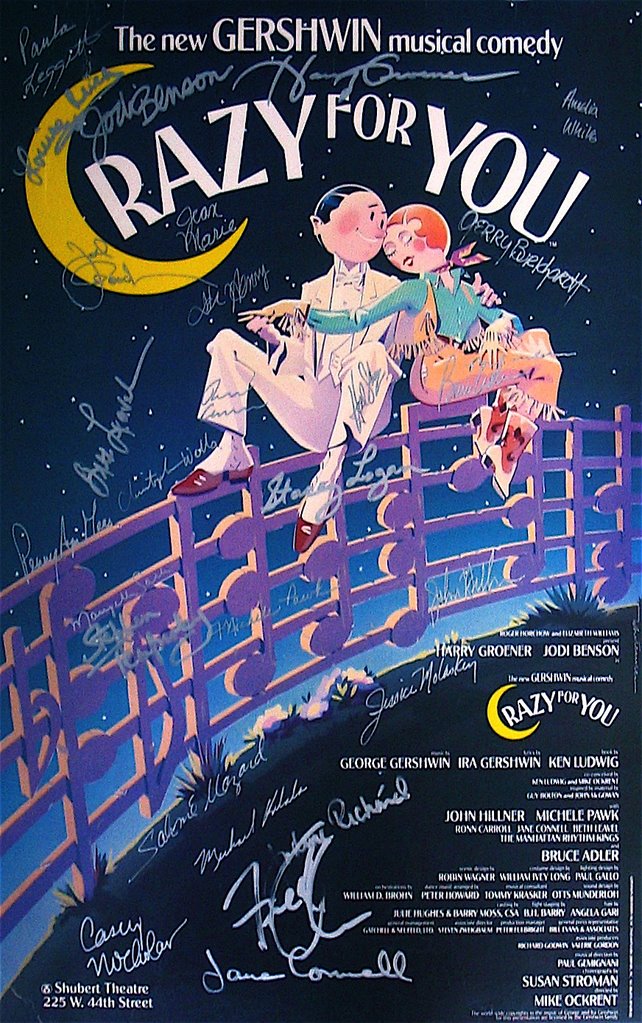
I developed a taste for Gershwin’s music some five decades later when a close friend of mine, himself formerly in show business, invited me to see the cheerful pastiche Crazy for You on Broadway (the above poster, signed by the entire cast, being a memento of that memorable event). Now, I have seen plenty of musical theater since then, anything from Show Boat and Gypsy to Sweeney Todd and The Drowsy Chaperone; but no show has left me humming quite as many long familiar yet ever thrilling tunes as Crazy for You, cleverly billed as a “New Gerswhin Musical Comedy.” Now, I don’t know how I might have felt about it had I seen Pia Zadora and Brady Bunch alumna Ann B. Davis in it (the latter getting far more requests for autographs than the former); let’s just say I was lucky to have experienced it being performed by the original cast.

The five broadcasts of BBC Radio 3’s Composer of the Week series are a serviceable introduction to Gershwin’s works, featuring the voices of Fred and Adele Astaire (“Fascinating Rhythm,” “So Am I”), Al Jolson (the inevitable “Swanee”), Ukulele Ike (“Lady, Be Good!”), Ella Fitzgerald (“The Man I Love”), Audrey Hepburn (“How Long Has This Been Going On”), excerpts from Of Thee I Sing, Strike Up the Band, Porgy and Bess—and plenty of Gershwin at the piano.

An Inspector Calls Our Bluff

Yesterday’s gloomy afternoon gave way to a splendidly sinister evening at the theater. The play was J. B. Priestley’s An Inspector Calls, which I had previously seen back in 1995, with 80’s heartthrob Maxwell Caulfield in his Broadway debut. In that production, the set pretty much upset the text—a huge, dark house confronting the audience from behind a curtain of rain. It was an impressive spectacle calculated, it seemed, to veil or countermand Priestley’s directives, the stark simplicity and artifice of his didactic play. Yet, as I realized last night, watching a touring Clwyd Theatr Cymru production directed by Barry Kyle, An Inspector Calls loudest when the lines are clear and the stage bare.

I had prepared for the evening by reviewing the 1934 film adaptation of Priestley’s Dangerous Corner, starring Virginia Bruce and Melvyn Douglas.  The movie struggles to open Priestley’s play to the demands of a dynamic camera.  The cinema audience wants, or is at any rate accustomed to, something other talking heads and sedentary bodies.  Even Martyn Bainbridge’s design, while effectively sparse compared to the melodramatic Broadway treatment of An Inspector Calls, at times displayed a doubt in the sufficiency of Priestley’s script by underscoring his words with visuals, turning walls into movie screens and tilting the stage to demonstrate the downfall of a supercilious and self-centered family.

Do we need images to get the picture? The theater of ideas is best accommodated by radio, a non-visual medium that forces our mind to focus on the spoken word and telling silences. Back in the early 1930s, Priestley may not have been convinced of this. After all, Dangerous Corner is a rather scathing commentary on the wireless as a soundcarpet under which the unspoken and unspeakable can be swept: the receiver has to break down to crack the surface of idle chatter among the civilized yet rotten.

In An Inspector Calls, which reworks the central idea of the earlier play, the part of the radio is performed by a telephone that rings to shut up a group of culpable and contemptible individuals talking themselves back into a state of calm. Unreliable or intrusive, both means of telecommunication are called upon to penetrate the walls of bourgeois conventions, obliging those standing apart to connect and disclose what has been carefully concealed from others.

Priestley could and did rely upon the wireless to spread the word and to popularize his ideas. His novels and plays were often heard on American and British radio during the 1930s and ‘40s, among them adaptations of Angel Pavement and Laburnum Grove, as well as the two works discussed here. The author-dramatist even made an appearance on Rudy Vallee’s show, as I read in a September 1939 issue of the Radio Times, and agreed to let the BBC serialize one of his novels prior to publication, with its author reading the first installment.

While expressing his reservations about the experiment and its effect on book sales, Priestley nonetheless decided to reach out to the populace he was eager to unite. Perhaps, some six years prior to the completion of An Inspector Calls, he had already gotten the call from his inquisitive messenger. It is a call that still resonates strongly today, not so much as socialist propaganda, but as an appeal to think beyond economics, beyond present self-interest, for the sake of turning a Dangerous Corner in the path of the planet we share.

Delayed Exposure: A Man, a Monument, and a Musical

Well, I don’t know why I took it. This picture, I mean. Over the years, I must have walked past that plaque hundreds of times without paying attention to it. A few months ago, returning for a visit to my old neighborhood in Manhattan, it insisted I take notice at last. I went to an exhibition at the Cooper-Hewitt Museum on the corner of Fifth Avenue and 91st Street. Erected in memory of the journalist W. T. Stead, this modest cenotaph stands opposite the museum, on the Central Park side of the avenue. I had no knowledge and little interest in the life of Mr. Stead, which (the plaque tells you as much) ended spectacularly aboard the Titanic. Last weekend, some three months after my return from New York, the man insinuated himself into my life once again, this time in the guise of a character in a Welsh musical.

Amazing Grace, staged at the local Arts Centre, tells the story of Evan Roberts, a Welsh miner turned preacher who, in the words of Mr. Stead, became the “central figure” of the early 20th-century “religious awakening in Wales.” Stead followed the movement, interviewed Roberts, and reported about this so-called Welsh Revival. In Mal Pope’s play, he appropriately serves as narrator and commentator on Roberts’s fabulous rise and his equally sudden disappearance from public view.

Unfortunately, Stead doesn’t get all that much to say or sing about Roberts, and the musical, which, in this particular production, featured the aforementioned Peter Karrie as a fierce reverend envious of the enigmatic upstart, suffers from a serious case of anticlimax: whether daunted by his fame or no longer driven to preach, Roberts simply shuts up—a silencing that doesn’t make for a rousing finale.

Unimpressed by Pope’s 1980s-styled power ballads and his by-the-numbers approach to biography, I was easily and gratefully distracted when I saw Mr. Stead walking across the stage and back into my conscious, as if to demand the leading role denied to him in this production. Now I find myself compelled to follow up on Stead’s life and writings.

As it turns out, Stead was fascinated by the spiritual, by premonition and second sight, by ghostly doubles and “long-distance telepathy.” For instance, he wrote about a case in which a telegram, then presumably the fastest means of telecommunication, was several hours slower in conveying a story than a message alleged to have been transmitted by a “disembodied spirit.” It is the extra-scientific (rather than the supernatural) speculated about by those growing up in the age of Darwin, an age of industrialism and shattered systems of belief.

Researching Etherized Victorians, my study on old-time radio, I came across one such comment on modernity by one of Stead’s contemporaries, Rudyard Kipling, whose 1902 short story “Wireless” marvels at psychic phenomena while questioning scientific progress: telepathy as the ultimate wireless connection.

It seems Mr. Stead is anxious to continue the debate from the beyond. I have unwittingly become a ghost writer for the late journalist; recalling him to life in word and image, I am merely his chosen amanuensis.

Mr. Benny Gets the Key to Baldpate

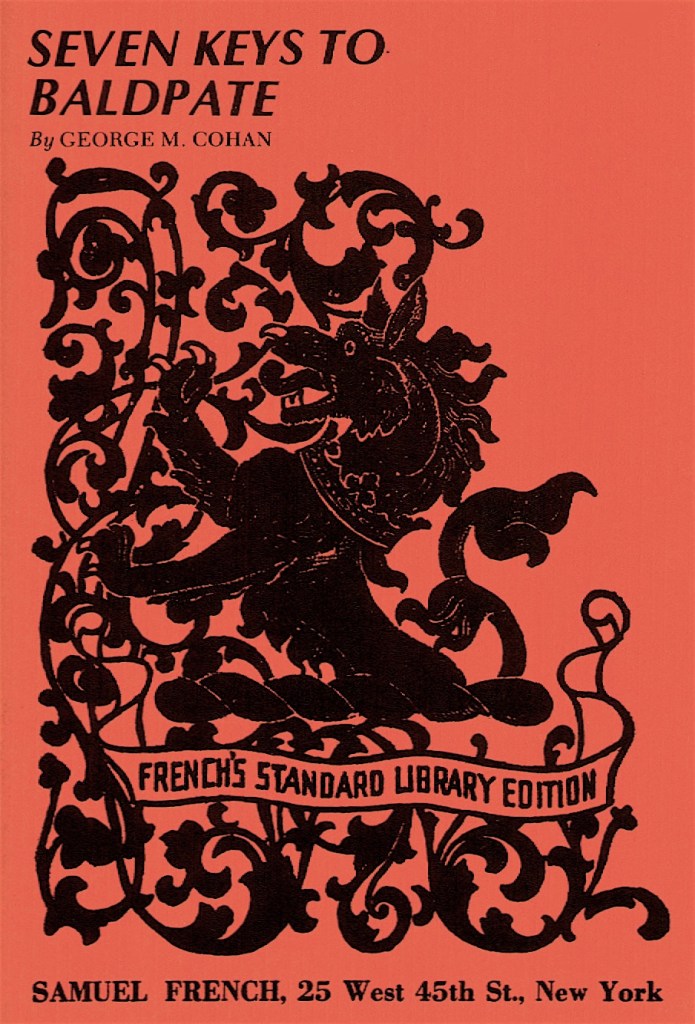
Well, I feel rather less prickly than yesterday. My cold seems to be on its way out and, having spent some time out of doors in the warmth of the autumn sun, I feel somewhat more serene and benevolent. Speaking of doors (a transition more creaky than the farce I am writing about today): Having complained previously (and elsewhere) about the conventional and therefore superfluous adaptation of Jane Eyre now flickering in weekly installments on British television, I am going to mark the anniversary of a decidedly more inspired variation on what was once a similarly familiar work of fiction, Seven Keys to Baldpate, a crowd-pleaser that was revived for radio on this day, 26 September, in 1938.

Granted, it is easier to rework a piece that does not warrant the reverence befitting a literary classic such as Jane Eyre, a respect that can be artistically stifling when it comes to revisiting or revising what seems to demand fidelity rather than felicitous tinkering. A mystery novel conceived by Earl Derr Biggers, the creator of Charlie Chan, Seven Keys opened many more doors after going through the smithy of theater legend George M. Cohan. Unlike Biggers, Mr. Cohan did not play it straight, but turned the thriller into what he then sold as a “Mysterious Melodramatic Farce”—starring himself.

In Cohan’s farce, the thriller writer Bill Magee accepts the $5000 challenge of a friend who dares him to pen a novel within twenty-four hours. To achieve this, the author is being given what he believes to be peace and quiet—the only key to a remote resort shut down for the winter.

During his night at Baldpate Inn, the supposedly single guest is disturbed by an assortment of singular strangers, lunatics and villains, until his friend shows up to confess that the bizarre goings-on were a practical joke designed to illustrate the ridiculousness of the author’s improbable plots. The epilogue of Seven Keys discloses, however, that the action of the play was a dramatization of the novel Magee actually managed to complete that night. He won the wager by fictionalizing the challenge.

Opening on 22 September in 1913, the play became an immediate and oft-restaged favorite with American theatregoers. It was subsequently adapted for screen and radio. When, some twenty-five years after its premiere, the producers of the Cecil B. DeMille hosted Lux Radio Theatre got their hands on this potboiler, they slyly revamped it as a commercial property fit for the latest medium of dramatic expression.

In his introductory remarks, DeMille promises the listener a “special treatment” of the play—and that, for once, was no overstatement. As I have discussed at length in Etherized Victorians, my study on old-time radio, the broadcast revision is not so much a rehash as it is an media-savvy update of the original.

Whereas Cohan’s version celebrates the victory of popular entertainment, of readily digested pulp fictions churned out for a quick buck, Lux writer-adaptor George Wells transforms Seven Keys into a radio story—a story about radio that parodies the anxiety of former vaudevillians-turned-broadcast artists to achieve lasting success, to be remembered long after the shows in which they starred week after week had gone off the air—to become cultural icons despite their invisibility. And those keys to uncertainty were handed to the man who had been through it all and stayed on top by knocking himself down, fall guy comedian Jack Benny.

Instead of a successful novelist, the artist now up for a crazy night at Baldpate is Jack Benny, as “himself,” a frustrated thespian who accepts the challenge of developing a suitable dramatic vehicle for himself after having been turned down for serious dramatic parts time and again. Benny’s challenger is no other than Mr. DeMille, who, in a rare stunt, not only introduces and narrates the play, but acts in it, and that without having to drop his director-producer persona. Throw in a few Lux Flakes and it comes out a clever bit of promotion all round.

The unpretentious yet self-conscious reworking of a play as old hat as Baldpate into a comment on the recycling business of radio entertainment—and a demonstration of how to lather, rinse, and repeat successfully—is one of Lux‘s most ingenious and engaging productions.