Asphalt Expressionism: The Creativity of Looking

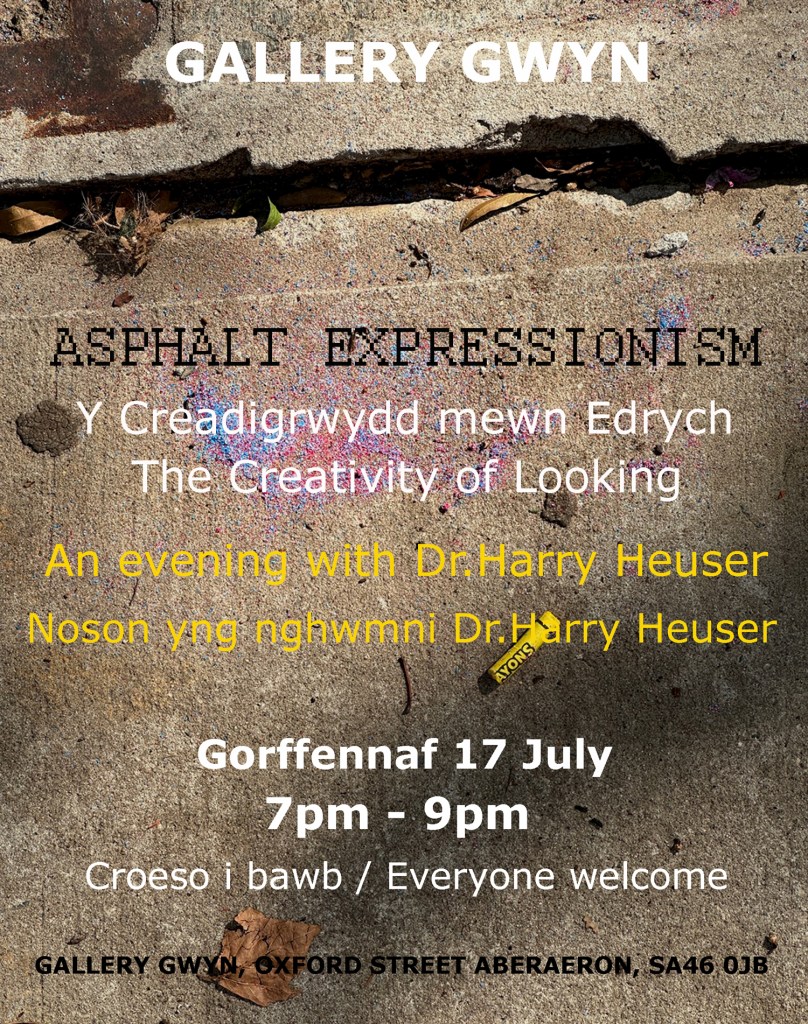
I have been asked, at some point during the run of my exhibition at Gallery Gwyn, to give a talk.ย ย I requested that the event be announced as โ€˜an evening with.โ€™ย ย Asphalt Expressionismย was intended to be inclusive and interactive, and the scheduled get-together, likewise, should promote exchange.ย ย Aย conversazione, perhaps, but not a lecture.

Given that the smartphone is my primary means of creating the images huddled under the fanciful umbrella of Asphalt Expressionismโ€”a series of digital photographs of New York City sidewalksโ€”reference to the ubiquitous technology strikes me as an effective way of connecting with those who, phone no doubt in hand, might be joining me that evening.

Continue reading “Asphalt Expressionism: The Creativity of Looking”

Flowering Inferno: Weather Extremes, Ersatz Aesthetics, and the Sprouting of Plastic Plants in New York Cityโ€™s Outdoor Spaces

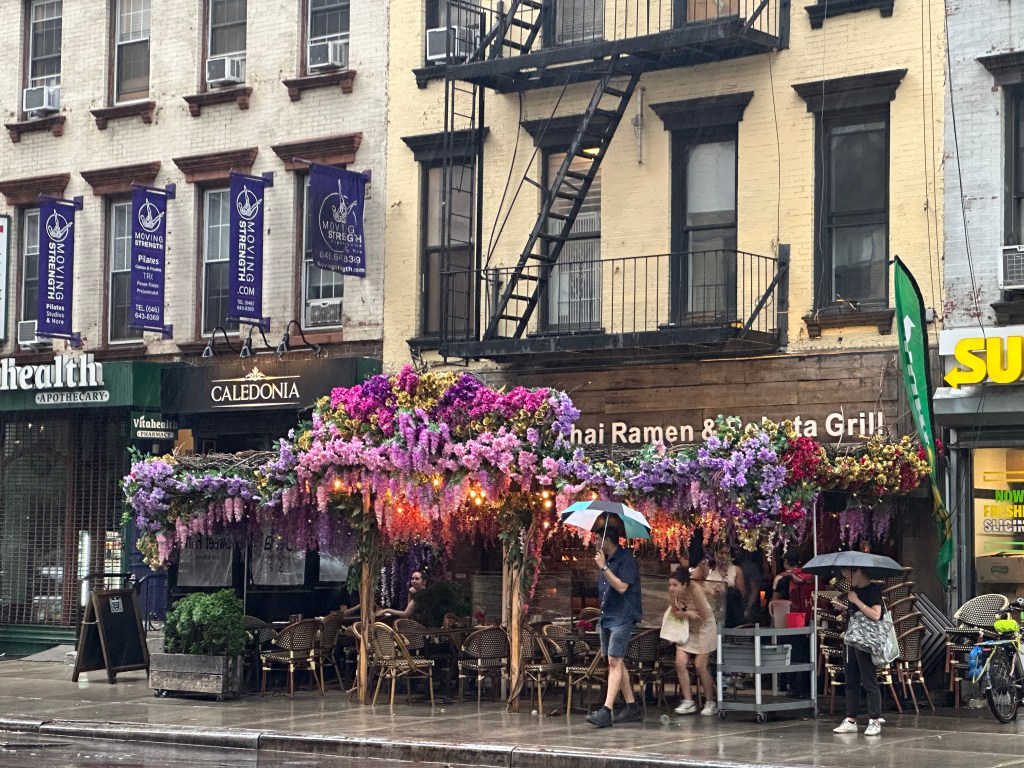
โ€œNotice anything different since your last visit?โ€ asked a friend of mineโ€”himself a former New Yorker now living in the wasteland of discarded values that is the Sunshine State of emergency known as Florida.  We were chatting on the phone some time after my arrival in the estival Big Apple, a stew seasoned with the smoke of Canadian wildfires.

Yorkville, 9 July 2023

I had not been in town for about eight months, so I was bound to spot some change beyond the odd coin left in my wallet. My bank account was taking a sustained beating while I was trying to enjoy a few drinks with friends at my favorite watering holes.  But that was to be expected.

West Village, 12 July 2023

Apart from air pollution, price hikes and the relentless bulldozing of neighborhood community, continuity and character wrought by the wrecking of the architecture for a glimpse of which we will soon have to refer to painting by Edward Hopperโ€”nothing new there, eitherโ€”what struck me most was an outbreak different from but related to the pandemic that, in the form of COVID-19 testing tents on Manhattan street corners, still dominated the sidewalks in the autumn of 2022.  At one of them, I had tested positive for the first time.

Continue reading “Flowering Inferno: Weather Extremes, Ersatz Aesthetics, and the Sprouting of Plastic Plants in New York Cityโ€™s Outdoor Spaces”

What Was I Thinking?: English 101, Phil Donahue and the Politics of Identity

I started college in the spring of 1991.  I had been visiting New York City since April the previous year, returning only once to my native Germany to avoid exceeding the six consecutive months I could legally stay in the US on a tourist visa.  The few weeks I spent in the recently reunited Vaterland that October had been difficult to endure, and for years I had nightmares about not getting back to the place I thought of as my elective home, the realities of the recession, the AIDS crisis, Gulf War jingoism and anti-liberal politics notwithstanding. 

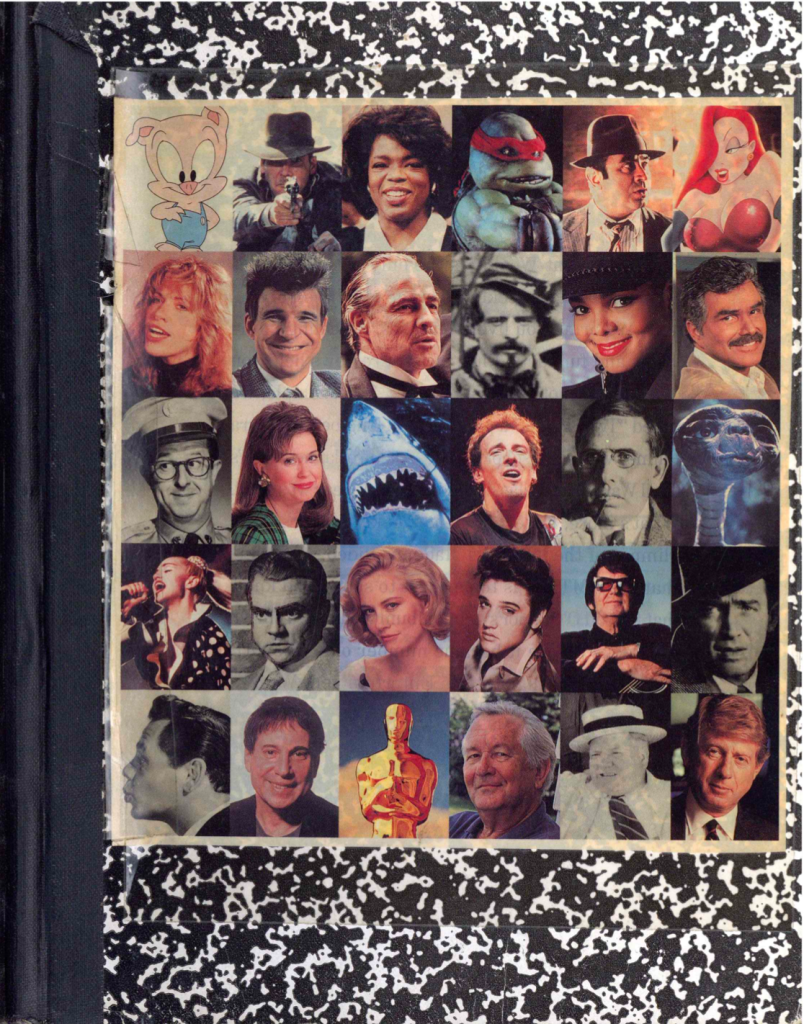
The cover of my 1991 journal, with an image collage
borrowed from a copy of Entertainment Weekly

I was determined not to repeat the experience of that involuntary hiatus once the next six-month period would come to an end.  A close friend, who worked at Lehman College in the Bronx, suggested that I become a student and generously offered to pay my tuition for the first year.  We decided that, instead of entering a four-year college such as Lehman, I should first enroll in classes at Borough of Manhattan Community College (BMCC), an option that would cut those “foreign” tuition fees in half.

Having gotten by thus far on my better than rudimentary German high school English, I had doubts nonetheless about my fitness for college.  My first English instructor, Ms. Padol, was both exacting and reassuring.  She worked hard to make her students try harder.  Not only did she give us bi-weekly essay assignments, and the chance to revise them, but also made us keep a journal, which she would collect at random during the semester.

“This requirement for my English class comes almost as a relief,” I started my first entry, titled โ€œA journal!โ€ That it was only “almost: a relief was, as I wrote, owing to the fact that, whatever my attitudes toward my birthplace, I felt “so much more comfortable in my native language.” Back then, I still kept my diary in German.  

What I missed more than the ability of putting thoughts into words was the joy of wordplay.  “My English vocabulary does not really allow such extravaganzas,” I explained, “and even though the message comes through โ€“ in case there is any โ€“ the product itself seems to be dull and boring to read.”  This reflects my thoughts on writing to this day.  To paraphrase Gertrude Stein, I write to entertain myself and strangers.

In the days of the lockdown โ€“ which were also a time of heightened introspection โ€“ I scanned the old journal to remind myself what I chose to entertain notions of back in 1991.  Many entries now require footnotes, if indeed they are worthy of them: who now recalls the stir caused by Kitty Kelleyโ€™s Nancy Reagan biography? Not that I had actually read the book. “Nobody will use this book in a history class,” I declared. Being “a compilation of anecdotes” it had “no value as a biography.” Autobiography, being predicated on the personal, cannot be similarly invalidated, as I would later argue after taking a graduate course in ‘self life writing’ with Nancy K. Miller at Lehman. What I knew even in 1991 was that a journal was not a diary.

Unlike the diary, the journal provided me with a chance to develop a writerly persona.  I was playing the stranger, and what my reader, Ms. Padol, may have perceived to be my outsider perspective on what, in one entry, I called the โ€œAmerican waste of lifeโ€ was in part my rehearsal of the part I thought my reader had reason to expect from me.  However motivated or contrived, that performance tells me more about myself than any posed photograph could. 

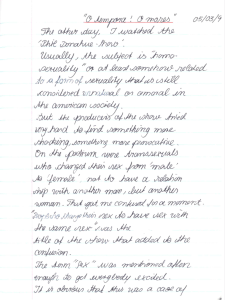
In an entry dated 3 May and titled โ€œO temporaO mores!โ€ I shared my experience watching Donahue, a popular talk show at the time, named after its host.  The broadcast in question was โ€œPeople Who Change Their Sex to Have Sex with the Same Sex,โ€ the sensationalism of which offering served as an opportunity to air my queer views as well as the closet of a journal that, for all its queerness, opened by lexically straightening my life by declaring my partner to be a โ€œroommate.โ€

After expressing my initial confusion about the title and my indignation about the “exploitation” of the subject, I considered my complicity as a spectator and confronted the narrow-mindedness of my binary thinking:

Like the audience in the studio I asked myself why anybody would go through such a procedure only to have a lesbian relationship.

But then I realized that this is really a very shallow, stupid and yet typical question that shows how narrow-minded people are.

It also reflects ongoing intolerance in this society.

The woman in question made it clear that there is a difference between sexual identity and sexual preference.  When a man feels that he is really a woman most people think that he consequently must be a homosexual.

I refer to myself in the journal as gay.  What I did not say was how difficult it had been for me to define that identity, that, as a pre-teen boy I had identified as female and that, as a teenager, I had suffered the cruelty of the nickname “battle of the sexes,” in part due to what I know know (but had to look up again just now) as “gynecomastia”: the development of breast tissue I was at such pains to conceal that the advent of swimming classes, locker rooms and summer holidays alike filled me with dread.  I had been a boy who feared being sexually attractive to the same sex by being perceived as being of the opposite sex.

Reading my journal and reading myself writing it thirty years later, I realise how green โ€“ and how Marjorie Taylor Green โ€“ we can be, whether in our lack of understanding or our surfeit of self-absorption, when it comes to reflecting on the long way we have supposedly come, at what cost and at whose expense.  We have returned to the Identity Politics of the early 1990s, which I did not know by that term back then but which now teach in an art history context; and we are once again coming face to face with the specter of othering and the challenge of responding constructively to difference.  I hope that some of those struggling now have teachers like Ms. Padol who make them keep a journal that encourage them to create a persona that does not hide the self we must constantly negotiate for ourselves.

There is no record online of a Ms. Padol having worked at BMCC.  Then again, there is no record of my adjunct teaching at Lehman College from around 1994 to 2001, or at Hunter College and CUNY Graduate Center thereafter.  The work of adjuncts, and of teachers in general, lives on mostly in the minds and memory of the students they shaped.

I was more surprised at not finding any references online to that particular Donahue broadcast, except for a few mentions in television listings โ€“ two, to be exact.  The immediate pre-internet years, that age of transition from analog to digital culture, are a time within living memory to the access of which a minor record such as my English 101 journal can serve as an aide-memoire.  Whatever the evidentiary or argumentative shortcomings of anecdotes, by which I do not mean the Kitty Kelleyian hearsay I dismissed as being “of no value,” historically speaking, they can be antidotes to histories that repeat themselves due to our lack of self-reflexiveness.

Those of us who have been there, and who feel that they are there all over again โ€“ in that age in which the literalness of political correctness was pitted against the pettiness of illiberal thinking โ€“ can draw on our recollections and our collective sense of dรฉjร  vu to turn our frustration at the sight of sameness into opportunities for making some small difference: we are returning so that those who are there for the first time may find ways of moving on. Instead of repeating the question in exasperation, we need answers to “What were we thinking?”

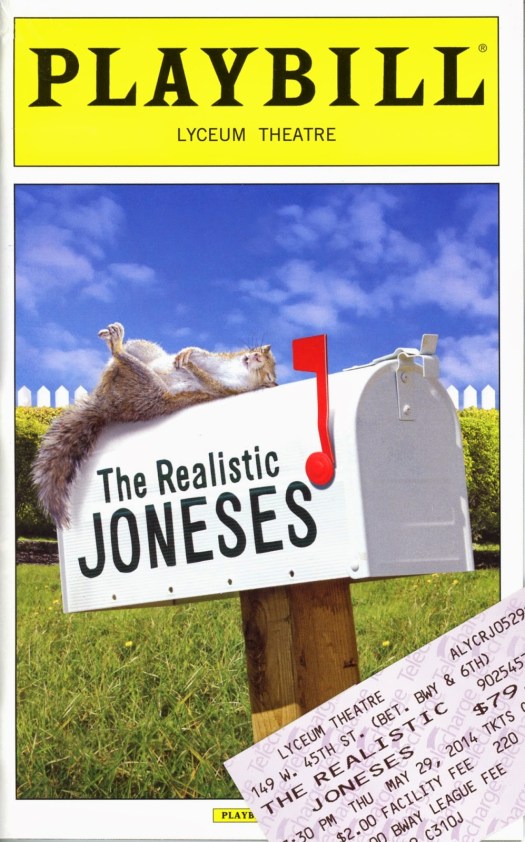
If only the Squirrel: A Word on Plays on Words as Plays like The Realistic Joneses

I donโ€™t get it.ย  No, I take that back.ย  I didnโ€™t get anything from it.ย  No, thatโ€™s not it, either.ย  I didnโ€™t really like it is more like it, really.ย  Will Enoโ€™sย The Realistic Joneses, I mean.ย  Itโ€™s one of those plays that are nothing more than wordplay.ย  Theย Jonesesย arenโ€™t reallyย Realistic.ย  That much I got, and not much else.ย 

The characters are just worders, if thatโ€™s the word for it.ย  If it were a word.ย  They are not word made flesh.ย  Iโ€™m not sure whether they are mouthpieces because Iโ€™m not sure what they were meant to mouth, other than that we are mostly words to one another.ย  Words that are no reliable access to thought or feeling, that are no substitute for flesh, for sensations and experiences.ย 

A playwright who says as much as that โ€“ or as little โ€“ has got a real challenge.ย  But that may be too charitable a word for a playwrightโ€™s “Iโ€™ve got nothing, really.”

The Realistic Joneses, to me, is a bad play.  Even the wordplay isnโ€™t that good.  It is of a sitcom caliber, and the characters are a bunch of near flatlining oneliners.  I mean, โ€˜Ice cream is a dish best served coldโ€™? Seriously, is that bit of lame rhetoric โ€“ a clichรฉ made obvious as a commonplace โ€“ a substitute for a plot twist? I didnโ€™t feel the play was a moving comment on the increasingly disembodied state of twenty-first century humanity, much less a sensitive portrait of toxic malaise. I didn’t feel.  Thatโ€™s just it.

The Realistic Joneses is a play on the hollowness of words, and I donโ€™t feel that that is a valid point to make in a play.  Not any more.  Not even for the middle-aged with a nostalgic yearning for some old-fashioned post-modern self-reflexivity.  Well, post-modernism isnโ€™t what it used to be because it just isnโ€™t anymore.  Or oughtnโ€™t to be.  The tongue has to come out of the cheek eventually, and it has to learn to speak again and say something other than, say, “What’s there to say?” Not just some piffle passing for the absurd.  To me, surrealism isnโ€™t anything goes nothing, at least not in the theater.

I walked out of the Lyceum Theatre thinking that I had just spent what amounts to a buck a minute on a rotten piece of ephemera โ€“ like that dead squirrel Tracy Letts picks up and throws into a trash bag, or the spoilt food Michael C. Hall takes out of the refrigerator โ€“ with little else but these few words of mine to show for it. If only that food had been served hot.ย 

If only the squirrel had lived.ย  If only.ย  Or maybe not.

Down Memory Street; or, Thanks for the Sesame

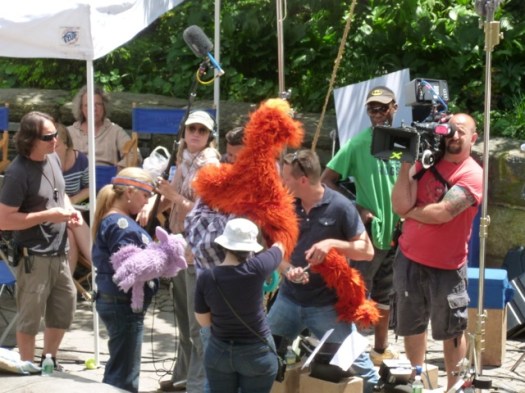
Filming of Sesame Street in Carl-Schurz Park, Manhattan

The sight was monstrous. There was shouting. They were shooting. Someone stood guard to keep strollers from trespassing while the action went on undisturbed. Few folks seemed to care, though, so familiar had such sights become in New York City. One could always catch up with it later, on television. Besides, this wasnโ€™t a crime scene. It sure wasnโ€™t Needle Park or Fort Apache, The Bronx. This was the peaceful, upmarket Upper East Side, for crying out not too loudly, and the wildly gesticulating savage in furs was of the Cookie Monster sort.ย  Sesame Street was being filmed on locationโ€”and the location, on that May day, was Carl-Schurz Park in my old neighborhood of Yorkville.

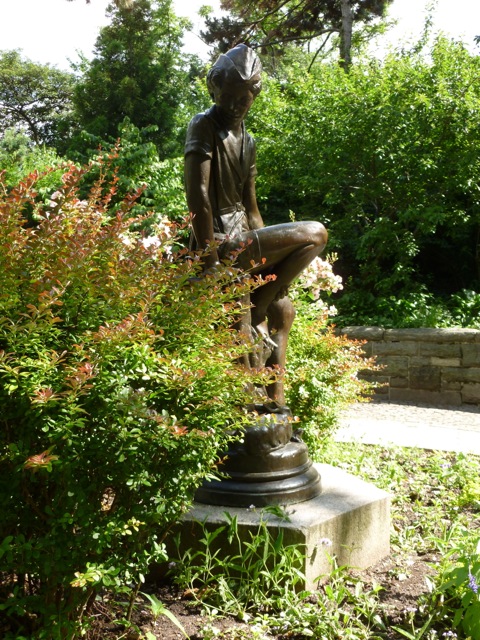
Peter Pan sculpture, Carl-Schurz Park

It seemed fitting that the beloved childrenโ€™s television series should be shot here, right in front of Peter Pan, the bronze statue that, some fifteen years earlierโ€”when the park had gone to seed other than Sesameโ€”was violently uprooted and tossed into the nearby East River like an innocent bystander who, some thugs decided, had seen too much. It seemed fitting because Carl-Schurz Park is a tribute to German-American relationsโ€”and, in a long and roundabout way, I came to New York City from Germany by way ofย Sesame Street. ย 

As a prepubescent, I spent a great deal of time in front of the television, a shortage of viewing choices notwithstanding. My parents were both working and I turned to the tube for company, comfort and the kind of guidance that didnโ€™t come in the form of a command or a slap. West German television had only three channels until well into the 1980s, and the third one, back in the early 1970s, was still experimental, reserved mainly for educational programs aired at odd hours. Odd hours would have been anything before mid-afternoon, when regular programming commenced on weekdays.ย ย 

So, there was literally nothing else on when I pushed the knob of our black-and-white set (a stylishly futuristic Wega) to come across Ernie, Bert, Oscar and the Cookie Monsterโ€”and they all spoke,ย growled or squeaked English. That is how I heard them first and how, several years before I was taught English at school, I got my first lessons in a foreign language.

I had just gotten through the alphabet and the numbers from one to ten when, without โ€œWarnung,โ€ย Sesame Streetย turned intoย Sesamstrasse and the felty, fluffy foreigners became German, even though they changed neither looks nor scenery. Being beyond pre-schooling, I now tuned in chiefly for the puppetry and the antics of the Krรผmelmonster. That is the way the Cookie Monster crumbled. โ€œKrรผmelโ€ literally means โ€œcrumb,โ€ suggestive of the state to which something solid could be reduced in the process of translation.

Educationally, the early dubbed version of Sesame Street was dubious, to say the least. Spoken and written words and images did not always match.ย  Sure, โ€œAโ€ is for โ€œappleโ€ as well as โ€œApfel,โ€ and โ€œBโ€ for โ€œbananaโ€ and, well, โ€œBanana.โ€ย  But there was little use for โ€œC,โ€ since few words in the German language begin with that letter; at least they didnโ€™t during those days before Computers.ย  I remember watching a lesson on โ€œAโ€ that ended in โ€œAlles am Arsch,โ€ an expression only a tad short of the exclamation summed up in the last three letters of โ€œsnafu.โ€ For once, even my parents took note.ย 

Never mind, I remained loyal to Ernie and Bert, whose odd coupling I envied; and once the magazine accompanying the series was launched, with images of the puppets as centerfolds, the pair became my first pinups.ย  If onlyย Sesame Streetย (a pun that, too, is lost in German translation) had remained on the air in its original language. By the time high school started, and with it lessons in Englishโ€”British, if you pleaseโ€”I had all but lost the enthusiasm; for the next nine years, I learned reluctantly and none too well, being that we were forced to go through joyless Grammar drills to arrive at the point of meaningful self-expression.ย 

As a child, I never associatedย Sesame Streetย with any real place, let alone New York City, the seedy ways of which, back then, conjured scenes of violence and decay: the turf of gangs, the marketplace for drugs, and the inspiration for nothing except TV cop shows. It was just as difficult to get that image out of my head as it had been to get English into it.ย 

Indeed, my first exposure to the Big Apfel demonstrated that image to be truer than the pictures of it in glossy travel brochures; no doubt, I had spent too much time eyeing the Carringtons of Denver, Colorado. That I fell in love with old, crime-ridden Gotham all the same had more to do with hormones than with anything we traditionally understand to be โ€œtourist attractions.โ€

Since the mid-1990s, Manhattan has cleaned up its act, even though it wiped out much of the cityโ€™s character along with the crimeโ€”so successfully, in fact, that I once was slapped with a fine for dozing off on a bench opposite Peter Pan because I felt safe enough to rest my eyes. ย 

Sesamstrasse, Carl-Schurz Park, and the old Wega set (images of which I had to google to remind myself): the neighborhood of memory sure gets crowded as you travel ever further down the road . . .

14 Gay Street: NYC, Myself and Eileen

I had walked past this place many an evening on the way to Tyโ€™s, my favorite Greenwich Village watering hole.ย  This time, though, it was mid-afternoon and I turned left, leaving Christopher for Gay Street.ย  I had come here specially to take a picture of number 14, the former residence of two sisters who, for about a quarter of a century or so, were household names across America. ย Ruth and Eileen McKenney had been on my mind ever since I saw that production of Wonderful Town on a visit to Manchester, Englandโ€”and the gals, whose misadventures are tunefully related in said musical, seemed determined to stay there.ย  On my mind, that is, not up in the Salford docklands; though, judging from their experience way down here on Gay Street, they might not have minded the docks.

A few days earlier, I had happened upon a copy of Ruth McKenneyโ€™s All About Eileen (1952) in the basement of the Argosy, one of my favorite antiquarian bookstores in town.  I hadnโ€™t even been looking for it at the time.  In fact, I had been unaware that such an anthology of McKenneyโ€™s New Yorkerstories existed.

Eileenย was lying there all the sameโ€”prominently if carelessly displayed, draped in a flashy, tantalizingly torn jacket that stood out among the drab, worn-out linen coats of a great number of unassuming second-hand Roses about to be put in their placeโ€”waiting to be picked up.ย  I don’t flatter myself.ย  My company was of no consequence toย Eileen.ย  If I was being lured, it was no doubt owing to an itchย Eileenย had to get out of yet another basement.

Thinking of the case I had to lug to the airport before longโ€”and the less than commodious accommodations that would awaitย Eileenย in my studyโ€”I had hesitated and walked out alone; but I soon changed my mind, returned to the Argosy, and, to my relief, foundย Eileenย still there, though shifted a little as if to say โ€œIโ€™m notย thatย easyโ€ and to make me suffer for waffling.

And here I was now, a week later. ย 14 Gay Street.ย  Itโ€™s an unassuming walk-up, next to a scaffolded shell of a building that, a friend told me, had been on fire a while ago.ย  Walk-up! More like a step-down for Ruth and Eileen. The two had been naรฏve enough to rent barely-fit-for-living quarters below street level, unaware that the construction of a new subway line was going to rattle their nerves and rob them of what one of their first visitors, a burglar, could not readily bag: their sleep.

โ€œ[W]e lived in mortal terror falling into the Christopher Street subway station,โ€ Ruth recalled, making light of her darksome days in their damp โ€œlittle cave.โ€โ€‚And “[e]very time a train roared by, some three feet under our wooden floor, all our dishes rattled, vases swayed gently, and startled guests dropped drinks.”

From the outside, at least, 14 Gay Street looked perfectly serene on that quiet, sunny afternoon. ย I was not the only one stopping by, though.ย  I walked up to what I assumed to be a fellow admirer ofย Eileenโ€™s; as it turned out, he was oblivious that the very spot had given rise to such lore as was retold on page, screen and stage.ย  He only had eyes for the wisteria that had taken its chancesโ€”and its timeโ€”to sidle up to and ravage a neighboring property.

Imposing as that looked, I had my heart set on those small dark windows peering from behind the pavement like a pair of Kilroy peepers.ย  Eileen was here, I thought, and was glad to have seen what seemed too little to look at.ย  Indifference, after all, is in the passerbyโ€™s eye.

I wonder now: How many sites of the cityโ€”fabled but forsakenโ€”are daily escaping the sightseerโ€™s gaze?

Donโ€™t Dress for Dinner: Six Characters in Search of a Round Table

The prosaically named American Airlines Theatre on Broadway has about as much intimacy and sex appeal as a departure lounge.  The long entrance hallway, which barely opens up to a space resembling the lobby of a two-star hotel, makes you feel that, once your ticket has been scanned, you are a mere hourโ€™s worth of taxiing away from takeoff.  That said, it wasnโ€™t the venue that made the Roundabout Theatre Companyโ€™s production of Donโ€™t Dress for Dinner such a terminal bore.

Farces are all about frustrated desires, about wanting to take it off and waiting to get it on, about fooling around the longest way round and never quite getting around to it.  In this case, though, the exasperation I sensed was all mine.  As the characters got together for their scheduled assignations, the actors seemed to be heading off in different directions.  Watching them move around on the stage was about as scintillating as staring at other folkโ€™s suitcases circling the baggage carousel, which aroused in me nothing but the suspicion that this was going to be a wearisome cat-and-spouse game indeed.

Not since Tony Randallโ€™s 1991 production of The Crucible had I witnessed such a spilled ragbag of irreconcilable acting styles.  Their task being merrily to prolong the unwanted dinner party at the expense of hoped-for dessert spooningโ€”and to make all this falling apart come together for usโ€”the assembled cast members were in desperate need of a round table, not a dinner table, and a director, not a waiter, giving orders rather than taking them.

To be sure, Marc Camoletti play is no Noises Off; and the fact that I had seen Michael Fraynโ€™s farce-to-end-all-farce only a few weeks earlier made Donโ€™t Dress seem like a morning after.  Camoletti, best known for Boeing-Boeing was ill served by a translator whose lines are so threadbare (yes, cooker does rhyme with hooker) as to deserve nothing more than booing, booing.

The male leads, Ben Daniels as Robert and Adam James as Bernard came dressed for office, not play. A third maleโ€”make that machoโ€”role was so indifferently cast that the ending, in which alone the character featured, fell as flat as postage stamp on a card reading โ€œWish I were anywhere but here.โ€

The ladies were livelier by far; but whereas classy Patricia Kalember as Jacqueline seemed to have expected a Noel Coward soiree, brassy Jennifer Tilly as Suzanne was fitted out for a Vegas dinner theater . . . or a romp with Chucky.  Meanwhile, the energetic Spencer Kayden as Suzetteโ€”who reminded me of Elizabeth Berridge and her role as the maid in the glorious if short-lived โ€˜90s sitcom satire The Powers That Beโ€”brought to the proceedings a verve and a timing well suited to the inspired slapstick that Donโ€™t Dress so desperately lacked.  Alas, you canโ€™t have good comic timing all by yourself.

What you can have by yourself is the last laugh, scoffing at what elicited nary a chuckle in the first place.

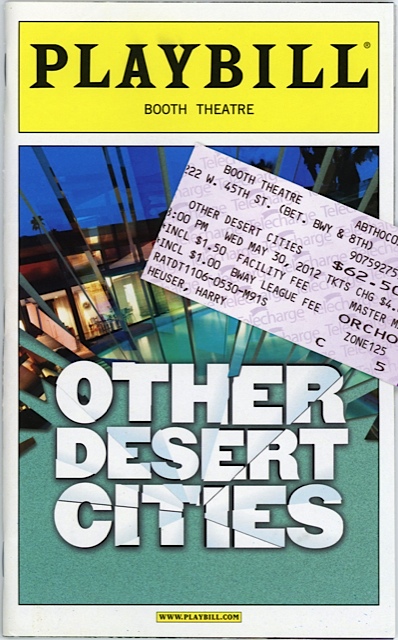
I Remember, Mama: Complicity, Mendacity, and Other Desert Cities

Once, as I recalled here before, I had the audacity to tell a well-known biographer, whose student I was, that I had no respect for writers of other peopleโ€™s life stories.  Unless content to be mere chroniclers, recording activities and recounting events, they are fabricators of interiorities that, I wasโ€”and amโ€” convinced, are unknowable to anyone other than the single occupant of that interior.  For all our confidences and intimations, we are ultimately unreadable to one another.

In order to turn life into story, biographers must impose a logic beyond chronology, a pattern to make unreason rhyme.  They connect the dots on a timeline to create causal relationships designed to account for peopleโ€™s behaviors and actions: because she couldnโ€™t face her past, she couldnโ€™t live with herself; because she lost her brother, she lost her trust in family; because he was in truth insecure, he became a make-believe gunslinger.  Without being supplied with at least a hint of what we call โ€œmotivation,โ€ we reject stories as lacking in psychological depth and moral complexity.

Back when I gave my professor a piece of my mindโ€”proffered, mind you, with a smileโ€”I thought of the biographerโ€™s determination to make sense of other peopleโ€™s existences as sheer hubris.  Now, I am more inclined to look at biography as an act of desperation.  Nothing is more disconcerting, more silencing and disabling, than the blank we have to call potentiality in order to face or overwrite and deface it.  We cannotโ€”will notโ€”settle for zilch.

Secrets and duplicities, intimacy and detachment.  Like all family dramas worth relating to, Jon Robin Baitzโ€™s stage play Other Desert Cities measures the distance between folks who are biologicallyโ€”and often physicallyโ€”closest to each other: the flesh, the blood and the closeted skeletons of kinfolk.

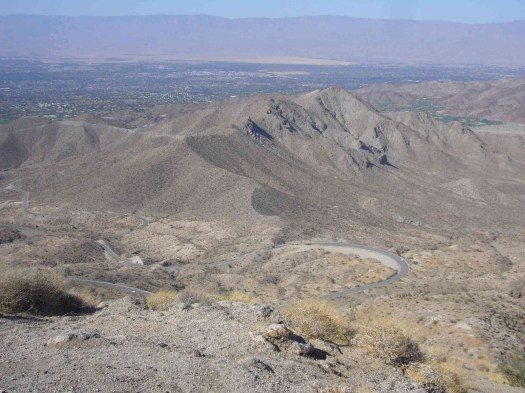
Approaching Palm Springs (and Other Desert Cities)

Baitzโ€™s American stage family, the Wyeths, could hardly be more traditional: a mother and father, married to one another, a daughter and son, offspring of that union.  Then there is the dramatically expedient extension of that nucleus; in this case an alcoholic, donโ€™t-give-a-damn aunt whom the audience looks at as a go-between, not only between characters but between those characters and ourselves.  It is a well calculated constellation, this, as Other Desert Cities does not just explore relationships but the act of relating, of putting that relationship and all those relations into words, and of questioning the words and the unspoken.

Though most of us couldnโ€™t live with Aunt Silda (Judith Light, in the Booth Theatre production), we love her for what we are encouraged to read as her forthrightness and free spirit.ย  She, we assume, would be the person most likely to tell the true story of that family, as compromised as her memory and judgment might be after years of swilling the kind of spirits from which she is unable to free herself.

Hello Sildaโ€”
The way I remember Palm Springs

After all, we cannot expect to get the inside dirt from her sister Polly (Stockard Channing), a staunch yet tarnished Republican who is terrified that her daughter Brooke (Elizabeth Marvel) has written a tell-all autobiography threatening to tear the faรงade right off the familyโ€™s sunny Californian home.

Yes, Silda tells it like it is.  Criticized by her class-conscious sister of wearing knock-offs, she barks back:

Honey.  News-flash: youโ€™re not a Texan, youโ€™re a Jew! Weโ€™re Jewish girls who lost their accents along the way, but for you that wasnโ€™t enough, you had to become a goy, too.  Talk about the real thing? Talk about โ€˜faking it.โ€™ Honey, this Pucci is a lot more real than your Pat Buckley schtick.

As it turns out, neither Silda nor Polly are what we are led to believe them to be; and this is Brookeโ€™s lesson, too, as she tries to piece together the life story of her lost brother, a left-wing radical whose act of terrorism forced Nancy Reagan pal Polly and her ex-Hollywood star husband Lyman (Stacey Keach) into retirement in the desert.

Desperate to figure out who or what made her brother Henry what the facts donโ€™t quite tell her he was, Brooke turns from writing fiction to biography.  Yet, in her attempt to expose the truth, she ends up with yet another version of the story rather than a definitive one.  โ€œShe presents us as ghouls who drove [Henry] to become sort of a murderer,โ€ her anguished, disconsolate father protests to his son (Thomas Sadoski), the โ€œADD riddled, junk-food-addicted porn surfing Trip Wyeth,โ€ as Brooke calls him to his face.

โ€œChrist, thereโ€™s something so vicious about what youโ€™re doing here, Brooke, donโ€™t you know that?โ€ Lyman exclaims.  Vicious and necessary, Other Desert Cities argues.  And futile? As suggested by the closing scene, which may strike some as perfunctory or incongruously sentimental, Brookeโ€™s ordealโ€”and the ordeal to which she put her familyโ€”has served a purpose.

What may seem like a coda or anticlimax I took as the point of the Baitzโ€™s drama.  As a biographer, Brooke has failed.  She has been taken in, taken story for life and secrecy for guilt only to become complicit in her familyโ€™s cover-up.  As an autobiographer, though, Brooke is to be envied.  She has learned something about herself that she didnโ€™t know before she came to investigate the lives of those around her.  We may be unknowable to each otherโ€”but we can learn to know ourselves.

Cinegram No. 14 (Because You Canโ€™t Rely on Air Mail These Days)

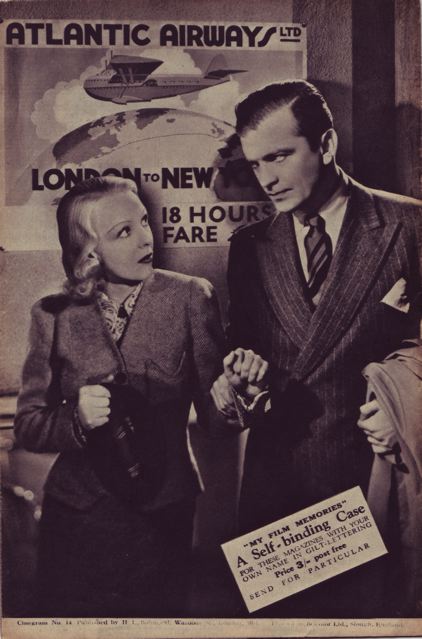
I am taking the passing ash cloud as an occasion to dust off my collection of Cinegrams, a late-1930s to early 1940s series of British movie programs I recently set out to acquire. Immemorabilia, you might call them. Not quite first-rate souvenirs of, for the most part, less-than-classic films like The Return of the Scarlet Pimpernel, or worse. These cheaply printed ephemera were designedโ€”quite pointlessly, it seemsโ€”to encourage folks to keep alive their memories of something that may well have been forgettable to begin with. Sure, why not pay a little extra for a few stills of a picture that wasnโ€™t much to look at while in motion? And why not pay still more to keep your โ€œFilm Memoriesโ€ in a self-binding case, with your name on itโ€” in gilt-lettering, no less? That was the offer made to British moviegoers anno 1937, who purchased Cinegram No. 14 to prevent Non-Stop New York from seeming all too fleeting.

Perhaps, I am confusing โ€œforgettableโ€ with โ€œforgotten.โ€ Non-Stop New York which is readily available online, has a lot going for it, quite apart from being a fast-paced romantic vehicle for John Loder and Anna Lee, helmed by Leeโ€™s husband, Robert Stevenson, who would go on to make Flubber and Mary Poppins soar at the box office.

Efficiently if somewhat routinely lensed, this Gaumont-British production might have served as a project for the companyโ€™s most notable director, Alfred Hitchcock. Substituting airlanes for tracks, itโ€™s the The Lady Vanishes in the realm of the birds. Except that, in this case, the ladyโ€”the young and innocent girl who knew too muchโ€”refuses to vanish, which makes the man whose secret she knows all the more eager to see to her disappearance.

The main attraction of Non-Stop New York is not its contrived plot, its charming leads or its rich assortment of goons and ganefs. Rather, it is the filmโ€™s setting, the futuristic plane aboard which this pursuit reaches its thrilling climax. It is a large, multi-story aircraft resembling a luxury linerโ€”right down to the outdoor deck on which windblown lovers kiss by moonlight and villains go for the kill. Thereโ€™s plenty of room for some old-fashioned hide and seek, as passengers are not crowded together but retreat into the privacy of their own cabins. Quite an extravagance, this, considering that the imagined travel time of eighteen hours hardly warrants accommodations fit for on a sea voyage, which mode of transatlantic crossing yet served as a point of reference to the production designers who conceived the vessel.

It took Christopher Columbus ten weeks to cross the Atlantic Ocean, Cinegram No. 14 educated its readers. โ€œToday, ten hours seem to be sufficient to complete the same journey.โ€ Set in the seemingly foreseeable future of 1939, Non-Stop New York

anticipates the regular air service which before long [that is, after the end of the wartime air raids that, even in the age of Guernica, purveyors of escapist entertainment did not trouble themselves to predict] will be flying regularly across the North Atlantic and carrying passengers overnight between London and New York. Already survey flights are being carried out by Imperial Airways and Pan American Airways and these flights have shown that such a service is not longer a dream of the fiction writer, but something which to-morrow will be as commonplace as the many daily services of to-day between London and Paris.

The first experimental flights were made in the Summer of 1937. The British company made a series of flights with two of the Empire class flying boats, the โ€œCaledoniaโ€ and the โ€œCambria.โ€ The terminal points of these flights were Southampton and New York and the route followed was by way of Foynes, on the west coast of Ireland across the Atlantic, 1992 miles, to Botwood, Newfoundland. From there the flying boats went to New York by way of Montreal.

In all, 5 two-way crossings were made and these were carried out without incident and with such certainty that they reached the other side of the Atlantic within a few minutes of schedule.

On the last eastward journey the โ€œCambriaโ€ set up an all time record, making the 1992 miles in 10 hrs. 33 min. or at an average speed of nearly 190 m.p.h.

These flying boats will not be used for the Atlantic service when passengers are carried but it is probably that flying boats of the same type, but with greater power and greater ranger will be used. These flying boats may have a cruising speed of 250 m.p.h., and carry 20-30 passengers in a degree of comfort equal to that of the present luxury liner.

With its promise of a jet-setting tomorrow, a title like Non-Stop New York must have sounded thrilling to picture-goers anno 1937, albeit not nearly as thrilling as such a promise is to any present-day passenger awaiting the all-clear for departure at one of Britainโ€™s dormant airportsโ€”among them a friend of ours whose plans for a birthday celebration in Gotham are being pulverized by the largest export of a cash-strapped nation to whom volcanic activity appears to be a natural substitute for banking.

Movies like Non-Stop New York and collectibles such as Cinegram No. 14 remind me that, in living memory, long distance air travel was rare and special indeed. They remind me as well of one momentous April morning in 1985โ€”some quarter century agoโ€”when my younger self first boarded a transatlantic flight to the exhilarating and treacherous metropolis that was New York City. Back then, we still applauded the captain who returned us safely to earth; nowadays, we merely moan when we are grounded for whatever strikes us non-stoppers as too long . . .

A โ€œkind of monsterโ€: Me[, Fascism] and Orson Welles

It doesnโ€™t happen often that, after watching a 21-century movie based on a 21-century novel, I walk straight into the nearest bookstore to get my hands on a shiny paperback copy of the original, the initial publication of which escaped me as a matter of course. Come to think of it, this never happened before; and that it did happen in the case of Me and Orson Welles has a lot to do with the fact that the film is concerned with the 1930s, with New York City, and with that wunderkind from Wisconsin, the most lionized exponent of American radio drama, into which by now dried up wellspring of entertainment, commerce and propaganda it permits us a rare peek. You might say that I was the target audience for Richard Linklaterโ€™s comedy, which goes a long way in explaining its lack of success at the box office.

And yet, despite the filmโ€™s considerable enticementsโ€”among them its scrupulous attention to verisimilitudinous detail and a nonchalant disregard for those moviegoers who, having been drawn in by Zac Efron, draw a blank whenever references to, say, Les Tremayne or The Columbia Workshop are being tossed into their popcorn littered lapsโ€”it wasnโ€™t my fondness for the subject matter, much less the richness of the material, that convinced me to pick up Robert Kaplowโ€™s novel, first published in 2003. Indeed, it was the glossiness of the treatment that left me with the impression that something had gotten lost or left behind in the process of adaptationโ€”and I was curious to discover what that might be.

On the face of it, the movie is as faithful to the novel as the book is to the history and culture on which it draws.  Much of the dialogue is lifted verbatim from the page, even though the decision not to let the protagonist remain the teller of his own tale constitutes a significant shift in perspective as we now get to experience the events alongside the young man rather than through his mind’s eye.  In one trailer for the film, the voice-over narration is retained, suggesting how much more intimate and intricate this story could have beenโ€”and indeed is in printโ€”and how emotionally uninvolving the adaptation has turned out to be.

Without Samuelsโ€™s narration and with a scene-stealing performance by Christian McKay as Welles, the screen version gives the unguarded protรฉgรฉ, portrayed by the comparatively bland Efron, rather less of a chance to have the final word and to claim center stage, as the sly title suggests, by putting himself first.

The question at the heart of the story, on page and screen alike, is whether successes and failures are born or made.  Prominence or obscurity, life or death, are not so much determined by individual talent, the story drives home, but by the circumstances and relationships in which that talent can or cannot manifest itself.  We know Welles is a phony when he goes around giving the same spiel to each member of the cast who is about to crack up and endanger the opening of the show, insisting that they are โ€œGod-created.โ€  They are, if anything, Welles-created or Welles-undone.

Finding this out the hard wayโ€”however easy it may have looked initiallyโ€”is high school student Richard Samuels who, stumbling onto the scene quite by accicent, becomes a minor player in a major theatrical production of a Shakespearean drama directed by a very young, and very determined, Orson Welles.  Samuelsโ€™s fortunes are made and lost within a single week, at the end of which his name is stricken from the playbill and his life reconsigned to inconspicuity, all on account of that towering ego of the Mercury.

The premise is an intriguing one: a forgotten man who lives to tell how and why he did matter, after allโ€”a handsome stand-in for all of us who blew it at some crucial stage in our lives and careers.  Shrewdly concealing that it was he who nearly ruined the Mercury during dress rehearsal by setting off the sprinklers, Samuels can luxuriate in the belief that he may have inadvertently saved the production by reassuring a superstitious Welles that opening night would run smoothly.

Speculating about the personalities and motives of historical figures, dramas based on true events often insert an imaginary proxy or guide into the scene of the action, a marginal figure through or with whom the audience experiences a past it is invited to assume otherwise real.  And given that Me and Orson Welles goes to considerable length capturing the goings-on at the Mercury Theater, anno 1937, I was quite willing to make that assumption.  Hey, even Joe Cotten looks remarkably like Joseph Cotten (without the charisma, mind).

It was not until I read the novel that I realized that Kaplow and the screenwriters, while ostensibly drawing their figures from life, attributed individual traits and behaviors to different real-life personages.  Whereas actor George Coulouris is having opening night jitters on screen, it was the lesser-known Joseph Holland who experienced same in the novel.

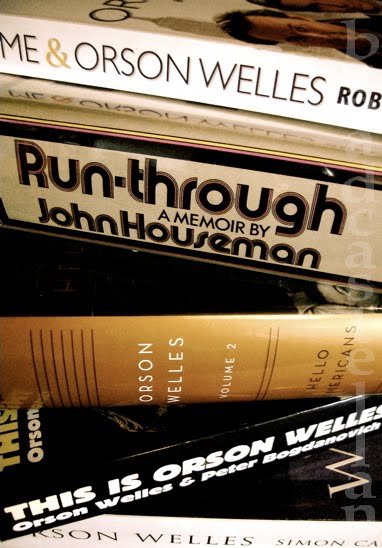
Although quite willing to let bygones be fiction, I consulted Mercury producer John Housemanโ€™s memoir Run-through, which suggests that the apprehensive one was indeed Coulouris.  Housemanโ€™s recollections also reveal that the fictional character of Samuels was based in part on young Arthur Anderson, a regular on radioโ€™s Letโ€™s Pretend program who, like Samuels, played the role of Lucius in the Mercury production.  According to Houseman, it was Anderson who flooded the theater by conducting experiments with the sprinkler valves.

Never mind irrigation; I was trying to arrive at the source of my irritation, which, plainly put, is this: Why research so thoroughly to so little avail? Why be content to present a slight drama peopled with folks whose names, though no longer on the tip of everyoneโ€™s tongue, can be found in the annals of film and theater? The missed opportunityโ€”an opportunity that Welles certainly seizedโ€”of becoming culturally and politically relevant makes itself felt in the character of Sam Leve, the Mercuryโ€™s set designerโ€”a forgotten character reconsidered in the novel but neglected anew in the screenplay.

Andersonโ€™s contributions aside, it is to Leveโ€™s account of the Mercuryโ€™s Julius Caesar that Kaplow was indebted, a debt he acknowledges in the โ€œSpecial thanksโ€ preceding the narrative he fashioned from it.

โ€œ[P]oor downtrodden Sam Leveโ€โ€”as Simon Callow calls him rather patronizingly in his biography of Orson Wellesโ€”was very nearly denied credit for his work on the set.  Featuring prominently in the novel, he is partially vindicated by being given one of the novelโ€™s most poignant speeches, a speech that turns Me and Orson Welles into something larger and grander than an intriguing if inconsequential speculation about a brilliant, egomaniacal boy wonder.

Confiding in Leve, with whom he has no such exchange in the movie, Samuels calls Welles a โ€œkind of monster,โ€ to which Leve replies: โ€œWe live in a world where monsters get their faces on the covers of the magazines.โ€  In this exchange is expressed what mightโ€”and, I believe, shouldโ€”have been the crux of the screen version: the story of a โ€œkind of monster,โ€ a man who professes to turn Julius Caesar into an indictment of fascism, however conceptually flawed (as Callow points out), but who, in his dictatorial stance, refuses to acknowledge Leveโ€™s contributions in the credits of the playbill and shows no qualms in replacing Samuels when the latter begins to assert himself.

โ€œAs in the synagogue we sing the praises of God,โ€ Leve philosophizes in the speech that did not make it into the screenplay, โ€œso in the theatre we sing the dignity of man.โ€  Without becoming overly didactic or metaphorical, Me and Orson Welles, the motion picture, could have put its authenticity to greater, more dignified purpose by not obscuring or trivializing history, by reminding us that Jews like Leve and Samuels were fighting for recognition as the Jewish people of Europe were facing annihilation.

To some degree, the glossy, rather more Gentile film version is complicit in the effacement of Jewish culture by homogenizing the story, by removing the Jewish references and Yiddish expressions that distinguish Kaplowโ€™s novel.  Instead of erasing the historical subtext, the film might have encouraged us to see the Mercuryโ€™s troubled production of Julius Caesar as an ambitious if somewhat ambiguous and perhaps disingenuous reading of the signs of the times, thereby making us consider the role and responsibility of the performing artsโ€”including films like Me and Orson Wellesโ€”in the shaping of history and of our understanding of it.


Related writings
โ€œOn This Day in 1938: The Mercury Players โ€˜dismember Caesarโ€™โ€
โ€œOn This Day in 1937: The Shadow Gets a Voice-overโ€