
Original? Sin!: Romancing the Reproducers (Part Two)

Well, I did say “romancing,” didn’t I? It may have sounded more like “pooping on” in the entry I balderdashed off yesterday. The accompanying image, by the way, referred to the new television series Balderdash and Piffle (on BBC2 in the UK), which invites the public to challenge, edit and amend the Oxford English Dictionary. More about that in a few days, perhaps. So, why “romancing”?

For one thing, I am very much attracted to and fascinated by remakes and adaptations. I am not one of those clamoring for so-called original material in favor of a smart revision or charming homage. Let’s face it: “originality” is a downright prelapsarian concept. There are only so many juicy stories to tell. We should not expect to be handed another forbidden fruit from the tree of knowledge; which does not mean that we should settle for any old lemon.

Reworking a so-called classic can be a questioning of its definitiveness, its very status. It can also mean a translation of a great idea or worthwhile thought into a context and language more accessible to present-day audiences, thus a way of keeping the original alive in spirit, rather than slaughtering it.

As diverting as both King Kong and The Producers might have been, I feel they have failed on both accounts. Yet even though I am not infrequently disappointed with remakes and sequels (which are often remakes in disguise), I seek them out again and again, embracing them—in concept, at least—as an alternative form of criticism.

Last night, for instance, I watched The Saint in London (1939), which aired during the first week of January 2006 on BBC 2 in a series of four Saint adventures. The movie is a reworking of Leslie Charteris’s mystery “The Million Pound Day.” So, I could not refrain from digging up that story from my library and will probably report my comparison in the near future, drawing on the 1940s Saint radio series as well.

I felt compelled to do the same after watching King Kong, of which I found an undated radio adaptation, with Captain Englehorn as narrator. And I might take the same multimedia approach to the Charlie Chan mystery, The Black Camel, having recently come across a first edition of the 1933 omnibus The Celebrated Cases of Charlie Chan at a local second-hand bookstore.

Tracing an adaptation to its source—not necessarily an original itself—often enhances my appreciation or understanding of a work and its workings. It does not follow that the older version is superior by virtue of its antecedents, even though our fondness for it may make us sceptical of any attempts at revision.

While in London, I saw two 1930s plays. One was the Kaufman and Hart comedy Once in a Lifetime, the other And Then There Were None. The latter is based on the 1939 Agatha Christie novel in which ten strangers find themselves on a remote island, murdered, one by one, by an unknown adversary among them. Rene Clair’s 1945 film adaptation is a marvel of both atmosphere and fidelity—right until the very end. One reviewer having his say on the internet movie database (IMDb) remarks that the novel’s ending “would never *ever* work in a dramatized setting, film or stage”—but Kevin Elyot’s new stage adaptation proved him wrong. I couldn’t wait for the play to be over. Not because it was so awful, not because I wanted to know the identity of the murderer (familiar to me from book and film)—but because I needed to see what was being done to the ending. A very satisfying counting down of corpses it turned out to be.

Once in a Lifetime—staged by the National Theatre, no less—was dead on arrival. Even the spirit of nostalgia, if I were possessed by it, could not assist in animating this propped up carcass. Period costumes, smart sets, and fidelity to the script—itself much in need of tightening and deserving of fresher jokes—are no substitute for a director’s knowing and assured handling of material that was still relevant and topical in 1930 (the advent of cinema’s sound era), but that now comes across as a quaint and pointless revisitation of Singin’ in the Rain—without the Singin’. A soggy muddle indeed.

The program for the show supplied a “Once in a Lifetime Glossary” to an audience confronted with a slew of 75-year-old in-jokes. What’s left is a dim farce of decidedly low wattage. Very few directors can work up and sustain the energy to prevent the potentially zany from being plain dull.

In short, rummaging through remakes and revivals can be a disenchanting exercise; but there are rewards in romancing the reproducers, especially if they take you to the occasional gem you might have otherwise overlooked.
Original? Sin! Romancing the Reproducers (Part One)

Well, it seems that complimentary wireless internet access is not yet a standard feature of the average London hotel room. Jury’s Inn, Islington, for instance, charges £10 per day for a broadband connection. That’s about 20 to 25 percent of the cost for a room, and as such no piffling add-on to your bill. So I felt compelled to take a prolonged but not unwelcome break from blogging, taking the small fortune thus saved to the theater box office, the movies, and the temples of high art. Meanwhile, my lingering cold (the New York acquisition mentioned previously) was worsening into something well-nigh debilitating; a numb skull and eyeballs ablaze in their dried up sockets kept me from keeping up with the out-of-date—ever the broadcastellan motto—for another week.

Time healing (or hardening you into accepting) most anything eventually, I am returning at last with something approaching gusto and will try now to sum up my recent pop cultural experiences in a few lines that, it is hoped, add up to a composition fit for your perusal.

Even though I have used the phrase myself, I have always pitied those who, when asked “What’s new?” merely offer the wan reply of “Same old, same old.” There is an art to finding the new in the old—and those who don’t possess this life-skill are likely to be miserable, dissatisfied creatures. There is a difference, however, between making the old merely seem new—which is a form of deception—and making new what merely seemed old—which is a philosophy. Hollywood has always been great at deception; but either its powers or my willingness to be duped are beginning to fade with age.

Take The Producers and King Kong, for instance. In the theater, where revisiting old favorites generally means playing it safe, revivals can be corny or cozy, as Once in a Lifetime and And Then There Were None demonstrated to me. At the museum, people are forever flocking to see the oldest and most reproduced objects of visual culture, such as those on display in the exhibition Samuel Palmer: Vision and Landscape. And on the radio . . . ahh, now there’s a repository for the lost and found. Listen!

The Producers hoofed into UK theaters on what is celebrated here as Boxing Day, which is precisely when I saw it. Nothing screams indifference louder than rows of empty seats on opening night (make that “matinee”). I’m not sure whether the Bialystock and Bloom formula of making money by staging a flop will serve those involved in bringing back the original leads of the stage remake of the 1968 film.

I have seen the stage musical twice; back in September 2003 at the St. James Theater in New York City, with John Treacy Egan and Don Stephenson heading the cast; and again in January 2005 starring Lee Evans and Brad Oscar at the Theatre Royal, Drury Lane, in London. Watching a filmed musical is like clutching an opera glass—parts at the expense of the sum. As a motion picture, The Producers was all picture and little motion. Opportunities to flesh out the Little Old Lady Land routine as some suitably bizarre Technicolor spectacle or to go all Busby Berkley with the Swastika dance were squandered in this stagy hokum of hummable tunes and ho-hum jokes.

And King Kong? While hardly an abject failure, this Titanicized remake of Jurassic Park (or the 1925 film adaptation of Conan Doyle’s The Lost World) comes across like a momentarily diverting thrill ride rather than a definitive version of a cinematic classic, let alone anything worthy of a nook in a time capsule.

Like The Producers, which mainly serves to preserve the performances of Nathan Lane and Matthew Broderick for posterity, King Kong makes little effort to be of its time, to provide any commentary save the by now tiresome postmodernist winks of self-reflexivity. The 1933 film smartly commented on the Great Depression, on the big city dreams gone bust; Peter Jackson’s film recreates the era with all the passion of a miniature train collector (from the shantytowns in Central Park to the Amos ‘n’ Andy sign in Times Square), but has little to say about our times.

Even when referencing Conrad’s familiar and perennially relevant novella The Heart of Darkness, the flashy new King Kong, unlike Apocalypse Now, does this pointlessly. Nor were the sexual tensions in this love triangle played out any more overtly than in the Hollywood pre-code version dreamed up by Cooper and Schoedsack. Might not there be accommodation for a few comments on, say, America’s anxieties about the constitution of marriage, terrorism and its countermeasures, or the future of immigration in a melodrama about an abducted alien forced into slave labor and desperate enough to die for a dream the realization of which those professing to be civilized are prepared to prevent at all cost?

It was beauty killed the beast, all right; but it’s a lack of vision that’s killing the movies. As the considerable decline in revenues suggests, the traditional cinema is about to die out like vaudeville; interactive computer games for the sit-at-home folk are taking their place. No longer able, let alone content, to follow the storylines so carelessly strung together by today’s filmmakers, audiences will want to create their own stories with the narrative fragments tossed to them by the Xbox builders now axing box office profits . . .

Hold on, while I am applying a fresh coat of Vicks VapoRub. Better make that “See you tomorrow.” Promise!

On This Day in 1959: A Ghost of Crises Past Shares "A Korean Christmas Carol"

Yesterday, we took the train up and across the border to Birmingham, England, to see the exhibition Love Revealed: Simeon Solomon and the Pre-Raphaelites at the Birmingham Museum & Art Gallery. Deceptively saccharine, the title of this show (borrowed from Solomon’s fanciful dream narrative “A Vision of Love Revealed by Sleep”) also refers to the Victorian artist’s troubled life, to the disclosure of his secret and the end it meant for his career as a commercially viable painter.

There was nothing sensationalistic about this staged revelation; and even though Solomon’s paintings and drawings do not always stand up particularly well when placed alongside the works of his better known contemporaries, “Love Revealed” did not leave me with the impression that this rather obscure artist is being deemed due for a revival chiefly because certain academics with an agenda think his private life under public scrutiny, his outing and ousting, fascinatingly queer or historically significant enough to warrant such a tribute. The past may come back to haunt us—but it may also be revealed, at last, in a light that is different without being garish.

Christmas, of course, is just the time to conjure up haunting spirits; the telling of ghost stories during the season when days are darkest is a tradition in Britain, Dickens’s “A Christmas Carol” being the most famous of them all. On US radio, updates of Ebenezer Scrooge were attempted on programs as diverse as Blondie (“Scrooge,” 15 Dec. 1939), The Six Shooter (“Britt Ponset’s Christmas Carol,” 20 Dec. 1953), and the syndicated propaganda series Treasury Star Parade (ca. 1942), in whose seasonal offering, “The Modern Scrooge ($18.75),” the reformed old miser becomes an air-warden.

The past was not always the exclusive domain of pastiche, however. On this day, 20 December, in 1959, a rather more gritty ghost story was presented by Suspense, an anthology of radio thrillers heard over the Columbia Broadcasting System in the United States between 1942 and 1962. Titled, “A Korean Christmas Carol,” the play tells the strange tale of an American soldier stationed in Korea, Christmas 1958.

On his way to Seoul, he picks up a hitchhiker, a fellow soldier who relates his own experience fighting in Korea some seven Christmases earlier. Insensitive to the icy weather and oblivious to the cigarette smoldering between and singeing his fingers, the stranger seems to be dwelling wholly in the past. When he steps out of the car and disappears into the darkness, he leaves behind his AWOL bag, forcing his listener to follow his path. But instead of taking him straight to some barracks or military installation, the path leads to a secluded orphanage. It is here that the ghosts of Christmas past, present, and future crowd in on our haunted storyteller.

Featuring the non-traditional holiday sounds of fierce machine gunfire, the play opens and closes with a choir of Korean children—the orphans of the war to whom the mysterious hitchhiker, himself a casualty of war, sets out to deliver a bag of toys by turning the driver-narrator into his earthly messenger. Having died to save his comrades, he now returns to remind and guide his countrymen to look after the offspring of those whose lives he took.

“A Korean Christmas Carol” is a story of sacrifice and redemption, a story of making amends—a story of love revealed in a vision of death. Will the present war on terror produce or inspire any such ghost stories to be shared underneath the Christmas tree in the decades to come?

A New York Souvenir Is Glorious! in London

Well, I am on my way to London in a few hours, even though I have barely recovered from my trip to New York City, a souvenir of which is a lingering cold. Still, I am looking forward to a weekend in the metropolis, where I’ll be reunited with my best pal to celebrate his birthday and the twentieth anniversary of our friendship. We used to have our annual get-togethers in the Big Apple, but the Big Smoke will do.

While there, I would love for us to take in a few shows, impervious as he is to the wonders of the “wooden O.” I, for one, have had some terrific theatrical experiences lately, including a rare staging of the outrageously bloody Revenger’s Tragedy at New York City’s Red Bull Theater, an all-male production of The Winter’s Tale by the touring Propeller company, and an out-of-tuneful Broadway evening with Judy Kaye in Souvenir.

True, the 9 December issue of Entertainment Weekly did not exactly endorse Souvenir, reviewer Thom Geier calling Stephen Temperley’s play “too broad, too shallow, and far too long for [its] modest pleasures.” Still, Kaye is marvellous in the role of Florence Foster Jenkins, the tone-deaf soprano and unlikely recording artist who managed to fill seats and thrill audiences in NYC’s Carnegie Hall, unaware that many came to gawk and deride, not to admire her.

I have seen musical-comedienne Kaye several times onstage and even had an after-theater drink with her, back in November 1992, when she played Sweeney Todd‘s Mrs. Lovett at the Paper Mill Playhouse in New Jersey. Her portrayal of the real-life phenomenon that was Florence Foster Jenkins managed at once to amuse and touch me, even though Souvenir, as written by Temperley, is slight, repetitive, and less than incisive.

You’ll have to get up close and zoom in on Kaye’s features—the snare and shelter of Jenkins’s oblivion expressing itself in innocent smiles and youthful exuberance, the firm belief in her musical disabilities as she refuses to heed the at fist cautioning then caustic words from her hapless accompanist, and the terror of recognition when at last she discerns the cruel laughter of the crowd—to wrest any oomphs from Temperley’s pleasant and chuckles-filled survey of the dubious diva’s odd career. Fortunately, I sat in the third row. Anyone back on the balcony is unlikely to get half as much out of this play, which is suited to a smaller venue than Broadway’s grand Lyceum.

Upon returning to the UK, I learned that another dramatization of Jenkins’s life, conceived by another playwright (Peter Quilter), is currently playing in London. Called Glorious, this version stars Maureen Lipman, whom I have last seen opposite Ian McKellen in the pantomime Aladdin at the Old Vic. Ms. Lipman hasn’t got Kaye’s pipes, but her acting garnered some favorable notices. I am sufficiently intrigued by Jenkins’s antics to judge her performance myself later this year.

How come there are two plays running simultaneously about a 1930s New York City curiosity, a novelty act who, like those making a spectacle of themselves during last year’s American Idol auditions, has become an old joke few can recall? It is encouraging, somehow. Ready to rediscover most anything, the public might yet turn a favourable ear to the golden age of radio. I sure wouldn’t mind having someone to talk to . . .

On This Day in 1943: Artist Jean Helion Escapes Into Thin Air

Feeling as miserable as I do right now (the aforementioned cold), I was tempted to abandon the “On This Day” feature and escape the self-imposed strictures of such a format. Then I came across a recording of Words at War that made me decide not to disenthrall myself just yet. I might not have gotten to know Jean Helion, had it not been for the frustrating and inept adaptation of his wartime memoir They Shall Not Have Me, first broadcast on 23 September 1943.
An ambitious literary anthology, Words At War (1943-45) was a class act in American radio propaganda. Produced by the National Broadcasting Company in cooperation with the Council on Books in Wartime, Words at War attempted to dramatize “important war books,” ranging from a clipped version of the home front melodrama Since You Went Away to a dystopian fantasy based on Louis Nizer’s fiercely anti-Teutonic “bible for peace” What to Do With Germany. The series was better suited than situation comedies, variety shows, and horror programs to provide a “living record” of the war and the “things” for which US citizens were called upon to fight. The program promised to be such a “living record,” but individual broadcasts were at times less than viable shorthand memos to the bewildered American public.

In the roughly twenty-five minutes allotted to the dramatization, “They Shall Not Have Me” attempts to recount the story of a French soldier, his imprisonment by the Nazis, and his escape. Neither its melodramatic potential nor its cultural significance was realized by the NBC staff writer at work on Jean Helion’s book. Having faced degradation by the Nazis, Helion now suffered a treatment akin to defacement. Sure, his name was mentioned often enough: “Yes, that is I, Jean Helion, weeping and unashamed like a baby,” the hero addressed the listener at the close of the play. Yet who was this man? Who was Jean Helion? The audience was left in the dark.

Radio actor Les Damon’s impression of the Frenchman, while commendable for its restraint, as it does not attempt to imitate a Gaul accent, already stripped the storyteller of his identity, an identity that motivated Helion to return to his native land to join the fight against German occupation. The script did worse. Emphasizing the supposedly uplifting event of an Allied soldier’s peril and perseverance, it omitted much that makes this individual account of bravery so remarkable and compelling.

Born in 1904, Helion was a French artist who enjoyed transatlantic success as a nonfigurative painter. In 1936, he moved to New York City, where his works had already been shown in a 1933 solo exhibition; among his acquaintances and friends numbered quintessential modernists like Marcel Duchamp, Max Ernst, Piet Mondrian, Joan Miró, and Yves Tanguy. Putting his career on halt in 1940, Helion joined the French army, but soon became a prisoner of war in Nazi Germany. He managed to escape in 1942 and made it back to the United States.

Apparently profoundly influenced by his wartime experiences, he not only wrote an account of it (published in 1943) but abandoned abstract for figurative art (such as the untitled 1943 painting shown above), thereby rupturing his integrity and risking his reputation. None of this is being captured by Kenneth White’s radio rendering of Helion’s story, which was essentially reduced to an undistinguished yarn of capture and getaway—a single man going free while thousands remained under Nazi occupation, a man who felt disenchanted and betrayed by the country he sought to serve. The situation in France left unimproved after his courageous effort to liberate what he believed to have been his home, is the story of escape artist Helion one of failure or triumph? Unfortunately, the adaptation lacks the intelligence to make use of such ambiguities.

I am grateful to old-time radio for the many literary and artistic encounters it has made possible by all these impossible foreshortenings. Such broadcasts instruct in their very failure to inform; that is, as long as the frustrated listener remains willing to supplement what was being tossed piecemeal across the airwaves. As it turns out, Helion’s paintings are now being exhibited (until 9 October 2005) at the National Academy in Manhattan, just around the corner from my former abode. Even when dwelling in the remotest corners of “unpopular culture,” there is always a personal connection waiting to be established.

Collecting Thoughts; or, What I Learned About Blogging from Baroness Thyssen-Bornemisza

Calle de las Huertas, Madrid

Well, I have returned from my weeklong trip to the center of the Iberian peninsula (that is, a stay in Madrid, with an excursion to Toledo) and am pleased to report how invigorating it can be to go away, come face to face with one’s own ignorance, and return in a confusion of humility and inspiration—souvenirs to be put to better use than dust-gathering bric-a-brac.

To be sure, I still cannot tell one Spanish monarch from another—except for the baby-faced Fernando VII and the big-nosed Carlos III, on the representation of whose none too prepossessing visages a fair amount of oil and canvas were expended. I still cannot order a Spanish meal without half-guessing what might end up on my plate—except that the tapas-and-cervezas cuisine is so lacking in variety as to render an extensive culinary lexicon unnecessary. And I still cannot relate to bullfights, flamencos, or devotional art—except that I know better now than to reduce arcane passions to patent stereotypes. I did learn something about blogging, though—and it was the Baroness Thyssen-Bornemisza who, however unwittingly, conveyed the lesson.

Carmen Thyssen-Bornemisza, of course, is the wife of Baron Thyssen-Bornemisza, the steel magnate-collector who displays his artistic riches at the magnificent Thyssen-Bornemisza Museo Nacional in Madrid, a generous sharing of his increasing wealth for which he gets amply rewarded in contracts throughout the city (you’ll notice the name of Thyssen wherever there’s a construction site—and there were plenty all over town).

Unlike her husband, the Baroness only started collecting in the 1980s. She seems to have a taste for the famous and nominal alike, but little sense of what is first-rate or exemplary. Her collection is overwhelmingly large and, for the most part, put together without much discernible grace, wit, or discrimination. She bought up third-rate paintings of first-rate artists, apparently at great speed, and caught many a masterful painter on an off day. Her husband had an eye—she’s got the Euros. That, at least, was my impression when I walked through the vast and ultimately stultifying Thyssen-Bornemisza National Museum. So, what have I learned?

In the broadest sense, a blog is a collection of thoughts. It may be regarded as a museum, a virtual storehouse of words and images that are culled from various sites, commenting, like all art does, on the world of today—be it on society, politics or religion.  Many bloggers are savvy name-droppers; quite a few exploit their writing for advertising purposes; some are merely providing the odd caption to the works they borrow. Others, like myself, simply try to share what they care about but disseminate thoughts without quite knowing how to reach either a specific or general audience, without being fully aware of the potentialities of their enterprise.

In other words, not all bloggers are good curators of their thought museums. Their growing collections may lack direction or purpose—rendering all but useless what might be of some small service to the few or many; unless, that is, the viewer, aware of the individual pieces in the museum, has the freedom to steer past the profusion to approach directly what matters to her or him. In this respect, a virtual collection, like the online version of the Museo Thyssen-Bornemisza, is more useful than a traditional one, since visitors can direct their curiosity so as to move specifically into the presence of the works they choose to see or care to know about (as some of my readers did, Googling their way to what I wrote about Valentine Vox or The Free Company, for instance).

And yet, a collection loses its cohesion and falls apart as a result of such selective viewings; it becoming as fragmented as the interests of the diverse public to which it is being made available.  How to keep an online journal like this together—and keep it going?

Any smart museum is, to some degree, self-reflexive about the collection it houses. A truly smart museum, like the Museo Lázaro Galdiano, acknowledges its shortcomings rather than trumpeting its ostensible merits. Over the next few weeks, I shall try new approaches to collecting my thoughts for subjection to the splintering vision of the public gaze. I am aware, for instance, that broadcastellan is missing a unifying narrative arch, mainly because I do not want to turn this journal into an intimate if public diary.

Some of the connections between what I label “unpopular culture” and our—or, rather, my—present everyday seem forced or arbitrary precisely because the personal link between what I experience and choose to discuss has been obscured: why am I watching this or that film; why am I listening to a specific radio play or reading a certain book just now?

Rather than becoming more personal, I aim to make more of an effort to relate to others by providing a historic connection to the works I choose to discuss without turning my musings into history lessons.

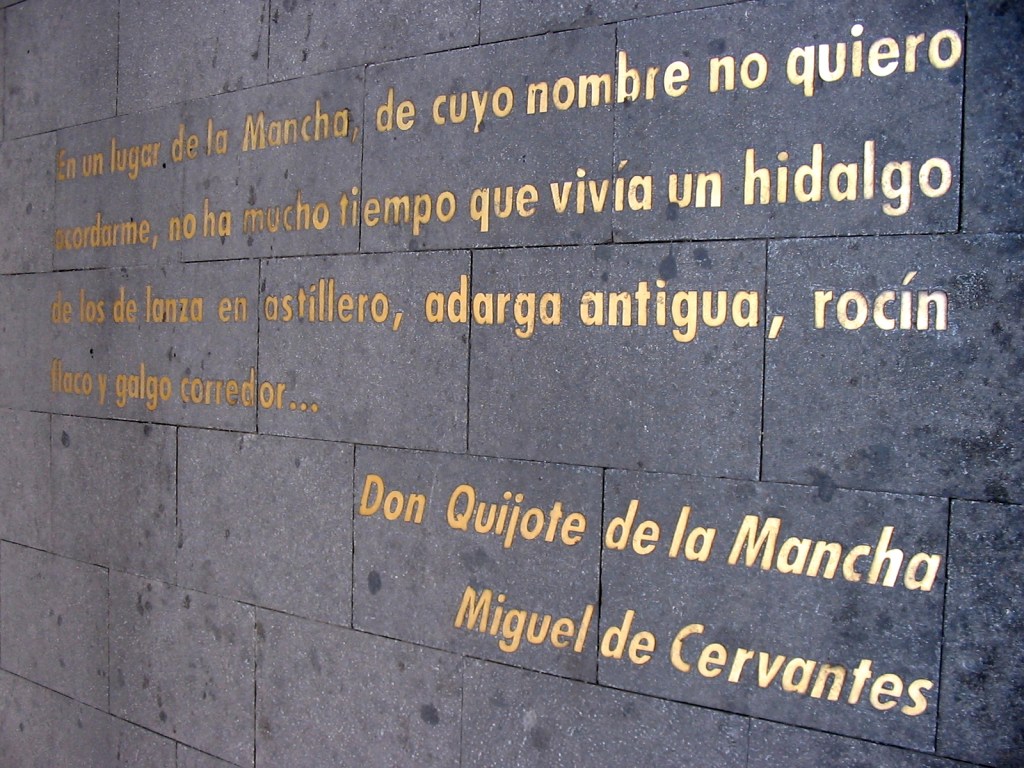
Thoughts can be gathered anywhere; in fact, Madrid’s streets are a veritable gallery of thoughts—to which above lines from Don Quixote, found on the Calle de las Huertas, attest. Words and images are dirt cheap and trivial unless a thoughtful collector sets out to render them precious and significant.  

Yes, it was the arbitrariness and the flaunting of Baroness Thyssen-Bornemisza’s wealth that made me reconsider the acts of collecting, exhibiting, and sharing my humble thoughts.

Hope on the Bottom Shelf; or, What to Do When the Cable Box Seems Barren

Moving to the UK from the movie junkie heaven that is New York City meant having to find new ways of getting my cinematic fix. Gone are the nights of pre-code delights at the Film Forum; no more silent film matinees at the MoMA (which is just concluding a Gregory La Cava retrospective); and no more browsing at J&R Music World—and all just a cab ride away. And yet, judging by who is posting reviews at IMDb, it becomes obvious that cineastes are not exclusively city dwellers (a review of the rarely screened talkie The Hole in the Wall may serve as a case in point). Just don’t count on UK television.

The commercial-free BBC 2 has proven the most reliable source of classic Hollywood fare, even though the screenings of old movies are generally relegated to the after-hours or late-morning time slots. There have been a number of pleasant surprises, such as a Val Lewton series (including the literate horror of The Dead Ship), the film adaptation of the Suspense radio drama “To Find Help” (reworked, not altogether successfully, as Beware, My Lovely) and several Claudette Colbert films (including Texas Lady, which I had never seen in the US).

Silent movies are unheard of, however; nor do pre-1940s films get much airtime (the team efforts of Astaire/Rogers and Laurel/Hardy being a notable exception). Still, this beats the advertisement-riddled offerings at TCM Britain, whose one-shelf library even infrequent viewers are likely to exhaust within a few months.

Since I am not an online shopper and still enjoy hunting trips per pedes, I have been checking out the DVD sections of the major music/video retailers here in the UK. Virgin is least attractive, stocking mainly recent titles at largely unacceptable prices. It is little more than a snazzy second-run theater where all the so-called blockbusters are dumped and repackaged as soon as they are pulled from the movie houses.

Rather better are HMV and MVC. With some luck, DVDs of classics like All About Eve, Sunset Blvd., or The Third Man can be had for under £10, while lesser-known titles may be spotted (and left behind) sporting higher price tags bespeaking their exclusivity. At HMV, for instance, Tod Browning’s Freaks bears the label “An HMV Exclusive.”

And then there is FOPP. A smarter store with a larger number of classic or literary films, it boasts £5 and £7 DVD shelves. It’s a good place to set out from for anyone interested in setting up a library of essential Hollywood films. Many Hitchcock features can be had here for £5, and most DVDs are authorized studio releases, rather than the cheap transfers that end up in supermarket bargain bins. These copies are so washed out that it often difficult to distinguish the features of the players; even the rugged male leads seem to be getting the Doris Day treatment, as if shot through layers of gauze. The problem is exacerbated if the DVD image is projected onto a screen, as I am wont to enjoy my movies whenever possible.

Well, to FOPP I went last weekend; and, once again, hope lay on the bottom shelf: a copy of G. W. Pabst’s Pandora’s Box. So, tonight is going to be spent looking at Lulu, our decidedly other Miss Brooks.

A Soundscape of Britain?

Princess Diana Memorial Fountain,
Hyde Park, London

A few days ago I went to the Tate Gallery in London to see A Picture of Britain. This exhibition of paintings, coinciding with a BBC television series, did not exactly get rave reviews. Critics complained that the real Britain was, for the most part, left out of the picture. The works on display mainly feature idyllic representations of what Britain could be or ought to be, according to followers of the Picturesque or romantically inclined artists. In short, plenty of nature, little naturalism. I wonder how A Soundscape of Britain would turn out, if ever there were such a showcase devoted to national noise. What would be the representative sounds of Britain?

In the US, during radio’s so-called golden age, the Columbia Workshop and the later CBS Radio Workshop offered listeners aural snapshots and panoramas of New York, London, and Paris. “A Portrait of London,” for instance, which aired over CBS on 20 July 1956, took listeners to Big Ben, the city zoo, and Buckingham Palace, with Sarah Churchill (daughter of the former Prime Minister) serving as tour guide.

A few weeks earlier (7 July 1956), the Workshop had taken tuners-in to Paris, while “The Sounds of a Nation” (18 November 1956) sonically evoked the history of the United States. Some twenty years earlier, the Columbia Workshop had presented a “Broadway Evening” (25 July 1936), a noisy report from the bustling Big Apple. Other such programs include “Crosstown Manhattan” (8 December 1938) and Norman Corwin’s “New York: A Tapestry for Radio” (14 May 1944).

While more concerned with the spoken word than with the creation of collages in sound, Corwin conducted frequent experiments in bringing faraway places home to the radio audience with travelogue series like An American in England (1942) and Passport for Adams (1943), as well as the ambitious documentary One World Flight (1947), which consisted of interviews and recorded sounds from actual locations in Italy, India, and Australia.

Corwin’s travelogues did not simply revel in sound qua spectacle; they were propagandistic or didactic in nature, designed to glean messages from or impose meaning on bits and bites of sound. As Alexander Pope once put it, the “sound must seem an echo to the sense.” How, then, could one make sense of Britain through sound? What, besides the tolling of Big Ben, or the water gurgling in the Diana, Princess of Wales Memorial Fountain (pictured above), or the chirping of robins, or the roaring North Sea, or raindrops falling on hedgerows, might be A Soundscape of Britain?

Many years ago, visiting New York City for the first time, I walked through the streets of Manhattan to capture the sounds of the sirens, the pedestrians on the pavement, the honking of cars and the hollering of cabbies during rush hour. It gave me immense pleasure listening to these recordings back in the misery that was my home across the Atlantic. I could drown out the silence and loneliness in ways that a few pictures in my photo album could not accomplish. I have always loved wrapping myself in sound’s cape, escaping in sound . . .