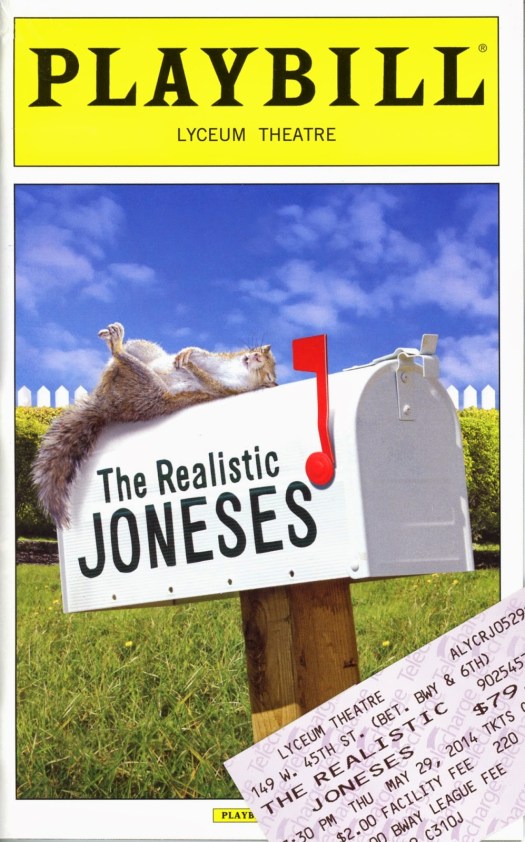
I don’t get it. No, I take that back. I didn’t get anything from it. No, that’s not it, either. I didn’t really like it is more like it, really. Will Eno’s The Realistic Joneses, I mean. It’s one of those plays that are nothing more than wordplay. The Joneses aren’t really Realistic. That much I got, and not much else.
The characters are just worders, if that’s the word for it. If it were a word. They are not word made flesh. I’m not sure whether they are mouthpieces because I’m not sure what they were meant to mouth, other than that we are mostly words to one another. Words that are no reliable access to thought or feeling, that are no substitute for flesh, for sensations and experiences.
A playwright who says as much as that – or as little – has got a real challenge. But that may be too charitable a word for a playwright’s “I’ve got nothing, really.”
The Realistic Joneses, to me, is a bad play. Even the wordplay isn’t that good. It is of a sitcom caliber, and the characters are a bunch of near flatlining oneliners. I mean, ‘Ice cream is a dish best served cold’? Seriously, is that bit of lame rhetoric – a cliché made obvious as a commonplace – a substitute for a plot twist? I didn’t feel the play was a moving comment on the increasingly disembodied state of twenty-first century humanity, much less a sensitive portrait of toxic malaise. I didn’t feel. That’s just it.
The Realistic Joneses is a play on the hollowness of words, and I don’t feel that that is a valid point to make in a play. Not any more. Not even for the middle-aged with a nostalgic yearning for some old-fashioned post-modern self-reflexivity. Well, post-modernism isn’t what it used to be because it just isn’t anymore. Or oughtn’t to be. The tongue has to come out of the cheek eventually, and it has to learn to speak again and say something other than, say, “What’s there to say?” Not just some piffle passing for the absurd. To me, surrealism isn’t anything goes nothing, at least not in the theater.
I walked out of the Lyceum Theatre thinking that I had just spent what amounts to a buck a minute on a rotten piece of ephemera – like that dead squirrel Tracy Letts picks up and throws into a trash bag, or the spoilt food Michael C. Hall takes out of the refrigerator – with little else but these few words of mine to show for it. If only that food had been served hot.
If only the squirrel had lived. If only. Or maybe not.
Much of what I know about English literature I learned in the Bronx. The peculiar indirection of my path—a German approaching British culture by taking the Lexington Avenue Express—did not escape me then; and even though I had no doubt as to the qualifications of those who taught me, I decided, upon finishing my Master’s thesis on the Scottish essayist-translator Thomas Carlyle, to go after something that, geographically speaking, lay closer to my temporary home.
Never one for obvious choices, I wrote my doctoral study on US radio drama, a subject that, however arcane, struck me as being rather more compatible with life in a Mecca for the enthusiasts of American popular culture among which I numbered. It also made it possible for me to take advantage of some of the resources particular to Manhattan, the isle of Radio City.
Not that I considered studying British culture so far removed from the Globe Theatre, the Scottish Borders, or the wilds of Yorkshire to be much of a disadvantage, being that I had adopted a subjective mode of reading that favors response over intention, that explores the reception of a written work rather than tracing is origins. Call it rationalizing, call it kidding yourself—I thought that I should make a virtue of vicariousness.
Living in Britain now, I am rediscovering its literature through the landscape rather than by way of the library; and I am finding my way back to those old books by stepping into even older buildings. One such book and one such building is Horace Walpole’s Castle of Otranto (1764), otherwise known as Strawberry Hill.
A most un-Gothic—but glorious—day at Strawberry Hill
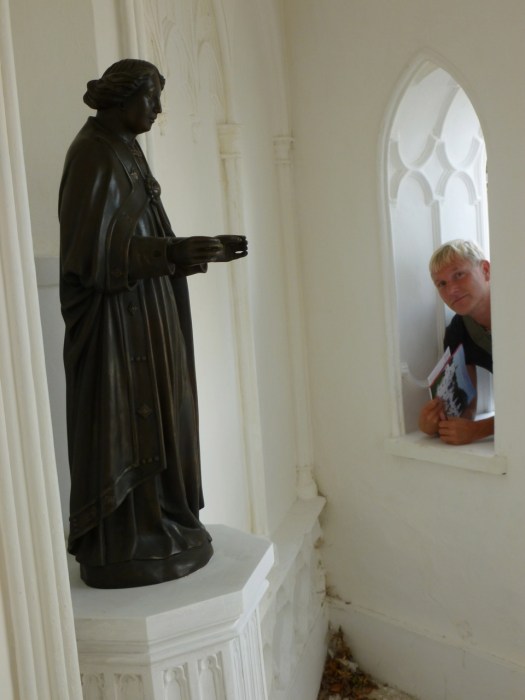
Originally a small cottage in rural Twickenham, Strawberry Hill was transformed by Walpole into a gothic castellino; it also housed the author’s own printing press, although Otranto was published in nearby London. The crenelated battlements were made of wood and needed to be replaced more than once in Walpole’s lifetime. “My buildings are paper, like my writings,” Walpole famously declared, “and both will blown away in ten years after I am dead.” This could well have happened; but, despite the relative weakness of his materials—a spurious medieval romance and the less than solid additions to Chopp’d Straw Cottage—both survive today as a testimony to Walpole’s enduring influence on popular tastes in architecture and literature.
And yet, however exciting the experience, walking around Strawberry Hill after all those years of living and studying so close to Strawberry Fields, Central Park, brought home nothing more forcibly than that getting to the heart of the matter that is art is not a matter of inspection but of introspection. Stripped of most of its furnishings, Strawberry Hill is a tease. Beyond the stained glass windows and the restored façade, there is little left of Walpole’s story or his antiquarian spirit. To be sure, even if Walpole’s library had not been emptied of the contents that makes and defines it, it would remain inaccessible to those looking around now without being permitted to touch and turn the pages.
Visitors to historic houses, like readers of fictions, must always be prepared to supply the fittings, to construct in their mind’s eye what the supposedly first-hand experience of seeing for ourselves can never make concrete and, therefore, never quite smash or supplant. Where, if not in our reading, dreaming, thinking selves does the spirit of literature reside?
The audio guide at Strawberry Hill is a self-conscious acknowledgment of this sightseeing conundrum; it plays like a radio drama—my studies of which have not gone to waste altogether—that teases us with the voices of the dead and the echoes of their footsteps. Our own footfall, meanwhile, is muffled by the protective plastic coverings provided for our shoes at the entrance to the site.
Walpole’s paper house has been given a permanence in the midst of which I am reminded of the paper-thinness of my own existence. What lingers is the anxiety of leaving here—or anywhere—without having left a trace at all.
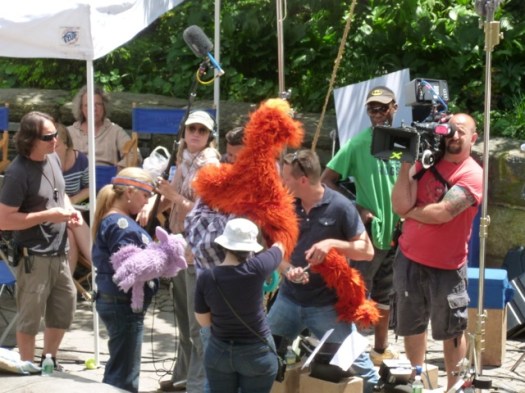
Filming of Sesame Street in Carl-Schurz Park, Manhattan
The sight was monstrous. There was shouting. They were shooting. Someone stood guard to keep strollers from trespassing while the action went on undisturbed. Few folks seemed to care, though, so familiar had such sights become in New York City. One could always catch up with it later, on television. Besides, this wasn’t a crime scene. It sure wasn’t Needle Park or Fort Apache, The Bronx. This was the peaceful, upmarket Upper East Side, for crying out not too loudly, and the wildly gesticulating savage in furs was of the Cookie Monster sort. Sesame Street was being filmed on location—and the location, on that May day, was Carl-Schurz Park in my old neighborhood of Yorkville.
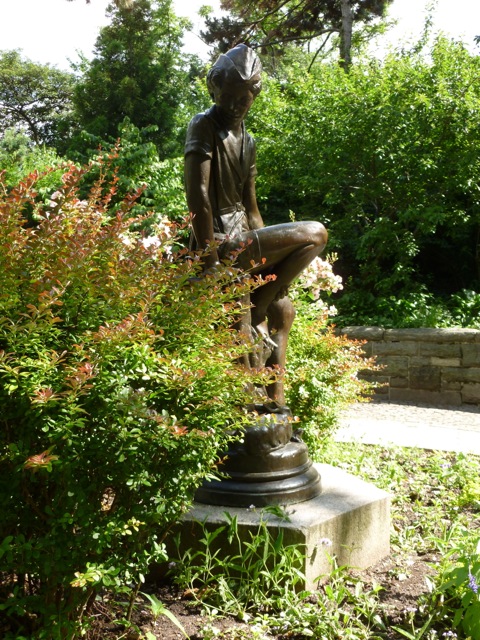
Peter Pan sculpture, Carl-Schurz Park
It seemed fitting that the beloved children’s television series should be shot here, right in front of Peter Pan, the bronze statue that, some fifteen years earlier—when the park had gone to seed other than Sesame—was violently uprooted and tossed into the nearby East River like an innocent bystander who, some thugs decided, had seen too much. It seemed fitting because Carl-Schurz Park is a tribute to German-American relations—and, in a long and roundabout way, I came to New York City from Germany by way of Sesame Street.
As a prepubescent, I spent a great deal of time in front of the television, a shortage of viewing choices notwithstanding. My parents were both working and I turned to the tube for company, comfort and the kind of guidance that didn’t come in the form of a command or a slap. West German television had only three channels until well into the 1980s, and the third one, back in the early 1970s, was still experimental, reserved mainly for educational programs aired at odd hours. Odd hours would have been anything before mid-afternoon, when regular programming commenced on weekdays.
So, there was literally nothing else on when I pushed the knob of our black-and-white set (a stylishly futuristic Wega) to come across Ernie, Bert, Oscar and the Cookie Monster—and they all spoke, growled or squeaked English. That is how I heard them first and how, several years before I was taught English at school, I got my first lessons in a foreign language.
I had just gotten through the alphabet and the numbers from one to ten when, without “Warnung,” Sesame Street turned into Sesamstrasse and the felty, fluffy foreigners became German, even though they changed neither looks nor scenery. Being beyond pre-schooling, I now tuned in chiefly for the puppetry and the antics of the Krümelmonster. That is the way the Cookie Monster crumbled. “Krümel” literally means “crumb,” suggestive of the state to which something solid could be reduced in the process of translation.
Educationally, the early dubbed version of Sesame Street was dubious, to say the least. Spoken and written words and images did not always match. Sure, “A” is for “apple” as well as “Apfel,” and “B” for “banana” and, well, “Banana.” But there was little use for “C,” since few words in the German language begin with that letter; at least they didn’t during those days before Computers. I remember watching a lesson on “A” that ended in “Alles am Arsch,” an expression only a tad short of the exclamation summed up in the last three letters of “snafu.” For once, even my parents took note.
Never mind, I remained loyal to Ernie and Bert, whose odd coupling I envied; and once the magazine accompanying the series was launched, with images of the puppets as centerfolds, the pair became my first pinups. If only Sesame Street (a pun that, too, is lost in German translation) had remained on the air in its original language. By the time high school started, and with it lessons in English—British, if you please—I had all but lost the enthusiasm; for the next nine years, I learned reluctantly and none too well, being that we were forced to go through joyless Grammar drills to arrive at the point of meaningful self-expression.
As a child, I never associated Sesame Street with any real place, let alone New York City, the seedy ways of which, back then, conjured scenes of violence and decay: the turf of gangs, the marketplace for drugs, and the inspiration for nothing except TV cop shows. It was just as difficult to get that image out of my head as it had been to get English into it.
Indeed, my first exposure to the Big Apfel demonstrated that image to be truer than the pictures of it in glossy travel brochures; no doubt, I had spent too much time eyeing the Carringtons of Denver, Colorado. That I fell in love with old, crime-ridden Gotham all the same had more to do with hormones than with anything we traditionally understand to be “tourist attractions.”
Since the mid-1990s, Manhattan has cleaned up its act, even though it wiped out much of the city’s character along with the crime—so successfully, in fact, that I once was slapped with a fine for dozing off on a bench opposite Peter Pan because I felt safe enough to rest my eyes.
Sesamstrasse, Carl-Schurz Park, and the old Wega set (images of which I had to google to remind myself): the neighborhood of memory sure gets crowded as you travel ever further down the road . . .
I had walked past this place many an evening on the way to Ty’s, my favorite Greenwich Village watering hole. This time, though, it was mid-afternoon and I turned left, leaving Christopher for Gay Street. I had come here specially to take a picture of number 14, the former residence of two sisters who, for about a quarter of a century or so, were household names across America. Ruth and Eileen McKenney had been on my mind ever since I saw that production of Wonderful Town on a visit to Manchester, England—and the gals, whose misadventures are tunefully related in said musical, seemed determined to stay there. On my mind, that is, not up in the Salford docklands; though, judging from their experience way down here on Gay Street, they might not have minded the docks.
A few days earlier, I had happened upon a copy of Ruth McKenney’s All About Eileen (1952) in the basement of the Argosy, one of my favorite antiquarian bookstores in town. I hadn’t even been looking for it at the time. In fact, I had been unaware that such an anthology of McKenney’s New Yorkerstories existed.
Eileen was lying there all the same—prominently if carelessly displayed, draped in a flashy, tantalizingly torn jacket that stood out among the drab, worn-out linen coats of a great number of unassuming second-hand Roses about to be put in their place—waiting to be picked up. I don’t flatter myself. My company was of no consequence to Eileen. If I was being lured, it was no doubt owing to an itch Eileen had to get out of yet another basement.
Thinking of the case I had to lug to the airport before long—and the less than commodious accommodations that would await Eileen in my study—I had hesitated and walked out alone; but I soon changed my mind, returned to the Argosy, and, to my relief, found Eileen still there, though shifted a little as if to say “I’m not that easy” and to make me suffer for waffling.
And here I was now, a week later. 14 Gay Street. It’s an unassuming walk-up, next to a scaffolded shell of a building that, a friend told me, had been on fire a while ago. Walk-up! More like a step-down for Ruth and Eileen. The two had been naïve enough to rent barely-fit-for-living quarters below street level, unaware that the construction of a new subway line was going to rattle their nerves and rob them of what one of their first visitors, a burglar, could not readily bag: their sleep.
“[W]e lived in mortal terror falling into the Christopher Street subway station,” Ruth recalled, making light of her darksome days in their damp “little cave.” And “[e]very time a train roared by, some three feet under our wooden floor, all our dishes rattled, vases swayed gently, and startled guests dropped drinks.”
From the outside, at least, 14 Gay Street looked perfectly serene on that quiet, sunny afternoon. I was not the only one stopping by, though. I walked up to what I assumed to be a fellow admirer of Eileen’s; as it turned out, he was oblivious that the very spot had given rise to such lore as was retold on page, screen and stage. He only had eyes for the wisteria that had taken its chances—and its time—to sidle up to and ravage a neighboring property.
Imposing as that looked, I had my heart set on those small dark windows peering from behind the pavement like a pair of Kilroy peepers. Eileen was here, I thought, and was glad to have seen what seemed too little to look at. Indifference, after all, is in the passerby’s eye.
I wonder now: How many sites of the city—fabled but forsaken—are daily escaping the sightseer’s gaze?
The prosaically named American Airlines Theatre on Broadway has about as much intimacy and sex appeal as a departure lounge. The long entrance hallway, which barely opens up to a space resembling the lobby of a two-star hotel, makes you feel that, once your ticket has been scanned, you are a mere hour’s worth of taxiing away from takeoff. That said, it wasn’t the venue that made the Roundabout Theatre Company’s production of Don’t Dress for Dinner such a terminal bore.
Farces are all about frustrated desires, about wanting to take it off and waiting to get it on, about fooling around the longest way round and never quite getting around to it. In this case, though, the exasperation I sensed was all mine. As the characters got together for their scheduled assignations, the actors seemed to be heading off in different directions. Watching them move around on the stage was about as scintillating as staring at other folk’s suitcases circling the baggage carousel, which aroused in me nothing but the suspicion that this was going to be a wearisome cat-and-spouse game indeed.
Not since Tony Randall’s 1991 production of The Crucible had I witnessed such a spilled ragbag of irreconcilable acting styles. Their task being merrily to prolong the unwanted dinner party at the expense of hoped-for dessert spooning—and to make all this falling apart come together for us—the assembled cast members were in desperate need of a round table, not a dinner table, and a director, not a waiter, giving orders rather than taking them.
To be sure, Marc Camoletti play is no Noises Off; and the fact that I had seen Michael Frayn’s farce-to-end-all-farce only a few weeks earlier made Don’t Dress seem like a morning after. Camoletti, best known for Boeing-Boeing was ill served by a translator whose lines are so threadbare (yes, cooker does rhyme with hooker) as to deserve nothing more than booing, booing.
The male leads, Ben Daniels as Robert and Adam James as Bernard came dressed for office, not play. A third male—make that macho—role was so indifferently cast that the ending, in which alone the character featured, fell as flat as postage stamp on a card reading “Wish I were anywhere but here.”
The ladies were livelier by far; but whereas classy Patricia Kalember as Jacqueline seemed to have expected a Noel Coward soiree, brassy Jennifer Tilly as Suzanne was fitted out for a Vegas dinner theater . . . or a romp with Chucky. Meanwhile, the energetic Spencer Kayden as Suzette—who reminded me of Elizabeth Berridge and her role as the maid in the glorious if short-lived ‘90s sitcom satire The Powers That Be—brought to the proceedings a verve and a timing well suited to the inspired slapstick that Don’t Dress so desperately lacked. Alas, you can’t have good comic timing all by yourself.
What you can have by yourself is the last laugh, scoffing at what elicited nary a chuckle in the first place.
Once, as I recalled here before, I had the audacity to tell a well-known biographer, whose student I was, that I had no respect for writers of other people’s life stories. Unless content to be mere chroniclers, recording activities and recounting events, they are fabricators of interiorities that, I was—and am— convinced, are unknowable to anyone other than the single occupant of that interior. For all our confidences and intimations, we are ultimately unreadable to one another.
In order to turn life into story, biographers must impose a logic beyond chronology, a pattern to make unreason rhyme. They connect the dots on a timeline to create causal relationships designed to account for people’s behaviors and actions: because she couldn’t face her past, she couldn’t live with herself; because she lost her brother, she lost her trust in family; because he was in truth insecure, he became a make-believe gunslinger. Without being supplied with at least a hint of what we call “motivation,” we reject stories as lacking in psychological depth and moral complexity.
Back when I gave my professor a piece of my mind—proffered, mind you, with a smile—I thought of the biographer’s determination to make sense of other people’s existences as sheer hubris. Now, I am more inclined to look at biography as an act of desperation. Nothing is more disconcerting, more silencing and disabling, than the blank we have to call potentiality in order to face or overwrite and deface it. We cannot—will not—settle for zilch.
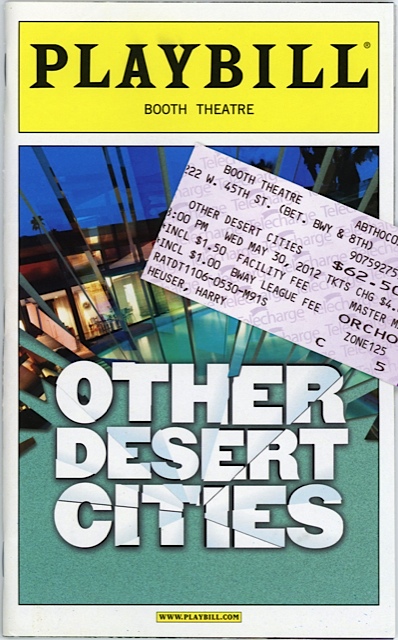
Secrets and duplicities, intimacy and detachment. Like all family dramas worth relating to, Jon Robin Baitz’s stage play Other Desert Cities measures the distance between folks who are biologically—and often physically—closest to each other: the flesh, the blood and the closeted skeletons of kinfolk.
Approaching Palm Springs (and Other Desert Cities)
Baitz’s American stage family, the Wyeths, could hardly be more traditional: a mother and father, married to one another, a daughter and son, offspring of that union. Then there is the dramatically expedient extension of that nucleus; in this case an alcoholic, don’t-give-a-damn aunt whom the audience looks at as a go-between, not only between characters but between those characters and ourselves. It is a well calculated constellation, this, as Other Desert Cities does not just explore relationships but the act of relating, of putting that relationship and all those relations into words, and of questioning the words and the unspoken.
Though most of us couldn’t live with Aunt Silda (Judith Light, in the Booth Theatre production), we love her for what we are encouraged to read as her forthrightness and free spirit. She, we assume, would be the person most likely to tell the true story of that family, as compromised as her memory and judgment might be after years of swilling the kind of spirits from which she is unable to free herself.
Hello Silda— The way I remember Palm Springs
After all, we cannot expect to get the inside dirt from her sister Polly (Stockard Channing), a staunch yet tarnished Republican who is terrified that her daughter Brooke (Elizabeth Marvel) has written a tell-all autobiography threatening to tear the façade right off the family’s sunny Californian home.
Yes, Silda tells it like it is. Criticized by her class-conscious sister of wearing knock-offs, she barks back:
Honey. News-flash: you’re not a Texan, you’re a Jew! We’re Jewish girls who lost their accents along the way, but for you that wasn’t enough, you had to become a goy, too. Talk about the real thing? Talk about ‘faking it.’ Honey, this Pucci is a lot more real than your Pat Buckley schtick.
As it turns out, neither Silda nor Polly are what we are led to believe them to be; and this is Brooke’s lesson, too, as she tries to piece together the life story of her lost brother, a left-wing radical whose act of terrorism forced Nancy Reagan pal Polly and her ex-Hollywood star husband Lyman (Stacey Keach) into retirement in the desert.
Desperate to figure out who or what made her brother Henry what the facts don’t quite tell her he was, Brooke turns from writing fiction to biography. Yet, in her attempt to expose the truth, she ends up with yet another version of the story rather than a definitive one. “She presents us as ghouls who drove [Henry] to become sort of a murderer,” her anguished, disconsolate father protests to his son (Thomas Sadoski), the “ADD riddled, junk-food-addicted porn surfing Trip Wyeth,” as Brooke calls him to his face.
“Christ, there’s something so vicious about what you’re doing here, Brooke, don’t you know that?” Lyman exclaims. Vicious and necessary, Other Desert Cities argues. And futile? As suggested by the closing scene, which may strike some as perfunctory or incongruously sentimental, Brooke’s ordeal—and the ordeal to which she put her family—has served a purpose.
What may seem like a coda or anticlimax I took as the point of the Baitz’s drama. As a biographer, Brooke has failed. She has been taken in, taken story for life and secrecy for guilt only to become complicit in her family’s cover-up. As an autobiographer, though, Brooke is to be envied. She has learned something about herself that she didn’t know before she came to investigate the lives of those around her. We may be unknowable to each other—but we can learn to know ourselves.
Once a year, in the run-up to Christmas, my better half and I make the seemingly interminable journey from Wales to London for some seasonal splurging on art and theater. Now, I don’t travel all the way east to the West End to waste my time on pap like Dirty Dancing. This isn’t snobbery, mind; I simply can’t thrill to a feast of re-processed cheese and the prospect of paying for it through a nose bigger than Jennifer Grey’s old one. Besides, why raid the bottom shelves of our pop cultural cupboard when I’ve got a heaping plateful of squandered opportunities to chew over? During the days of my graduate studies in English and American literature, I had little money to spare for Broadway theatricals, which is why I now tend to seek out revivals of plays I missed the first, second, or umpteenth time around—drama with some history to it, be that pedigree or baggage. James Goldman’s The Lion in Winter has a bit of both.
As an added attraction, the current Theatre Royal Haymarket production also has the ever Ab-fabulous Joanna Lumley, whom I first saw on stage in the 2010 Broadway revival of La Bête. Lumley plays caged lioness Queen Eleanor opposite Robert Lindsay’s Henry II, the husband who keeps her under lock and key. Witty and fierce, The Lion is a domestic drama fit for the tryingly festive season. All the same, the darn cat is in a confounded state of seasonal disorder.
What those stepping into the auditorium from the audio-visual onslaught that is Christmas time in the city cannot but gasp at is that even Henry’s halls are decked: his French chateau, anno 1183, features a regal Tannenbaum, no less. It certainly had my eyebrows raised to the alert level of WTF: you might expect a Green Knight, surely, but a bebaubled evergreen?
The proud Lion is prepared to pounce, though, ready to defend itself against “turbulent” critics crying bloody murder in the cathedral of culture. Goldman acknowledged that his “play contains anachronisms” such as the “way . . . Christmas is celebrated.” As he states in the notes duly reprinted in the playbill, the ahistorical trimmings are “deliberate”; “though it deals carefully with history,” The Lion “remains a piece of fiction.”
Towering over the assembled branches of Henry’s living family tree, the familiar, dead one serves as a reminder of the storyteller’s presence. The needling transplant from our present day tells not only of the author’s intervening re-inventiveness but also of his obligation to make that past relevant: the dramatist does not simply stage history; he fashions it. To withhold evidence of this intervention would mean to falsify, to deny the hand and mind involved in the process of transcribing.
Goldman was nonetheless concerned that this never-evergreen might overshadow his research and cast doubt on his responsible interpretation of verifiable historical events. “This play,” he pointed out to his audience, “is accurately based on the available data.”
The elephant of a dislocated trunk aside, The Lion is refreshingly unself-conscious; it is a deluxe soap free from the by now irritating additives of postmodernist reflexivity. For all its modern day translations—of which only its pre-gay lib treatment of the 19th century construct of homosexuality struck me as dated—it affords a close look at historical figures that rarely seem human to us in the accounts of battles and political maneuverings.
If Goldman reduces the sweep of history to an intimate first-family portrait, he chose a subject that warrants such an approach; as historian John Gillingham argued, what “really mattered” to Henry II “was family politics,” in the belief of the failure of which he died. Far from being a Peyton Placeholder, Goldman’s “Christmas Court that never was” has been assembled to bring historical intrigue home.
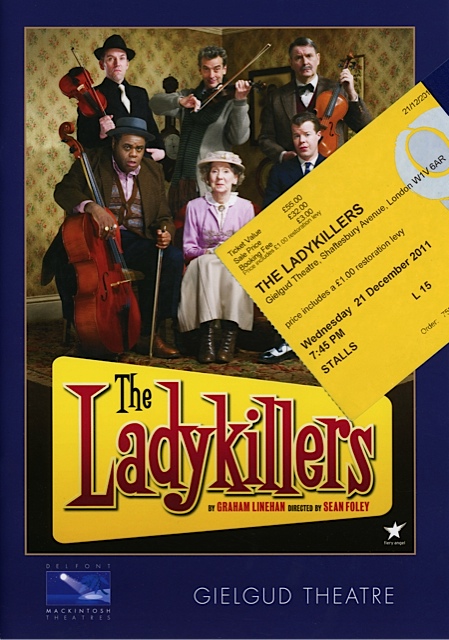
“What’s your great online discovery,” an interviewer asked Marcia Warren, star of the current West End production of Ladykillers. To this, the veteran of stage, screen and radio replied, “What does online mean?” It is just the kind of answer most of us expect—and want to hear—from someone past middle age, which makes hers such a sly response. Warren remains in character, as Mrs. Wilberforce, kindly old landlady to the killers, giving us what we find so reassuring and endearing about the senescence we otherwise dread. She may or may not be joking—but she sure has earned the right neither to know nor to care. Looked at it that way, being past it becomes a shelter, a retreat beyond trends, updates and upgrades whose seeming simplicity appeals to those who cannot afford to be quite so nonchalant about technology, who feel the pressure of performing in and conforming to the construct of the present as a digital age.
Not to know or willfully to ignore—what luxury! Young and not-so-young alike find comfort in this deflecting mirror image of our future selves. It’s a Betty White lie we use to kid ourselves .
We enjoy making light of old age; and those of us who have half a conscience enjoy it even more to be presented with elderly people or characters who are not simply the brunt of yet another ageist joke but are in on it—and cashing in on it as well. We laugh all the way as they take our laughter to the bank.
We want older folks to be feisty because it comforts us to know that, even in our declining years, there are weapons left with which to fight, however futile the fighting. The middle aged, by comparison, are past the prime against which the standard their looks and performances are measured; it is their struggle to conceal or deny this obsolescence that makes them the stuff of deflationary humor. We don’t laugh at Mrs. Wilberforce; we laugh at the bumbling crooks whose willfulness is no match for her force shield of insuperable antiquity.
It is this nod to nostalgia as a weapon against the onslaught of modernity that makes Ladykillers such a charmer of a story. And what makes it work on the stage just as it works on the screen is that the 1955 original requires no update: the Ladykillers was born nostalgic. It hit the screens—in fabulous Technicolor, no less—at a time when, after years of postwar austerity, the British were ready to look back in amusement at their wants and desires and all those surreptitious attempts to meet them. Sneers turned to smiles again as greed was finally being catered to once more.
Eluding those who try to will it by force, fortune winks at those who wait like Mrs. Wilberforce, a senior citizen yet hale, clearheaded and driven enough to enjoy a sudden windfall. It is a conservative fantasy that appealed then as it appeals now, especially to middleclass, middle-aged theatergoers eager to distract themselves from banking woes and pension fears, from cybercrime and urban riots.
Familiar to me from radio dramatics, Warren’s name was the only one on the marquee I recognized as I decided whether or not take in what I assumed to be another one of those makeshift theatricals that too often take the place of real theater these days—stage adaptations of popular movies, books and cartoons like Shrek, Spider-Man, or Addams Family with which the theater world is trying rather desperately to augment its aging audience base.
Written by Graham Linehan and directed by Sean Foley, this new production of The Ladykillers fully justified its staging. There is much for the eye to take in; indeed, it owing to an able cast—and the lovely, lively Ms. Warren above all— to prevent the ingenious set and special effects from stealing this caper.
In the real, honest-to-goodness make-believe beyond the online trappings of which she claims to be ignorant, Warren gives us just what we want. After all, acting for our pleasure and acting out our desires is her business. It’s the oldest profession in the world.
The folks who proved that they had made their mark in Hollywood by leaving it in the cement slabs in front of Grauman’s Chinese Theatre had one thing in common. Besides having the stature of a movie star or Tinseltown personality, I mean. They could all stand up, bend down, and exert whatever pressure is required to produce those imprints. Even Charlie McCarthy, apparently. I always thought that it might please the supposed untouchables to be commemorated in a medium that is not as telltale about our inescapable senescence as a photograph or moving image. Many of us can stand up far longer than we can stand looking in the mirror.
Then again, the moving hands of time are readable in our footprints. Shirley Temple’s tiny imprint reminds us that, on 14 March 1935, she was at the height of a career that diminished as she increased in size. Still, the prints are meant to bespeak immortality. We don’t get to see the tracks of Christopher Reeve’s wheelchair, for instance. Nor is Zsa Zsa likely to be given the honor now to join those ladies in cement. These prints are all solid, no matter how much the concrete crumbles. The stars have bodies—and they are able and sound . . .
There is something reassuring in that solidity—if it weren’t for those cracks, and the puzzled looks I come across in the crowd gathered here to take pictures, mainly of themselves in front of a Hollywood landmark. Who was Rudy “My Time Is Your Time” Vallee, anyway? Norma Talmadge, who’s she? What were the Ritz Brothers all about? And who was that Sid fellow for whom they left those cryptic messages?
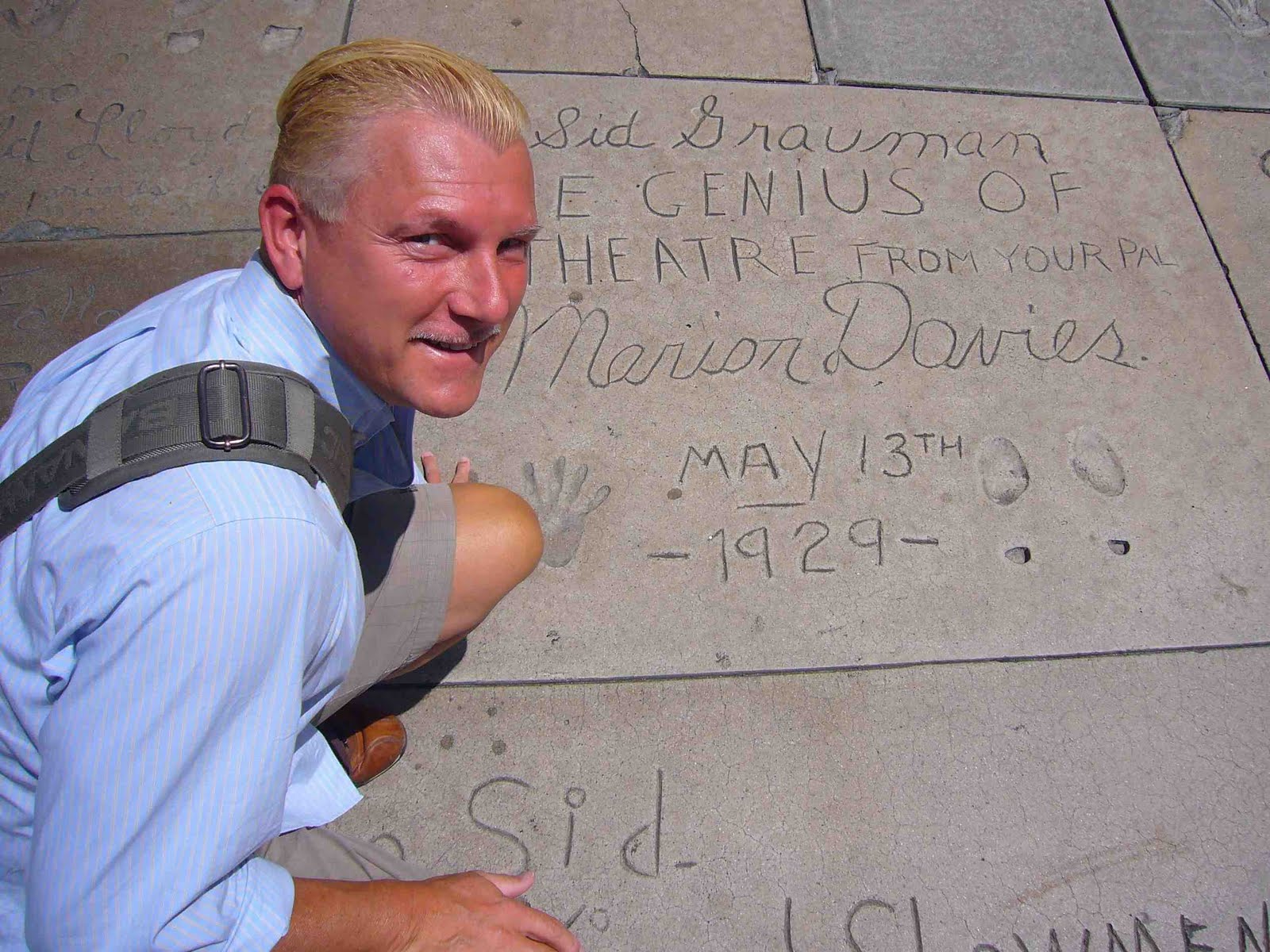
I got the space to myself as I have my picture taken with Marion Davies’s dainty indentations (dated 1929), my palm covering the hollow. No one is likely to pull a Lucy now; the Duke is still standing. Most walk right past—no, over—Ezio Pinza, whose block of concrete has become a mere steppingstone. Not a soul stoops to Monty Woolley. He’s the actor to whom my dog owes his name (I’m telling no one). I, too, I am out of touch.
There is one imprint, though, that keeps impressing after nearly sixty years. You can tell from the grime in the handprints of Marilyn Monroe just how many visitors have bowed down to approximate her posture, crouching over to show that they still look up to her. Screen partner Jane Russell’s palms are eloquently untainted by comparison. Marilyn—and we call her by her first name in recognition of her vulnerability—would be dead within ten years after being immortalized at Grauman’s. Our reaching out to her now is a belated, selfish gesture. You can’t expect rectitude from a crowd bent on lowering themselves for a photo opportunity. Remaining upright here means to be indifferent.
“Wipe your mucky paws,” I want to cry out. Yet these cultural touchstones are unlike other memorials to the untouchables. Here, we touch what we deem worth preserving. We bestow genuine stature with our own hands. We grasp at the chance to grease the Hollywood machine with our grubby palms, to fashion destinies with our filthy fingers. Since greatness does not rub off, most of us leave little more than a smudge. There is humanity in the residue of perspiration.
I have said nothing yet about my trip to Germany. It was not any old sightseeing tour, mind; nor was it a carefully mapped out homecoming, which makes it all the more difficult to capture in a few indifferent words. The thing is, I had not been to my native country in over two decades; and, during that time, not going back to what folks presume to be my home evolved into a programmatic, defining rejection of the notion that home equals country of origin. I vowed never to return, except in a pine box.
Ella and I
That I did go back at last, in the similarly confining encasement that is the cabin of a budget airline craft, required a great deal of preliminary introspection—and a leap over the shadow to which I had tried to relegate my past.
The department at the university where I teach was taking students to Berlin for its annual outing. Previously, I had been on the departmental trip to Budapest; and while that adventure was an adulterated delight, owing to transportation problems in the form of a broken bus and a missed flight, I thought that it would be petty to stick to my principles and stay put while my partner, as head of the School, was joining our students and colleagues for a week in the town known for Cabaret, communism, and Currywurst. Besides, Berlin is too far from my native Rhineland to be thought of as “home” or trigger unwanted back-where-I-come-from reminiscences. So, to Berlin I agreed to go . . .
Now, a few days before we were scheduled to depart for the German capital—which hadn’t been capital at the time I left former West Germany for the East Coast of the United States—I received one of those infrequent e-missives from the fatherland that are reserved mainly for anniversaries, holidays, and assorted disasters. My sister’s message read that my grandmother had contracted a virus while hospitalized for a fracture—her first hospitalization in well over half a century—and that, unless I acted posthaste, I might never see her alive again.
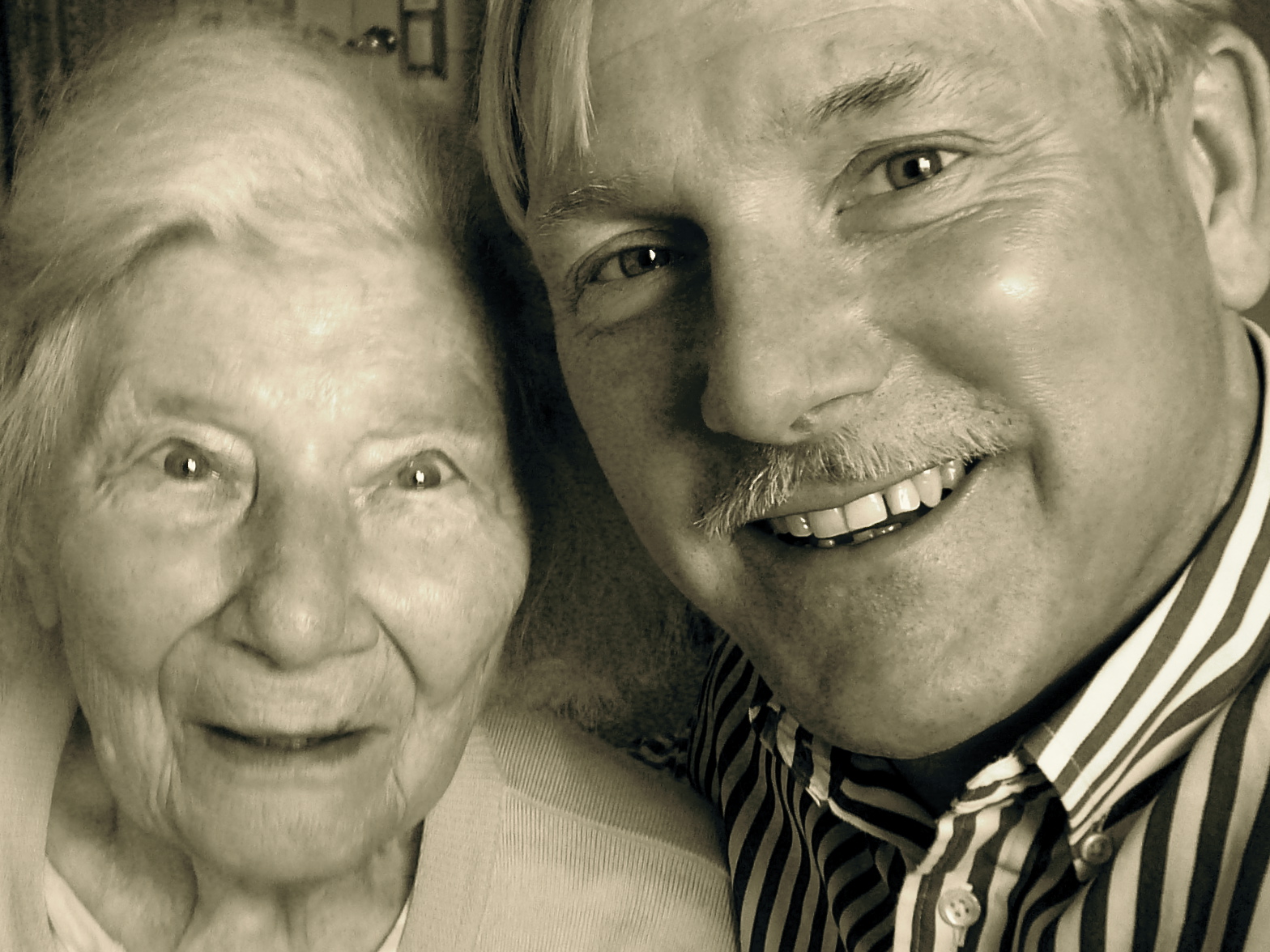
Unlike the mater of my father (both deceased), my maternal grandmother had kept in touch with me during my years abroad. She had learned, decided—or perhaps never thought twice—to accept me, which, given her youth in fascist Germany, is a triumph of spirit over doctrine. For years, she had been sending her regards to my same-sex partners, companions my other grandmother thought best accommodated behind barbed wire, if they were to be granted living space at all.
So, a few days before I was scheduled to depart for Berlin, I booked a flight to Düsseldorf to see Oma. I suffered a great deal of anxiety going by myself, going to see relatives I had abandoned years ago and walking down streets I had known during what, not in retrospect only, was an unhappy youth.
Luckily, I had friends on whom I could count: a cousin came to collect me from the rather remote airport and old friends offered quarters and shoulders should my visit prove overwhelming . . . or my arrival too late. Such comforts notwithstanding, it was disconcerting to visit Ella at the hospital, especially since it involved having to wear a protective mask that obscured my face so that she did not recognize me. I had not announced my visit lest she might think that, if even the prodigal grandson was coming to see her, her condition must truly be touch-and-go. It was sobering to be greeted like a stranger, but also deserved, I thought—until at last there was a look of recognition in her eyes and a warm smile radiating from her lips.
Not having booked a hotel room, I stayed in grandmother’s apartment that night. There I was, sleeping in the bed of a woman who might not see another morning and who, as it turned out, would never sleep in it again, though live she did.
We all have our security blankets, I suppose. Mine is made out of immaterial stuff, a fabric as gossamer and yet as tangible as the air on a sultry summer’s evening as I had known it well to the west of Wales. Lying there, alone in Ella’s bed, I surrounded myself with voices at once strange and familiar; voices of a safe, distant past—a past that was none of mine.
On a night rendered restless by thoughts of loss and futility—a life in danger and a life wasted in the refusal to be faced—I belatedly tuned in The Couple Next Door, a late-1950s serialized radio sitcom. Written by and starring Peg Lynch, whom I had once seen performing one of her husband-and-wife sketches during an old-time radio convention, The Couple controlled the crowds with which my thoughts were teeming. It comforted like no cotton coverlet could, warmed like no drop of Scotch. Though not soundly, I did sleep that night, wrapped up as I was in a cocoon of sound . . . a quilt to muffle the guilt I felt for not returning sooner and for being defined instead by a quarter century of negation . . .




.jpg)





 Harry Heuser
