
Man of the World (Wide Web)?

Okay, so, I tend to overdramatize. I can’t help it. I was born with a hyperbole on my lips. Turns out, I am still a man of the world wide web, despite the scheduled (and currently ongoing) landline repairs I lamented previously. At least, the prospect of not having access to the internet motivated us to realize some last-minute holiday plans by booking a trip to . . . Budapest. However eager I might be to share my experience, the challenge, as always, is not to drift too far from the format and subject of this journal and yet to make it reflect my everyday life, whether I am spending An Evening with Queen Victoria (as I will be on 22 April) or going back to my old neighborhood in New York City (on 14 May). Still, it is going to be (almost) all about Budapest from now until my royal visit.

“There is no such place as Budapest. Perhaps you are thinking of Bucharest, . . . and there is no such place as Bucharest, either,” New England wit Robert Benchley once remarked. Fortunately, especially for someone with a non-refundable ticket, there is ample proof to the contrary on the birth certificates of a number of film and radio personalities; and, as much as I love goulash or views of the Danube, I shall devote subsequent entries in the broadcastellan journal to the exploration of a few Hollywood-Budapest connections, whether prominent or obscure. To director Michael Curtiz, perhaps (whose Mildred Pierce I revisited earlier this year), or matrimonially challenged Zsa Zsa Gabor, whom I spotted not too long ago in Touch of Evil.

Then there are playwright Ferenc Molnar, whose Liliom was spun into a musical Carousel, and director Géza von Bolváry, who made movies starring the glamorous Zarah Leander (recently back in the limelight, in commemorations of the 100th anniversary of her birth). Never mind character actor Paul Lukas, who became a US citizen in 1933, or (soon to be exhumed?) escape artist Harry Houdini, who denied his Budapest birthplace. How could I, as an old-time radio aficionado, resist a few half-hours with “gorgeous” Ilona Massey, whose Top Secret adventures were blurted out on US radio back in 1950.

Now, I don’t question that Ms. Massey was indeed gorgeous; the quotation marks are merely embracing the adjective to suggest that the actress was billed in this manner when she agreed to become incorporeal for the sake of starring in her own thriller series (before materializing on television in 1954, when, years after her meeting with an Invisible Agent (a 1942 comedy-thriller co-starring Austro-Hungarian Peter Lorre) she got to host a variety program named after her).

In Top Secret, the aforementioned Hollywood actress played a Baroness on perilous assignments of “international intrigue and espionage before and during the World War II.” It all began on a “Night Train to Berlin,” in a compartment of which the Baroness found herself locked up with a Gestapo officer who threatens to break more than her silence: “Your fingernails, your knuckles, your beautiful white teeth, that golden hair. I promise you, your hair will be gray as ashes before the treatment is over.”

Not exactly the Beverly Hills spa treatment. How did she get into such a pickle? And how come she carries six lumps of poisonous sugar in her handbag and a radioactive transmitter in her heels, like some “walking Geiger counter” in search of tea or uranium? “It is very simple,” the Baroness explains in an accent thicker than the plots she was dealt. “A long time ago, a man, a very wonderful, brave man,” offered her a job and she took it.

Who would refuse a position that guaranteed “no credit in success, no protection in danger, no recognition even in death,” a career in which “your first mistake will be your last”? The job takes her to Berlin, where the Baroness works . . . as a manicurist. “It is surprising how much one can pick up in a beauty parlor. And I do not mean, er, tips.” A real nail salon-biter.

Massey got out of Hungary for that? I’ll have to study the travel brochures more carefully next time. Anyway. I may not be a Man of the World like debonair William Powell (whom I watched last night, opposite Carole Lombard, presuming to be one); but it sure is swell to be traveling to foreign countries now and again. I get to enjoy all those Hollywood stopovers.

"What monstrous place is this?": Hardy, Holmes, and the Secrets of Stonehenge

I’ve returned from my weekend excursion to Sussex, England, which took us to the market town of Chichester. Considering that Patricia Routledge will soon perform there in two short plays by Alan Bennett, I would not mind a return visit. Even the local cinema can boast a distinguished cast of supporting players, Kenneth Branagh and Maggie Smith being among its vice presidents. The hilarious For Your Consideration aside, we only got to dunk our heads into Darren Aronofsky’s murky Fountain, which might as well have been scored by Yanni for all its new-aged bubbleheadedness.

On to things more solid—and more intriguing to boot. Yesterday, on our drive home to Wales, we made a little detour to Stonehenge where, dodging hordes of tourists, I managed to take the above picture. The sun was just breaking through the clouds on that cold March afternoon, as I, along with dozens of sightseers, walked round the fabled circle. Some of the mighty bluestones were transported here from Mynydd Preseli, Welsh hills lying 240 miles to the west. By whom? And why? Which fallen heroes or forgotten deities were being commemorated or worshipped here?

Perhaps, the legendary Sherlock Holmes was able to solve these mysteries, when, on 19 March 1945, he tackled the “Secret of Stonehenge” as one of radio’s New Adventures of Sherlock Holmes. Unfortunately, Dr. Watson has long been silent about this particular case, transcription disks proving fragile by comparison to the stones from which such popular fictions are being ground by the sheer force of ingenuity and imagination.

As Thomas Hardy’s Tess of the D’Urbervilles reminded me, those rocks are not silent, even though it might take rather more effort these days to hear them amid travelers’ prattle or the traffic on the road. No matter how muffled the motors might be by the wind or how muted the multitudes by the audio tour guides they press to their ears, the place looks less than serene.

How different it must have been for Tess when she and Angel Clare, running from the law under cover of night “almost struck themselves against” this “heathen temple” in the “open loneliness and black solitude” in which it once stood, unfenced and unguarded:

“What monstrous place is this?” said Angel. 

“It hums,” said she. “Hearken!” 

He listened. The wind, playing upon the edifice, produced a booming tune, like the note of some gigantic one-stringed harp. No other sound came from it, and lifting his hand and advancing a step or two, Clare felt the vertical surface of the structure. It seemed to be of solid stone, without joint or moulding. Carrying his fingers onward he found that what he had come in contact with was a colossal rectangular pillar; by stretching out his left hand he could feel a similar one adjoining. At an indefinite height overhead something made the black sky blacker, which had the semblance of a vast architrave uniting the pillars horizontally. They carefully entered beneath and between; the surfaces echoed their soft rustle; but they seemed to be still out of doors. The place was roofless. Tess drew her breath fearfully, and Angel, perplexed, said— 

“What can it be?”

While Clare would no doubt be able to recognize this “Temple of the Winds” today, well signposted as it is, the surrounding landscape has changed considerably, as has its soundscape. Currently, plans are under way to remove or conceal two of the roads leading to and past the site, in an effort once again to place Stonehenge in a grassland setting, free from present-day visual and aural distractions. However grateful I am for the roads that led us to this place, its secrets and solitude should not be sacrificed on the altar of convenience.

Back to Blackpool: Lost Jewelry, Google Searches, and a Silent Discovery

Well, what do you want from me? That, I’m sure, is a question many web journalists ask themselves when pondering their reception. What is it that leads those following the threads of the internet to the dead end that is broadcastellan? In recent days (after the aforementioned Chinese invasion), the vast majority of folks who stumbled upon this journal did so by Googling for answers regarding Marlene Dietrich’s lost jewelry. Considering that the discovery of Ms. Dietrich’s earring in an amusement park in Blackpool, England, occurred and was shared here some time ago, I am rather puzzled by this upsurge of curiosity (as captured in the screenshot below).

Perhaps, it was a quiz show question and, owing to my musings on Dietrich’s loss, someone has won a little something. While not one chiefly concerned with giving people what they want (otherwise, I’d be writing less cumbersomely on matters less obscure), I took this as an occasion to return to the site of this attention-grabbing incident by screening Hindle Wakes (1927), a silent film partially shot on location in Blackpool (as well as the Welsh seaside resort of Llandudno).
Maurice Elvey’s Hindle Wakes (1927), the first film I successfully digitized from video tape using our (previously maligned) DVD recorder), takes viewers on a ride on the Big Dipper, the rollercoaster from which Dietrich dropped her bauble some seven years later. Like Bhaji on the Beach (1993), it captures the atmosphere of the place, a Vegas for laborers in the north of England, as well as the difficulties of getting away from one’s cares and responsibilities. More than earrings are lost here; and even though visitors hope that their indiscretions remain uncovered, their everyday invariably puts an end to the carnivalesque.

Despite this potentially tawdry premise, Hindle Wakes refrains from the sensational; indeed, its most thrilling scene, the drowning of the heroine’s female companion—a male-rebuffing tomboy whose behavior and demise called to mind the character of Martha in The Children’s Hour (previously discussed here)—is only talked of, not shown. Quietly remarkable, Elvey’s adaptation of Stanley Houghton’s oft-filmed 1918 play documents an indiscretion and its consequences.

Startlingly unconventional, the conclusion departs from both the virgin/whore schema of Victorian melodrama and the finance or romance driven match-makings of Victorian comedy, as the impecunious yet strong-willed heroine deals with her misstep without stooping to a makeshift union with the wealthy man who made love to her while engaged to another.

Of all the forty-odd movies I have seen so far this year (and listed, right), Hindle Wakes is at once the most obscure and surprising. Yet, if it had not been for all those stopping over in search of Dietrich’s jewelry, I might not even have watched it last night. Never mind the quiz show prizes; I walked away with something after all.

Lost and Found: A Blackpool Romance

Well, this is a story sure to give hope to all those who, like me, are prone to misplacing things. Things will show up . . . eventually. In my case, it all started with a set of house keys I buried in a sandbox. Then went my retainers, which disappeared into the trash before they could do much straightening. Nowadays, I am constantly fishing for my glasses, rarely in places where I could have sworn to have left them. So, when I learned today that an earring lost by Marlene Dietrich has been unearthed at last, I just had to pass on the good news. My thanks to James Robert Parish, author of The Paramount Pretties (one of my Christmas presents last year) and It’s Good to Be the King, a new Mel Brooks biography, for alerting me to the story. It goes something like this:

Back in 1934, the glamorous Blue Angel descended upon the spa town of Blackpool, England, where she mingled with the vacationing multitude—purely for the sake of publicity, no doubt—at the Pleasure Beach amusement park. As if to prove that she was almost down to earth, Dietrich took a ride on the Big Dipper, the park’s new wooden rollercoaster. That is pretty much what I did when I went there some seventy years later—except that, rain-drenched as I was, I looked about as glamorous as a pair of wet socks. I sure wasn’t wearing anything that I could not afford to lose. Experience had taught me as much.

Ms. Dietrich, on the other hand, couldn’t afford not to look her most fetching as the stepped into the coaster. She probably looked just as smart leaving the park, with just the one, her hat covering the denuded lobe. At any rate, the earring was missing. No mere bauble, it was dear enough to the future star of Golden Earrings—a romance not based on her Blackpool experience—that she later inquired about it in writing, albeit to no avail. Today, said pearl was dug up from the mud, of which there is plenty in Blackpool, a place so vulgar that it makes San Jose look like a haven of cultural refinement. That, at least, was my impression, not having had the thrill of encountering a star of Ms. Dietrich’s calibre (or any calibre, for that matter), however pleasant the company in which I travelled.

No doubt, the folks who run (or ran down) Blackpool are delighted at this find. It is as if Ms. Dietrich were giving an encore performance from the grave, once again lending allure and intrigue to that aptly named dump of a seaside resort. To me, there could not be a more poignant illustration of the decline of Western civilization than the picture presenting itself to the workers who found said piece of jewelry among false teeth, glass eyes, and a wig, objects not claimed to have been lost by the star. According to a spokesperson for Pleasure Beach, the pearl “appears to have withstood the test of time quite well.” The same can certainly not be said of the site of this dig.

One thing Marlene Dietrich never lost—aside from her place in Hollywood history and the items aforementioned—was her German accent. Nor have I, as you can plainly tell by listening to one of my old-time radio podcasts; but in Ms. Dietrich’s case, the accent was both an asset and an impediment, accounting in part for the many ups and more downs of her career before, during, and after the Second World War.

Just before the golden era of Hollywood and radio drama was up, the aging actress could once more exploit the exotics of her Teutonic timbre. Having to rethink her media exposure at a time when rollercoaster rides and appearances at popular spots like Blackpool were not enough to keep alive a film career that had very nearly run its course, the aging diva began to take full advantage of the magic of radio to star in two dramatic series of her own. Dietrich and the radio—there’s an idea for a future podcast. Now, where did I leave my iPod?

George Gershwin, "Composer of the Week"

Well, I gave up on it years ago. I lost touch, or the desire to catch up with it. With Pop music, I mean. You know, whatever it is that is being presented to you as the latest and therefore presumably the hottest. The “hottest” is rarely what anyone tells you it is; it is something you’ve got to discover for yourself, no matter how odd, old, or remote it may be from current, industry-generated trends. Trends are for those too inert to develop an individual taste, those who listen, wear, read or see whatever sly marketers have styled “stylish.” There’s a lot of this trendsetting by proxy going on in the blogosphere, which has at last turned into an extension of the advertising racket.

I do not feel sorry for web journalists who go in for and are let down by schemes that promise them a few bucks, at the mere mention of which they forsake their integrity and turn hawkers. No, I do not pity them—I despise them for subjecting me to what can only be described as more or less inept infomercials. For once, amateurs and professionals alike, writers and artists with a creative impulse quickened by exhibitionism are given a chance to publish and display whatever they please, whenever they choose, without any interference from patrons or sponsors. Never before has such an opportunity presented itself to so many. Why squander it all to become a mouthpiece for someone else, rather than your own product, idea, or person?

However incompetent in the arts of self-promotion, I am not averse to conjuring the entrepreneurial spirit; nor am I condemning advertising outright. If that were the case, I could hardly endure, let alone enjoy, American radio drama, the first entertainment designed to sell something above and beside itself. It just ain’t for me, this kind of double-dealing. Instead, I relish in the freedom of sharing whatever crosses my path or tickles my still sensitive fancy. And (commercial free) BBC Radio 3 is certainly doing some tickling these days: its “Composer of the Week” is George Gershwin, a song plugger (some kind of human demo tape) who Tin Pan Alley-ooped himself to the top of the perennial pops.

A tuneful if cursory biography of the composer and the many people who shaped his career (Astaire, Max Dreyfuss, Paul Whiteman and Walter Damrosch, impersonated by accomplished if unidentified radio actors, including Kenny Delmar, Frank Readick, Tom Collins, and Agnes Moorehead) was presented on the Cavalcade of America program on 27 February 1939, a year and half after after Gershwin’s death.

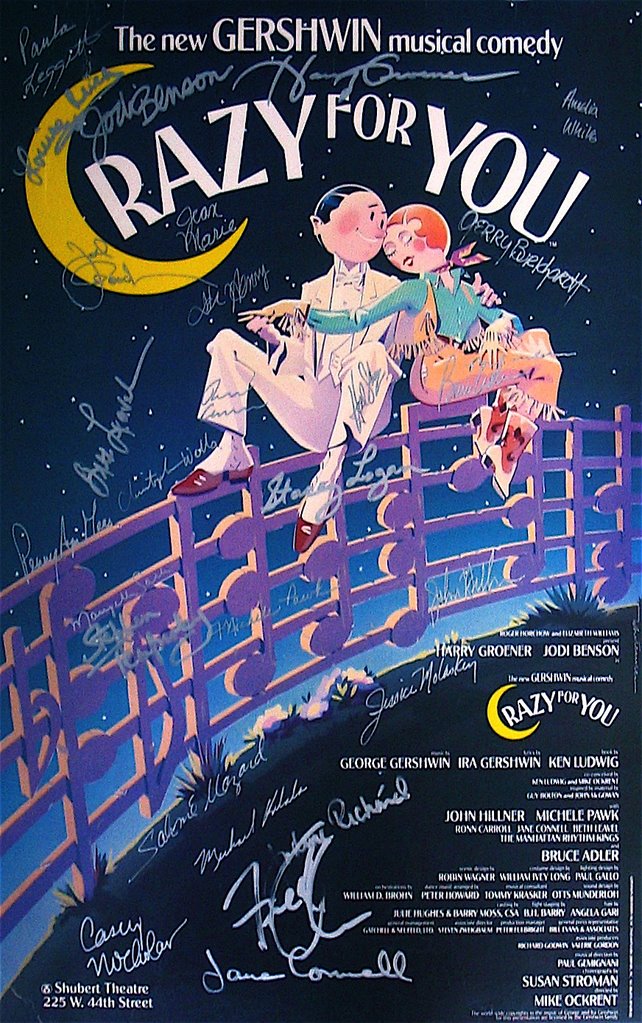
I developed a taste for Gershwin’s music some five decades later when a close friend of mine, himself formerly in show business, invited me to see the cheerful pastiche Crazy for You on Broadway (the above poster, signed by the entire cast, being a memento of that memorable event). Now, I have seen plenty of musical theater since then, anything from Show Boat and Gypsy to Sweeney Todd and The Drowsy Chaperone; but no show has left me humming quite as many long familiar yet ever thrilling tunes as Crazy for You, cleverly billed as a “New Gerswhin Musical Comedy.” Now, I don’t know how I might have felt about it had I seen Pia Zadora and Brady Bunch alumna Ann B. Davis in it (the latter getting far more requests for autographs than the former); let’s just say I was lucky to have experienced it being performed by the original cast.

The five broadcasts of BBC Radio 3’s Composer of the Week series are a serviceable introduction to Gershwin’s works, featuring the voices of Fred and Adele Astaire (“Fascinating Rhythm,” “So Am I”), Al Jolson (the inevitable “Swanee”), Ukulele Ike (“Lady, Be Good!”), Ella Fitzgerald (“The Man I Love”), Audrey Hepburn (“How Long Has This Been Going On”), excerpts from Of Thee I Sing, Strike Up the Band, Porgy and Bess—and plenty of Gershwin at the piano.

Delayed Exposure: A Man, a Monument, and a Musical

Well, I don’t know why I took it. This picture, I mean. Over the years, I must have walked past that plaque hundreds of times without paying attention to it. A few months ago, returning for a visit to my old neighborhood in Manhattan, it insisted I take notice at last. I went to an exhibition at the Cooper-Hewitt Museum on the corner of Fifth Avenue and 91st Street. Erected in memory of the journalist W. T. Stead, this modest cenotaph stands opposite the museum, on the Central Park side of the avenue. I had no knowledge and little interest in the life of Mr. Stead, which (the plaque tells you as much) ended spectacularly aboard the Titanic. Last weekend, some three months after my return from New York, the man insinuated himself into my life once again, this time in the guise of a character in a Welsh musical.

Amazing Grace, staged at the local Arts Centre, tells the story of Evan Roberts, a Welsh miner turned preacher who, in the words of Mr. Stead, became the “central figure” of the early 20th-century “religious awakening in Wales.” Stead followed the movement, interviewed Roberts, and reported about this so-called Welsh Revival. In Mal Pope’s play, he appropriately serves as narrator and commentator on Roberts’s fabulous rise and his equally sudden disappearance from public view.

Unfortunately, Stead doesn’t get all that much to say or sing about Roberts, and the musical, which, in this particular production, featured the aforementioned Peter Karrie as a fierce reverend envious of the enigmatic upstart, suffers from a serious case of anticlimax: whether daunted by his fame or no longer driven to preach, Roberts simply shuts up—a silencing that doesn’t make for a rousing finale.

Unimpressed by Pope’s 1980s-styled power ballads and his by-the-numbers approach to biography, I was easily and gratefully distracted when I saw Mr. Stead walking across the stage and back into my conscious, as if to demand the leading role denied to him in this production. Now I find myself compelled to follow up on Stead’s life and writings.

As it turns out, Stead was fascinated by the spiritual, by premonition and second sight, by ghostly doubles and “long-distance telepathy.” For instance, he wrote about a case in which a telegram, then presumably the fastest means of telecommunication, was several hours slower in conveying a story than a message alleged to have been transmitted by a “disembodied spirit.” It is the extra-scientific (rather than the supernatural) speculated about by those growing up in the age of Darwin, an age of industrialism and shattered systems of belief.

Researching Etherized Victorians, my study on old-time radio, I came across one such comment on modernity by one of Stead’s contemporaries, Rudyard Kipling, whose 1902 short story “Wireless” marvels at psychic phenomena while questioning scientific progress: telepathy as the ultimate wireless connection.

It seems Mr. Stead is anxious to continue the debate from the beyond. I have unwittingly become a ghost writer for the late journalist; recalling him to life in word and image, I am merely his chosen amanuensis.

Istanbul (Not Constantinople); or, There’s No Boat "Sailing to Byzantium"

Well, I have returned from a weeklong trip to Istanbul, Turkey. I did not bother to go in search of the aforementioned Rocky Jordan or look for his Café Tambourine in the Grand Bazaar, a shopping maze I, being slightly claustrophobic and averse to haggling, was glad to escape. A man like Jordan bey would probably be lost as well in present-day Istanbul, a sprawling metropolis whose population continues to grow at an environment and infrastructure challenging rate and may well have surpassed twelve million. And yet, you are not likely to encounter the populace in Sultanahmet, the old part of town, which, despite its ancient buildings and monuments, comes across as spurious—and thoroughly commercial—as an American pulp serial like A Man Named Jordan—a western reconception of Istanbul as a Disney theme park.

Walking from the Blue Mosque to the Haghia Sophia, the erstwhile site of the Byzantine Hippodrome, you will find yourself amid hordes of British, American, Australian, and German tourists. I rarely got an opportunity to pull out the Turkish phrase book I had purchased for the occasion. Nor did the dishes served at restaurants just off the Hippodrome strike me as authentic; then again, many of the menus were written in English or German, however ill spelled. You will have to cross the Golden Horn to Beyoğlu better to appreciate that foreign influences other than commercial tourism have been shaping the city for centuries.

Tourism might have been somewhat more discreet and less detrimental when the Orient Express first stopped in Istanbul, but the tracks for the seasonal invaders, many of whom flock to the cinematically commodified Topkapi (it having been on worldwide display since the 1964 movie of the same name), were already being laid during the late-19th century.

One of the oldest hotels catering to western visitors is the Pera Palas, where, among other well-known personages including Mata Hari and her Hollywood impersonatrix Greta Garbo, the previously discussed whodunit writer Agatha Christie stayed during the journey that inspired her Murder on the Orient Express. On the anniversary of her birth (15 September 1890), an enterprising concierge took us up into her room, now itself shrouded in a mystery contrived, no doubt, by the operators of said establishment; but more about that another time.

I grew up among Turks who were lured to Germany by the thousands during the post-World War II economic boom known as the Wirtschaftswunder and stayed there despite much hostility and humiliation. I lived among Turks, but rarely got to interact with them. I cannot say from experience how the situation is nowadays; but until I left Germany in 1990, Turks were still regarded as little more than servants who cleaned our streets and tidied our houses, a cleanliness ascribed to German efficiency but actually owning to foreign guest workers desperate enough get their empty hands dirty for a people known for its ethnic cleansing, a supposedly reformed nation enjoying the US support that ought to have gone to Blitzkrieg-devastated ally Britain.

Apparently, Germans have not reformed altogether. After strolling around remnants of glorious Constantinople and Byzantine ruins such as the Medusa head that, lying upside down, adorns the cavernous 6th century Basilica Cistern (pictured above) or taking a ferryboat across the Bosphorus to the Asian side of Istanbul, where we enjoyed lunch talking culture and politics with a descendant of the Ottoman rulers, CNN kept us up-to-date about the return of the Nazis in Germany’s local elections and gave us the jitters when the German Pope, who is supposed to visit Turkey in November, made some inflammable remarks about Islamic faith.

To avoid having to explain that I spent most of my adult life in the United States and just where my present home, Wales, is on the map and in relation to England, I often found myself replying “Germany” to the often voiced query “Where are you from?”—but I could not say it either with pride or a sense of veracity.

To be sure, as today’s news reminded me, Turkey faces its own struggle to match the ideals of Western democracy, ideals rarely met anywhere but most conveniently found wanting elsewhere. Apparently, it is still deemed a criminal offence for any Turkish citizen openly to criticize the state, past or present, so that even a fictional character’s voicing of controversial remarks may get its author-creator into serious legal trouble.

Turkey might be a more dangerous place than Agatha Christie or the creators of A Man Named Jordan could have dared to imagine, lest they were prepared to divest this gateway to the Orient of its fabled and profitable enchantments.

As I have always insisted writing this journal, I am not one to be carried away by bouts of nostalgia. When poet William Butler Yeats imagined “Sailing to Byzantium,” one year before Constantinople’s name was officially changed to Istanbul, he talked of visiting antiquity by reading about an illustrious golden age so that he might dwell in the “artifice of eternity.” Arriving by plane and walking in present-day Istanbul, such reveries seem out of place.

What kind of place is Istanbul now? What is its place in the West as Turkey strives to join the European Union but rejects or refuses to embrace much of what strikes us as Western (money and consumerism aside)? Having caught a couple of fragmentary chapters of the country’s history, I, for one, will stay tuned . . .

Manhattan Transcript: Why The Drowsy Chaperone Might Have Done Well on the Air

Well, there I was this afternoon, walking Montague, our terrier, and picking sloes along the lane near our house halfway up in the Welsh hills. I was walking him in order to get to the sloes, truth be told. Unlike Montague, though, the sloes won’t be seen again until Christmas, as I learned, much to my dismay, after having spent half an hour pricking them. I had heard of a Sloe Gin some time ago; but I always assumed it to be spelled “slow” and work as fast as the regular kind. Now I know that my ear hadn’t led me altogether astray, considering that it will take so long to appreciate this potent concoction. At any rate, a predilection for booze is something I share with that celebrated Broadway dame known as The Drowsy Chaperone, who may currently be seen failing her charge in the Tony Award-winning “Musical Within a Comedy” of the same name, a show that reminded me of my love not only for stiff drinks but old-fashioned radio drama.
I might not have learned about The Drowsy Chaperone had it not been for some of my New York City pals, some of whom work in the theater. Now, Broadway isn’t exactly “My Beat.” As much as I enjoy “How Do You Solve a Problem Like Maria?” (a West End Sound of Music audition-turned-TV reality show starring Andrew Lloyd Webber presently unfolding on BBC television), I am rather selective in my choice of musical treats. I would not be caught dead watching Cats, to be sure, and have refused to attend a performance of Phantom even when a close friend of mine was one of its featured actors on Broadway.

A few years ago, I enjoyed Drowsy Chaperone‘s leading lady Sutton Foster in a revival of Thoroughly Modern Millie, and her presence, as long as it does not remind me of Leslie Caron (as indeed it sometimes does), suffices to make me shell out some $75, the highest price I have yet paid for a TKTS ticket, to see a show that is an amusing trifle rather than a certified classic.

Now, on that particular night (the date of which you may glean from the ticket displayed above), Ms. Foster was rather subdued and lackluster. Too bad, considering that her “Show Off” routine is the smartest number in the whole production, which opens with Mary Tyler Moore alumna Gloria Engel going on about her “Fancy Dress,” a tune that is insipid rather than comically inspired. Worse still, the eponymous character (the Drowsy one) was played by an understudy, as that dreaded white slip in my Playbill informed me. Understudy, in this case, meant second best. Luckily, the same was not true for the whole production.

There is a self-reflexivity about The Drowsy Chaperone that is so subtle and commercially slick as to render this musical comedy charming rather than clever. In fact, the play struck me as decidedly dumb—in a manner that ingratiates instead of irritates. The smartest thing about it all is the opening of the play and its concept. After all, The Drowsy Chaperone begins in utter darkness, with the voice of a middle-aged Broadway aficionado (who, traditionally, does not speak in a booming baritone) telling you about the costly experience of going to the theater these days before sharing a record (vinyl, no less) from his collection of show tunes.

One of those forgotten gems is The Drowsy Chaperone, the forgotten (and entirely fictional) 1929 musical our host (the “Man in a Chair”) has never seen but imagined often enough sitting in front of his outmoded home entertainment system and listening to an old and not altogether groove-proof record in his rundown New York City apartment. As he tells the audience about the show, the impressions made by the recording come to life and The Drowsy Chaperone materializes before us as it presumably might come alive in our MC’s mind. Of course, for seventy-five bucks or more, we demand to see our theater. Most of us go to a Broadway show for sheer dazzle, not dialectics. We rely on Off-off Broadway for the subversive and provocative—and the clear demarcation makes it easy for most to avoid such intellectual challenges.

And yet, nothing I saw onstage quite matched the excitement or warranted the enthusiasm of that middle-aged man (wonderfully portrayed by Bob Martin), an unassuming cardigan-clad homebody whose visions, no doubt, were more potent than anything devised by the set designers of this show. I wonder how theatregoers might have reacted had the scene been cast in darkness for the entire eighty-odd minutes (a short enough time for a Broadway play). They might have concurred with the guy.

Aside from “Show Off,” “Accident Waiting to Happen” and the surprising “Message from a Nightingale,” The Drowsy Chaperone wasn’t all that much to look at. Then again, who would pay this much for a single radio play? The eyes had it, as usual—but they did not quite have their fill . . .

Where Silent Partners Join for Noisy Crime

White trousers may be out of fashion; but there are still a lot of ways to tell that summer is officially over. And I am not even talking about the mist rolling in from the Irish Sea this afternoon. After all, I am reporting from New York City, even though my reports are filed a few weeks late and some three thousand three hundred miles away.

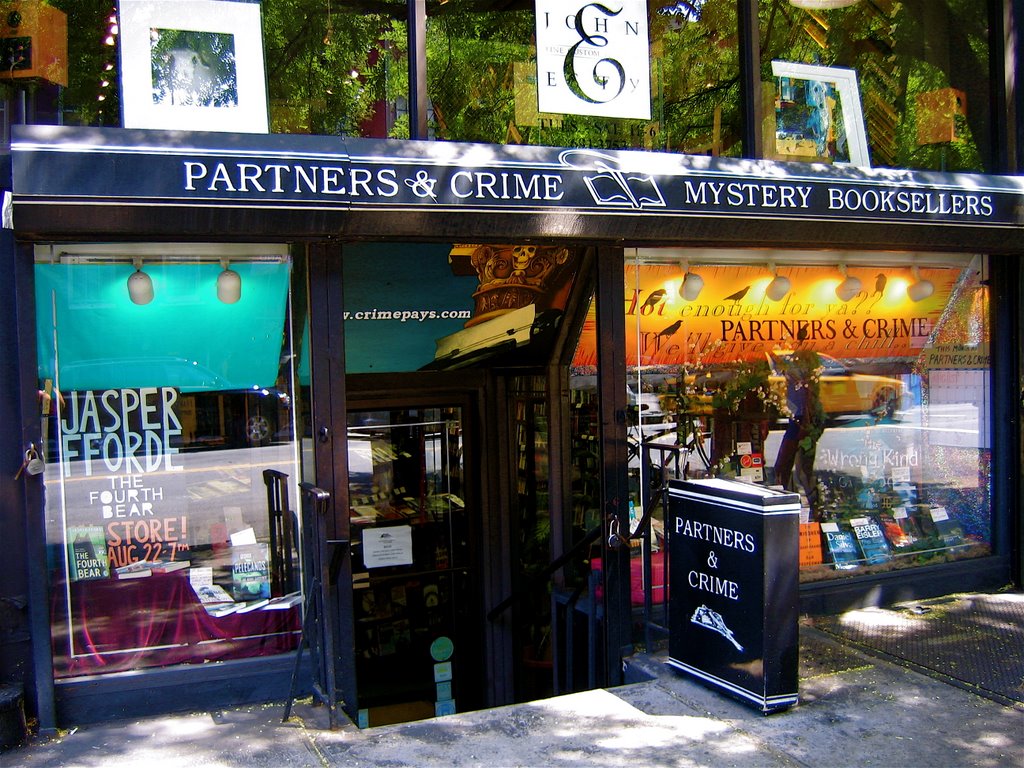
In the United States, the summer season traditionally ends on the first weekend in September, a time when millions of college students abandon beaches for bookstores and a certain band of players reclaims its space behind the shelves. Unlike those students I used to teach during my ten years of adjunct lecturing in the metropolis, the W-WOW! troupe only frequents one exclusive—if academically less than sound—venue: the Partners & Crime bookstore in the West Village.

Ever since the mid-1990s, when the city that presumably never sleeps still bore a slight resemblance to the bawdy and raucous town it had been before naps (and a lot else) became mandatory or derigueur, the W-WOW! players have been gathering on the first Saturday of each month (summer excepting) to re-enact the cases of Sherlock Holmes, Harry Lime, Philip Marlowe, and The Shadow as they were heard on US radio during the 1940s and early 1950s. You know, those days when the city had so much character to spare that a shadier one of it could be knocked off and tossed into the East River without causing more than a RIP-ple. Those days when the city was divided into distinct and clashing neighborhoods rather than being homogenized for the purpose of corporate milking. Those pre-television days during which keeping ones eyes shut to the world to share an imagined one was a national pastime rather than a geo-political hazard.

Anyway. Partners & Crime is a terrific store, one of the few sites that somehow managed to withstand the pressures imposed by chains like Borders or Barnes and Noble. One day, when the millennium was still very young and terrorism something that, from an American perspective, happened mainly to people in Europe and the distant Middle East, I discovered that Partners & Crime had become somewhat of an old-time radio institution—without ever going on the air. In short, it was an intriguing anachronism in a town about to trade in its past for clean facades and the promise of crime-free streets. I’d rather look at the scar above my left eye, dating back to a nightly stroll anno 1989, than walk what now goes for 42nd Street. But, back to fictitious felonies . . .

I was probably browsing for an old copy of Seven Keys to Baldpate or some such chestnut brought to light in my dissertation, when, much to my astonishment and joy, I spotted a microphone at the back of the store. As it turned out, there was an entire studio in the tiny, windowless backroom, a space modelled after station WXYZ in Detroit, as the playbill informed me.

I don’t suppose the goings-on behind the shelves do much for the sales at Partners & Crime. I, for one, immediately forgot all about the volumes around me and inquired about the microphone and its purpose. I was thrilled to learn that it was not set up for a reading of a contemporary crime novel, but for some old-fashioned radio mystery, to be performed for the benefit of a small group of theater-of-the-mind goers who eagerly squeezed into this nook beyond the books. I joined them, of course.

The W-WOW! players recreate old-time radio thrillers—commercials ‘n all—by placing their audience inside the make-believe Studio B of the equally imaginary W-WOW Broadcast Building. It may not further or elevate the art of radio drama and be done largely for camp (a way of misreading I can do without); but watching the performers as audiences once watched live broadcasts over at Radio City is nonetheless an enjoyable experience, particularly if you happen to eye the sound effects artist eager to elicit a few laughs while playing to the onlookers.

It is unfortunate that the W-WOW! troupe, unlike the Gotham Radio Players, do not go on the air to put their skills to the ultimate test of prominent invisibility. Theatrical training insures that some of the voices are fit for radio; and the actors are passionate even when the scripts are ho-hum. One among them, a certain Darin Dunston, not only appeared in a production of Under Milk Wood, but was the lead in Radioman, an award-winning student film about drama.

For a mere five bucks (less than one tenth of the cost of a half-price theater ticket), you may still take in a double feature of thrillers, transcribed from original recordings. Never mind that most of those in attendance at Partners & Crime seem more interested in the corny sales talk than in the plot of the mysteries or in the history of radio dramatics. I, for one, often listen to audio plays to get lost in sound instead of bothering to find much sense in them; and the noise made in the back of that West Village bookstore is quite in keeping with the shots, thuds, and wisecracks heard on US radio during the 1940s.

Larks, Turkey(s), and the Not-so-friendly Skies

Well, Jell-O again! To me, these past four weeks offline seemed like a summer hiatus, except that they were unscheduled and open-ended. Still sustaining and not in pursuit of a commercial sponsor, I am less certain than ever of an audience (save those lost souls who happen upon these pages in hopes of finding some dirt on—or salacious images of—Lois DeFee, a lesser-known burlesque queen I once mentioned in passing). I wonder who took my place during the interim and whether I will succeed in reclaiming my none-too-prominent slot. Just what has kept me so long (I hope that someone set apart from the apathetic might ask)? Here is the long and very nearly short of it.

After some two-and-a-half weeks of playing broadbandit in New York City, piggybacking rather than coffee-shopping for internet access to so little avail as to manage to file only a single report while on location, I returned to Wales to find our wireless network collapsed, the router having given up the proverbial ghost during a summer storm. And now, just as things are sliding back into their groove, I am taking off again for a weeklong trip to Istanbul. Not that air travel, let alone to Turkey, is a particular delight these days of tourism-targeting terrorism.

Air travel has always been rather uncomfortable; present security measures are even less comforting. Despite several checks and hassles, I still managed to board with a bottle of mouth freshener, which, much to my embarrassment, I discovered at the bottom of my hand luggage while fishing for my generally dormant cellular phone. I sunk into my seat feeling like a felon in flight, at least until I settled down to an episode of Tallulah Bankhead’s Big Show a New York pal of mine had shared with me.

It is with some delay, therefore, that, starting tomorrow and leading up to the fifth anniversary of the World Trade Center attack, I carry on with my NYC impressions as they relate to old-time radio, including accounts of my tour of various second-hand bookstores, landmarks and museums, a review of the rather radiogenetic musical The Drowsy Chaperone, assorted remarks about the construction of the Second Avenue subway and the current state of Yorkville (my old neighborhood in Manhattan). The news, such as they are, won’t be altogether current; but then again, I am forever catching up with the out-of-date and my own life need not be an exception.

Indeed, I find it difficult to gather experience and gather my thoughts at the same time. It is far easier when the experiences about which I write are lived vicariously, through radio plays, books, or movies; I gather, it is easier to gather thoughts along with dust. The time is ripe for some house cleaning and perhaps even some reventilating of the old broadcastle I am keeping here. Not only will I catch up with some of my favorite internet journals, but I will also make a few long overdue additions to my mossy blogroll.

The above image, meanwhile, constitutes the latest addition to my collection of Claudette Colbert memorabilia. While in New York City, I purchased the Cecil B. DeMille Collection, containing three of Colbert’s films (one of which, Four Frightened People, I reviewed for the Internet Movie Database earlier this year). And, more than two decades after discovering and losing sight of Mitchell Leisen’s Hands Across the Table (mentioned here), I could once again soak in the bubbles of this frothy charmer, along with Leisen’s Big Broadcast of 1938 about which I will have more to say in the none too distant future.

All this by way of reintroduction. However small the interstice until I take flight again next week, it sure feels good to spend some time sweeping the dust out of my cyberspatial niche . . .